“Enigma Of The Pacific”

Marbled Murrelet

Brachyramphus marmoratus

About

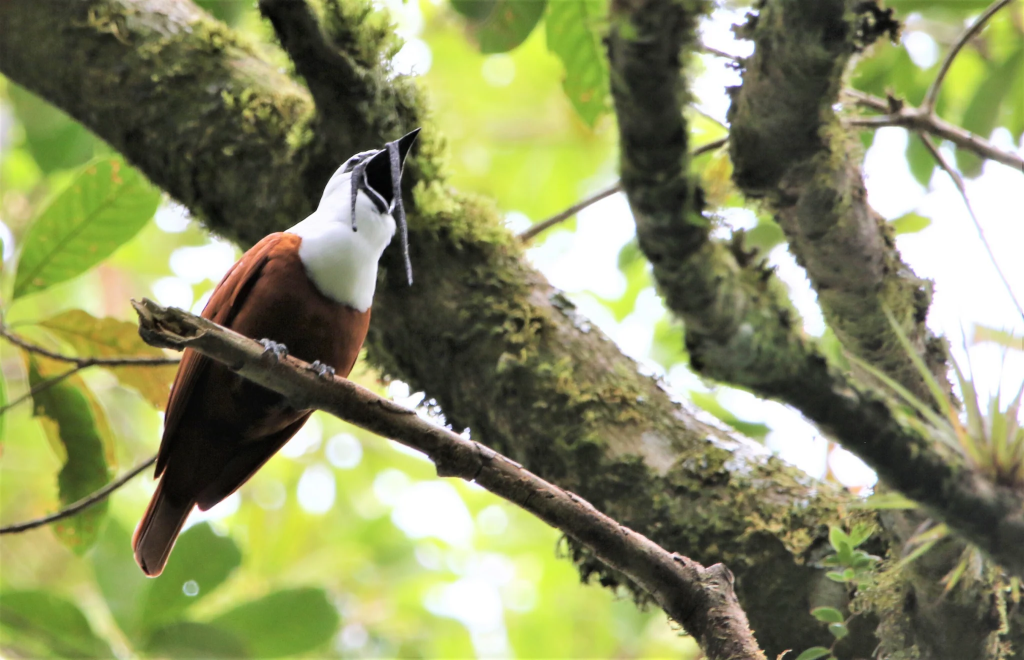
The petite, quail-sized Marbled Murrelet has been called the “enigma of the Pacific.” So much about this stub-tailed seabird is unusual and remains poorly known. The bird’s range extends from Alaska to California; in northern treeless areas, it nests on the ground, but in the rainforests of the Pacific Northwest, it flies inland as far as 55 miles to nest high in trees. Its nesting habits remained one of North America’s great bird mysteries until 1974, when a tree surgeon working 147 feet up in a 200-foot-tall Douglas fir found an active nest. The only other bird in the alcid family that shares this nesting behavior is the murrelet’s close cousin, the Long-billed Murrelet, found in Asia.

Marbled Murrelet populations are in steady decline, due in part to the clearing of old-growth temperate rainforests, habitat shared with the imperiled Northern Spotted Owl. But nest predation by clever corvids like Steller’s Jays and Common Ravens can also adversely impact murrelets. These birds gather where people enjoying the Pacific Northwest’s forest leave garbage behind — the picnic areas and campsites more than 100 feet below nesting murrelets — making it all the more important to clean up and pack out what you bring in.

Threats

Seabirds are declining faster than any other bird group. The Marbled Murrelet faces many of the threats that endanger all seabirds, but the loss of its old-growth forest nesting habitat is unique among seabirds. Listed as Threatened under the Endangered Species Act in 1992, the Marbled Murrelet is also listed as a Yellow Alert Tipping Point species by Partners in Flight, a result of the loss of more than 50 percent of its population in the past 50 years. (snip-MORE on the page)

https://abcbirds.org/birds/marbled-murrelet/

What’s new at the NASA Earth Observatory

It is indeed good to see the NASA Earth Observatory newsletter in my Inbox again, since the shutdown ended. This is one of the things we the people own and pay taxes to maintain, and it’s a wonderful thing, good for all to learn about our world. Even if a person never gets farther than their own downtown, they can still learn about the world with the information we receive from the Observatory. We need to keep the stuff we’ve paid for!

Go and explore here: https://science.nasa.gov/earth/earth-observatory/ . There is all manner of stuff! And you, too, can have a newsletter!

Snippet: We are back! After the lapse in appropriations at the beginning of October, and therefore a lapse in our ability to pay for our newsletter platform, the Earth Observatory team is back to publishing our Image of the Day and we are happy to be back in your inbox. We have a slate of new stories to share with you (I will include them all below so you can catch up) and more planned. But in other news…

Satellites Detect Seasonal Pulses in Earth’s Glaciers

RIP, “Iconic Swamp King” Claude

I enjoyed reading about Claude now and then; maybe I’m not the only one.

‘Iconic swamp king’: San Francisco’s beloved albino alligator dies aged 30

Claude, the de facto mascot for a local museum, was the subject of a children’s book and regularly received fan mail

Claude, at the California Academy of Sciences in San Francisco, on 24 April 2025. Photograph: Jeff Chiu/AP

Claude, the beloved albino alligator who called the California Academy of Sciences home for the better part of two decades, has died at age 30.

The San Francisco museum announced his death on Tuesday and said that the reptile had in recent weeks received treatment for a “suspected infection”. Claude, with his unusual white scales, had become a sort of mascot for the academy and the city. He was the subject of a children’s book and regularly received fan mail and gifts from around the world, the museum said.

“He brought joy to millions of people at the museum and across the world, his quiet charisma captivating the hearts of fans of all ages,” a statement from the museum read. “Claude showed us the power of ambassador animals to connect people to nature and stoke curiosity to learn more about the world around us.”

In September, the museum celebrated his 30th birthday with a month of festivities in honor of the “iconic swamp king”. (snip-MORE)

Astronomy Pic Of The Day Today

M77: Spiral Galaxy with an Active Center
Image Credit: HubbleNASAESAL. C. HoD. Thilker

Explanation: What’s happening in the center of nearby spiral galaxy M77? The face-on galaxy lies a mere 47 million light-years away toward the constellation of the Sea Monster (Cetus). At that estimated distance, this gorgeous island universe is about 100 thousand light-years across. Also known as NGC 1068, its compact and very bright core is well studied by astronomers exploring the mysteries of supermassive black holes in active Seyfert galaxies. M77’s active core glows bright at x-rayultravioletvisibleinfrared, and radio wavelengths. The featured sharp image of M77 was taken by the Hubble Space Telescope. The image shows details of the spiral’s winding spiral arms as traced by obscuring red dust clouds and blue star clusters, all circling the galaxy’s bright white luminous center.

https://apod.nasa.gov/apod/astropix.html

“Virginia Partridge”

or “Virginia Quail.”

Snippet:

The Northern Bobwhite, also known as Virginia Quail or Virginia Partridge, is in the same family as the Montezuma and Scaled Quails, but the bobwhite is the only native quail species in the eastern United States. This delightfully round little quail is capable of strong, short bursts of flight — particularly when fleeing predators — though they prefer to walk or run, scuttling about under the dense, low cover of vegetation in grasslands, agricultural fields, and open forests.

The Northern Bobwhite is more often heard than seen, its namesake whistled bob-white! call sounding from the brushy undergrowth, where their dappled brown-and-white plumage provides excellent camouflage. But sometimes, especially when calling in spring, males will occupy highly visible locations, perching atop fenceposts and tree limbs.

A popular game bird, the Northern Bobwhite has a whopping 22 subspecies across its range, one of which — the Masked Bobwhite — is federally listed as Endangered. Its status as a game bird has made it one of the most well-studied birds in the world, and scientists have observed sharp declines, likely owing to multiple causes that include habitat loss and the increased use of pesticides.

Threats

Populations of Northern Bobwhite plunged between 1966 and 2019, resulting in an overall decline of 81 percent, according to the North American Breeding Bird Survey. Partners in Flight considers the Northern Bobwhite as a “Common Bird in Steep Decline.” For years, an explanation for such drastic declines has been elusive. However, most biologists agree that multiple causes are to blame. (snip-MORE on the page)

https://abcbirds.org/birds/northern-bobwhite/

The Universe

The Observable Universe
Illustration Credit & LicenceWikipediaPablo Carlos Budassi

Explanation: How far can you see? Everything you can see, and everything you could possibly see, right now, assuming your eyes could detect all types of radiations around you — is the observable universe. In light, the farthest we can see comes from the cosmic microwave background, a time 13.8 billion years ago when the universe was opaque like thick fog. Some neutrinos and gravitational waves that surround us come from even farther out, but humanity does not yet have the technology to detect them. The featured image illustrates the observable universe on an increasingly compact scale, with the Earth and Sun at the center surrounded by our Solar Systemnearby starsnearby galaxiesdistant galaxiesfilaments of early matter, and the cosmic microwave background. Cosmologists typically assume that our observable universe is just the nearby part of a greater entity known as “the universe” where the same physics applies. However, there are several lines of popular but speculative reasoning that assert that even our universe is part of a greater multiverse where either different physical constants occur, different physical laws apply, higher dimensions operate, or slightly different-by-chance versions of our standard universe exist.

Explore the Observable Universe: Random APOD Generator
Tomorrow’s picture: stellar shell game

Music For Peace

Just a short bit with the video for today from Bee. Same from me, below hers.

=====

I choose this one, because the music of it brings me peace. I bet I’m not the only one. It’s a peaceful song.

Music For Peace

Bee brings us the Black Pumas, and a bit of commentary that begins, “One aspect of a peaceful existence is to consider our fellow humans as our family not our enemies.” Precisely!

My selection is this story, with The BeeGees performing Bob Dylan and then their own peace music. It’s an excellent story, and very good performances! Their own song is equal, at least, to Bob Dylan’s, but Barry Gibb discusses Bob Dylan’s influence on his music.

Barry Gibb recalls brave Bee Gees TV performance of Bob Dylan song to protest the Vietnam War

In 1962, the Australian Army began its formal military commitment to the U.S war in Vietnam. Two years later, young men were required to register for the National Service scheme and forced to fight in a bloody war that would enlist over 80,000 Australians. Over the next 11 years, 523 Australians died in battle and nearly 2400 were wounded before the country withdrew.

The fear of being sent to Vietnam to kill or be killed for the government struck fear into the hearts of many young Australians in 1963. That’s why three teenage boys, Barry (17), Robin (14), and Maurice (14) Gibb, The Bee Gees, took their big moment on Australian TV to speak truth to power by singing Bob Dylan’s “Blowin’ in the Wind.” The Bee Gees were relative unknowns that night on Bandstand, but by the end of the decade, they would be among the biggest acts in the world.

The Bee Gees sang ‘Blowin’ in the Wind’ on Australian TV in 1963

“Blowin’ in the Wind,” released earlier that year, asks fundamental questions about war, racial justice, and whether humanity will ever live in peace and equality. The song would become one of the most important anthems in the Civil Rights and peace movements of the ‘60s and beyond.

Barry Gibb, now 79, says that even as a teenager, he completely understood why Dylan’s song needed to be heard. “I was rapidly approaching the time when I would have to register for the draft,” he told Upworthy in an exclusive interview. “It’s hard to explain that period, except that everyone was very worried, very worried, and Bob Dylan was our hero.”

“The Vietnam War was such chaos to the Australian people that it shadowed everything. I wrote a song called ‘And the Children Laughing’ because of what Bob Dylan had written. It’s about life and dying, and the idea that you would die for your country or go and kill people you don’t know. And I don’t want to go kill people. It was not on the table for me. So everything he wrote touched me deeply,” Gibb continued.

Why don’t you get on your feet

It’s about time you got to think

Whatever happened to peace?

Well, open your eyes and you’ll see children laughing

Voices singin’, hearts a-beatin’ ah…

Barry Gibb has always believed in peace

(snip-there MORE; it’s not too long, but this is a long post with the music)

Music For Peace

Bee’s post is eloquent! There is/was not a video in the post, but she named the song, and gives great background on the artist and the song. I checked YouTube, found the one I hope is the right one, and posted it beneath Bee’s entry here. She has posted this one in the past; I recall it. It’s beautiful and perfectly expressive. Well worth a repeat listen!

I can’t follow this one! I’ll do it tomorrow. ☮

From Jenny Lawson-

PROVE ME WRONG by Jenny Lawson (thebloggess)
Read on Substack

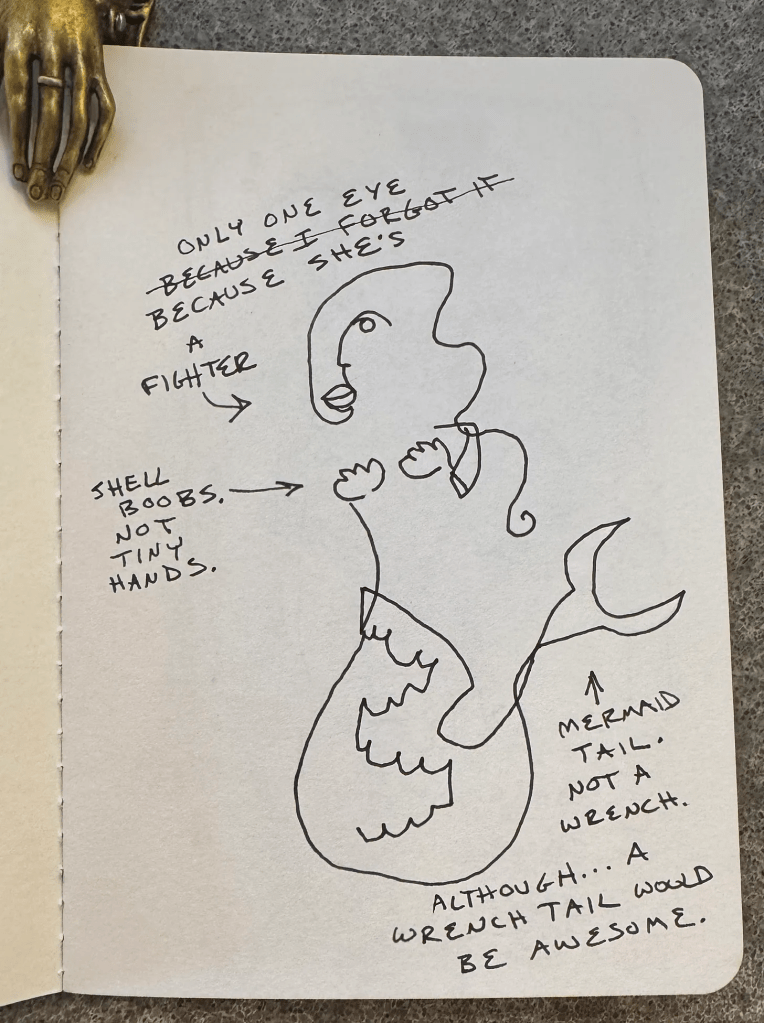
Last week when I was flying home I was scanning the ocean because I’m always certain that I’ll see Godzilla or a sea serpent if I look hard enough, but instead I saw a rainbow from the plane window and it was a perfect circle over the ocean. I was so excited I hit my head on the window and scared the person behind me. I didn’t have time to capture it on my phone but I shook Victor awake and was like, “YOU’LL NEVER BELIEVE WHAT I JUST SAW OUTSIDE THE WINDOW” and he said, “Was it a colonial woman churning butter on the wing?” and I was like, “…yep…that’s exactly what it was” because a circular rainbow feels anticlimactic after that guess.

Aaanyway, that leads to this week’s drawing, which I’m fairly certain counts as a scientific illustration:

Sending you love, rainbows and godzilla hugs,

~me

(snip)