Clay Jones, Leading Kansas

He Has Risen

To vote yes

Clay Jones

This cartoon was drawn for the Fredericksburg Advance. But don’t yell at them for it; you can yell at me.

If you live in Virginia, you have been bombarded with flyers about the special election on redistricting. And it’s not just flyers but also TV commercials, which are also popping up online. We are getting these things from both sides.

There is a special election in November on a state constitutional amendment that would give Democrats as many as four seats in Congress. The measure would also temporarily bypass the state’s redistricting commission to redraw maps in the middle of the decade.

The state’s Supreme Court approved the measure to be on the ballot less than a week before early voting began. State Republicans repeatedly tried to stop Democrats from moving forward with the referendum. The irony here is that Republicans claim that voting yes will disenfranchise voters, while they literally tried to keep this off the ballot so people couldn’t vote on it.

This is a direct response to Donald Trump and Republicans redistricting mid-decade to give themselves more seats. Donald Trump even said he was entitled to have more congressional seats. This is one reason why we need to No Kings protest. Donald Trump already believes he’s entitled to win elections he’s lost. (snip-MORE, and it’s on point)


The Parsons Project

by André Swartley

Leading Kansas

Key points at a glance

  • Energy company Deep Fission is in the process of building a new and untested type of underground nuclear reactor in Parsons, KS
  • The Trump administration has reduced regulations to encourage nuclear power production
  • The reactor will likely power data centers for artificial intelligence
  • Large data centers consume huge amounts of water and energy and produce different types of pollution, leading to health risks for nearby residents

In November 2025 a two-year-old energy company called Deep Fission broke ground in Parsons, Kansas. They hope this project will enable them to install the second ever energy producing nuclear reactor in the state, after Wolf Creek, potentially with more reactors on the way in the future. If the early “characterization” drilling goes to plan, they claim the reactor could begin pumping electricity into the grid in the near future.

Parsons is a city of 10,000 in southeastern Kansas, near the Oklahoma border. I’ve lived in Kansas for most of my life and I had not heard of Parsons until last week. So, why is Deep Fission in Parsons, Kansas, and why now? Not coincidentally, the Great Plains Industrial Park, also located in Parsons, has lately been advertised as a prime location for new data centers to power the trillion-dollar (yes, trillion with a T) artificial intelligence boom forced upon us by large technology corporations and their venture capitalist backers. Which means the Parsons nuclear reactor project would likely come as a package with one or more new data centers, along with potential economic prosperity and a host of legitimate concerns that community members have already raised.

Part 2: The New Nuclear Power

While the Department of Energy set a goal for the Parsons reactor to go online in July of this year, Deep Fission themselves are aiming to connect to the grid by 2027 or 2028. Two years is still an unusually rapid rollout for a nuclear power plant, which usually takes 6-10 years from groundbreaking to full operation.

This reduced timeline comes by way of the Trump Administration’s efforts to slow the national and worldwide adoption of renewable energies like wind and solar power. In February of this year alone, Trump’s Department of Energy halted the approval of “168 projects – those that focused on renewable energy projects” while allowing nearly 11,000 other energy projects to proceed as planned, including new nuclear energy projects. Executive Order 14301 in May of 2025 provided Deep Fission with the means to build their experimental nuclear reactor on such a short timetable.

Nuclear energy is typically labeled as “clean” energy compared to coal, oil, and natural gas, meaning that it releases fewer pollutants into the air and water than fossil fuel consumption. Still, there are two main concerns. First is the disposal of nuclear waste, which ranges from the lightly contaminated clothing of plant workers to the lethally radioactive spent fuel a plant produces over time. This latter “accounts for just 3% of the total volume of waste, but contains 95% of the total radioactivity.”

A relatively new method in the US and Europe for disposing of our most dangerous nuclear waste is to bury it very deep underground, so that it can be surrounded by solid rock to provide the same level of pressure containment as required at structure at a surface nuclear reactor facility. The father-daughter team that eventually founded Deep Fission originally created Deep Isolation to dispose of nuclear waste. Deep Fission takes their concept a step further by placing the entire reactor, and therefore its most dangerously radioactive elements, into a borehole drilled one mile underground.

The second main concern related to nuclear energy production is, of course, accidents or attacks. It is true that large-scale nuclear accidents are very rare, but when they happen, they become instant, globally recognized disasters whose names we all know: Chernobyl, Three Mile Island, Fukushima. The effects are so widespread as to be practically impossible to quantify. The reactor explosion and meltdown in Chernobyl, for example, caused several dozen deaths directly related to radiation exposure, but various studies have predicted anywhere from thousands up to a million eventual additional cancer deaths. Not to mention the environmental and economic cost to the entire region around Chernobyl. And radioactive boars still terrorize people and farmland in the region around the Fukushima plant in Japan.

But those issues are known, and regulations have historically attempted to shore up potential dangers posed by new plants. In contrast, nothing like the underground nuclear reactor in Parsons, Kansas has ever been attempted before, and thanks to Executive Order 14301, will not need to go through long established design and testing phases that other types of nuclear reactors have been subject to in the past. John Young, a mining environmental regulatory specialist who lives in Sedgwick County, asks, “Why abandon the current regulatory process for something created out of whole cloth with no public input? And no one can define the current regulatory pathways for Federal and State authorizations.

“What,” Young asks in frustration, “could possibly go wrong?”

Part 3: Data Centers and Artificial Intelligence

So that is a glimpse into the nuclear energy side of things. Next we must address concerns around data centers and artificial intelligence. Data centers come in different sizes, like the smaller center being proposed in Wellington, KS, which would reportedly “use roughly 30% of the city’s electrical capacity while generating an estimated $1.3 million in annual electric utility revenue” while consuming only two gallons of water per day. Larger data centers consume resources less modestly. “Around the country, and the world, there is a land race among the big tech companies for sites for their data centers,” claims a November 2024 investigative report by Rolling Stone. Data centers are much newer than nuclear energy technology, yet the ways in which they harm communities near them have already become apparent.

Water: “Large data centers can consume up to 5 million gallons per day, equivalent to the water use of a town populated by 10,000 to 50,000 people,” according to a June 2025 study by the Environmental and Energy Study Institute (EESI). And data centers built explicitly to power AI represent the fastest growing portion of the market.

Last year, researchers at the University of California, Riverside calculated that ChatGPT—one of several popular Large Language Models (LLMs) vying for marketplace dominance—answered about 10,000 queries per second. The processing load to do so guzzled about 6,000 liters (or about 1,000 toilet flushes) of fresh water per second, all day, every day. That is only generating written text. AI photos require more water, and still more for AI video. “The extraction process is permanent,” explains the University of Alabama at Birmingham Institute for Human Rights. Water used to cool data centers evaporates as it cools hot components, meaning it can no longer be used by people in the region who need water for drinking, cooking, bathing, laundry, and general survival.

Pollution: Unfortunately, it is not only consumption of water to worry about. The evaporation of water cooling data centers leaves behind higher concentrations of nitrates and other contaminants leaked through agricultural fertilizers and pesticides into local water supplies, drastically increasing incidents of “rare cancers, muscle disorders, and miscarriages” among people who live nearby. Geographically, Parsons, Kansas sits atop the Alluvial and Ozark Aquifers.

Reports of noise pollution have increased near data centers as well. Residents in different Virginia towns experienced disturbing high and low frequency humming in a wide radius around two new data centers.

Energy: New York City is the most populous city in the United States. The population consumes about 11 billion watts of electricity per hour. However, by 2030, “power usage of…data centers is projected to rise to nearly 2967 trillion watts an hour,” increasing load and wear on current energy infrastructure and raising energy prices for regular people while tech companies receive sweetheart discounts from local and state institutions.

Gradual Disempowerment: Artificial Intelligence scholars and ethicists have identified a trend they call “gradual disempowerment.” As AI becomes more capable, people will continue to offload, “almost all societal functions, such as economic labor, decision making, artistic creation, and even companionship” to their favorite AI service. The scariest part is that these studies have actually measured reduced cognitive ability “at neural, linguistic, and behavioral levels” after only a few months of using services like ChatGPT.

These same experts predict that the disempowerment will not only come at the individual level, but also at the societal level, as lawmakers turn their attention and favor even more toward tech companies and AI services that increasingly take over tasks that used to be performed by human beings.

DHS and ICE: The Department of Homeland Security (DHS) and Immigration and Customs Enforcement (ICE), and have been using AI models to power their violent and unpopular immigration raids across the country. They are also surveilling, threatening, and creating databases of protesters.

Part 4: What Next?

The purpose of this article is not to overwhelm with doomsaying or inevitability. If the Deep Fission underground reactor works as advertised, it could genuinely provide cleaner energy than fossil fuel and mitigate some of the effects of climate change. But to get there safely, we need to demand transparency and regulatory protections from political and corporate leaders. If enough of us speak up in place like ParsonsTopekaSedgwick County, and every corner of our town, state, country, and world, we embolden those watching, each other, and ourselves to continue building the world we want and deserve.

Some Shorts & A Story

Science-y, funny, not as or at all funny, plus a big surprise. Enjoy!


A man planted tomato seeds from two McDonald’s burgers. Three months later, whoa.

“I expected this tomato to grow,” James Prigioni said, “but I did not expect this.”

By Annie Reneau

In many ways, fast-food restaurants feel like the opposite of a backyard vegetable garden. But one gardener has tied a McDonald’s hamburger directly to a garden harvest in a way that even surprised him.

James Prigioni makes popular gardening videos on YouTube. In one, he wanted to see if he could grow a whole tomato plant by planting the seeds from a tomato on a McDonald’s burger. He picked up a Deluxe Quarter Pounder with cheese, pulled out a tomato slice, and removed two seeds. After rubbing the seeds on a paper towel to remove the protective coating, which can inhibit sprouting, they were ready to plant.

Trying out different seed-planting methods

But like any good scientist, Prigioni wanted to try a different method for testing McDonald’s tomato seeds. So he pulled a slice of tomato from a second Quarter Pounder and, instead of extracting the seeds, planted the entire slice.

With the help of a heat mat and a grow lamp, both sets of seedlings germinated and sprouted in soil-filled red Solo cups in about a week. After they were fully established, Prigioni separated the plants so they could thrive individually before being planted outside.

He planted one of the plants in the ground outside and another in a 5-gallon bucket. He then showed how he culled the lower leaves as they developed blight and used a tomato cage to support the plants as they produced fruit and grew heavier. He also added extra fertilized soil and mulch to the bucket plant.

The harvest was unexpected

After three months, the plants were producing abundant fruit. The bucket plant didn’t perform as well as the in-ground plant, which Prigioni said was due to insufficient watering during very hot days. The bucket plant also ripened faster, likely due to the stress it had been under. Still, it was an impressive harvest, especially for a plant that started on a McDonald’s burger.

The in-ground McDonald’s plant was even more incredible, with dozens of tomatoes dripping from it.

“I expected this tomato to grow,” Prigioni said, “but I did not expect this.”

The fruit from both plants tasted good and sweet, he said. By the fourth month, the in-ground plant was starting to struggle with its health, but not with its fruit production.

“The plant had so many tomatoes on it that it seemed like it was having a little difficulty ripening that much fruit at one time,” Prigioni said. “I mean, I have had some plants with a lot of tomatoes on them, but never in my life have I seen a single tomato plant with this much fruit on it. I was completely blown away.”

How the McDonald’s tomatoes compared

He said one of his favorite parts of the experiment was seeing what kind of tomatoes would grow from the seeds. He thought it might be a beefsteak variety, but it turned out to be a Roma type. However, he surmised that the McDonald’s tomato was likely a hybrid, based on its ripening characteristics.

Prigioni also shared how the McDonald’s tomato plants compared with his other tomato plants.

“In another area of the garden, I grew Roma tomatoes that I got from Lowe’s, and I planted them at the same time as the McDonald’s tomatoes,” he said. “The harvest from them wasn’t quite as large, but the fruit ripened way more evenly, and I was able to harvest a lot more fresh fruit right off the vine that was ripe.”

A ripe harvest of Roma tomatoes growing in a garden
There’s nothing like a tomato right off the vine. Photo credit: Canva

“Overall, I was shocked with the level of production,” he continued. “And this is probably my favorite experiment that I’ve ever done. I mean, to be able to take a cheeseburger, grab a tomato from it, then grow a tomato plant, and then harvest pounds and pounds of tomatoes from it is just such a unique and refreshing experience.”

Perhaps an unexpected result, but a great way to challenge our assumptions and demonstrate the power of nature, even in the context of fast food.

You can follow The Gardening Channel with James Prigioni on YouTube for more gardening education.

The Word

The Bird’s The Word:

Least Flycatcher

Empidonax minimus

Also Known As:

  • Chebecker
  • Mosquero Mínimo (Spanish)
  • Mosquerito Chebec (Spanish)
  • Papamoscas Chico (Spanish)

About

The Least Flycatcher is a small but fierce bird of North American forests, known for its fearlessness in confronting birds much larger than itself, including formidable foes like Blue Jays and even hawks. They often share habitat and compete with American Redstarts, a fly-catching warbler, which they exclude from the best habitat through repeated chases and attacks. Of course, Least Flycatchers defend their territories from their neighbors as well.

However, despite their intense territoriality, these flycatchers are widely known to form dense clusters of breeding territories, even in areas with plenty of suitable habitat. Interestingly, the males closest to the center of a cluster are the healthiest, and the first to find mates. Conversely, birds that don’t join a cluster usually do not mate at all that season. While other factors may contribute to this pattern, the main influence seems to be that it facilitates birds mating with their neighbors in addition to their social mate.

Least Flycatchers are socially monogamous, pairing with a single bird during the breeding season with whom they defend a territory and raise young. But these birds are also quite promiscuous. More often than not, the nest of a mated pair will have at least one nestling sired by another male. “Spreading the love” in this way benefits both males and females — females end up with more genetic diversity in their nests, while males don’t have all their eggs in one “basket,” in case a nest fails. This breeding system, where territories are clustered together, females seek matings outside of the pair, and paired males compete for each other’s mates, has been described as a “hidden lek.” In some ways, this system is quite similar to the communal display areas, or leks, where birds like Lesser Prairie-Chicken and Greater Sage-Grouse defend small arenas to display for females.

One big difference between a classic lek and the so-called “hidden lek” of Least Flycatchers is that both the male and female in a pair are looking to mate with other birds without their own mate knowing about it. Also, the displays are a bit less dramatic. Rather than elaborate plumages, dances, and bizarre methods of sound production, these drab males instead opt to sing the same monotonous two-note song several thousand times an hour.

Threats

Though fairly common in appropriate habitat, Least Flycatcher populations have been declining since the 1970s. There are now a little over half as many Least Flycatchers as there once were. As such, Partners in Flight lists them as a Common Bird in Steep Decline. More research is needed to better understand the causes of this decline, but factors affecting the structure and health of forests probably play an important role. (snip)

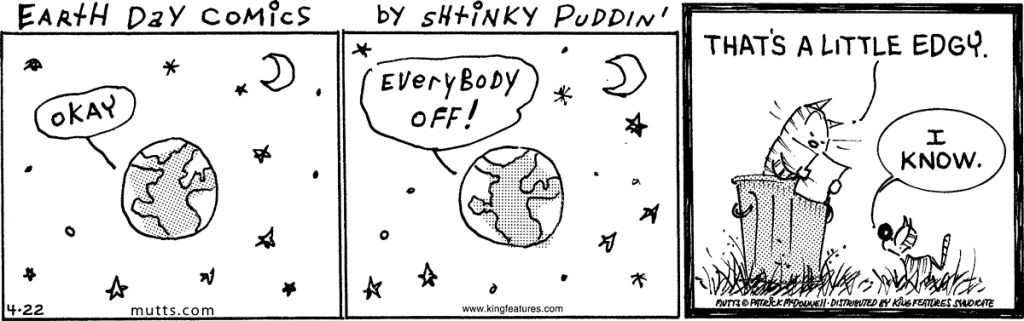
Earth Month On Friday

Earth Month Ecochallenge, running from April 1st to April 30th, is a 30-day program focused on environmental and social engagement. During this month, you’re invited to select actions that resonate with your values, committing to them for 30 days to foster and reinforce positive habits. Each action you complete earns points and generates real-world impact. Your efforts, combined with those of your team, contribute to a significant collective difference.

This year’s theme, People and Planet: Resilient Together, focuses on resilience: the capacity to adapt, recover, and grow stronger through change. Resilience lives in people, in communities, and in the natural systems that sustain us. In a world shaped by uncertainty, it helps us stay grounded, connected, and capable of creating positive change. Our new actions and categories will help you explore resilience at many levels – personal, in your community, in the organizations you are part of, and in nature. (snip)

https://earthmonth.ecochallenge.org/challenges

The Active Month Of April

Lots of awareness items for this month! Of course, one designation I’m fully aware of is for Autism, another for Earth Day/Month. I was feeling a bit overwhelmed thinking of blogging these things, which are pertinent to our interests, then thought, well, I don’t want to omit anything. So, I did a search, and holy cow. There are a lot! Below see some; click through to see them all. I ain’t bloggin’ everything, but I love NATIONAL MONTH OF HOPE – April Founded in 2018 by National Day Calendar® and Mothers In Crisis, Inc., so I’ll try to include it this month.

April – Month

NATIONAL ARAB AMERICAN HERITAGE MONTH | April

NATIONAL ARAB AMERICAN HERITAGE MONTH | April

NATIONAL PICKLEBALL MONTH | April

NATIONAL PICKLEBALL MONTH | April

LIMB LOSS AND LIMB DIFFERENCE AWARENESS MONTH | April

LIMB LOSS AND LIMB DIFFERENCE AWARENESS MONTH | April

NATIONAL AFTERNOON TEA MONTH | April

NATIONAL AFTERNOON TEA MONTH | April

Founded in 2022 by National Day Calendar® and Tea Tea and Company.

ESOPHAGEAL CANCER AWARENESS MONTH | April

ESOPHAGEAL CANCER AWARENESS MONTH – April

NATIONAL BRUNCH MONTH | April

NATIONAL BRUNCH MONTH | April

Founded in 2021 by National Day Calendar® and Ebb & Flow.

(snip-so much MORE!)

A Snip, Short Vids, & A Chance To Vote


Josh Johnson
9 hours ago

Hi Friends, I have been nominated for ‪@TheWebbyAwards‬ and you can vote if you want me to win. https://vote.webbyawards.com/PublicVo… . I’ll also be hosting the awards this year which is truly wild. Thank you all so much for getting me here ❤️

http://youtube.com/post/Ugkx__HG-YmAkQTa7nviWbuaUqd05QWyZ1x8?si=C7rai-VAr9tNrk-u


https://youtube.com/shorts/Kcol2OLmmko?si=2OFQPUVfmJyLrf6E


Elderly cats are being saved from being euthanized with adorable cat retirement village

It’s a cat paradise.

By Jacalyn Wetzel

An amazing retirement village is accepting guests in Shropshire, England—but instead of catering to elderly people, it’s designed for elderly cats. Shropshire Cat Rescue has been rescuing elderly cats set to be euthanized and providing them with top-notch elder care for over 21 years. Thanks to donations and sponsorship, the retirement village was built in 2009 to create comfortable homes within the rescue for senior and super senior kitties.

The owner and co-founder of the rescue, Marion Micklewright, was tired of seeing older cats get passed over for adoption and subsequently put to sleep simply because they were old. So she decided to do something about it. Shropshire was created in 1991 and moved to Micklewright and her husband Richard’s current home address in 1998. Today there are cats wandering the retirement village who are over 20 years old. One cat, lovingly named Cat, loves to hang out in the little “store” in the tiny cat town, while others lounge in cat condos. (snip-MORE)

Happy April 1st To You, From Me

We’ve got a tornado watch with storms on their way, so I don’t know how active I’ll be online tonight. However, I want to finish off the day nicely, since nothing is happening right now. Enjoy! TTYL, or tomorrow. 🙂

Important Words From Rev. William Barber

Rev. William Barber: Why the Midterm Election is So Important

Rev. Barber: We have to start teaching people that when we talk about politics, there is not an aspect of your life—from your birth to your death—that is not impacted.

By Rev. William Barber II

Published March 30, 2026

When we look at the midterm elections, we have to start with the basics. We are electing every member of the United States House of Representatives and one-third of the United States Senate. In most places, we are electing their entire state general assemblies, and many are electing governors, attorney generals, and so forth. We are electing the very people who impact every aspect of our lives. These elections determine whether we will have people in office who want to ensure everyone has health care or who want to take health care away; whether we want people in office who will vote to make sure everyone is paid a living wage versus just giving more money to corporations; whether they will care about poor and low-wage voters and the resources for people to afford a basic life, or whether all they will care about is giving more wealth to the already wealthy. That is what’s on the line.

Rev. Dr. William Barber, co-chair of the Poor People’s Campaign speaks at the Poor People’s Campaign: A National Call For Moral Revival Rally at the US Supreme Court on October 27, 2021 in Washington, DC. (Photo by Jemal Countess/Getty Images for Repairers Of The Breach)

What is at stake is whether or not you have a Congress that will demand that the President, whoever that President is, cannot just act unilaterally, but must get congressional approval for war; whether or not we have a budget; whether or not TSA agents are paid; whether or not government employees are paid; whether or not we have a Congress that will stand up and not just be a rubber stamp to what an authoritarian President wants to do or will just “go along to get along.”

We have to start teaching people that when we talk about politics, there is not an aspect of your life—from your birth to your death—that is not impacted. You’re not officially recognized without a birth certificate, which is the result of a political decision. You can’t guarantee your Medicaid, Medicare, or Social Security without political decisions. Even as you die, people must understand that politics is not just about personality; it’s about people being put in place and the kinds of policies and vision they will enact.

Rev. Dr. William J. Barber II, is a Professor in the Practice of Public Theology and Public Policy and Founding Director of the Center for Public Theology and Public Policy at Yale Divinity School. He serves as President and Senior Lecturer of Repairers of the Breach, Co-Chair of the Poor People’s Campaign

Snips & Toons & The King

Trump’s rat

Senator Lindsey Graham is spotted enjoying Disney World

Ann Telnaes Mar 30, 2026

Trump’s war cheerleader chows down breakfast at Chef Mickey’s.


He was arrested while repainting Dallas’ rainbow crosswalks. He’d do it all again

Before he was detained, Mason Whiteside, 25, said he spray-painted more than a dozen crosswalks.

By Jamie Landers

Mason Whiteside of Carrollton poses for a photo in front of the Oak Lawn United Methodist Church, Tuesday, March 24, 2026, in Dallas. Chitose Suzuki / Staff Photographer

It was already dark when Mason Whiteside finished his workday at a Deep Ellum brewery. By the time he was done cleaning and closing up, it was nearing midnight, but there was another job to do.

Whiteside, 25, called a Waymo to take him to Oak Lawn, where he’d lugged a backpack full of chalk and spray paint: red, orange, yellow, green, blue and purple.

“Does anyone want to color with me?” Whiteside asked as people walked by.

No one stopped. He didn’t need them to.

Over the course of three and a half hours, Whiteside alone repainted more than a dozen crosswalks, what he considered a vibrant act of defiance less than 24 hours after the city began stripping the roads of their color. Dallas is among several Texas cities complying with a state directive to remove “political ideologies” from public roadways.

“I wasn’t hurting anybody,” Whiteside, who is queer, told The Dallas Morning News Tuesday. “I didn’t damage anything. I literally just put back the same things that had been there.” (snip-a bit MORE; click the title)


Idris and Sabrina Elba are on a mission to transform an entire West African island 

Off the coast of Sierra Leone, the actor and model are fighting against tourists traps with their own vision: a tropical “eco-city” of the future.

Sherbro Island, a tropical outpost of farmers and fishermen nestled in the crook of Sierra Leone’s arcing Atlantic coastline, is about the size of Chicago, but its population of 40,000 wouldn’t even fill Wrigley Field. Electrical power and wireless internet are scarce. Fishermen can’t refrigerate their catches long enough to sell them on the mainland, and farmers often lack the expertise and equipment to harvest much more than they need to survive. But Sherbro Island has some enviable resources, including miles of unblemished beaches and lagoons, as well as an abundance of replenishable fresh water.

One other invaluable asset: the support of Golden Globe–winning British actor Idris Elba and his wife, Canadian model Sabrina Elba. The couple see an opportunity there to marry ecological sustainability with economic growth in a way they hope can be a template for development projects across Africa—and perhaps help rewrite a whole continent’s narrative. Idris’s father is from Sierra Leone, Sabrina’s mother is from Somalia, and growing up, Sabrina says, “there were particular stigmas attached with being African.” She remembers seeing ads that seemed to show abject people waiting for a handout. “We wanted to see Africa represented the way that we knew it to be,” she says. “We wanted to change the storytelling.”

Her husband—known for the baritone potency he brings to prestige TV dramas like Luther and The Wire, along with films like last year’s critically acclaimed thriller A House of Dynamite—first heard about Sherbro Island years ago. A close family friend had tried to convince him it could become a world-class holiday destination. “At that juncture, I was just like, Oh, OK, that sounds interesting,” says Idris, 53, who co-owns a wine bar in London’s King’s Cross neighborhood. “Like, maybe I’ll build a nightclub, maybe build some tourism.” He made a mental note to visit someday.

He got the opportunity in 2019, while he and Sabrina, now 37, were in Sierra Leone touring small family farms as part of their ambassadorial roles with the International Fund for Agricultural Development (IFAD). It was during that trip, Idris says, that he had something of an epiphany. He’d been venturing into philanthropy as his celebrity grew: supporting childhood education and hunger-relief programs in Africa, as well as campaigning on behalf of at-risk youths in the United Kingdom (work for which he was recently knighted). But on that trip, the Elbas saw an opportunity to build something more enduring and meaningful than a fancy vacation spot—and “to reframe the conversation,” Sabrina says, “[from] one of aid to one of investment.” (snip-a little more on the page; click through on the title, please)


Wrong Island

Everyone’s talking about Kharg Island, but there’s another island we should not forget about.

Clay Jones


Cool Off Topic Thing, If You’re A Puzzler (or even if not!)

Now and then, I post here from NASA’s Astronomy Picture of the Day. I read there every day; it’s a good way to begin the day online, for me. Anyway, today, there is a link, Jigsaw Galaxy: Astronomy Puzzle of the Day So, being curious, I clicked it, and it’s pretty neat. If you like to do jigsaws, take a look!