The Great Horned Owl Cam just got a whole lot cuter this week thanks to two new arrivals. Athena, the female owl, stood watch over the nest as her first egg hatched a down-covered owlet on April 8 after 34 days of incubation. The second owlet arrived two days later, on April 10. Over the next six weeks, viewers will get an intimate look at the nestling period of one of the sky’s most formidable predators.
This marks Athena’s sixteenth consecutive season nesting with her mate in a sotol planter above the courtyard of the Lady Bird Johnson Wildflower Center in Austin, Texas. It is also the third year in a row that she has successfully hatched a pair of owlets on camera since the stream launched in 2024.
At hatch, the owlets are covered in white natal down and are largely helpless. They begin to raise their heads after about three days and may start snapping their bills and casting pellets of indigestible material within the first week. Their eyes remain closed until about 9–11 days old, and they rely on Athena to keep them warm and fed during their first weeks.
April 12, 1935 60,000 students across the U.S. took part in the first nationwide student strike. The protest was against fascism and participation in any war. Posters from the anti-war movement of the 1930’s One of the events that day
April 12, 1963 Martin Luther King, Jr. and his fellow ministers Fred Shuttlesworth and Ralph Abernathy, along with 60 others were arrested on Good Friday in Birmingham, Alabama, for marching downtown. They had been denied a parade permit, and were violating a court order banning them from all protest activities. Public Safety Commissioner Theophilus Eugene “Bull” Connor had sought the injunction to put an end to a series of sit-ins, kneel-ins, boycotts and other nonviolent actions designed to challenge the local and state segregation laws. Fred Lee Shuttlesworth (left), Ralph David Abernathy (center), and Martin Luther King Jr. (right) march on Good Friday on April 12, 1963, in Birmingham. The Birmingham campaign of 1963Arrest in Birmingham
April 12, 1971 Protest at Fessenheim The first European demonstration against nuclear power brought together 1300 peacefully to oppose construction of a nuclear power plant at Fessenheim, on the Rhine in the Alsace region of France. The four 900 megawatt reactors have been in operation since 1977.
Scientists found that the male’s hectocotylus, the specialized arm for mating, is lined with receptors that can sense hormones from the female.
The California two-spot octopus is a solitary creature. How exactly they manage to find suitable mates has been one of the ocean’s best-kept secrets.
Now scientists have discovered that male octopuses have a unique way of sensing a female’s presence: they use special sensors in the arm they use for sex. Receptors in the suckers on this arm taste female sex hormones, and directly guide the arm to where it needs to go to deliver sperm, researchers report in the journal Science. (snip-MORE; click the title above)
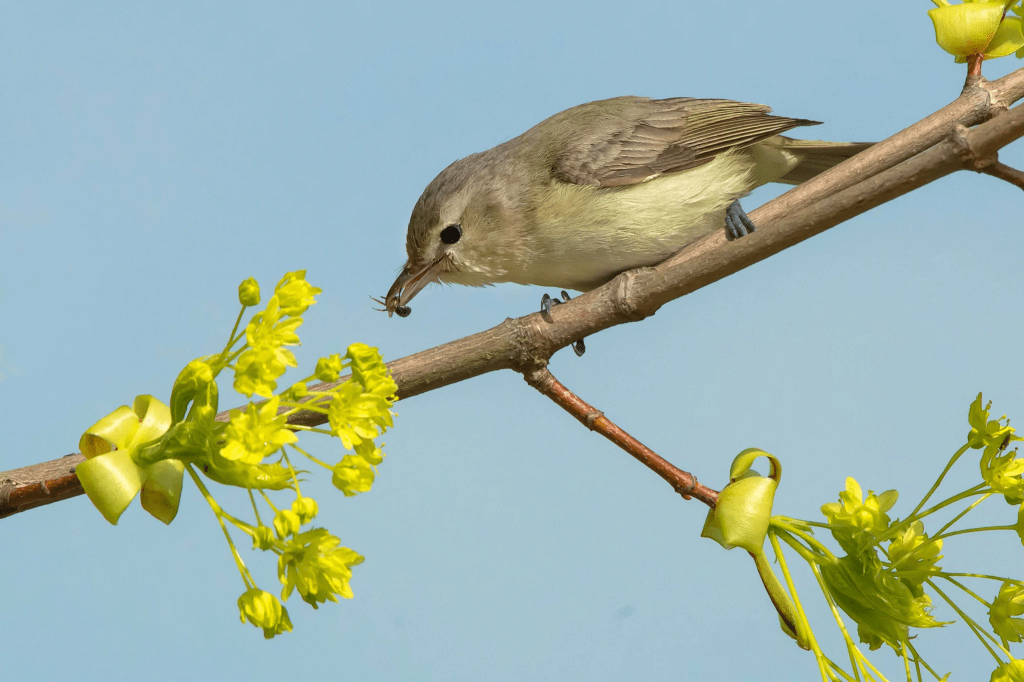
The Eastern Warbling Vireo is a quintessential species of spring and summer across much of eastern North America. This rather drab bird is often hard to spot, hidden up high among the leaves of tall deciduous trees, but its buoyant, easygoing song is hard to miss. One of the most persistent singers through summer, this vireo’s song is considered by many ornithologists and naturalists to be among the most beautiful in its range. Males do most of the singing, but females sing as well — an unusual trait among songbirds in temperate regions. Even more unusual, these birds will even sing while sitting on their nests!
Unfortunately for the vireos, Brown-headed Cowbirds seem to cue in on this species’ habit of singing from the nest. Cowbirds are “brood parasites,” laying their own eggs in the nests of other species, often resulting in the death of some or all of the host’s young. Female cowbirds are quite crafty, even using the movements of parent birds to determine the location of a nest; the more often a parent uses the same paths to and from the nest, the more likely cowbirds are to find it. However, Eastern Warbling Vireos are remarkably efficient at removing cowbird eggs, often puncturing the offending eggs with their bills before discarding them. Studies of this behavior showed that these vireos seem to recognize cowbird eggs by differences in the pattern of speckles on the shell — and get rid of them 90-100 percent of the time! (snip-MORE-2 calls and a song!)
I remember seeing a headline or a hyperlink somewhere, maybe yesterday or the day before, but I didn’t get to the story. Lucky for me, it’s linked again in an email today, so here it is!
Paris (France) (AFP) – Scientists have managed to film a spectacular event rarely witnessed by humans: a sperm whale giving birth while other females worked together to support the mother and her newborn.
A team from Project CETI, an international effort seeking to understand how whales communicate, were in a boat near a pod of 11 whales off the coast of the Caribbean island of Dominica on July 8, 2023.
A 19-year-old female named Rounder was surrounded by family members and others as she was about to give birth to her second calf.
Over nearly five and a half hours, the scientists documented the group’s behaviour, watching them from the boat, filming them with drones and recording the sounds underneath the waves.
The data they collected, which was published in the journals Scientific Reports and Science on Thursday, represent an exceptional rarity in the history of science.
Out of 93 species of cetaceans — a group that includes whales, dolphins and porpoises — only nine have ever been observed giving birth in the wild.
Rarer still was that whales not related to the mother were helping out.
“This is the first evidence of birth assistance in non-primates,” Project CETI team member Shane Gero told the New Scientist.
“It is fascinating to see the intergenerational support from the grandmother to her labouring daughter, and the support from the other, unrelated females.”
Lifting up the newborn
The birth lasted 34 minutes, from their tails emerging from the water to the calf being born.
During labour, other adult females dove under Rounder’s dorsal fin, often on their backs with the heads facing her genital slit.
Immediately after the birth, the pod’s behaviour “rapidly changed” as every member became active, according to the study in Scientific Reports.
All the adults were “squeezing the newborn’s body between theirs, touching it with their heads”, the researchers wrote.
The whales pointed their noses towards the newborn, “pushing it around, under the water, and onto and across their bodies above the surface”.
The remarkable behaviour dates back more than 36 million years and is believed to be due to the unique history of cetaceans.
After their distant ancestors left the water and adapted to life on land, cetaceans are the only mammals that returned to the ocean.
This dive back into the water required some evolutionary tricks to prevent newborns from drowning.
For example, whale calves are born tail-first, rather than head-first like other mammals.
However, while newborn sperm whales become talented swimmers within a few hours, they still sink right after birth.
So other whales have to lift the calf up “to prevent the newborn from sinking while also facilitating its first breaths”, the researchers suggested.
Primates — including humans — are the only other mammals known to help assist each other out during birth.
Excited vocal sounds
The scientists also recorded the whales making many sounds, including significant changes in “vocal style” during key events, the study said.
This included when a group of pilot whales approached the pod after the birth.
The changes in vocalisation suggest that the group was coordinating to support the birth — or protect the newborn, the researchers said.
Sperm whales have one of the longest pregnancies in the animal kingdom, with a gestation period that lasts up to 16 months.
When calves are born they are already four metres (13 feet) long. They will rely on their mother’s milk for at least two years.
As they grow, the young become the centre of their pod’s social unit, with others helping out with babysitting while the mother searches for food.
After the birth was filmed in 2023, the pod was not spotted again for over a year. Then the newborn was spotted with Accra and Aurora — the other young members of the pod — on July 25 last year.
Surviving its first year is a good sign that the sperm whale will reach adulthood, the Project CETI team said.
NASA’s Earth Observatory brings you the Earth, every day: sharing images, stories, and discoveries about the environment, Earth systems, and climate that emerge from NASA research, including its satellite missions, in-the-field research, and models.
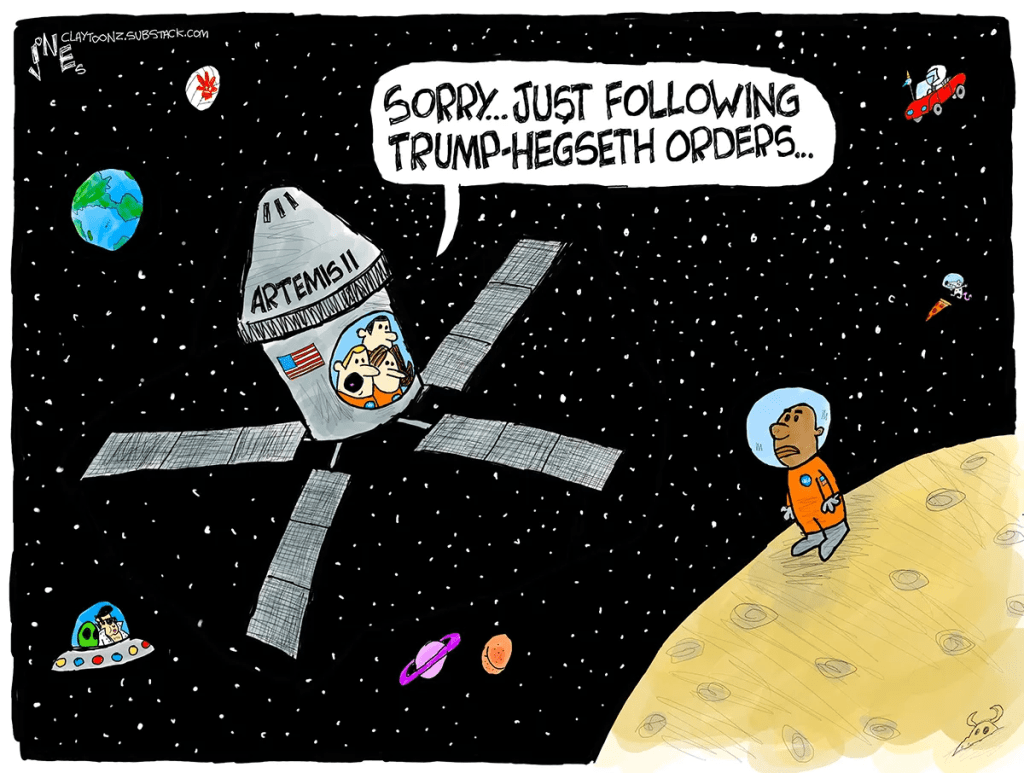
The crew of Artemis II set a record for the farthest-traveled humans from Earth, and they still could not get away from Donald Trump. The mission had a 45-minute blackout from communication with Earth while flying over the dark side of the moon, and Donald Trump was waiting for them when they came out of it.
The astronauts had a very uncomfortable and awkward 12-minute Earth-to-space call, facilitated by NASA administrator and Trump acolyte, Jared Isaacman. During the call, Trump told the astronauts how they would be honored if he got their autographs. They were also honored by Trump blowing smoke up their asses and telling them that he had saved NASA from extinction when, in reality, he tried to cut their budget by 24% when he returned to office for his second term. Not just that, (snip-MORE)
And now, this brilliant story from a friend of the blog:
Ann Arbor (Informed Comment) – On Easter Sunday, God’s chosen in the White House issued a vulgar and unbalanced posting on his “Truth Social” that epitomizes the insanity of his Iran War. Attending to it closely will help us understand how Trump has strengthened the government of the Islamic Republic and put it in control of global energy. Trump fondly imagines that he can dislodge Iran from this new ascendancy, but he is wrong, since it depends on sabotage, a sabotage that cannot be policed.
This is embarrassing, Delete it, President @realDonaldTrump – unless you want everyone to think you’ve lost your marbles.
The foul language and clear mental imbalance visible in this announcement sparked a further round of calls for Trump’s removal under Article 25 of the Constitution, which is nothing more than an internet meme since Trump has surrounded himself on his cabinet with people even more certifiable than he is, and who wouldn’t dare move against him.
Trump, having imbibed whatever substance it is that makes him manic, announced that “Tuesday will be Power Plant Day, and Bridge Day, all wrapped up in one, in Iran. There will be nothing like it!!!”
He is repeating a threat he made previously, to bomb Iran’s civilian electricity-generating plants as well as its civilian bridges.
Iran has 98 major power plants fueled by fossil gas, which generate 85% of the country’s electricity. The largest, the Damavand power plant south of the capital, Tehran, has a generating capacity of over 2.8 gigawatts.
One of Iran’s power plants is nuclear, at Bushehr. If Trump or Israel bombs it, the consequent radiation pollution will deeply harm the Arab Gulf states, not only through airborne particles but also by contaminating sea water, which is drawn on by the region’s desalinization plants. This exposure to radiation would certainly increase cancer risk in the region. There are mountains between Bushehr and the Iranian interior, so the radioactive particles would be blown west toward other countries such as the United Arab Emirates, Saudi Arabia and Qatar.
Striking civilian power plants, and above all nuclear ones, endangers the noncombatant population of children, women and unarmed men and violates International Humanitarian Law.
In fact, the International Criminal Court in the Hague issued “warrants of arrest for two individuals, Mr Sergei Kuzhugetovich Shoigu and Mr Valery Vasilyevich Gerasimov, in the context of the situation in Ukraine for alleged international crimes . . .” on June 24, 2024. They were indicted for “for the war crime of directing attacks at civilian objects (article 8(2)(b)(ii) of the Rome Statute) and the war crime of causing excessive incidental harm to civilians or damage to civilian objects (article 8(2)(b)(iv) of the Rome Statute), and the crime against humanity of inhumane acts under article 7(1)(k) of the Rome Statute.”
Among the “civilian objects” that these Russian officials ordered attacked in Ukraine were power plants and structures such as the Kryukovsky Bridge.
So Trump is talking like a war criminal, which tells you why he has placed sanctions on International Criminal Court judges.
Trump already struck the unfinished B1 bridge linking Tehran to Karaj. Since it was not finished, it could not possibly have had a military purpose, contrary to the lies of the lying liars in the Trump administration who gave that as the excuse for hitting it.
Trump continued, “Open the Fuckin’ Strait, you crazy bastards, or you’ll be living in Hell– JUST WATCH!
It is not clear how a body of water such as a strait could copulate. However, it can engender revenue, and does so for Iran. A lot of revenue.
Iran has not actually closed the Strait of Hormuz entirely. It is exporting its own petroleum through that narrow aperture, mainly to China. Trump has been forced by the global oil shortage to lift sanctions on the Iranian tankers, and so Iran is also selling again to India. Before Israeli Prime Minister Benjamin Netanyahu rushed Trump into war on Iran on February 28, Iran was exporting about 1.4 million barrels a day to China. The price of petroleum was about $67 a barrel then, but Iran had to offer a steep discount to offset American sanctions, and so was probably only getting $57 or less a barrel. So Iran was getting something like $29 billion a year for its petroleum from China and a few other customers (90% goes to China).
China is now likely having to pay $110 a barrel for Iranian petroleum.
Iran’s oil income just went up to $55 billion a year if these prices and this volume of trade persists, which is plausible. So the “crazy bastards” in charge of Iran have nearly doubled their income off the Netanyahu-Trump war because of the fertility, under their control, of the “fuckin’ Strait.” The Iranian oil industry is state-owned, so all the money goes to the clerics and the Iranian Revolutionary Guards Corps, as well as to the conventional army and the elected institutions, the parliament and president. This extra income helps the government tamp down resistance, strengthening it against civil society. In any case, many Iranians under foreign attack are rallying around the flag. Of course there are also tax losses from the economic disruption of the war, but the vastly increased oil income helps make up for them as far as the government is concerned. If the price of oil goes to $200 a barrel, as it may well, Iran’s government could get $100 billion a year for its petroleum.
Not only that, but Iran has instituted a toll system, wherein countries that have good relations with Iran and pay a fee can transit the Strait without fear of an Iranian drone attack. In contrast, countries that Iran believes contribute to the American war effort against Tehran such as the Emirates and Kuwait, are blockaded by the threat of such strikes. These tolls could be an ongoing and lucrative source of income for the government. Before the war, 138 ships transited the Strait daily. If that traffic resumes but each has to pay Iran a $2 million toll, that would bring in $96 billion a year, i.e. four times what Iran was getting for its petroleum before the war.
So here’s the thing. With the advent of Iran’s Shahed drones, which can be manufactured inexpensively and of which it has tens and thousands, there is no way for anyone, including Trump and the US military, to stop Iran from sabotaging ships that won’t pay the $2 million. At least, I don’t see how it could be done. You’d need tens of thousands of interceptors, and we hardly have any left. Moreover, interceptors cost $1.5 million apiece, so it makes much more sense to allow each ship to pay Iran the $2 million.
Container ship in Strait of Hormuz. (U.S. Navy photo by Mass Communication Specialist 2nd Class Indra Beaufort).Public Domain. Via Picryl .
Trump has shown Iran how it can go into the protection business in the Gulf for the long term. Nice oil shipping industry you have here, it would be a shame if anything happened to it. And off that, Iran actually increases its GDP substantially.
If Trump takes out Iran’s electricity and bridges, he can interfere with its economy and its society in a big way. But he can’t stop the drones or the protection racket that way. Moreover, Iran has made it clear that its response will be to take out the power plants in the Gulf Arab states as well as in Israel. Since the US and Israel are running low on interceptors, and since even small Shahed drones have great range and can do a lot of damage, Iran’s threat is credible.
If Trump takes out Iran’s petroleum-production capability, Iran will crash oil production in the Gulf, taking 20 million barrels a day off the market for years to come. That would certainly be another Great Depression and likely would spell the end of the oil industry, since everyone in the world would migrate to electric vehicles quickly.
So although Trump meant the phrase ironically and blasphemously, the Iranian authorities may well end up saying “Praise be to Allah” over Trump’s monumental stupidity.
There are many ways in which the world feels uncertain, and with every news update, we ask ourselves questions: What role do we play? How can we help? We know many readers turn to Mooch and Earl for a daily dose of comfort and joy. Recently, someone told us MUTTS is their “place to go for a warm hug each day.” Will raising a particular issue interrupt that sense of refuge that readers value here?
Not long ago, we received a letter from a reader named Tyla. With her permission, we’re sharing part of it below.
“With recent ICE raids impacting Minneapolis and communities across the country, some families are being separated very suddenly, and in many cases this has meant pets are left without caregivers. Animal shelters and rescues have shared that they’re seeing more animals being taken in or surrendered unexpectedly, and in some situations, people have stepped in to foster or adopt pets whose families were detained.
“The health and well-being of both people and animals isn’t always part of the conversation when issues like this come up, even though both are affected. Animals, especially, rely entirely on their families for care and stability, and sudden disruptions can be very hard on them.
“I was wondering if this is something the [MUTTS] team might feel comfortable acknowledging this, specifically from the perspective of how animals are affected.
“I understand this is a sensitive and complicated topic … I also know that many readers, including myself, turn to MUTTS as an escape from the real world, and I truly respect that. I just wanted to offer this suggestion thoughtfully, since when people are affected in situations like these, animals are often affected too, and their needs can easily be overlooked.”
Tyla’s letter moved us. We’d been thinking about this, too. We started drafting a blog post based on one specific concern: What happens to pets when their families are detained or deported? We were discussing this internally, and considering ways to help, when the scope widened. The news headlines, unfortunately, have not slowed down.
The world feels increasingly uncertain, but one thing we know for sure is that pets depend on the humans who love them. They don’t understand geopolitics or political parties. And the truth is, preparing for any unexpected event — from a natural disaster to a family emergency or something else — is an act of love and responsibility.
At MUTTS, we believe in compassion for all creatures. With that spirit, here are practical ways we can all help our human and animal neighbors.
If You’re a Pet Parent: Plan Ahead
Choose a backup caregiver. Identify a trusted friend, neighbor, or family member who could step in temporarily if you can’t be home. Make sure they’re willing and understand what would be involved. Share basic care information in advance so nothing is left to guesswork. If you’re comfortable with it, you may even want to give them a spare key to your home (or tell them where one is hidden).
Keep identification current. Ensure your pet’s tags and microchip records are up to date. Consider listing a secondary contact (such as your backup caregiver) on file with your vet.
Prepare a small “just in case” kit. Put together a bag with essentials: medications, vaccination records, feeding instructions, favorite comforts like a blanket or toy, and a short written profile of your pet’s personality and needs. Think of it as something you’d want ready in any unexpected situation.
If you currently need assistance caring for your pet, know that there are many community resources around the country that may be able to help. You can start your search with PetHelpFinder.org, which allows you to search for pet pantries, affordable veterinary services, and other resources in your area. You might also contact your local animal shelter for guidance. Many shelters offer community assistance — and even if yours does not, it’s very possible they can help point you in the right direction.
If You Want to Help In Your Community
Volunteer at a local shelter. Many animal shelters are already stretched thin, and shelters across the country are receiving pets whose guardians were detained or unexpectedly displaced. Time, donations, and supplies all help.
Consider fostering.This is an incredibly impactful way to help pets in your community, especially right now. Fostering gives an animal stability during a time of upheaval. In some cases, it provides time and space for an eventual reunion with their family. It also helps shelters by freeing up room so they can care for more animals.
Offer to be a backup pet caregiver for friends, family, or neighbors. You don’t need a specific reason to make this offer. You can simply say you’ve been thinking about family preparedness and realized how comforting it would be to know someone nearby could step in for your own pet if needed. Sometimes people hesitate to ask for help, and by offering proactively (and gently), you can remove that barrier and replace it with reassurance.
Create or strengthen local support networks. If your area doesn’t have a pet food pantry, consider starting one. Offer to deliver pet food or walk dogs for families facing temporary hardship. Some communities have organized quiet grocery or supply deliveries for neighbors who are unable to leave home. No pet should go hungry because their family is going through a difficult time.
Build Real Connections In Your Community
This may sound simple, but it really matters. Support systems don’t appear overnight. They grow from familiarity and trust. If you don’t already have a close-knit community, consider planting the first seed. For example:
Start a “take one, leave one” table or box. This could include books, baked goods, even extra apples or herbs from plants in your own yard.
Bring back front-yard or porch time. Read or drink your coffee outside. Smile and wave at anyone who passes. This invites casual conversation without any pressure.
Check on neighbors during extreme weather. A quick knock before a storm or heat wave can go a long way.
Remember that when communities feel connected, pets are safer too.
Share Your Ideas to Help Pets and People
If you have ideas we haven’t mentioned, we would love to hear them. In the spirit of MUTTS, we ask that comments remain friendly and constructive, aimed at helping animals and strengthening compassion. That’s something we can all stand behind.
I wish! 😄 Leading Kansas writes this time in regard to data centers, and about addressing our local governments in our own behalf.It works the same in every state.
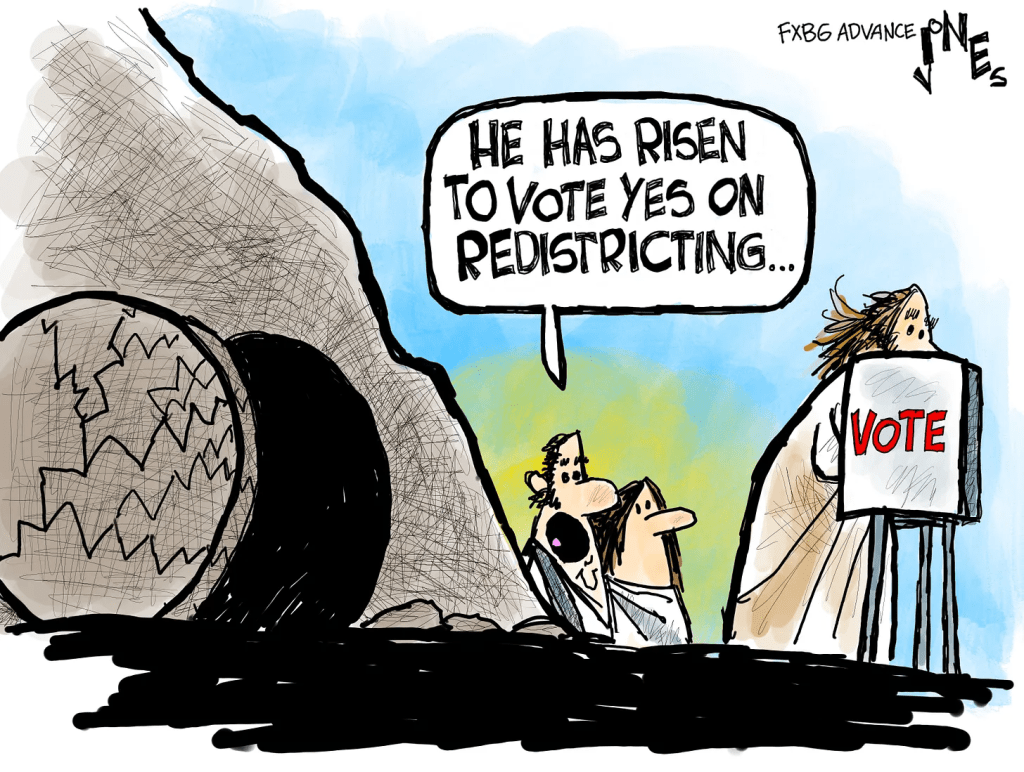
This cartoon was drawn for the Fredericksburg Advance. But don’t yell at them for it; you can yell at me.
If you live in Virginia, you have been bombarded with flyers about the special election on redistricting. And it’s not just flyers but also TV commercials, which are also popping up online. We are getting these things from both sides.
There is a special election in November on a state constitutional amendment that would give Democrats as many as four seats in Congress. The measure would also temporarily bypass the state’s redistricting commission to redraw maps in the middle of the decade.
The state’s Supreme Court approved the measure to be on the ballot less than a week before early voting began. State Republicans repeatedly tried to stop Democrats from moving forward with the referendum. The irony here is that Republicans claim that voting yes will disenfranchise voters, while they literally tried to keep this off the ballot so people couldn’t vote on it.
This is a direct response to Donald Trump and Republicans redistricting mid-decade to give themselves more seats. Donald Trump even said he was entitled to have more congressional seats. This is one reason why we need to No Kings protest. Donald Trump already believes he’s entitled to win elections he’s lost. (snip-MORE, and it’s on point)
Energy company Deep Fission is in the process of building a new and untested type of underground nuclear reactor in Parsons, KS
The Trump administration has reduced regulations to encourage nuclear power production
The reactor will likely power data centers for artificial intelligence
Large data centers consume huge amounts of water and energy and produce different types of pollution, leading to health risks for nearby residents
In November 2025 a two-year-old energy company called Deep Fission broke ground in Parsons, Kansas. They hope this project will enable them to install the second ever energy producing nuclear reactor in the state, after Wolf Creek, potentially with more reactors on the way in the future. If the early “characterization” drilling goes to plan, they claim the reactor could begin pumping electricity into the grid in the near future.
Parsons is a city of 10,000 in southeastern Kansas, near the Oklahoma border. I’ve lived in Kansas for most of my life and I had not heard of Parsons until last week. So, why is Deep Fission in Parsons, Kansas, and why now? Not coincidentally, the Great Plains Industrial Park, also located in Parsons, has lately been advertised as a prime location for new data centers to power the trillion-dollar (yes, trillion with a T) artificial intelligence boom forced upon us by large technology corporations and their venture capitalist backers. Which means the Parsons nuclear reactor project would likely come as a package with one or more new data centers, along with potential economic prosperity and a host of legitimate concerns that community members have already raised.
Part 2: The New Nuclear Power
While the Department of Energy set a goal for the Parsons reactor to go online in July of this year, Deep Fission themselves are aiming to connect to the grid by 2027 or 2028. Two years is still an unusually rapid rollout for a nuclear power plant, which usually takes 6-10 years from groundbreaking to full operation.
Nuclear energy is typically labeled as “clean” energy compared to coal, oil, and natural gas, meaning that it releases fewer pollutants into the air and water than fossil fuel consumption. Still, there are two main concerns. First is the disposal of nuclear waste, which ranges from the lightly contaminated clothing of plant workers to the lethally radioactive spent fuel a plant produces over time. This latter “accounts for just 3% of the total volume of waste, but contains 95% of the total radioactivity.”
A relatively new method in the US and Europe for disposing of our most dangerous nuclear waste is to bury it very deep underground, so that it can be surrounded by solid rock to provide the same level of pressure containment as required at structure at a surface nuclear reactor facility. The father-daughter team that eventually founded Deep Fission originally created Deep Isolation to dispose of nuclear waste. Deep Fission takes their concept a step further by placing the entire reactor, and therefore its most dangerously radioactive elements, into a borehole drilled one mile underground.
The second main concern related to nuclear energy production is, of course, accidents or attacks. It is true that large-scale nuclear accidents are very rare, but when they happen, they become instant, globally recognized disasters whose names we all know: Chernobyl, Three Mile Island, Fukushima. The effects are so widespread as to be practically impossible to quantify. The reactor explosion and meltdown in Chernobyl, for example, caused several dozen deaths directly related to radiation exposure, but various studies have predicted anywhere from thousands up to a million eventual additional cancer deaths. Not to mention the environmental and economic cost to the entire region around Chernobyl. And radioactive boars still terrorize people and farmland in the region around the Fukushima plant in Japan.
But those issues are known, and regulations have historically attempted to shore up potential dangers posed by new plants. In contrast, nothing like the underground nuclear reactor in Parsons, Kansas has ever been attempted before, and thanks to Executive Order 14301, will not need to go through long established design and testing phases that other types of nuclear reactors have been subject to in the past. John Young, a mining environmental regulatory specialist who lives in Sedgwick County, asks, “Why abandon the current regulatory process for something created out of whole cloth with no public input? And no one can define the current regulatory pathways for Federal and State authorizations.
“What,” Young asks in frustration, “could possibly go wrong?”
Part 3: Data Centers and Artificial Intelligence
So that is a glimpse into the nuclear energy side of things. Next we must address concerns around data centers and artificial intelligence. Data centers come in different sizes, like the smaller center being proposed in Wellington, KS, which would reportedly “use roughly 30% of the city’s electrical capacity while generating an estimated $1.3 million in annual electric utility revenue” while consuming only two gallons of water per day. Larger data centers consume resources less modestly. “Around the country, and the world, there is a land race among the big tech companies for sites for their data centers,” claims a November 2024 investigative report by Rolling Stone. Data centers are much newer than nuclear energy technology, yet the ways in which they harm communities near them have already become apparent.
Water: “Large data centers can consume up to 5 million gallons per day, equivalent to the water use of a town populated by 10,000 to 50,000 people,” according to a June 2025 study by the Environmental and Energy Study Institute (EESI). And data centers built explicitly to power AI represent the fastest growing portion of the market.
Last year, researchers at the University of California, Riverside calculated that ChatGPT—one of several popular Large Language Models (LLMs) vying for marketplace dominance—answered about 10,000 queries per second. The processing load to do so guzzled about 6,000 liters (or about 1,000 toilet flushes) of fresh water per second, all day, every day. That is only generating written text. AI photos require more water, and still more for AI video. “The extraction process is permanent,” explains the University of Alabama at Birmingham Institute for Human Rights. Water used to cool data centers evaporates as it cools hot components, meaning it can no longer be used by people in the region who need water for drinking, cooking, bathing, laundry, and general survival.
Pollution: Unfortunately, it is not only consumption of water to worry about. The evaporation of water cooling data centers leaves behind higher concentrations of nitrates and other contaminants leaked through agricultural fertilizers and pesticides into local water supplies, drastically increasing incidents of “rare cancers, muscle disorders, and miscarriages” among people who live nearby. Geographically, Parsons, Kansas sits atop the Alluvial and Ozark Aquifers.
Reports of noise pollution have increased near data centers as well. Residents in different Virginia towns experienced disturbing high and low frequency humming in a wide radius around two new data centers.
These same experts predict that the disempowerment will not only come at the individual level, but also at the societal level, as lawmakers turn their attention and favor even more toward tech companies and AI services that increasingly take over tasks that used to be performed by human beings.
The purpose of this article is not to overwhelm with doomsaying or inevitability. If the Deep Fission underground reactor works as advertised, it could genuinely provide cleaner energy than fossil fuel and mitigate some of the effects of climate change. But to get there safely, we need to demand transparency and regulatory protections from political and corporate leaders. If enough of us speak up in place like Parsons, Topeka, Sedgwick County, and every corner of our town, state, country, and world, we embolden those watching, each other, and ourselves to continue building the world we want and deserve.