‘Nobody’s negotiating for the people here’: comedian Charlie Berens takes on AI datacenters
Sun 17 May 2026 07.00 EDT
Last summer, journalist turned comedian Charlie Berens started getting social media messages from concerned Wisconsin residents about plans for a massive datacenter campus in their state.
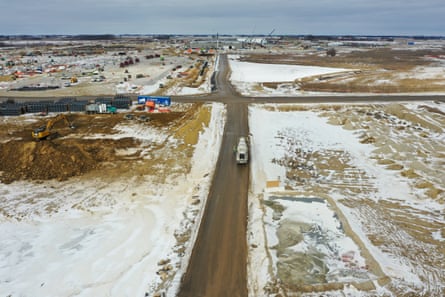
The developer, Vantage Data Centers, claimed the $8 bn project would largely run on zero-emission energy resources like solar, wind and battery storage. The company said the campus would bring thousands of temporary construction jobs and potentially more than 1,000 permanent jobs to Port Washington, a city of 13,000 people about a half-hour north of Milwaukee. Residents opposed the project for what they said was lack of transparency and criticized the lucrative tax incentives offered to Vantage. They worried about the strain on local water and energy sources from an enormous 1.3-gigawatt project that could ultimately span 1,900 acres.
Berens, who shot to internet fame with his “Manitowoc Minute” videos that play on midwestern quirks and stereotypes, had his own reservations about the artificial intelligence datacenter boom. A Milwaukee-area native who still lives in the city, he’d heard about the potential environmental hazards, the steep rise in energy costs for neighbors and noise pollution, among other risks.
When he Googled, he found that lawmakers in his state had paved the way to make the Port Washington project a reality. The deal between Port Washington and Vantage gave an estimated $458m in tax breaks to the developer over 20 years to fund infrastructure for the project, with the city not seeing any of that tax revenue during that period.
“It was shocking,” Berens said.
That’s when he decided to do something he had rarely done before: discuss politics in his videos. He used his platform to address one of the more polarizing issues in contemporary life: what AI portends for Americans.
In August 2025, Berens published his first “Manitowoc Minute” video on AI datacenters. The two-minute skit matched the typical style of Berens’s videos, where he intersperses facts with humor in the style of a TV news report. But he was remarkably direct in his critique of big tech. Sporting a Green Bay Packers tie, he lambasted Silicon Valley CEOs, accusing them of using Wisconsin as a “dumping ground” for datacenters at the expense of the state’s cherished natural resources while evading any type of public scrutiny.
“It is our civic duty to make sure the billionaires become trillionaires,” said Berens in a satiric bit.
He channelled his outrage at lawmakers in Port Washington, a historic city on the banks of Lake Michigan and once home to thriving fishing and shipping industries. In a contentious vote last August, officials there approved the initial $8bn datacenter campus despite strong resistance from residents. (The project later expanded to a $15bn joint venture with OpenAI and Oracle, one of the Trump administration’s showcase “Stargate” megaprojects.)
“I was shocked at how many people I saw speak against this [at public meetings he watched online] and then to see a unanimous vote for it,” Berens said. “It just felt like an imbalance of democracy.”
The video went viral, garnering more than 2.5m views on YouTube alone. Berens’s inbox was soon flooded with messages of support from Wisconsinites of all political stripes – self-declared Maga supporters, avowed socialists and everyone in between – sounding the alarm on datacenters.
“It was 99% positive comments, which doesn’t happen on anything these days,” said Berens. “From that point, I decided that I should do more because nobody’s negotiating for the people here.”
Berens has since thrown himself into the cause, routinely publishing videos and headlining well-attended events with field experts and anti-datacenter activists. He has quickly become the most famous face of a burgeoning movement in Wisconsin, where resistance to these projects – Port Washington is just one of seven hyperscale datacenter projects across the state – has risen dramatically in the last year. A March survey from Marquette University Law School found that nearly 70% of registered voters in Wisconsin say the costs of large datacenters outweigh the benefits they provide, a remarkable shift from last October when that figure stood at 55%.
The attention has placed the comedian in the crosshairs of most of the state’s labor unions, pro-business groups and much of its political establishment, who argue the badger state cannot afford to be left behind in the AI arms race.
In a series of interviews, Berens laid out why he decided to jump head-first into the movement; his case for how big tech destroyed public trust through hard-armed, often secretive tactics to push forward datacenters; and what he has learned as he has crisscrossed the state and toured the country.
“Every step of the way, the more people look, they’re seeing that this is not really a fair fight here,” said Berens.
‘Protecting the people’
On a late winter evening in March, hundreds of people packed a community center in Juneau, a tiny rural town about 45 miles north-east of the state capital, Madison.
The crowd had assembled for a “people’s town hall” to address a $1bn Meta datacenter that has pitted residents of nearby Beaver Dam against their elected officials. The featured speakers ranged from community activists to a former Meta employee. The main act was Berens, who squeezed in the appearance between stops in Iowa and Vermont on his standup comedy tour.
“This is the most bipartisan issue since beer,” he said in opening remarks.
In his roughly 15-minute speech, he called for more regulation of AI, pointing out that a beloved Wisconsin staple, bratwurst, was more heavily regulated than the trillion-dollar industry. Berens warned the audience of the risks of AI technology, running through a slideshow of news headlines that highlighted the potential, and very real, harm to children. He also addressed his critics.
“I will stick to comedy when our politicians stick to policy and stop protecting big tech and start protecting the people that put them into office,” said Berens, to applause.
As he turned his attention to the project in Beaver Dam, he attacked Meta’s use of a shell company and nondisclosure disagreements (NDAs) that required secrecy from some public officials in the process of getting to an approval. In April 2025, a report found Meta was the mystery tech company behind Degas LLC, the listed corporation on the development. By November, the company acknowledged they were behind the project.
Meta’s practices in Beaver Dam are part of a larger pattern across the state, where datacenter projects have often been developed in secrecy despite their huge price tags and massive footprint on communities. A recent investigation from Wisconsin Watch, a non-profit news site, found that NDAs have been signed in at least five cities in Wisconsin where AI datacenters are proposed or under construction.
Another panel speaker that night was Maily Kocinski, a lifelong Beaver Dam resident whose farm lies less than 2 miles from the 700,000 sq ft datacenter campus construction site. Last June, she posted a TikTok video after a creek that runs on her property had gone dry one morning. The water came back, but occasionally appeared milky white and gave off a toxic smell. Kocinski said she contacted the state’s department of natural resources on several occasions and was told the agency collected water samples but were not always able to reach her property in time before the water cleared up again.
She personally commissioned a water analysis in February from a lab at the University of Wisconsin-Stevens Point, which found metal levels in her well water above what was considered safe to drink, per recommendations from the Wisconsin department of health services. She questions whether the daily controlled blasts on the construction site led to disruptions in her water supply. Meta commissioned its own study in response, denying any link.
A spokesperson for the Wisconsin department of natural resources confirmed that the department collected a water sample at Kocinski’s creek last November. The results, shared with the Guardian, show elevated metal levels but the department did not speculate as to the potential cause.
“Without a site specific review, the DNR cannot speculate on the role of the blasting on the aquifer and Ms. Kocinski’s private water supply,” the spokesperson said in a statement.
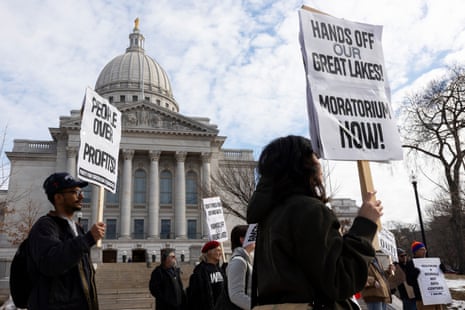
Kocinski, an elementary school teacher, said since last fall, she has spent up to 15 hours a week researching the large-scale construction of datacenters and the potential environmental harms they can wreak in a community. In March, she testified in the Wisconsin senate in favor of a datacenter oversight bill that ultimately failed to reach a vote.
She said she had never met Berens before the event in Juneau but the two had been in regular contact for months after she cold-emailed him her story.
“Charlie has really put in the work to understand this issue,” said Kocinski. “Most people came to Juneau probably because he was there, but they stayed and maybe learned a bit about these things [datacenters] … That kind of education leads to action.”
The risks of speaking out
As Berens’s critiques of datacenter projects in Wisconsin have gained traction with the public, he has faced pushback from the state’s trade unions, who welcome the thousands of temporary construction jobs that typically come with a project.
A major Wisconsin labor leader called out Berens in a December op-ed in the Milwaukee Journal Sentinel. “For us in the building trades, data centers aren’t some big, scary mystery,” wrote Emily Pritzkow, head of the Wisconsin Building Trades Council that represents nearly 50,000 workers in the state. “They’re high-skill, long-term work. The kind of work that feeds families, pays mortgages, and sends kids to college.”
Local governments have weighed in too. In Port Washington, city officials posted a “fact sheet” online to “clarify some lingering misconceptions” after Berens posted a second video urging residents to question officials about the datacenter project at an October council meeting.
Ted Neitzke, Port Washington’s mayor, expressed frustration with the attention that Berens’s videos had brought his city. He noted that more than 100 people began showing up at council meetings after the comedian published his first video last August, forcing the city to move them to a hotel conference center with an added police presence.
“After Charlie Berens’s video, things escalated very rapidly, very contentiously, and our city was besieged with people from outside of our town,” said Neitzke. “Charlie Berens created chaos for us.”
Neitzke also challenged some claims Berens has made in his videos, including those about the amount of jobs the project would create, its environmental impact and whether residents’ power bills would increase.
“I don’t know where the line gets drawn between factual and embellishment for him,” said Neitzke. “There’s a very gray area between the entertainment and the facts.”
Berens defended his videos and the people who showed up to council meetings in response, noting that a hyperscale datacenter affects not just one city but the surrounding communities and “they deserve a say too”. He maintained that his videos were well-researched and cited news articles to back up his claims.
“I informed people about a massive AI datacenter going up by adding some punchlines,” said Berens. “If the truth brings chaos, that seems like something the mayor would want to take accountability for.”
Neitzke met with Berens last fall in an attempt to find common ground. The mayor described the two-hour meeting as cordial but both left in disagreement. He has been the project’s greatest champion, referring to it as a “transformative” development for the Rust Belt city, one that has the potential to once again make Port Washington a hub in the midwest.
That stance has drawn some fierce public opposition, even leading to an attempted recall effort over the $458m tax incremental finance, or TIF, district with Vantage. Under the deal, Vantage will pay upfront costs for the development and the city will reimburse the company with new property tax revenues over a period up to 20 years. Neitzke said he was no fan of TIFs but called them a “necessary evil” in negotiations to win the contract over other cities chasing major developments to boost revenue.
“This is a save our city strategy,” said Neitzke. “[Berens is] doing what he does, and we’re going to do what we’re doing.”
Berens has also faced criticism online from those who say the comedian has built his career on tech platforms, while looking to close the door to their projects in Wisconsin. He said he “understands the irony” but wants to use his sizable platform to educate his audience on these types of developments that could remake their communities.

Advertisers, too, have noticed his shift to politics. Berens acknowledged that he lost a major brand deal with a company that did not want to appear alongside his anti-datacenter content, though he declined to name the business.
“I’m asking for transparency. I’m asking for honesty. I’m asking for people to get informed,” said Berens. “I’m trying to facilitate that and if that at the end of the day means I lose everything, then so be it.”
A personal evolution on AI
Berens was not always an AI pessimist.
A few years ago, he believed the utopian vision laid out by AI luminaries like OpenAI’s Sam Altman, who spoke of how the technology could be used to cure social ills, even to treat intractable diseases. Berens thought maybe it could also help Wisconsin deal with its Pfas contamination issue. “My interest in AI started with a lot of hope and optimism actually,” he said.
That sentiment eventually turned to cynicism as, he claims, the industry’s billionaire CEOs dispelled any virtuous use of the technology for the social good in favor of enriching themselves and their investors. He cited Altman’s recent efforts to create an Erotica feature in OpenAI’s ChatGPT chatbot, despite concerns even from the company’s advisers that such a tool could create a “sexy suicide coach”, according to a Wall Street Journal report.
“I thought this thing was supposed to cure cancer,” Berens said, referencing Altman’s past statements. “Is this what we’re giving our land for? Is that what we’re giving our water for? Is this what you’re asking to change our communities for?”
For him, the “tip of the iceberg” was the gold rush to build hyperscale datacenters in his state through secretive tactics and potentially exploitative agreements in post-industrial cities longing for an economic revival.
“Wisconsin created an environment that would please the billionaire tech companies,” said Berens of the tax incentives. “Billionaire tech companies took full advantage of that.”
Prescott Balch knows a bit about those types of corporate tactics. A former technology executive at US Bank turned anti-datacenter activist in retirement, Balch was on the frontlines of the successful effort to stop a major Microsoft AI datacenter project last fall in the picturesque eastern Wisconsin village of Caledonia, where he lives. In April, he won a seat on the town’s village board, beating an incumbent who supported the datacenter. He views the AI datacenter boom as akin to the dot-com bubble crash of the early 2000s, another chapter in the boom-and-bust cycles of the volatile tech industry.
“We got irrationally exuberant and built too much stuff,” Balch said of the dot-com period. “Maybe the company running your datacenter will go bankrupt. This big dollar amount that you’re chasing comes with significant risk.”
Balch’s insider expertise in the wonky world of municipal subsidies has been fundamental for Berens. Balch factchecked many of Berens’ videos on the issue, even appearing in one where he methodically crunched the numbers on these developments, referring to the Port Washington project as “up and down a horrible deal”.
The 62-year-old is, in many ways, the polar opposite of Berens. He is professorial in demeanor and careful to point out that he is not an AI alarmist. Where the two agree is a belief that there’s been an information vacuum around these projects, leaving the public largely uninformed about their size and scope. That’s part of the message they have taken on the road, appearing together at events in Wisconsin and Illinois. Berens’s celebrity has been the draw for people to turn out.
“[He] gets people interested in the topic and warms them up,” Balch said. “And I get to do the dry delivery of the financial perspective.”
Port Washington vote
On 7 April, Port Washington residents passed the nation’s first anti-datacenter referendum. By a roughly 2-1 margin, voters approved a measure that would require city officials to get approval from voters before approving tax incremental districts of more than $10m.
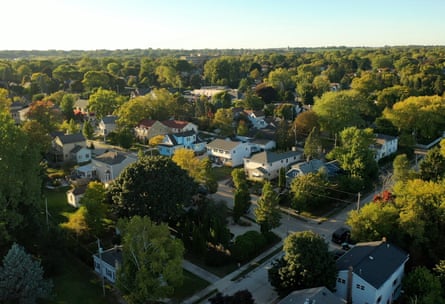
The effort came together after a group of residents called Great Lakes Neighbors United gathered more than 1,000 signatures in less than two weeks to get it on the ballot. The referendum does not stop the $15bn datacenter campus under construction, but would apply to all future projects above that $10m threshold. Industry advocates have warned the vote could set a dangerous precedent for municipalities across the country, potentially paralyzing AI datacenter developments.
Mayor Neitzke said the referendum makes the city less competitive and puts it at a disadvantage to vie for future projects. For Berens, the vote reflected the energy he has seen on the ground in Port Washington and in every corner of the state.
“The people who are the heartbeat of this movement are like people in Great Lakes Neighbors United,” said Berens. “These are people from all different walks and all different political stripes, but they all care about the same thing: [that] their community should have a voice.”
© 2026 Guardian News & Media Limited or its affiliated companies. All rights reserved. (dcr)