A recent article from Jesse Singal in the New York Times seemed to indicate the organization might be quietly retreating from supporting trans youth care.
Erin In The Morning is a reader-supported publication. To receive new posts and support my work, consider becoming a subscriber.
Yesterday, anti-transgender activist and columnist Jesse Singal published a piece claiming there were “cracks in the wall” around gender-affirming care (which you can find fully fact-checked here). To make that case, he relied heavily on a statement from the American Society of Plastic Surgeons that bypassed the organization’s normal scientific review process and was advanced under pressure from leadership aligned with the Trump administration, including a president who is a major Republican donor. Singal also invoked the American Psychological Association, suggesting the organization was retreating from its 2024 position supporting transgender care and rejecting claims that gender identity is “caused” by external factors. But a representative for the APA tells Erin In The Morning that the organization stands firmly by its 2024 guidelines supporting transgender youth care and provided documentation indicating Singal mischaracterized its position.
“No, APA’s position has not changed,” says a representative speaking for the APA, attaching a link to their 2024 policy statement which provided broad support for gender-affirming care. “APA continues to support unobstructed access to evidence-based care for transgender and gender-diverse individuals of all ages.”
The 2024 policy statement is to date one of the most significant supportive stances of any medical organization for gender-affirming care. It states that gender-affirming medical care is medically necessary, opposes bans on gender-affirming care, declares that being transgender is not caused by autism or post-traumatic stress, establishes the organization’s support for combatting disinformation on transgender healthcare, and finds that rejection of a trans youth’s gender identity can increase their risk of suicide and harm their psychological wellbeing. The policy was passed overwhelmingly, 153-9, with each voter representing a large subset of the organization’s 157,000 members. Now, the organization says that it is not accurate to claim that there is any regression on support for transgender youth care from the organization.
The organization also disputes Singal’s portrayal of a 2025 letter written by Katherine McGuire to the Federal Trade Commission. In his piece, Singal claims the APA “cautioned that gender dysphoria diagnoses could be the result of ‘trauma-related presentations’ rather than a trans identity,” and noted that “co-occurring mental health or neurodevelopmental conditions (e.g., depression, anxiety, autism spectrum disorder) … may complicate or be mistaken for gender dysphoria,” framing this as evidence that the organization is retreating from its 2024 policy supporting transgender youth care. That interpretation is incorrect, according to an APA representative, who says the letter does not contradict the organization’s 2024 position and does not represent a regression in its support for evidence-based transgender care.
The FTC letter sent by APA Services was not saying that transgender identity can be caused by autism or depression. Rather, it was describing what any competent psychologist does with any patient: assess the whole person, including whether conditions like depression or anxiety are present. The letter does not say that depression or anxiety or autism cause gender dysphoria; it says that psychologists are careful about not mistaking these conditions for gender dysphoria. Notably, the letter was written in direct response to the Trump administration’s FTC, which had accused gender-affirming care providers of deceiving consumers, and McGuire was explaining that psychologists conduct thorough, individualized assessments—not that the organization’s position on care or “causes” of being transgender had changed. Had McGuire not indicated that psychologists were making these determinations, the FTC would likely then accuse the organization of not investigating its crank theories on gender dysphoria.
You can view the letter here:
American Psychological Assocation Response To Ftc Rfi Gender Affirming Care 9 26 2025 Signature (1)
“The 2024 policy statement and the 2025 FTC letter are consistent. The 2024 statement reflects the organization’s policy position on access to care. The 2025 FTC letter describes what competent psychologists do in individual clinical practice: they do not make generalized claims to families but instead provide individualized, evidence-based assessment. Both documents reflect APA’s consistent commitment to evidence-based psychological care,” says the representative.
The American Psychological Association’s reaffirmation of its support for transgender youth health care is significant. The organization is among several reportedly under FTC investigation as part of a broader effort to pressure medical bodies to retreat from transgender youth care. It is also facing a coordinated pressure campaign from anti-trans activists like Jesse Singal and outlets such as The New York Times, both of which have repeatedly sought to cast doubt on established standards of care. That context makes Singal’s portrayal especially consequential. Readers were left with the impression that the APA was backtracking. According to the organization itself, that is false. What Singal presented as evidence of “cracks in the wall” was yet another attempt to manufacture doubt around the professional consensus supporting transgender youth care.
Erin In The Morning is a reader-supported publication. To receive new posts and support my work, consider becoming a subscriber.
I am so tired of a small group of Christian nationalists who demand the right to force their religious views and church doctrines on the rest of the country. They want and are working for a Christian theocracy in the US. I just posted about how Kanas pushed a law over the veto of the governor that bans trans markers on drivers licenses and makes all trans drivers licenses that don’t match birth sex of the person immediately void and illegal. All because of refusing to accept the facts and medical science. These attacks on drag are just a way to get at trans people. Drag has a long history in vaudeville, on TV from the beginning of comedy, anyone remembeer flip Wilson who was hallirise as a woman. Hugs.
And while the law doesn’t have language explicitly referencing drag performances, SB 12’s original version specifically included them. Republican leaders have also made it clear that drag shows are the target.
“Texas Governor Signs Law Banning Drag Performances in Public. That’s right,” Gov. Greg Abbott said in a post on X in June 2023.
The 5th U.S. Circuit Court of Appeals on Wednesday reaffirmed a November ruling removing a block on Senate Bill 12 and denied a request by plaintiffs for a rehearing.
Drag Queen Brigitte Bandit performs during a Fight The Trump Takeover Rally at the south side steps of the Capitol on Saturday, Aug. 16, 2025. Ronaldo Bolaños for The Texas T
Texas can enforce a 2023 law that restricts some public drag shows, a federal appeals court reaffirmed in a new ruling on Wednesday.
Senate Bill 12 prohibits drag performers from dancing suggestively or wearing certain prosthetics on public property or in front of children. The law would fine business owners $10,000 for hosting such performances, while those who violate the law could be hit with a Class A misdemeanor.
In September 2023, U.S. District Judge David Hittner declared the law unconstitutional, saying that it “impermissibly infringes on the First Amendment” and that it is “not unreasonable” to think it could affect activities like live theater or dancing. More than two years later in November, a three-judge panel in the 5th U.S. Circuit Court of Appeals unblocked the law and returned the case to the district court.
On Wednesday, the appeals court withdrew its November opinion and reissued a largely identical ruling, denying the plaintiff’s request for a rehearing in the process. SB 12 will now take effect on March 18, according to the American Civil Liberties Union of Texas, who represented several of the plaintiffs.
As part of the ruling, the panel found that most of the plaintiffs — a drag performer, a drag production company and pride groups — failed to show that they intended to conduct a “sexually oriented performance,” and therefore, could not be harmed by the law. The ruling suggests that the federal judges don’t believe all drag shows are sexually explicit.
Critics of the ban have previously raised concerns that Republican lawmakers were portraying all drag performances as inherently sexual or obscene.
And while the law doesn’t have language explicitly referencing drag performances, SB 12’s original version specifically included them. Republican leaders have also made it clear that drag shows are the target.
“Texas Governor Signs Law Banning Drag Performances in Public. That’s right,” Gov. Greg Abbott said in a post on X in June 2023.
SB 12 considers a performance to be sexually oriented if the performer is nude or engages in sexual conduct, which could include “actual contact or simulated contact” between one person and another person’s “buttocks, breast, or any part of the genitals.” It also has to “appeal to the prurient interest in sex” — and most didn’t meet this criteria, according to the appeals court’s ruling.
The international accompaniment movement teaches us that to sustain an emergency response to state violence, we must build durable, collective and supportive structures now.
Targeted state violence and rising fascism are being met with creative organizing by people in Minneapolis and across the country, from mass marches to neighborhood mutual aid to ICE watch foot patrols. These are all beautiful manifestations of resistance that have kept many people safe and demonstrated widespread repudiation of the Trump administration’s policies.
Yet as state-sanctioned violence becomes more coordinated, normalized and national in scope, we must continue adapting our response systems to shifting needs. Emergency response structures set up in moments of crisis can often lead to isolated, reactive decision making with responsibility falling on a few shoulders, creating the conditions for burnout, security failures, movement fragmentation and individual and organizational missteps or even collapse.
Here we can draw on some hard-earned lessons from our predecessors in the decades-long international accompaniment movement, who witness, stand with and provide security support for human rights defenders, communities and activists under attack by authoritarian regimes in Latin America.In response to sometimes devastating losses, accompaniment organizations developed a set of skills and strategies over many years for collaborative, sustainable decision making to respond to security incidents while under conditions of constant threat. We ourselves learned these skills in our many years of working with accompaniment organizations in Guatemala, Honduras and Colombia from 2008 to 2022.
We share here principles and practices from this legacy, which we hope organizations and networks, whether formal or informal, can use to develop emergency response structures that are sustainable, don’t overly burden a few individuals with the difficult decision making, actively build collective capacity and shared analysis, and support skill-building for more people in our movements.
What we present here are suggestions, and we invite you to adapt them to particular organizations and situations. They may take a bit more planning and preparation than may seem available in moments of urgency. But if we want to sustain our movements for what, unfortunately, is likely to be a long struggle, we must begin now to put durable, collective and supportive structures into practice.
1. No one person decides alone
Decision making in emergency security situations is emotionally and mentally taxing. Stress can narrow our literal and metaphorical fields of vision. And because the weight of a decision can be incredibly heavy to bear — especially if things go wrong — no one ever made a decision alone in the accompaniment organizations of which we were a part. We had clearly established protocols for which people, based on their roles in the organization, would come together for specific emergency response decisions.
For example, we established regional subcommittees based on where a security incident occurred. Each subcommittee was composed of a security lead, a representative from the advocacy team and on-the-ground volunteers, who worked together to assess, analyze and respond to emergency situations.
Applying this principle in a U.S. context, organizers of a publicly advertised protest could set a team of folks who gather at an office or a home to monitor social media and news reports for security incidents or threats, and be ready to make decisions about emergency response.
2. Prepare decision-making structures and roles beforehand
Emergency response or crisis moments are when people are most activated and are also the most likely to lead to organizational, interpersonal or movement conflict. This shouldn’t come as a surprise. After all, we are being subjected to situations of prolonged violence directed at ourselves and people we care for. We want to show up in the best way possible, yet often also feel frustration, impotence or rage.
In our accompaniment organizations, we mitigated stress and conflict (to the extent possible) by having clear processes and roles for decision making.
First, we frontloaded as many decisions as possible before an emergency, allowing us to focus on the situation at hand rather than spend time debating who would do what and delaying important support for the impacted individuals. Knowing who is going to be involved in emergency response reduces the need for conversation and shortens the response time.
The Peace Brigade International accompanies the Front of People in Defense of Land and Water in Amilcingo, Mexico. (Facebook/Peace Brigades International)
We have seen this play out in high-risk moments in our accompaniment work. For example, when we responded to nationwide protests that extended over months and saw daily murders of protesters by military and police forces, we set up a rotating decision-making group. Because roles and communication channels had already been agreed upon, colleagues didn’t have to debate who should verify information, call other allied organizations or set up our emergency response protocol. They could simply act.
Second, we made decisions in consensus. While clear decision-making structures are essential, that doesn’t necessarily mean they have to be hierarchical. We’ve found in our accompaniment work that decisions are easier to implement when everyone has a hand in shaping them. A consensus-based decision-making structure keeps any one person from carrying the whole mental load (see “No one person decides alone”) and lets us actually use the full brainpower in the room. We all come with different lived experiences, risk tolerances and ways of thinking, which means we’re bound to catch things others won’t and, luckily, vice versa.
This works best when folks talk it out together and create a clear timeline to decide. In the example above, if the group got stuck, they would start with a quick break to rest and regroup, and if that fails, go to a smaller predesignated subgroup — and, if even that doesn’t work, have a clear fallback decision-maker. Something else we’ve learned: Consensus tends to work better when we trust each other and each other’s criteria, so it helps to make the effort to get to know each other, grab a coffee or go for a walk before the emergencies happen.
3. Some participants in decision making should be offsite
It might seem logical that those directly involved in the emergency response should be onsite, able to see the situation firsthand and respond immediately. In fact, we learned in our accompaniment work that involving folks offsite as advisors or even decision makers can provide essential perspective, bring in crucial information and further spread the decision-making burden.
In one protest scenario, while tensions escalated on the ground, an off-site team a few blocks away tracked both police staging and local news sources and relayed that information back to organizers. This wider view allowed on-the-ground leadership to make informed choices without relying only on what was immediately visible.
4. Rotate the decision makers
Holding a decision-making role in an emergency situation is not easy; it means putting your body on high alert, navigating complex situations and grappling with violence directed at our communities. This, unsurprisingly, takes a toll on us over an extended period of time (more on this below).
Even if we believe we can hold this indefinitely, the reality is that, without moments to regulate our nervous systems, our bodies normalize the constant alertness, making it harder to activate when necessary and to properly analyze what is truly an emergency. We want our emergency decision makers to be well-rested, regulated and connected — for their wellbeing and ours, too.
That’s why we recommend that the decision makers in an emergency situation shift on an agreed-upon rotation. Depending on organizational structure, the best rotation might be every protest or event, or it might be a time period, like a week. This not only gives us a chance to skill up more folks in emergency response (always a benefit for our movements!), but it also gives us decision makers a chance to rest and recharge.
In the protest scenario previously mentioned, once things settled for the day, the people who had been making decisions rotated out. Some went home to sleep; others took quiet time away from phones and updates. A few days later, once they were rested enough to look at what they’d learned and what might need to change next time, they checked back in for the follow-up stage.
5. Institute Urgency Guides
Prolonged emergency situations make it harder over time to accurately recognize urgency. When everything feels critical, true emergencies can become blurred. Clear guidelines help mediate this by providing structure and clarity for decision making under sustained stress. In our accompaniment work, we used the following guidelines to categorize our responses:
On alert (prior to emergency): The situation seems to be escalating. We have seen a few signs indicating the risk level may be increasing (increased presence of armed actors, state or non-state, counter-protesters gathering, surveillance signs, suspected infiltration, etc.). Start to notify the security team (on and offsite) and start to implement increased security measures.
Immediate response (minutes to hours after): The emergency situation is active; the threat has not yet passed and there is potential for the situation to escalate or repeat. The physical and emotional well-being of impacted individuals is prioritized immediately.
Rapid (24 to 48 hours after): The specific situation has passed, but there is potential of it repeating in the near future. This could be because we will go to the same location in the next few days, or the event we are hosting will continue, or the aggressor is still nearby or indicating potential harm to our communities.
Follow-up (a few days to weeks after): The situation has passed. Here we focus on analysis and whether we need to adapt our organizational and movement strategy. This is also a great time to broaden the analysis by including allies in answering questions like: What was the aggressor’s desired impact? Have we seen this strategy used before? What are the increased security measures we may need to implement based on this situation?
We have used this for years in accompaniment spaces, allowing us to clearly mark stages in our response and who had to be involved. For example, when activists we were supporting suffered an assassination attempt, the attention moved from split-second decisions (immediate response) to checking in with impacted participants, ensuring medical attention, locating others who could be targeted next and finding safe houses, to adjusting security plans for the next day and watching for signs the situation might flare up again (rapid response). Later still, the group circled back to look at what had happened and what it meant going forward (follow up).
6. Establish ways to take care of yourself and your team before and after taking on decision-making roles.
When stepping into an emergency response decision-making role, it is essential to shore up your emotional resources before an emergency and repair your heart and mind afterward. This will look different for everyone, but all organizations and networks should dedicate time and space for everyone involved in emergency response to do this. You might employ the same tools for shoring up and for repairing: They could include a nice walk with your dog, tea with a close friend, reading a good book or taking a bath.
Whatever you need to rest and recharge, identify those activities and build them into your plans. We know this is hard, and to be clear, this level of care has not always been consistently present within accompaniment organizations; its absence often contributes to rapid turnover and diminished response capacity. Naming this matters. After more than a decade of collective work in emergency accompaniment, we have seen clearly that constant crisis response is not sustainable if people’s nervous systems are never given real opportunities to rest and regulate.
This is why we believe it is so important to speak directly about intentional, collective care practices not as an ideal, but as a necessary condition for the longevity and effectiveness of accompaniment and emergency response itself.
We don’t need to reinvent the wheel
These tools aren’t a panacea for the real risks presented by escalating state violence. They won’t stop all arrests, injuries, raids, deportations or assassinations. They won’t undo the harm already done or bring back the people we’ve lost. But the more we incorporate skillful emergency response tools into our repertoire, the more we can stay connected to one another under pressure, reduce preventable harm, and keep showing up again and again without burning out, fragmenting or turning on each other.
None of this work is new. We are drawing from the accumulated knowledge of mentors, organizers, human rights defenders, journalists, accompaniers, medics, lawyers and movement elders who have spent decades responding to fascist and authoritarian governments across regions and generations. From underground networks resisting military dictatorships, to civil rights organizers facing state-sanctioned terror, Indigenous land defenders, abolitionists, anti-colonial movements and transnational solidarity networks, people have long been building collective security, emergency response and care structures under conditions that mirror in many ways what we are facing now.
Luckily, this means we don’t have to reinvent the wheel. We just need to know how to look to the past, to other contexts and to each other for guidance and support. The more intentional we are,the better we’ll be able to keep up the struggle so that, one day soon, we will not just have survived fascism but defeated it.
Welcome back to Cover Snark! These covers were all sent in by the community!
From Jane Buehler: At first glance (small thumbnail) I thought he was shooting out a laser beam from his chest!
Sarah: That’s an interesting place for a stigmata.
Amanda: Why is he so grainy, like his skin is the texture of a basketball.
Sarah: Wait. WAIT. Whatever this cheetah-print thing is, it is both above and below his pec. What IS that?! Why is it partially encircling his pec? Why is it shooting out pink silly string? WHAT IS THIS.
And this is only the first cover. God help me with this set.
From Jen: My cousin introduced me to you guys a while back. We have a regular cousin chat about your Cover Snark because it cracks us up.
Recently I was at a gift shop and saw this gem. I immediately shared it to the cousin chat and they encouraged me to submit it!
Thanks for giving us all so many laughs.
Sarah: At first glance this looks unremarkable, but the more I looked the tiltier my head got. Why does his chest hair patch match the small patch of hair on his arm? I’m presuming the Yankee’s logo is backwards on purpose but also ????
And her boobs are going in very different directions – unless she’s got one of those bathing suit tops that only holds in one tit and the other is free to roam. I Hate suits like that. Also she’s reading a book called HOWL and that’s very funny.
There are a lot of stylistic choices that I really like, and also some details that I do not get.
Claudia: I have one question — why he doesn’t seem to have eyes?
Sarah: I was wondering that, too! It looks like they got blurred or something? Why does she have features while he does not?
Amanda: Why are we not talking about the fact that he’s a satyr?!
Sarah: A satyr in that shirt!
From Marianne: This popped up in my edelweiss+ pre-approved and I had to embiggen because what was I even looking at? Who wears light beige jeans with their chaps???
Sarah: WHAT is WITH the cowboy-hat-hides-the-faces trend? Do people not like drawing faces? Or is kissing difficult (I imagine it is) to draw?
And WHY would anyone wear light jeans with chaps. I get that it’s a Look, but also it’s a Laundry.
Amanda: It reminds me of when you’re in middle school and you draw people with their hands in their pockets or behind their back so you can avoid it.
Sarah: “Where’s your teal and white cow print cowboy hat?”
“Why?”
“I need it for reasons.”
From Deborah: Is he giving himself a simultaneous breast and pelvic exam under the watchful eyes of Dr Giant Tree Wolf?
Sarah: That’s a very intimidating way to do a breast exam.
Amanda: It also looks like he’s checking his crotch. Perhaps he’s just making sure everything is where it should be.
Sarah: So many cover models do that. Should we be worried? (snip)
This is horrific that a young person has had to live with racism all his life and now has to protect his family and others from a racist gang of thugs who only want to hurt brown people like him. He is doing a great thing but he shouldn’t need to do this in the land of the free. Hugs.
Cesar Vasquez, who has supported families of undocumented immigrants since age 14, has become a community lifeline – and a known ICE target
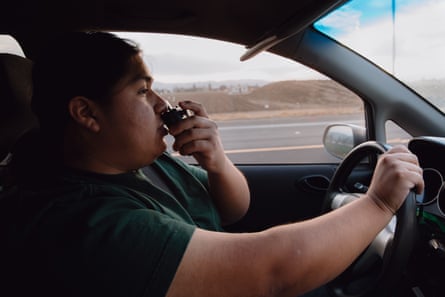
While most 18-year-olds worry about college papers and spring break plans, Cesar Vasquez drives through coastal California farm towns scanning for unmarked SUVs before dawn. He flips down his driver’s seat visor to look at a taped list of license plates he has already identified as Immigration and Customs Enforcement (ICE) vehicles, and jots down a few new ones he suspects could be. His phone buzzes constantly – tips from neighbors, text chains from volunteers alerting to ICE activity – all in an attempt to keep his community safe from being swept up in federal agents’ widening dragnet.
This is what organizing looks like for this son of undocumented immigrants. In his home town of Santa Maria, a small farming town on California’s central coast where over 80% of farm workers are undocumented, Vasquez has become both a crucial community lifeline and a known target of federal immigration enforcement.
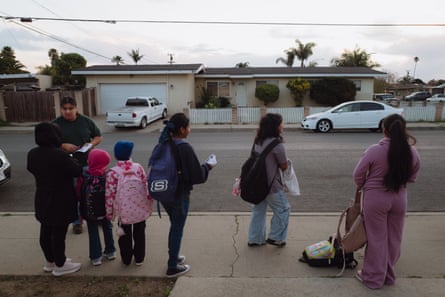
Outside the ICE office in Santa Maria, California, Cesar Vasquez and a group of activists gather to decide who will patrol each neighborhood.
Vasquez began volunteering with the 805 Immigrant Rapid Response Network as a high school senior. Last August, he was hired full-time as a rapid response organizer, covering North Santa Barbara and San Luis Obispo counties, overseeing volunteers, supporting families and tracking ICE activity.
Routinely, he visits the families of detained immigrants. “There have been so many occasions where I walked through the door, and a kid was expecting their father or mother,” Vasquez said wistfully. “And it was just me, and I had to explain what happened to their parents.”
Other times, for Vasquez, the reality is personal. He recalled in December, speaking with families waiting for news about their detained relatives outside the immigration enforcement office in Santa Maria, when an ICE vehicle slowed down in front of them. The agent’s voice crackled from the car’s speaker, loud enough to carry through the open window: “How’s your mother, Cesar? We’ll go visit her soon.”
Vasquez drove straight home and found his mother washing clothes.
“I took her car keys and told her to stop everything she’s doing. My hands were shaking,” Vasquez said. “I then moved her to a secret location that I have precisely for this moment.”
As the sun rises in Santa Maria, Vasquez continues monitoring ICE activity in his neighborhood. The 18-year-old says he spends more time in his car than anywhere else these days.
Growing up as a birthright citizen of undocumented parents
Vasquez’s mother is one of the thousands of undocumented farm workers in Santa Maria whom he is trying to protect. She left her home in a tiny town in Mexico to cross the US-Mexico border at age 13 in search of a better life. Vasquez’s biological father was one of the first people she encountered – a Guatemalan American whose family was settled in California and who held US citizenship. He was also abusive and never legally married her, keeping her from accessing US citizenship, Vasquez said. When Vasquez was an infant, his mother ran away with her three children to Santa Maria, a town about 150 miles (240km) north of Los Angeles, where she found work in the strawberry fields. She has been trying to secure documentation for more than a dozen years now.
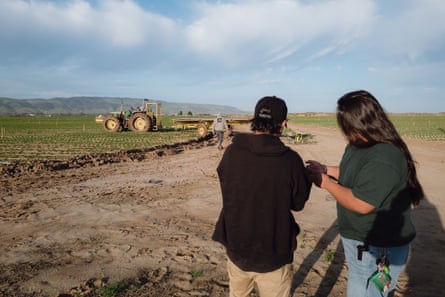
Vasquez distributes flyers on immigration rights to farmworkers in Santa Maria on 6 February.
Strawberry picking is physically demanding work, and the pay is minimal. Pickers spend hours bent over in the fields under the California sun, with no benefits, no sick days and no guaranteed work once the season slows between October and March. Climate change has made the labor even more precarious, disrupting growing cycles and shrinking paychecks. Rising costs of living – rent, food, transportation – have squeezed families further. In Santa Maria, where a two-bedroom apartment can cost $3,000 a month, many families crowd into single rooms or garages.
Built on an economy of strawberries, lettuce and wine grapes, Santa Maria has long depended on undocumented labor while rendering those workers largely invisible. Many arrived during waves of Mexican migration in the 1980s and 90s, settling into a community where immigration enforcement and workplace exploitation became routine. Before Donald Trump’s recent immigration priorities, ICE enforcement in the region tended to be more targeted – focusing on people with criminal convictions or referrals from local jails, rather than broad community sweeps. ICE didn’t even have a holding facility in Santa Maria until 2015.
But since 2025, enforcement has intensified dramatically with rapid‑response trackers documenting more than 620 immigration arrests across Santa Barbara, Ventura and San Luis Obispo counties, with Santa Maria often at the center of daily apprehensions. These high‑profile raids – often carried out with unmarked vehicles and tactical gear, drawing protests and criticism from community leaders – reflect a broader national surge in immigration enforcement under Trump.
Vasquez holds his mother along the river in Santa Maria. He keeps a feather with him, which he says brings spiritual cleansing when he burns sage.
When Trump was first elected, Vasquez was only nine years old. He was already well-acquainted with the repercussions of growing up in a mixed-status household.
“I mean, it’s common for most children of immigrants to be doing things for their parents like filling out their legal forms, right?” Vasquez said. “But in fourth grade, I had to learn what a warrant looked like and what rights I had.”
He was in a Halloween costume shop, age 14, when it clicked that his fears and concerns weren’t just his own. He overheard a woman at the register, saying she had saved all year to buy her son a costume, but it didn’t fit. The store wouldn’t take it back. Her shirt was stained with strawberries, her exhaustion visible. He’d seen his own mother do the same thing countless times, so he offered to buy the woman’s son the costume.
Building a network at 14
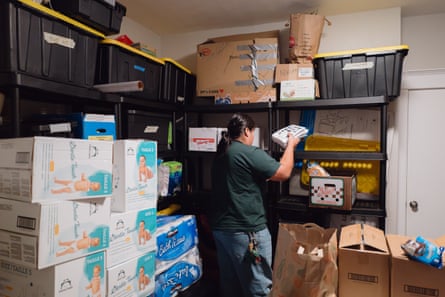
At age 14, Vasquez founded La Cultura Del Mundo, an entirely youth-led organization that eliminates what he calls the “red tape” associated with traditional aid. They prioritize direct, unrestricted support to families in need, asking, “How much do you need?” rather than requiring forms. The group then rapidly mobilizes whatever the family requests, whether that’s cash assistance, groceries, rent help or other essential support.
In August, La Cultura Del Mundo drew national attention when Vasquez organized La Marcha De La Puebla, a national protest against ICE raids that involved nearly 30 cities across 17 states, drawing about 10,000 participants.
Seventeen-year-old Claudia Santos is one of the many young people Vasquez has inspired. “My sister and I heard about a school walkout and just decided to go. After that, Cesar told us about a meeting at city hall, and that’s how I got involved,” Santos said. “I did it because I feel like the kids coming here from Mexico deserve a good future too.”
Vasquez packs up flyers to hand out to the immigrant community as they head to work in Santa Maria.
While Vasquez was organizing in high school, he was simultaneously struggling with his own mental health. He commuted by bus an hour each way to a school in a predominantly white neighborhood with good academic prospects.
When he told his counselor that he had anxiety, “she couldn’t understand that I was uncomfortable because I was brown in a white school, where the principal was racist and the students were racist. It led me to become really suicidal.”
Being misunderstood drove him closer to his community. He transferred to his local school and graduated early. Despite being accepted into San Diego State University, he deferred enrollment.
Most kids who grow up in Santa Maria look forward to leaving. One of Vasquez’s older sisters became a teacher in Los Angeles, the other a graduate student in the UK. But Vasquez likes that the impact of his work is immediate.
Tina van den Heever, one of his teachers from Santa Maria high school, said it was clear Vasquez was a leader with great potential: “To be honest, I worry about his safety, because as we’re seeing, the United States tends to silence people who stand up in the way that he does.”
‘I think about the kids being left behind’
During a four-day raid in late December, Vasquez’s uncle was among the 118 people detained.
“I think about the kids being left behind,” Vasquez said. “The children home for winter break whose parents never returned because of the December raids. And there was no way to know what happened to them because school didn’t reopen until days later.”
Vasquez distributes flyers on immigration rights to parents.
During the raids, flower vendors disappeared from the streets. When Vasquez later visited the area, the children of a family he had gotten close to told him they had gone inside after hearing his warning. They were safe.
The work – the constant alertness, the phone calls at all hours, the weight of knowing families depend on his network – has taken a toll. But he sees no alternative.
“I’m continuously preparing for the worst,” Vasquez said. He keeps a “to-go bag”, extra clothes and cash in his car.
Every time ICE picks up someone in the Central Coast valley, Vasquez plays the same song in his car: Hasta La Piel (Down to My Skin) by the Mexican American artist Carla Morrison. The lyrics speak to having and losing, wanting and not being able to say, intense love and desperate fear of loss – an homage to those who have been detained.
“They want us to be afraid,” he said. “But fear is what keeps people isolated.”
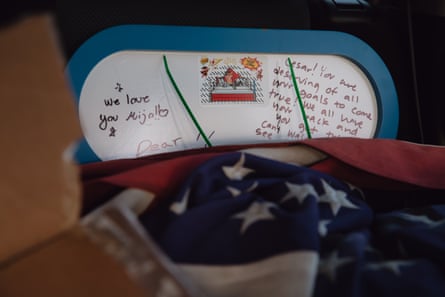
In the back seat of his car, a whiteboard filled with encouraging messages for Vasquez sits alongside an American flag.
Jennifer Chowdhury reported this story while participating in the USC Annenberg Center for Health Journalism’s Kristy Hammam Fund for Health Journalism
ICE nearly kills another child by mistreatment and ignoring their worsening health and healthcare needs. This is so familiar if you remember history. Lack of food, no healthcare, no humanity. Hugs
Children cry, thinking their parents will be taken if ICE follows them home. All because they are brown skinned. Is this the USA? Hugs








 Cesar Vasquez, who has supported families of undocumented immigrants since age 14, has become a community lifeline – and a known ICE target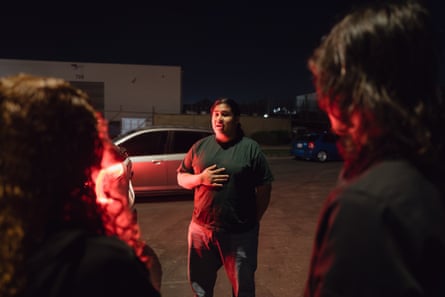


 Scottie's Playtime