I love Ethel and her way of presenting facts and reality. She points out that studies in high schools indicate that the rates of trans children are 3.+ and those questioning are 2.+. Plus she points out the reason more trans people are out is the same reason more gay kids came out in the 2000s, it was the left handed issue again. When being left handed became OK to admit more people admitted and openly lived as left handed. Despite everything, trans kids feel safer coming out in the US than ever before. Hugs.
More than two-thirds of adults oppose the construction of the massive and costly complexes used to power artificial intelligence, with a majority saying they’d prefer to have a nuclear power plant in their backyard instead. While women and men overwhelmingly expressed opposition, women did so more intensely. Out of 1,000 adults surveyed, 55 percent of women said they strongly oppose data centers, compared to 43 percent of men. In fact, men were more likely to favor data centers, citing their economic benefits and job opportunities.
Jeffrey Jones, a senior editor at Gallup and the study’s author, attributed the distinction to women having more empathy for public-facing issues like the environment and healthcare, and favoring Democratic policies that protect the environment. Resistance to data centers often focuses on the imposition of environmental and financial problems, like water scarcity, noise and air pollution, and excessive energy use that can result in higher utility bills and increased health complications for the low-income communities of color who live near where they are usually built.
“A lot of the opposition is based on environmental concerns about using too many resources, especially water,” Jones added. “Centers need a lot of water to cool the computing machines that they’re using. Land, electricity, and resources are the most common concerns people have.”
Gendered fears about the environment are nothing new, experts say. Women are disproportionately impacted by environmental degradation and at higher risk of poverty, food insecurity and gender-based violence when displaced by climate change, the United Nations reports. Studies have consistently shown that women are also key to driving inclusive, effective action to address the impacts of climate change.
“I’ve been organizing for 15 years, and it’s always been the case that women are leading our fights,” said Danny Cendejas, a campaign specialist for MediaJustice, who works with grassroots movements across the country that are opposing data centers. “We are definitely seeing everyone join the fight, but we have to recognize the truth, and it’s women, trans, queer and nonbinary people leading the work.”
Cendejas pointed to environmental justice movements in places like Memphis, Tennessee, and Amarillo, Texas, which have already been overburdened by environmental pollutants and health impacts from gas and oil industries. Those impacts are now being exacerbated by data centers.
“There’s a big connection where big tech is targeting Black, Brown and Indigenous communities,” Cendejas said. “The progress that has been made over the years to shut down coal plants or gain protections… a lot of that is being undone, by big tech and the demand for data centers.”
Data centers have become an increasingly pressing issue for candidates and their campaigns heading into the midterms in November. They’re also a rare source of bipartisan concern in a polarized political environment.
“There are really strong feelings about this. I see this playing out as a political issue, and now people who are running for governor, Senate, or local offices, are having to take a position on this, whereas this is not something people were talking about two years ago,” Jones said. “And now politicians across both parties are coming out as against data centers, which seems like the more popular viewpoint.”
During a House hearing on Wednesday featuring the Environmental Protection Agency’s Assistant Administrator for Water Jessica Kramer, Democratic Rep. Alexandria Ocasio-Cortez of New York held up jars of an opaque, brown liquid that she said had come out of a rural community east of Atlanta where Donald Trump got 70 percent of the vote in the last election. Meta has disputed the claim.
“This is the current drinking water in Morgan County, Georgia, right after a data center was constructed, the Meta data center was constructed,” Ocasio-Cortez said. “The only difference between the clean water and this was that data center.”
In New Mexico, first-time candidate Daisy Maldonado is running for county commissioner in Doña Ana County on a platform that includes opposition to Project Jupiter, a $165 billion mega data center under construction in the area. Maldonado was recently endorsed by Sen. Bernie Sanders of Vermont, a proponent of data center regulation, adding to the national conversation about community resistance to AI infrastructure and environmental accountability.
“I see a lot of moms concerned,” said Ana Carolina de Assis Nunes, a researcher at the nonprofit Data & Society Research Institute who studied Pittsburgh’s data center industry. “It’s very connected to ‘I want a good future for my kids and if things go this way, I don’t know what world we will have for them in 15 years.’”
To Nunes, the Gallup poll’s results serve as a reminder and reflection of the gendered impacts of AI in society.
“A lot of the interviewees we had in Pennsylvania, when it comes to developers, or people in government, are mostly men, but people who are activists and doing work on the ground, they are mainly women,” Nunes said.
NASHVILLE, Tenn. (AP) — A human smuggling case against Kilmar Abrego Garcia, whose mistaken deportation helped galvanize opposition to President Donald Trump’s immigration policies, was thrown out Friday.
Abrego Garcia’s deportation to El Salvador last year became an embarrassment for Trump officials when they were ordered to return him to the U.S. Abrego Garcia claimed that both the timing of the criminal charges and inflammatory statements about him by top Trump officials demonstrated that the prosecution was vindictive.
U.S. District Judge Waverly Crenshaw, ruling from Nashville, granted Abrego Garcia’s motion to dismiss for “selective or vindictive prosecution.”
Without Abrego Garcia’s “successful lawsuit challenging his removal to El Salvador, the government would not have brought this prosecution,” said Crenshaw, dismissing claims of “new evidence” against him.
In earlier court filings, Crenshaw wrote he had found some evidence that the prosecution against Abrego Garcia “may be vindictive.” The judge said many statements by Trump administration officials “raise cause for concern.” He cited a statement by then-Deputy Attorney General Todd Blanche that seemed to suggest the Justice Department charged Abrego Garcia because he won his wrongful-deportation case.
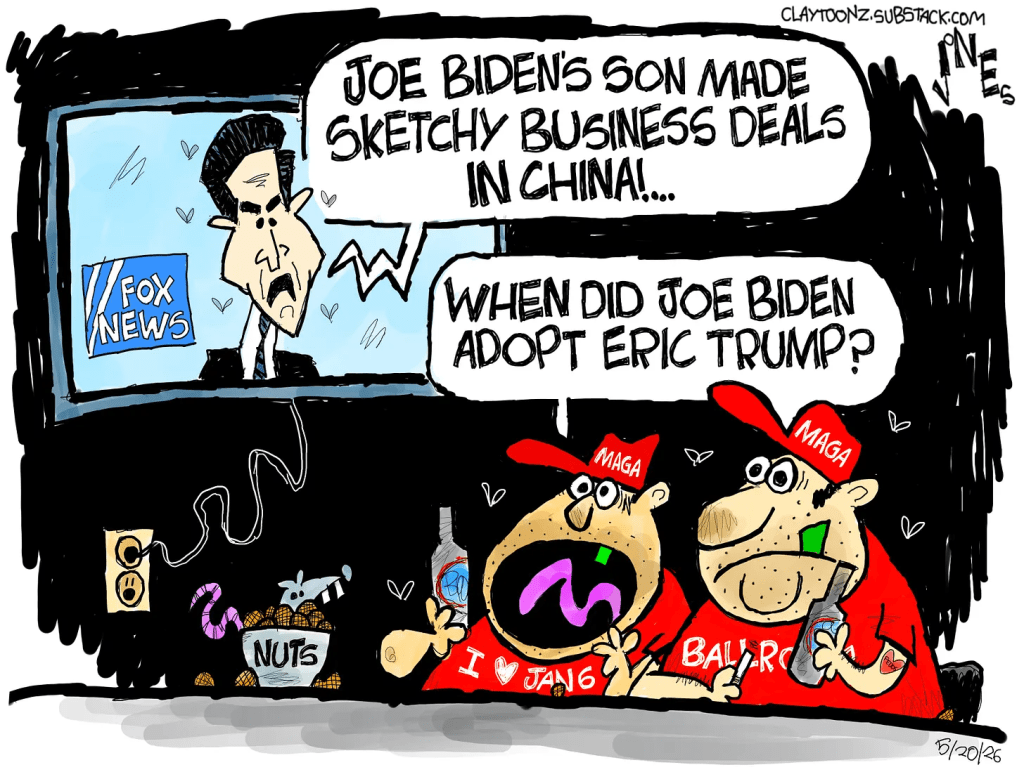
Eric Trump is threatening to sue Jen Psaki for a segment on her MS NOW show.
Psaki questioned on her show, The Briefing with Jen Psaki, if there’s a conflict of interest by Eric joining his father on his trip to China. She cited an article by the Financial Times that reported that Alt5 Sigma, a company with ties to Eric Trump, was pursuing a deal to build data centers in the US with a Chinese chipmaker that American lawmakers have warned is connected to the ruling Communist Party.
Presidents usually put a blind trust in charge of their finances while they are in office, but not Donald Trump. Instead of a blind trust, he has put Eric in charge of the family business. That does not prevent Donald from controlling his money, and in fact, he has been making a lot of trades and investments lately himself. Psaki pointed out that this arrangement with Eric was supposed to prevent conflicts of interest, “but there he is.” (snip-MORE)
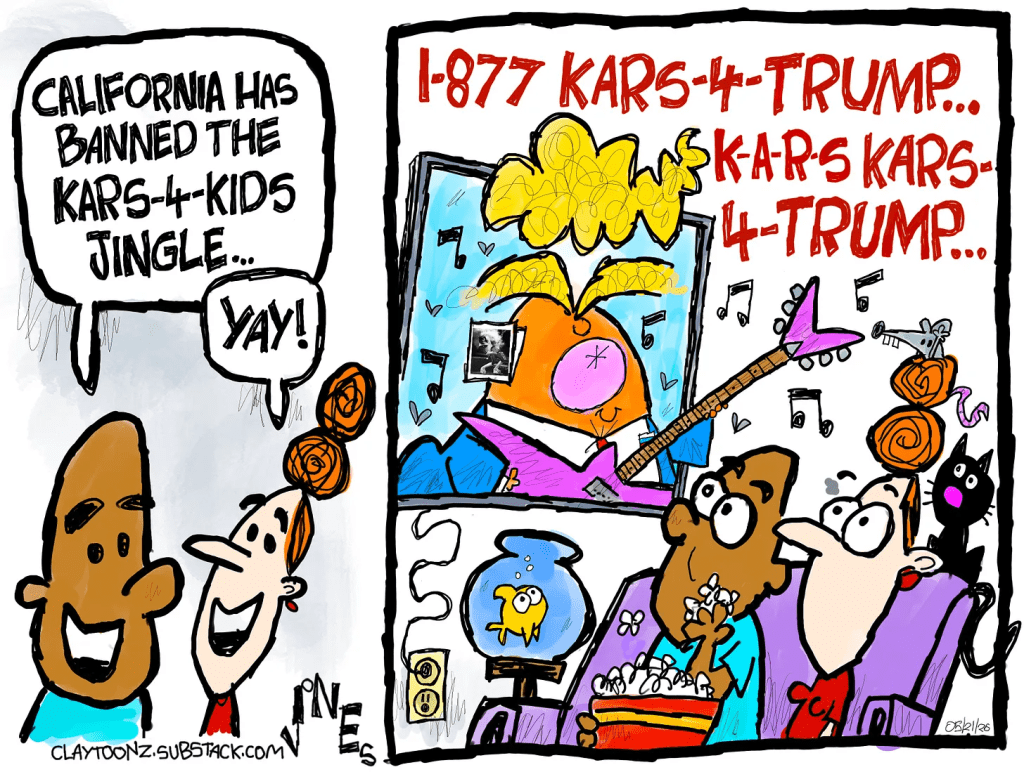
Usually, when someone tells you about a news item you may not have heard about yet, they’ll leave out some pertinent facts. When I first heard that California had banned the Kars4Kids jingle, the most annoying song in the world, they did not tell me why. I thought to myself that California couldn’t do that because of the First Amendment. Right? No one has banned Nickelback yet.
As it turns out, the supposed nonprofit group, Kars4Kids, has to stop airing its jingle in California because the judge found that it violated the state’s false advertising and unfair competition laws. (snip-MORE)
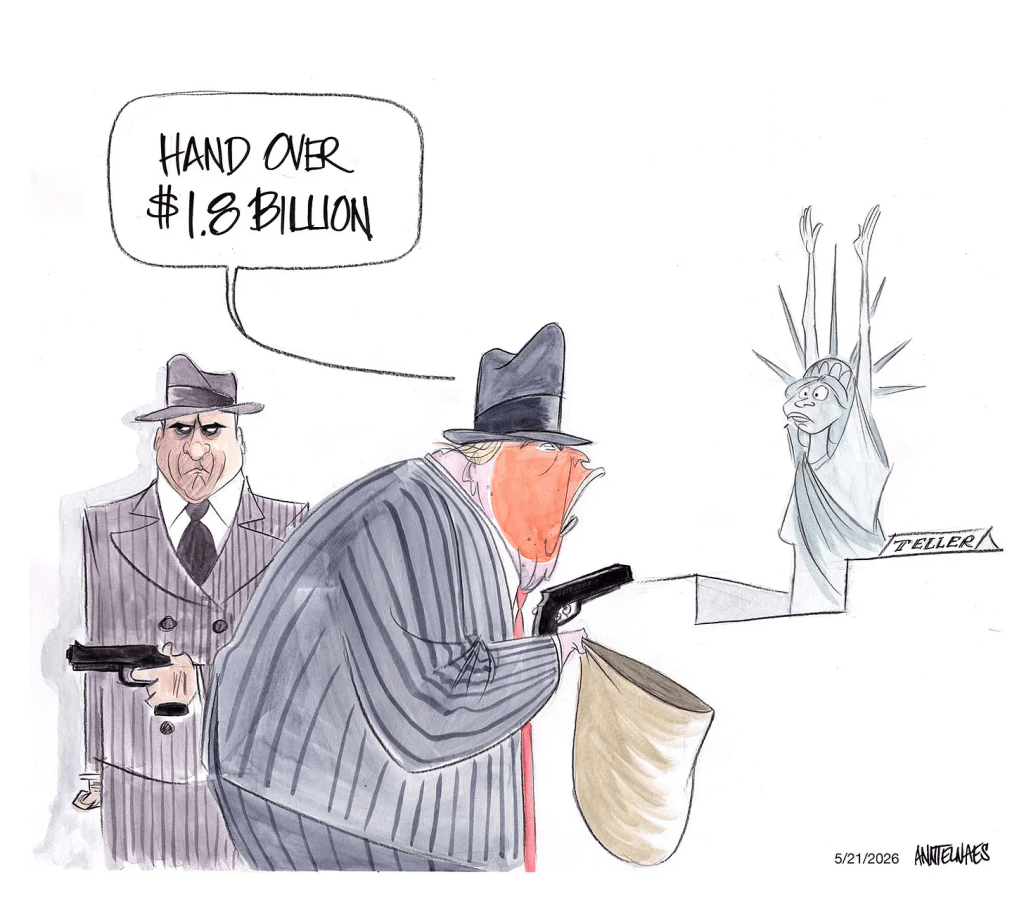
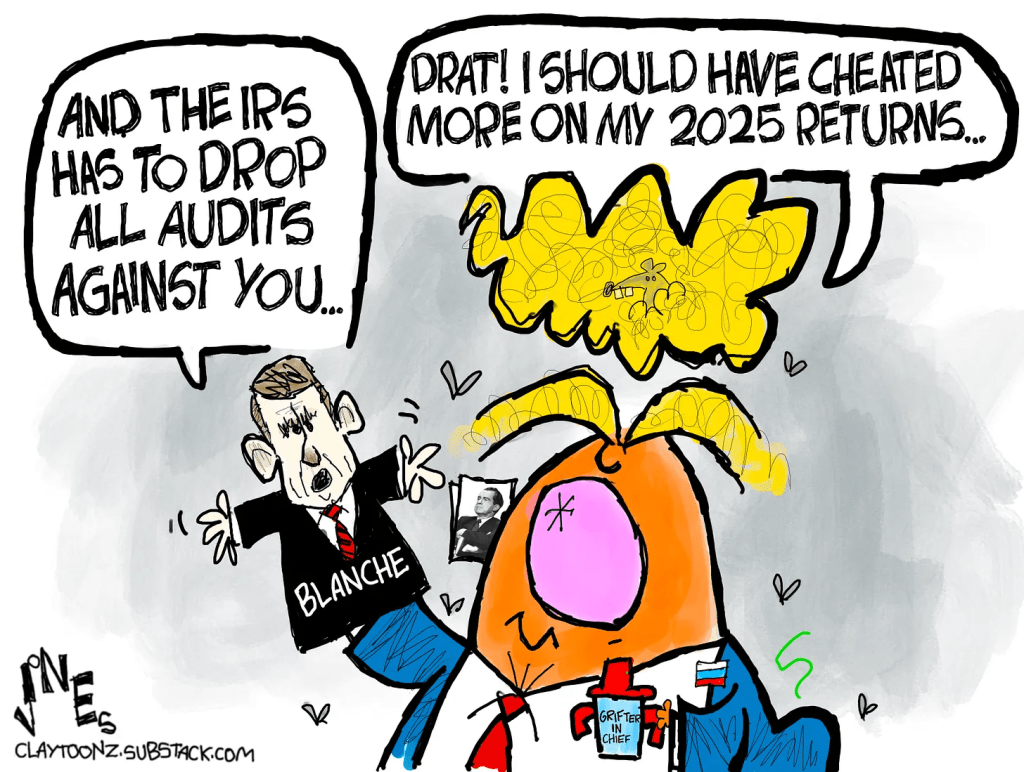
The $1.8 billion slush fund that the Justice Department is awarding to Donald Trump’s criminal allies is so blatantly corrupt that even Republicans can’t defend it. Some Republicans are so upset that they’re actually speaking out publicly against it.
Referring to acting Attorney General, Todd Blanche, and the fact that J6 terrorists are eligible for the so-called “anti-weaponization fund,” Mitch McConnell said, “So the nation’s top law enforcement official is asking for a slush fund to pay people who assault cops? Utterly stupid, morally wrong – take your pick.”
Senate Republicans derailed a massive immigration enforcement bill and left town until early today, despite Donald Trump ordering them to pass the $7o billion bill before June 1. How disgusting do you have to be to sicken sycophantic MAGAt Republicans? (snip-MORE)
And why judges should never be elected, but should be nominated by those who practice law, then confirmed by elected legislators and governors. All should be public so we the people know what and when it’s happening. When judges have to run for the bench, politics overtakes and minimizes law, tainting decisions.
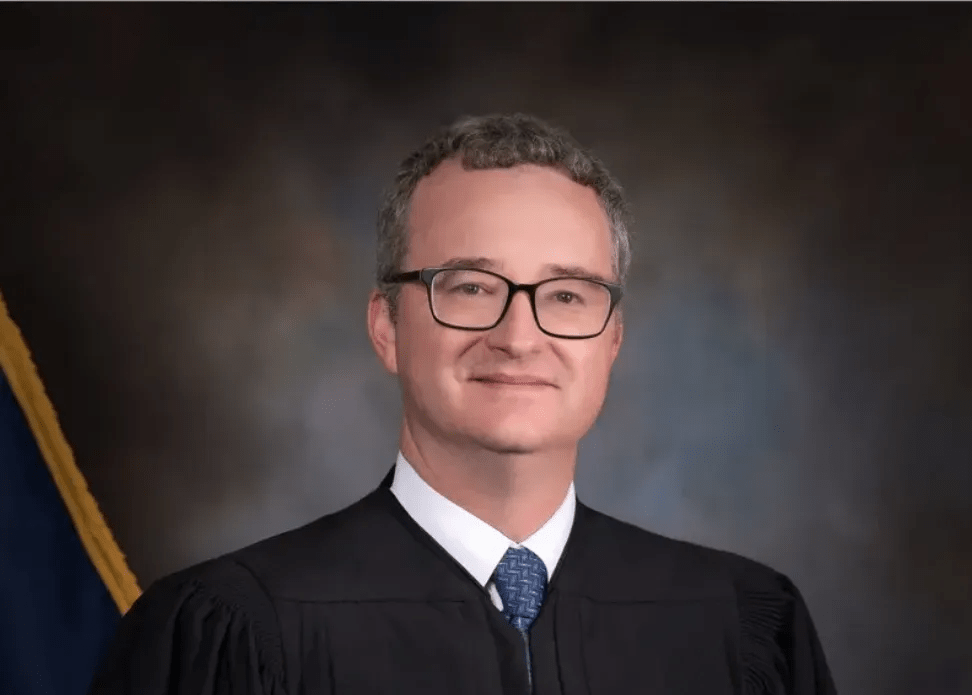
This weekend, a Kansas judge issued a scathing 117-page rebuke of the state’s ban on gender-affirming care for transgender youth—and in doing so, methodically dismantled the case against that care. In his ruling, Judge Carl Folsom III worked through the testimony of the state’s witnesses one by one, finding that its anti-transgender “experts”—routinely paraded by groups like the Alliance Defending Freedom, SEGM, and Genspect—offered opinions built on “cherry-picked information, conjecture, and research taken out of context,” and granting their testimony little to no weight. He then laid out 349 individual findings of fact, drawn from scientific evidence and the testimony of credible medical experts, documenting the safety and efficacy of gender-affirming care. He ultimately found that the ban likely violates the Kansas Constitution—which guarantees broader protections than its federal counterpart. That distinction matters enormously: because the ruling rests on state constitutional grounds, it is largely insulated from the U.S. Supreme Court and its decision in Skrmetti, which closed the federal courthouse door to these challenges but left the state one wide open.
“Allowing a transgender adolescent with gender dysphoria to experience their endogenous puberty when puberty blockers are medically indicated according to the Endocrine Society Clinical Practice Guideline is highly likely to result in irreversible physical changes that create enormous short- and long-term distress and gender dysphoria,” Folsom wrote. “Thus, there was substantial evidence that S.B. 63 not only fails to protect minors, but also endangers them, by prohibiting the use of GnRH agonists when medically indicated.”
Before weighing the evidence, the judge first had to determine who could credibly be considered an expert. Republican Attorney General Kris Kobach brought forward a litany of anti-trans witnesses familiar from litigation defending these bans. Among them was James Cantor, a Toronto psychologist who has built a career testifying for states defending care bans despite no clinical experience treating transgender minors—and who was once quietly dropped from a Florida Board of Medicine hearing after it emerged he had served on the advisory council of the Prostasia Foundation, a group that has worked to destigmatize pedophilia. Folsom wrote that Cantor “has not conducted any original scientific research on the efficacy or safety of gender dysphoria treatments,” and noted he is not licensed to treat anyone under 16 and has never diagnosed a minor with gender dysphoria. The judge then catalogued a record of self-contradiction: Cantor “stated that ‘peer-review is the line between acceptable and not’ but himself relied on non-peer reviewed sources,” cited systematic reviews while ignoring that “the authors of those reviews stated that their work should not be used to prevent the provision of gender-affirming medical care,” and “makes several statements which have no scientific support,” including that gender dysphoria might be a misdiagnosis of borderline personality disorder. “The Court gives Dr. Cantor’s testimony little weight,” Folsom concluded.
The judge turned next to Farr Curlin, a Duke University doctor and theologian who was an author of the Trump administration’s HHS report on pediatric gender dysphoria—a document authored anonymously by a roster of hate-group affiliates and career anti-trans activists, and which deadnames Christine Jorgensen, one of the first Americans to get gender affirming surgery. Curlin, Folsom noted, “is not a pediatrician, nor is he a psychiatrist or endocrinologist,” and “has never treated anyone for gender dysphoria.” Curlin testified that gender-affirming care is “ethically problematic”—but under questioning, the breadth of what Curlin considers unethical became clear. He believes that prescribing birth control for contraception is also “ethically problematic,” because “blocking the capacity for reproduction seems contrary to the purposes of health.” He believes in vitro fertilization is “ethically problematic” as well. He testified that when gender-affirming care reduces fertility, it “prevents the realization of the basic good of marriage, since sexual capacities make possible the one flesh union of marriage.” By his own admission, Folsom noted, Curlin’s views are “radically counter to current medical orthodoxy.” The judge found his opinions “appear motivated by his personal views as opposed to a methodology applicable in the field of medical ethics,” and gave his testimony “little-to-no weight.”
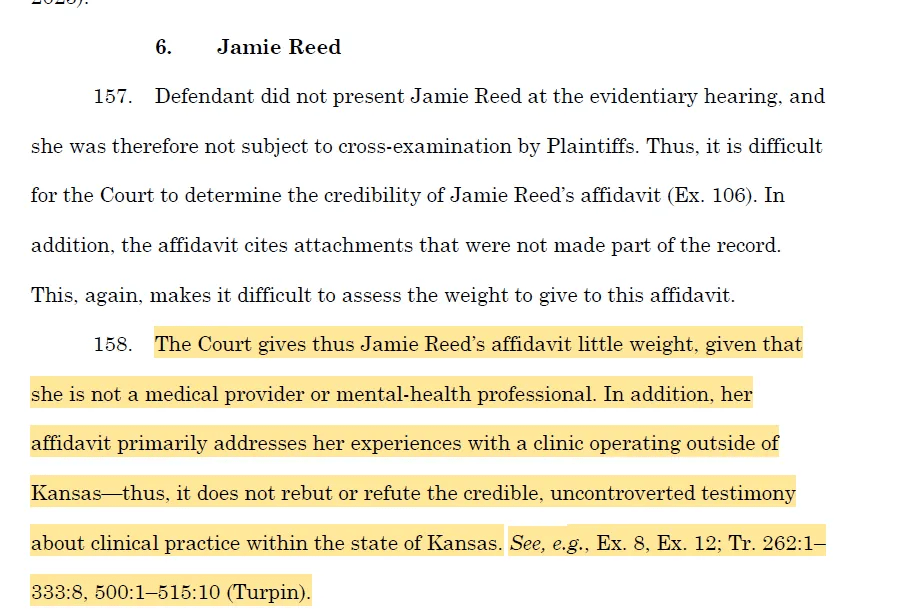
The judge also had pointed words for the state’s roster of prominent anti-trans activists. Chloe Cole, the country’s most prominent anti-trans detransitioner, testified about receiving care as a minor in California—but Folsom noted that Cole “admittedly did not receive care in Kansas,” and that the plaintiffs’ expert Dr. Angela Turpin testified the care Cole described “would not have occurred in Kansas” and would have been inconsistent with the clinical guidelines Kansas providers actually follow. Her testimony was given “less weight.” Corinna Cohn, another anti-trans detransitioner who has testified for care bans across the country and who has publicly denied that transgender people existed before 1939 or were victims of the Holocaust, did not appear at the hearing at all. The judge noted that Cohn’s affidavit described “care accessed as an adult” and treatment “in Wisconsin”—nothing to do with minors, or with Kansas—and gave it “little weight.” And then there was Jamie Reed, the self-styled “whistleblower” who built a national profile on lurid, largely unsubstantiated accusations against a St. Louis gender clinic and who has gone on Fox News to describe being transgender as a delusion. Reed also did not testify and could not be cross-examined. Folsom gave her affidavit “little weight,” and had scathing remarks towards her lack of expertise:
“The Court gives thus Jamie Reed’s affidavit little weight, given that she is not a medical provider or mental-health professional. In addition, her affidavit primarily addresses her experiences with a clinic operating outside of Kansas—thus, it does not rebut or refute the credible, uncontroverted testimony about clinical practice within the state of Kansas,” read the order.
Folsom then turned to set the record straight on the care banned by Kansas. Working through the testimony of the credible medical experts, he set out 349 separate numbered findings of fact, each documenting some component of what the science actually shows about gender-affirming care. Among them: that “the currently available body of medical research, as a whole, shows that gender-affirming medical care is effective at improving mental-health outcomes for adolescents with gender dysphoria,” supported by “over 20 scientific studies” finding the treatments “effective at alleviating gender dysphoria and improving a variety of mental-health outcomes, including anxiety, depression, and suicidality.” Folsom found that “for many adolescents, gender-affirming medical care provides significant relief from gender dysphoria and decreases depression, anxiety, suicidality, and thoughts of self-harm.” On the question of regret, the talking point most relied upon by the law’s defenders, the court found, based on the Kansas clinic’s own long-term follow-up data, that 99.2% of patients who received gender-affirming care “continue to identify as transgender into adulthood,” and that of the remaining 0.8%, “most did not regret the medical treatment they received.”
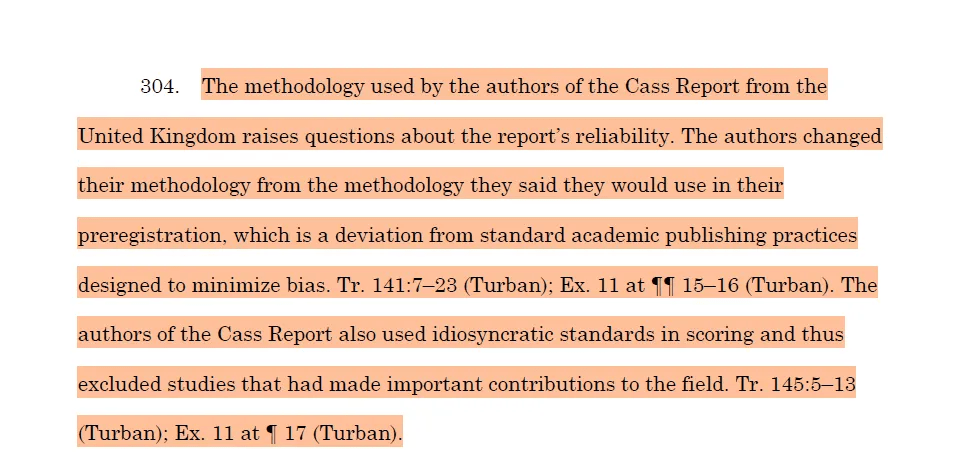
Folsom reserved some of his sharpest fact-finding for the Cass Review and claims over European care. The state’s experts pointed to systematic reviews from the United Kingdom, Sweden, Finland, Germany, and Norway as “proof” the science had turned. Folsom found otherwise. “None of these systematic reviews recommend categorically banning gender-affirming medical care for adolescents,” he wrote, and “the United Kingdom, Sweden, Finland, Germany, and Norway have not categorically prohibited gender-affirming medical care for minors”—as Kansas had. On the Cass Review specifically, Folsom found that its authors “changed their methodology from the methodology they said they would use in their preregistration, which is a deviation from standard academic publishing practices designed to minimize bias,” and “used idiosyncratic standards in scoring and thus excluded studies that had made important contributions to the field.” Far from recommending a ban, the court found, the Cass Report “reaches conclusions that are similar to those in the Endocrine Society Guideline and WPATH Standards of Care” and “concludes that there are young people who absolutely benefit from gender-affirming care.” On Germany, the state had the facts backwards: Folsom found that “Germany’s recent guideline endorses the provision of gender-affirming medical care”—a reference to the 2025 guidelines from 26 medical organizations across Germany, Austria, and Switzerland, the largest European medical consensus on transgender youth care ever produced.
The judge’s ruling rested on the Kansas constitution. Folsom found the plaintiffs likely to succeed on the claim that SB 63 violates the fundamental right of parents, guaranteed by Section 1 of the Kansas Constitution Bill of Rights, to make medical decisions for their children. Section 1, he wrote, quoting the Kansas Supreme Court, “protects the core right of personal autonomy—which includes the ability to control one’s own body, to assert bodily integrity, and to exercise self-determination” and “allows Kansans to make their own decisions regarding their bodies, their health, their family formation, and their family life.” Because SB 63 strips parents of that right, Folsom applied strict scrutiny, the most demanding standard in constitutional law, and found the state had failed to meet it. That reasoning was used recently before in Kansas politics for another issue. The same Section is what protects abortion rights in the state. In previous abortion-related decisions, the Kansas Supreme Court held that Section 1 secures “an inalienable natural right of personal autonomy”—language the court used to strike down abortion restrictions, and that Kansas voters chose to keep in 2022 when they rejected a constitutional amendment that would have stripped it away.
For now, gender-affirming care is legal again in Kansas. The injunction is temporary, blocking SB 63 while the case is litigated, and Attorney General Kris Kobach has said he will appeal, calling the ruling “a stark example of judicial activism.” But the appeal faces a structural problem. Because the decision rests entirely on the Kansas Constitution, the U.S. Supreme Court and its ruling in Skrmetti have no power to disturb it—a state’s highest court is the final word on its own constitution. And the Kansas Supreme Court, where the case is ultimately likely to land, has five of seven justices appointed by Democratic governors and has repeatedly upheld the same Section 1 personal-autonomy right that Folsom relied on here.
WASHINGTON (AP) — The Senate advanced legislation Tuesday that seeks to force President Donald Trump to withdraw from the Iran war, as a growing number of Republicans defied the president’s wishes.
Since Trump ordered the attack on Iran at the end of February, Democrats have forced repeated votes on war powers resolutions that would require him to either gain congressional approval for the war or withdraw troops. Republicans had been able to muster the votes to reject those proposals, but Louisiana Sen. Bill Cassidy — fresh off a primary election loss in which Trump endorsed his opponent — switched sides to deliver a crucial vote to pass the legislation.
The 50-47 vote tally demonstrated the small but crucial number of Republicans voting to halt the war with Iran. The legislation will get a vote on final passage, but the timing was not immediately clear.
Republican Sens. Rand Paul of Kentucky, Susan Collins of Maine and Lisa Murkowski of Alaska had all previously voted for similar war powers resolutions and did so again Tuesday. Cassidy voted for the legislation for the first time.
After his primary election loss last week, Cassidy returned to Washington saying that he was proud of his work to uphold the Constitution and would carefully consider how he would vote on several priorities of the Trump administration.
It’s horrifying that these Jewish settlers who want to eradicate entirely the Muslim population. One woman described Islam as a cancer and wants the Islamists killed or reeducated. Muslims who own businesses can’t even open their shops. But there is a small minority trying to protect the arabs. Hugs
Last week I flagged that oral argument was set in the D.C. Circuit for this past Thursday in the combined challenges filed by four law firms against Trump’s executive orders seeking to keep them from conducting much of their business. All four firms won in the lower courts. Based on the panel’s reception, they seem on track to do it again.
These cases are highly significant because they go to the heart of a major abuse of executive power: Trump’s insistence that he has the ability to put entities that oppose him out of business. Former Solicitor General for George W. Bush, Paul Clement, representing the firms, argued that Trump’s executive orders “run afoul of the better part of the Bill of Rights.” Not just one or two provisions, mind you, but “the better part.” He argued that they threaten the right to counsel, the separation of powers, and the rule of law.
Clement explained, “The executive orders here strike at the heart of the First Amendment and the ability of lawyers to zealously represent their clients. Lawyers cannot zealously represent their clients while walking on eggshells for fear of reprisals; thus, the executive orders strike at the heart of the rule of law and the zealous representation on which the judiciary and the adversary process depend.” That seems entirely clear. It could even be possible that firms might avoid representing certain clients—one of Trump’s early attacks was on Covington and Burling, a D.C. firm that gave advice to Jack Smith, the special counsel during the Biden administration who oversaw the two prosecutions of Donald Trump.
Clement also explained the headlock Trump had put firms in: “I either keep my security clearance, or I can sue the Trump administration, not both.” For many defense firms, the ability to obtain a security clearance is essential to doing certain types of work. Trump’s orders purported to remove those clearances for lawyers at firms that ran afoul of him. He also tried to suspend active government contracts and prevent attorneys who worked at the interdicted firms from entering government buildings, including federal courthouses. As we discussed here, it was always going to be a nonstarter because the orders, if permitted to go into effect, would allow a president to pick and choose which attorneys could continue to make a living and put ones he didn’t like out of business.
During argument, the panel seemed unpersuaded that the executive orders were discretionary national security decisions made by a president that aren’t subject to review by the courts. If the case makes its way to the Supreme Court, Trump will undoubtedly argue that the district judges who first considered the case were biased. Assuming Trump loses at the Court of Appeals, the Supreme Court could take the case on appeal, but is not obligated to. For instance, Judge Richard Leon, one of first district judges to consider a law firm executive order case, is also the judge who issued a preliminary injunction halting construction of Trump’s ballroom, finding that the president is the “steward” of the White House and not the “owner,” and that Trump had no statutory authority to proceed, absent authorization from Congress. So prepare yourself for meritless arguments about judicial bias if Trump suffers a loss here. There is no way of predicting how long it will take the court to rule, and the administration is enjoined from putting the orders into effect while the cases are being litigated.
Closing the loop on mifepristone
With only two justices, predictably, Thomas and Alito, writing in dissent, the Supreme Court has prevented Louisiana’s law, which would make mifepristone unavailable via telehealth, from going into effect while the litigation moves forward.
It’s not skeptical to question whether this happened because the Court is well aware of the risk of agitating voters in advance of the midterm elections.
Trump is hyperfocused on trying to salvage the November election despite his sinking performance in the polls.
We always knew that, backed into a corner, Trump would become ever more willing to damage democracy to save himself. It’s on.
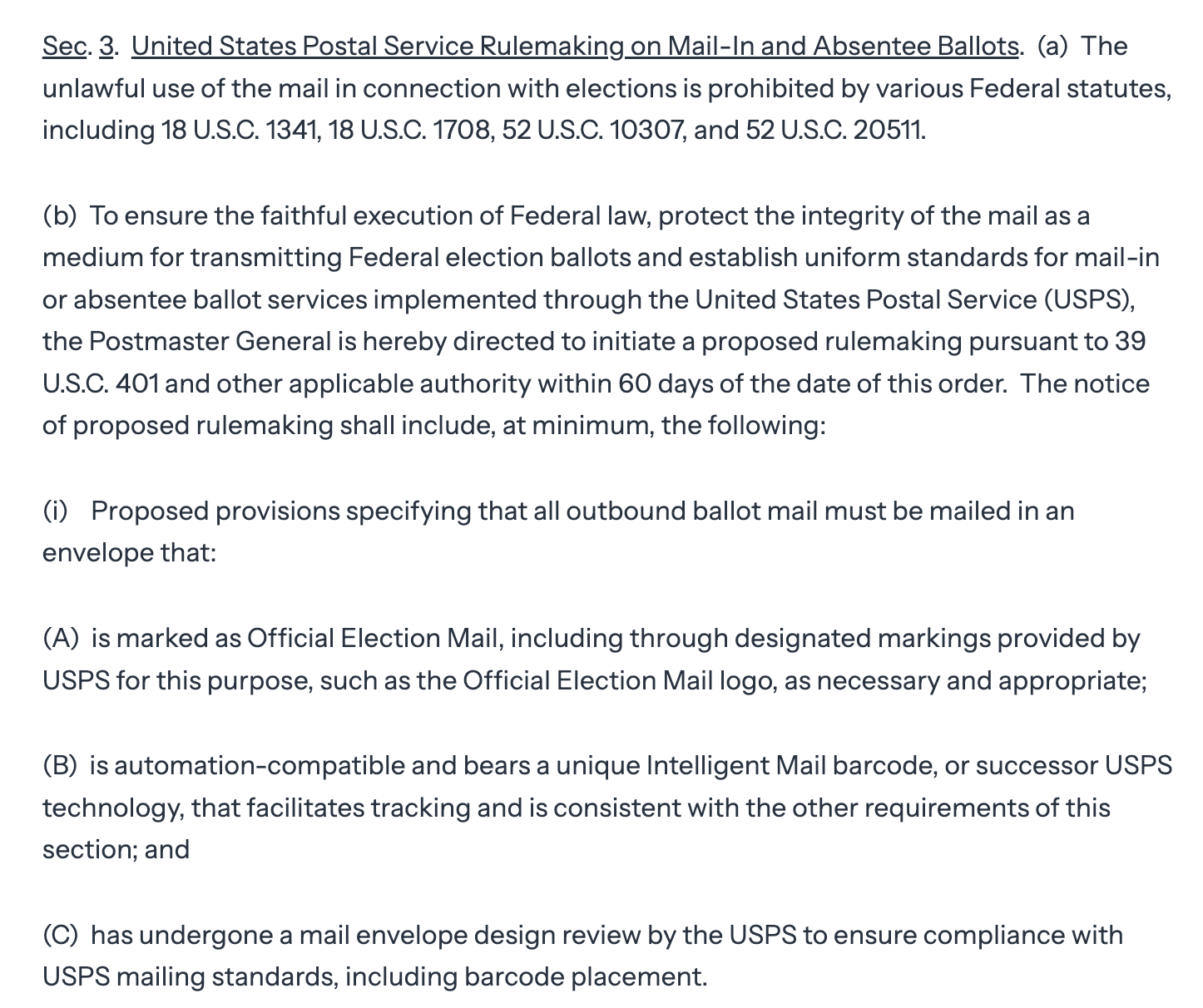
NOTUS is reporting that meetings are being held, out of the public eye, between the White House, DOJ, DHS, and the Postal Service to try and interfere with the election. The goal seems to be building a national voter database that can then be used to determine who can and can’t vote—which is up to the individual states—and implement Trump’s order that the Post Office should interfere with mailing ballots.
The report in NOTUS included comments from an unidentified White House staffer speaking on background, who declined to acknowledge that the conversations were taking place, but did say that “it is standard process for administration officials to coordinate on implementing President Trump’s executive orders. We do not comment on private meetings that may or may not have happened.” That’s as good as a yes.
Trump’s executive order directing USPS to interfere in state-run elections is under challenge in court. At a hearing last week, DOJ argued that the court can’t act because the issue being raised is an “abstract legal question unless and until the Postal Service actually issues a rule that injures the plaintiffs and it does so only because it was directed to by the president — rather than, for example, as an exercise of the agency’s own independent judgment.” Judge Carl Nichols seemed inclined to buy that argument at one point in the hearing, asking how there could be irreparable injury, which he must find before he can enjoin the executive order, when no action has been taken as of yet. But at other points in the hearing, he pushed the government on the constitutionality of the president’s executive order.
We’ll watch carefully for a forthcoming ruling in this case, which will tell us a lot about whether the courts will entertain presidential interference in each state’s administration of its own election. But the White House is making its position clear.
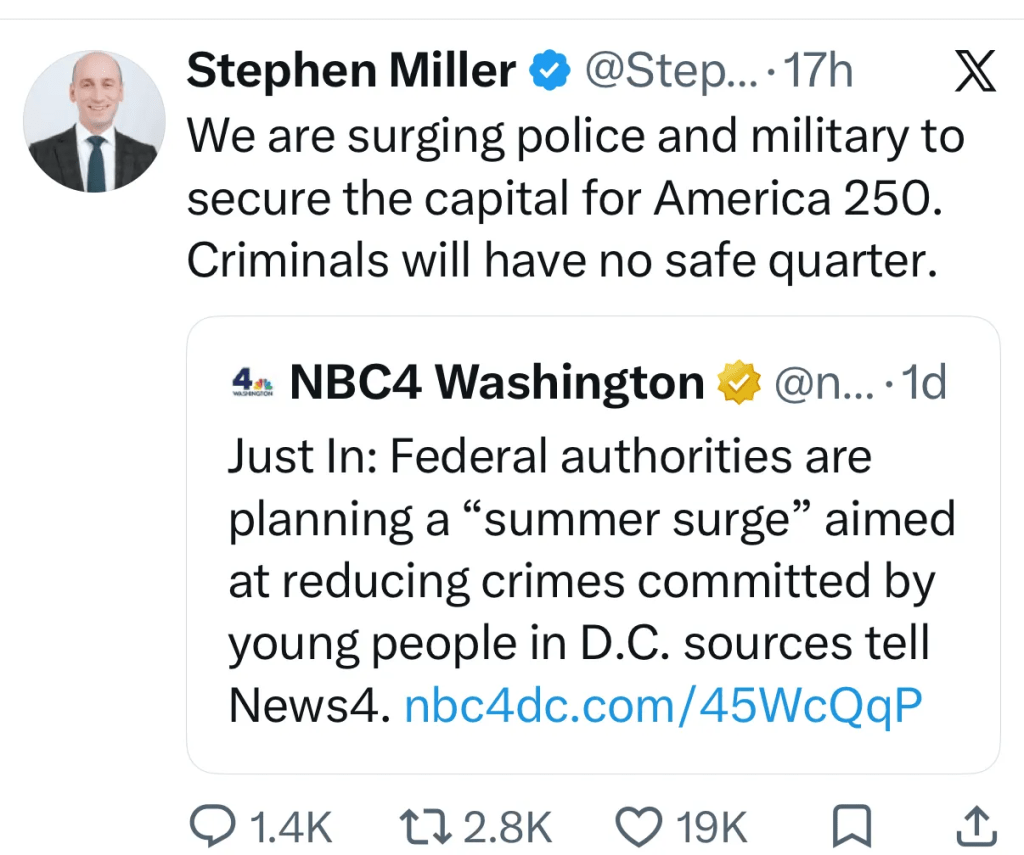
Stephen Miller, who it’s always worth noting is not a lawyer and doesn’t seem to appreciate what the Constitution says, seems to be continuing to look for a new way to militarize the country for reasons that don’t hold water in advance of the election. We’ll take up the issue of the illegality of sending federal troops or federal agents to the polls first breather we get.
Also …
On Wednesday, the state of Tennessee has a court date to defend itself against the NAACP’s allegations that it cannot, without violating state law, redraw its voting maps this late in the decade.
On Thursday, SCOTUS will be issuing more opinions.
By Friday, the Government has to produce discovery to the defendants in the Minnesota church protest case against Don Lemon and individual protestors who were indicted for violating the FACE Act. A judge ruled that heavily redacted discovery that prevents the defendants from identifying witnesses, including members of law enforcement, so they can prepare their cases violates the law. He has given the government until Friday to rectify its errors and “produce discovery consistent with its Rule 16(a) obligations, unredacted as to all victim and witness names, addresses, and telephone numbers; as well as fully unredacted as to law enforcement PII [personally identifiable information]” to every defendant who has agreed to abide by a protective order preventing its public dissemination. The government’s case has been widely viewed as likely violating the First Amendment from the outset.
Next up on the list of bad cabinet secretaries
Agriculture Secretary Brooke Rollins is being sued for violating employees’ right to be free from establishment of religion by the government. She’s been proselytizing in emails to the captive audience that is her workforce.
I recall once handling a case where a public employee was being subject to far less overt religious commentary, and the government agency immediately conceded error and fired the offender. This case is even more clear. Government employees are not disciples of Christ.
In new federal lawsuit, employees accuse Agriculture Secretary Brooke Rollins of "sending increasingly proselytizing communications to the entire USDA workforce, promoting her own preferred brand of Christian beliefs and theology to the captive audience of employees"
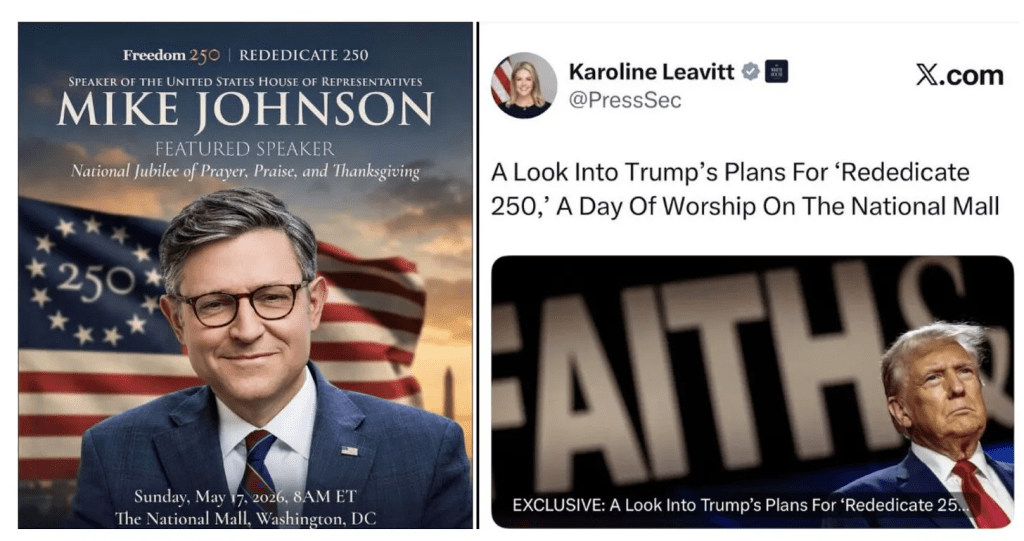
But don’t hold your breath for the president to fire her. This was a weekend characterized by a full-scale display of support for Christianity being promoted by the White House. The administration held a “Rededicate 250,” which many observers, both approvingly and disapprovingly, referred to as a Christian religious service featuring high-ranking government officials on the National Mall.
Rededicate 250 was “a White House-backed prayer festival dedicated to America’s Christian roots.” Trump gave a video speech. Speaker Mike Johnson, Secretary of Defense Pete Hegseth, and Secretary of State Marco Rubio were present, standing with evangelical leaders on the stage. Johnson told the crowd, “Our founders boldly proclaim that our rights do not derive from the government. They come from you, our Creator and Heavenly Father.”
Podcaster Brian Allen posted this snippet from MAGA radio host Eric Metaxas’ speech at the federally funded prayer event on the National Mall today: “It’s hard to believe that it would take two centuries for the Lord to raise up a great man to bring that ballroom finally to stand where it needs to stand. It’s extraordinary. We only had to wait two hundred years.”
As Allen put it, Metazas “told a crowd of thousands of Christians that God spent two centuries waiting to raise up Donald Trump — to build a ballroom.” The crowd responded by cheering.
The only way to overcome this sort of thing, a clear violation of the Constitution, is with a relentless commitment to telling the truth and sharing it widely. We know from Trump’s poll numbers that some of it is breaking through. The utter lunacy of the Christian God wanting a ballroom is something to ask people to stop, and instead of just following like sheep, spend a moment thinking about.
More Kleptocracy
Bloomberg is reporting that Trump’s disclosure forms for the first quarter of 2026 show that he made 3,600 Stock trades, and that they are worth as much as $750 Million (the reporting is done in bands, so it’s impossible to determine the exact amount from the forms). Former Undersecretary of State Rick Stengel pointed out that Bush and Clinton kept their assets in a blind trust and neither Obama nor Biden traded stocks or bonds while in office.
“3,700 trades,” Stengel tweeted, “is probably more than all the trades of all the presidents until now. And he is trading stocks that are affected by his decisions. A walking conflict of interest, at the least, and perhaps insider trading. Just as members of Congress should not be able to trade stocks, so too the president.” Stock trades aren’t official acts; they’re clearly personal ones. Stengel has certainly identified reasons that merit a closer look at these trades.
So, lots happening this week. We’ll be here through everything as we head into the Memorial Day weekend, trying to make it make sense. I’m grateful to all of you who spend part of your week here with me, thinking carefully about the law, democracy, and where we go from here. Thank you for being a part of Civil Discourse.