Kavanaugh claims the court does the same for every president not just tRump. The facts don’t show that to be true. tRump has a near perfect record of the court giving himwhat ever he asks for, while Biden was often either denied a chance for the court to rule or the court ruled against him often having to ignore precedent and prior rulings to do so. Either tRump has compromising material on the right wing justices or they are ruling based on poltical idology and racism. Hugs.
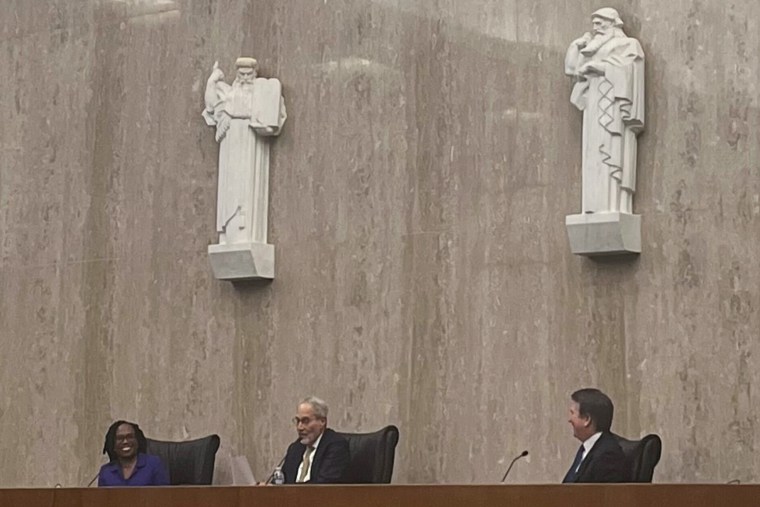
Liberal Justice Ketanji Brown Jackson and conservative Justice Brett Kavanaugh disagreed about frequent rulings in favor of the Trump administration at a rare joint appearance.
Supreme Court Justices Kentanji Brown Jackson, left, and Brett Kavanaugh.AP; Getty Images
WASHINGTON — Internal Supreme Court divisions over how the high court has frequently ruled in favor of the Trump administration in emergency situations spilled out into public Monday with liberal Justice Ketanji Brown Jackson and conservative Justice Brett Kavanaugh locking horns.
The court’s conservative majority has on a regular basis blocked lower court rulings that have stymied President Donald Trump’s agenda, sparking criticism from within and outside the judiciary.
Jackson, often a vocal dissenter in those cases, forcefully aired her critique of the court’s actions in a rare public appearance with Kavanaugh at an event for lawyers and judges held at the federal courthouse in Washington.
Bemoaning the recent increase in such emergency filings — requested to challenge lower court rulings — she suggested that the number of filings would drop if the court were stingier about granting them.
The procedure has become known as the “shadow docket” because the court rarely hears arguments and often issues terse decisions with little explanation. The Supreme Court decisions can allow policies to go into effect at early stages in legal challenges, long before lower courts have reached any definitive conclusions. The casesmight then return to the Supreme Court later in the process, leading to final decisions on the merits.
In the last year, the court has, among other things, allowed Trump to fire thousands of federal workers, assert control over previously independent federal agencies and implement various aspects of his hard-line immigration policy. All those moves, done through the shadow docket, had been blocked by lower courts.
“I just feel like this uptick in the court’s willingness to get involved … is a real unfortunate problem,” Jackson said. Among other things, it affects how lower court judges approach cases, as they already have a preliminary sense of how the Supreme Court might approach them on appeal, creating “a warped kind of proceeding,” she added.
Jackson and Kavanaugh during introductions at the beginning of Monday’s event.Lawrence Hurley / NBC News
“It’s not serving the court or this country well,” Jackson said.
Kavanaugh, usually in the majority in shadow docket cases, defended the court — as he has done in the past — saying it has to act one way or another when the government or another litigant files an emergency application.
Kavanaugh noted that the increase in government applications is not unique to Trump, saying the court also granted similar requests made by the Biden administration, albeit at a lower rate.
The reason successive administrations have rushed to the Supreme Court is that presidents have relied more on executive orders in recent years because of the difficulty of persuading Congress to enact legislation, and those actions are often challenged in court, he said.
The justices have aired their disagreements in written opinions, but this was a rare example of two justices entering into a public debate about internal court business.
“None of us enjoy this,” Kavanaugh said of the shadow docket trend, noting that the court has opted in some cases to hear oral arguments and issue longer written rulings in response to some of the criticism.
“We have to have the same position regardless of who is president,” he added, a statement that Jackson expressed agreement with.
Responding to questions posed by Washington-based Senior U.S. District Judge Paul Friedman, the justices were otherwise mostly on the same page during the hourlong event.
In particular, they both expressed concern about the increase in violent threats against judges. Recently, judges who have ruled against Trump have been regular targets.
“There’s no easy answer, for sure,” Jackson said. “It’s unfortunate because it relates to a lack of understanding about judicial independence.”
Kavanaugh praised Chief Justice John Roberts, who he said had “picked his spots” to push back against the criticism.
Roberts, for example, put out a statement rebuking Trump and his allies for suggesting judges should be impeached for ruling against the administration. One of the judges some Republicans want to impeach, Chief Judge James E. Boasberg of Washington, D.C., was among those at Monday’s event.
I emailed this to me on Sunday, but have only just gotten back to it to post here. My apologies on that, but it’s been both busy and stormy here! Anyway, I haven’t heard anything about the status of this; I hadn’t heard anything about it at all until I read it in Kansas Reflector. With no further ado:
LAWRENCE — Kansans won’t know until at least Tuesday if a judge will delay implementation of the state’s new “bathroom law,” but a concession by Attorney General Kris Kobach means key components of the law can be delayed until March 26.
Douglas County District Judge James McCabria heard arguments Friday about Senate Bill 244, the controversial new law that forces people to use bathrooms in government buildings and gender markers on driver’s licenses based on sex assigned at birth.
The three-hour hearing focused on technicalities, including whether the law meets any one of five specific criteria that would lead the judge to approve a temporary restraining order and pause enforcement of the law for up to 14 days.
Attorneys with the American Civil Liberties Union and the Kansas Department of Administration said the law’s speedy implementation provided no grace period to Kansans needing a new driver’s license and for government leaders statewide to put a system in place for tracking bathroom usage.
The law took effect Feb. 26, a little over a week after the GOP-led Legislature overrode Gov. Laura Kelly’s veto. Kansans who held driver’s licenses with a gender marker that didn’t match their sex at birth were told their licenses were immediately invalidated and government leaders statewide were told they had to immediately enforce the bathroom portion of the bill.
Kobach told McCabria he agreed to give Kansans who needed to update driver’s licenses until March 26 to complete that. He also said he wouldn’t enforce the law’s penalties — which could be as high as $125,000 per day for violations — for cities, counties, municipalities and schools that might violate the bathroom rules, as well.
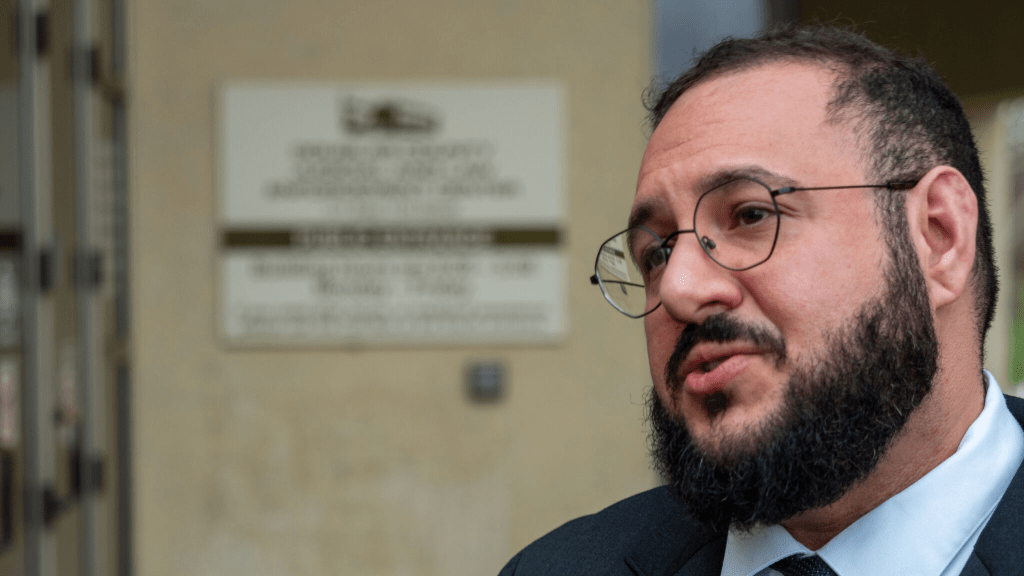
Harper Seldin, senior staff attorney for the American Civil Liberties Union, talks to reporters after a Douglas County District Court hearing on March 6, 2026. Seldin asked the judge to place a temporary restraining order on the state to stop implementation of a new law that forces Kansans to use bathrooms and have documentation in their biological sex at birth. (Photo by Sherman Smith/Kansas Reflector)
Harper Seldin, an ACLU attorney representing the two Lawrence transgender men who brought a case against the law under pseudonyms Daniel Doe and Matthew Moe, told the judge the law violates the Kansas Constitution.
SB 244 infringes on the rights of personal autonomy, expectations of privacy, and equal protection under the law, and has other issues, he said.
“The attorney general is incorrect when he says that we’re asking the court to break new ground,” Seldin said. “This is not a novel set of theories that require the government to do anything. The thread through these individual rights claims is that this is about Daniel and Matthew’s right to be left alone by the government.”
Seldin also said the law targets transgender individuals, which can be shown by the results of its implementation even if it’s not stated outright. He said the way SB 244 was implemented violated the Kansas Constitution when the bathroom portion of the bill was “logrolled” into the bill that originally addressed driver’s license and birth certificate gender markers.
Logrolling refers to dropping a bill into an unrelated bill, sidestepping the opportunity for public input. Seldin said cramming two separate subjects into one law violates the Kansas Constitution, which has a “single subject” clause.
Kobach said the two issues are congruent in that they both deal with defining sex within Kansas government.
“It’s this idea that bills should mean what they say and say what they mean,” Seldin said. “There’s a particular perniciousness to a law that hides the law.”
Kobach told the judge that a driver’s license is a government document, used for government purposes, and the state has the right to define the information contained in the document.
McCabria questioned Kobach about briefs included in the plaintiff testimony outlining the negative psychological effects on transgender people being made to use documents that don’t match their gender identity.
“Whatever a person may feel about their need to be perceived by the world in a certain way, what right do I have to compel the government to identify me in that way?” McCabria asked.
Kobach said the driver’s license is a document that records pertinent information, and sex is one of the elements, along with eye color and birthdate, that doesn’t change over time.
Kobach said the bathroom portion of the bill maintains the status quo in Kansas, where he contended residents have always gone to the bathroom that matches their biological sex at birth.
Seldin said trans people in the state have been going to the bathroom without any harms for decades.
Kobach said women who hear a man’s voice or see a man in private spaces could become anxious about their safety.
He acknowledged plaintiff’s assertions about the psychological or emotional harm they may suffer but told McCabria that in a balance of equities, that didn’t outweigh the harms of “99-plus percent of the population.”
When McCabria asked him to substantiate that number, Kobach said he didn’t mean to imply that everyone outside of transgender individuals were harmed by the law.
“Many courts have recognized the fear that ‘biological females’ have when a ‘biological male’ is in the bathroom with them, and that is something that I think any Kansan can identify with, especially a female,” Kobach said after the hearing.
Asked how women would be affected by seeing or hearing a transgender man who now has to use a woman’s bathroom, Kobach said, “All kinds of hypothetical cases are possible.”
McCabria said he had hoped to make a ruling Friday but that he needs more time to study the filings in the case and examine constitutional issues. He said he expects to rule by Tuesday.
“I think most people want to be respectful,” Seldin said after the hearing. “I think most people don’t want to pry into other people’s private lives. I think a law like this suggests the opposite, that Kansans have some prurient interest in other people’s habits and private spaces. And I don’t think that’s right.”
Z Kemp attended the hearing because her partner and many friends are affected. She said the law has caused “a lot of stress and anxiety.”
“That’s just unnecessary because as they’ve stated before, there was — especially with the bathroom situation —- no prior problem,” she said. “It’s only a problem whenever you make it a problem. I don’t think it’s that radical to just let trans people be. Just let them go to the bathroom.”
Avie Fallis said she has been through a lot of physical and legal changes to find herself. She said she is tired of well-meaning people recommending that she leave Kansas, which is her home state where her family and loved ones live.
“I feel like it’s a fire that’s just growing,” she said. “I’m not going to run away from fire. I feel like it should be extinguished.”
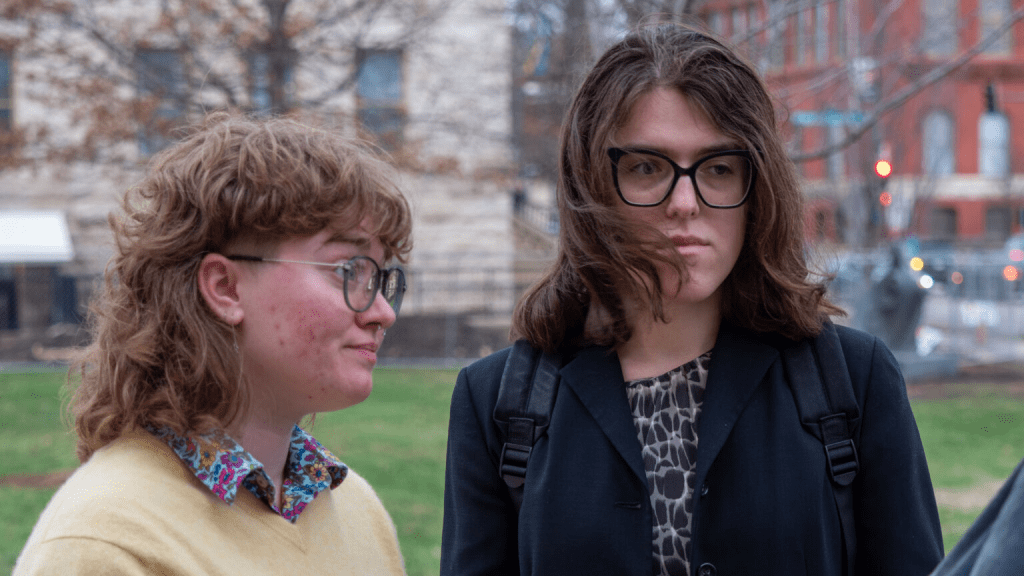
Z Kemp, left, and Avie Fallis attended a Douglas County District Court hearing March 6, 2026, about Kansas’ new law because it affects them and their loved ones. The law forces people to use the bathroom related to their biological sex at birth and to put that sex marker on their driver’s licenses and birth certificates. (Photo by Sherman Smith/Kansas Reflector)
Amazing news! We were in the middle of of a zoom press conference about the Gas Suffocation aspect of the planned execution of Sonny Burton in Alabama on Thursday when a reporter put into the chat:
“Did you see that Governor Ivey just commuted Burton’s sentence?”
And with that, the news was broken. Governor Ivey heard YOUR messages, received YOUR petitions, read the articles YOU sent, heard YOU ringing her phone off the hook, heard us tolling our bell outside her house…. and she acted. Amen! THANK YOU!
Once again, this proves, sometimes, our united efforts work!
Congratulations to Sonny and his legal team, his family, and to all who had a hand in creating this moment!
Governor Ivey has declared that “All Life is Precious,” which is why we made sure to bring along our 4×10 foot banner to the 24-hour vigil we helped coordinate in front of her house a few weeks ago. The banner could not be missed from any street-facing window of the Governor’s mansion. We know with certainty that the Governor was there…. NOW we know that she heard our message!
The other good news is that now we don’t have to drive all the way to Alabama. In fact, we had planned to go to Texas fiirst to toll the bell outside the prison in Huntsville at the execution of Cedrick Ricks on Wednesday, which is still on. Without our planned return through Alabama, making such a long drive makes less sense.
As you know, everything we do to support local activists working to halt executions is another expense. It’s not just the costs of being on the road that we must cover, but also the overhead…
The four full time staff and our media consultant who do the behind-the-scenes work.
The costs of the tools and services we use to communicate our message to the world.
The price of existing as an organization that shows up to oppose every execution.
(snip-donation request. You can get there from the page of any of these links.)
Thank you. Yours in the Struggle,
–abe
PS: New execution dates are being set regularly. Click here to oppose every upcoming execution.
This caller is a well know immegration lawyer who calls in often. There has been a long running joke about the buttons on Sam’s shirts so ignore that part. The lawyer talks about what ICE is doing to help the detained people and he describes how horrific the conditions are. The goal is to make it so horrific these people will self-deport willingly. But the government is doing everything possible to hurt and harm the immigrants and detained people because of hate and bigotry of ICE and the white supremacists in the US government. Hugs
Her real crime was exercising her 1st amendment right to report negatively on ICE and the higher crime of doing it in spanish a language I would say most ICE couldn’t understand. She committed no crime and remember what DHS, Tom Lyons, Stephen Miller, and Bovino keep telling us they are only going after the worst of the worst criminals. Again look at my first sentence to see her worst of the worst crime. It is flat out racism and genocide of brown people in and name of creating a white ethnostate with an entrenched apartheid system. These people say they want people to come here legally but she is here legally. Hugs
A reporter for a Spanish-language news outlet in Tennessee who has been detained by U.S. Immigration and Customs Enforcement was not shown any warrant when she was arrested this week, according to court documents filed by her attorney.
Estefany Rodriguez Florez, a reporter for Nashville Noticias who has done stories critical of ICE, was arrested Wednesday during a traffic stop, according to documents filed in federal court in Nashville. Her lawyer called for her immediate release, but ICE has asked a judge to deny the request.
Rodriguez, a Colombian citizen, entered the U.S lawfully and has been living in the country for the past five years, court records filed by her lawyer show. She has a valid work permit, and she has applied for political asylum and legal status through her husband, who is a U.S. citizen.
Rodriguez has said she left Colombia after receiving death threats for her coverage of crime in the region, according to a statement from the National Association of Hispanic Journalists. The association said it “denounces immigration tactics that detain journalists and any efforts to interfere with news coverage of immigration enforcement.”
Rodriguez was with her husband in a marked Nashville Noticias vehicle when it was surrounded by several other vehicles and she was taken to a detention center, the news outlet said in a statement.
A court filing Friday by a lawyer for ICE said an arrest warrant had been issued for Rodriguez on Monday and her visa authorizing her to stay in the U.S. had expired. The filing said her arrest and detention “are not in violation of any laws or regulations.” ICE spokesperson Melissa Egan said Rodriguez was arrested during a “targeted enforcement operation” and she will remain in custody as her case proceeds through court.
Court documents filed by Rodriguez’s lawyer said that her attorney, Joel Coxander, spoke to an ICE agent who indicated that there was no arrest warrant for her at the time of her arrest. When she was arrested, Rodriguez was only shown an immigration document telling her to appear before ICE, according to the documents.
Rodriguez’s lawyer said in court documents that ICE had twice rescheduled a meeting with Rodriguez on her case, first because the office was closed during a winter storm and the second time because an agent couldn’t find her appointment in the system.
A new meeting was then set for March 17.
Rodriguez joined Nashville Noticias in 2022, covering social, family, health, police and immigration issues, the news outlet’s statement said.
“She needs to reunite with her young daughter and husband to continue her legal process within the framework permitted by law,” the statement said.
___
This story has been corrected to show the reporter’s second surname is Florez, not Flores as her attorneys initially said in a court filing.
White House Press Secretary Karoline Leavitt walked into a briefing this week trying to keep the focus where President Donald Trump wanted it — defending the administration’s handling of the escalating war with Iran and projecting confidence that the operation was working exactly as planned.
But as reporters pressed her about the deaths of U.S. service members, the moment began slipping away, and the briefing room exchange quickly spiraled into a tense back-and-forth she struggled to rein back in.
WASHINGTON, DC – MARCH 06: White House Press Secretary Karoline Leavitt introduces Steve Witkoff, special envoy to the Middle East to speak to the press outside of the White House on March 06, 2025 in Washington, DC. Witkoff spoke to the press about a range of foreign policy issues including peace talks involving Ukraine and Russia and the ceasefire between Israel and Hamas. (Photo by Anna Moneymaker/Getty Images)
On Wednesday, Leavitt’s sales pitch ran into turbulence. CNN reporter Kaitlan Collins pressed her about remarks made earlier in the day by Defense Secretary Pete Hegseth, who appeared to complain about the way the media was covering the deaths of American troops killed during the military campaign known as Operation Epic Fury.
The tense exchange erupted in the White House briefing room after Collins asked whether the administration believed the press should avoid prominently covering the deaths of U.S. service members.
Earlier that day, Hegseth had lashed out at the media while discussing the conflict.
“This is what the fake news misses,” Hegseth said. “So when a few drones get through or tragic things happen, it’s front page news. I get it — the press only wants to make the president look bad. But try for once to report the reality.”
When Collins brought up those remarks during the briefing a tense back and forth ensued.
“Given what Secretary Hegseth said this morning, is it the position of this administration that the press should not prominently cover the deaths of U.S. service members?” Collins asked.
Leavitt immediately rejected the premise.
“No. It’s the position of this administration that the press in this room and the press across the country should accurately report on the success of Operation Epic Fury …,” she said.
Collins wasn’t convinced and pushed back, quoting Hegseth directly and noting that he had criticized the media for placing coverage of the troop deaths on the front page.
“That’s not what the secretary said, Kaitlan, and that’s not what the secretary meant — and you know it,” Leavitt fired back. “You know you are being disingenuous.”
Leavitt continued, attempting to pivot away from the quote, “We’ve never had a secretary of defense who cares more.”
But Collins quickly interrupted and read Hegseth’s remarks verbatim. Suddenly Leavitt seemed to reverse course.
“The press does only want to make the president look bad — that’s it, that’s a fact,” she declared, doubling down in a way that appeared to confirm the very point Collins was pressing.
The room erupted as reporters reacted to the blunt admission.
“Listen to me,” Leavitt snapped, attempting to regain control of the briefing.
“Especially you — and especially CNN.”
She went on to accuse the network of relentlessly attacking the president, declaring that it was an “objectible fact” that CNN’s coverage of Trump was overwhelmingly negative — though she appeared to briefly misspeak while making the argument.
“If you’re trying to argue right now that CNN’s overwhelming coverage is not negative of President Donald Trump I think the American people would tend to agree — and your ratings would tend to agree,” Leavitt said with a freudian slip she never caught.
Clips of the confrontation quickly spread across social media, where critics mocked the press secretary’s argument and accused the administration of attacking journalists rather than answering the underlying question.
“He does not need help looking bad Karoline,” one Threads user wrote. Another added, “Trump makes Trump look bad. The press don’t need to put any effort in.”
“Kaitlan Collins seems to be the only one who asks this administration tough questions. Look how they completely lose their shit every time she presses them on something,” one X user wrote.
“Leavitt really out here mad the truth got dragged into the light huh,” one X user wrote.
“She is unraveling in real time. Let’s see if she lasts a month,” another added.
Some critics also pointed to the controversy surrounding Trump’s past remarks about service members. One X post read, “Karoline Leavitt and Pete Hegseth: the press is making Trump look bad by reporting the death of 6 ‘suckers and losers.’”
The phrase “suckers and losers” references allegations that Trump privately disparaged U.S. service members killed in war. In 2023, former White House chief of staff John Kelly confirmed that Trump had made disparaging comments about military veterans and fallen troops during his presidency, reinforcing earlier reporting that sparked widespread backlash.
Later Wednesday night, Collins addressed the clash during her CNN program “The Source,” pushing back against the suggestion that coverage of the fallen soldiers was politically motivated.
“Needless to say, our coverage of Americans who have made the ultimate sacrifice for their country is not about the president, and it’s not about CNN either,” Collins said.
“It’s about the people that you’re looking at here.”
She then read the names of the six U.S. service members killed so far during the conflict with Iran: Captain Cody Khork, Sergeant First Class Noah Tietjens, Sergeant First Class Nicole Amor, Sergeant Declan Coady, Major Jeffrey O’Brien and Chief Warrant Officer 3 Robert Marzan.
The tense exchange underscored the administration’s increasingly combative posture toward the press as the Iran conflict stretches into its fifth day and questions continue to swirl about the costs and consequences of the military campaign.
(There’s an embedded video on the page that I can’t bring here. Just click the title above to go to the page. Basically, it’s this story, but with comments from Suzanne Ford that aren’t within the story below.)
A California activist is calling for a boycott of the entire state of Kansas because of a new law.
Last month, the law took effect requiring all transgender people to use the bathroom of their sex at birth. The same law also invalidated hundreds of transgender Kansans driver’s licenses.
San Francisco Pride released a statement calling for a national boycott of the state, saying transgender Kansans are being targeted for simply existing.
North Carolina passed a similar law back in 2016, and economic consequences followed. The NCAA pulled the first weekend of the men’s basketball tournament out of Greensboro, and the NBA moved the All-Star game out of Charlotte because of those laws.
FOX Kansas News at 9 anchor Jack Cooper shares more in the video posted at the top of this page.
Here’s an example of another “ingenious” bill in the Great State of Kansas. From my Topeka Buzz email, where there’s lots of similarly ingenious work. I post these because I’ve read that this stuff is being brought up in almost every state, so do all you can to keep track in yours.
Senate Passes Mail Voting Bill With Built-In Self-Destruct Clause
SB 394 passed the Senate 26-11 Thursday with one senator voting present and two absent. The bill adds signature requirements to mail ballot envelopes — spaces for the voter, any helper, and anyone signing on a voter’s behalf, plus a perjury-warning affidavit. But the headline provision is the court-triggered repeal: if any court issues a final, non-appealable order blocking the signature-check rule in K.S.A. 25-1124(h), the Secretary of State must publish notice in the Kansas Register and most state laws authorizing mail voting automatically void, except where federal law requires it. Three Republicans—Mike Argabright (R), Joseph Claeys (R), and Brenda Dietrich (R)—voted no alongside the Democratic caucus, while Ronald Ryckman (R) and Pat Pettey (D) were absent. The bill effectively tells the courts: strike down our signature rules and we’ll take mail voting with them. It now heads to the House.
Medicaid and SNAP Eligibility Overhaul Clears Senate
SB 363 — the Medicaid and SNAP eligibility-tightening bill we flagged when it came out of the Government Efficiency Committee — passed the Senate 25-12 Thursday with one present vote and two absent. The bill requires cross-agency data matching for eligibility verification, cuts retroactive Medicaid from three months to two, limits self-attestation, raises the SNAP work requirement age to 64, and mandates quarterly legislative reporting starting in 2027. One provision cuts the other direction: KDHE must seek federal approval for continuous Medicaid coverage for people with permanent intellectual or developmental disabilities who receive home services. The bill now heads to the House, where anti-hunger advocates and disability groups are likely to press their case that the eligibility barriers will cause coverage losses that outweigh any savings from reduced improper payments.
Identical Constitutional Amendments Filed in Both Chambers to Eliminate State Taxes
Legislators introduced matching constitutional amendments Thursday — SCR 1624 in the Senate and HCR 5034 in the House — proposing a “Freedom from Taxes Fund” in the Kansas Constitution. The plan would repeal certain sales and use tax exemptions and deposit the added revenue as untouchable principal in a state investment fund; only the interest earnings could be spent, and only to replace revenue from taxes being eliminated. The phased sequence: motor vehicle property taxes and registration fees first, then certain state-mandated property taxes, then state income and privilege taxes. A temporary Kansas Citizens Freedom Review Board would review exemptions, and each tax elimination would require the State Treasurer to certify sufficient interest earnings and the Legislature to approve by concurrent resolution. The dual filing signals serious intent, but both resolutions would need two-thirds votes in each chamber to reach the ballot — a high bar for a proposal that critics will argue relies on investment returns to replace billions in tax revenue.
The point is both cruelty and wiping trans people from public society. The not only don’t understand being trans, don’t feel trans so it must not be real, and being transgender seems to upset their god they feel. Their god created the trans person trans but that doesn’t fit with the world view of these Christians. So if their god is not powerful enough to get rid of trans people then the entire LGBTQ+ they will do it for him. Sound like they created god in their image rather than being in his. Hugs
A trans Kansas resident recently changed her name but not her gender marker on her license, fearing what Kansas may do if she did. The Kansas DMV still flagged her ID.
by Nate Zuke
Andrea Ellis of Wellington, KS was one of many transgender Kansans who opened her mail on February 25 to learn that in less than 24 hours, her driver’s license would be invalid. The letter, issued by the Kansas Department of Revenue, informed her that because House Substitute for Senate Bill 244 (S.B. 244) “requires Kansas-issued driver’s license and identification cards to reflect the credential holder’s sex at birth,” her current license would become “invalid immediately” on February 26.
Ellis had been following the news closely in the past few months. She knew S.B. 244 would be going into effect. But she never expected the state to send her a letter invalidating her license.
That’s because Ellis had never changed the sex marker on her license in the first place.
Ellis last updated her driver’s license on January 7, 2026, after completing a legal name change in December 2025. Fearing her license would be revoked if she updated her sex marker, she deliberately held off on doing so.
“I saw the writing on the wall after listening to [Attorney General] Kobach’s testimony for H.B. 2426,” she said. H.B. 2426, containing the original transphobic legislation sponsored by Republican Kansas Representative Susan Humphries, would later be repurposed as S.B. 244 using the Kansas State Legislature’s “gut and go” trick. This allowed legislators to strip the original contents of S.B. 244, replace it with the contents of H.B. 2426, and pass S.B. 244 without giving the public time to weigh in, dodging accountability for the bill’s contents.
Most bills being passed during this session of the Kansas Legislature won’t go into effect until July 1, 2026. S.B. 244, however, contains a provision that allowed it to go into effect as soon as it was published in the Kansas Register, the state newspaper of record, on February 26. This tactic echoed 2025, when the Kansas Legislature made the same maneuver with Senate Bill 63 to rapidly ban gender-affirming care for minors in Kansas.
On February 25, transgender Kansans like Ellis started receiving letters in the mail informing them that as of February 26, their licenses would be rendered invalid. With no grace period, many recipients of these letters found themselves with less than 24 hours to figure out what to do in a rural state where driving is necessary for most people.
Ellis was confused about the letter she received, but felt as though she had no choice but to comply. She spends nearly an hour and a half each day driving to and from her job in Park City. Thursdays are one of her days off, so she didn’t have to call out of work on the 26th to go to the DMV. Still, having to suddenly get a new driver’s license was extremely inconvenient, as it would be for anyone.
“Wellington doesn’t have a DMV, so when I got the letter in the mail, I had to decide between going to the DMV in Winfield or the DMV in Derby,” said Ellis. Both locations were over thirty minutes away.
When Ellis left her house on Thursday morning, her license was officially invalid. She couldn’t comply with the new law unless she was able to get to a DMV, but in order to get to the DMV, she was forced to break the law. Every minute she was on the road, she was at risk of being arrested, jailed, or fined. Fortunately, she reached her destination without any trouble.
Once Ellis arrived at the DMV, she presented the letter to a confused employee. “It seemed like none of the DMV staff had any idea what was going on. I don’t think there was time for them to have any training on how to handle the SB244 stuff,” Ellis said. After presenting her letter, she was forced to surrender the license she had been issued less than two months ago and watch as the DMV employee cut a large chunk out of it, rendering it officially invalid. Her altered license was returned to her alongside her new temporary paper license. Both credentials designated her sex as “M.”
Paper license in hand, Ellis got in her car and started driving northeast to El Dorado, a town roughly 40 minutes away. “With a background like mine, I have to do something when there’s a crisis going on. I can’t just sit still,” Ellis said, referencing her past military service and reflecting on her deployments to Afghanistan. That morning, Equality El Dorado, the town’s local LGBTQ+ organization, had posted on Facebook asking for volunteers to help drive trans Kansans to the DMV, as well as cash donations to help people cover the unexpected cost of a replacement license. Other organizations, such as the LGBTQ Foundation of Kansas, also sprung into action to try and help transgender community members.
Ellis was ready to pitch in once she arrived in El Dorado, but she was stopped in her tracks. When she parked her car and checked her phone, she learned the Derby DMV had called her and left a message requesting that she come back to the DMV as soon as she could. Apparently, there was a problem with the new license she had just been issued. She tried to call the DMV back to get more information, but no one answered her calls. Frustrated, she got back in her car, canceled a doctor’s appointment she had scheduled for later that afternoon, and resigned herself to the fact that she was going to have to spend the majority of her day off at the DMV.
The DMV employee had to call a manager over for assistance, and Ellis waited patiently as the DMV staff tried to solve the issue. “They didn’t tell me what the problem was, but I overheard them saying there was a ‘flag’ tied to my ID in their system that they had to remove,” Ellis explained. Eventually, she was given another temporary paper license. Just like the license that had been cut up that morning, just like the first temporary paper license she had been issued as a replacement, and just like her original Alabama birth certificate, the sex marker printed on her newest paper license identified her as “M.”
By the time Ellis met up with me at Pennant Coffee/Good Company in Wichita, a local queer spot, a coffee shop by day and bar by evening, she’d driven a total of over 131 miles and spent close to three hours on the road. Sitting at Pennant, surrounded by pride flag decorations and chatting with the visibly queer and trans staff, it felt surreal to think that we were in one of the worst states in the U.S. to be transgender. But Ellis’s story proved the extent the state was willing to go to torment its transgender residents.
“I had never even changed my sex marker. All I did was change my name in December, so that’s the only way they could’ve flagged me,” Ellis said.
The fact that Ellis was flagged for her name change alone suggests the state of Kansas is intensely monitoring transgender citizens. In a state where changing one’s legal sex marker has now been rendered impossible, Ellis’s story shows that even just changing one’s name can be enough for a transgender person in Kansas to be identified, targeted, and forced to surrender their legal documents.
On February 27, 2026, the ACLU of Kansas announced it would be filing a lawsuit challenging S.B. 244. However, for the time being, S.B. 244 remains in effect. With the 2026 Kansas gubernatorial election looming large in November, it is extremely concerning to see the way the state is already using its power to not only disenfranchise its citizens, but effectively immobilize them in a state where driving is so essential to daily life.
Nate Zuke (he/him) is originally from Omaha, Nebraska. He has lived in Wichita, Kansas since 2016. His Bluesky handle is @natezuke.bsky.social



 Congratulations to Sonny and his legal team, his family, and to all who had a hand in creating this moment!

 Scottie's Playtime