
Category: Crime
Peace & Justice History On Elton John’s Birthday
I made a big production on Elton’s birthday last year, and it sort of fell flat. So just know that March 25th is Elton’s birthday, and he’s still standing. Click the links and enjoy. And now some Peace & Justice History.
| March 25, 1807 Great Britain abolished international trade in slaves. Emancipation of slaves in the country, however, did not occur until 1834, and persisted as unpaid apprenticeship for the technically emancipated for years after that. The story of abolition in England |
| March 25, 1872 Toronto printers went on strike for a 9-hour workday and a 54-hour workweek—the first major strike in Canada. When the editor of the Globe newspaper had thirteen of them arrested, 10,000 turned out to support them. Later that year unions were made legal in Canada. |
| March 25, 1894 In the midst of a depression that had begun the previous year, a millionaire businessman from Massillon, Ohio, Jacob Coxey, organized a march of an “industrial army” from Ohio to Washington, D.C. Congress had done little in response to the economic crisis and Coxey advocated a range of solutions, many considered radical at the time, such as building roads and other public works (known as infrastructure today).  Coxey’s Army passing through Mayland on their way to Washington. Coxey is seated behind the horses looking at the camera. “Coxey’s Army” gathered on the Capitol lawn but they were driven off and Coxey was arrested for trespassing when he tried to deliver his address to the crowd in violation of their first amendment rights “peacably to assemble, and to petition the Government for redress of grievances.” |
| March 25, 1911 The Triangle Shirt Waist Company, occupying the top floors of a ten-story building on New York’s lower east side, was consumed by fire.  147 people, mostly immigrant women and young girls working in sweatshop conditions, lost their lives. Approximately 50 died as they leapt from windows to the street; the others were burned or trampled to death, desperately trying to escape via stairway exits illegally locked to prevent “ the interruption of work.”Company owners were charged with seven counts of manslaughter—but were found not guilty.The incident was a turning point in labor law, especially concerning health and safety. For three days prior, the company, along with other warehouse owners, had grouped together to fight the Fire Commissioner’s order that fire sprinklers be installed.   Protests in the wake of the Triangle Shirtwaist fire, button from the struggle Comprehensive collection of materials on the tragedy from Cornell University’s labor school |
| March 25, 1915 The Sisterhood of International Peace was founded in Melbourne, Australia, by Eleanor May Moore and Dr. Charles Strong. |
| March 25, 1965 Their numbers having swelled to 25,000, the Selma-to-Montgomery marchers arrived at the Alabama state capitol.Organized by the Southern Christian Leadership Conference (SCLC) and the Student Nonviolent Coordinating Committee (SNCC), the march was to bring attention to the denial of voting rights to black Americans in the state and elsewhere in the south. Twice the people had been turned back, denied the right to leave Selma peacefully.  Martin Luther King Jr. and wife Coretta lead march into Montgomery, Alabama. Dr. King spoke to the crowd: “Yes, we are on the move and no wave of racism can stop us. (Yes, sir) We are on the move now. The burning of our churches will not deter us. (Yes, sir) The bombing of our homes will not dissuade us. (Yes, sir) We are on the move now. (Yes, sir) The beating and killing of our clergymen and young people will not divert us. We are on the move now.” The Federal Voting Rights Act was passed within two months. The Selma to Montgomery National Historic Trail |
March 25, 1965 Viola Liuzzo Viola Gregg Liuzzo, a housewife and mother from Detroit, driving marchers back to Selma from Montgomery, was shot and killed by Ku Klux Klansmen from a passing car. She had driven down to Alabama to join the march after seeing on television the Bloody Sunday attacks at Selma’s Edmund Pettus Bridge earlier in the month. It was later learned that riding with the Klansmen was an FBI informant, Gary Rowe. More about Viola Liuzzo Viola Gregg Liuzzo |
| March 25, 1967 Reverend Martin Luther King, Jr. led an anti-war march for the first time in Chicago, opposing the Vietnam War by saying: “Our arrogance can be our doom. It can bring the curtains down on our national drama . . . Ultimately, a great nation is a compassionate nation The bombs in Vietnam explode at home—they destroy the dream and possibility for a decent America . . . .”  Reverend King addresses rally at the end of the Chicago march photo: Jo Freeman |
| March 25, 1969 The newly wed John Lennon and Yoko Ono-Lennon began their seven-day “bed-in for peace” against the Vietnam War in the presidential suite of the the Amsterdam Hilton in The Netherlands. Their doors were open to the media from 10am to 10pm. They invited all to think about and talk about creating peace. “Yoko and I are quite willing to be the world’s clowns, if by so doing it will do some good”.  The Wedding and “Ballad of John and Yoko” |
| March 25, 1972 30,000 participated in the Children’s March for Survival in Washington, D.C., sponsored by the National Welfare Rights Organization. They were supporting the Family Assistance Program, then pending in Congress (but never passed), which guaranteed a minimum income level for all families. |
| March 25, 1990 A new community, Segundo Montes, was started by campesinos in El Salvador who had lived for nine years as exiles in Honduras following the El Mozote Massacre, when 1000 civilians were killed by the U.S.-trained Salvadoran military. The town was named after a priest who had helped them in the Colomoncagua refugee camp on the border, and who was murdered along with four other Jesuit priests by the Salvadoran military. |
From My DPA Email, Info On Anti-Execution Hunger Striking in Iran
No bombs, no warships, no solid food on Tuesdays before executions on Wednesdays. Even while being bombed and threatened with warships.
113th Week of the “No to Execution Tuesdays” Campaign in 56 Prisons Across Iran

Political prisoners in 56 different prisons across the country continued their hunger strike in the 113th week of the “No to Execution Tuesdays” campaign. Members of this campaign, while condemning the widespread and arbitrary executions, particularly the execution of several protesters on the eve of Nowruz, called these actions an attempt by the regime to instill fear and terror in society. The striking prisoners, warning about the dire conditions of the prisons and the risk of execution for recent detainees in the shadow of communication blackouts, called upon the international community and human rights organizations to increase pressure on the Iranian regime to halt these sentences and secure the release of political prisoners.
Please find the full text of the statement by the “No to Execution Tuesdays” campaign below:
Continuation of the “No to Execution Tuesdays” Campaign in its 113th Week in 56 Different Prisons
The “No to Execution Tuesdays” campaign congratulates the general public of Iran, and especially the families of those who lost their lives in the Dey [January] 1404 uprising and all the executed individuals of the past year who were massacred by the despotic and repressive “Velayat-e Faqih” regime, on the occasion of Eid al-Fitr and Nowruz 1405. We express our utmost thanks and appreciation to all individuals, teachers’ trade syndicates, retirees, workers, and families of those sentenced to death, as well as independent media and all those who served as the voice for death row inmates, and we hope that the year 1405 will be the year of Iran’s freedom—an Iran without torture and executions.
The execution regime has hanged over 2,650 of our compatriots in various parts of the country over the past year. Cruelly, on the eve of Nowruz, it executed three brave youths named Mehdi Ghasemi, Saeed Davoudi, and Saleh Mohammadi, who had been arrested during the Dey [January] protests, in Qom, and hanged another prisoner named Kourosh Keyvani on charges of espionage in Karaj Central Prison.

We, the members of the “No to Execution Tuesdays” campaign, while condemning the arbitrary and brutal executions carried out with the aim of creating fear and terror in society, call upon the United Nations, various countries, and human rights organizations to exert pressure on the Iranian regime so that the minimum rights of prisoners are respected. This is particularly crucial for those prisoners who have been arrested in recent months and are enduring torture in the midst of media silence and internet blackouts, facing the risk of death sentences; we also demand the release of political prisoners. Especially under the conditions of bombardments, the lives of prisoners are exposed to a double threat, and many prisoners are suffering from a lack of food and medical care. In the past week, dozens of prisoners in Chabahar Prison were killed and wounded by prison guards due to their protests against the lack of food supplies.
It should be noted that over the past two weeks, the statement of this campaign (Weeks 111 and 112) was not published due to communication blackouts.
The “No to Execution Tuesdays” campaign in its 113th week is on hunger strike in the following 56 prisons:
Evin Prison (Women’s and Men’s Wards), Ghezel Hesar Prison (Units 2, 3, and 4), Karaj Central Prison, Karaj Fardis Prison, Greater Tehran Prison, Qarchak Prison, Khorin Prison of Varamin, Choubindar Prison of Qazvin, Ahar Prison, Arak Prison, Langarud Prison of Qom, Khorramabad Prison, Borujerd Prison, Yasuj Prison, Asadabad Prison of Isfahan, Dastgerd Prison of Isfahan, Sheiban Prison of Ahvaz, Sepidar Prison of Ahvaz (Women’s and Men’s Wards), Nezam Prison of Shiraz, Adelabad Prison of Shiraz (Women’s and Men’s Wards), Firuzabad Prison of Fars, Dehdasht Prison, Zahedan Prison (Women’s and Men’s Wards), Borazjan Prison, Ramhormoz Prison, Behbahan Prison, Bam Prison, Yazd Prison (Women’s and Men’s Wards), Kahnuj Prison, Tabas Prison, Birjand Central Prison, Mashhad Prison, Gorgan Prison, Sabzevar Prison, Gonbad-e Kavus Prison, Qaemshahr Prison, Rasht Prison (Men’s and Women’s Wards), Rudsar Prison, Haviq Prison of Talesh, Azbaram Prison of Lahijan, Dizelabad Prison of Kermanshah, Ardabil Prison, Tabriz Prison, Urmia Prison, Salmas Prison, Khoy Prison, Naqadeh Prison, Miandoab Prison, Mahabad Prison, Bukan Prison, Saqqez Prison, Baneh Prison, Marivan Prison, Sanandaj Prison, Kamyaran Prison, and Ilam Prison.
Week 113
Tuesday, 4 Farvardin 1404
#No_to_Execution_Tuesdays_Campaign
A Letter From God
Tuesday Mix
(Remember Clay Jones writes a blog entry under his comics on Substack, and they’re Gold. Just click through right there on the title.)
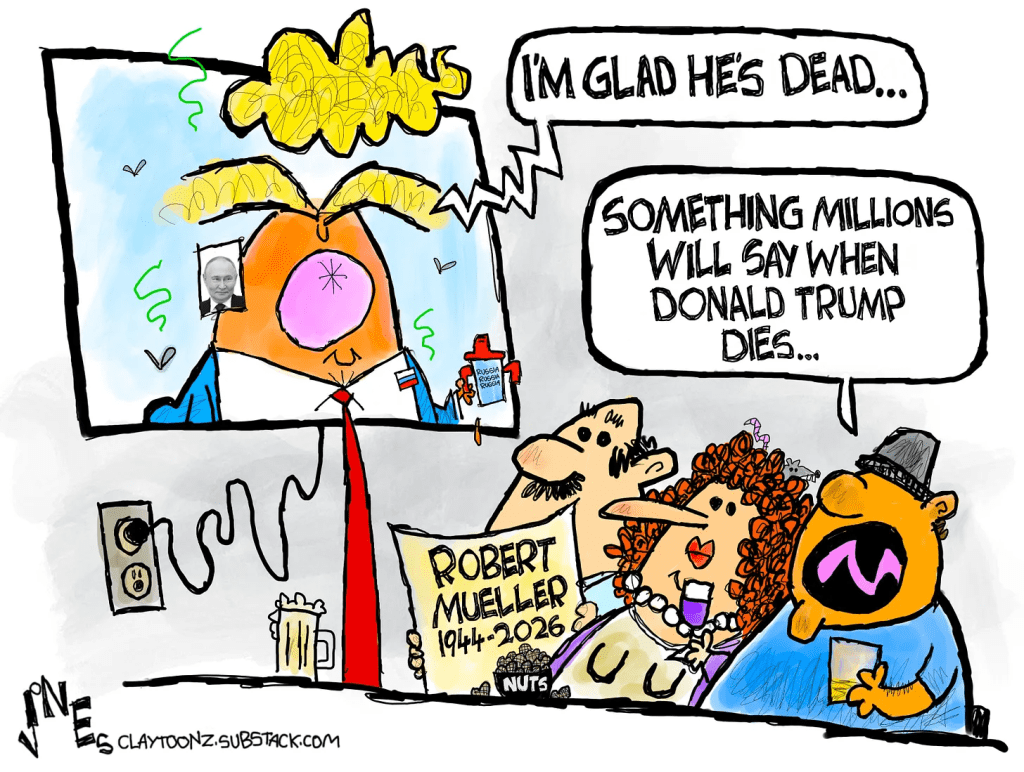
Mewling About Mueller
Prez POS strikes again

https://www.gocomics.com/heathcliff/2026/03/23
It’s our friend Bee!

Josh Johnson11 hours agoProbably my most requested topic ever. Do your thing for the algo so everyone knows new set will be live premiering Tuesday at 9pm eastern Friends ❤️
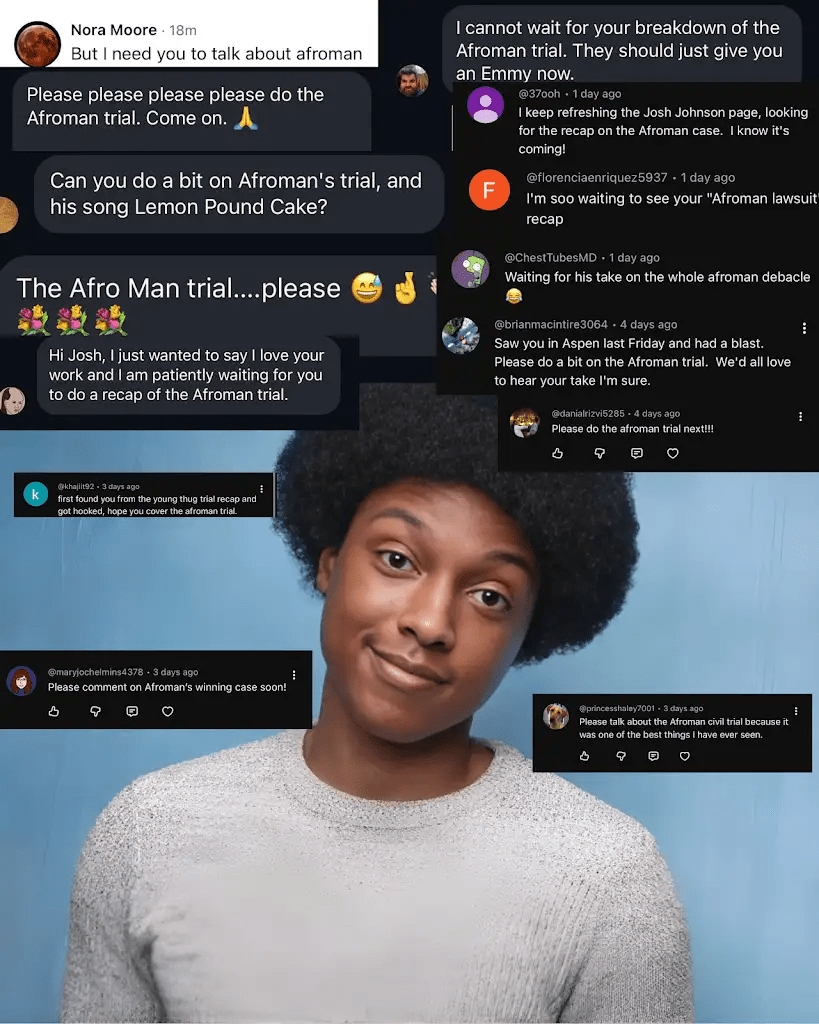
(Don’t forget!)
Josh Johnson 7 hours agoH i Friends, good news! I am hosting @TheDailyShow this week Tuesday – Thursday. Do your thing for the algo so more people see it. Guests this week are Sterling K. Brown, Mero, and Eiza González. March 24-26 on Comedy Central and Paramount

A Little MidAfternoon Sumpin’-
Clown Show
Ronald McDonald, Jr.
The madman whose first name is Donald
Wants to dress up like Ronald McDonald
But he’s too fat to fit
An obese monstrous twit
For this we can blame Mitch McConnell.
McConnell, he should have impeached
And the fat fetid douche would be beached
But Mitch, he’s so bad
A coward, a cad
And the rest of us now have been leeched!
The women leading the farmworker movement won’t let it be defined by Cesar Chavez
The sexual abuse allegations against Chavez have rocked them. But their focus is still on protecting other women.
This story was originally reported by Chabeli Carrazana, Shefali Luthra and Marissa Martinez of The 19th. Meet Chabeli, Shefali and Marissa and read more of their reporting on gender, politics and policy.
Monica Ramirez has spent much of her life spotlighting the pervasiveness of sexual violence against women farmworkers. She, like many in that movement, considered civil rights leader Cesar Chavez an icon.
Since allegations came to light this week that Chavez sexually assaulted women and girls as young as 12 — including fellow movement leader Dolores Huerta — Ramirez and the larger farmworker community have been left reeling. Now, they’re trying to reconcile how this man who so many revered — whose name is on streets, schools and even a holiday — could perpetrate the violence that has plagued women farmworkers for decades.
The community has been “shaken to its foundation,” said Ramirez, the founder of Justice for Migrant Women, a civil rights organization focusing on farmworker and migrant women. She and other leaders are now trying to push forward the farmworker movement and continue the work that many women — not just Chavez — spearheaded.

“The farmworker movement is a leaderful movement, and women have always been part of that leadership,” Ramirez said. But their work has often been made invisible, sometimes by the very men who stood beside them in building worker power for Latinx people in the United States.
“In order to have a movement, in order to have a boycott, in order to organize any kind of action, it’s often women who are helping to organize the meetings, helping to bring their compañeras,” Ramirez said.
Chavez was one of the most revered figures in the Latinx civil rights movement. The labor leader cofounded what became the United Farm Workers union alongside Huerta, and was most known for a series of strikes and protests that grew unionization efforts across California. After Chavez’s death in 1993, he was posthumously awarded the Presidential Medal of Freedom, the nation’s highest civilian honor. In 2014, former President Barack Obama designated his birthday, March 31, as a federal holiday to celebrate his legacy, which many states had already marked.
Now, many of those celebrations are being canceled or renamed after a bombshell, yearslong investigation published by The New York Times Wednesday found evidence of a pervasive pattern of sexual abuse perpetrated by Chavez. Two women said Chavez sexually abused them for years as girls, when the organizer was in his 40s and had already become a powerful global figure. Ana Murguia said Chavez first assaulted her when she was 13; Debra Rojas was 12.
In the years following the abuse, both suffered from depression, panic attacks and substance abuse.
“I feel like he’s been a shadow over my life,” Rojas told the Times. “I want him to stop following me around. It’s time.”
Huerta, the renowned activist who coined the rallying cry, “Sí, se puede,” spoke at length about emotional and physical abuse from her longtime organizing partner — a disclosure she had never made publicly. She told the Times that he raped her in a secluded grape field in 1966, and had pressured her to have sex with him another time during a work trip in 1960. Both encounters resulted in children. Huerta concealed the pregnancies and arranged for the baby girls to be raised by others.
She was shaken upon hearing the allegations from other women, and told the Times she struggles to reconcile the man she knew and the one who assaulted her.

In a statement released Wednesday, Huerta said she carried her secret for 60 years because “building the movement and securing farmworker rights was my life’s work. The formation of a union was the only vehicle to accomplish and secure those rights and I wasn’t going to let Cesar or anyone else get in the way.”
She said she spoke up because she learned there were others coming forward.
“The farmworker movement has always been bigger and far more important than any one individual. Cesar’s actions do not diminish the permanent improvements achieved for farmworkers with the help of thousands of people,” she said. “We must continue to engage and support our community, which needs advocacy and activism now more than ever.”
Magaly Licolli knew exactly what Huerta was talking about in her statements about Chavez.
Licolli is the co-founder and executive director of Venceremos, an organization advocating for poultry workers in Arkansas, and she’s heard stories about sexual harassment and assault on women for years.
Before she started Venceremos, she was fired from another poultry worker organization after speaking up about multiple accusations of sexual harassment and assault against a well-known organizer.
“Women came forward and accused the organizer of sexually assaulting them or sexually harassing them. When I brought that to the board, they didn’t believe it,” Licolli said. “I had to stand with the women … I cannot do this work pretending I’m doing justice when I’m hiding injustice.”
Licolli felt that echoed this week.
“Women of color, we are not trusted on what we go through. We have to prove with pictures, with testimony, our own stories for our own stories to be validated,” she said. “I’m happy that now it’s something that people are talking about, and I’m happy that people are now reflecting about what is the role of women in the movement and when we have to be silenced toward that kind of injustice to protect the work that we do.”

A growing share of farmworkers are women, according to the U.S. Department of Agriculture: about 26.4 percent in 2022, the most recent year for which data is available. Most are Latina.
A 2012 report by Human Rights Watch, an advocacy organization, found that women farmworkers are often at risk of sexual harassment or assault, with virtually every worker interviewed for the report saying they either had experienced harassment or assault or knew someone who had. Farmworkers work in mixed-gender settings, and they have limited worker protections But women typically lack avenues to report their experiences, the report’s authors wrote, in large part because of immigration status. As of 2022, most farmworkers were immigrants without U.S. citizenship.
“Sexual violence and harassment in the agricultural workplace are fostered by a severe imbalance of power between employers and supervisors and their low-wage, immigrant workers,” the report said.
A 2024 review published in the Journal of Agromedicine suggested that as many as 95 percent of women farmworkers in the United States have experienced workplace sexual harassment.
None of the women in the Times story spoke publicly until recently because of the shame and fear associated with reporting abuse against prominent organizers.
But over the past decade, after the growth of the #MeToo movement and the release of millions of Epstein files that have implicated numerous people in powerful positions, survivors have been more willing to speak up about their experiences.
Ramirez, who also founded the public awareness campaign known as the Bandana Project to raise awareness of sexual violence against farmworker women, said she now expects more women to come forward with their own stories. At an event Wednesday night shortly after the news broke, she said one woman came up to her to tell her how sexual assault was a problem in the fields where she worked as a teenager.
“Now that we understand clearly that this issue of sexual violence is an endemic problem in our society … the question we have to answer is: Knowing that, how serious are we going to get in our commitment to ending the problem?”
California lawmakers already plan to change the name of Cesar Chavez Day on March 31 to “Farmworkers Day,” and efforts are underway to remove his name from landmarks. But the real work to come will be about investing resources and support to improve the culture that has protected perpetrators in organizing spaces over victims.
Rep. Delia Ramirez, an Illinois Democrat who worked in organizing before entering politics, said it was “devastating” that the claims took so long to come out. She said when she became an executive director of a nonprofit at 21, she, too, had faced situations that in hindsight were not appropriate, and left the organization with a responsibility to create safer environments for other young women.
“Oftentimes women, especially women of color, we end up having to hold so many things for the sake of the movement, family, community,” Delia Ramirez told the 19th. “I don’t believe that there is one hero for our movements. Movements are led by a collective, and you can’t create some pedestal for one person, because humans will always fail you.”

Moving forward, Monica Ramirez said people will be watching how leaders in the farmworker movement respond to the allegations. Do they take a defensive posture or question the veracity of the survivors’ accounts? The revelations about Chavez come at a time when sexual misconduct by powerful men has been in the spotlight, all while the country grapples with a wave of immigration enforcement actions that are targeting Latinx people.
Licolli, the poultry organizer, said she has “never romanticized the immigrant community and the immigrant movement.” Sexual abuse happens in every movement and it doesn’t negate the work that’s been done to secure worker power, she said.
And for the farmworker women who are leading this work, it feels more urgent than ever that they continue leading.
Rosalinda Guillen, a farmworker and organizer in Washington state, leads Community to Community Development, an explicitly feminist and women-led organization — a perspective that she said lends itself to advocating for workers who are also parents, and that she said offers space for women farmworkers to assert their needs.
Guillen never met Chavez but was inspired to devote herself to organizing on behalf of farmworkers after his death. The news has been a “revision of everything that many of us know about the farmworker movement,” she said.
Her organization is removing images of Chavez from its office, Guillen said. “We revisited our values and principles in how we work together, reiterating there is no room for that,” she said, referring to sexual misconduct.
On Wednesday, while staff were still processing the reports, five farmworkers walked in. They had just lost their jobs.
Her staff switched gears, turning to figure out what those workers needed and how they could support them.
“They walked in reminding us this is the focus,” Guillen said. “This is why we’re here: To protect farmworkers.”
The Majority Report clips on tRump’s illegal war.
Some Things To Watch, From Joyce Vance
The Week Ahead
March 15, 2026
Joyce Vance Mar 15, 2026
It’s another week full of legal proceedings. And a little politics, too.
Tuesday: Maduro and Flores hearing
The U.S.-ousted Venezuelan leader Nicolás Maduro and his wife, Cilia Flores, were captured by U.S. forces on January 3 at their Caracas home. They were arrested pursuant to an indictment federal prosecutors had obtained and taken to the U.S. to face those charges. Both pled guilty and are currently detained pending trial. The superseding indictment can be found here. We discussed it at length here.
There was supposed to be a status conference on the case this Tuesday. But the government wrote the Judge, Alvin Hellerstein in the Southern District of New York, requesting a “brief continuance.” The stated reason was to permit discovery to proceed before the parties returned to court, a reasonable request given the likely amount of evidence the government will be turning over to the defense and the time it takes to review it with defendants who remain in custody.
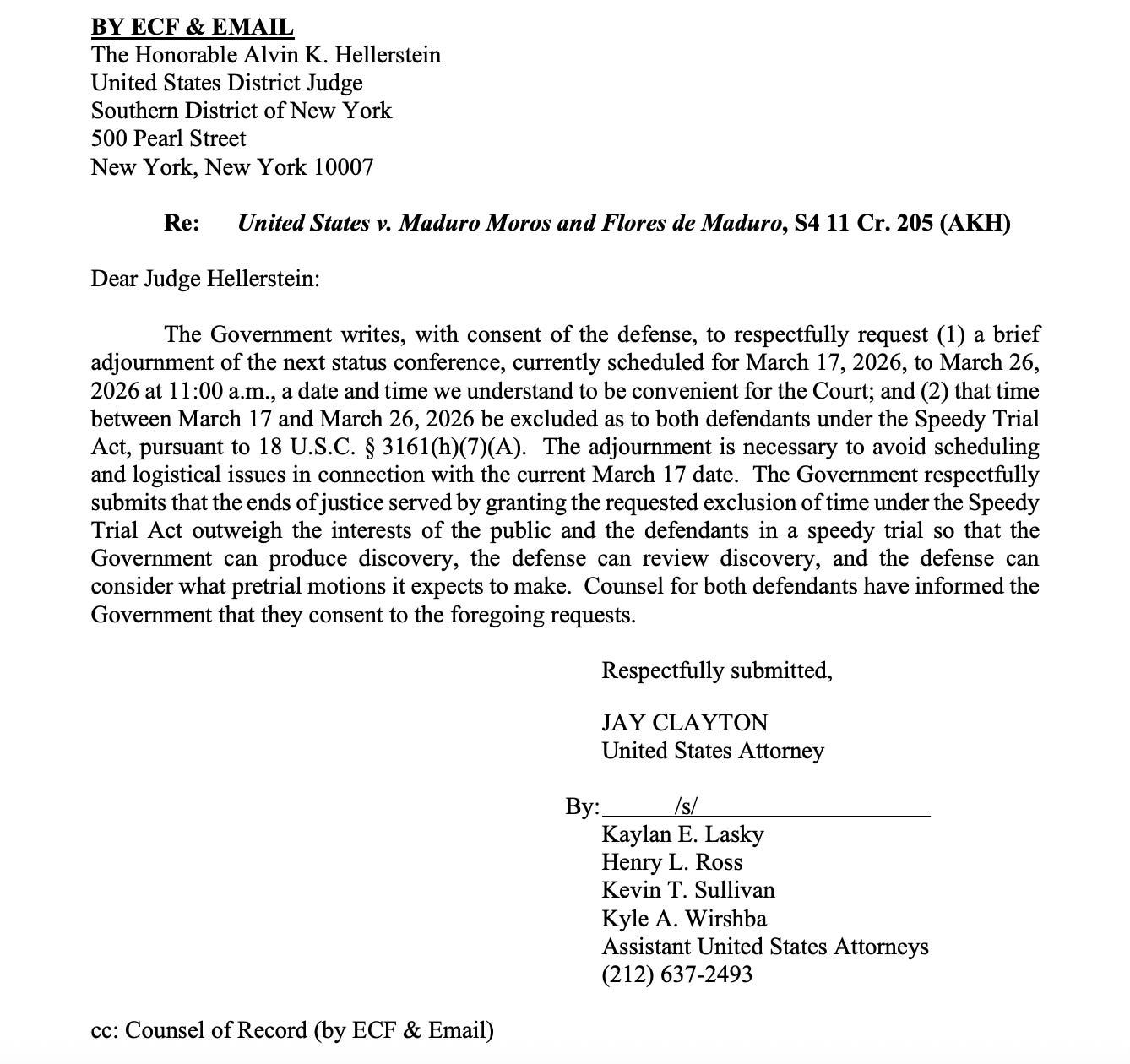
But the government has been busy on the case already, opposing the defendants’ efforts to use Venezuelan government monies to fund their defense. Prosecutors say Maduro is not the legitimate leader of Venezuela and hasn’t been considered by the U.S. to be so for several years. Madura and Flores’ lawyers argue the laws and traditions of the country permit it to fund their defense. A Venezuelan official has said they are prepared to do so.
The defendants argue that their inability to access certain third-party funds to pay for their legal fees violates their Fifth and Sixth Amendment rights to due process and effective assistance of counsel. The parties have filed their briefs, and Judge Hellerstein is expected to consider the legal fees dispute during the March 26 hearing.
Tuesday: Illinois Primary
Illinois voters head to the polls Tuesday to choose their Democratic and Republican nominees for the open Senate seat being vacated by Dick Durbin, who is retiring after almost three decades. Two members of the House, Raja Krishnamoorthi and Robin Kelly, have thrown their hats into the ring, leaving their seats up for grabs. Three additional Illinois representatives are retiring: Danny Davis, Jan Schakowsky, and Jesus “Chuy” Garcia.
That means the Illinois delegation will look different, possibly younger, heading into 2027, and we will have new names to learn. Kamala Harris won the state with 54.8% of the vote in 2024, and it’s unlikely Democrats will lose any seats. In Kelly’s district, former representative Jesse Jackson Jr, who pled guilty to misusing campaign funds in 2013 and was sentenced to 30 months in prison (he served a little under two years), is trying to make a comeback, but he is one of 10 Democrats running for the seat. Jackson, who represented the district for over 20 years before going to prison, is up by double digits in two polls.
Everyone expects Governor JB Pritzker to handily win reelection. But as a potential 2028 presidential contender, there will be heavy scrutiny of how he handles himself during the campaign and how well he performs and leads the Democratic ticket. So there’s a lot to see here.
Under Illinois law, only poll workers and poll watchers can be at the polls on election day, and other people may not mill around outside as voters go about their business. Nonetheless, there have been concerns that ICE might show up to intimidate people. But DHS’s Assistant Secretary for Election Integrity, Heather Honey, issued a statement in late February, saying “Any suggestion that ICE is going to be present at polling places is simply disinformation.” She committed that there would “be no ICE presence at polling locations” during a call with voting officials from across the country.
That makes sense and I’m inclined to believe it. But only because doing it now would trigger legal challenges that would likely be decided against the administration. If they’re going to do this, we’ll likely see it for the first time when voters go to the polls in November.
Wednesday: Fulton County.
As you may recall from our earlier discussion, Judge J.P. Boulee sent the Justice Department and Fulton County to mediation in the case filed by the latter over the government’s seizure of voting records. Wednesday is the date by which the parties must let the Judge know whether they’ve been able to resolve the matter voluntarily. If mediation failed, it will be up to the Judge to decide whether the records are due to be returned, which they almost certainly are (the government gets to keep copies), but the administration could face some messy, revelatory testimony in court if the County goes into the unusual decision to have a U.S. Attorney from Missouri take over the matter, rather than the local U.S. Attorney.
The Rest of the Mess
Pam Bondi wants to deprive state bar associations of their ability to consider ethics challenges to federal prosecutors’ behavior.
DOJ has posted a proposed new regulation in the Federal Register that would prohibit state bars from proceeding while DOJ is conducting an internal review. Nothing in the rule would preclude DOJ from engaging in endless delay and short-circuiting state investigations.
In practice, state bar associations have routinely deferred to DOJ to conduct internal ethics proceedings before they act against a Justice Department lawyer. But that was under the old rules, where DOJ took ethics seriously. And as a practical matter, state bars, not Pam Bondi or Donald Trump, decide whether to give a specific lawyer a license to practice law in their state, so it’s difficult to see how the government has a legal leg to stand on here. It would be like Donald Trump deciding who can be a barber in Oklahoma or a cosmetologist in Arizona.
There is a 30-day comment period for the proposed regulations that will close on April 6. Comments will be public. Expect a wide variety of members of the legal profession to weigh in against the administration’s transparent effort to prevent state bar action against DOJ officials who are in ethical trouble. Congress made it clear in a law called the McDade Amendment that government attorneys “shall be subject to State laws and rules … governing attorneys in each State where such attorney engages in that attorney’s duties, to the same extent and in the same manner as other attorneys in that State.” The measure was passed in 1998 amid concerns about overzealous prosecutors. Pennsylvania Republican Representative Joseph McDade (R-PA) championed the measure after he was acquitted on bribery and racketeering charges.
The SAVE Act heads to the Senate for a vote this week.
We’ve been talking about it for months. This appears to be the week the Senate will vote on the SAVE Act. It has already passed in the House. In our conversation at Big Tent last week, Marc Elias opined it would not pass. The Senate would have to abandon the filibuster rule to get it across the finish line. That would be a last-ditch measure that Republican Senators have long argued against, but some seemed to waffle on the issue last week.
Trump tried to get Republican Senators to abandon the filibuster last November. He made that pitch with visiting Hungarian Prime Minister Viktor Orbán at his side. Orban heads what he has called an “illiberal democracy” in that country. It was quite an image.
The issue last year was the pending government shutdown. Trump called on Senate Republicans to scrap the filibuster rule and allow simple majority votes to prevail on that issue and for most other legislation. They declined, even though, or perhaps because, Trump promised his party that if they did, the GOP would “never lose the midterms and we will never lose a general election” for the foreseeable future. It will be interesting to see if that pitch reemerges this week as Trump tries to pass a measure designed to suppress Democratic votes in the upcoming election.
Senators on both sides of the aisle have long understood the power that honoring the filibuster gives both sides; it’s a form of mutually assured retention of power. But Texas Senator John Cornyn, long a proponent of the filibuster, put out an op ed in the New York Post arguing that the SAVE America Act is more important than it is.
“For many years, I believed that if the US Senate scrapped the filibuster, Texas and our nation would stand to lose more than we would gain … My fellow conservatives and I have proudly used the 60-vote threshold to protect the country from all sorts of bad ideas and dangerous policies. But when the reality on the ground changes, leaders must take stock and adapt…Today, Democrats are weaponizing the Senate’s rules to block the SAVE America Act, defund the Department of Homeland Security and hurt the American people — all to spite President Donald Trump.”
It was quite a reversal of long-held principles in service of Trump from the Texas Republican, who is facing an uphill battle to hold onto his Senate seat. He faced a primary challenge from Texas Attorney General Ken Paxton. Neither candidate reached the 50% threshold necessary for an outright win, so there will be a runoff, which is scheduled for May 26, although there have been whispers of a voluntary resolution. How we are about to find out if other Republican senators want to hold onto any of their institutional power or are willing to throw it away on Trump and a law that has strong arguments against its constitutionality.
Finally, Julie Le, the former government lawyer in Minneapolis who we met in this piece, when she begged a judge to hold her in contempt so she could get a good night’s sleep, has launched a Congressional campaign website. “This job sucks,” she told the judge. Now, it appears she might be looking for a new one, since she was ultimately removed after her outburst in court.
We’re in this together,
Joyce
Remember Stormy Daniels?
Here’s an update.
 Scottie's Playtime