Transgender Kansans are being informed on the eve of a new state law going into effect that their driver’s licenses will be considered invalid as of Thursday.
“Please note that the Legislature did not include a grace period for updating credentials. That means that once the law is officially enacted, your current credentials will be invalid immediately, and you may be subject to additional penalties if you are operating a vehicle without a valid credential,” read letters mailed by the Kansas Department of Revenue’s vehicles division.
“Pursuant to the new law, if the gender/sex indication on the face of your current credential does not match your sex assigned at birth, you are directed to surrender your current credential to the Kansas Division of Vehicles,” reads the letter, which The Star reviewed multiple copies of.
I feel our national security has been deeply harmed by the tRump adminsitration. I posted for tomorrow how Ukraine started making big gains against Russia’s invasion once they and foreign countries stopped sharing the war intel with the US. Seems clear everything Ukraine was sharing with the US went right to Putin. tRump’s amistration has given military secrets and tech to enemy countries just for their personal profit. And the worst of the stuff they hide. Horrific and I wonder with the military purges if the US can actually recover in the next decade. Hugs
I really don’t care to dignify or even acknowledge that last night’s spectacle was an actual State Of The Union address, but it was what we get. I thought I’d simply ignore all of it and all surrounding it, but of course I read this article in The Guardian because old civic duties habits die hard (this one’s not dead yet!), and I thought I’d bring it here because it’s not sharp or negative. It’s simply what happened. (And what, no doubt, we all expected, though I’m certain some expected far less from the Democrats in attendance.)
Amid Trump’s lies and xenophobic rants, people struggling to pay bills and make ends meet are unlikely to be moved
He wanted to give the king’s speech. Donald Trump entered the US House chamber on Tuesday like a medieval monarch, with Republicans lined up eager to touch his royal robes (or, in two cases, grab a selfie with him). But within moments, the illusion was shattered.
As the US president strolled by, soaking up adulation, Democratic representative Al Green of Texas held aloft a handwritten sign: “Black people aren’t apes!” – a reference to Trump recently sharing a racist video depiction of Barack and Michelle Obama.
When the first State of the Union address of Trump’s second term got under way, Republicans moved in on Green menacingly and tried to tear the sign away. But he persisted until being escorted out for the second year in a row. As he departed, there were more acrimonious exchanges with Republicans, a few of whom tried to start a chant of “USA! USA!”
(snip-embedded 3 minute video, on the page: “Donald Trump’s two-hour State of the Union address in 3 minutes – video”)
It was the first but not the last time that a person of color would take a stand during the wannabe autocrat’s record 107-minute speech while others remained silent or raucously egged him on. It was a night where Trump again sought to poison US politics and divide Americans along various fault lines, none more inflammatory than race.
The great salesman, sporting his familiar red tie and orange hue, began with a predictable pitch: “Our nation is back – bigger, better, richer and stronger than ever before.” In his telling, inflation, mortgage rates and gas prices are falling, while the stock market, oil production and foreign direct investment are booming along with construction and factory jobs.
Luckily for Trump’s speechwriter, the US men’s hockey team won Olympic gold two days earlier. The reality TV president hailed them in the press gallery, prompting applause and roars from both Democrats and Republicans. But while Republicans chanted “USA! USA!” with gusto, barely any Democrats did.
“We’re winning so much that we really don’t know what to do about it,” Trump declared. While he didn’t mention his gilded ballroom, it was still a Pollyannish version of America that will not be recognized by people struggling to pay bills and make ends meet. Trump is not the man to offer: “I feel your pain.”
Republicans ritually stood and clapped and cheered all the same. Democrats, who last year waved protest signs that looked like Marty Supreme’s table tennis paddle, this time remained bolted to their seats and grunted, rolled their eyes, dropped their jaws, shook their heads, waved their hands or got bored and studied their phones.
Trump moved on to his beloved tariffs, calling the supreme court decision to kill his pet project “very unfortunate” and “disappointing” as four black-robed justices wore inscrutable expressions on the front row. Compared with last week’s White House tantrum, when he threw all toys and decorum out of the pram, this was Trump showing self-restraint worthy of a child refusing a second ice cream.
It didn’t last. As Trump riffed on crime, election integrity and transgender issues, he turned his fire on Democrats: “These people are crazy, I’m telling ya, they’re crazy. Boy, oh, boy, we’re lucky we have a country with people like this. Democrats are destroying our country, but we’ve stopped it just in the nick of time.”
He soon reminded everyone that, since the day he came down the golden escalator a decade ago and ranted about immigrants, race has always been at the heart of the Trumpist project. He gazed out at a chamber where Democrats – including the late Jesse Jackson’s son, Jonathan Jackson – somewhat resembled America in their diversity while Republicans presented a sea of white faces with only a handful of exceptions.
Trump announced a “war on fraud” led by vice-president JD Vance, citing a social services scam in Minnesota that he mendaciously and absurdly estimated to have cost $19bn. Ilhan Omar, a Somali-born representative from Minnesota, and Rashida Tlaib, a Palestinian American from Michigan, shouted: “That’s a lie!” and “You’re a liar!”
The president was just warming up. He went on a xenophobic rant: “The Somali pirates who ransacked Minnesota remind us that there are large parts of the world where bribery, corruption and lawlessness are the norm, not the exception. Importing these cultures through unrestricted immigration and open borders brings those problems right here, to the USA.”
Omar shook her head, perhaps more in sorrow than in anger.
Trump challenged Democrats: “If you agree with this statement, then stand up and show your support: the first duty of the American government is to protect American citizens, not illegal aliens.” Democrats remained seated. Trump retorted: “You should be ashamed of yourself, not standing up.”
It was rich from the man who sent a goon squad into Minneapolis that resulted in the needless deaths of two US citizens, Renee Good and Alex Pretti, who went unmentioned by the president (as did survivors of abuse by Jeffrey Epstein).
Omar, raising a hand to the side of her mouth to project her voice, yelled with piercing moral clarity: “You have killed Americans! You have killed Americans! You have killed Americans! You have killed Americans!”
Helpfully, Omar and Tlaib had set up a real-time factchecking service for the chamber. Trump boasted that he ended eight wars. Tlaib shouted: “It’s a lie! What are you talking about?”
Trump said: “No one cares more about protecting America’s youth – .” Tlaib interjected: “Then release the Epstein files!”
Trump vowed to halt insider trading by members of Congress. Mark Takano of California yelled: “How about you first!” Tlaib called out: “You’re the most corrupt president!”
The more Trump talked, the less he said. He had gone into the address with an approval rating of 39% positive and 60% negative, according to a Washington Post-ABC News-Ipsos poll, lower than any past president delivering his first State of the Union address. Over an hour and 47 minutes, he offered little to change that equation. The longest State of the Union speech in history was also one of the most inconsequential.
It was small wonder that Omar, Tlaib and several other Democrats walked out before the end. As for Green, his seat remained empty too save for a handwritten cardboard sign that simply and defiantly said: “Al Green.”
A 5-year-old girl detained in Dilley drew herself and her family trapped in a cage.Credit: Courtesy / Eric Lee
A 9-year-old girl detained in Dilley’s South Texas Family Residential Center says she wants to die, according to family attorney Eric Lee, who recently went viral when a protest erupted inside the facility as he tried to visit his clients.
“The 9-year-old has expressed that she wishes she was no longer alive,” Lee said in a Wednesday phone interview with the Current.
Lee said the mother conveyed her child’s alarming wish to him in a recent a phone call from within the U.S. Immigration and Customs Enforcement facility an hour southwest of San Antonio, which houses over 1,400 people, including hundreds of children.
Lee represents a family of five, consisting of the 9-year-old along with 5-year-old twin sisters, a 16-year old brother, an 18-year-old sister and her mother. All are Egyptian citizens, and all have had birthdays inside the facility. The minors are not named in this article to protect their identities.
The family, which immigrated from Kuwait, has been detained in Dilley for eight months for what Lee calls “political retribution” from the Trump administration for the alleged crimes of the family’s patriarch, Mohamed Soliman. Soliman became a suspect in an anti-Semitic attack in Boulder, Colorado last June using Molotov cocktails and a makeshift flamethrower.
The attack left seven people injured. One 82-year-old woman died from injuries relating to the attack 24 days later. Soliman received 12 counts of federal hate crime and 118 state criminal charges.
When the attack occurred, Soliman had been estranged from the family for at least a year, living in his car over an hour away and working as an Uber driver, according to Lee. Soliman only saw his family once a week at most, the attorney added, saying they had no knowledge of his plans. The family has spoken out condemning the attack and the mother, Hayam El Gamal, is now seeking a divorce.
Over the months of detainment, their mental health has deteriorated, Lee said.
On a previous visit, the 9-year old daughter gave Lee a picture she drew inside Dilley. The drawing is of the Colorado house she hasn’t seen in the months she’s been in detention.
A 9-year-old child detained in Dilley for months drew this picture of her one-time home.Credit: Courtesy / Eric Lee
One of the five-year-old twins also gave Lee a drawing, which depicts her and her family in a cage. She told Lee that she had a dream that she was trying to run away from a wild animal.
“But she’s stuck in a cage and can’t get out,” Lee said.
The family’s younger kids also have begun skipping meals, “which they hadn’t been doing before,” Lee added.
People detained at the Dilley site have complained that the food inside sometimes is served with bugs, worms and mold. Lee described the water there as “putrid.”
The 16-year-old boy at one point suffered from appendicitis and was told to simply take a pain reliever before collapsing and being rushed to the hospital.
“He could have died,” Lee said.
But, if deported, the family could face certain death in Egypt, Lee claims, for cooperating with the FBI and speaking out against their patriarch.
The Detroit attorney says after months of detention, the Soliman family’s optimism began to rapidly decline in January.
“They really believed that the immigration judge was going to give them a fair hearing after he granted them bond in September,” Lee said. “And so they were hopeful, they were hopeful that they were going to be released through that process, and they weren’t.”
Meanwhile, even the older siblings have shown signs of worsening mental health, despite attempting to hold it together for their family, the attorney added.
“[T]he 16 year old, who’s been kind of, you know, rock solid, taking on the role of man of the house — his attitude has really begun to change,” Lee said. “And that goes for all of them.”
The oldest daughter, Habiba Soliman, was separated from her family once she turned 18 as punishment for talking to the press, Lee asserted. Separated from her family, she’s also been denied religious exemptions, he added.
“They’ve been calling me less in the last week or so, which I think is because they’re just sort of despondent and depressed,” Lee said of his clients. “That’s been the goal from the start, to ruin these children’s lives. And they didn’t do anything.”
U.S. District Judge Fred Biery, who wrote the fiery opinion releasing 5-year-old Minneapolis boy Liam Conejo Ramos from the same facility, will consider the family’s third habeas case, but Lee doesn’t know when.
“It’s a deplorable situation. There’s really no silver lining,” Lee added.
The FBI interviewed one of Jeffrey Epstein’s victims four times over her allegation that Donald Trump assaulted her when she was underage.
Nathan Howard/Getty Images
The Department of Justice spoke four separate times to a woman who credibly accused Donald Trump of having sex with a minor he met through Jeffrey Epstein—but most accusations against the president appear to have been removed from the government’s documents on the alleged sex trafficker.
A 21-page slideshow buried in the massive trove of Epstein-related documents included allegations that sometime between 1983 and 1985, Trump forced a woman to give him oral sex when she was in her early teens. When the woman bit down on Trump’s exposed penis, he allegedly punched her in the head and kicked her out. That same woman told the DOJ that Epstein had introduced her to Trump in 1984.
Yet last week, Attorney General Pam Bondi insisted that there was “no evidence” that Trump had committed any crime—adding to the growing pile of denials from Trump officials that constitute a sweeping cover-up of the president’s alleged wrongdoing.
Justice Department records indicate that the FBI spoke to this woman not once but at least four separate times, according to independent journalist Roger Sollenberger. Now those records appear to have been removed from public viewing—despite the Epstein Files Transparency Act, which requires all documents relating to the alleged sex trafficker to be made public.
Sollenberger discovered a record of four separate interviews, which took place in the summer of 2019, in a separate database of documents downloaded from the government’s public files on Epstein. That document indicated that the first of the four interviews was conducted on July 24, 2019, and the last conducted on October 16, 2019. That document was given to Ghislaine Maxwell’s lawyers as part of her trial, though the specific allegations predated Maxwell’s involvement with Epstein, Sollenberger wrote.
The woman’s first interview was entered into the FBI’s case files on August 9, 2019, just one day before Epstein was found dead in his jail cell. FBI agents typically have a deadline of five working days to file interview write-ups, indicating an abnormal 16-day gap, Sollenberger noted.
This is horrific that a young person has had to live with racism all his life and now has to protect his family and others from a racist gang of thugs who only want to hurt brown people like him. He is doing a great thing but he shouldn’t need to do this in the land of the free. Hugs.
Cesar Vasquez, who has supported families of undocumented immigrants since age 14, has become a community lifeline – and a known ICE target
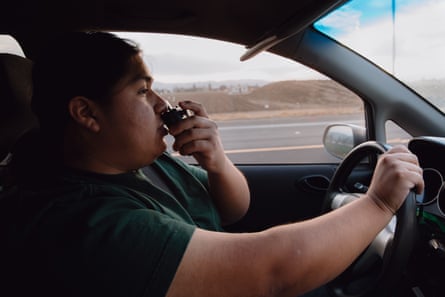
While most 18-year-olds worry about college papers and spring break plans, Cesar Vasquez drives through coastal California farm towns scanning for unmarked SUVs before dawn. He flips down his driver’s seat visor to look at a taped list of license plates he has already identified as Immigration and Customs Enforcement (ICE) vehicles, and jots down a few new ones he suspects could be. His phone buzzes constantly – tips from neighbors, text chains from volunteers alerting to ICE activity – all in an attempt to keep his community safe from being swept up in federal agents’ widening dragnet.
This is what organizing looks like for this son of undocumented immigrants. In his home town of Santa Maria, a small farming town on California’s central coast where over 80% of farm workers are undocumented, Vasquez has become both a crucial community lifeline and a known target of federal immigration enforcement.
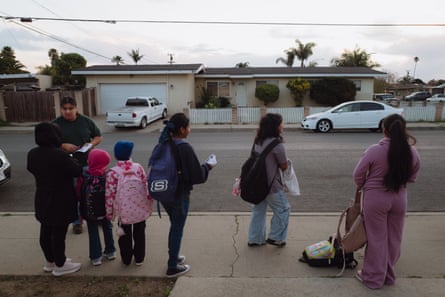
Outside the ICE office in Santa Maria, California, Cesar Vasquez and a group of activists gather to decide who will patrol each neighborhood.
Vasquez began volunteering with the 805 Immigrant Rapid Response Network as a high school senior. Last August, he was hired full-time as a rapid response organizer, covering North Santa Barbara and San Luis Obispo counties, overseeing volunteers, supporting families and tracking ICE activity.
Routinely, he visits the families of detained immigrants. “There have been so many occasions where I walked through the door, and a kid was expecting their father or mother,” Vasquez said wistfully. “And it was just me, and I had to explain what happened to their parents.”
Other times, for Vasquez, the reality is personal. He recalled in December, speaking with families waiting for news about their detained relatives outside the immigration enforcement office in Santa Maria, when an ICE vehicle slowed down in front of them. The agent’s voice crackled from the car’s speaker, loud enough to carry through the open window: “How’s your mother, Cesar? We’ll go visit her soon.”
Vasquez drove straight home and found his mother washing clothes.
“I took her car keys and told her to stop everything she’s doing. My hands were shaking,” Vasquez said. “I then moved her to a secret location that I have precisely for this moment.”
As the sun rises in Santa Maria, Vasquez continues monitoring ICE activity in his neighborhood. The 18-year-old says he spends more time in his car than anywhere else these days.
Growing up as a birthright citizen of undocumented parents
Vasquez’s mother is one of the thousands of undocumented farm workers in Santa Maria whom he is trying to protect. She left her home in a tiny town in Mexico to cross the US-Mexico border at age 13 in search of a better life. Vasquez’s biological father was one of the first people she encountered – a Guatemalan American whose family was settled in California and who held US citizenship. He was also abusive and never legally married her, keeping her from accessing US citizenship, Vasquez said. When Vasquez was an infant, his mother ran away with her three children to Santa Maria, a town about 150 miles (240km) north of Los Angeles, where she found work in the strawberry fields. She has been trying to secure documentation for more than a dozen years now.
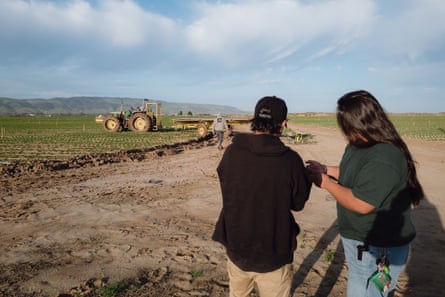
Vasquez distributes flyers on immigration rights to farmworkers in Santa Maria on 6 February.
Strawberry picking is physically demanding work, and the pay is minimal. Pickers spend hours bent over in the fields under the California sun, with no benefits, no sick days and no guaranteed work once the season slows between October and March. Climate change has made the labor even more precarious, disrupting growing cycles and shrinking paychecks. Rising costs of living – rent, food, transportation – have squeezed families further. In Santa Maria, where a two-bedroom apartment can cost $3,000 a month, many families crowd into single rooms or garages.
Built on an economy of strawberries, lettuce and wine grapes, Santa Maria has long depended on undocumented labor while rendering those workers largely invisible. Many arrived during waves of Mexican migration in the 1980s and 90s, settling into a community where immigration enforcement and workplace exploitation became routine. Before Donald Trump’s recent immigration priorities, ICE enforcement in the region tended to be more targeted – focusing on people with criminal convictions or referrals from local jails, rather than broad community sweeps. ICE didn’t even have a holding facility in Santa Maria until 2015.
But since 2025, enforcement has intensified dramatically with rapid‑response trackers documenting more than 620 immigration arrests across Santa Barbara, Ventura and San Luis Obispo counties, with Santa Maria often at the center of daily apprehensions. These high‑profile raids – often carried out with unmarked vehicles and tactical gear, drawing protests and criticism from community leaders – reflect a broader national surge in immigration enforcement under Trump.
Vasquez holds his mother along the river in Santa Maria. He keeps a feather with him, which he says brings spiritual cleansing when he burns sage.
When Trump was first elected, Vasquez was only nine years old. He was already well-acquainted with the repercussions of growing up in a mixed-status household.
“I mean, it’s common for most children of immigrants to be doing things for their parents like filling out their legal forms, right?” Vasquez said. “But in fourth grade, I had to learn what a warrant looked like and what rights I had.”
He was in a Halloween costume shop, age 14, when it clicked that his fears and concerns weren’t just his own. He overheard a woman at the register, saying she had saved all year to buy her son a costume, but it didn’t fit. The store wouldn’t take it back. Her shirt was stained with strawberries, her exhaustion visible. He’d seen his own mother do the same thing countless times, so he offered to buy the woman’s son the costume.
Building a network at 14
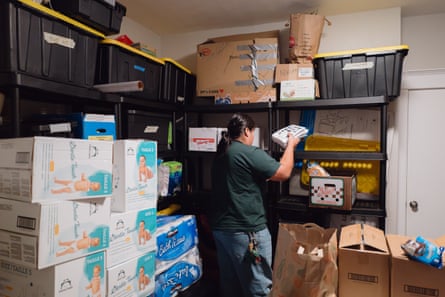
At age 14, Vasquez founded La Cultura Del Mundo, an entirely youth-led organization that eliminates what he calls the “red tape” associated with traditional aid. They prioritize direct, unrestricted support to families in need, asking, “How much do you need?” rather than requiring forms. The group then rapidly mobilizes whatever the family requests, whether that’s cash assistance, groceries, rent help or other essential support.
In August, La Cultura Del Mundo drew national attention when Vasquez organized La Marcha De La Puebla, a national protest against ICE raids that involved nearly 30 cities across 17 states, drawing about 10,000 participants.
Seventeen-year-old Claudia Santos is one of the many young people Vasquez has inspired. “My sister and I heard about a school walkout and just decided to go. After that, Cesar told us about a meeting at city hall, and that’s how I got involved,” Santos said. “I did it because I feel like the kids coming here from Mexico deserve a good future too.”
Vasquez packs up flyers to hand out to the immigrant community as they head to work in Santa Maria.
While Vasquez was organizing in high school, he was simultaneously struggling with his own mental health. He commuted by bus an hour each way to a school in a predominantly white neighborhood with good academic prospects.
When he told his counselor that he had anxiety, “she couldn’t understand that I was uncomfortable because I was brown in a white school, where the principal was racist and the students were racist. It led me to become really suicidal.”
Being misunderstood drove him closer to his community. He transferred to his local school and graduated early. Despite being accepted into San Diego State University, he deferred enrollment.
Most kids who grow up in Santa Maria look forward to leaving. One of Vasquez’s older sisters became a teacher in Los Angeles, the other a graduate student in the UK. But Vasquez likes that the impact of his work is immediate.
Tina van den Heever, one of his teachers from Santa Maria high school, said it was clear Vasquez was a leader with great potential: “To be honest, I worry about his safety, because as we’re seeing, the United States tends to silence people who stand up in the way that he does.”
‘I think about the kids being left behind’
During a four-day raid in late December, Vasquez’s uncle was among the 118 people detained.
“I think about the kids being left behind,” Vasquez said. “The children home for winter break whose parents never returned because of the December raids. And there was no way to know what happened to them because school didn’t reopen until days later.”
Vasquez distributes flyers on immigration rights to parents.
During the raids, flower vendors disappeared from the streets. When Vasquez later visited the area, the children of a family he had gotten close to told him they had gone inside after hearing his warning. They were safe.
The work – the constant alertness, the phone calls at all hours, the weight of knowing families depend on his network – has taken a toll. But he sees no alternative.
“I’m continuously preparing for the worst,” Vasquez said. He keeps a “to-go bag”, extra clothes and cash in his car.
Every time ICE picks up someone in the Central Coast valley, Vasquez plays the same song in his car: Hasta La Piel (Down to My Skin) by the Mexican American artist Carla Morrison. The lyrics speak to having and losing, wanting and not being able to say, intense love and desperate fear of loss – an homage to those who have been detained.
“They want us to be afraid,” he said. “But fear is what keeps people isolated.”
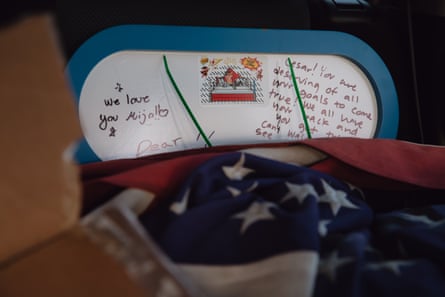
In the back seat of his car, a whiteboard filled with encouraging messages for Vasquez sits alongside an American flag.
Jennifer Chowdhury reported this story while participating in the USC Annenberg Center for Health Journalism’s Kristy Hammam Fund for Health Journalism


A 5-year-old girl detained in Dilley drew herself and her family trapped in a cage.Credit: Courtesy / Eric Lee


 Cesar Vasquez, who has supported families of undocumented immigrants since age 14, has become a community lifeline – and a known ICE target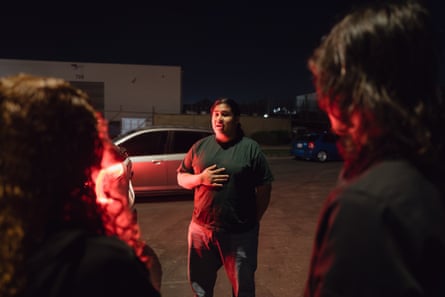


 Scottie's Playtime