3 Clips from Rev Trevor

I think there’s a blurb about this on Peace History, but I could be misrecalling. Anyway, here is far more of the story. Language alert, from the beginning.
Queer History 111: Before the Stonewall Riots, There Was Compton’s Cafeteria by Wendy🏳️⚧️🏳️🌈🌈 Read on Substack
You’ve heard about Stonewall—everyone has. It’s become the sanitized, rainbow-washed origin story of the LGBTQ+ rights movement that gets trotted out every Pride month by corporations selling overpriced merchandise. But three years before Stonewall rocked New York City, a group of fierce-as-fuck transgender women and drag queens in San Francisco’s gritty Tenderloin district had already thrown the first punch in the fight for queer liberation. The Compton’s Cafeteria Riot of 1966 wasn’t just a footnote in history—it was a goddamn declaration of war against police brutality and societal oppression that’s been deliberately erased from our collective memory.
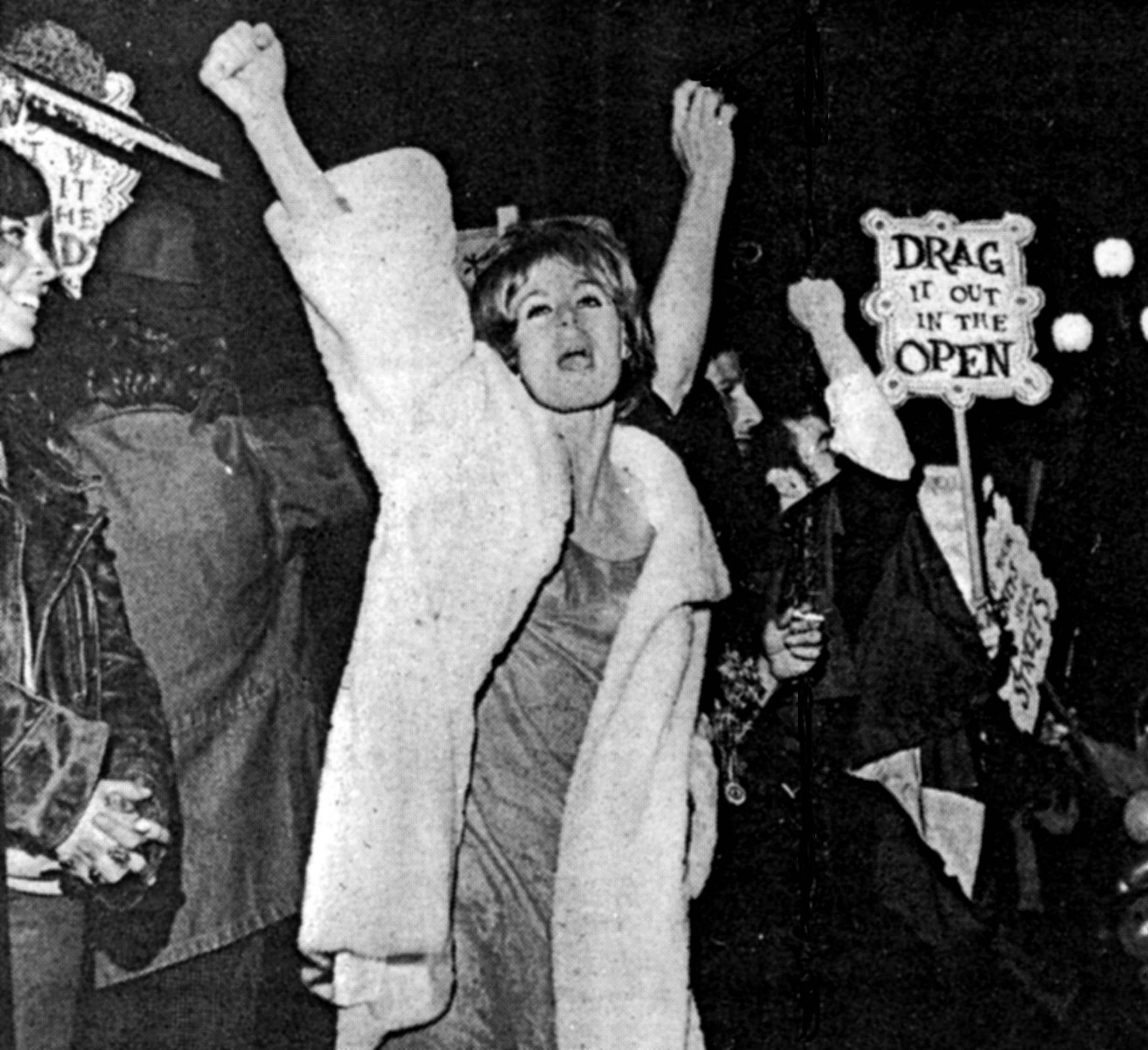
Let me tell you something straight up: these women weren’t politely asking for their rights with carefully worded petitions. They were fighting for their very existence in a society that treated them like garbage. And when pushed to their absolute limit one hot August night, they didn’t just push back—they burned the whole system down. Literally throwing coffee in cops’ faces, smashing windows, and lighting a police car on fire. This wasn’t a “disturbance” or an “incident”—it was a motherfucking riot, and it’s time we remember it for what it was.
San Francisco’s Tenderloin district in the 1960s wasn’t the gentrified hipster paradise it’s becoming today. It was a last-resort neighborhood—the only place that would accept the people society had discarded. Transgender women, particularly trans women of color, found themselves with precious few options for survival. Denied employment, housing, and basic human dignity, many turned to sex work simply to eat and keep a roof over their heads.
“We couldn’t get jobs, couldn’t get housing, couldn’t even walk down the street without being arrested,” recalled Amanda St. Jaymes, a trans woman who lived in the Tenderloin during this era. “The cops would book us as ‘female impersonators’ and throw us in the men’s jail. Do you have any fucking idea what happened to us in there?”
The brutal reality was that transgender women faced constant police harassment under California’s “masquerade laws,” which made it illegal to dress in clothing of the “opposite sex.” Cops could and did arrest trans women for the crime of simply existing in public. These weren’t occasional incidents—this was systematic persecution backed by the full force of the law.
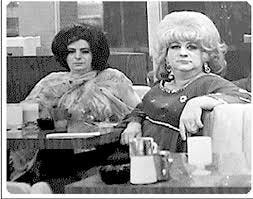
Gene Compton’s Cafeteria, a 24-hour diner at the corner of Taylor and Turk, was one of the few places trans women could gather safely—or so they thought. Open all night, it became an unofficial community center for transgender women, drag queens, gay hustlers, and other marginalized folks who had nowhere else to go. But the management often called the police when too many “queens” gathered, leading to regular harassment and arrests.
On a hot night in August 1966 (the exact date has been lost to history), the simmering tension finally boiled over. When police attempted to arrest a transgender woman at Compton’s for the “crime” of being there, she threw her coffee in the officer’s face. What followed was an explosion of rage that had been building for decades.
“It wasn’t planned,” said Felicia Elizondo, a transgender activist who frequented Compton’s. “It was just the night I got tired of being bullied. We all got tired at the same fucking moment.”
The cafeteria erupted. Cups, saucers, and trays became projectiles. The plate glass windows of the restaurant were smashed. A newsstand was set on fire. The women fought back with everything they had—high heels, heavy purses, and righteous fury. When a police car pulled up outside, it was immediately surrounded, its windows broken and, according to some accounts, set ablaze.
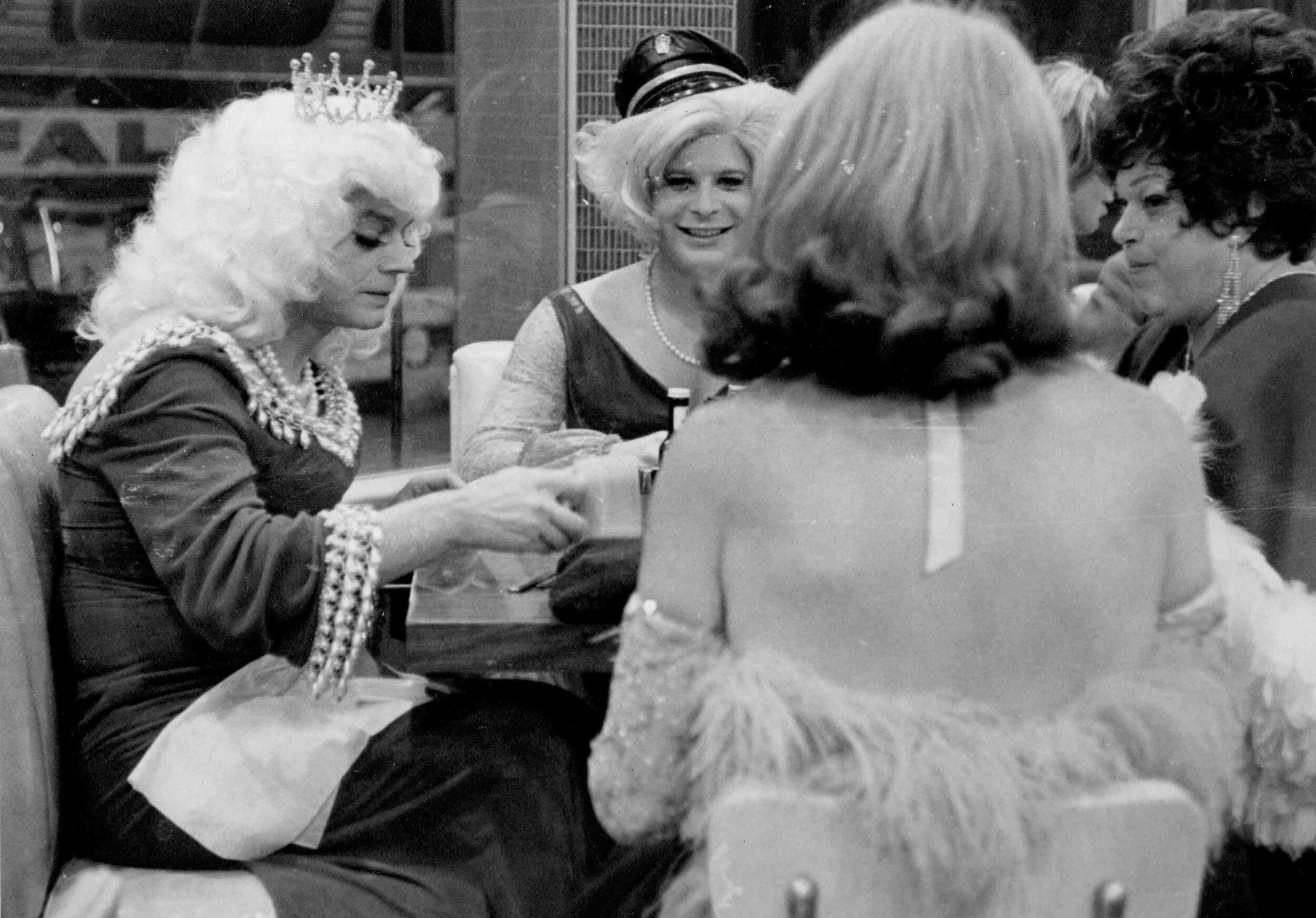
“Those queens fought like hell,” remembered one witness. “You’d think a bunch of ‘girls’ couldn’t do much damage, but honey, when you’ve been beaten and raped by cops, when you’ve been refused medical care, when your own family has thrown you out like trash—you fight like someone with nothing left to lose.”
The riot spilled into the streets and continued through the night. Unlike at Stonewall, there were no photographers present, no reporters to document what happened. The next day, more transgender women and supporters returned to picket the cafeteria, which had banned transgender customers in response to the riot. This marked one of the first known instances of organized transgender direct action in U.S. history.
Here’s where the story gets even more fucked up: this watershed moment was almost completely erased from history. No major newspapers covered it. Police records of the incident mysteriously disappeared. For decades, Compton’s Cafeteria Riot existed only in the memories of those who were there, many of whom didn’t survive the AIDS crisis of the 1980s and ’90s.
“They didn’t want people to know we fought back,” explained historian Susan Stryker, whose groundbreaking documentary “Screaming Queens” finally brought the riot to public attention in 2005. “Transgender resistance didn’t fit the narrative they wanted to tell about passive victims who needed saving.”
The erasure was so complete that even many LGBTQ+ historians were unaware of the riot until nearly 40 years after it occurred. When Stryker discovered a brief reference to the “uprising of drag queens” in the archives of gay liberation periodicals, she had to piece together what happened through painstaking interviews with survivors and witnesses.
Why was this history buried? Simple: it centered transgender women—particularly trans women of color—as the vanguard of the LGBTQ+ liberation movement. It challenged the comfortable narrative that the movement began with Stonewall and was led primarily by white gay men. The Compton’s story was inconvenient for those who wanted to sanitize queer history for mainstream consumption.
What makes the Compton’s Cafeteria Riot even more remarkable is that it actually led to concrete changes in San Francisco. In the aftermath, a network of transgender support services emerged. The city established the Tenderloin Health Clinic, which provided hormones and healthcare to transgender people—the first of its kind in the nation. The police department even initiated the first-ever training on interacting with transgender people.
Sergeant Elliott Blackstone, the SFPD’s first liaison to the “homophile community,” became an unlikely ally. After the riot, he worked with transgender activists to stop police harassment and helped establish programs to support transgender residents. “I just treated them like human beings,” Blackstone later said, “which nobody else was doing.”
The riot also galvanized the formation of organizations like Vanguard, one of the first gay youth organizations in the U.S., and the National Transsexual Counseling Unit, the first peer-run support organization for transgender people. These laid the groundwork for the transgender rights movement that continues today.
“We built something from nothing,” said Tamara Ching, a Tenderloin activist who lived through this era. “We created community when the whole damn world wanted us dead or invisible.”
The heroes of Compton’s didn’t get streets named after them or Hollywood biopics made about their lives. Many died in obscurity, their contributions uncelebrated. Women like Alexis Miranda, who later became an influential transgender activist; Tamara Ching, who fought for the rights of transgender sex workers; and Amanda St. Jaymes, who established support services for transgender women in the Tenderloin.
“Some of the fiercest women I ever knew didn’t live to see their impact,” recalls Felicia Elizondo, one of the few surviving veterans of the Tenderloin scene. “They died from violence, from AIDS, from the sheer exhaustion of fighting every day just to exist.”
Unlike Stonewall, where key figures like Marsha P. Johnson and Sylvia Rivera eventually received some recognition (though still not enough), many of the women who fought at Compton’s remain nameless in historical records. Their revolutionary act was nearly lost to history, remembered only by those who were there.
The anonymity of many Compton’s participants speaks to the precarious nature of transgender life in the 1960s—and still today. Many lived under assumed names, without identification documents, invisible to official records. They existed in the margins, which made their uprising all the more remarkable and all the more easily erased.
If you think this is just ancient history, wake the fuck up. In 2023, we’re seeing the most aggressive legislative assault on transgender rights in modern history. Over 500 anti-trans bills have been introduced in state legislatures in recent years. Access to healthcare is being restricted. Transgender people are being banned from public spaces. Sound familiar?
“It’s the same playbook,” says Miss Major Griffin-Gracy, a transgender elder who has been fighting for rights since the 1960s. “Criminalize our existence, push us out of public spaces, make it impossible to live authentically. They’ve just dressed it up in fancier language.”
The courage of the women at Compton’s Cafeteria provides a powerful template for resistance in the face of overwhelming oppression. They didn’t wait for permission to fight back. They didn’t seek respectability. They recognized that when a system is designed to destroy you, sometimes you have to break the whole damn thing and start over.
“We’ve been here before,” warns historian Jules Gill-Peterson. “And the lesson from Compton’s isn’t to write polite letters to politicians. It’s that direct action gets the goods. It’s that sometimes you have to throw the first punch—or the first coffee cup.”
Today, the corner of Taylor and Turk in the Tenderloin bears a plaque commemorating the riot. In 2017, the city of San Francisco renamed a section of Turk Street as “Compton’s Transgender Cultural District”—the first legally recognized transgender district in the world. It’s a belated recognition of the community that has called this area home for over half a century and the uprising that marked its coming of age.
But the real legacy of Compton’s isn’t in plaques or street names—it’s in the radical tradition of transgender resistance it established. From Compton’s to Stonewall to the modern movements against police brutality, the thread of transgender leadership in liberation struggles remains unbroken, even when unacknowledged.
“Those girls didn’t have Twitter or TikTok or any way to document what they did,” reflects contemporary transgender activist Raquel Willis. “But they changed the world anyway. Imagine what we can do now with all the tools and visibility we have.”
The next time you celebrate Pride, remember that it wasn’t born from corporate sponsorships and rainbow capitalism. It was born from a coffee cup thrown in a cop’s face by a transgender woman who had decided she wasn’t going to take any more shit. It was born from the broken windows of a cafeteria in the Tenderloin and the fiery determination of women who fought back when the world told them they shouldn’t even exist.
That’s the legacy of Compton’s Cafeteria Riot—not just a historical footnote, but a battle cry that still echoes today: We have always been here. We have always fought back. And we’re not going anywhere.
Bone Spurs meets Bone Saw by Clay Jones
How does Trump sleep? Probably with a lot of fartin’ and snorin’. Read on Substack
Donald Trump loves asskissers because he is an asskisser. That explains why his lips are constantly puckered.

During his speech in Saudi Arabia at the Investment Forum, he spent a good portion of it waxing non-eloquently about the awesomeness of Mohammed Bin Salman, the Crown Prince.
Trump said, “Riyadh is becoming not just a seat of government but a major business, cultural, and high-tech capital of the entire world.”
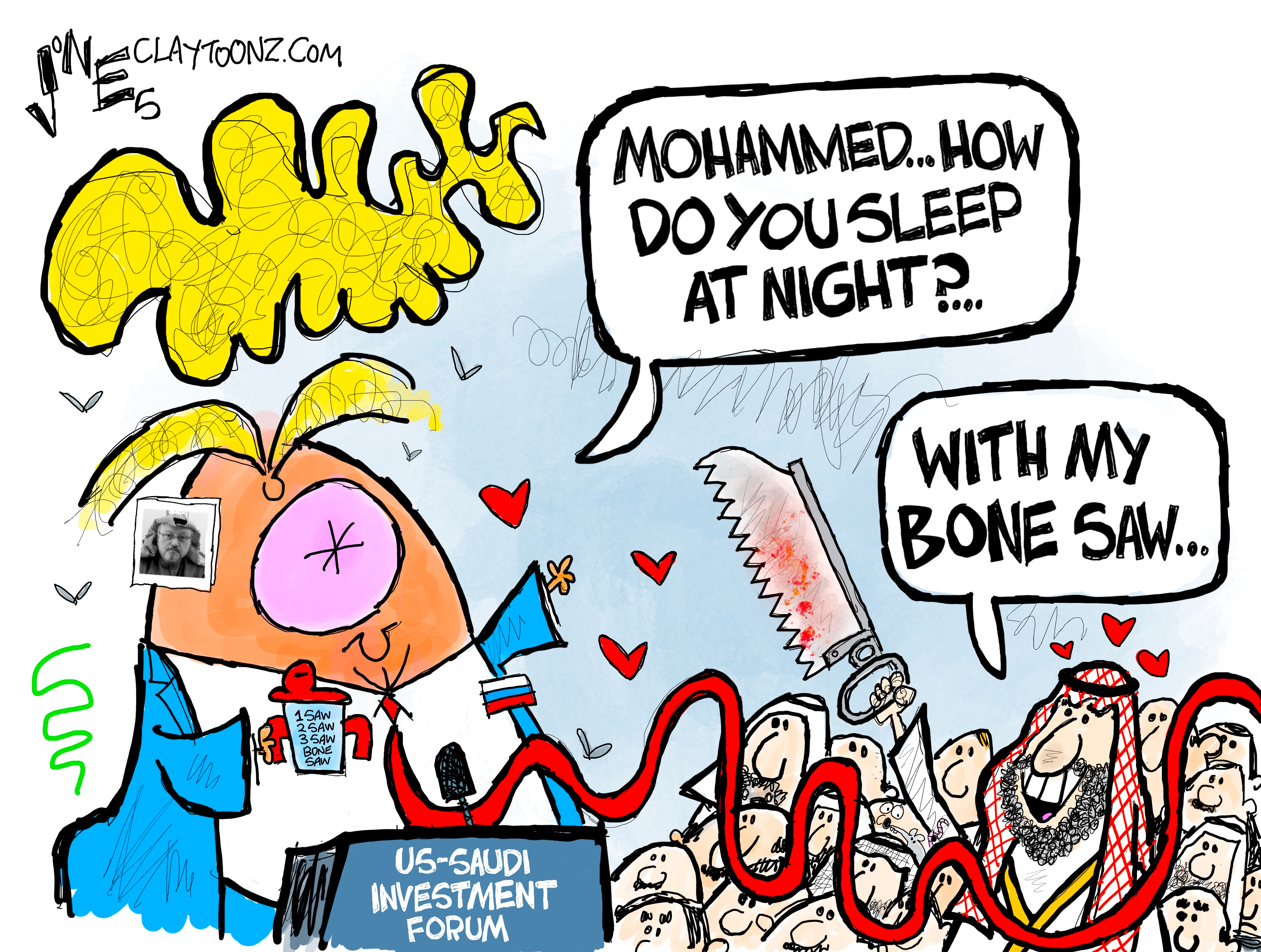
MBS was sitting in the audience directly across from Trump, and Trump asked rhetorically, “Mohammed, do you sleep at night? How do you sleep? Critics doubted that it was possible, what you’ve done, but over the past eight years, Saudi Arabia has proved the critics totally wrong.”
“He’s your greatest representative, greatest representative. And if I didn’t like him, I’d get out of here so fast. You know that, don’t you? He knows me well. I do — I like him a lot. I like him too much.”
The crowd applauded and giggled as Trump flirted with the man who directed the murder of Jamal Khashoggi, a Saudi journalist living in the United States for his safety. The crowd was made up of the world’s most powerful CEOs, like Jensen Huang, Larry Fink, and Sir Shit-for-Brains Elon Musk. So naturally, this audience lacked morals and integrity. What’s a little murder when it comes to making billions of dollars? These people, like Trump and MBS, aren’t the biggest fans of journalists.
I shouldn’t have to refresh your memory, but just in case, in 2018, Jamal Khashoggi was lured into the Saudi consulate in Istanbul, Turkey, murdered and hacked up with bone saws by Saudi agents on the orders of Trump’s buddy, Mohammed Bin Salman.
After the murder, Trump said it was a “bad event,” and went on to defend MBS. He said, “Nobody has directly pointed a finger.” That’s a lie. Our intelligence agencies have “directly pointed a finger at him.” The United Nations has “directly pointed a finger at him.”
Trump also said that MBS is “innocent until proven guilty.” But MBS will never be proven guilty because they don’t have fair trials in Saudi Arabia. The nation doesn’t have due process, freedom of speech, human rights, or elections. Those are things Trump hates, which is probably why he spent another portion of his speech whining and lying about our elections. He lied that he won the 2020 election to people who don’t hold elections.
There will never be an investigation into Khashoggi’s death in Saudi Arabia. MBS will never stand trial. This man didn’t just order the murder, but that Khashoggi be cut into pieces with bone saws. Mohammed Bin Salman is a sick murderous fuck.
When Jared Kushner, who worked directly with MBS as a White House adviser, was asked about the murder last year, he said, “Are we really still doing this?” Jared said he hadn’t seen the US Intelligence report that concluded MBS ordered the murder of Khashoggi, finding fault with it because it was made during the Biden administration.
Of course, not reading the report made it a lot easier for Jared to accept $2 billion from MBS. Jared acts like being made to feel uncomfortable about accepting a $2 billion gift from a murderer is worse punishment than being sliced apart by a bone saw.
Under the Trump regime, our nation feels it’s more important to secure arms deals with Saudi Arabia than to stand up for our American principles. Plus, those arms deals deliver a quid pro quo as the Saudi Government will conduct golf tournaments at Trump golf courses, and invest in new Trump resorts in their nation.
Just remember that all the money Trump and Jared take from MBS is blood money.
How does Donald Trump sleep at night? Probably in a bed full of KFC and Big Mac crumbs.
Did I do that? ToonAmerica, the site using AI to steal my cartoons, is down.

Why is it down? Because of this.
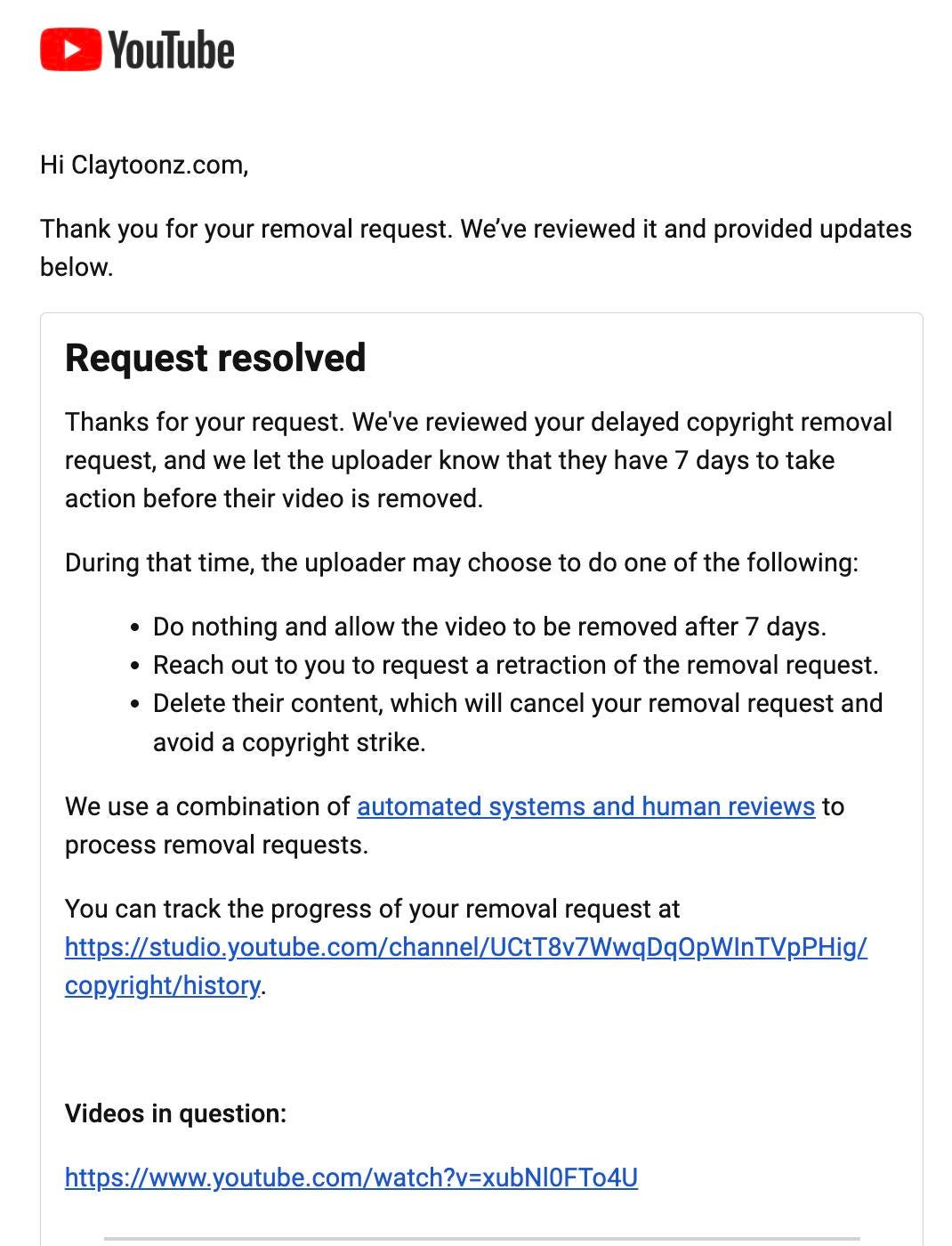
The thieves can’t fight my reports or those from my colleagues, so they remove the videos, avoiding copyright strikes and saving their channel from deletion. They saved the channel, but now there’s no content because all their content was stolen copyright. That’s all they had.
I’m not declaring victory yet because I don’t know if the ToonAmerica YouTube channel will start over, create a new channel, find another scam to fuck people over with, or give up. But for now, they can’t monetize the cartoons they stole, at least not on YouTube.
But TikTok is something else.
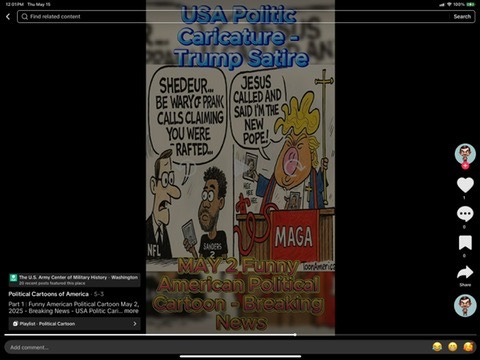
Now I have to take them down on TikTok.
AmeriSatire, the other one stealing cartoons with AI, is still up, but they’re next on my target. Thanks to my friend and colleague, Pedro Molina, I now know that they’ve stolen one of my cartoons.
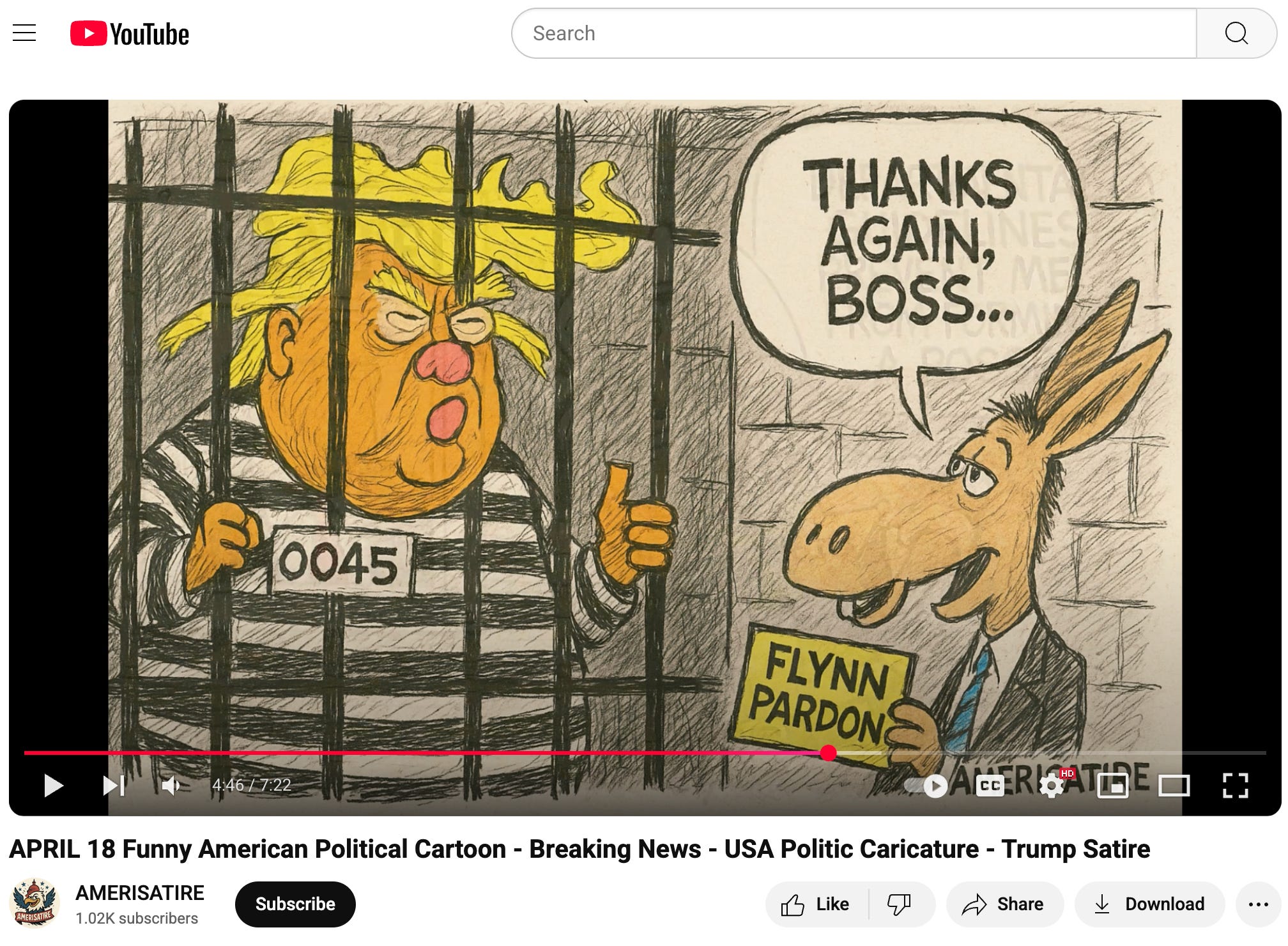
That means I can file a report on them. And why did AI make Flynn a donkey?
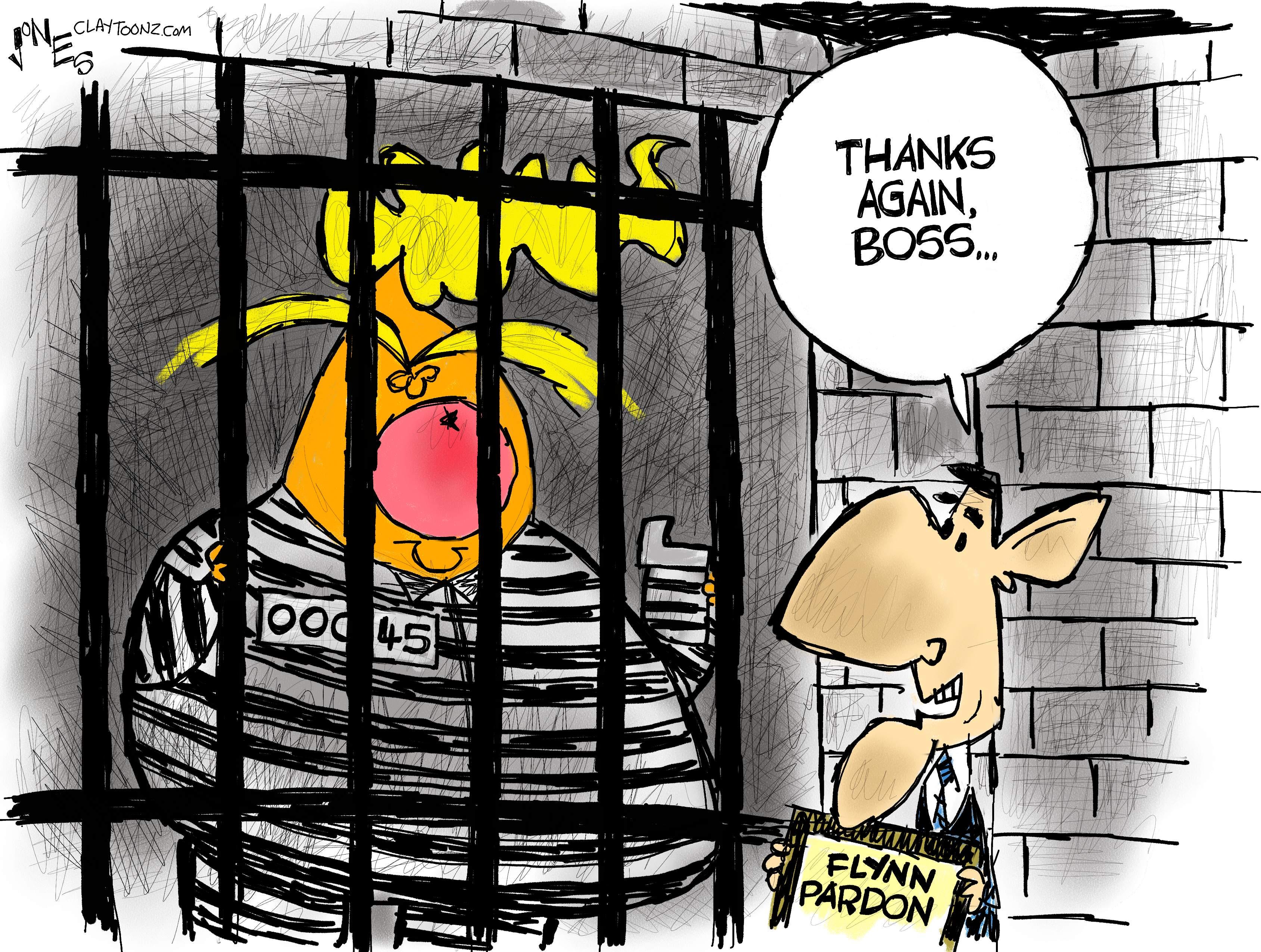
Creative note: I almost did my bone saw cartoon yesterday, but went for the Pete Rose one instead. I think this cartoon is better and more important.
Music note: I listened to Blondie.
Drawn in 30 seconds: (snip-go see it!)
| May 16, 1792 Denmark became the first country to outlaw the slave trade.  CHRONOLOGY-Who banned slavery when? CHRONOLOGY-Who banned slavery when? |
| May 16, 1918 The U.S. Congress passed the Sedition Act, legislation designed to protect America’s participation in World War I. Along with the Espionage Act of the previous year, the Sedition Act was orchestrated largely by A. Mitchell Palmer, the United States attorney general under President Woodrow Wilson. The Espionage Act, passed shortly after the U.S. entrance into the war in early April 1917, made it a crime for any person to convey information intended to interfere with the U.S. armed forces’ prosecution of the war effort or to promote the success of the country’s enemies. Aimed at socialists, pacifists and other anti-war activists, the Sedition Act imposed harsh penalties on anyone found guilty of making false statements; insulting or abusing the U.S. government, conscription, the flag, the Constitution or the military; agitating against the production of necessary war materials; or advocating, teaching or defending any of these acts. The Sedition Act of 1918 |
| May 16, 1943 The Nazis crushed the Jewish uprising in the Warsaw ghetto after a month of bloody fighting. 56,000 died in the struggle.  Read more |
| May 16, 1967 Nhat Chi Mai immolated herself in Saigon, the capital of South Vietnam, to protest the war. “I offer my body as a torch / to dissipate the dark / to waken love among men / to give peace to Vietnam.”  The flower known as Nhat Chi Mai. Read more |
| May 16, 1998 Tens of thousands of Britons supporting Jubilee 2000 formed a human chain around the meeting place of the G7 Summit (an annual meeting of the leaders of the largest industrial countries) in Birmingham, England. Jubilee 2000 urged the major international lending countries to relieve terms of and forgive the massive indebtedness of poor countries around the world. Jubilee 2000 by Noam Chomsky |
https://www.peacebuttons.info/E-News/peacehistorymay.htm#may16
So after about two hours a different person than who checked him in came into the waiting room and told Ron they did the diagnostic and it showed this spark plug dome clearance problem so Ron needed to buy a new engine. Ron told them him drove it in and he was driving it out. The guy said that it could cause more damage to the engine and he shouldn’t drive it. Ron told him he was leaving with the car!
That seemed to cause them some problems because it took them almost another hour to bring Ron the car. It was the person who checked him in who came into clear the paper work with Ron over what was done. When Ron questioned them on what spark plugs they put in she said none they did not even do anything like that. She showed him the paperwork and it said that they put it on the diagnostic machine and it gave an error code meaning that the spark plug was seized with an intrusion of coolant fluid. The suggested thing was to try to remove the spark plug.
Instead they did the oil change, checked the fluids, and rotated the tires. The standard stuff for an oil change. They discounted the $360 dollar diagnostic tests $100 because Ron told them to not do it but they had already started it, they don’t say if they completed it. When he signed in the woman tried to tell him he needed the 60,000 mile fluid flush and it would cost $650.00. Yet she did not tell him and the paperwork did not say how much each fluid was or cost.
When he got home Ron told me the other part of this. Our car is the top of the line with all option. It has had all maintenance done at the dealership along with us having bought the “butler service” keeping the paint job as grand as possible by redoing the clear coat after doing touch up work. It has a very high resale price. The dealership has been sending us offers to buy the car back or give us a great trade in for it. Seems they have wanted it back so badly someone thought if they went in and told this senior citizen that their car that would be paid off next month and was 7 years old needed a 10 grand engine replacement they might get him to deal the car away to them.
The thing that I stick on is after they told Ron that and he said no he was taking the car home it took them an hour to bring it out from the garage to the waiting room area. Why. Did they just not do anything for a couple of hours and then tell him that thinking he would be too scared to try to drive it home? So then they had to do the service he had an appointment for? Or did they do it and had something else going on that they had to do to get the car ready to come back to the front? It took three hours to run the diagnostic machine, do the oil change and fluid check, and rotate the tires. Seems a long time to me. I would love to hear the thoughts you all have. Hugs.
Ron took our 2018 Ford Escape to the dealership this morning for an oil change and that the car ran rough when first started. On the way there the check engine light came on. No blinking but steady. So the dealership told Ron that to even do the tests would be $360 plus the cost of the oil change along with any needed repairs. They came back to Ron nearly 2 hours later and told him we needed a new engine for $10,000 because of a dome spark plug clearance problem. Ron told them he drove it there with no issues and he was driving it home. I called Randy who has some knowledge and works with mechanics who say that it is possible but not likely and that the engine should go for $3,500 not $10,000. I found online that normally it is the plug that is the problem, using the wrong plug or the plug specs have changed a small amount. But like anything online I couldn’t find a real clear answer. I could use some help if anyone out there understands engines and this stuff. Thanks and hugs
May 15, 1870 Julia Ward Howe Julia Ward Howe, suffragist, abolitionist and author of the “Battle Hymn of the Republic,” proposed Mother’s Day as a peace holiday. She had seen firsthand some of the worst effects of war during the American Civil War—the death and disease which killed and maimed, and the widows and orphans left behind on both sides and realized that the effects of the war go beyond the killing of soldiers in battle. Mother’s Day did not become a national holiday until declared by President Woodrow Wilson in 1914. “… Disarm! Disarm! The sword of murder is not the balance of justice.” Blood does not wipe our dishonor, Nor violence indicate possession. As men have often forsaken the plough and the anvil At the summons of war, Let women now leave all that may be left of home For a great and earnest day of counsel.” Read about her Mother’s Day Proclamation |
| May 15, 1935 The National Labor Relations Act was passed, recognizing workers’ rights to organize unions and bargain collectively with their employers. Read more |
| May 15, 1957 Britain tested its first hydrogen bomb over Christmas Island in the South Pacific, after just two years of development.  Mushroom cloud over Christmas Island |
| May 15, 1965 A National teach-in to oppose the Vietnam War was held in Washington, D.C. |
| May 15, 1966 The American Friends Service Committee, SANE (The Committee for a Sane Nuclear Policy), and Women March for Peace, along with four other organizations, sponsored a 10,000+ person anti-war picket at the White House and a 60,000+ rally at the Washington Monument to oppose the Vietnam War. . . . elsewhere the same day . . . Buddhist altars were placed in streets to impede troops arresting dissidents in South Vietnam. |
| May 15, 1969 Governor Ronald Reagan sent in the National Guard to reclaim People’s Park from 6,000 protesters in Berkeley, California, who had occupied the space and created the park. Police gunfire killed a bystander, James Rector, blinded another, and injured dozens.  People’s Park March, Friday May 30, 1969, at the intersection of Haste Street and Telegraph Avenue, in Berkeley |
| May 15, 1970 In response to the U.S. invasion of Cambodia (an expansion of the Vietnam War) and the killings at Kent State and Jackson State Universities, several million U.S. students held campus strikes to oppose the Vietnam War.  |
| May 15, 1970 The Native American Rights Fund filed suit on behalf of the Hopi tribe to prevent strip-mining on sacred Black Mesa in Arizona. |
| May 15 (since the 1980’s) International Conscientious Objectors Day, established to honor those who leave or refuse to enter their country’s armed forces for reasons of principle. Conscientious Objector Day history  |
https://www.peacebuttons.info/E-News/peacehistorymay.htm#may15

