It’s World Press Freedom Day, I celebrated with a great conversation on The Andy Borowitz Showwith Andy and director Laura Nix about free speech, and the predictions made in the film DEMOCRACY UNDER SIEGE that have come true since its release.
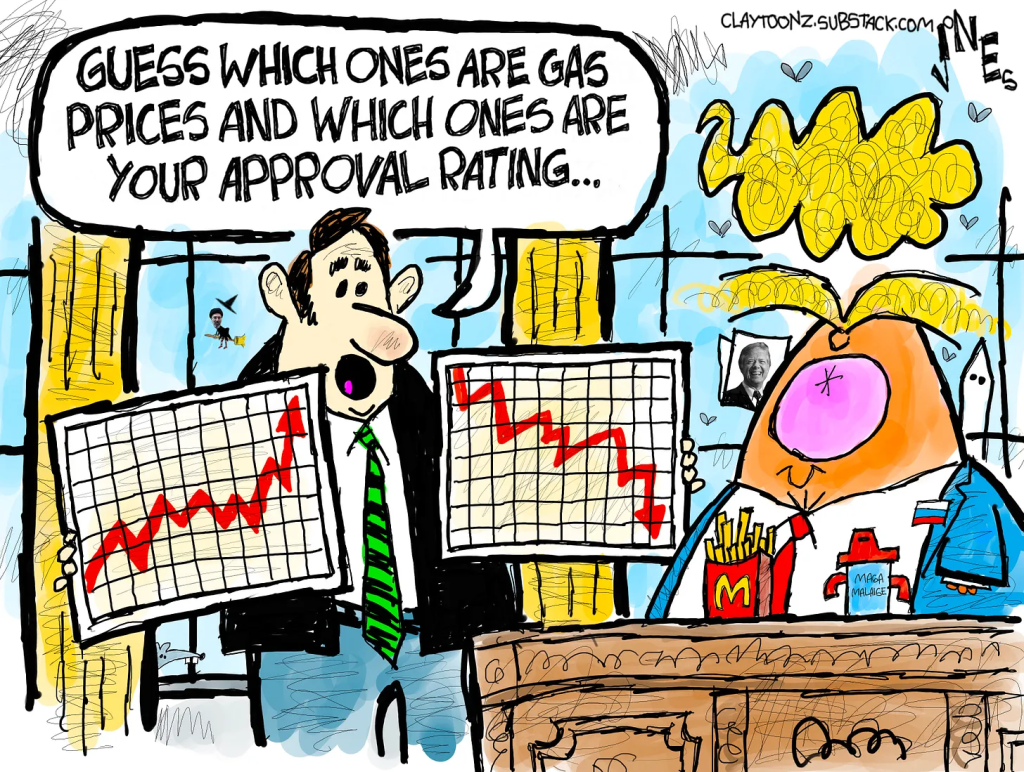
Today, the national average gas price is $4.43 a gallon. That’s the national average. If you are in California, a gallon of gas will cost you more than $4.43. If you’re in a place like South Carolina, it will probably be a little less. At any rate, it’s much more expensive than it should be, all because of Donald Trump.
One whatabout that MAGAts use is that gas prices were high when Joe Biden was president, at least for a minute. What they leave out is that Joe Biden didn’t do anything to cause high gas prices. When gas prices were high under Biden, they were high internationally, and again, not because of any negative policies inflicted by President Biden.
Today, gas prices are also high internationally, and it’s all because of Donald Trump. Donald Trump chose to start a war that didn’t need to be started. Trump is trying desperately to get a deal with Iran and get them to the negotiating table, which is where they were before he started dropping bombs on them. (snip-MORE)
Donald Trump is attempting to select his own citizenry and control who can vote by gathering the personal details of all Americans, Arizona’s top election official has warned.
Adrian Fontes, Arizona’s Democratic secretary of state, fears that the Trump administration’s active efforts to forcibly extract voter files from 30 states including Fontes’s own are part of a bigger plan to gather vital information on all US citizens into a centralised database. “Trump is trying to amass a master list that will allow him to declare someone an enemy of the state,” he said.
In his 19th-floor office in Phoenix, Fontes said that in his view Trump wants to create the equivalent of “apartheid in the United States” and likened his actions to those of his counterpart in North Korea. With personal information on all Americans at his disposal, the president could regulate key aspects of the lives of his opponents, including “shutting off their bank accounts, or keeping them from getting healthcare”.
“This is Donald Trump trying to pick his own voters,” he said.
Fontes won a major victory in his running battle with the Trump administration on Tuesday when a federal judge threw out a lawsuit from the US justice department against Arizona over its refusal to hand over its voter roll. The judge, Susan Brnovich, a Trump appointee, ruled that the Department of Justice was not entitled to the document under federal law.
The suit was part of a push by the DoJ to obtain voter roll information from all 50 states, suing 30 including Arizona that have refused to co-operate. At least 13 states have voluntarily complied with the DoJ’s demands, but many others are resisting.
In those cases where courts have ruled on the dispute – California, Oregon, Michigan, Massachusetts and Rhode Island – all judges have found against the administration. Fontes – who was himself sued after he declined to hand over the data, pointing out that it would be illegal under state law to divulge sensitive personal information about almost 5 million Arizonan voters – has joined that list of vindicated parties.
“This is now the sixth federal court to reach the same conclusion. Arizona acted correctly in refusing this request, and today’s ruling vindicates that decision,” he said.
Fontes was elected secretary of state four years ago as part of a sweep by Democrats of top statewide positions. Katie Hobbs was elected governor and Kris Mayes as attorney general.
All three are now in re-election battles facing Republican challengers who have in varying degrees embraced the lie that the 2020 election was stolen from Trump.
Arizona has for years been pivotal to Trump’s efforts to stoke election denial conspiracy theories. Maricopa county, which covers Phoenix, is one of the largest and most electorally consequential swing counties in the country.
In 2020, it was the focus of a fierce battle in which Trump loyalists attempted to declare victory in the face of his defeat to Democratic rival Joe Biden. The Republican-controlled state senate contracted Cyber Ninjas, a private security firm that had no background in election administration, to conduct an audit into Maricopa county’s results.
The audit, which was widely debunked, concluded that Biden had won the election.
Arizona is now back in the crosshairs as the November midterm elections approach. The state has been the subject of at least three federal investigations into its election procedures, with the Trump administration continuing to press unfounded claims that electoral fraud is rife.
The DoJ claims that its data demands aim to root out rampant fraud and voting by noncitizens. Fontes rejects that argument .
“This doesn’t have anything to do with non-citizens, because non-citizens don’t vote. Every study shows that,” he said. “So what you have here is an unprecedented invasion into the privacy of Americans, sold under a false narrative of illegal voting.”
In March the FBI seized a vast stash of digital data that had been compiled by the Cyber Ninjas’ audit of Maricopa county in 2020. Though it is unclear what exactly was in the trove, it is possible that it included details of votes cast and images of actual ballots.
The material was handed over to FBI agents under a federal grand jury subpoena by the Republican president of the state senate, Warren Petersen. Fontes was scathing about Petersen’s decision to cooperate with the subpoena, suggesting it may have broken state data-protection laws.
“He was so quick to turn over the material as a political favor to Donald Trump,” Fontes said. “Clearly he had no intention of protecting Arizona voters or legal processes.”
Petersen’s compliance with the FBI subpoena is likely to be a factor in the mid-term election for Arizona attorney general. He is currently the frontrunner to become the Republican candidate challenging Mayes, the incumbent Democrat.
The third federal investigation into Arizona elections is being conducted by Homeland Security Investigations (HSI), the investigative arm of US Immigration and Customs Enforcement (ICE). It is also taking a renewed look at the 2020 presidential election result in a further bizarre move to relitigate a contest that was settled more than five years ago.
“It’s like herpes,” Fontes said, referring to the perpetual resurfacing of the election denial conspiracy in Arizona. “It just keeps coming back. And I just don’t think the state, or the nation, deserves that.”
Trump’s latest ploy to wrestle control over elections from the states is his executive order last month that tries to limit mail-in voting by creating a national voter file to which the US postal service would have to defer before delivering mail ballots. The order, which is being challenged as unconstitutional, is especially sensitive in Arizona, where 80% of votes are cast by mail in a system devised decades ago, ironically, by the Republican party.
“This is a bald-faced attempt at completely controlling American democracy according to the whims of one political actor, and that’s not just un-American, it’s absolutely anti-American,” Fontes said.
Fontes is gearing up for his own potentially bruising re-election battle in November, in which he is likely to be competing against an election denialist. The two Republicans vying for their party’s candidacy in the secretary of state’s race both have election-denial track records.
Alexander Kolodin, a lawyer, was placed on probation by the state bar association after he filed lawsuits challenging Biden’s 2020 victory that a judge slammed as being full of “gossip and innuendo”.
The other candidate, the former chair of the Arizona Republican party, Gina Swoboda, was the Trump campaign’s director of operations on election day in 2020. She claimed in a lawsuit that was dismissed for lack of evidence that more than 1 million ineligible voters may have been on the rolls.
Fontes said he was “cautiously optimistic” that he and his Democratic peers would sweep the state again in November. But he conceded that “we have to be extra vigilant”.
“We have to spend every single day from now until November focused on communicating as clearly as we can with every Arizona voter,” he said.
Two factors were in play this midterm cycle that would make re-election more difficult, he said: unlike in 2022, there is no US senate race in Arizona this year, so there is less of a draw to attract Democratic voters to the polls.
The other factor he pointed to was that since 2022, the rightwing activist group Turning Point USA has grown in influence. Turning Point, whose leader Charlie Kirk was killed by a gunman in September, is headquartered in Arizona and in Fontes’s view has largely surplanted the old Republican party in the state.
“We’ve got to be cautious because we’re going to be running against the conspiracy theories, lies and misrepresentations,” he said. “The stakes of this election are enormous, and every voter will be impacted by the outcome.”
On the last post I made about this I was going to write a long intro. However when I read the comments every point I would have made is made in the comments in far fewer words than I would have done. So if you wish to see opinions on what the government is doing to follow Russia and wipe the LGBTQ+ from society in the name of protecting children / straight people / cis people / and religious privilege to discriminate then please read the comments. Hugs
The Trump administration is investigating three dozen Illinois school districts to assess if their curriculums include “gender ideology” — and parental opt-outs — and whether trans students can participate in competitive sports.
The districts are the latest in a string of public schools, colleges and universities across the country named as subjects of similar federal investigations since President Donald Trump began his second term last year.
The ACLU of Illinois said the Trump administration is wrongly interpreting both federal and state law.
This summary was written by the reporters and editors who worked on this story.
Three dozen Illinois school districts are the latest in a string of public schools, colleges and universities across the country named as subjects of federal investigations into whether the institutions teach about sexual orientation and “gender ideology,” and whether parents can opt out of such curriculum.
The inquiry, announced by the U.S. Department of Justice on Thursday, will also “assess” whether the 35 school districts around the state, plus Chicago’s largest charter school network, allow transgender students to use single-sex bathrooms or participate in competitive sports.
The DOJ’s notice did not say what prompted the investigation or why the districts — which range from rural schools with extremely small enrollment to one of the largest districts in Illinois — and the agency did not respond to a request for clarification. More than half of the school districts are in the Chicago area, though the list does not include any of the large suburban school districts that have attracted attention in recent years for litigation over trans students’ access to bathrooms and locker rooms.
But Thursday’s announcement did point to a June 2025 U.S. Supreme Court decision that requires school districts to allow opt-outs for LGBTQ-related lessons in the classroom, plus a more recent March ruling blocking a California policy that allowed schools to keep a student’s gender transition private from their parents.
“This Department of Justice is determined to put an end to local school authorities keeping parents in the dark about how sexuality and gender ideology are being pushed in classrooms,” Assistant Attorney General Harmeet Dhillon said in the news release.
Dhillon, who advised Trump’s 2020 reelection campaign and rose to prominence as the face of several unsuccessful lawsuits against California’s COVID-19 pandemic restrictions, is the administration’s key lawyer on civil rights issues. As assistant attorney general for civil rights, Dhillon oversees the “Title IX Special Investigations Team” — a joint effort between the DOJ and U.S. Department of Education that was launched last year.
“Supreme Court precedent leaves no doubt: Parents have the fundamental right and primary authority to direct the care, upbringing, and education of their children,” Dhillon said. “This includes exempting their children from ideological instruction that contradicts their values or decisions about their children’s health and best interests.”
In a statement, Gov. JB Pritzker dismissed the inquiry as the Trump administration continuing to “punish states the president does not like,” calling it a “sham investigation.”
“The Civil Rights Division used to investigate actual discrimination concerns to ensure all individuals are treated equally under the law, but they’re now focused on belittling the rights and humanity of LGBTQ+ communities,” he said.
In 2019, Pritzker signed legislation requiring Illinois public schools’ history curriculum “include a study of the roles and contributions of lesbian, gay, bisexual, and transgender people in the history of this country and this state,” but Thursday’s news release made no mention of the law.
String of investigations
The DOJ’s announcement is similar to more than a dozen from the Trump administration since the president began his second term last January, most citing Title IX, the sweeping 1972 federal law that prohibits sex discrimination in education.
One of his first official acts back in power was signing an executive order dubbed “Keeping Men out of Women’s Sports,” which threatened to “rescind all funds from educational programs that deprive women and girls of fair athletic opportunities.”
That included school lunch funds from the U.S. Department of Agriculture, as the state of Maine found out in early 2025 after a public spat between the president and Gov. Janet Mills at the White House over the executive order. After the Department of Education launched an investigation into the state’s education agency and subsequently froze the funding, a judge ordered the USDA to unfreeze the funds, and the agency settled the suit.
Inquiries announced last year in states like New York, Oregon and Washington are ongoing, though the administration has claimed it found evidence of violation of Title IX in Kansas and Colorado school districts. The administration has also launched, and in some cases wrapped up, similar assessments of public universities and community colleges.
ACLU of Illinois cites wrong interpretation
Ed Yohnka with the ACLU of Illinois said the Trump administration is wrongly interpreting both federal and state law, which he said are both “clear that students have an ability to play on sports teams and to use private areas consistent with their gender identity.”
Yohnka also said it was ironic that the Trump administration, brought to power by Republicans who generally oppose government overreach, was trying to limit local control of school districts.
“None of these schools need some ideological culture warrior in Washington, D.C., telling Watseka what their curriculum should be,” he said. “The notion that Justice Department is going to launch investigations and divert money for education because the president signed a piece of paper is just a misuse of our tax dollars.”
Yohnka said he wasn’t aware of any pattern among the three dozen districts the DOJ is investigating, but one school official from rural northwest Illinois has an “emerging operational theory.” In a social media post Friday, Oregon Community Unit School District 220 Superintendent PJ Caposey said he didn’t have “definitive answers” from the DOJ as to why his district was included, he posited it may have something to do with the districts’ participation in a federal School Violence Prevention Program grant.
“To be absolutely clear, this does not confirm that grant participation is the reason for inclusion, nor can we state that as fact,” he wrote. “It is simply one possible connection being explored as we work to better understand the broader picture.”
Capitol News Illinois is a nonprofit, nonpartisan news service that distributes state government coverage to hundreds of news outlets statewide. It is funded primarily by the Illinois Press Foundation and the Robert R. McCormick Foundation.
The Trump administration has made an aggressive push to add the president’s name to buildings, battleships, money and government websites.
President Donald Trump is physically leaving his mark on Washington and beyond, more so than any other president in modern U.S. history.Andrew Harnik / Getty Images file
The federal government is undergoing an unprecedented presidential branding makeover, with Donald Trump’s name being added to everything from buildings and battleships to a drug website and a park pass.
While Trump has had roads and even an airport named after him since winning a second term in office, his administration has initiated a series of actions to imprint his name and likeness on the federal government well beyond internal documents and communications.
The branding is in stark contrast to prior presidencies, including Trump’s first term, when the largest branding controversy involved having his name added to Covid relief checks during an election year.
Here’s a look at all the places and items where the administration has added Trump’s name during his second term.
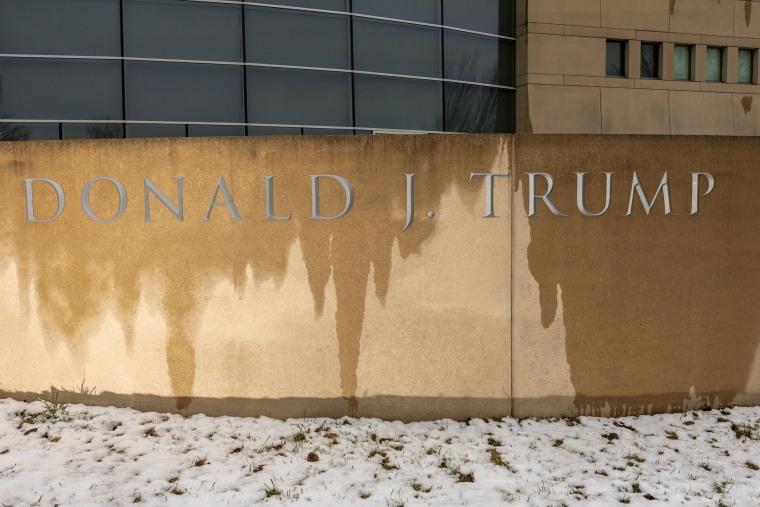
Donald J. Trump U.S. Institute of Peace
The U.S. Institute of Peace headquarters in Washington last year.Alex Kent / Bloomberg via Getty Images file
The first federal building to be named after a sitting U.S. president was the U.S. Institute of Peace headquarters in downtown Washington in December 2025. The agency was named by Congress when it was established through legislation in 1984.
The renaming was carried out by the State Department.
“President Trump will be remembered by history as the President of Peace. It’s time our State Department display that,” Secretary of State Marco Rubio said in a post on social media on Dec. 3, 2025.
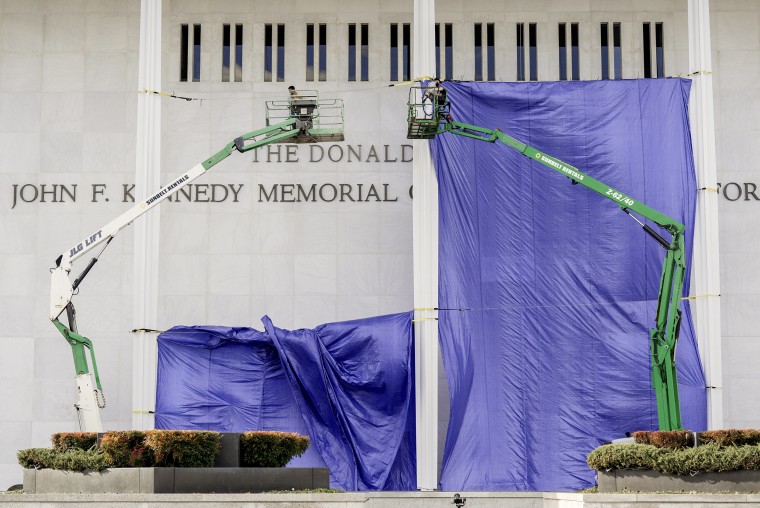
The Donald J. Trump and John F. Kennedy Memorial Center for the Performing Arts
The Kennedy Center in Washington last year.Al Drago / Bloomberg via Getty Images file
About two weeks after the Institute of Peace renaming, the president’s handpicked board at the John F. Kennedy Memorial Center for the Performing Arts voted to add his name to the storied performance venue as well.
“The unanimous vote recognizes that the current Chairman saved the institution from financial ruin and physical destruction,” a spokesperson for the center said at the time.
Democrats and some Kennedy family members say the name change is illegal, since the center was established as a living memorial to Kennedy. Rep. Joyce Beatty, D-Ohio, who’s an ex officio member of the board, filed a suit challenging the change. The case is still in litigation.
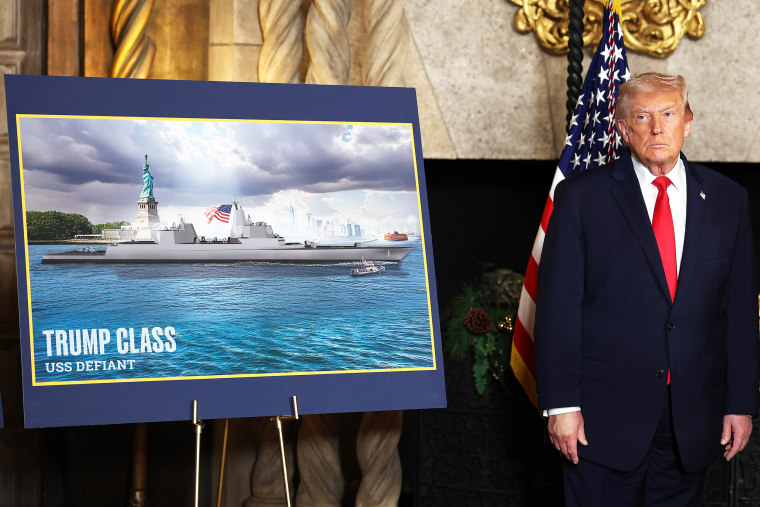
Trump-class battleships
“Trump-class” battleships were announced at Mar-a-Lago last year.Tasos Katopodis / Getty Images file
Also in December, then-Navy Secretary John Phelan unveiled “Trump-class” warships during an event at Trump’s Mar-a-Lago estate in Florida.
The “Trump-class battleships,” including a vessel dubbed the USS Defiant, will be “the largest, deadliest and most versatile and best-looking warship anywhere on the world’s oceans,” Phelan said.
“Hopefully we never have to use them, but there will never be anything built like these,” Trump said at the event.
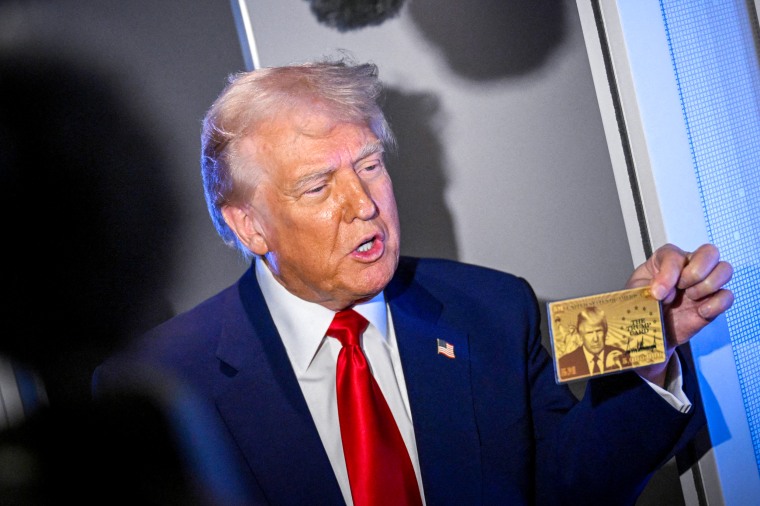
The Trump gold card
President Donald Trump displayed a “Trump gold card” visa aboard Air Force One last year.Mandel Ngan / AFP – Getty Images file
The president unveiled his “Trump gold card” visa in December. Foreign nationals can pay $1 million to obtain the card, which enables them to legally live and work in the U.S. once they’re approved.
It’s “the green card on steroids,” Trump said as he displayed the card at the White House. He said companies can buy the gold cards for students so they can stay in the country instead of being “shipped out” after graduation.
As of late April, only one person has been approved for the card, The Associated Press reported.
Trump coins
Designs for Semiquincentennial gold coins featuring President Trump.Treasury United States Mint
In March, a federal commission consisting solely of Trump-appointed members approved a 24-carat commemorative gold coin depicting the president in honor of the country’s 250th anniversary.
The design approved by the Commission of Fine Arts features an image of Trump in the Oval Office on one side and a bald eagle on the other. The coin needs to be approved by the Treasury Department, which has already announced plans to release a separate $1 coin featuring the president as part of the anniversary celebration.
Trump dollar bills
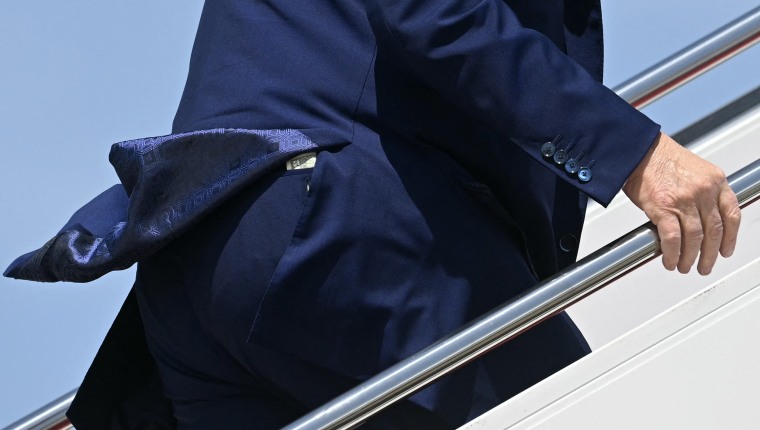
The President boarding Air Force One with a $50 bill sticking out of his pocket last year.Jim Watson / AFP via Getty Images file
The Treasury Department announced in March it would be adding Trump’s signature to “future paper currency” as another part of the country’s 250th anniversary.
“There is no more powerful way to recognize the historic achievements of our great country and President Donald J. Trump than U.S dollar bills bearing his name, and it is only appropriate that this historic currency be issued at the Semiquincentennial,” Treasury Secretary Scott Bessent said in his announcement.
Paper currency typically only bears the signature of the treasury secretary and treasurer, and has never featured that of a sitting president.
Trump passports
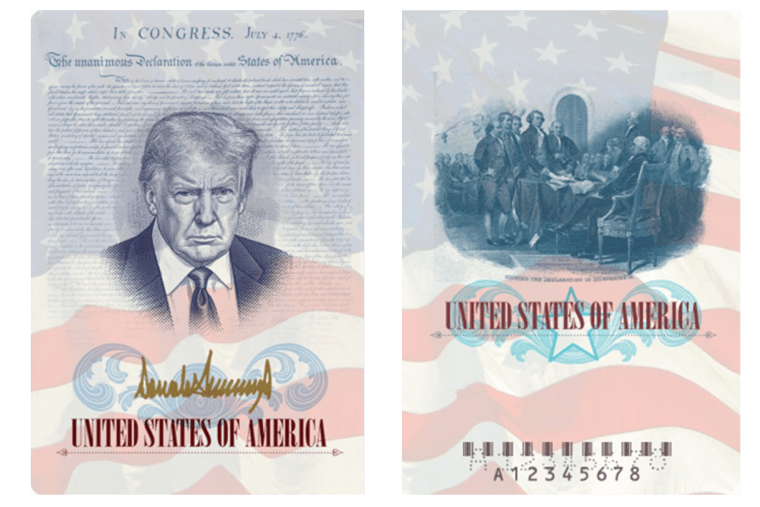
The State Department will be releasing a limited series of U.S. passports featuring an image of President Trump.U.S. State Dept.
The State Department announced in April that it would be issuing a limited number of U.S. passports with a large image of Trump on the inside cover as part of the 250th celebration as well.
Olivia Wales, a White House spokesperson, said in a statement that the “new patriotic passport design provides yet another great way Americans can join in the spectacular celebrations for America’s 250th birthday.”
Trump national park pass
The Interior Department revealed in November that it was featuring Trump and George Washington on the front of its annual park pass, citing the 250th anniversary.
That move led to a lawsuit from an environmental group, alleging the department violated a 2004 law requiring the pass to carry a picture by the winner of an annual photo contest. The winner for this year had been image of Glacier National Park in Montana.
Trump banners
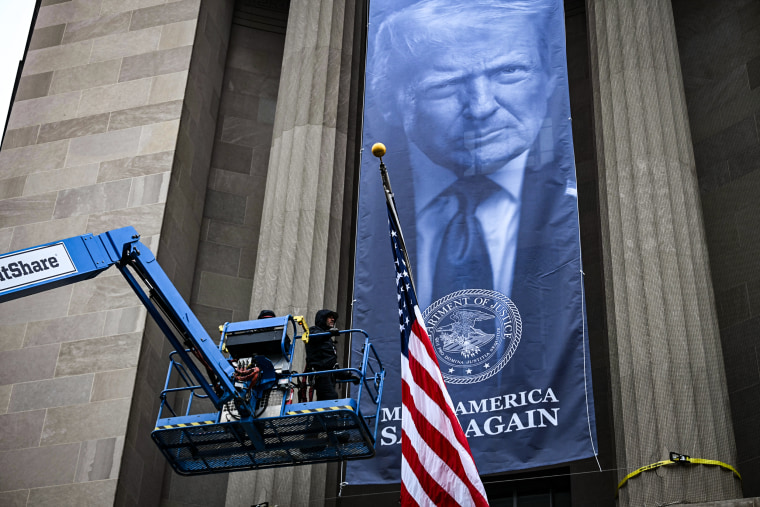
The Department of Justice headquarters in Washington earlier this year.Brendan Smialowski / AFP – Getty Images
Large banners of Trump have been hung from the Justice, Agriculture and Labor departments.
“We are proud at this Department of Justice to celebrate 250 years of our great country and our historic work to make America safe again at President Trump’s direction,” a DOJ spokesperson said when the banner was hung in February.
TrumpIRA.gov
Trump issued an executive order in April directing the Treasury Department to launch a new website called TrumpIRA.gov.
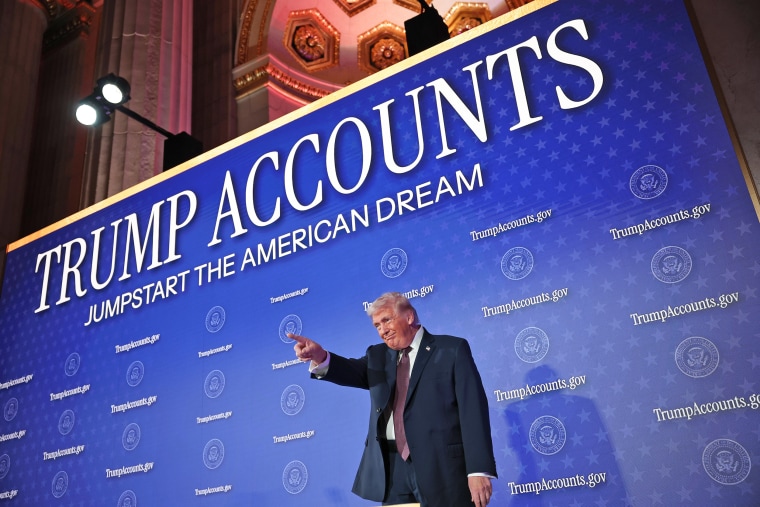
A “Trump Accounts” event in Washington in January.Win McNamee / Getty Images file
The Trump administration is launching new savings accounts for children this summer called Trump Accounts.
Created under the “big, beautiful bill,” Trump Accounts are tax-advantaged investment accounts for children under 18. Babies born from Jan. 1, 2025, to Dec. 31, 2028, will get $1,000 from the Treasury Department to kick-start their accounts.
“This is something that’s so special,” Trump said at his State of the Union speech in February.
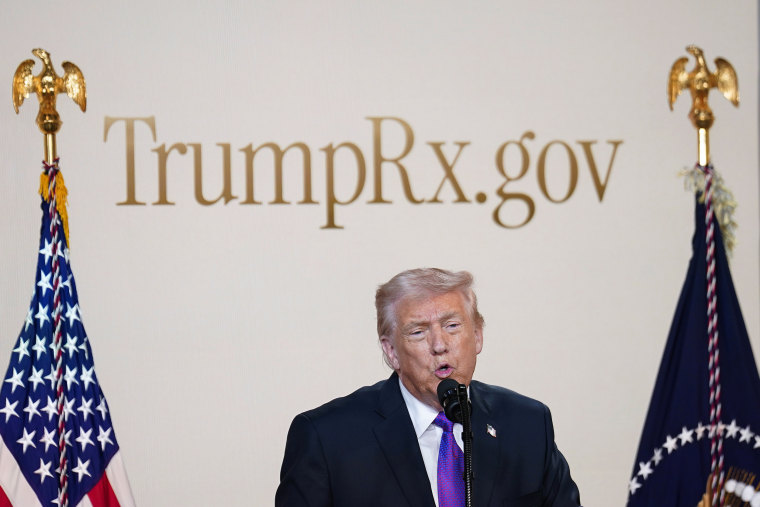
TrumpRx.gov
The launch of “TrumpRx.gov”, which the adminstration said would help to lower prescription drug prices, at the White House in February.Nathan Howard / Getty Images file
In February, the administration launched TrumpRx.gov, a self-pay prescription drug website. It offers coupons that people can take to the pharmacy where they fill their prescriptions.
“You’re going to save a fortune,” Trump said at the news conference launching the site. “And this is also so good for overall healthcare.”
I love this video. John Fugelsang is a wonderful person to elaborate on the bible and he does so as a follower of Jesus, not Paul or the Old Testament. His mother was a nun and his father was a monk and the way he describes his father wearing his robes is as the Christian jedi of Flatbush. He explains how those using the bible to attack or bash others including the LGBTQ+ are not following Jesus that they are following Paul. He explains clearly how Jesus brought a new covenant for the people doing away with the old one in Leviticus. He explained how those using the bible to bash others and not feed & clothe the stranger/ immigrant are totally against what Jesus preached. He also mentioned how those trying to force the Old Testament of the bible in schools never want the words of Jesus hung in classrooms in public schools, they never want the sermon on the mount posted on the walls. Those kind of people only want authoritarian laws or do and dont do pushed on kids. Enjoy the video, I listen to him on The Daily Beans (news with swearing) friday newscast and his Sirius talk show. Hugs
As Congress finalizes its funding for fiscal year 2027, Republicans are attempting to include five anti-LGBTQ riders in the National Security and Department of State Appropriations Act.
A rider is an unrelated provision tacked onto a bill that must pass — in this instance, the bill provides funding for national security policy and for the State Department.
The riders range from restricting Pride flags in federal buildings to banning transgender healthcare, but all aim to limit the visibility and rights of LGBTQ Americans.
Section 7067(a) prohibits Pride flags from being flown over federal buildings.
Section 7067(c) restricts the United States’ ability to appoint special envoys, representatives, or coordinators unless expressly authorized by Congress. These roles have historically been used to promote U.S. interests in international forums — including advancing human and LGBTQ and intersex rights and other policy priorities. The change would halt what the Congressional Equality Caucus describes as providing “critical expertise to U.S. foreign policy and leadership abroad.”
Section 7067(d) reinforces multiple anti-equality executive orders signed by President Donald Trump, effectively requiring that foreign assistance funded by the United States comply with those orders. This includes rescinding federal contractor nondiscrimination protections, including for LGBTQ people.
Section 7067(e) prohibits funding for any organization that provides or promotes medically necessary healthcare for trans people or “promotes transgenderism” — effectively banning funds for organizations that recognize trans people exist. This is despite the practice of gender-affirming care being supported by nearly every major medical association.
Section 7067(g) reinforces two global gag rules put forward by the Trump-Vance administration. One is the Trans Global Gag Rule, which prohibits foreign assistance funding for organizations that acknowledge the existence of trans people or advocate for nondiscrimination protections for them, among other activities. The second is the DEI Global Gag Rule, which prohibits foreign assistance funding for organizations that engage in efforts to address the ongoing effects of racism, sexism, and other forms of bigotry outside the United States.
The global gag rule has its roots in anti-abortion policy introduced by President Ronald Reagan in 1984, when the 40th president barred foreign organizations receiving U.S. global health assistance from providing information, referrals, or services for legal abortion, or from advocating for access to abortion services in their own countries. Planned Parenthood notes that the policy also affects programs beyond abortion, including efforts to expand access to contraception, prevent and treat HIV/AIDS, combat malaria, and improve maternal and child health.
If organizations funded by the State Department engage in these activities, they could lose funding.
This anti-LGBTQ push aligns with broader actions from the Trump-Vance administration since the start of Trump’s second term, which have focused on restricting human rights — particularly those of trans Americans.
The House Appropriations Committee is responsible for drafting the appropriations legislation. U.S. Rep. Tom Cole (R-Okla.) serves as chair, with U.S. Rep. Rosa DeLauro (D-Conn.) as ranking member. The committee includes 34 Republicans and 27 Democrats.
For FY27 appropriations, Congress is supposed to pass and have the president sign the funding bills by Sept. 30, 2026.
Over 50 cities, mostly European, have either restricted or tabled motions to introduce formal limitations on the advertisement of polluting products and services. Some – including several Dutch municipalities, Stockholm, Edinburgh and Sydney – have banned them altogether.
A ban on advertising of fossil fuels and meat products in public spaces came into effect on Friday in Amsterdam, marking the first capital city in the world to introduce such a policy.
The city’s council passed a legally binding ban on ads for fossil fuels and meat products in a 27-17 vote in January. The ban spans high-carbon products and services like flights, petrol and diesel vehicles, gas heating contracts as well as meat products like fast-food burgers across all public spaces in the city, including on billdboards, public transport and in transit environments.
The burning of coal, natural gas, and oil for electricity and heat is the single-largest source of global greenhouse gas emissions. These are the primary drivers of global warming as they trap heat in the atmosphere and raise Earth’s surface temperature. The meat industry is also responsible for a huge portion of global greenhouse gas emissions, and for nearly 60% of the food sector’s emissions. The global livestock industry alone is one of the world’s highest emitting sectors, estimated to be responsible for between 14-18% of total human-made greenhouse gas emissions.
“Advertising doesn’t just sell products; it grants social licence, shaping what we see as normal and acceptable,” said Andrea Mancuso, Community & Grants Manager at Creatives for Climate. Ahead of the vote in January, Creatives for Climate and local campaign group Reclame Fossielvrij (Fossil Free Advertising) coordinated an open letter backed by more than 100 creatives and industry leaders urging Amsterdam’s council members to fulfill its 2020 commitment to ban fossil fuels and meat ads in the city.
“Promoting fossil fuels directly undermines climate action and locks in behaviour we know must change. By becoming the first capital to legally ban fossil fuel and meat advertising, Amsterdam is drawing a clear line; and setting a global standard,” said Mancuso. (snip-MORE)
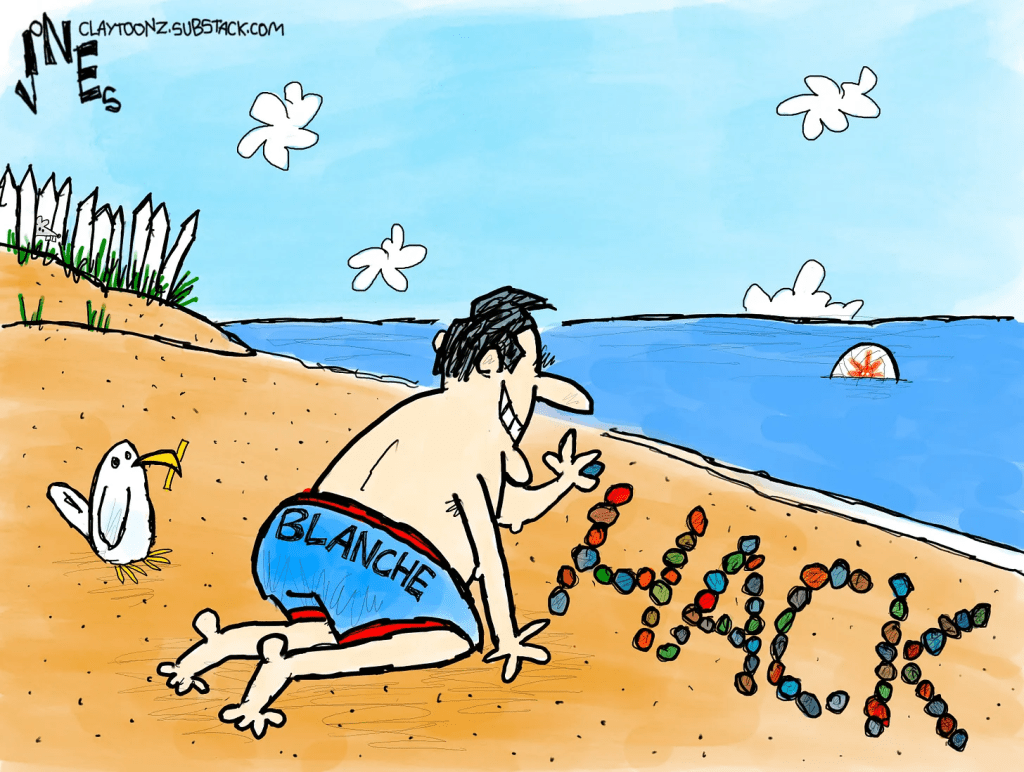
As you know, by now, Todd, Blanche, Donald Trump’s former personal lawyer and current acting Attorney General, is a political hack.
If you had read that someone was going to prison in another country for posting an image of seashells that spelled out 8647, you would think that it was from an authoritarian state. If this were North Korea, would James Comey be put to death by anti-aircraft fire?
Pam Bondi, Blanche’s predecessor, was fired for what many believe was for being too slow to prosecute Donald Trump’s enemies. She had already indicted James Comey once before, which was basically laughed out of court, and never had even the slightest possibility of ever going to trial.
Participation in the Supplemental Nutrition Assistance Program (SNAP) fell by more than 3 million people (8 percent) nationwide between July 2025 and January 2026. The drop followed the enactment of H.R.1, the Republican megabill that made unprecedented cuts to the program. SNAP typically expands to meet need and then shrinks when economic conditions improve. It took over three years for the caseload to drop by over 3 million people (or 7 percent) between its peak in December 2012 and February 2016, during the recovery following the Great Recession.
But economic conditions haven’t been improving as the number of people receiving SNAP has plummeted in recent months, representing the sharpest decline in decades. The last time there was such a steep decrease in participation in such a short period of time (other than temporary spikes following natural disasters) was nearly three decades ago, after Congress enacted very deep cuts to SNAP (then the Food Stamp Program) in 1996. SNAP participation dropped by 9.4 percent (2.2 million people) in the six months between March and September 1997.
SNAP participation has fallen in every state and in some, the drop is particularly alarming. (snip-MORE)