Iowa KWQC morning anchor Dustin Nolan announced his departure from the station Friday in an emotional message that made clear he does not intend to remain in the news industry. Nolan told viewers he believes “that we as a local news station have to be more than trends or sanitized news” and added, “That’s why the facts matter and that’s why we do what we do here.”
Nolan was near tears from the beginning of his message. “I’ll try to get through this. Well, before we go this morning, I have an announcement. Today is my last day here at KWQC TV6. I have chosen to step away from the news industry,” the Emmy Award winning anchor began. “Before I say goodbye, I just want to say, I hope everyone of you that’s allowed me to be a part of your mornings know just how important that I have taken this job. How much it means to me that you’ve trusted … that you’ve trusted me these past few years to bring you the news in the morning.”
He continued: “I promise you I’ve given you everything I have. I’ve never tried to be perfect or what many think a newsman is supposed to be. But I’ve always done my best to be transparent, bring you the facts, and I’ve always been myself. I’ve loved being able to provide a public service to this place we all call home, the Quad Cities.”
Nolan then made it clear he wasn’t leaving to pursue a role at another station. “When it comes to this job, all I’ve ever wanted to do is report on the issues that really matter. I’ve always believed that we as a local news station, owe you, the viewers, the best that we can do because without you, none of us would be able to do this job,” he explained. “I also believe that we as a local news station have to be more than trends or sanitized news because it makes people feel uncomfortable. That’s why the facts matter and that’s why we do what we do here. We have to take people out of their bubbles and comfort zones and make them think about the world we all live in.”
Nolan began working at the station in November 2022, according to his LinkedIn. profile. He is married to his former co-anchor, Jenna, whom he thanked on the show.
Stephanie is a reporter at TheWrap. She has been covering news, politics, entertainment, media, and sports (mostly women’s basketball) for over 15 years. Her experience includes The Guardian, People, the BBC, SB Nation and more.
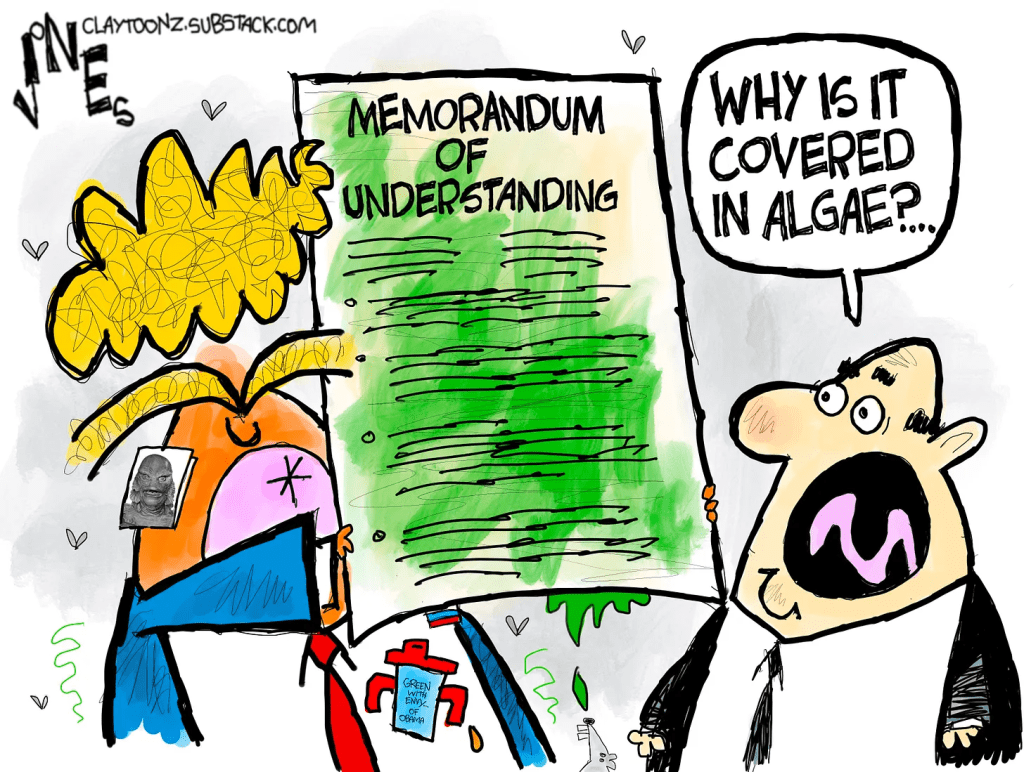
Trump’s failure with the Lincoln Memorial Reflecting Pool is a perfect example of how this regime operates.
He said he wants to beautify Washington DC, though the city is already beautiful. This is like when he came into office in 2017, and before the afternoon was over, he took credit for rebuilding the military. We were spending over $800 billion a year on our military before Donald Trump came into office, so trust me…. We already had a military. If anything, our military is weaker today because Donald Trump just wasted a lot of its armaments on his stupid chosen illegal war. It’s also being led by a chauvinistic, racist, white Christian nationalist with the brain of a moldy sponge.
Back to the pool. Trump wanted to beautify it before July 4, when our nation celebrates its 250th birthday, not to be confused with June 14, which is Donald Trump’s birthday, which will now be commemorated every year by having shirtless men pummel each other in your backyard. (snip-MORE)
The UFC event at the White House last Sunday was not supposed to be political, even though it was held on Donald Trump’s birthday. But after winning his fight, UFC fighter Josh Hokit was being interviewed by podcaster and ring announcer, Joe Rogan, when he grinned and looked into the camera, and said, “And lastly, Michelle Obama is a man! Am I right, America?”
Of course, he is not right, and his racist and sexist conspiracy theory shouldn’t be given the dignity of a defense because it is just too ridiculous and stupid. But what Hokit did wasn’t just disrespectful to Michelle Obama and President Obama, but also to the White House, where he made the comment (hasn’t that place suffered enough during Trump 2.0?), and the country, as this was supposed to be for America’s 250th birthday.
The event itself was disrespectful enough to the White House and the Oval Office without Hokit’s hateful comment. (snip-MORE)
Three things I love in one video. I really enjoy The Majority Report, I love why they have Digby on, and I am very supportive of Platner’s progressive anti establishment corporate democrats policies. As Digby says the party is much more left today that it used to be since the 90s and the center is much more right than it was. She says we have to push back hard against the push to the right that the establishment cooperate democrat’s leadership has made. Hugs
While I detest the end song he plays I love Mark’s take on issues. He doesn’t pull his punches and lays out the facts. In this case it is important to watch to the end where he elaborates on the current attempt to genocide trans people by making them illegal as Russia has. Now requiring that no business, event or medical facility that takes any government money can allow any kind of support or positive affirmation of trans people. He talks about how important it is to let trans youth socially transition and live as the gender they identify with, and to get puberty blockers to not go through the wrong puberty. He mentions trans children figure out their gender the same way and ages that cis kids do. Hugs
Panic over the existence of LGBTQ+ people is becoming so ridiculous it’s almost impossible to tell if it’s satire or not. In this video we’ll look at some of the most ridiculous examples of right-wing hysteria over queer people. Well also talk about how conservatives have successfully weaponized their outrage against queer people and how culture influences politics.
The Humanist Report (THR) is a progressive political podcast that discusses and analyzes current news events and pressing political issues. Our analyses are guided by humanism and political progressivism. Each news story we cover is supplemented with thought-provoking, fact-based commentary that aims for the highest level of objectivity.
As I have posted before on this subject this is an attempt to push a fundamentalist Christianity on the entire rest of the public. It is an attempt to enshrine Christian nationalism and the doctrines of one sect into the laws we all must live by. The people doing these attacks want to make any and all LGBTQ+ content seem dangerous and harmful which would require warning labels. It is about demonizing the way other people live because the hyper religous don’t like it. The Christians are free to live as they wish and think as they want but they can not be allowed to oppress and require everyone to live as they do. They are a minority and the polls show the majority of the public doesn’t share these haters belief that LGBTQ+ people are dangerous or bad. The majority of people are live the way they want to and let others live the ways they want to. Republicans keep using attacks on trans and gay marriage to distract from real issues, to enrage their base to excite them to vote, and to demonize a minority group so that the status quo can go back to the 1950s cis straight white male hierarchy. Hugs
Some GOP lawmakers are attempting to rebrand June, which has been nationally recognized as Pride Month, as “Nuclear Family Month” in some states. GLAAD CEO & President Sarah Kate Ellis joins Laura Barrón-López to share her thoughts on this and a new poll around support for LGBTQIA+ communities.
This is another Riley Gaines person trying to say she lost only because her opponent was trans. They claim that the wrestler Kallie Keeler was sexually assaulted. The issue is that all the wrestlers asked and the experts say the moves were standard wrestling moves. Even the coach says that fingers often end up in places they don’t belong in normal activities in public. I was not a wrestler, but I know someone who did wrestle in high school. I had joked with him I couldn’t have done wrestling with all the hands on the crotch of the wrestlers touching each other’s cocks and balls or fingers in the butt. He told me it was very common and if you watched many boys got up from the floor during or after a match with hard ons or wet spots on their uniforms where their dicks are. The law suit is an over the top attempt to get wrestler Kallie Keeler a bunch of rewards that she did not earn and to punish all trans athletes. It also is so she can repeat Riley Gaines track of using her anti-trans hate to be on TV and make a lot of money she wouldn’t make if she was not pushing bigotry and hate. Plus if the opponent was a cis girl and accidentally did the same thing she wouldn’t have won either. This is a Christian family who feels entitled to award seh did not earn. Athe the end of the video he reads responses and comments from anti-trans people who said it was a commonly used move and sexual touching happens. Hugs
The right-wing legal group Alliance Defending Freedom has filed a sweeping federal lawsuit on behalf of Washington high school wrestler Kallie Keeler, claiming she was sexually assaulted during a match against a transgender opponent.
The problem? There’s video of the match, and according to multiple wrestlers, coaches, and wrestling experts I spoke with, it shows nothing controversial. Just legal, routine wrestling techniques.
The lawsuit goes far beyond the match itself, targeting the Washington Interscholastic Activities Association (WIAA), school officials, coaches, and state authorities while demanding that Keeler’s losses to transgender athletes be erased from the record books and that trans athletes be barred from competing against her in the future.
Despite the dramatic allegations, Pierce County prosecutors declined to pursue criminal charges, and even some conservatives who oppose transgender participation in sports have criticized ADF’s characterization of the match.
Dan McCellan again goes to great lengths to explain that the bible doesn’t talk about homosexuality. He first explains that the frame work of same sex attractions did not exist in the people’s worldview. The social frame work for sex was not desire but power / authority over others with the penetrative man being the top of the hierarchy with the receiving person the woman was lower in status because she received the man as he penetrated her. If a man penetrates another man the man doing the penatrator is emasculating and feminizing the man receiving the penetration, lowering that man’s status to the level of a woman. In the culture of the time of the bible status as a man was paramount so to show dominance over another man they would rape them. Simple. He explains why they did not do to Lot’s daughters what they did to the Levite’s concubine. He goes over the reasons that Genesis 19 is about males using dominance over the other. He explains it a lot better than I can. But the main thing to understand is it was not same sex orientation that was the issue it was one man dominating another by penetrating him, which caused a loss of status that was what they were trying to say was a sin. In other words men don’t ruin the good thing we have going by making some men have a lower status or women will see we are not really so much better than them. Hugs
David Wise’s new experimental play, “Fight Back,” opens a portal to an earlier era of organizing and spotlights the enduring power of slow-moving consensus building.
Imagine a murder mystery dinner party, where everyone sheds their true identity at the door and assumes a role to play in the night’s events — only instead of solving a crime, they must reenact a contentious activist meeting. That’s what artist David Wise tasks participants with in his immersive theater piece “Fight Back.” He recreates the AIDS Coalition to Unleash Power, or ACT UP, meeting on March 13, 1989 in the same room where it happened nearly 40 years ago.
It’s impossible to sit in the same room in New York City’s LGBT Community Center where their meetings happened nearly 40 years ago without feeling the echoes of today’s governmental failures, and the urgent need for both resistance and mutual aid.
At the May 18 performance of “Fight Back” — which takes its title from ACT UP’s chant: “Act up! Fight Back! Fight AIDS!” — I did something we rarely have to do these days: relinquish checking and doomscrolling on my phone to spend uninterrupted time face-to-face with strangers, co-creating something from scratch. Nearly 40 of us had two and a half hours to make our way through a 26-item agenda, an education in ACT UP’s work.
ACT UP is a direct action group formed during the AIDS epidemic to fight for visibility, healthcare access and an end to the crisis. To mark the second anniversary of the group’s formation, they were in the midst of planning Target City Hall — the kind of creative, high-profile direct action for which the group had become known — to protest Mayor Ed Koch’s failure to adequately address the AIDS crisis in New York City.
By the beginning of 1989, more than 18,000 New Yorkers had been diagnosed with AIDS and over 12,500 had died. ACT UP was demanding affordable access to the highly toxic but potentially life-saving drug AZT, which had just come on the market a year earlier. They also demanded housing for people living with AIDS and changes to the Food and Drug Administration’s drug trial policy to give more patients hope. They demanded dignity for the living and the dead. In the midst of all this, members still found the time and space to plan fundraising parties and, more importantly, to flirt.
The 1980s was an era of phone trees and answering machines. We checked our cell phones at the door. The experience is an invitation to follow the advice writer Mira Jacob gave on Instagram earlier this year: “Stop scrolling. Do literally anything else … We’re going to prevail, but only if you don’t let this app scare you numb.” If you were mad in 1989 because your friends were dying at the hands of the government and you wanted to yell at someone about it, you had to show up to a meeting or participate in a phone zap or volunteer to surreptitiously print flyers at your office denouncing Mayor Koch as a closet case. (One attendee politely corrected our pronunciation of “Koch” — no relation to the present-day billionaire brothers who pronounce their last name “coke.”)
A smaller group within ACT UP gathers during David Wise’s experimental theater piece, a reminder that the organization was not a monolith. (Hong-An Tran)
The atmosphere in the room was tentative. Every question opened up a minefield that only the basic tenets of improv could answer: Say “yes, and” to help the scene unfold; make bold choices, even when you are unsure of them, and don’t “break” the illusion. Most of us had brought hastily scribbled notes about our assigned historical personas, pulled from summaries and the ACT UP oral history archive. This background helped with questions like, “What affinity groups are you in?” and “Is this your first meeting?” But they offered little to lean on when it came to more quotidian conversation starters, “Are you coming from work?” or “Are you out to your family?” Those we stumbled through, together.
I had been assigned the role of Bill Bahlman, my first part since a non-speaking role in the middle school production of “Schoolhouse Rock!” A lifelong New Yorker and a music journalist, Bill had been a part of the Gay Activists Alliance and the Gay and Lesbain Alliance Against Defamation, or GLAAD. A self-described anarchist, he sometimes found the groups to be too soft, particularly the Gay Activists Alliance’s discussions of whether to drink mixed drinks or soft drinks at their dances. He splintered off from GLAAD into the Lavender Hill Mob, a direct action group formed in 1986 and named after a British comedy film. The dozen members focused on AIDS activism and organized disruptive “zaps,” interrupting a CDC meeting, a Catholic mass and other high-profile events with leaflets and banners bearing slogans like, “Gays and lesbians will not be silenced!”
When ACT UP formed in March 1987, Bill and many other Lavender Hill Mob members joined, but their affiliation and camaraderie with one another remained. While ACT UP is often remembered as a monolith, it was in practice a true coalition under which many smaller groups coalesced, including affinity groups like Delta Queens, La Cocina or Wave 3 that demonstrated together at actions.
Bill was slated to speak late in the agenda. The items were laborious in their minutia. Should the flyers Wave 3 planned to wheat paste around the city to gather people for Target City Hall in two weeks be printed in color, or black and white? Should we send three or four people to the Lesbian and Gay Health Conference in San Francisco? We rose from our chairs for civil disobedience training, half of us playing cops and half of us playing protesters gone limp to resist arrest, but then it was butts right back in seats.
By the two-hour mark, I could no longer stifle my yawns. There may have been flirting at meetings, and even a little in our reenactment, but the agenda was a reminder that there is little instant gratification in organizing. It took much longer than an Amazon delivery or a ChatGPT response. This focus on consensus decision making has undergirded some of the most visible movements and organizations, like Occupy Wall Street, Jewish Voice for Peace and the Democratic Socialists of America. While they don’t offer an instant dopamine hit, the memorable actions and ballot wins delivered by these groups are clear evidence of their effectiveness.
There are no professional actors associated with the production. Every meeting member was a stranger assigned to play their role for one night only. That said, I recognized an actor from an old TV show who attended as a curious citizen. She had been assigned the role of our chant leader Ron Goldberg, and I expected that, given her background, she might be the one to voice the most objections. Or, I thought, they might come from the tall, brawny and bespectacled man who wore a Larry Kramer name tag, a historical figure whose outspoken anger and divisive politics had been a catalyst for ACT UP’s formation. Instead, the objections came from Karen Ramspacher, a 24-year old curatorial assistant played by a middle-aged white woman seated in the back row with a bun on top of her head. “People are dying and we can’t cobble together the money for color printing?”
The meeting’s facilitators, one of whom I assumed must be Wise himself, tried to keep us on track. I kept glancing at my watch, hoping that time would run out before it was my turn to speak. When my name was called, my hands shook. I stood at the front of the room and looked out at the gathered crowd, some in their 50s, some in their 20s, many filling out the ages in between. I held the mic and spoke about Steve Zabel, my friend who I had found murdered in his apartment at the beginning of the month. The police had done nothing. What could we do to put pressure on them? Steve was just one man, but we all knew a Steve. To my surprise, everyone had ideas. The Media Committee wanted to take it to the press. The woman with the bun wanted to agitate with the neighbors. They had Bill’s back.
When the bell rang to return us to 2026, I made my way over to the outspoken woman, who in real life looked closer to 54 than 24.
“You were great!” I said, relieved to speak as myself again. “Really channeled the anger of the time.”
“I was there,” she said.
“What?”
The woman who had interjected so many times during “Fight Back” had attended ACT UP meetings as a teenager. She had a job in the 80s in Philly calling men to let them know where they were on the wait list to see the only doctor in the city who would treat AIDS patients. Many had died before their turn came.
A little group gathered around to hear her story. One man shared that he had come to the center that night with a friend who had also been a part of ACT UP, but he had turned around at the door because she wasn’t ready to reopen the emotions of that time. Wise revealed himself to have been Iris Long from the Treatment and Data Committee, a cancer researcher determined to publicize the life-saving uses of aerosolized pentamidine. The reenactment of the meeting had, in fact, been facilitated by everyday people.
Later, the woman continued, she had worked as a social worker in New York City with young transvestites, as they called themselves then, and sex workers. At one point she was given one dose of AZT and had to choose who to give it to in her community. She didn’t realize at the time that the medication had to be taken once every 12 hours to be effective. Of course she was still angry.
After everyone else dispersed, I lingered. The woman pointed across the room at her adopted daughter, a young Black woman whose biological parents had died of AIDS in Africa. She had remained in the global AIDS fight her whole life.
“If the AIDS crisis happened in New York today, we’d all be dead already,” she told me. “You had to be out there, you had to be visible, you had to be risking arrest to make yourself heard. Today everyone is stuck at home. You know what you have to do?”
I leaned in closer.
“Host a dinner party of strangers. You don’t even have to cook. Tell everyone to bring their favorite dish. People love to show off their culinary skills. Think about the seating arrangements. You don’t even need to set an agenda. That’s where political action comes from, talking to people.”
Wise had laid the groundwork for such unexpected offline encounters. His theatrical experiment will take place again on June 15, but Wise hopes to make his impressive research on these figures widely available someday, so school groups and others can try to reenact the meeting on their own.
Art about AIDS abounds. For starters, there’s “Rent”and there’s “Angels in America,” there’s Sarah Schulman’s “People in Trouble,” Rebecca Makkai’s “The Great Believers,”and, more recently, Natalie Adler’s “Waiting on a Friend.” Those pieces invite sorrow and rage, empathy and memory in equal measure. “Fight Back” invites you to act.
Amelia Possanza is a writer and book publicist who lives in Brooklyn. Her book “Lesbian Love Story: A Memoir in Archives” was the winner of a 2023 Lambda Literary Award.

Dustin Nolan (Credit: KWQC TV6)