Texas State Board of Education advisers signal push to the right in social studies overhaul

Texas State Board of Education advisers signal push to the right in social studies overhaul

Some advisers have criticized diversity efforts, questioned the historical contributions of people of color, and promoted debunked beliefs.
The Texas State Board of Education launched the process of redesigning the state's social studies standards earlier this year.The Texas State Board of Education launched the process of redesigning the state’s social studies standards earlier this year. Trace Thomas for The Texas Tribune

The Texas State Board of Education is reshaping how public schools will teach social studies for years to come, but its recent selection of the panelists who will advise members during the process is causing concern among educators, historians and both Democrats and Republicans, who say the panel’s composition is further indication that the state wants to prioritize hard-right conservative viewpoints.

The Republican-dominated education board earlier this year officially launched the process of redesigning Texas’ social studies standards, which outline in detail what students should know by the time of graduation. The group, which will meet again in mid-November, is aiming to finalize the standards by next summer, with classroom implementation expected in 2030.

A majority of the 15 members in September agreed on the instructional framework schools will use in each grade to teach social studies, already marking a drastic shift away from Texas’ current approach. The board settled on a plan with a heavy focus on Texas and U.S. history and less emphasis on world history, geography and cultures. Conservative groups like Texas Public Policy Foundation and the Heritage Foundation championed the framework, while educators largely opposed it. 

In the weeks that followed, the board selected a panel of nine advisers who will offer feedback and recommendations during the process. The panel appears to include only one person currently working in a Texas public school district and has at least three people associated with far-right conservative activism. That includes individuals who have criticized diversity efforts, questioned school lessons highlighting the historical contributions of people of color, and promoted beliefs debunked by historians that America was founded as a Christian nation. 

That group includes David Barton, a far-right conservative Christian activist who gained national prominence arguing against common interpretations of the First Amendment’s establishment clause, which prevents the government from endorsing or promoting a religion. Barton believes that America was founded as a Christian nation, which many historians have disproven. 

Critics of Barton’s work have pointed to his lack of formal historical training and a book he authored over a decade ago, “The Jefferson Lies,” that was pulled from the shelves due to historical details “that were not adequately supported.” Brandon Hall, an Aledo Republican who co-appointed Barton, has defended the decision, saying it reflected the perspectives and priorities of his district. 

Another panelist is Jordan Adams, a self-described independent education consultant who holds degrees from Hillsdale College, a Michigan-based campus known nationally for its hard-right political advocacy and efforts to shape classroom instruction in a conservative Christian vision. Adams’ desire to flip school boards and overhaul social studies instruction in other states has drawn community backlash over recommendations on books and curriculum that many felt reflected his political bias. 

Adams has proclaimed that “there is no such thing” as expertise, describing it as a label to “shut down any type of dialogue and pretend that you can’t use your own brain to figure things out.” He has called on school boards to craft policies to eliminate student surveys, diversity efforts and what he considers “critical race theory,” a college-level academic and legal framework examining how racism is embedded in laws, policies and institutions. Critical race theory is not taught in K-12 public schools but has become a shorthand for conservative criticism of how schools teach children about race.

In an emailed response to questions from The Texas Tribune, Adams pointed to his earlier career experience as a teacher and said he understands “what constitutes quality teaching.” Adams also said he wants to ensure “Texan students are taught using the best history and civics standards in America” and that he views the purpose of social studies as forming “wise and virtuous citizens who know and love their country.”

“Every teacher in America falls somewhere along the political spectrum, and all are expected to set their personal views aside when teaching. The same goes for myself and my fellow content advisors,” Adams said. “Of course, given that this is public education, any efforts must support the U.S. Constitution and Texas Constitution, principles of the American founding, and the perpetuation of the American experiment in free self-government.”

Republicans Aaron Kinsey and LJ Francis, who co-appointed Adams, could not be reached for interviews.

David Randall, executive director of the Civics Alliance and research director of the National Association of Scholars, was also appointed a content adviser. He has criticized standards he felt were “animated by a radical identity-politics ideology” and hostile to America and “groups such as whites, men, and Christians.” Randall has written that vocabulary emphasizing “systemic racism, power, bias, and diversity” cannot coexist with “inquiry into truth — much less affection for America.” He has called the exclusion of the Bible and Christianity in social studies instruction “bizarre,” adding that no one “should find anything controversial” about teaching the role of “Judeo-Christian values” in colonial North America. 

Randall told the Tribune in an email that his goal is to advise Texas “as best I can.” He did not respond to questions about his expertise and how he would work to ensure his personal beliefs do not bleed into the social studies revisions.

Randall was appointed by Republican board members Evelyn Brooks and Audrey Young, both of whom told the Tribune that they chose him not because of his political views but because of his national expertise in history and civics, which they think can help Texas improve social studies instruction.

“I really can’t sit here and say that I agree with everything he has said. I don’t even know everything that he has said.” Brooks said. “What I can say is that I can refer to his work. I can say that he emphasizes integrating civics.”

The advisory panel also consists of a social studies curriculum coordinator in the Prosper school district and university professors with expertise ranging from philosophy to military studies. The group notably includes Kate Rogers, former president of the Alamo Trust, who recently resigned from her San Antonio post after Lt. Gov. Dan Patrick criticized her over views she expressed in a doctoral dissertation suggesting she disagreed with state laws restricting classroom instruction on race and slavery.

Seven of the content advisers were selected by two State Board of Education members each, while Texas’ Commissioner of Higher Education Wynn Rosser chose the two other panelists. Board member Tiffany Clark, a Democrat, did not appoint an adviser, and she told the Tribune that she plans to hold a press conference during the board’s November meeting to address what happened.

Staci Childs, a Democrat from Houston serving on the State Board of Education, said she had anticipated that the content advisory group would include “extremely conservative people.” But her colleagues’ choices, she said, make her feel like “kids are not at the forefront right now.” 

Pam Little, who is the board’s vice chair, is one of two members who appear to have chosen the only content adviser with active experience working in a Texas K-12 public school district. The Fairview Republican called the makeup of the advisory panel “disappointing.”

“I think it signals that we’re going in a direction where we teach students what we want them to know, rather than what really happened,” Little said. 

The board’s recent decisions show that some members are more focused “on promoting political agendas rather than teaching the truth,” said Rocío Fierro-Pérez, political director of the Texas Freedom Network, a progressive advocacy organization that monitors the State Board of Education’s decisions.

“Whether your political beliefs are conservative, liberal, or middle of the road really shouldn’t disqualify you from participating in the process to overhaul these social studies standards,” Fierro-Pérez said. “But it’s wildly inappropriate to appoint unqualified political activists and professional advocates with their own agendas, in leading roles and guiding what millions of Texas kids are going to be learning in classrooms.” 

Other board members and content advisers insist that it is too early in the process to make such judgments. They say those discussions should wait until the actual writing of the standards takes place, which is when the board can directly address concerns about the new framework.

They also note that while content advisers play an integral role in offering guidance, the process will include groups of educators who help write the standards. State Board of Education members will then make final decisions. Recent years have shown that even those within the board’s 10-member Republican majority often disagree with one another, making the final result of the social studies revisions difficult to predict.

Donald Frazier, a Texas historian at Schreiner University in Kerrville and chair of Texas’ 1836 Project advisory committee, who was also appointed a content adviser, said that based on the panelists’ conversations so far, “I think that there’s a lot more there than may meet the eye.”

“There’s people that have thought about things like pedagogy and how children learn and educational theory, all the way through this panel,” Frazier said. “There’s always going to be hand-wringing and pearl-clutching and double-guessing and second-guessing. We’ve got to keep our eye on the students of Texas and what we want these kids to be able to do when they graduate to become functioning members of our society.”

The makeup of the advisory panel and the Texas-heavy instructional framework approved in September is the latest sign of frustration among conservative Republicans who often criticize how public schools approach topics like race and gender. They have passed laws in recent years placing restrictions on how educators can discuss those topics and pushed for instruction to more heavily emphasize American patriotism and exceptionalism. 

Under the new framework, kindergarteners through second graders will learn about the key people, places and events throughout Texas and U.S. history. The plan will weave together in chronological order lessons on the development of Western civilization, the U.S., and Texas during grades 3-8, with significant attention on Texas and the U.S. after fifth grade. Eighth-grade instruction will prioritize Texas, as opposed to the broader focus on national history that currently exists. The framework also eliminates the sixth-grade world cultures course.

When lessons across all grades are combined, Texas will by far receive the most attention, while world history will receive the least — though world history would receive more time under the new framework than the one currently used.

During a public comment period in September, educators criticized the new plan’s lack of attention to geography and cultures outside of America. They opposed how it divides instruction on Texas, U.S. and world history into percentages every school year, as opposed to providing students an entire grade to fully grasp one or two social studies concepts at a time. They said the plan’s strict chronological structure could disrupt how kids identify historical trends and cause-and-effect relationships, which can happen more effectively through a thematic instructional approach.  

But that criticism did not travel far with some Republicans, who argue that drastic changes in education will almost always prompt negative responses from educators accustomed to teaching a certain way. They point to standardized test results showing less than half of Texas students performing at grade level in social studies as evidence that the current instructional approach is not working. They also believe the politicization of education began long before the social studies overhaul, but in a way that prioritizes left-leaning perspectives.

“Unfortunately, I think it boils down to this: What’s the alternative?” said Matthew McCormick, education director of the conservative Texas Public Policy Foundation. “It always seems to come down to, if it’s not maximally left-wing, then it’s conservative indoctrination. That’s my perspective. What is the alternative to the political and policymaking process? Is it to let teachers do whatever they want? Is it to let the side that lost the elections do what they want? I’m not sure. There’s going to be judgments about these sorts of things.”

This is not the first time the board has garnered attention for its efforts to reshape social studies instruction. The group in 2022 delayed revisions to the standards after pressure from Republican lawmakers who complained that they downplayed Texan and American exceptionalism and amounted to far-left indoctrination. Texas was also in the national spotlight roughly a dozen years prior for the board’s approval of standards that reflected conservative viewpoints on topics like religion and economics. 

Social studies teachers share the sentiment that Texas can do a better job equipping students with knowledge about history, geography, economics and civics, but many push back on the notion that they’re training children to adhere to a particular belief system. With challenges like budget shortfalls and increased class sizes, they say it is shortsighted to blame Texas’ academic shortcomings on educators or the current learning standards — not to mention that social studies instruction often takes a backseat to subjects like reading and math.

“I think we’re giving a lot more credit to this idea that we’re using some sort of political motivation to teach. We teach the standards. The standards are there. That’s what we teach,” said Courtney Williamson, an eighth-grade social studies teacher at a school district northwest of Austin.

When students graduate, some will compete for global jobs. Others may go to colleges across the U.S. or even internationally. That highlights the importance, educators say, of providing students with a broad understanding of the world around them and teaching them how to think critically. 

But with the recent moves requiring a significant overhaul of current instruction — a process that will likely prove labor-intensive and costly — some educators suspect that Texas leaders’ end goal is to establish a public education system heavily reliant on state-developed curricula and training. That’s the only way some can make sense of the new teaching framework or the makeup of the content advisory panel.

“I’m really starting to notice an atmosphere of fear from a lot of people in education, both teachers and, I think, people higher up in districts,” said Amy Ceritelli-Plouff, a sixth-grade world cultures teacher in North Texas. “When you study history, you look at prior conflicts and times in our history when there has been extremism and maybe too much government control or involvement in things; it starts with censoring and controlling education.” 

Disclosure: Schreiner University, Texas Freedom Network and Texas Public Policy Foundation have been financial supporters of The Texas Tribune, a nonprofit, nonpartisan news organization that is funded in part by donations from members, foundations and corporate sponsors. Financial supporters play no role in the Tribune’s journalism. Find a complete list of them here.

Teen Pleads For His Dad Detained By ICE

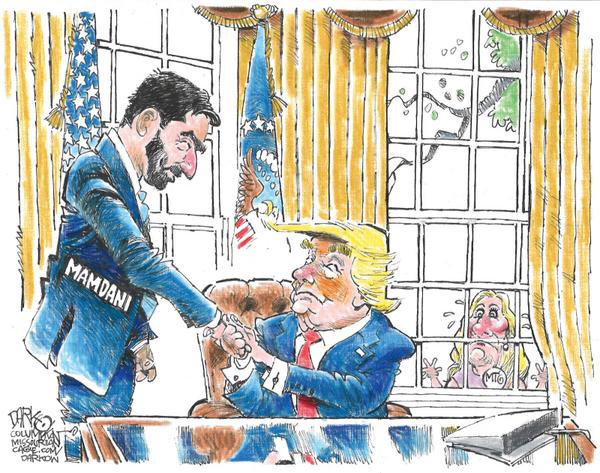
Mayor Adams’ new role as he leaves office? Mamdani spoiler.

https://gothamist.com/news/mayor-adams-new-role-as-he-leaves-office-mamdani-spoiler

We rely on your support to make local news available to all

Make your contribution now and help Gothamist thrive in 2025. Donate today

The election may be over in New York City, but Mayor Eric Adams isn’t done fighting against Zohran Mamdani.

In the last two weeks, Adams has made – or flirted with – maneuvers that could cause some political headaches for mayor-elect Mamdani and even stall his affordability agenda. The moves have implications for Mamdani’s pledge to freeze the rent for stabilized tenants, maintain funding for the NYPD and build more housing to address the city’s affordability crisis.

Political experts say Adams is following a tried and true tradition.

“There’s a history of mayors making decisions in the final days of their mayoralty,” said Chris Coffey, a political strategist who worked for Mayor Michael Bloomberg. “Whether it’s for messing with the next mayor, or getting the things they want before their term is up, only a psychiatrist could tell you.”

Late last month, Adams began weighing whether to pack the Rent Guidelines Board with members opposed to Mamdani’s plan to freeze the rent on the city’s 1 million regulated apartments. Those appointees would remain in place when Mamdani took office, potentially setting up an unprecedented legal battle over whether the new mayor could fire them.

Adams has not yet announced any new appointees. Eleonora Srugo, a real estate agent and star of a Netflix reality show, “Selling the City,” told the New York Times she had declined Adams’ job offer.

Days later, Adams announced additional funding to hire 5,000 police officers. Mamdani has said he would keep the police headcount at its current level of 35,000 officers — a headcount the NYPD has failed to reach under Adams due to struggles with recruitment.

Once Mamdani takes office, he will have to decide whether to rescind the $316 million Adams allocated to hire the additional officers. The move would be largely symbolic since the city can’t meet its currently budgeted staffing levels.

During the primary, Mamdani distanced himself from his previous calls to reduce police spending.

“I am not defunding the police. I am not running to defund the police,” he said in July. He described himself as a person who “learns and one that leads, and part of that means admitting as I have grown.”

The latest example of Adams’ maneuvering came on Wednesday, when Gothamist exclusively reported that the administration had designated Elizabeth Street Garden as parkland. The move was the latest development in the years-long saga over whether the city could build an affordable housing development for seniors on the site in Nolita.

Mayor Adams has said he’s committed to a smooth transition. But he’s implemented policies that go against Zohran Mamdani’s agenda.

On Thursday, Mamdani accused Adams of “using his final weeks and months to cement a legacy of dysfunction and inconsistency.”

But he also said that the administration’s actions “make it nearly impossible to follow through with” building housing on the garden.

Adams is far from the first mayor to complicate his successor’s plans.

Former Mayor David Dinkins ignored his successor Rudy Giuliani’s criticisms of a deal to keep the U.S. Open in Queens by building Arthur Ashe Stadium.

During the final month of his second term, Giuliani, a baseball fan, signed deals for new stadiums for the Mets and Yankees. Bloomberg canceled them not long after he took over City Hall.

Adams has publicly said he’d ensure a smooth transition. On Thursday, he rejected Mamdani’s criticism of his move to preserve Elizabeth Street Garden.

“It’s not about a legacy of dysfunction,” Adams told reporters. “It’s about protecting a legacy in the promises we made.”

He also said, “I’m the mayor until December 31st.”

With the Elizabeth Street Garden, Adams may have actually done Mamdani a favor. The proposed development has devolved into a nasty fight pitting housing advocates against the garden’s well-heeled supporters, who include Patti Smith, Robert DeNiro, Martin Scorsese and others.

“These are political sh– sandwiches,” Coffey said, referring to the garden. “I’m sure the mayor- elect would want that off the table.”

During a live podcast with the news site Hell Gate last month, Mamdani said he would evict the garden’s operators in his first year as mayor. But at least one key member of his inner circle may be pleased with Adams’ move to make the Elizabeth Street Garden a park — filmmaker Mira Nair.

“My mother really disagrees with me,” Mamdani said.

BU College Republicans president says he called ICE to ‘detain these criminals’ at Allston Car Wash

BU College Republicans president says he called ICE to ‘detain these criminals’ at Allston Car Wash

The president of Boston University College Republicans wrote on X he called the U.S. Immigration and Customs Enforcement requesting it detain employees at Allston Car Wash, the site of a Nov. 4 raid where nine employees were arrested.

Boston University College Republicans President Zac Segal being interviewed at a club meeting. Segal posted on X that he called U.S. Immigration and Customs Enforcement to investigate the Allston Car Wash that was raided last week. (AVA RUBIN)

“I’ve been calling ICE for months on end. This week they finally responded to my request to detain these criminals,” BUCR President Zac Segal posted Nov. 7 above a Boston.com article about the ICE raid.

Segal declined to comment Thursday morning.

“As someone who lives in the neighborhood, I’ve seen how American jobs are being given away to those with no right to be here. Pump up the numbers!” Segal’s post concludes.

BUCR did not immediately respond to a request for comment Thursday morning.

The nine detained employees all had work permits, Allston Car Wash Manager Jose Barrera told Boston.com.

Barrera said around 22 federal agents arrived at the Cambridge Street car wash holding subpoenas, but agents began arresting employees before they could retrieve their documents from the locker room, Barrera told Boston.com.

ICE did not immediately respond to a request for comment Thursday morning.

This is a developing story and will be updated with more information.


https://x.com/JonathanCohn/status/1989005430077468731?s=20

https://x.com/endthehiding/status/1986897982097387614?s=20


ICE tries to deport Native American Woman.

Please notice she had documentation on her and was known to the jail personnel.  ICE doesn’t care about a person’s documentation nor did the jail people, they seem to be racists who want brown people out of the US at any costs.   Hugs

https://www.msn.com/en-us/news/us/ice-tries-to-deport-native-american-woman/ar-AA1Qrh8y

ICE is engaging in illegal Gestapo tactics based on the egregiously unconstitutional executive orders from the convicted felon and puppet of war criminal Vladimir Putin. These violent and fascist thugs must be abolished and their obscene funding reallocated to America’s crumbling infrastructure and woefully underfunded social services. These two areas of resource redirection would significantly improve the quality of life for millions of Americans, unlike the GOP’s incessant assaults upon our republic!

This is how the great sleeping giant of America awakens, roars and puts an end to it

https://www.rawstory.com/this-is-how-the-great-sleeping-giant-of-america-awakens-roars-and-puts-an-end-to-it/

This is how the great sleeping giant of America awakens, roars and puts an end to it
U.S. President Donald Trump and Secretary of State Marco Rubio attend a cabinet meeting at the White House, in Washington, D.C., U.S., October 9, 2025. REUTERS/Evelyn Hockstein

Something dramatic has happened.

Many people who consider themselves non-political or independent, or moderate Republican, or who even voted for Trump last November, can’t avoid seeing what’s now come so clearly into the open.

And they’re finding it terrifying.

They’ve watched Trump order the Texas National Guard into Portland and Chicago, over the objections of the mayors of those cities and the governors of Oregon and Illinois. They’ve heard him call for jailing the mayor of Chicago and governor of Illinois for opposing these moves.

They’ve heard him threaten to invoke the Insurrection Act and send federal troops all over America.

They’ve watched Trump’s ICE agents drag people out of their beds in the middle of the night, zip-tie them and their children, and haul them away.

They’ve seen Trump’s prosecutors indict the attorney general of New York state because she held Trump accountable for fraud. And seen him threaten to do the same to a California senator because he conducted hearings in the House exposing Trump’s role in the attack on the Capitol.

They’ve heard Trump say he can kill anyone who he claims is an enemy combatant trafficking drugs.

They’ve heard Trump direct the IRS, FBI, and Justice Department against liberal groups that oppose him — George Soros’s Open Society Foundation; ActBlue, the Democratic fundraising organization; Indivisible, the community-based resistance organization.

And they watched him take off the air comedians who criticize him — Stephen Colbert, Jimmy Kimmel.

All across America, millions of people who have avoided politics, or identified as independents or moderate Republicans or even Trump voters, are shaken by what they’re seeing and hearing.

It’s no longer Democrat versus Republican or left versus right.

It’s now democracy versus dictatorship. Right versus wrong.

It’s no longer a war on undocumented immigrants. It’s now a war on Americans.

It’s no longer a foreign enemy. It’s now the “enemy within.”

Across the land, average Americans are realizing that they too could be dragged out of their homes in the middle of the night by Trump’s ICE agents, or tear-gassed and arrested by Trump’s National Guard, or targeted by Trump’s prosecutors, or shot by Trump’s military.

The Big Reveal is that all of us are now endangered.

Multiple polls show Trump’s approval tanking, but I think it runs deeper than this.

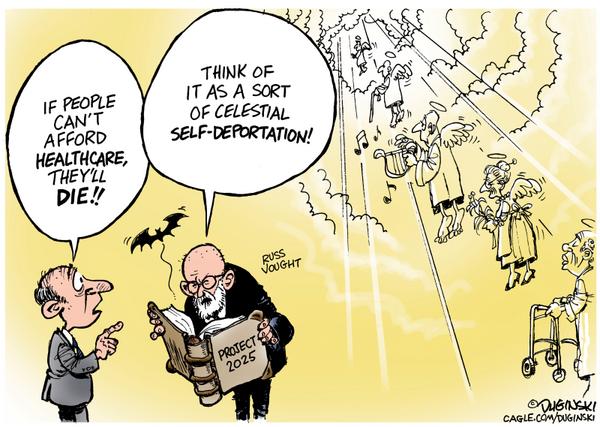
Something dramatic has happened over the last two weeks — as America sees more vividly than ever who Trump is, where he and his trio of lapdogs (Miller, Vought, and Vance) want to take the country, and how we’re all potential targets.

The Big Reveal is impossible not to see. Trump and his lapdogs are doing all of this completely in the open. They have no shame.

Most Americans abhor what they see, because what they see is abhorrent.

This is how the great sleeping giant of America awakens, roars, and puts an end to it.

Robert Reich is a professor of public policy at Berkeley and former secretary of labor. His writings can be found at https://robertreich.substack.com/.

Fetterman Cries About Being A Democrat “Devoted” To Israel

Ms. Rachel Calls-Out NYT In Response To Leaked Internal Memo

Responding to an argument about gay marriage

Mass deportations ensnare immigrant service members, veterans

https://www.militarytimes.com/news/your-military/2025/09/18/mass-deportations-ensnare-immigrant-service-members-veterans/

Leading up to the 2024 presidential election, U.S. Army veteran Sae Joon Park kept in mind a warning from an immigration officer: If Donald Trump were elected, Park would likely be at risk for deportation.

Park was 7 when he came to the U.S. from Seoul, South Korea. He joined the Army at 19 and received a Purple Heart after being shot in Panama. After leaving the military, he lived with PTSD, leading to addiction issues.

After a 2009 arrest on a drug charge, Park was eventually ordered deported. But because he was a veteran, he was granted deferred action, allowing him to remain in the U.S. while he checked in with immigration officials annually.

For 14 years he did just that, while raising children and building a new life in Honolulu. Then in June, when Park went in for his appointment, he learned he had a removal order against him. Instead of facing extended time in detention, he chose to self-deport.

“They allowed me to join, serve the country — front line, taking bullets for this country. That should mean something,” he said.

Instead, “This is how veterans are being treated.”

During his first term in office, Trump enacted immigration policies aimed at a group normally safe from scrutiny: noncitizens who serve in the U.S. military. His administration sought to restrict avenues for immigrant service members to obtain citizenship and make it harder for green card holders to enlist — actions that were unsuccessful.

Now, military experts and veterans say service members are once again targets of the president’s immigration policies.

“President Trump campaigned on a promise of mass deportations, and he didn’t exempt military members, veterans and their families,” said retired Lt. Col. Margaret Stock, a lawyer who helps veterans facing deportation. “It harms military recruiting, military readiness and the national security of our country.”

Under the Biden administration, Immigration and Customs Enforcement issued a policy stating a noncitizen’s prior military service was a “significant mitigating factor” that must be considered in enforcement decisions. The policy also offered protection to noncitizen family members of veterans or those on active duty.

In April, that policy was rescinded and replaced with one saying “military service alone does not automatically exempt” one from immigration enforcement.

Both policies barred enforcement actions against active-duty service members, absent aggravating factors. Under the new policy, noncitizen relatives of service members are not addressed.

Some service members, like Park, are choosing to self-deport. In other instances, immigrant family members of soldiers or veterans have been detained — including Narciso Barranco, a father of three U.S. Marines who was detained earlier this year in Santa Ana, California.

“The people being ripped from our communities are hardworking, honest, patriotic people who are raising America’s teachers, nurses and Marines,” Barranco’s son, veteran Alejandro Barranco, testified in July to a U.S. Senate subcommittee. “Deporting them doesn’t just hurt my family. It hurts all of us.”

This image provided by News21 shows Michael Evans, a veteran who has been deported, hugging Diane Vega, a veteran and volunteer, at the Deported Veterans Support House on Saturday, June 28, 2025, in Ciudad Juárez, Mexico. (Sydney Lovan/News21 via AP)

There is no publicly available data on how many veterans are being affected, though ICE is supposed to track service member removals and the Department of Homeland Security is typically required to share that information with Congress.

A 2019 federal report found 250 veterans had been placed in removal proceedings between 2013 and 2018. News21 could find only two DHS reports tracking removals of veterans. One, covering the first half of 2022, said five veterans had been deported; another, for calendar year 2019, said three veterans had been deported.

In June, U.S. Rep. Yassamin Ansari, an Arizona Democrat, and nine members of Congress wrote to federal officials seeking the number of veterans currently facing deportation — noting “some estimates” put the overall number of deported veterans at 10,000.

Her office did not return messages. DHS and ICE also did not respond to questions.

Federal lawmakers have proposed several bills to protect immigrant service members and their relatives. One measure, introduced in May, would give green cards to parents of service members and allow those already deported to apply for a visa.

U.S. Sen. Tammy Duckworth, an Illinois Democrat and Army veteran, has sponsored some of that legislation. She told News21: “This is about the men and women who wore the uniform of our great nation, many of whom were promised a chance at citizenship by our government in exchange for their service. It’s about doing the right thing.”

As of February 2024, more than 40,000 foreign nationals were serving in active and reserve components of the Armed Forces, according to the Congressional Research Service. Another 115,000 were veterans living in the U.S.

Serving in the military has long been a pathway to citizenship, with provisions providing expedited naturalization dating back to the Civil War.

During designated periods of hostility, noncitizens who serve honorably for even one day are eligible to apply for naturalization if they meet all criteria. The U.S. has been in a period of hostility since 2001.

This image provided by News21 shows Army veteran Jose Francisco Lopez holding a portrait from his time in service on June 28, 2025, at the Deported Veterans Support House in Ciudad Juárez, Mexico. (Sydney Lovan/News21 via AP)

Despite that longstanding policy, the Department of Defense, during Trump’s first term, required service members to complete six months before obtaining military documents required to apply for citizenship.

The American Civil Liberties Union sued, and in 2020, a federal judge struck down the change. The Biden administration wound up rescinding the six-month policy.

Nevertheless, ACLU attorney Scarlet Kim said: “If you don’t get your citizenship while you’re serving and then you’re discharged … you can potentially become vulnerable to deportation.”

That’s the situation facing Army veteran Marlon Parris.

Parris, born in Trinidad, has been in the U.S. with a green card since the 1990s. He served in the Army for six years and received the Army Commendation Medal three times, according to court records.

Before his discharge in 2007, he was diagnosed with PTSD — which was cited when Parris pleaded guilty in 2011 to conspiracy to distribute cocaine and sentenced to federal prison.

Upon his release in 2016, the government assured him he would not be deported, according to the group Black Deported Veterans of America. But on Jan. 22, agents detained Parris near his home in Laveen, Arizona. In May, a judge ruled he was eligible for deportation.

His wife, Tanisha Hartwell-Parris, told News21 the couple plan to self-deport and bring along some of the seven children, ranging in age from 8 to 26, who are part of their blended family.

“I’m not going to put my husband in a situation to where he’s going to be a constant target, especially in the country that he fought for,” she said.

This image provided by News21 shows memorabilia from Jose Francisco Lopez’s service during the Vietnam War displayed inside the Deported Veterans Support House on Saturday, June 28, 2025, in Ciudad Juárez, Mexico. (Sydney Lovan/News21 via AP)

A report published last year by the Veterans Law Practicum at the University of California, Berkeley, School of Law noted that more than 20% of veterans with PTSD also have a substance use disorder, and that can result in more exposure to the criminal justice system.

That situation is “the most common scenario in terms of how deportation is triggered,” said Rose Carmen Goldberg, who oversaw completion of the report and now teaches in the Veterans Legal Services Clinic at Yale Law School.

The report stressed that even though deportation does not disqualify veterans from benefits earned through service, “Geographic and bureaucratic barriers may … stand in the way.”

In 2021, the Biden administration launched the Immigrant Military Members and Veterans Initiative (IMMVI) to ensure deported veterans could access Veterans Affairs benefits. The program offered parole to those needing to return to the U.S. for legal services or health care.

Jennie Pasquarella, a lawyer with the Seattle Clemency Project, said the biggest flaw of the program is that parole into the U.S. is temporary — a “dead end” if a veteran doesn’t have a legal claim to restore legal residency or to naturalize.

“We had asked the Biden administration to do more to ensure that there was a further path towards restoring people’s lawful status beyond parole,” she said. “Basically, we didn’t succeed.”

In the absence of aid in the U.S., more veterans are turning to help elsewhere.

José Francisco Lopez, a native of Torreón, Mexico, and Vietnam War veteran, experienced PTSD and addiction. He eventually went to prison for a drug-related crime and in 2003 was deported.

“I almost gave my life in Vietnam, and now they just throw me away like garbage,” he said.

For years, Lopez thought he was the only deported veteran in Mexico — until he met Hector Barajas, a deported Army veteran who in 2013 founded the Deported Veterans Support House in Tijuana.

Inspired, Lopez opened his own Support House in Ciudad Juárez.

Lopez, 80, is now a legal resident of the U.S. but splits his time between El Paso and Juárez, providing deported veterans housing, food and advice about how to apply for benefits. Since opening the support house in 2017, he’s helped about 20 people.

Back in Seoul, Park, 56, is adjusting to life in a country he hadn’t visited in 30 years. When he first arrived, he cried every morning for hours.

“It’s a whole new world,” he said. “I’m trying to really relearn everything.”

Park’s attorney started a petition to urge prosecutors to dismiss his criminal convictions, to help cancel his deportation order. More than 10,000 people have signed.

Park said he’s grateful for the support but has little faith he will ever be allowed to return to the U.S. He said: “This is not the country that I volunteered and fought for.”

News21 reporters Tristan E.M. Leach, Sydney Lovan and Gracyn Thatcher contributed to this story. This report is part of “Upheaval Across America,” an examination of immigration enforcement under the second Trump administration produced by Carnegie-Knight News21.