June 5, 1851 Uncle Tom’s Cabin or, Life Among the Lowly began to appear in serial form in the Washington National Era, an abolitionist weekly. The novel by Harriet Beecher Stowe, a tear-jerking tale of the hardships of slavery, became a central reference point in the national debate over the issue. Read more
June 5, [since 1972] World Environment Day was established by the U.N. General Assembly to commemorate the opening of the Stockholm Conference on the Human Environment in Sweden. The United Nations Environment Program (UNEP) was established as a result of the conference. The 1972 Stockholm conference UNEP’s mission: To provide leadership and encourage partnership in caring for the environment by inspiring, informing, and enabling nations and peoples to improve their quality of life without compromising that of future generations. Each year World Environment Day adopts a different theme.
June 5, 1989 Just a few days before the first fission reaction was to be allowed at New Hampshire’s Seabrook Station nuclear power plant, hundreds breached the security fence, leading to 627 arrests. They carried signs reading, “In Mourning for the Late, Great State of New Hampshire,” and “Remember Chernobyl.” Led by the Clamshell Alliance, their concern was for the safety of local residents in the event of a nuclear accident, as well as environmental pollution and the unsolved problem of safe disposal of nuclear waste generated by the reactor. There were also concerns for increased electricity rates to cover the costs of the project. Repeated significant protests occurred as early as 1976 at the beginning of construction when sometimes more than a thousand would be arrested. Ron Sher, a Seabrook spokesman, termed the demonstrators “very vocal but a small minority . . . They don’t represent the millions of people in New England that recognize that nuclear energy is a viable energy option.” The plant was projected to produce up to 1.15 gigawatts, enough for one million homes.
June 5, 1993 Thousands marched to protest neo-Nazi violence against foreigners, particularly ethnic Turks, living in Germany.
Colm Tóibín, Alan Hollinghurst, Adam Mars-Jones and more recall the high style and libidinous freedom of a writer who ‘was not a gateway to gay literature but a main destination’
Edmund White’s luminous career was in part a matter of often dark history: he lived through it all. He was a gay teenager in an age of repression, self-hatred and anxious longing for a “cure”; he was a young man in the heyday of gay liberation, and the libidinous free-for-all of 1970s New York; he was a witness to the terrifying destruction of the gay world in the Aids epidemic in the 1980s and 90s. All these things he wrote about, in a long-term commitment to autofiction – a narrative adventure he embarked on with no knowledge of where or when the story would end. He is often called a chronicler of these extraordinary epochs, but he was something much more than that, an artist with an utterly distinctive sensibility, humorous, elegant, avidly international. You read him not just for the unsparing account of sexual life but for the thrill of his richly cultured mind and his astonishingly observant eye.
What amazed me about A Boy’s Own Story, when it came out in 1982, was that a stark new candour about sexual experience should be conveyed with such gorgeous luxuriance of style, such richness of metaphor and allusion. This new genre, gay fiction, could also be high art, and almost at once a worldwide bestseller! It was an amazing moment, which would be liberating for generations of queer writers who followed. These younger writers Edmund himself followed and fostered with unusual generosity – I feel my whole career as a novelist has been sustained by his example and encouragement. In novels and peerless memoirs right up to the last year of his life he kept telling the truth about what he had done and thought and felt – he was a matchless explorer of the painful comedy of ageing and failing physically while the libido stayed insatiably strong. It’s hard to take in that this magnificent experiment has now come to a close. (snip-MORE)
US actor Jonathan Joss, known for his roles in King of the Hill and Parks and Recreation, has died aged 59.
Joss was shot dead, in what his husband called a homophobic hate crime, although police in Texas say there is no evidence of this.
Joss’s broad career spanned different genres and platforms, appearing in films, sitcoms, animations, stage productions and more.
He has been credited with increasing representation of Native Americans on screen. Here are three of the notable performances he will be remembered for.
John Redcorn in King of the Hill
In the animated sitcom King of the Hill, Joss voiced the character of John Redcorn, a Native American “licensed New Age healer” from season two onwards.
The sitcom centres around the Hill family and is set in the fictional town of Arlen, in suburban Texas.
For the first four seasons, Redcorn is having an affair with Hank Hill’s neighbour, Nancy Gribble. Nancy’s husband Dale is oblivious.
While a flawed character, Redcorn is known for his kindness and calm persona, and for championing his Native American heritage.
In season four, during perhaps his most notable storyline, Redcorn reveals an ongoing battle between his tribe and the Bureau of Indian Affairs, saying he hoped to regain Native American land from the government.
Considering Redcorn a “true friend”, Dale decides to help him with the lawsuit filed against the government, by introducing him to the Freedom of Information Act.
Redcorn then permanently ends his14-year affair with Nancy, out of respect for Dale. The affair is not revealed to Dale and he happily heads home with Nancy.
Author Dustin Tahmahkera once described Redcorn as “arguably the most developed and complex indigenous character in US sitcom history, thanks in critical part… to the on-and-offscreen work of Joss”. (snip-MORE)
At the end of the video the Reverend says our only job is to love god by loving others. The only question is … how much will you love. Good thoughts in this video. Had the church been like this when I was a teen, had the church been inclusive like this when I was a little boy being molested by the Pastor I would have stayed in the faith, in the church. I might not have believed in the magic parts of the bible and I might have quibbled over the facts, but I would have stayed for the community. The environment of people who enjoyed each other’s company and loved the comradery of fellowship. Sadly the churches I saw as a child, as a teen, and as an adult lost people because rather than love, they clung to hate. The joy of feeling better than some other group, of being able to look down on them, to revel in negative emotions meant more to them than hugging those different that maybe they did not understand. They set themselves up as god judging others. Not as a loving flock, but as deciders over who was worthy to be in the flock. They were not the sheep, they wanted to be the Sheppard. Hugs
Wow. A group that initially included no Jews hatched a plan to make support for Palestine a crime. The US is following their playbook and supporting the mass killing & removal of Palestinians.Group Behind Project 2025 Has a Plan to Crush the Pro-Palestinian Movement http://www.nytimes.com/2025/05/18/u…
Cooking the books? Fears Trump could target statisticians if data disappointsProposed rule change could pave way for president to fire economists whose figures prove politically inconvenientwww.theguardian.com/us-news/2025…
OK I admit this guy is a scholar so he uses words and phrases that are sometimes hard for me to follow with my limited education. But I do understand enough to follow what he is saying. Charley Kirk is full of shit on what he thinks they bible says because he is letting his own bigotry and prejudices create what the passages mean for him rather than research it with people more knowledgeable. Jesus and the bible were not against homosexuality as we understand it because they did not see sexuality and sex acts the same way we do. The sin of Sodom was lack of hospitality and men wanting to take a higher sexual role than angels. The people of the time of the bible were like young macho men types today, worried about what looked manly enough, and putting your penis in someone regardless of sex was manly. But the person who took another person in them was not, they were lessor. Women were viewed as lessor, inferior, and so were men that took another male’s penis inside them. It was not about pleasure or love, it was all about status. One thing I like about this guy is he freely admits the bible is context driven and doesn’t know what we know and understand today, that in some areas the morals we have today are superior to that of the bibles for example slavery. Hugs.
Erin In The Morning is a reader-supported publication. To receive new posts and support my work, consider becoming a subscriber.
Subscribe
Inch by inch, day by day, and legal battle after legal battle, trans Montanans are dismantling the unconstitutional laws proposed by Republicans meant to destroy trans lives, and indeed, trans life itself.
Last week, they were able to let out a sigh of relief—for now. A Montana judge issued a preliminary injunction on HB 121, which would ban trans and intersex people from using gender-separated public facilities, such as bathrooms or changing rooms, that differ from their sex assigned at birth.
This decision follows a temporary restraining order (TRO) on the law from earlier this year, instituted after legal rights groups like the ACLU challenged it in court for violating Montanans’ right to privacy under the state constitution. A preliminary injunction is a more steadfast barrier—it means the law won’t take effect until after legal proceedings conclude, if ever.
The Attorney General for the State of Montana, like many anti-trans actors, is defending HB 121 using the thinly-veiled premise of “protecting women” from sexual violence. But the injunction filings indicate that the judiciary isn’t buying it.
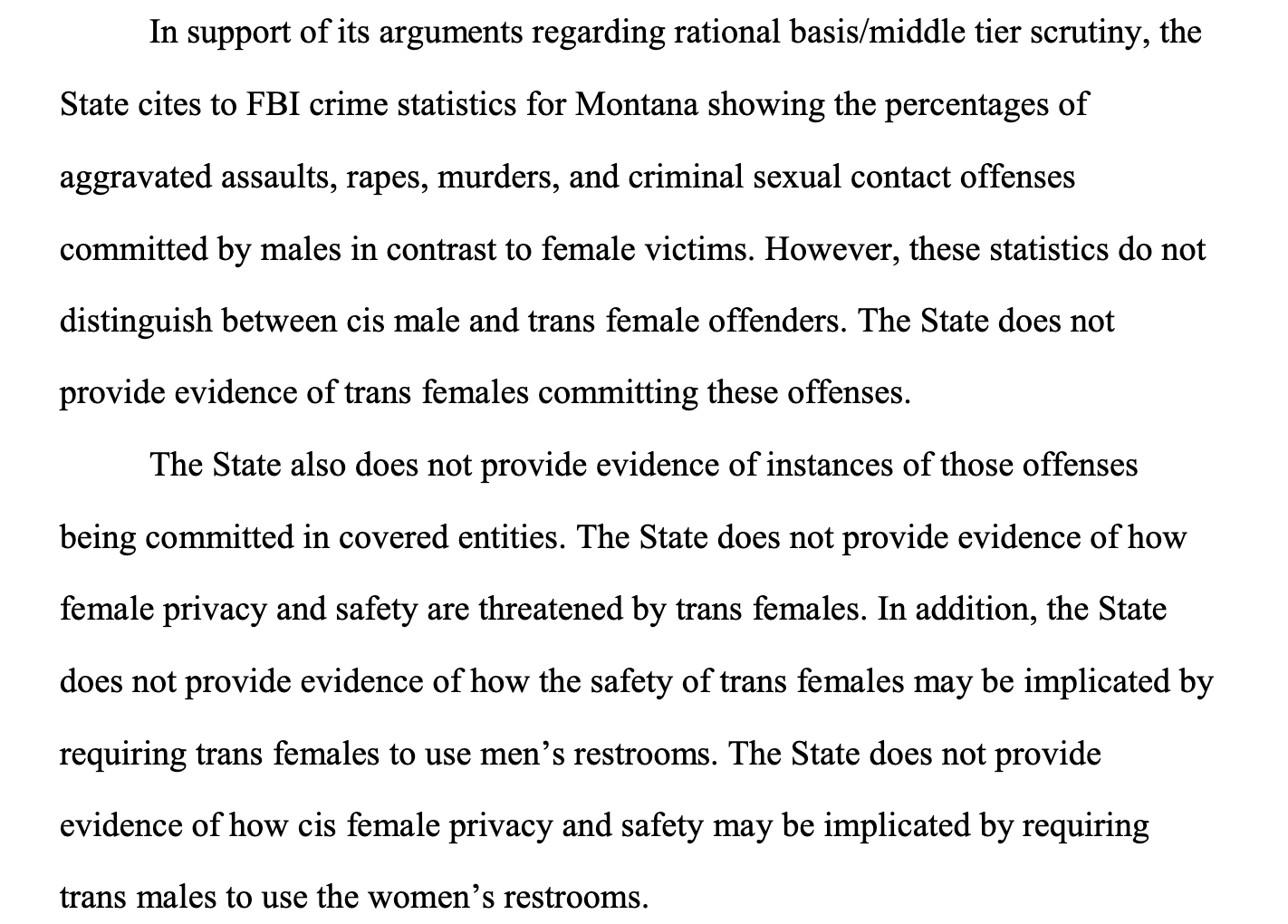
“The State has not shown even a rational basis for the Act,” wrote Judge Shane A. Vannatta, who oversees a Montana District Court. “The State does not provide evidence of trans female offenses against [cis] women or evidence of offenses being committed in covered entities to support the necessity of immediate implementation of the Act.”
Instead, the court found that anti-trans bathroom bans do not protect women from harm. It only serves to stoke violence against trans women and cis women alike—everyone’s gender and sex becomes subject to public debate when these laws are put in place.
“Each individual observed walking into a restroom of a covered entity does directly and indirectly disclose that individual’s transgender or intersex identity, anatomy, and genetics,” the filing said. “All Montanans regardless of gender […] will not be subject to the prying eyes of others or to governmental snooping or regulation.”
Vannatta further notes that it is already illegal for people of any gender or sex to commit a sex crime, and that there is “no evidence” to support the notion that trans or intersex people “have a predisposition toward such offenses.”
He added that the state’s purported concerns were “disingenuous” and purely “conjecture.”
In reality, trans women—especially those of color—are more likely than any other demographic to be the victims of violent crime. And by using the law to force trans people to out themselves every time they use a public restroom, or to embolden self-deputized gender police, so-called “trans bathroom bans” create a greater risk of violence for everyone. There are countless stories of cis and trans people alike being accosted in bathrooms precisely because of the anti-trans panic these policies create.
The filing further concluded that trans women have been relentlessly targeted by the state government and are in dire need of protection. “Transgender Montanans have been subjected to such a history of purposeful unequal treatment and have been relegated to such a position of political powerlessness as to command extraordinary protection from the majoritarian political process,” Vannatta noted.
The fight against HB 121 is not over, but State Representative Zooey Zephyr—who would be legally forced into the men’s room under the bill her colleagues passed—says she is hopeful.
“The Montana Supreme Court has been clear: every law that targets the trans community is a clear invasion by the government into the privacy of transgender people,” she told Erin in the Morning. “These laws are driven by animus against the community. I expect this law—like all laws driven by the anti-trans fervor—to be struck down by Montana’s courts.”
(Editor’s Note: For transparency, Erin in the Morning founder Erin Reed is the loving wife to the aforementioned Rep. Zooey Zephyr.)
Erin In The Morning is a reader-supported publication. To receive new posts and support my work, consider becoming a subscriber.
Minnesota Governor Tim Walz criticized President Donald Trump during an interview with MSNBC host Jen Psaki, stressing just why the people who elected Trump to run the country “like a business” were completely misguided.
Walz particularly lamented the impacts of Trump’s ongoing trade war with Canada and Mexico, noting that Trump has a history of scuttling deals and “a proven track record of being an absolute failure.”
U.S. Secretary of Defense Pete Hegseth speaks at the Al Udeid Air Base, Thursday, May 15, 2025, in Doha, Qatar. (AP Photo/Alex Brandon)
Military commanders will be told to identify troops in their units who are transgender or have gender dysphoria, then send them to get medical checks in order to force them out of the service, officials said Thursday.
A senior defense official laid out what could be a complicated and lengthy new process aimed at fulfilling President Donald Trump’s directive to remove transgender service members from the U.S. military.
The new order to commanders relies on routine annual health checks that service members are required to undergo. Another defense official said the Defense Department has scrapped — for now — plans to go through troops’ health records to identify those with gender dysphoria.
Far Right Federal Judge Rules Gay And Trans People Can Be Discriminated Against In Workplaces
Judge Kacsmaryk, a federal judge in the Northern District of Texas, ruled on the EEOC’s treatment of Title VII employment discrimination claims on gay and trans people.
On Thursday, Judge Matthew Kacsmaryk—a far-right federal judge in the Northern District of Texas with a record of aligning with the GOP’s most extreme legal positions—issued a ruling declaring that Title VII no longer protects LGBTQ+ people from workplace discrimination. The decision directly contradicts the Supreme Court’s landmark 2020 ruling inBostock v. Clayton County, which held that discrimination based on sexual orientation or gender identity is, by definition, sex discrimination. Kacsmaryk’s ruling marks one of the most alarming judicial rollbacks of LGBTQ+ rights in recent memory—and sets up a direct legal challenge to one of the foundational civil rights protections for queer and trans people in the United States.
Montana Court Issues Final Blow to Anti-Trans Health Care Law
A judge found that the law’s premise is not scientific, but “political and ideological.”
A state judge in Montana has permanently struck down SB 99, a law which sought to ban gender-affirming care for Montana youth under age 18.
The court decision is a welcome reprieve for young trans Montanans, who have had the threat of forced detransition hanging over their heads since 2023. The bill would have threatened the licensure of physicians who provided trans-affirming care to this age group and prevented state funds from being used for gender-affirming surgeries, hormones, puberty blockers, and “social transitioning” measures for trans youth. It also would have allowed parents of trans kids to sue medical professionals for providing their children with the proper care.
But these kinds of laws, which are being passed around the country, are highly unscientific. They try to erase the biological reality of gender and sexual diversity to further a far-right gender ideology. As the court ruling declared, “the State’s interest is actually a political and ideological one: ensuring minors in Montana are never provided treatment to address” their gender dysphoria.
“In other words, the State’s interest is actually blocking transgender expression.”
1) The court found overwhelming evidence backing the benefits of gender-affirming care for trans people.
Israeli ministers said the settler outpost at Homesh will be retrospectively legalised (file photo from May 2023)
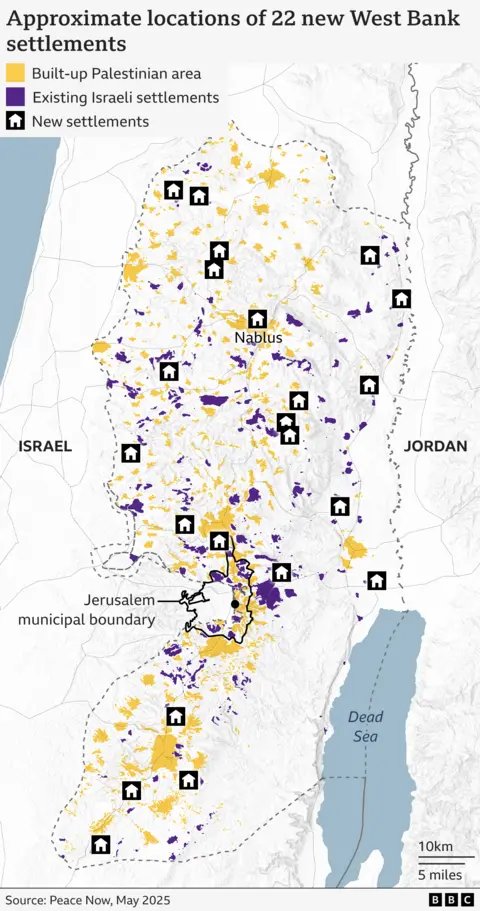
Israeli ministers say 22 new Jewish settlements have been approved in the occupied West Bank – the biggest expansion in decades.
Several already exist as outposts, built without government authorisation, but will now be made legal under Israeli law. Others are completely new, according to Defence Minister Israel Katz and Finance Minister Bezalel Smotrich.
Settlements – which are widely seen as illegal under international law, though Israel disputes this – are one of the most contentious issues between Israel and the Palestinians.
Katz said the move “prevents the establishment of a Palestinian state that would endanger Israel”, while the Palestinian presidency called it a “dangerous escalation”.
The Israeli anti-settlement watchdog Peace Now called it “the most extensive move of its kind” in more than 30 years and warned that it would “dramatically reshape the West Bank and entrench the occupation even further”.
BBC team’s tense encounter with sanctioned Israeli settler while filming in West Bank
Israeli settlers are seizing Palestinian land under cover of war – they hope permanently
Israel has built about 160 settlements housing some 700,000 Jews since it occupied the West Bank and East Jerusalem – land Palestinians want, along with Gaza, for their hoped-for future state – in the 1967 Middle East war. An estimated 3.3 million Palestinians live alongside them.
Successive Israeli governments have allowed settlements to grow. However, expansion has risen sharply since Prime Minister Benjamin Netanyahu returned to power in late 2022 at the head of a right-wing, pro-settler coalition, as well as the start of the Gaza war, triggered by Hamas’s 7 October 2023 attack on Israel.
On Thursday, Israel Katz and Bezalel Smotrich – an ultranationalist leader and settler who has control over planning in the West Bank – officially confirmed a decision that is believed to have been taken by the government two weeks ago.
A statement said they had approved 22 new settlements, the “renewal of settlement in northern Samaria [northern West Bank], and reinforcement of the eastern axis of the State of Israel”.
It did not include information about the exact location of the new settlements, but maps being circulated suggest they will be across the length and width of the West Bank.
Katz and Smotrich did highlight what they described as the “historic return” to Homesh and Sa-Nur, two settlements deep in the northern West Bank which were evacuated at the same time as Israel withdrew its troops and settlers from Gaza in 2005.
Nine of the settlements would be completely new, according to the watchdog. They include Mount Ebal, just to the south of Homesh and near the city of Nablus, and Beit Horon North, west of Ramallah, where it said construction had already begun in recent days.
The last of the settlements, Nofei Prat, was currently officially considered a “neighbourhood” of another settlement near East Jerusalem, Kfar Adumim, and would now be recognised as independent, Peace Now added.
Katz said the decision was a “strategic move that prevents the establishment of a Palestinian state that would endanger Israel, and serves as a buffer against our enemies.”
“This is a Zionist, security, and national response – and a clear decision on the future of the country,” he added.
Smotrich called it a “once-in-a-generation decision” and declared: “Next step sovereignty!”
But a spokesperson for Palestinian Authority President Mahmoud Abbas – who governs parts of the West Bank not under full Israeli control – called it a “dangerous escalation” and accused Israel of continuing to drag the region into a “cycle of violence and instability”.
“This extremist Israeli government is trying by all means to prevent the establishment of an independent Palestinian state,” Nabil Abu Rudeineh told Reuters news agency.
Lior Amihai, director of Peace Now, said: “The Israeli government no longer pretends otherwise: the annexation of the occupied territories and expansion of settlements is its central goal.”
Elisha Ben Kimon, an Israeli journalist with the popular Ynet news site who covers the West Bank and settlements, told the BBC’s Newshour programme that 70% to 80% of ministers wanted to declare the formal annexation of the West Bank.
“I think that Israel is a few steps from declaring this area as Israeli territory. They believe that this period will never be coming back, this is one opportunity that they don’t want to slip from their hands – that’s why they’re doing this now,” Mr Ben Kimon told the BBC’s Newshour programme.
Israel effectively annexed East Jerusalem in 1980, in a move not recognised by the vast majority of the international community.
AFP
Israeli soldiers accompanied settlers establishing the Homesh outpost in May 2023
This latest step is a blow to renewed efforts to revive momentum on a two-state solution to the decades-old Israel-Palestinian conflict – the internationally approved formula for peace that would see the creation of an independent Palestinian state alongside Israel – with a French-Saudi summit planned at the UN’s headquarters in New York next month.
Jordan’s foreign ministry condemned what it called a “flagrant violation of international law” that “undermines prospects for peace by entrenching the occupation”.
UK Foreign Office Minister Hamish Falconer said the move was “a deliberate obstacle to Palestinian statehood”.
Since taking office, the current Israeli government has decided to establish a total of 49 new settlements and begun the legalisation process for seven unauthorised outposts which will be recognised as “neighbourhoods” of existing settlements, according to Peace Now.
Last year, the UN’s top court issued an advisory opinion that said “Israel’s continued presence in the Occupied Palestinian Territory is unlawful”. The International Court of Justice (ICJ) also said Israeli settlements “have been established and are being maintained in violation of international law”, and that Israel should “evacuate all settlers”.
Netanyahu said at the time that the court had made a “decision of lies” and insisted that “the Jewish people are not occupiers in their own land”.





AFP
Israeli ministers said the settler outpost at Homesh will be retrospectively legalised (file photo from May 2023)AFP