It was a yesterday’s Wonkette tab, but I just got to that email over lunch. It’s a horrible story. Of course, the hospital likely is understaffed thanks to policies and practices of our government, but still. Here is this-
Cara Lynn Shultz is a writer-reporter at PEOPLE. Her work has previously appeared in Billboard and Reader’s Digest. People Editorial Guidelines
NEED TO KNOW
Conor Hylton’s family has filed a wrongful death lawsuit against Yale New Haven Health-Bridgeport Hospital
The ICU where Hylton was treated had no on-site doctors and relied on off-site telehealth monitoring, the complaint alleges
A representative for the hospital tells PEOPLE, “We are unable to comment on pending litigation”
A dental student died in a Connecticut ICU where he wasn’t being cared for by an on-site doctor, but instead, was monitored remotely by an off-site physician via video.
The family of Conor Hylton has filed a wrongful death lawsuit against Yale New Haven Health-Bridgeport Hospital after the 26-year-old died in the Milford Campus’s intensive care unit. According to the complaint obtained by PEOPLE, the site is a “tele-ICU meaning there are no qualified ICU intensivists on site.” The complaint further states, “ICU intensivists are located off-site at a centralized remote location, purportedly monitoring critically ill patients through a video screen.”
In a statement to PEOPLE, a representative for the medical group said, “Yale New Haven Health is aware of this lawsuit and is committed to providing the safest and highest quality of care possible, however, we are unable to comment on pending litigation.”
Hylton first arrived at the hospital at 11:08 a.m. on August 14, 2024, with abdominal pain and vomiting, per the complaint, which says he was admitted and diagnosed with “pancreatitis, dehydration, metabolic acidosis, and alcohol withdrawal.” His condition “continued to change and deteriorate over the evening.”
At 4:30 a.m., the complaint says, “Mr. Hylton slid down in bed, his eyes rolled back and he became unresponsive and exhibited seizure-like activity, vomited, became bradycardic and code was called. He was intubated, but he could not be resuscitated, and he was pronounced dead.”
The complaint states that although the pronouncement of Hylton’s death was said to be made by an on-site doctor, it was actually done by a ‘tele-health’ provider on a video screen.”
According to the complaint, an on-site doctor was called to intubate Hylton, but “the provider summoned to perform the intubation did not know how to find the ICU and had to find someone else to show him where it was located. This led to a delay in [care].”
An expert medical opinion included with the lawsuit wrote, “no on-site doctor assessed Mr. Hylton from the time he was admitted to the ICU until after he exhibited seizure activity at 4:30 a.m.”
Joel T. Faxon, partner at Faxon Law Group, which is representing Hylton’s family, said in a press release: “It’s alarming to think in a supposedly intensive care setting: Where is a doctor? Where are the nurses? How does the emergency doctor not know how to get to the ICU to provide life saving care?”
Faxon confirmed to PEOPLE that neither Hylton nor his family were informed there were no on-site doctors at the ICU. As Faxon told PEOPLE exclusively, “If the Hylton family knew that their son was being placed in a fake icu with no doctor present they would have demanded he be transferred to a hospital that could properly treat him. They were never given that option and, tragically, Conor died as a result.”
*** Personal Note. By Monday things here should be back to normal. Ron will be in Texas driving his sister home. I will have had the weekend to rest. Ron is on his last full day of doing no exertion not even house work. They went into a major artery in his wrist. He had a wrist board to keep the wrist from flexing for 24 hours, shower lightly but leave the large bandaid on. Change the bandaid after showering for 72 hours. Call 911 if it starts to bleed. On Saturday morning he is off restrictions and flies to Texas. Then he and his sister will drive to Florida. She will stay with us for a few days as her house here is emptied and then she will settle her stuff and go to New Hampshire. She is flying up there. Hugs ****
Trump administration health officials are giving serious consideration to a plan that would make injuries from COVID-19 vaccines a formal diagnosis that can be coded in medical records. Increasing documentation of what’s still a loosely defined condition could help lay the groundwork for future lawsuits against vaccine manufacturers.
The ICD-10 system already covers general vaccine injuries and reactions to some specific vaccines, but it doesn’t have a designation for the COVID shot, whose safety has become a major point of contention within the administration.
The new code could allow providers “to identify, track, and study patients who experience adverse effects specifically related to COVID vaccines,” Mary Stanfill, a CDC health information specialist, said during a public meeting on code proposals last week.
Read the full article. You will recall that the cult has claimed that COVID vaccines cause the human body to become literally magnetic, and that they cause “turbo cancer,” autism, miscarriages, myocarditis, pericarditis, hearing loss, and taste loss. Oh, and the vaccines also supposedly contain graphene nanobots meant to connect people to the internet for the purpose of mind control.
Erin In The Morning is a reader-supported publication. To receive new posts and support my work, consider becoming a subscriber.
In the latest episode of their podcast A Touch More, all-star athletes Megan Rapinoe and Sue Bird denounced the International Olympic Committee’s new rule requiring sex testing for athletes competing in the women’s category.
The anti-trans policy will subject athletes competing in the women’s division—and only women’s, not men’s—to invasive sex testing to determine whether they have an SRY gene. Why this is where the International Olympic Committee chose to draw the gender line is arguably arbitrary.
No major medical organization endorses this litmus test as a reliable marker of athletic skill or “biological sex.” Even the scientist who discovered the SRY gene has slammed this practice in sports, saying “science does not support” this “overly simplistic” approach. Rather, it’s an arbitrary line in the sand used to cram unscientific ideas about gender and sex into manmade, binary boundaries.
Nonetheless, if a woman tests positive for the gene, she could be forced to compete in the “male” category. This has had dire consequences the last few times it was deployed against women’s athletes. From 1992 to 1999, cisgender women were forced into testing and found out, on the world stage, that they had intersex conditions they never knew about. The spectacle led to ostracization, disqualification, and at least one suicide before such testing was abolished.
“What we’re doing is subjecting everybody, all women and all people who are identifying as women, to this really invasive testing that only to me just says like, oh, so we’re just trying to whittle it down to a certain type of woman,” Rapinoe said.
Rapinoe is one of the most high-profile athletes in the country, a soccer player with three Olympic competitions under her belt and a decorated career in the U.S. Women’s National Team (USWNT). Bird, meanwhile, is among the most successful athletes in history—the retired WNBA legend spent her 20-season professional career as a point guard for the Seattle Storm, and is a record-breaking Olympian in her own right. The athletic power couple has been engaged since 2020. Together, they’ve long been outspoken advocates for the LGBTQ community.
Rapinoe connected the anti-trans vitriol in sports to the right wing’s broader attacks on queer and trans people, calling the push for sex testing “hateful.”
“They sort of like, lost the battle on gay marriage,” Rapinoe said. “So, it’s just like, we’re going to have this whole campaign for all these years to just hate trans people, which is such a small percentage of the population.”
Countless women, cisgender and transgender alike, have faced harassment and persecution because of the anti-trans athlete witch hunt.
“It’s just a total acquiescence to the Trump Administration,” Rapinoe said. “It’s just horrible, and I’m just sickened by it.”
The IOC rule is part of a broader pattern. In the United States, sports bans have served as a Trojan Horse for more sweeping anti-trans policies. The DOJ’s recent lawsuit over “women’s sports,” for example, also demands that transgender students be banned from bathrooms and locker rooms.
“Can we please stop obsessing over trans people and, I don’t know, maybe focus our time, energy, and resources into real problems women’s sports face?” Bird chimed in. She rejected the idea that sex testing, as the IOC claims, “protects women,” instead calling it a “fear-mongering” political ploy meant to generate support from conservative voters.
“That’s all this is,” Bird said. “If you crack this door open, it gets blown open. You’re now policing women’s bodies across the board.”
Erin In The Morning is a reader-supported publication. To receive new posts and support my work, consider becoming a subscriber.
Ron is home and well. The procedure went well. The blockage was not as bad as the CT scan showed. The doctor said no stents were needed and the blockage could be managed by medication. Hugs
Hi everyone. I am in the waiting room and they just took Ron into the OR. So we got up at 3:30 am. We showered and packed our stuff. I forgot the sandwiches but I do have my chips and pretzels. Of all the people waiting I am the only one eating. I did not eat at home because Ron couldn’t eat and I felt it would be mean as he couldn’t eat and it would’ve mean. I am not really hungry but I took my medications and I am diabetic so I need something in my stomach.
The good news is his OR nurse is a friend of ours from our ICU days. She is a really great nurse and it is grand Ron had someone he knew. The bad news is the doctor was not sure if stents were the best course of action. Instead of by pass surgery. He will check to see how bad it is and if stents would work as Ron is a diabetic and stents tend to clog in a few years. So once he gets in there he will measure the pressure. Then he will explain to Ron if stents are appropriate or if a bypass operation would be a better option. Pretty scary. Hugs
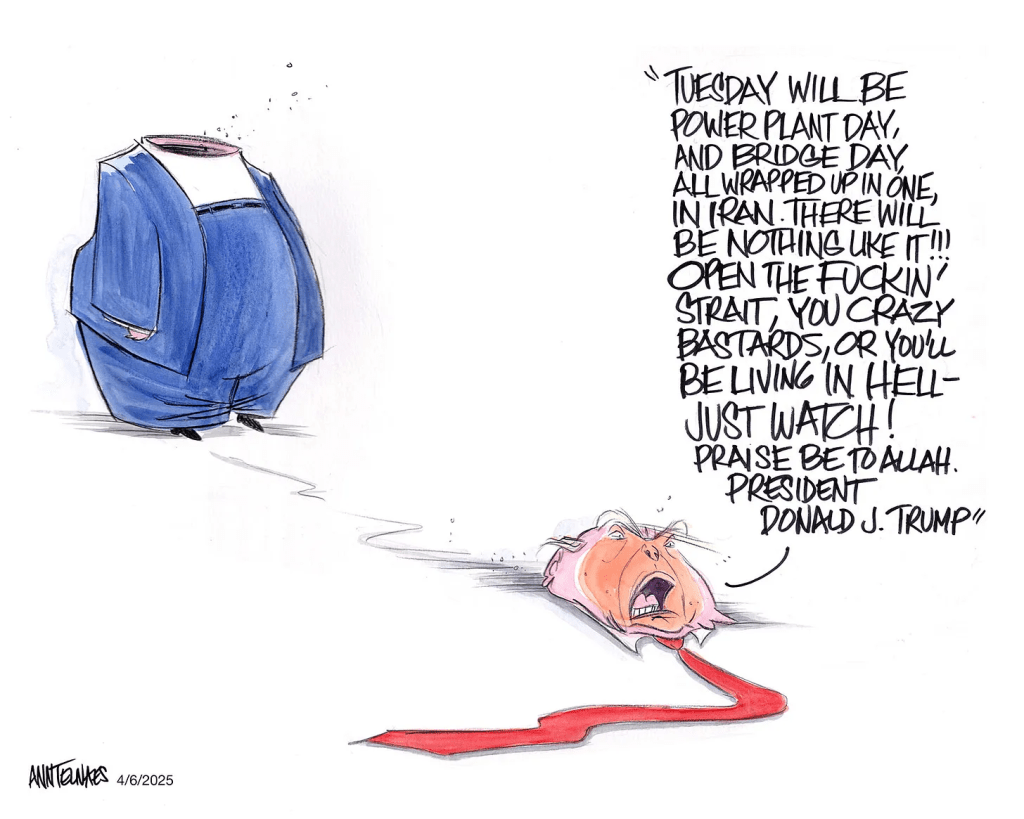
On Easter Sunday, Donald Trump posted to Truth Social, “Tuesday will be Power Plant Day, and Bridge Day, all wrapped up in one, in Iran. There will be nothing like it! ! ! Open the Fuckin’ Strait, you crazy bastards, or you’ll be living in Hell – JUST WATCH! Praise be to Allah. President DONALD J. TRUMP”
Trump supporters, including the evangelicals, don’t care how vulgar he is, how insane he is, or that he is threatening to commit war crimes. They don’t care that he unleashed his tirade on Easter Sunday. They don’t care that he has gone back and forth with his demands regarding the Strait of Hormuz, from wanting to get it open, to demanding help from NATO, to saying it will open up naturally, back to demanding that Iran open it, or he will bomb them straight to hell. (snip-MORE)
Trump unhinged
Another truth social posting by the tangerine monster
Put whatever you’d like to inscribe with your sig. in a comment. Scottie is with Ron as Ron gets his stents today. Here’s to all the best from all of us, with positive and healing energy to you both!
I wish! 😄 Leading Kansas writes this time in regard to data centers, and about addressing our local governments in our own behalf.It works the same in every state.
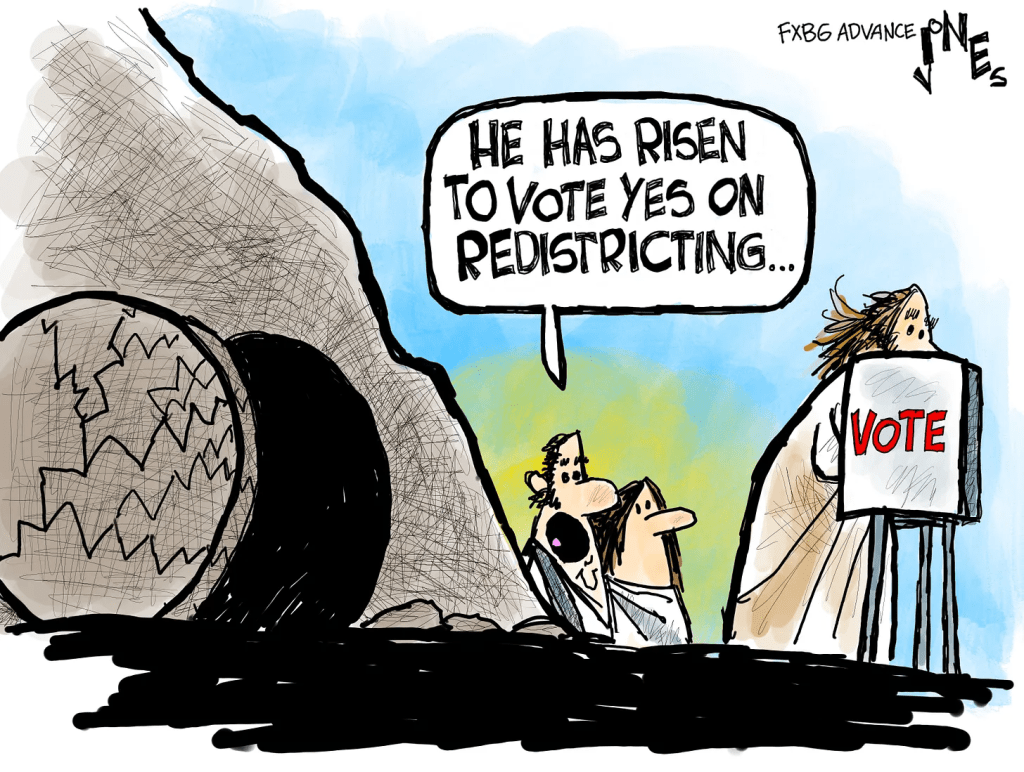
This cartoon was drawn for the Fredericksburg Advance. But don’t yell at them for it; you can yell at me.
If you live in Virginia, you have been bombarded with flyers about the special election on redistricting. And it’s not just flyers but also TV commercials, which are also popping up online. We are getting these things from both sides.
There is a special election in November on a state constitutional amendment that would give Democrats as many as four seats in Congress. The measure would also temporarily bypass the state’s redistricting commission to redraw maps in the middle of the decade.
The state’s Supreme Court approved the measure to be on the ballot less than a week before early voting began. State Republicans repeatedly tried to stop Democrats from moving forward with the referendum. The irony here is that Republicans claim that voting yes will disenfranchise voters, while they literally tried to keep this off the ballot so people couldn’t vote on it.
This is a direct response to Donald Trump and Republicans redistricting mid-decade to give themselves more seats. Donald Trump even said he was entitled to have more congressional seats. This is one reason why we need to No Kings protest. Donald Trump already believes he’s entitled to win elections he’s lost. (snip-MORE, and it’s on point)
Energy company Deep Fission is in the process of building a new and untested type of underground nuclear reactor in Parsons, KS
The Trump administration has reduced regulations to encourage nuclear power production
The reactor will likely power data centers for artificial intelligence
Large data centers consume huge amounts of water and energy and produce different types of pollution, leading to health risks for nearby residents
In November 2025 a two-year-old energy company called Deep Fission broke ground in Parsons, Kansas. They hope this project will enable them to install the second ever energy producing nuclear reactor in the state, after Wolf Creek, potentially with more reactors on the way in the future. If the early “characterization” drilling goes to plan, they claim the reactor could begin pumping electricity into the grid in the near future.
Parsons is a city of 10,000 in southeastern Kansas, near the Oklahoma border. I’ve lived in Kansas for most of my life and I had not heard of Parsons until last week. So, why is Deep Fission in Parsons, Kansas, and why now? Not coincidentally, the Great Plains Industrial Park, also located in Parsons, has lately been advertised as a prime location for new data centers to power the trillion-dollar (yes, trillion with a T) artificial intelligence boom forced upon us by large technology corporations and their venture capitalist backers. Which means the Parsons nuclear reactor project would likely come as a package with one or more new data centers, along with potential economic prosperity and a host of legitimate concerns that community members have already raised.
Part 2: The New Nuclear Power
While the Department of Energy set a goal for the Parsons reactor to go online in July of this year, Deep Fission themselves are aiming to connect to the grid by 2027 or 2028. Two years is still an unusually rapid rollout for a nuclear power plant, which usually takes 6-10 years from groundbreaking to full operation.
Nuclear energy is typically labeled as “clean” energy compared to coal, oil, and natural gas, meaning that it releases fewer pollutants into the air and water than fossil fuel consumption. Still, there are two main concerns. First is the disposal of nuclear waste, which ranges from the lightly contaminated clothing of plant workers to the lethally radioactive spent fuel a plant produces over time. This latter “accounts for just 3% of the total volume of waste, but contains 95% of the total radioactivity.”
A relatively new method in the US and Europe for disposing of our most dangerous nuclear waste is to bury it very deep underground, so that it can be surrounded by solid rock to provide the same level of pressure containment as required at structure at a surface nuclear reactor facility. The father-daughter team that eventually founded Deep Fission originally created Deep Isolation to dispose of nuclear waste. Deep Fission takes their concept a step further by placing the entire reactor, and therefore its most dangerously radioactive elements, into a borehole drilled one mile underground.
The second main concern related to nuclear energy production is, of course, accidents or attacks. It is true that large-scale nuclear accidents are very rare, but when they happen, they become instant, globally recognized disasters whose names we all know: Chernobyl, Three Mile Island, Fukushima. The effects are so widespread as to be practically impossible to quantify. The reactor explosion and meltdown in Chernobyl, for example, caused several dozen deaths directly related to radiation exposure, but various studies have predicted anywhere from thousands up to a million eventual additional cancer deaths. Not to mention the environmental and economic cost to the entire region around Chernobyl. And radioactive boars still terrorize people and farmland in the region around the Fukushima plant in Japan.
But those issues are known, and regulations have historically attempted to shore up potential dangers posed by new plants. In contrast, nothing like the underground nuclear reactor in Parsons, Kansas has ever been attempted before, and thanks to Executive Order 14301, will not need to go through long established design and testing phases that other types of nuclear reactors have been subject to in the past. John Young, a mining environmental regulatory specialist who lives in Sedgwick County, asks, “Why abandon the current regulatory process for something created out of whole cloth with no public input? And no one can define the current regulatory pathways for Federal and State authorizations.
“What,” Young asks in frustration, “could possibly go wrong?”
Part 3: Data Centers and Artificial Intelligence
So that is a glimpse into the nuclear energy side of things. Next we must address concerns around data centers and artificial intelligence. Data centers come in different sizes, like the smaller center being proposed in Wellington, KS, which would reportedly “use roughly 30% of the city’s electrical capacity while generating an estimated $1.3 million in annual electric utility revenue” while consuming only two gallons of water per day. Larger data centers consume resources less modestly. “Around the country, and the world, there is a land race among the big tech companies for sites for their data centers,” claims a November 2024 investigative report by Rolling Stone. Data centers are much newer than nuclear energy technology, yet the ways in which they harm communities near them have already become apparent.
Water: “Large data centers can consume up to 5 million gallons per day, equivalent to the water use of a town populated by 10,000 to 50,000 people,” according to a June 2025 study by the Environmental and Energy Study Institute (EESI). And data centers built explicitly to power AI represent the fastest growing portion of the market.
Last year, researchers at the University of California, Riverside calculated that ChatGPT—one of several popular Large Language Models (LLMs) vying for marketplace dominance—answered about 10,000 queries per second. The processing load to do so guzzled about 6,000 liters (or about 1,000 toilet flushes) of fresh water per second, all day, every day. That is only generating written text. AI photos require more water, and still more for AI video. “The extraction process is permanent,” explains the University of Alabama at Birmingham Institute for Human Rights. Water used to cool data centers evaporates as it cools hot components, meaning it can no longer be used by people in the region who need water for drinking, cooking, bathing, laundry, and general survival.
Pollution: Unfortunately, it is not only consumption of water to worry about. The evaporation of water cooling data centers leaves behind higher concentrations of nitrates and other contaminants leaked through agricultural fertilizers and pesticides into local water supplies, drastically increasing incidents of “rare cancers, muscle disorders, and miscarriages” among people who live nearby. Geographically, Parsons, Kansas sits atop the Alluvial and Ozark Aquifers.
Reports of noise pollution have increased near data centers as well. Residents in different Virginia towns experienced disturbing high and low frequency humming in a wide radius around two new data centers.
These same experts predict that the disempowerment will not only come at the individual level, but also at the societal level, as lawmakers turn their attention and favor even more toward tech companies and AI services that increasingly take over tasks that used to be performed by human beings.
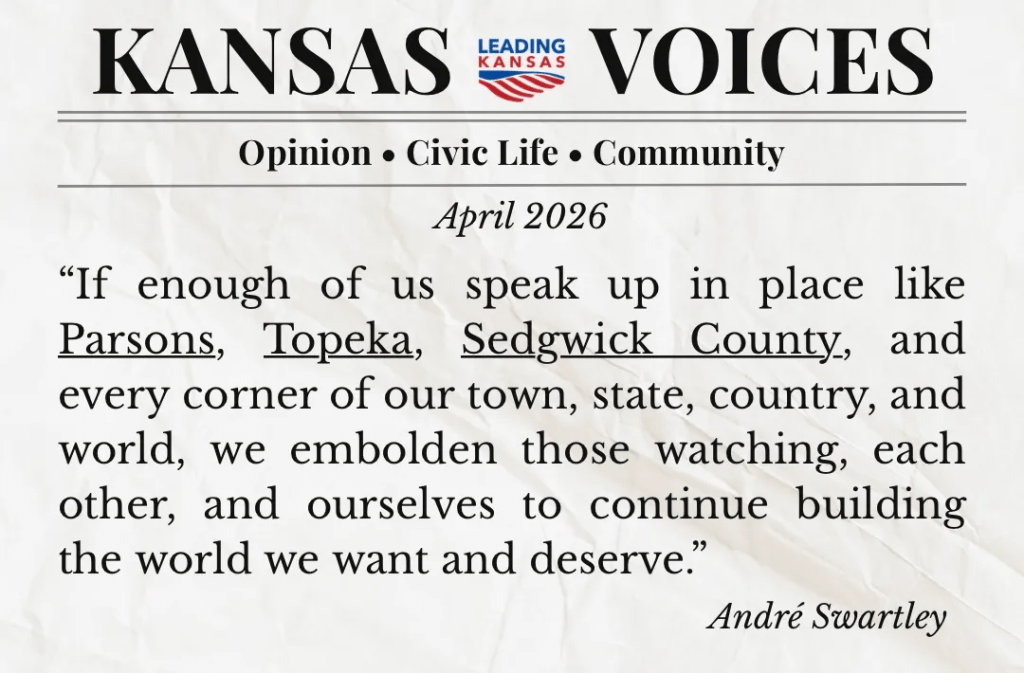
The purpose of this article is not to overwhelm with doomsaying or inevitability. If the Deep Fission underground reactor works as advertised, it could genuinely provide cleaner energy than fossil fuel and mitigate some of the effects of climate change. But to get there safely, we need to demand transparency and regulatory protections from political and corporate leaders. If enough of us speak up in place like Parsons, Topeka, Sedgwick County, and every corner of our town, state, country, and world, we embolden those watching, each other, and ourselves to continue building the world we want and deserve.
James Prigioni makes popular gardening videos on YouTube. In one, he wanted to see if he could grow a whole tomato plant by planting the seeds from a tomato on a McDonald’s burger. He picked up a Deluxe Quarter Pounder with cheese, pulled out a tomato slice, and removed two seeds. After rubbing the seeds on a paper towel to remove the protective coating, which can inhibit sprouting, they were ready to plant.
Trying out different seed-planting methods
But like any good scientist, Prigioni wanted to try a different method for testing McDonald’s tomato seeds. So he pulled a slice of tomato from a second Quarter Pounder and, instead of extracting the seeds, planted the entire slice.
With the help of a heat mat and a grow lamp, both sets of seedlings germinated and sprouted in soil-filled red Solo cups in about a week. After they were fully established, Prigioni separated the plants so they could thrive individually before being planted outside.
He planted one of the plants in the ground outside and another in a 5-gallon bucket. He then showed how he culled the lower leaves as they developed blight and used a tomato cage to support the plants as they produced fruit and grew heavier. He also added extra fertilized soil and mulch to the bucket plant.
The harvest was unexpected
After three months, the plants were producing abundant fruit. The bucket plant didn’t perform as well as the in-ground plant, which Prigioni said was due to insufficient watering during very hot days. The bucket plant also ripened faster, likely due to the stress it had been under. Still, it was an impressive harvest, especially for a plant that started on a McDonald’s burger.
The in-ground McDonald’s plant was even more incredible, with dozens of tomatoes dripping from it.
“I expected this tomato to grow,” Prigioni said, “but I did not expect this.”
The fruit from both plants tasted good and sweet, he said. By the fourth month, the in-ground plant was starting to struggle with its health, but not with its fruit production.
“The plant had so many tomatoes on it that it seemed like it was having a little difficulty ripening that much fruit at one time,” Prigioni said. “I mean, I have had some plants with a lot of tomatoes on them, but never in my life have I seen a single tomato plant with this much fruit on it. I was completely blown away.”
How the McDonald’s tomatoes compared
He said one of his favorite parts of the experiment was seeing what kind of tomatoes would grow from the seeds. He thought it might be a beefsteak variety, but it turned out to be a Roma type. However, he surmised that the McDonald’s tomato was likely a hybrid, based on its ripening characteristics.
Prigioni also shared how the McDonald’s tomato plants compared with his other tomato plants.
“In another area of the garden, I grew Roma tomatoes that I got from Lowe’s, and I planted them at the same time as the McDonald’s tomatoes,” he said. “The harvest from them wasn’t quite as large, but the fruit ripened way more evenly, and I was able to harvest a lot more fresh fruit right off the vine that was ripe.”
“Overall, I was shocked with the level of production,” he continued. “And this is probably my favorite experiment that I’ve ever done. I mean, to be able to take a cheeseburger, grab a tomato from it, then grow a tomato plant, and then harvest pounds and pounds of tomatoes from it is just such a unique and refreshing experience.”
Perhaps an unexpected result, but a great way to challenge our assumptions and demonstrate the power of nature, even in the context of fast food.