We rely on your support to make local news available to all
Make your contribution now and help Gothamist thrive in 2025. Donate today
Gothamist is funded by sponsors and member donations
The election may be over in New York City, but Mayor Eric Adams isn’t done fighting against Zohran Mamdani.
In the last two weeks, Adams has made – or flirted with – maneuvers that could cause some political headaches for mayor-elect Mamdani and even stall his affordability agenda. The moves have implications for Mamdani’s pledge to freeze the rent for stabilized tenants, maintain funding for the NYPD and build more housing to address the city’s affordability crisis.
Political experts say Adams is following a tried and true tradition.
“There’s a history of mayors making decisions in the final days of their mayoralty,” said Chris Coffey, a political strategist who worked for Mayor Michael Bloomberg. “Whether it’s for messing with the next mayor, or getting the things they want before their term is up, only a psychiatrist could tell you.”
Late last month, Adams began weighing whether to pack the Rent Guidelines Board with members opposed to Mamdani’s plan to freeze the rent on the city’s 1 million regulated apartments. Those appointees would remain in place when Mamdani took office, potentially setting up an unprecedented legal battle over whether the new mayor could fire them.
Adams has not yet announced any new appointees. Eleonora Srugo, a real estate agent and star of a Netflix reality show, “Selling the City,” told the New York Times she had declined Adams’ job offer.
Days later, Adams announced additional funding to hire 5,000 police officers. Mamdani has said he would keep the police headcount at its current level of 35,000 officers — a headcount the NYPD has failed to reach under Adams due to struggles with recruitment.
Once Mamdani takes office, he will have to decide whether to rescind the $316 million Adams allocated to hire the additional officers. The move would be largely symbolic since the city can’t meet its currently budgeted staffing levels.
During the primary, Mamdani distanced himself from his previous calls to reduce police spending.
“I am not defunding the police. I am not running to defund the police,” he said in July. He described himself as a person who “learns and one that leads, and part of that means admitting as I have grown.”
The latest example of Adams’ maneuvering came on Wednesday, when Gothamist exclusively reported that the administration had designated Elizabeth Street Garden as parkland. The move was the latest development in the years-long saga over whether the city could build an affordable housing development for seniors on the site in Nolita.
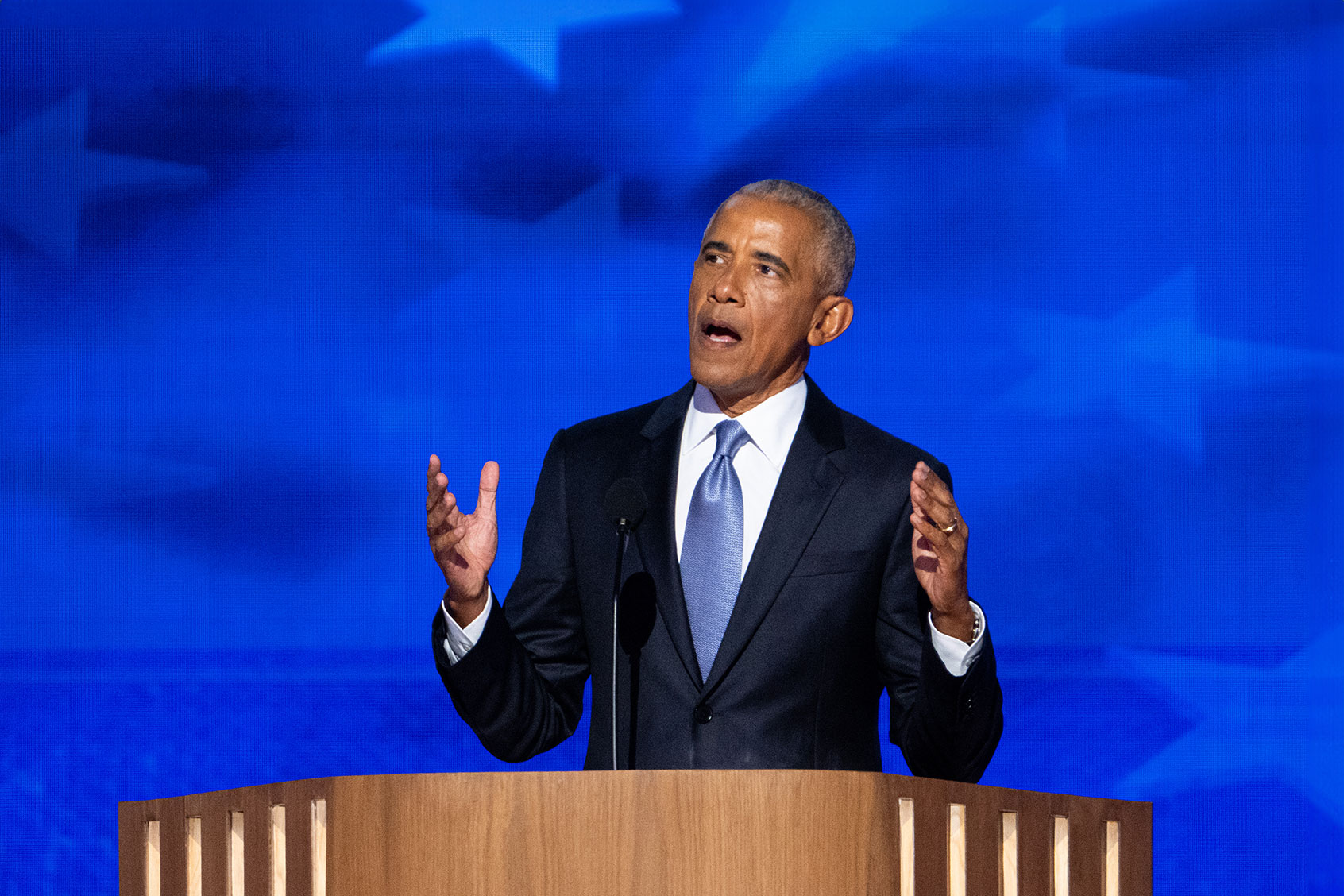
Mayor Adams has said he’s committed to a smooth transition. But he’s implemented policies that go against Zohran Mamdani’s agenda.
Benny Polatseck/Mayoral Photography Office
On Thursday, Mamdani accused Adams of “using his final weeks and months to cement a legacy of dysfunction and inconsistency.”
But he also said that the administration’s actions “make it nearly impossible to follow through with” building housing on the garden.
Adams is far from the first mayor to complicate his successor’s plans.
Former Mayor David Dinkins ignored his successor Rudy Giuliani’s criticisms of a deal to keep the U.S. Open in Queens by building Arthur Ashe Stadium.
During the final month of his second term, Giuliani, a baseball fan, signed deals for new stadiums for the Mets and Yankees. Bloomberg canceled them not long after he took over City Hall.
Adams has publicly said he’d ensure a smooth transition. On Thursday, he rejected Mamdani’s criticism of his move to preserve Elizabeth Street Garden.
“It’s not about a legacy of dysfunction,” Adams told reporters. “It’s about protecting a legacy in the promises we made.”
He also said, “I’m the mayor until December 31st.”
With the Elizabeth Street Garden, Adams may have actually done Mamdani a favor. The proposed development has devolved into a nasty fight pitting housing advocates against the garden’s well-heeled supporters, who include Patti Smith, Robert DeNiro, Martin Scorsese and others.
“These are political sh– sandwiches,” Coffey said, referring to the garden. “I’m sure the mayor- elect would want that off the table.”
During a live podcast with the news site Hell Gate last month, Mamdani said he would evict the garden’s operators in his first year as mayor. But at least one key member of his inner circle may be pleased with Adams’ move to make the Elizabeth Street Garden a park — filmmaker Mira Nair.
“My mother really disagrees with me,” Mamdani said.
U.S. President Donald Trump and Secretary of State Marco Rubio attend a cabinet meeting at the White House, in Washington, D.C., U.S., October 9, 2025. REUTERS/Evelyn Hockstein
Something dramatic has happened.
Many people who consider themselves non-political or independent, or moderate Republican, or who even voted for Trump last November, can’t avoid seeing what’s now come so clearly into the open.
They’ve watched Trump order the Texas National Guard into Portland and Chicago, over the objections of the mayors of those cities and the governors of Oregon and Illinois. They’ve heard him call for jailing the mayor of Chicago and governor of Illinois for opposing these moves.
They’ve heard him threaten to invoke the Insurrection Act and send federal troops all over America.
They’ve watched Trump’s ICE agents drag people out of their beds in the middle of the night, zip-tie them and their children, and haul them away.
They’ve seen Trump’s prosecutors indict the attorney general of New York state because she held Trump accountable for fraud. And seen him threaten to do the same to a California senator because he conducted hearings in the House exposing Trump’s role in the attack on the Capitol.
They’ve heard Trump say he can kill anyone who he claims is an enemy combatant trafficking drugs.
They’ve heard Trump direct the IRS, FBI, and Justice Department against liberal groups that oppose him — George Soros’s Open Society Foundation; ActBlue, the Democratic fundraising organization; Indivisible, the community-based resistance organization.
And they watched him take off the air comedians who criticize him — Stephen Colbert, Jimmy Kimmel.
All across America, millions of people who have avoided politics, or identified as independents or moderate Republicans or even Trump voters, are shaken by what they’re seeing and hearing.
It’s no longer Democrat versus Republican or left versus right.
It’s now democracy versus dictatorship. Right versus wrong.
It’s no longer a war on undocumented immigrants. It’s now a war on Americans.
It’s no longer a foreign enemy. It’s now the “enemy within.”
Across the land, average Americans are realizing that they too could be dragged out of their homes in the middle of the night by Trump’s ICE agents, or tear-gassed and arrested by Trump’s National Guard, or targeted by Trump’s prosecutors, or shot by Trump’s military.
The Big Reveal is that all of us are now endangered.
Multiple polls show Trump’s approval tanking, but I think it runs deeper than this.
Something dramatic has happened over the last two weeks — as America sees more vividly than ever who Trump is, where he and his trio of lapdogs (Miller, Vought, and Vance) want to take the country, and how we’re all potential targets.
The Big Reveal is impossible not to see. Trump and his lapdogs are doing all of this completely in the open. They have no shame.
Most Americans abhor what they see, because what they see is abhorrent.
This is how the great sleeping giant of America awakens, roars, and puts an end to it.
Robert Reich is a professor of public policy at Berkeley and former secretary of labor. His writings can be found at https://robertreich.substack.com/.
November 15, 1917 About 20 women peacefully picketing for universal suffrage (right to vote), who had been arrested in front of the White House a few days earlier, were subjected to beatings and torture at Occoquan workhouse in Virginia. The National Women’s Party and other organizations had been picketing the White House and President WoodrowWilson as he traveled around the country ever since the inauguration of his second term. Mary Winsor The incident became known as the “night of terror.” Wilson had led the country into the European war (later called World War I), by characterizing the U.S. mission as “making the world safe for democracy.” The women demonstrating outside in Lafayette Square called attention to the need for complete democracy at home, where half of its citizens lacked complete voting rights. Many women, including Lucy Burns and Alice Paul, had been arrested several times, usually for obstructing the sidewalk, and imprisoned before. When a judge learned of the abuse he freed the women. Public outrage over their treatment increased sympathy for the suffrage movement. . left: Lucy Burns in Occoquan Workhouse, Washington, DC right: Alice Paul, New Jersey, National Chairman, Congressional Union for Woman Suffrage; Member, Ex-Officio, National Executive Committee, Woman’s Party, ca 1915 Amazing resources from the Library of Congress on women’s suffrage (It’s still all there-go see!)
November 15, 1940 75,000 men were called to Armed Forces duty under the first peacetime conscription. Draft inductees leaving Wilmington, Delaware in November, 1941
November 15, 1943 Heinrich Himmler, Adolf Hitler’s head of the SS (Schutzstaffel or protective rank), Gestapo, the Waffen SS and the Death’s Head units that ran the concentration camps, made public an order that “Gypsies”-more properly, the Roma-and those of mixed Roma blood were to be put on “the same level as Jews and placed in concentration camps.” “Gypsy” prisoners arriving at a Concentration Camp Himmler was determined to prosecute Nazi racial policies, which dictated the elimination from Germany and German-controlled territories of all races deemed “inferior,” as well as “asocial” types, such as hardcore criminals. “Gypsies” fell into both categories according to the thinking of Nazi ideologues and had been executed in droves both in Poland and the Soviet Union. The order of November 15 was merely a more comprehensive program, as it included the deportation to the Auschwitz death camp of “Gypsies” already in labor camps. The Gypsies in Germany Gypsies: Forgotten Victims of the Holocaust
November 15, 1957 U.S. Committee for a Sane Nuclear Policy (SANE) was founded. Thirty years later on November 20, SANE merged with the Nuclear Freeze organization (dedicated to freezing all nuclear weapons testing worldwide) at a joint convention in Cleveland to form SANE/FREEZE. Its successor is known as Peace Action, the largest U.S. peace organization. Sane Nuclear Policy poster, 1960 SANE history-Peace Action
November 15, 1969 Following a symbolic three-day “March Against Death,” the second national “moratorium” against the Vietnam War opened with massive and peaceful demonstrations in San Francisco and Washington, D.C. Organized by the New Mobilization Committee to End the War in Vietnam (“New Mobe”), an estimated 500,000 demonstrators participated as part of the largest such gathering to date. It began with a march down Pennsylvania Avenue in front of the White House (while Pres. Nixon watched the Purdue-Ohio State football game on TV) to the Washington Monument, where a mass rally with speeches was held. Pete Seeger, Arlo Guthrie, Peter, Paul and Mary, and four different touring casts of the musical “Hair” entertained the demonstrators. The rally concluded with nearly 40 hours of continuous reading of known U.S. deaths (to that date) in the Vietnam War.
November 15, 1986 A government tribunal in Nicaragua convicted American Eugene Hasenfus, a CIA operative, of delivering arms to Contra rebels and sentenced him to 30 years in prison. He had been arrested when his plane was shot down by Sandanista troops. He was pardoned a month after his conviction (his last name means “rabbit’s foot” in German). Hasenfus under arrest
Karl says the democrats feel they won because they highlighted the act that 20 million people will lose their healthcare or their premiums will soar making the costs more than they can afford, showing people that the republicans did not care. So the democrats are in a better position or the midterms. WTF! What good does that do the 20 million people right now or this January? It shows some democrats are only interested in keeping their job, privilege, and power. They don’t prioritize the people they are said to serve. They don’t really want to do their jobs or put them at risk for the sake of the people. They got their golden ticket to fame, wealth, and power so everything is good let’s not rock the boat. There is a name for that. Corporate moderate democrats. Or as I call them, republican lite. Who votes for the lite beer when they can have the full taste one? So the idea that they are going to attract republicans to the democratic side is unrealistic. Hugs
November 14, 1910 Eugene Ely performed the first airplane takeoff from a ship. His Curtiss pusher flew from the deck of the U.S.S. Birmingham in Hampton Roads, Virginia.By January he would execute the first (takeoff and) landing on a warship, the U.S.S. Pennsylvania. Captain Washington I. Chambers of the Navy Department had been interested in the military uses for the seven-year-old invention. Naval flight training started shortly thereafter. More of the whole story.
November 14, 1954 “Ten Million Americans Mobilized for Justice” began a campaign to collect 10 million signatures on a petition urging the Senate not to censure Senator Joseph McCarthy (R-Wisconsin). The motion of censure against Senator McCarthy was for obstructing a Senate committee and for acting inexcusably and reprehensibly toward a U.S. soldier appearing before his own committee. McCarthy had used his Senate Permanent Investigations Subcommittee to publicly denounce thousands as subversive, especially within the federal government, many without any justification. The political views of most were painted as treasonable and conspiratorial, rather than differing political views. The petition effort fell about nine million signatures short. More on Joe McCarthy
November 14, 2000 Florida Secretary of State Katherine Harris, simultaneously co-chair of George W. Bush’s Florida presidential campaign organization and the public official responsible for the conduct of the election itself, certified Governor Bush’s fragile 300-vote lead over Vice President Al Gore in the 2000 presidential election. Katherine Harris Florida Judge Terry Lewis gave Harris the authority to accept or reject a follow-up manual recount from some counties where the count was open to question. Harris rejected the manual recounts.
This blogger is a newer subscriber to Scottie’s, and comments here some. Here is a short bit with info on Poland’s November 11th Independence Day observance and history.
(I don’t know what this formatting is about. This is the 3d try, so here it is as it is.)
November 10, 1924
The Society for Human Rights, the first gay rights organization in the U.S., was founded in Chicago by Henry Gerber, a German immigrant. He had been inspired by Germany’s Scientific Humanitarian Committee, formed to oppose the oppression of men and women considered “sexual intermediates.”
Henry Gerber–founder of the Society for Human Rights
The founder of Chicago’s Society for Human Rights in 1924, the first gay rights organization in the United States, Henry Gerber was born in Bavaria as Joseph Henry Dittmar on June 29, 1892, and arrived at Ellis Island in October, 1913. With members of his family, he moved to Chicago because of its large German population. After working briefly at Montgomery Ward, he was interned as an alien during World War I. He wrote that although this was not right, he did receive three meals a day. From 1920 to 1923 he served with the U.S. Army of Occupation of Germany and during this time, he came into contact with the German homosexual emancipation movement. He subscribed to German homophile magazines and was in contact with Magnus Hirschfeld’s Scientific-Humanitarian Community in Berlin. In 1924, Gerber returned to Chicago and was hired by the post office. Gerber’s return to Chicago was amidst a backdrop of urbanization and an emerging gay subculture.
Following what Gerber had seen in Germany, he felt the need to establish an organization to protect the rights of gays and lesbians. With several friends, Gerber formed an organization which was later incorporated as The Society for Human Rights, a nonprofit corporation in the State of Illinois. The organization published a newsletter, Friendship and Freedom, which was distributed to its small membership.
In July, 1925, the society came to an abrupt end. The wife of one of the co-founders reported her husband, a reputed bisexual, to her social worker who contacted the police. Following a police raid, Gerber and several others were arrested and prosecuted for their deviancy. After three costly trials the case against Gerber was dismissed. Gerber lost his entire life savings defending himself and was fired from his job at the post office for conduct unbecoming a postal worker.
After his ordeal, Gerber moved to New York City where he reenlisted in the U.S. Army and served for 17 years. During the 1930s he managed a personal correspondence club and wrote articles in gay publications under a pseudonym. The correspondence club became a national communications network for gay men. In the 1940s, Gerber exchanged a number of letters with Manuel Boyfrank of California. Boyfrank was enthusiastic about organizing to combat homosexual oppression. Gerber offered his assistance, but refused to risk his job again. He continued his assistance through personal correspondence and numerous articles.
On December 31, 1972, Gerber died at the U.S. Soldiers’ and Airmen’s Home in Washington, D.C., at the age of 80. He lived to see the Stonewall Rebellion and the start of a new era of activist gay and lesbian liberation organizations.
People dressed in inflatable duck costumes at the Indianapolis No Kings protest on October 18, 2025 (Photo courtesy of J. Bortel)
And public and street art has likewise become a consistent space for expressions of protest and resistance, as illustrated by this graffiti quotation from the 14th Amendment found on the wall of an abandoned Dunkin Donuts near my university in Fitchburg, Massachusetts.
Protest graffiti in Fitchburg, Massachusetts (Photo courtesy of Ben Railton)
Those examples comprise two distinct but interconnected categories: protest art — artworks present at or directly representing collective actions; and art as protest — artworks that themselves comprise an expression and form of resistance. Both types are part of a long, rich history, as art has been integral to the foundational American story of protest. Here I’ll highlight just a few examples of each category from across our history. (snip-MORE-click through on the title)
“I like to be rough. I like to be rowdy. I also like to be loving….I like to baby sit.”
—Mary Fields
Mary Fields was as beloved as she was feared. Few people dared challenge the six-foot-tall, 200-pound former slave who carried a gun, drank, and had a hot temper. Despite her formidable image, Fields loved children, helped others, and carried the mail through the blizzards of northern Montana.
Born into slavery around 1832 in Hickman County, Tennessee and freed after the Civil War, Fields later found work as a chambermaid on the Mississippi steamboat Robert E. Lee. There she met Judge Edmund Dunne, who hired her as a servant in his household. After his wife’s death, Dunne sent Fields and his five children to live with his sister, Sara, or Mary Amadeus, Mother Superior of the Ursuline convent in Toledo, Ohio around 1874. There the former slave and the nun became fast friends. According to the Toledo Blade, legend has it that when Fields arrived in Toledo, Mother Amadeus asked if she needed anything, to which her friend replied, “Yes, a good cigar and a drink.”
The following year, Mother Amadeus was sent to Montana Territory to establish a school for indigenous girls at St. Peter’s Mission, west of the town of Cascade. When Fields learned that Mother Amadeus was stricken with pneumonia, she moved to Montana and nursed the nun back to health. After that, the 52-year-old Fields volunteered at the convent, hauling stones to build the school, fetching supplies from nearb y towns, washing the convent’s laundry, tending to its many chickens, managing the kitchen, and maintaining the mission’s garden and grounds. (While she lived at the convent, Fields refused to be paid for her work, preferring to come and go as she pleased.) (snip-MORE-click through on the title)