Category: History
tRump’s lies are going to cost the US taxpayer money as tRump uses the US treasury as his own money
Three clips from Belle of the Ranch on US aggression against other countries.
Mamdani Hits The Ground Running
Let Them Fight…
RFK And Trump’s “Fleshy Dominoes”
US Billionaire Wealth Surges to $8.1 Trillion as Affordability Crisis Hammers Working Class
https://www.commondreams.org/news/us-billionaire-wealth
“Billionaires are raking in staggering profits off the backs of ordinary workers,” said Chuck Collins of the Institute for Policy Studies.
The collective wealth of US billionaires surged to $8.1 trillion in 2025 as working-class Americans faced a cost-of-living crisis made worse by President Donald Trump’s tariff regime and unprecedented assault on the social safety net.
An analysis released Friday by the Institute for Policy Studies (IPS) found that the top 15 US billionaires saw the largest wealth gains last year, with their collective fortune growing from $2.4 trillion to $3.2 trillion. That 33% gain was more than double the S&P 500’s 16% increase in 2025.
What IPS describes as the “elite group” of US billionaires includes Tesla CEO Elon Musk, the richest man in the world; Google co-founder Larry Page; Amazon founder Jeff Bezos; and Oracle executive chairman Larry Ellison.
IPS emphasized that “these staggering combined billionaire wealth totals come as the Trump-GOP budget bill passed in 2025 defunded health insurance, food stamps, and other vital anti-poverty safety net programs, in order to pay for tax cuts for the wealthy and budget increases for militarism and mass deportations.”
“The affordability crisis is hitting ordinary Americans particularly hard as we head into the new year, but not everyone is feeling the pain: Billionaires are raking in staggering profits off the backs of ordinary workers,” Chuck Collins, director of the Program on Inequality and the Common Good at IPS, said in a statement.
“These extreme concentrations of wealth and power,” Collins added, “undermine our daily lives and further rig our economy in favor of the ultra-rich and corporations, while ordinary Americans get a raw deal once again.”
IPS released its analysis days after Bloomberg reported, based on its Billionaires Index, that the world’s 500 richest people gained a record $2.2 trillion in wealth last year.
Omar Ocampo, an IPS researcher, said that in the US, billionaires are “paying far less in taxes compared to the huge amount of wealth they amass,” allowing them to continue accumulating vast fortunes, supercharging inequality, and using their wealth and influence to subvert reform efforts.
“Not only are a small number of Americans holding more wealth than the rest of America, but they’re also not paying their fair share in taxes,” said Ocampo.
The new report comes as families across the US struggle to make ends meet amid high and still-rising prices for groceries, housing, and other necessities. A Century Foundation survey released last month found that “roughly three in 10 voters delayed or skipped medical care in the past year due to cost, while nearly two-thirds switched to cheaper groceries or bought less food altogether.”
Minnesota day care hoax is fueled by MAGA psychosexual weirdness
OK let’s discuss the hidden thing here. A 20 plus year old claims he has never had sex. I remember being a 16 yr old newly inducted into the SDA church. Any touching of your male members was a huge sin they constantly harped on. I did try, but seriously, a teen boy with my history but any normal teen boy is going to do the deed to get off. And for many of them it leaves them with after crippling guilt of not pleasing their god who watched them do it. God is a perv. I can’t tell you the number of boys in that church school I hugged with and they cuddled with me … but we never had sex. Two wanted to but if I got thrown out of the school I had to return to the brutal home I was using the school to escape from. But the idea of just ignoring one’s hormone driven sex drive is not healthy and the religious leaders pushing that all did it when they were teens. But the grift has to be kept up. Hugs
https://www.salon.com/2026/01/05/minnesota-day-care-hoax-is-fueled-by-maga-psychosexual-weirdness/
The racism underlying MAGA’s latest obsession is intertwined with misogyny
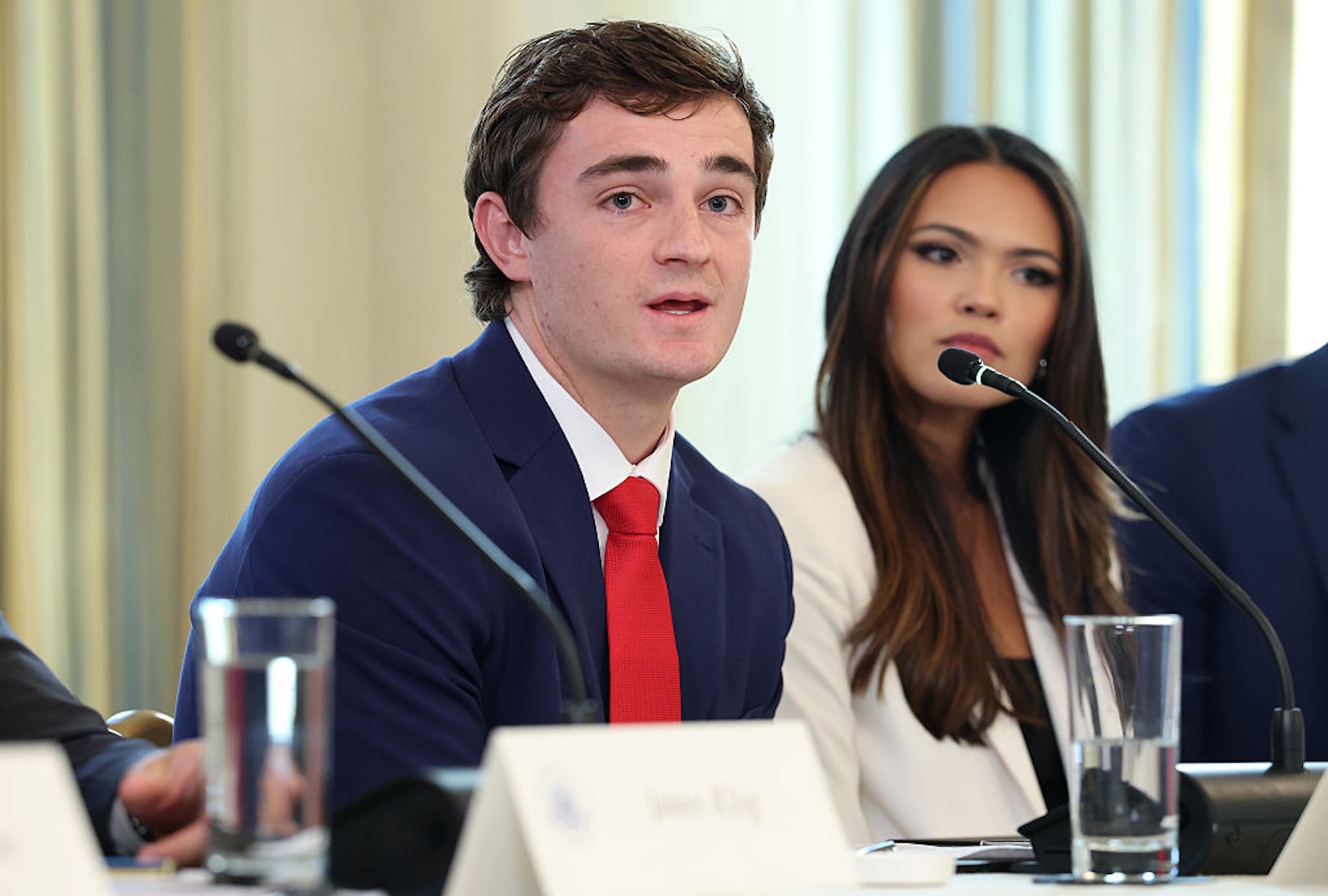
Senior WriterMAGA influencer Nick Shirley speaks during a roundtable discussion on antifa at the White House on Oct. 8, 2025. ( Anna Moneymaker/Getty Images)Nick Shirley really wants the world to know that he’s never had sex. The YouTuber who moved from “prank” videos to the more lucrative world of creating MAGA disinformation apparently believes that sexual inexperience is an armor against accusations that he’s a liar. “I’m a virgin. I don’t have sex with random girls. You’re not gonna catch me on those sexual allegation charges,” he rambled on “PBD Podcast,” insisting that he is “religious” and doesn’t “have any vices.”A deeper dig shows even more how ridiculous this situation is. Shirley has a history of dishonesty, which includes paying immigrant laborers to hold pro-Biden signs, clearly hoping voters would think they were self-motivated. In another video, he claimed Portland had “fallen” and “antifa” had taken “control of the city,” an unvarnished lie.
CNN verified that children were being dropped off at a day care center Shirley had targeted. The Minnesota Star Tribune visited the day cares in question and found, when they were allowed access, children playing and napping peacefully. CBS News reviewed security footage showing kids being dropped off at one targeted center. Others were indeed empty; they had gone out of business before Shirley filmed outside the buildings.
Shirley stands accused of lying for racist reasons, so his “but I’m a virgin” defense is irrational — at least on the surface. But it makes more sense, in a psychosexual way, in light of the right’s long-standing fear and loathing of day cares.
Shirley stands accused of lying for racist reasons, so his “but I’m a virgin” defense is irrational — at least on the surface. But it makes more sense, in a psychosexual way, in light of the right’s long-standing fear and loathing of day cares. After all, the scandal Shirley is exploiting isn’t really about day cares. It’s about a larger case in Minnesota of Feeding Our Future, a fraudulent food pantry that was run by Aimee Bock, a white woman who was convicted in March of cheating taxpayers out of nearly $250 million of pandemic funds. While Bock was the mastermind, other defendants in the case are Somali American. On Dec. 30, a federal judge cleared the way for the government to seize $5.2 million in assets from Bock.
If Shirley was only interested in building his hoax on that existing and very real case, he could have targeted anti-hunger charities for his fake sting. Instead, he went after day cares, which are only tangentially related insofar as they are — along with churches, mosques, schools and community centers — sites that were supposed to get assistance from the fraudsters but never received it.
These businesses were picked almost certainly because Shirley and his colleagues have tapped into the long-standing tendency of paranoid reactionaries to make day cares the subject of conspiracy theories. Along with birth control and abortion — whose providers are also smeared constantly with right-wing lies — day care is loathed on the right for allowing women to work instead of being financially dependent on a husband. In the 1980s, day care workers were accused of being Satanists. Now, during the MAGA era, the scapegoat for men’s fears of female independence has shifted from imaginary devil-worshippers to real immigrants. White women are implicitly accused of using immigrant labor as a cheat to avoid their god-given duty to quit work to stay home and raise babies. Vice President JD Vance has been especially loud with his belief that day care is pushing women away from their supposedly inherent desire to be housewives.
Want more Amanda Marcotte on politics? Sign up for her free newsletter, Standing Room Only, now also on YouTube or wherever you get your podcasts.
Vance almost certainly doesn’t believe his own narrative. For one thing, it’s illogical to believe women would think, “Gosh, I want nothing more than to stay at home, but if there’s a day care down the street, I guess I have to use it.” His own wife has been outspoken about how much she loved working at her law firm that offered on-site childcare — and how much she misses it. But Vance has apparently decided that the bulk of support for his 2028 presidential bid will be rooted in the world of extremely online, sexually dysfunctional misogynists that love shady influencers like Shirley. The vice president’s messaging strategy has long been focused on this loose conglomerate known as the “manosphere”: bitter divorced men, “incels” (involuntarily celibates) and devotees of the “red pill,” an ideology that holds that dating and marriage aren’t about love but about men tricking or forcing women into submission.
The manosphere isn’t just deeply misogynist; it’s also incredibly racist. For liberals taking a cursory glance into that world, it can be very confusing how MAGA men can somehow blame immigrants for their own dating woes. But in the cesspool of incoherent resentment that Vance is clearly absorbing, the alleged evils of feminism and immigration are seen as part of a larger “woke” conspiracy against the white man. Before he died, Turning Point USA founder Charlie Kirk often posted about how “who we actually can’t stand are angry, liberal, white women.” He would portray white women as idiots for not perceiving immigrants as a threat. “If woke is a mind virus,” he posted, “then white college indoctrinated women are the most susceptible hosts.” Influencers like LibsofTikTok hold up white women who resist mass deportations as selfish ninnies who just want to keep their babysitters.
Shirley has engaged in this rhetoric himself. “White liberal women tend to support the people that steal and rob from them,” he claimed in one post. Another was more ominous: “Liberal white womens [sic] logic and empathy will get them killed eventually.”
In this toxic stew of sexual resentment, misogyny and racism, it makes more sense that Shirley thinks his virginity is relevant. Anti-immigrant sentiment is woven into a larger MAGA narrative about expelling allegedly decadent and foreign influences. White male dominance, people like Shirley believe, can be restored by adhering to strict sexual and social mores prescribed by right-wing Christianity. Abstaining from sex until marriage is part of a larger program meant to produce male-dominated marriages, where wives are too busy with large broods of white children to hold jobs. Attacking Black immigrants at a day care center has powerful symbolic resonance; it’s seen as an important front in a war both to make America whiter and to restore white women to a submissive role in the home.
The irony is that Shirley’s diatribe about his sexual status only underscores how much the attack on the day cares is not, contrary to his claims, driven by a nonpartisan, disinterested desire to end fraud. That much was always obvious. Shirley loves Donald Trump, who is himself a convicted fraudster who continues to use his office to enrich himself in blatantly corrupt ways. Shirley has followed the president’s lead — he, too, has a long history of posting racist vitriol about immigrants.
But bringing his sexuality and views on gender relations into the discussion — when no one else has done so — suggests that those issues aren’t far from mind, either. The fixation on “purity” is a common fascist obsession, manifesting in backwards fantasies of racial and sexual purity. None of this has any relation to the real world where people of all races and genders are just trying to do their jobs, raise their children and live their lives.