Brotherton, The “Joe 1”, & More, in Peace & Justice History for 8/29

August 29, 1758
The first Indian reservation, Brotherton, was established in New Jersey. A tract of three thousand acres of land was purchased at Edge Pillock, in Burlington County. The treaty of 1758 required the Delaware Tribes, in exchange for the land, to renounce all further claim to lands anywhere else in New Jersey, except for the right to fish in all the rivers and bays north of the Raritan River, and to hunt on unenclosed land.
History Of The Brotherton Reservation 
August 29, 1949
The Soviet Union detonated its first atomic bomb in a test at Semipalatinsk in eastern Kazakhstan. It was known as Joe 1 after Josef Stalin, then General Secretary of the Communist Party.

” Joe 1, the first Soviet atomic bomb
Andrei Dmitrievich Sakharov, key developer of the Soviet bomb, later worked for peace
The Semipalatinsk test site
August 29, 1957
Following consultations among the NATO allies and other nations, the Western (non-Communist) countries presented to the United Nations a working paper entitled, “Proposals for Partial Measures of Disarmament,” intended as “a practical, workable plan to start on world disarmament.” The plan proposed stopping all nuclear testing, halting production of nuclear weapons materials, starting a reduction in nuclear weapons stockpiles, reducing the danger of surprise attack through warning systems, and beginning reductions in armed forces and armaments.
August 29, 1957

African Americans in Milledgeville, Georgia, wait in line to vote following the Civil Rights Act of 1957.
The U.S. Congress passed the Civil Rights Act, the first such law since reconstruction. The bill established a Civil Rights Commission which was given the authority to investigate discriminatory conditions. A Civil Rights Division was created in the Department of Justice, allowing federal prosecutors to obtain court injunctions against interference with the right to vote, among other things.
In an ultimately futile attempt to block passage, then-Democrat, former Dixiecrat, and later Republican Senator Strom Thurmond of South Carolina set the all-time filibuster record: 24 hours, 19 minutes of non-stop speaking on the floor of the Senate.
A filibuster is the deliberate use of prolonged debate and procedural delaying tactics to block action supported by a majority of members. It can only be stopped with a 60% majority voting to end debate.

Senator Strom Thurmond with his 24-hour filibustering speech
August 29, 1961

Robert Moses,leader of SNCC
The Student Nonviolent Coordinating Committee (SNCC) was pursuing its voter registration drive in Amite County, Mississippi. Of 5000 eligible Negro voters in the county, just one was registered to vote. SNCC leader Robert Moses was attacked and beaten this day outside the registrar’s office while trying to sign up two voters. Nine stitches were required but the three white assailants were acquitted.
Bob Moses recorded the incident 
Hear Moses recall the time 
August 29, 1970
Between 15 and 30 thousand predominantly Chicanos (Americans of Mexican descent) gathered in East LA’s Laguna Park as the culmination of the Chicano National Moratorium. It was organized by Rosalio Munoz and others to protest the disproportionate number of deaths of Chicano soldiers in Vietnam (more than double their numbers in the population).

There had been more than 20 other such demonstrations in Latino communities across the southwest in recent months.

Three died when the anti-war march turned violent. The Los Angeles Police Department attacked and one gunshot, fired into the Silver Dollar Bar, killed Ruben Salazar, a Los Angeles Times columnist and a commentator on KMEX-TV (he had been accused by the LAPD of inciting the Chicano community).
The Chicano Moratorium 
Ruben Salazar LA Times 

https://www.peacebuttons.info/E-News/peacehistoryaugust.htm#august29

Two clips from The Majority Report on the democratic leadership.

The Breakfast Club’s Charlemagne Tha God delivers a devastating new nickname for Hakeem Jeffries. We explain why the Jeffries and the Democratic establishment are so afraid of being challenged from the left, especially on issues like Israel and the influence of AIPAC. 


The 2025 Netroots conference is over and David Weigel joins to break down the key takeaways, from a surprising lack of donor support to the crucial debate over how politicians should communicate their message.

Slavery Abolition, & More, In Peace & Justice History for 8/28

August 28, 1833
The Abolition of Slavery Act was passed by the British Parliament. As early as 1787, members of the Society of Friends (Quakers), particularly Thomas Clarkson and Granville Sharp, organized to end the slave trade.Since Quakers were barred from serving in the House of Commons, the cause was led by a member of the Evangelical Party, William Wilberforce, ending the international trade in slaves in 1807. By 1827 slaving was considered piracy and punishable by death. The complete ban on slavery itself through the British Empire didn’t happen until this day; Wilberforce was informed of the Act’s passage on his death-bed.

William Wilberforce
============================================
August 28, 1963

Reverend Martin Luther King, Jr. delivered his “I Have a Dream” speech from the steps of the Lincoln Memorial to a crowd of half a million gathered on the Mall in Washington, D.C.
They gathered there for jobs and freedom.


The speech 

 
organizing to build the march
Film of the March and the speech
1983: Three hundred thousand marched in Washington on the 20th anniversary of MLK’s “I Have A Dream” speech for the second “March on Washington for Jobs, Peace and Freedom.”
==============================================
August 28, 1976

60,000 joined the Community of Peace People demonstrations in Belfast and Dublin, Ireland. Peace People was founded by two women, Betty Williams and Mairead Corrigan to decry the painful violence between Catholics and Protestants, between unionists and republicans, and to move the peace process forward in Northern Ireland.

Betty Williams

Mairead Corrigan
They jointly won the Nobel Peace Prize for 1976.
More about Betty Williams and Mairead Corrigan 
From the Declaration of the Peace People:
“ . . . We want to live and love and build a just and peaceful society.
We want for our children, as we want for ourselves, our lives at home, at work and at play, to be lives of joy and peace.
We recognize that to build such a life demands of all of us, dedication, hard work and courage . . .
We dedicate ourselves to working with our neighbors, near and far, day in and day out, to building that peaceful society in which the tragedies we have known are a bad memory and a continuing warning.”

The Peace People’s website 

https://www.peacebuttons.info/E-News/peacehistoryaugust.htm#august28

W.E.B. DuBois, & The Peace Torch in Peace & Justice History For 8/27

August 27, 1963

DuBois in Ghana
W.E.B. DuBois, the black American sociologist, scholar, author, pan-Africanist, communist, and one of the founders of the NAACP, died in Accra, the capital of Ghana, where he had expatriated. He had been charged and tried in the U.S. for being a “foreign principal” in 1951 because he chaired the The Peace Information Center.
The Center was dedicated to banning nuclear weapons but Secretary of State Dean Acheson designated it a Communist front group.
W.E.B. DuBois background 
August 27, 1967

The Peace Torch Marathon arrives at the Mall.
The San Francisco Peace Torch began its two-month journey to Washington, D.C. for a demonstration against the Vietnam War.

https://www.peacebuttons.info/E-News/peacehistoryaugust.htm#august27

Women’s Equality Day, Samantha Smith, & So Very Much More, in Peace & Justice History for 8/26

August 26, 1789
The French National Assembly agreed to document known as the “Declaration of the Rights of Man.” It was a set of principles for gauging the legitimacy of any governing system, and included (in summary):
• “Men are born and remain free and equal in rights”
“ Those rights are liberty, property, security, and resistance to oppression”
“ Liberty consists in the freedom to do everything which injures no one else”
• “The free communication of ideas and opinions is one of the most precious of the rights of man”

Declaration des Droits de L’Homme et du Citoyen (Declaration of the Rights of Man and the Citizen)
• Law can only prohibit such actions as are hurtful to society and law is the expression of the general will. “ Every citizen has a right to participate personally, or through his representative, in its foundation.”
• No person shall be accused, arrested, or imprisoned except when in violation of a public law, all persons are held “innocent until they shall have been declared guilty,” and receive punishments “only as are strictly and obviously necessary”
• The security of the rights of man and of the citizen requires public military forces, and a “common contribution” is essential for the maintenance of the public forces and for the cost of administration, and that public servants are obliged to account for use of those funds
• Property is an “inviolable and sacred right,” and no one shall be deprived thereof

The complete text: 
August 26, 1839
The Amistad (“Friendship”), a Spanish slave ship seized by the 54 Africans who had been carried as cargo on board, landed on Long Island, New York.
The leader of the mutiny was Joseph Cinque, a Mende, from the part of Africa that is now Sierra Leone.

Cinque-one of the revolt leaders

The Amistad 
More on the story of the Amistad
August 26, 1920

The 19th Amendment, guaranteeing women the right to vote, officially became part of the U.S. Constitution: “The right of citizens of the United States to vote shall not be denied or abridged by the United States or by any State on account of sex.”
This day has been known since 1971 as Women’s Equality Day.

More on Women’s Equality Day
The document itself, from the National Archives (And it is still there.)
August 26-29, 1968
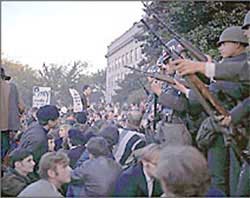
Police and anti-war demonstrators clashed in the streets of Chicago as the Democratic National Convention nominated Vice President Hubert Humphrey for president inside the Amphitheater.
Club-swinging Chicago police indiscriminately tear-gassed, kicked and beat anti-war demonstrators, delegates, reporters and innocent bystanders outside, arresting 500. 11,900 Chicago police, 7500 Army troops, 7500 Illinois National Guardsmen and 1000 Secret Service agents were ultimately involved.
Protesting what was later officially designated a police riot, members of the Democrats’ Wisconsin delegation attempted to march to the convention hall, but police turned them back.
When Senator Abraham Ribicoff (D-Connecticut) delivered his nominating speech, he infuriated Mayor Richard Daley by saying, 
“with George McGovern as President of the United States, we wouldn’t have Gestapo tactics in the streets of Chicago.”

Julian Bond, the first black member of the previously all-white Georgia state legislature, seconded the nomination of anti-war presidential candidate Minnesota Senator Eugene McCarthy. Bond added that he had seen such police behavior before, but only in segregationist Mississippi, Alabama, and Georgia.
a narrative account
Arthur Miller on the Convention
August 26, 1970
Betty Friedan leads a nationwide protest called the Women’s Strike for Equality in New York City on the fiftieth anniversary of women’s suffrage.
August 26, 1971
Six thousand turned out for a National Organization for Women-organized Women March for Equality in New York City. They were calling for equal rights, including the demand “51 percent of everything,” reflecting women’s proportion of the U.S. population.
This first “Women’s Equality Day,” instituted by Bella Abzug, was established by Presidential Proclamation and reaffirmed annually.
August 26, 1985
Samantha Smith, a 10-year-old from Manchester, Maine, was invited to visit the Soviet Union by its Premier, Yuri Andropov.

Statue of Samantha Smith at the Maine State Library, Augusta, Maine
She had written him a letter asking if the Soviet Union intended to attack the United States. She visited him in the U.S.S.R. and became a young ambassador for peace. She died in an airplane crash at age 13 on this day returning home with her father from a peace mission.

Grade school student, peace activist 1972-1985 

https://www.peacebuttons.info/E-News/peacehistoryaugust.htm#august26

US Military Refuses, in Peace & Justice History for 8/25

(I don’t know what this formatting is about; it’s a copy/paste, as they all are. If it’s annoying, read it as it usually posts, on the page. Thanks. -A.)

August 25, 1969
Company A of the 3rd Battalion, the 196th Light Brigade, refused to advance further into the Songchang Valley of Vietnam after five days of heavy casualties; their number had been reduced from 150 to 60.
This was one of hundreds of mutinies among troops during the war.

“He [President Nixon] is also carrying on the battle in the belief, or pretense, that the South Vietnamese will really be able to defend their country and our democratic objectives [sic] when we withdraw, and even his own generals don’t believe the South Vietnamese will do it.” James Reston in the New York Times
Vietnam: The Soldier’s Revolt 
GI resistance in the Vietnam War 

https://www.peacebuttons.info/E-News/peacehistoryaugust.htm#august25

The first video shows how the israeli lobby is buying the US government and teh second shows how being Jewish means more than stopping child sexual abuse. This is politics in the US now.

The Fangataufa Test, & UFW Leaders Cesar Chaves, Dolores Huerta in Peace & Justice History for 8/24

August 24, 1968 
France became the world’s fifth thermonuclear power when it exploded a hydrogen bomb at the Fangataufa Atoll in the South Pacific. It had a yield of 2.6 megatons (the equivalent of more than two-and-a-half million tons of TNT) and heavily contaminated the atoll, leaving it off-limits to humans for six years.

Fangataufa test
Atmospheric and underwater nuclear weapons testing continued there for nearly thirty more years.
August 24, 1970
United Farm Workers Organizing Committee (UFWOC) leaders Cesar Chavez and Dolores Huerta called for a consumer boycott of lettuce to support the strike against lettuce growers who would not negotiate contracts with the farm workers for decent wages and working conditions.

United Farm Workers show their support for the lettuce strike and boycott at a rally in Salinas, California.
U.F.W. history

Farm Labor leader Cesar Chavez, pictured at a rally in Salinas, California
The United Farm Workers today
 Farmworker Movement Documentation Project

Susan Due Pearcy
 
Boycott Posters and buttons

https://www.peacebuttons.info/E-News/peacehistoryaugust.htm#august24

Mahatma Gandhi, Baltic Hands, in Peace & Justice History for 8/23

August 23, 1933
Mahatma Gandhi, weighing only 90 pounds, was released unconditionally from Sassoon Hospital in Poona because, after 5 days of his latest “fast unto death,” the doctors feared that his body could no longer stand the strain of fasting.
He had been taken to the hospital from Yeravda jail, which he had described as his “permanent address,” when he started his fast. He was protesting official refusal to allow him to continue his work with the Untouchables (he had called them harijan, or “children of God”) while in prison.


Gandhi leaving hospital, 1933
He had deliberately courted arrest, rejecting an order permitting him to reside only within the limits of Poona, and had been sentenced to a year’s imprisonment.
Gandhi and his fasts 
August 23, 1945
In a letter to his friend Anne Marie Petersen shortly before the end of British colonial rule in India, Mahatma Gandhi wrote, “When there is independence, why should you fear the majority? If you have God with you and the majority have not, should you still fear? And if both have God between them who should fear whom? Is there then any question of majority and minority?
Let us pray.
Love.
Bapu”
August 23, 1989
Over one million joined hands across the three Baltic republics (Lithuania, Latvia and Estonia) in a 400-mile-long chain of resistance against control by the U.S.S.R. (Union of Soviet Socialist Republics).
It was the 60th anniversary of the Soviet-German Non-Aggression Pact, also known as the Molotov-Ribbentrop Pact after the foreign ministers of the Soviet Union and Nazi Germany who had negotiated it.
Generally called the Hitler-Stalin Pact, it secretly agreed to Soviet control of Latvia and Estonia, and German influence over Poland and Lithuania. Germany, again secretly, later ceded control over Lithuania to the Soviets for 7.5 million dollars in gold ($115 in 2008 dollars).


Baltic hands
The Baltic Way  (with pictures of the action)

https://www.peacebuttons.info/E-News/peacehistoryaugust.htm#august23

Fannie Lou Hamer, Rhodesia’s Olympics Team, Karen Silkwood, & More, In Peace & Justice History for 8/22

Say It Loud-Say It With Me!

August 22, 1958
President Dwight Eisenhower announced a voluntary moratorium on nuclear weapons testing. A report outlining a system for monitoring and verifying compliance of a complete ban on such testing had been released just the day before. The Conference of Experts, as it was known, had been meeting in Geneva, Switzerland, to work out the details on detection of violations of such a treaty. The U.S. delegation was led by Nobel physics laureate Ernest Lawrence from the University of California (the Lawrence Livermore National Laboratory is named after him).
Eisenhower predicated his moratorium on U.S.S.R. and U.K. agreement to the same limitations. All three countries agreed to the one-year halt in testing and to begin negotiations on a complete test ban at the end of October; all three performed last-minute (atmospheric) tests before the opening of talks.
August 22, 1964

Singing at a boardwalk demonstration: Hamer (with microphone), Stokely Carmichael, (in hat), Eleanor Holmes Norton, Ella Baker.
Fannie Lou Hamer, leader of the Mississippi Freedom Democratic Party (MFDP), testified in front of the Credentials Committee at the Democratic National Convention. She was challenging the all-white delegation that the segregated regular Mississippi Democrats had sent to the presidential nominating convention.

Mississippi’s Democratic Party excluded African Americans from participation. The MFDP, on the other hand, sought to create a racially inclusive new party, signing up 60,000 members.
The hearing was televised live and many heard Hamer’s impassioned plea for inclusion of all Democrats from her state.The hearing was televised live and many heard Hamer’s impassioned plea for inclusion of all Democrats from her state. In her testimony she spoke about black Mississippians not only being denied the right to register to vote, but being harassed, beaten, shot at, and arrested for trying. Concerned about the political reaction to her statement, President Lyndon Johnson suddenly called an impromptu press conference, thereby interrupting television broadcast of the hearing.

Hear her testimony  
Link to photo gallery 
August 22, 1971

The FBI (Federal Bureau of Investigation) arrested twenty in Camden, New Jersey, and five in Buffalo, New York, for conspiracy to steal and destroy draft records. Eventually known as the Camden 28, most were Roman Catholic activists, including four priests, and a Lutheran minister.“We are not here because of a crime committed in Camden but because of a war committed in Indochina….” Cookie Ridolfi
The Camden 28 
August 22, 1972
Rhodesia’s team was banned from competing in the Olympic Games with just four days to go before the opening ceremony in Munich, Germany. The National Olympic Committees of Africa had threatened to pull out of the games unless Rhodesia was barred from competing. Though the Rhodesian team included both whites and blacks, the government was an illegal one, controlled by whites though they represented just 5% of the country’s population. It had broken away from the British Commonwealth over demands from Commonwealth member nations that power be yielded to the majority.
Read more 
August 22, 1986

The Kerr-McGee Corporation agreed to pay the estate of the late Karen Silkwood $1.38 million ($2.68 in 2008), settling a 10-year-old nuclear contamination lawsuit. She had been active in the Oil, Chemical and Atomic Workers union, specifically looking into radiation exposure of workers, and spills and leaks of plutonium.
The story of Karen Silkwood 

https://www.peacebuttons.info/E-News/peacehistoryaugust.htm#august22