
Domestic deployment under Section 502(f) has its limits, and for good reason.
The National Guard plays a crucial role in the United States, both in its capacity as a reserve component of the armed forces and as a versatile asset that state governors can call on in times of civil unrest, natural disaster, or even the coronavirus pandemic. Section 502(f) of Title 32 of the U.S. Code is a long-standing authority that facilitates a range of important domestic National Guard missions. In the summer of 2020, however, the Trump administration made unprecedented use of this law to bring unfederalized, out-of-state Guard troops into Washington, D.C., to respond to protests following the murder of George Floyd. In doing so, the administration put forward an unbounded interpretation of § 502(f) that risks subverting the broader statutory scheme Congress has created to govern domestic deployment of the military. In addition, if a future president were to rely on this interpretation of the law to ask governors to send unfederalized Guard personnel into a nonconsenting state—as opposed to a non-state jurisdiction like D.C.—that deployment would violate the Constitution.
Section 502 is the primary statute that authorizes the National Guard to operate in “Title 32 status,” one of the three different duty statuses in which members of the Guard may serve at any given moment. In “State Active Duty status,” Guard personnel carry out a state-defined mission, under state command and control, and with state funding and benefits. By contrast, in “Title 10 status,” the Guard has been “called into federal service,” or “federalized,” by the president. When federalized, Guard forces carry out federal missions under federal command and control, and with federal funding and benefits. Title 32 status occupies a middle ground between State Active Duty and Title 10 status, featuring both federal and state involvement. In this hybrid status, the Guard remains under state command and control but can perform federal missions, is paid with federal funds, and receives federal benefits. Crucially, because Guard personnel in Title 32 status are under state control, they have not been federalized and are not subject to the Posse Comitatus Act. That means they are not barred from participating in civilian law enforcement activities.
Although Title 32 status was originally conceived to allow the federal government to foot the bill for the extensive training requirements that Congress requires each state and territory’s National Guard to fulfill, the purposes for which it may be used have expanded over time. Today, § 502(f) allows the Guard to carry out a wide range of nontraining, operational missions in Title 32 status. But the authority that the law provides has its limits.
The 2020 National Guard Deployment in Washington, D.C.
In early June 2020, thousands of National Guard troops from 11 states were deployed to Washington, D.C., as part of the Trump administration’s response to largely peaceful protests following the police killing of George Floyd in Minneapolis, Minnesota. At the time, there was a great deal of confusion and controversy over the legal authority under which these soldiers had been brought to D.C.
In a letter to D.C. Mayor Muriel Bowser, who had publicly objected to the deployment, then-U.S. Attorney General William Barr offered the following explanation: “At the direction of the President, the Secretary of Defense … requested assistance from out-of-state National Guard personnel, pursuant to 32 U.S.C. § 502(f), which authorizes States to send forces to assist the ‘[s]upport of operations or missions undertaken by the member’s unit at the request of the President or Secretary of Defense.’” According to Barr, these troops had been given broad responsibilities, including authority to participate in certain law enforcement activities:
“Consistent with the President’s direction, the Secretary of Defense assigned to out-of-state National Guard personnel the mission of protecting federal functions, persons, and property within the District of Columbia. That mission includes the protection of federal properties from destruction or defacement (including through crowd control, temporary detention, cursory search, measures to ensure the safety of persons on the property, and establishment of security perimeters, consistent with the peaceful exercise of First Amendment rights); protection of federal officials, employees, and law enforcement personnel from harm or threat of bodily injury; and protection of federal functions, such as federal employees’ access to their workplaces, the free and safe movement of federal personnel throughout the city, and the continued operation of the U.S. mails.”
The deployment and Barr’s subsequent justification raise two crucial questions about the scope of § 502(f). The first is whether § 502(f) authorizes the use of National Guard personnel to perform any mission the president could conceivably request. The Guard’s June 2020 operation in D.C. was unprecedented; § 502(f) had never before been used for a federally requested deployment in response to civil unrest. Historically, when presidents have desired to deploy the military for this purpose, they have invoked the Insurrection Act and deployed either active-duty federal troops or federalized National Guard. The District of Columbia’s unusual status within the United States’s federal system presents a second question: whether the deployment of unfederalized, out-of-state Guard troops into a nonconsenting jurisdiction would be lawful if that jurisdiction were a state. The answer to both of these questions is no.
Section 502(f): a Broad Authority, but Not an Unlimited One
Section 502 of Title 32 of the United States Code addresses “required drills and field exercises”—that is, the particulars of how often and in what manner National Guard units are required to train each year. Its first provision, § 502(a), establishes the normal training requirements for the Guard, commonly summarized as “one weekend a month and two weeks a year.” Section 502(f) sits at the end of the statute and has two prongs. The first, § 502(f)(1), allows Guard personnel to be ordered to perform “training or other duty” above and beyond the standard training regimen described by subsection (a). The second, § 502(f)(2)(A), provides that this “training or other duty” may include “[s]upport of operations or missions undertaken by the member’s unit at the request of the President or Secretary of Defense.”
The word “request” in § 502(f)(2)(A) is significant. The president or the secretary of defense may ask a governor to deploy National Guard troops, but the governor is under no obligation to acquiesce. This reading is supported by 32 U.S.C. § 328, which makes clear that a governor is the party empowered to order National Guard troops to duty under either prong of § 502(f). A governor’s right to refuse was evident in the summer of 2020—the Trump administration asked a total of 15 governors to deploy their Guard personnel into Washington, but four declined to do so. This point is discussed further below.
As for the question of what kinds of missions § 502(f) is intended to authorize, the statute itself offers little guidance. The words “other duty” in § 502(f)(1) plainly permit the National Guard to carry out non-training-related missions. The critical question is how broadly “other duty” should be interpreted. Barr and the Trump administration appear to have assumed that “other duty” means any duty—that under § 502(f)(2)(A), National Guard troops provided by a willing governor may be used to perform any mission the president could request. As Barr explained, the out-of-state Guard forces in D.C. had been assigned a wide range of duties, including law enforcement activities such as “crowd control, temporary detention, [and] cursory search.”
Such a broad reading, however, is inconsistent with the statute’s legislative history, its place in the statutory scheme, and judicially established rules of statutory interpretation. In effect, it allows an end run around the procedures and guard rails that Congress has created to govern domestic deployment of the military. Section 502 was originally enacted as part of the codification of Title 32 in 1956, but subsection (f) and the “other duty” language within it were not added until 1964. On paper, the addition of subsection (f) opened the door for National Guard personnel to perform operational missions under Title 32. However, the legislative history of its adoption suggests that it was intended principally to provide funding and authorization for training-related duties beyond the specific exercises cited in the law. The provision was not used for operational missions until 1989, when Congress added specific statutory authority for one kind of § 502(f) “other duty” in particular: drug interdiction missions under 32 U.S.C. § 112.
Another type of operational mission was added in 2004, when, amid the broadening war on terror, Congress added an entirely new chapter to Title 32—Chapter 9—that authorized National Guard personnel operating under state control to be federally funded under § 502(f) while engaging in certain “homeland defense activities.” But state governors struggled to obtain Department of Defense approval for these missions because of the requirement that missions under Chapter 9 respond to a “threat … against the United States” as a whole. In 2005, Hurricane Katrina devastated the Gulf Coast and exposed disastrous shortcomings in the federal government’s ability to respond to natural disasters. The next year, Congress responded to both of these problems by further expanding the potential nontraining uses of § 502(f), this time by amending the provision itself rather than adding any new sections to Title 32.
The newly added subsection (f)(2)(A), which authorizes National Guard support of federal operations or missions “at the request of the President or Secretary of Defense,” was undoubtedly meant to simplify and ease the process by which National Guard forces could perform domestic operational missions under Title 32. However, although the legislative history for the 2006 amendment does not clearly identify the exact bounds of what Congress intended to authorize, it does suggest that Congress was concerned primarily with facilitating homeland defense activities already authorized elsewhere in Title 32 as well as the National Guard’s traditional role in responding to natural disasters like Katrina.
Indeed, the Report of the House Armed Services Committee on the 2006 amendment hardly mentions the new authority it would create for governors to use their Guard forces to support missions requested by the president or secretary of defense, and instead focuses on discussing how other parts of the same amendment would allow “reserve component personnel performing active guard and reserve duty, as well as military technicians (dual status), to … train active duty members of the armed forces” and the limitations on this new authority. In short, it is highly unlikely that Congress intended to revolutionize the landscape of domestic deployment in the United States by giving the president an easy alternative to the Insurrection Act.
A narrower interpretation of Section 502(f) is also consistent with established principles of statutory interpretation. The Supreme Court explained in Whitman v. American Trucking that “Congress … does not alter the fundamental details of a regulatory scheme in vague terms or ancillary provisions—it does not, one might say, hide elephants in mouseholes.” Similarly, when the Court held in FDA v. Brown & Williamson that the Food and Drug Administration’s authority does not include power to regulate tobacco products as drugs, it said that “Congress could not have intended to delegate a decision of such economic and political significance to an agency in so cryptic a fashion.” In short, the Court generally assumes that Congress will speak to major issues directly.
There is no doubt that Congress meant for the 2006 amendments to § 502(f) to widen the scope of the activities it authorizes. Even so, it seems extraordinarily unlikely that Congress would have buried within a section of the U.S. Code that is primarily concerned with National Guard training requirements an open-ended authorization for American military forces to participate in domestic law enforcement activities at the behest of the president, notwithstanding the Posse Comitatus Act and without reliance on the Insurrection Act. Indeed, that would be the very definition of “hiding an elephant in a mousehole.”
State Sovereignty and Deployment of Unfederalized National Guard Personnel Into a Nonconsenting State
If the District of Columbia were a state, then the deployment of out-of-state National Guard troops into the District over its chief executive’s objections in June 2020 would have violated the Constitution. U.S. states are sovereign entities, although their sovereignty is limited and made subordinate to the federal government under the Constitution. Like foreign sovereigns, their sovereignty is territorially defined. As the Supreme Court explained on multiple occasions in the early republic, “the jurisdiction of a state is coextensive with its territory, coextensive with its legislative power.”
It is a function of the states’ co-equal and territorially limited sovereignty that one state’s courts cannot reach into another and adjudicate the affairs of people living there, unless those individuals have sufficient “minimum contacts” with the forum state. For the same reason, it cannot be the case that a state, solely under its own authority, may deploy its National Guard forces into another state without that state’s permission. Simply put, U.S. states may not invade one another.
The deployment of one state’s National Guard into another state in State Active Duty status without the receiving state’s consent would therefore be unlawful. Were this not the rule—if one state could freely reach into another and exercise governmental power there—then any kind of conflict between the states would have the potential to lead to a physical confrontation between their law enforcement agencies and National Guard forces, with potentially disastrous consequences.
The crucial remaining question is whether placing Guard forces in Title 32 status obviates this sovereignty barrier, making deployment into a nonconsenting state permissible. It does not.
The principal difference between State Active Duty status and Title 32 status is that the latter allows National Guard forces to operate at federal expense and to perform certain federal missions, all while remaining under state command and control. State command and control has legal as well as practical consequences. To start, it means that Guard personnel in Title 32 status have not been federalized. The federal courts have made clear that whether Guard personnel have been federalized depends solely on whether they are under state or federal command and control.
Further consequences of state control are apparent within Title 32 itself. As noted above, § 502(f)(2)(A) makes clear that governors are free to reject a president’s request for National Guard assistance. Likewise, 32 U.S.C. § 328 provides that for any § 502(f) deployment, the governor—not the president—issues the orders to mobilize and deploy. Barr’s letter to Bowser likewise acknowledges that § 502(f) “authorizes States to send forces” to support missions requested by the president.
All of these factors point to the same conclusion: Although a deployment under § 502(f)(2)(A) is federally requested, defined, and funded, state authority is being exercised as a legal matter.
This conclusion is consistent with what the Supreme Court has said about what it means for members of the National Guard to be “federalized.” In Perpich v. Department of Defense, the Court explained that when Guard troops are federalized, they temporarily become part of the active-duty federal military. When not federalized, however, they remain state officers. The Perpich Court made clear that, when on active duty, a member of the Guard must be either a part of the federal military or a state officer—they can never be both at the same time. Since Guard personnel in Title 32 status have not been federalized, they are not part of the federal military and must instead be state officers operating under state authority.
For the purposes of the co-equal and territorially limited sovereignty of the states, then, there is no difference between State Active Duty status and Title 32 status. In both cases, National Guard personnel are state officers exercising state authority. That means they cannot operate in another state without its consent, no matter who requested their presence or who is paying them.
Conclusion
Congress should amend § 502(f) to narrow and clarify its scope. In the meantime, though, the law is not a blank check allowing the president to use military forces anywhere in the country and for any purpose so long as they can find one willing governor. Congress no doubt intended the creation of § 502(f)(2)(A) to make domestic deployment of the National Guard easier rather than harder, but it is highly unlikely that lawmakers meant to blow a gaping hole in the complex web of laws that govern the military’s domestic activities. Rather, § 502(f)(2)(A) was likely intended to facilitate missions that were already authorized by other statutes as well as traditional Guard functions like disaster relief.
Moreover, regardless of Congress’s intent, deployments of the National Guard in Title 32 status must in all cases respect the co-equal and territorially limited sovereignty of the states. As a constitutional matter, the deployment of unfederalized Guard personnel into a nonconsenting state is never permissible. If the president wishes to unilaterally deploy military forces into a nonconsenting state, then they must do so through the statutory mechanism that Congress has provided for this purpose since 1792: the Insurrection Act.
In all cases and regardless of the statutory device used, domestic deployment of the military should be treated as an option of last resort. There is a tradition in American law and political thought, with roots that can be traced to medieval England, that opposes any kind of military interference in civilian affairs outside of emergencies. This tradition recognizes the fundamental danger of turning an army inward to face its own country’s citizens. As the Eighth Circuit explained in Bissonette v. Haig:
“The use of military forces to seize civilians can expose civilian government to the threat of military rule and the suspension of constitutional liberties. On a lesser scale, military enforcement of the civil law leaves the protection of vital Fourth and Fifth Amendment rights in the hands of persons who are not trained to uphold these rights. It may also chill the exercise of fundamental rights, such as the rights to speak freely and to vote, and create the atmosphere of fear and hostility which exists in territories occupied by enemy forces.”
Domestic deployment presents risks for the military itself, too. While sometimes necessary, all domestic military operations distract and draw resources away from the military’s core national security responsibilities. Domestic law enforcement operations, in particular, are also broadly unpopular among military personnel, who did not enlist in the armed services to police their fellow citizens—a fact that is all the more significant as the military continues to struggle through a recruitment and retention crisis.
The National Guard is not immune to these risks. While the Guard certainly continues to fulfill its traditional role of providing local support in times of crisis, over the past three decades it has also been integrated into the broader United States armed forces. Today’s National Guard is a professional army and an essential piece of the Department of Defense’s “Total Force.” To be sure, Guard personnel are more likely to be trained in law enforcement than their active-duty counterparts, but many Guard units are frontline combat units trained and equipped to fight overseas, with comparatively little experience or training in responding to civil unrest.
Accordingly, when considering whether to use any part of the military domestically, leaders should not merely ask whether a deployment would be constitutional and authorized by statute. They should also ask whether it would be an appropriate use of limited military resources and whether it is consistent with the foundational American belief that domestic civilian affairs should be managed by domestic civilian authorities whenever possible.
Category: History

Peace & Justice History for 6/8

| June 8, 1956 Air Force Tech Sergeant Richard B. Fitzgibbon, of North Weymouth, Massachusetts is listed by the U.S. Department of Defense as being the first U.S. military casualty of the Vietnam War. His name is listed on The Wall (the Vietnam Veterans Memorial in Washington, DC) with that of his son, Marine Corps Lance Colonel Richard B. Fitzgibbon III, who died September 7, 1965.  |
June 8, 1966 270 walked out of graduation ceremonies at New York University (NYU) to protest the presentation of an honorary degree to Robert McNamara, then the Secretary of Defense and responsible for U.S. forces waging war in Vietnam. |
| June 8, 1969 Two-thirds of the graduating class of Brown University (Providence, Rhode Island) turned their backs on Secretary of State Henry Kissinger as he gave the commencement address, silently expressing their opposition to U.S. foreign policy and the war in Vietnam. |
| June 8, 2002 1500 Israeli and other peace activists demonstrated peacefully in front of the Prime Minister’s Jerusalem residence in opposition to 35 years of Israeli occupation of Palestinian territory. “The occupation is hurting us all,” said advertising placed by the organizers, “draining billions of shekels from us, forcing cutbacks in social and educational programs.”  Coalition of Women for a Just Peace leading a demonstration against the continued Israeli occupation of Palestine. They also claimed the occupation inculcates the belief that “violence is the only way to solve problems” and “allows militarism to run rampant in our lives.” Buses with banners saying “End the Occupation” and “The Occupation is Hurting Us All” started out from four locations throughout Israel, arriving in Jerusalem together. A choir of Israeli and Palestinian children had been scheduled to close the action but their conductor feared government retribution; the demonstration ended in silence instead of with children’s voices. |
https://www.peacebuttons.info/E-News/peacehistoryjune.htm#june8
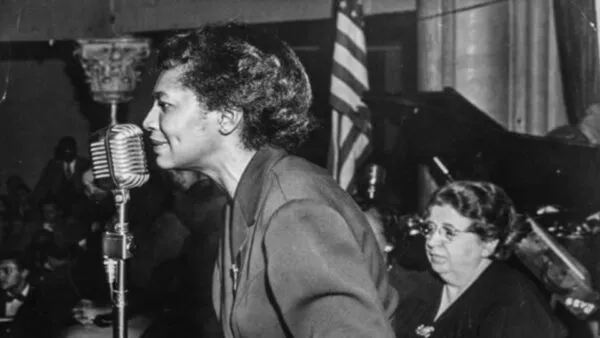
Intersectionality
“Her insistence that the rights of women, people in poverty, people of color, and immigrants all be upheld within the political Left, as well as without it, left a legacy of intersectionality that was ahead of its time.”
Queer History with Blue Language
I had to post this one! IIRC, Anne Bonny is in one of our son’s “Badass” books. We bought those for him in his late elementary and middle school years. He’s always loved history, and most tweens/early teens enjoy blue language, so you get both with these books and the website. I’ve read them, and they’re just rollicking fun, and accurate. Anyway, I’ve had a soft spot for Anne Bonny due to her story and her fortitude. And now, for some more history with blue language!
Queer History 133: Anne Bonny by Wendy🏳️⚧️🏳️🌈🌈
The Bisexual Buccaneer Who Shattered Every Fucking Chain Read on Substack
The Caribbean sun beats down mercilessly on the deck of the Revenge, its rays catching the glint of steel and the flash of defiant eyes. Blood mingles with salt spray as cutlasses clash, and in the midst of this violent ballet dances a figure that would make the devil himself take notice—Anne Bonny, her red hair whipping like flames in the ocean wind, her blade singing its deadly song as she carves through enemies with the fury of a woman who has never, not once, apologized for who she fucking is.
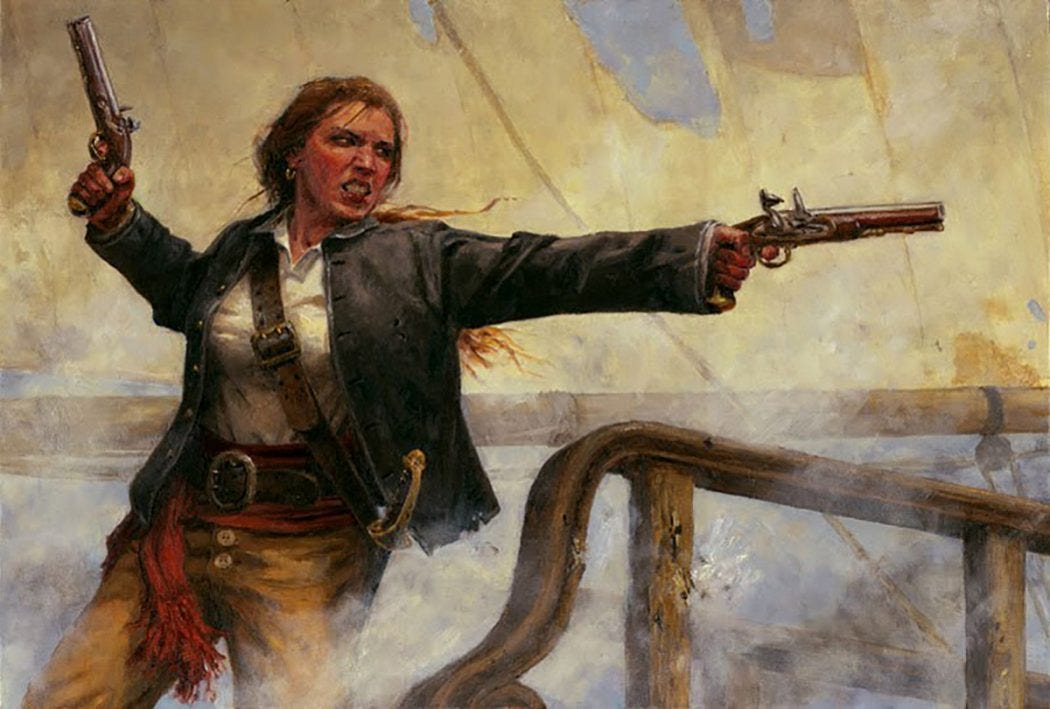
This is no sanitized fairy tale of pirates and buried treasure. This is the raw, unvarnished truth of a woman who lived as she pleased, loved whom she chose, and fought like hell against every goddamn soul who tried to cage her spirit. Anne Bonny wasn’t just a pirate—she was a revolution wrapped in leather and lace, a middle finger raised to every suffocating convention of her time, and a blazing torch of queer defiance centuries before the world had words for what she represented.
Born around 1697 in County Cork, Ireland, Anne Cormac entered a world that had already decided her fate before she drew her first breath. She was meant to be silent, subservient, and safely tucked away in the shadows of more “important” men. The patriarchal machine had clear expectations: marry young, breed often, and die quietly. But from her earliest days, Anne Bonny grabbed those expectations by the throat and strangled them with her bare hands.
Her father, William Cormac, was a lawyer who had knocked up the family maid—Anne’s mother. In the rigid social hierarchy of 18th-century Ireland, this scandal should have destroyed them all. Instead, Cormac said “fuck it” to respectability, took his lover and bastard daughter, and sailed for the American colonies where they could start fresh. This act of defiance—choosing love over social standing—planted the first seeds of rebellion in young Anne’s soul.
In Charleston, South Carolina, the Cormac family built a new life from scratch. William established a successful law practice and plantation, but it was clear from the start that his daughter was not cut from ordinary cloth. While other girls her age were learning needlepoint and practicing their curtsies, Anne was learning to ride like a demon, shoot like a marksman, and curse like a sailor. She moved through the world with a swagger that made proper ladies clutch their pearls and men wonder if they were seeing things.
The first whispers about Anne’s unconventional nature started early. Servants gossiped about the young mistress who preferred the company of both the stable boys and the parlor maids with equal enthusiasm. They spoke in hushed tones about midnight escapades and passionate encounters that defied easy categorization. Anne Bonny was discovering that her heart and her loins recognized no boundaries when it came to attraction—a revelation that would have sent most people of her era scrambling for the nearest priest, but only made Anne more determined to live authentically.
When Anne was barely out of her teens, she shocked Charleston society by marrying James Bonny, a small-time pirate and fortune hunter who thought he could tame the wild Irish girl and claim her father’s wealth. The poor bastard had no idea what he’d gotten himself into. Anne married him not out of love, but as a means of escape from her father’s increasingly desperate attempts to marry her off to someone “respectable.” It was a calculated move by a young woman who understood that sometimes you have to play the game to change the rules.
James Bonny turned out to be everything Anne despised—weak, grasping, and utterly conventional. While he dreamed of easy money and social climbing, Anne burned with restless energy and unfulfilled desires. Their marriage was a farce from the start, a prison that Anne was already planning to escape before the ink was dry on the wedding certificate.
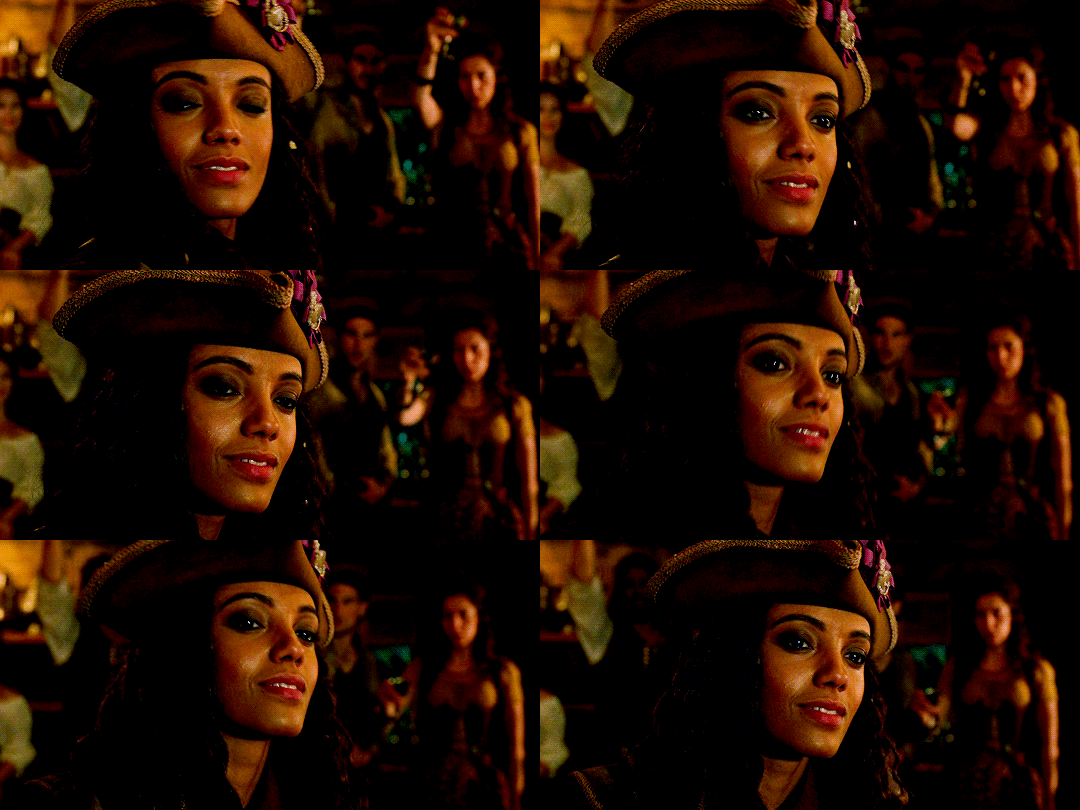
The couple moved to Nassau in the Bahamas, a lawless pirate haven where conventional morality went to die and freedom could be bought with steel and courage. For James, Nassau represented opportunity for his petty schemes. For Anne, it was liberation incarnate—a place where she could finally breathe freely and explore every aspect of her complex sexuality without the suffocating weight of mainland propriety.
Nassau in the early 1700s was a powder keg of sexual and social revolution. Pirates, prostitutes, escaped slaves, and social outcasts from across the Atlantic world had created a society that operated by its own rules. Gender roles were fluid, sexual boundaries were negotiable, and survival depended on wit, strength, and ruthless determination—qualities Anne possessed in abundance.
It was in this intoxicating atmosphere that Anne first encountered other women who loved women, men who challenged traditional masculinity, and people who refused to be defined by society’s narrow categories. She found herself drawn into passionate affairs with both men and women, sometimes simultaneously, always honestly. While the respectable world would have labeled her a whore or worse, in Nassau she was simply Anne—a woman living life on her own terms.
Her marriage to James became increasingly irrelevant as Anne explored her true nature. She took lovers as she pleased, fought alongside men as an equal, and began to develop the reputation that would make her legendary. Her bisexuality wasn’t a phase or a rebellion—it was simply part of who she was, as natural and integral as her red hair or her fierce temper.
Everything changed when Anne met Captain John “Calico Jack” Rackham. Unlike her pathetic husband, Jack was a real pirate—charming, dangerous, and utterly unintimidated by Anne’s fierce independence. More importantly, he saw her for what she truly was: not a woman to be tamed, but a force of nature to be unleashed. Their affair was passionate, public, and absolutely scandalous by any civilized standard.
But Anne Bonny was never one to do things halfway. When she decided to leave her husband for Calico Jack, she didn’t sneak away in the night like a guilty adulteress. She walked out in broad daylight, her head held high, her hand on her cutlass, daring anyone to try and stop her. When James Bonny appealed to the colonial governor for the return of his “property,” Anne’s response was swift and brutal—she showed up at the governor’s mansion armed to the teeth and made it clear that any attempt to drag her back to her miserable marriage would result in bloodshed.
Joining Calico Jack’s crew aboard the Revenge was the moment Anne Bonny truly came alive. Here, finally, was a life that matched her spirit—dangerous, free, and absolutely uncompromising. She didn’t join as Jack’s woman or as some token female presence. She earned her place with blade and blood, proving herself in combat and command until even the most skeptical pirates acknowledged her as an equal.
The open ocean became Anne’s cathedral, piracy her religion, and freedom her god. She reveled in the violent ballet of ship-to-ship combat, the intoxicating rush of victory, and the democratic brutality of pirate life where respect was earned through courage and cunning rather than birthright or gender. Her bisexuality continued to be an open secret among the crew—she took lovers as she pleased, both male and female, and anyone who had a problem with it could settle the matter with steel.
It was during this period that Anne encountered Mary Read, another woman living as a pirate in male disguise. Their meeting was electric—two fierce women who had refused to accept the limitations society tried to impose on them, finding kinship in the most unlikely of circumstances. While historical records are frustratingly vague about the exact nature of their relationship, the intensity of their bond was undeniable.
Some accounts suggest they were lovers, others insist they were simply close comrades, but the truth is likely more complex and more beautiful than either simple explanation. In Mary Read, Anne found someone who understood the cost of living authentically in a world determined to crush anyone who colored outside the lines. Whether their relationship was romantic, platonic, or something that defied easy categorization, it represented a profound connection between two extraordinary women who refused to be diminished.

The partnership between Anne, Mary, and Calico Jack created one of the most formidable pirate crews in Caribbean history. They terrorized merchant shipping with ruthless efficiency, their reputation spreading fear across the trade routes. But more than their success as pirates, they represented something revolutionary—a chosen family built on mutual respect, shared danger, and absolute loyalty that transcended traditional bonds of blood or marriage.
Anne’s life as a pirate was a masterclass in living without apology. She fought with savage grace, loved with passionate intensity, and commanded respect through sheer force of personality. Her bisexuality wasn’t hidden or apologized for—it was simply part of the complex tapestry of who she was. In an era when women were expected to be passive vessels for male ambition, Anne Bonny was a hurricane given human form.
The psychological impact of Anne Bonny’s defiance cannot be overstated. In a world that sought to define women by their relationships to men—as daughters, wives, mothers, or whores—Anne created her own identity through action and choice. She loved both men and women not as a rejection of heteronormativity (a concept that wouldn’t exist for centuries), but as a natural expression of her authentic self.
Her story resonated through the centuries, whispered in taverns and immortalized in ballads, because it represented something profoundly subversive: the possibility of a life lived entirely on one’s own terms. For generations of LGBTQ+ people struggling against societal expectations and legal persecution, Anne Bonny became an inadvertent patron saint—proof that it was possible to be queer, dangerous, and absolutely unapologetic about both.
The philosophy Anne embodied was simple but revolutionary: authentic living requires the courage to reject false choices. When society insisted she choose between respectability and freedom, she chose freedom. When it demanded she pick between loving men or women, she refused to choose at all. When it tried to cage her spirit in the narrow confines of 18th-century femininity, she exploded those boundaries with cutlass and pistol.
But Anne’s story is also a testament to the brutal costs of living authentically in a hostile world. Her career as a pirate was cut short in 1720 when their ship was captured by pirate hunters. While Calico Jack and most of the male crew were quickly tried and executed, Anne and Mary’s pregnancies bought them temporary reprieve from the gallows.
The trial of Anne Bonny and Mary Read became a sensation, not just because of their piracy, but because their very existence challenged fundamental assumptions about gender, sexuality, and power. Court records show that Anne remained defiant to the end, reportedly telling the cowering Calico Jack before his execution: “Sorry to see you there, but if you had fought like a man, you would not have been hanged like a dog.”
Mary Read died in prison, probably from fever, taking with her the secrets of her relationship with Anne and the full story of their extraordinary partnership. Anne’s fate became one of history’s tantalizing mysteries—some accounts suggest she was executed, others claim her father’s influence secured her release, and still others whisper that she simply vanished back into the chaos of the Caribbean to live out her days in obscurity.
The uncertainty surrounding Anne’s ultimate fate is perhaps fitting for a woman who consistently refused to be pinned down or defined by others’ expectations. Like the best outlaws and revolutionaries, she became more powerful as a legend than she ever was as a living person.
For modern LGBTQ+ people, Anne Bonny represents something profoundly important: historical proof that queer people have always existed, have always fought for their right to love and live authentically, and have always found ways to create chosen families and communities even in the most hostile circumstances. Her story demolishes the lie that LGBTQ+ identities are modern inventions or temporary phases—Anne Bonny was living an openly bisexual life in the early 1700s with a confidence and authenticity that would be admirable in any era.
The social impact of Anne Bonny’s legend extended far beyond her own lifetime. Her story became part of the folklore that sustained marginalized communities through centuries of oppression. When LGBTQ+ people were told they were sick, sinful, or unnatural, they could point to figures like Anne Bonny as proof that queer people had always been part of human history—not as victims or cautionary tales, but as heroes and legends.
The psychological effect of having historical figures who lived openly queer lives cannot be understated. For young people struggling with their identity, for adults facing discrimination, for anyone told that their love is wrong or their authentic self is unacceptable, Anne Bonny stands as a reminder that it’s possible to live with courage, dignity, and absolute refusal to apologize for who you are.
Her story also highlights the intersection of multiple forms of oppression and resistance. As a woman in a patriarchal society, as someone who loved both men and women in a heteronormative world, as an Irish person in a British colonial system, Anne faced multiple layers of marginalization. Her response was to reject all attempts at categorization and to create her own path through sheer force of will.
The philosophical legacy of Anne Bonny extends beyond LGBTQ+ rights to encompass broader questions of authenticity, freedom, and the right to self-determination. Her life was a practical demonstration that it’s possible to refuse false choices, to love without limits, and to fight against any force that tries to diminish your humanity.
In our current moment, when LGBTQ+ rights are under attack and bisexual people still face discrimination from both straight and gay communities, Anne Bonny’s story remains urgently relevant. She represents the long history of bisexual people who refused to choose sides, who loved authentically across gender lines, and who demanded recognition as complete human beings rather than confused or indecisive half-measures.
Anne Bonny died as she lived—on her own terms, leaving behind a legacy that continues to inspire and challenge. She proved that it’s possible to be queer and fierce, that authenticity is worth fighting for, and that love—in all its forms—is the most rebellious act of all. Her cutlass may have fallen silent centuries ago, but her spirit continues to slash through the bonds that try to limit human potential and queer joy.
Every time someone refuses to hide their authentic self, every time someone loves without apology, every time someone chooses freedom over respectability, they’re following in the wake of Anne Bonny’s ship. She remains what she always was—a force of nature, a revolution in human form, and proof that the queer spirit cannot be conquered, only temporarily suppressed before it explodes back into glorious, defiant life.
Citations
- Nelson, J. 2004 “The Only Life That Mattered: The Short and Merry Lives of Anne Bonny, Mary Read, and Calico Jack” McBooks Press
- Simon R. 2022 “Pirate Queens: The Lives of Anne Bonny & Mary Read”
Locals Furious Over Closure Of Dupont Circle [VIDEO]
The Washington Post reports:
Mayor Muriel Bowser addressed the closure for the first time in a public radio appearance Friday afternoon. She called the closing an “unfortunate error” and said she would “continue to try to lean on” the National Park Service “for a different decision.” At the same time she appeared to defend the decision, saying police had “a lot of events to be responsible for” and that “unfortunately, the public safety issue rose to the top over the public celebration.”
A cyclist draped in a rainbow Equality flag chanted “shame” as she rode loops around the park. Passersby, turned away by police from entering the circle, shouted expletives. A man, driving top-down in a convertible through the snarled traffic around Dupont Circle, shouted, sarcastically: “Oh no! I’m a heterosexual man, and I must be protected from Pride!
The park has been a historic gathering place that has hosted celebrations following the first Pride events in the 1970s, AIDS protests in the ’80s and ’90s and vigils after violent attacks on the LGBTQ community, including a vigil for the victims of the 2016 Pulse nightclub shooting and a Black Trans Lives Matter rally.
The Advocate reports:
Earlier this week, D.C. Council members Brooke Pinto and Zachary Parker announced that the Metropolitan Police Department had withdrawn its request to close the park following backlash from community members. But federal officials proceeded with the shutdown anyway and have not responded to requests for comment.
“I am extremely disappointed and frustrated that Dupont Circle Park will be closed this weekend despite MPD’s commitment to keep folks safe there,” Pinto said in a statement to The Advocate.
“This closure is disheartening to me and so many in our community who wanted to celebrate World Pride at this iconic symbol of our city’s historic LGBTQ+ community. I wish I had better news to share.”
News radio station WTOP reports:
Underscoring their desire to implement the closure, USPP highlighted criminal incidents that were initially pointed out in Smith’s April 22 letter. Those incidents, which took place during the District’s Pride celebration, included damages to the park’s historic fountain in 2023 that amounted to approximately $175,000.
In 2019, panic erupted at the park after loud popping sounds were perceived as gunshots being fired. However, it was later determined no firearm had been discharged. Seven people were transported to the hospital for non-life-threatening injuries prompted by the chaos that had initially broken out.
Washington’s ABC affiliate reports:
Police responded to recent incidents of vandalism to Pride decorations in D.C. The suspects tore down rainbow wraps from poles in the area, according to two incident reports from the Metropolitan Police Department (MPD). One incident is listed as a suspected hate crime. The suspects got away in both cases, according to MPD.
Chris De Anda said he wrapped himself around one of the poles to block the suspect from ripping off the rainbow wrap, thinking that would stop him. It didn’t.
“He starts to rip down the flag, rips my arms off trying to get into them to pull down the paper a little bit more, but the entire time I basically hold on to it,” de Anda described, saying the man scratched his arms a bit to get to the flag.
Watch the videos.
————————————————————————————————————————-

Peace & Justice History for 6/7
| June 7, 1712 The Pennsylvania Assembly banned the importation of slaves into the colony. |
| June 7, 1892 Homer Plessy, a Creole of European and African descent, was arrested and jailed for sitting in a Louisiana railroad car designated for white people only. Plessy had violated an 1890 state law, the Louisiana Separate Car Act, that called for racially segregated rail facilities. He then went to court, claiming the law violated the 13th and 14th amendments, but Judge John Howard Ferguson found him guilty anyhow. The U.S. Supreme Court allowed Plessy’s guilty verdict to stand by an 8-1 majority. The decision, Plessy v. Ferguson, established the doctrine of “separate but equal” [separate facilities for white and black people,] institutionalizing and legalizing segregation in the United States public transportation until 1946 in Morgan v. Virginia [see June 3, 1946]. More about Homer Plessy Read the decision |
June 7, 1893 a young Gandhi In his first act of civil disobedience, Mohandas Gandhi refused to comply with racial segregation rules on a South African train and was forcibly ejected at Pietermaritzburg. “Pietermaritzburg: The Beginning of Gandhi’s Odyssey” The birthplace of Gandhi’s peaceful protest |
| June 7, 1997 Seven activists are arrested for distributing copies of the Bill of Rights outside the Bradbury Science Museum, part of Los Alamos National Laboratory in New Mexico, the primary nuclear research facility in the U.S. |
https://www.peacebuttons.info/E-News/peacehistoryjune.htm#june7
The U.S.A. now, and then,
from Heather Cox Richardson. Though our current president has little respect for U.S. veterans, that is not true of anybody I know. Even anti-war I believe our current service people and our veterans are deserving of all benefits of their citizenship and especially added benefits of their service to the U.S. Many readers here are military veterans. My mother’s brother-in-law, my (favorite!) Uncle Jack, served as a U.S. Marine in WWII. My father served in the U.S. Army during the Korean conflict. All of us know and love someone who’s served us in this honorable and unique fashion. While our president doesn’t think to respect that, or even think about it at all, the rest of us do. I know we are thankful. And now, from Heather Cox Richardson, history expert,
June 5, 2025 by Heather Cox Richardson
Read on Substack
Today the U.S. political world was consumed today by a public fight between President Donald J. Trump and his former sidekick, billionaire Elon Musk. Musk invested about $290 million into the 2024 election, vowing to elect Trump in order to get rid of government investigations into his businesses he worried would “take [him] down.”
When Trump took office, Musk became a fixture in the White House, attending Cabinet meetings and heading the “Department of Government Efficiency.” That group set out to kill government programs by withholding congressionally approved funds at the same time that its staff sucked up information on Americans that could feed the training of artificial intelligence and killed the investigations into his businesses Musk had worried about.
In February, Musk posted on social media: “I love [Donald Trump] as much as a straight man can love another man.”
But Musk overstepped boundaries and overstayed his welcome even as his antics hurt sales of his signature car, the Tesla, inspiring Trump to do a car commercial for him on the White House grounds. Just a week ago, Musk officially left the White House on the same day that an article in the New York Times documented his heavy drug use on the campaign.
Then, on Tuesday, June 3, he took a public stand against the omnibus bill Trump desperately wants Congress to pass, posting on X: “I’m sorry, but I just can’t stand it anymore. This massive, outrageous, pork-filled Congressional spending bill is a disgusting abomination. Shame on those who voted for it: you know you did wrong. You know it.”
And with that, the falling out began.
This morning, Trump told reporters he was “disappointed” in Musk. Ron Filipkowski of Meidas followed the saga from there.
“Without me, Trump would have lost the election, Dems would control the House, and the Republicans would be 51–49 in the Senate,” Musk wrote. “Such ingratitude.”
Trump then suggested that “The easiest way to save money in our Budget, Billions and Billions of Dollars, is to terminate Elon’s Governmental Subsidies and Contracts. I was always surprised that Biden didn’t do it!”
Musk promptly said he would begin decommissioning SpaceX’s spacecraft, which supply the International Space Station.
The two men continued to go back and forth, with Musk saying that “Donald Trump is in the Epstein files,” a reference to the records compiled by convicted sex offender Jeffrey Epstein, with whom Trump was friendly. Musk also said Trump’s tariffs will cause a recession, and agreed with another poster who suggested that Trump should be impeached and replaced with Vice President J.D. Vance.
Trump responded to that attack far more weakly than one would have expected, simply turning back to the omnibus bill and insisting it “is one of the Greatest Bills ever presented to Congress.”
Musk’s behavior is erratic in its own right, but if there is anything but pique behind it, it appears he is threatening Trump by making a play to control the Republican Party. In response to a post by conspiracy theorist Laura Loomer suggesting that Republican lawmakers are unsure if they should side with Trump or Musk, Musk wrote: “Oh and some food for thought as they ponder that question: Trump has 3.5 years left as President, but I will be around for 40+ years.”
It’s quite a gamble, since Trump controls the government contracts on which Musk’s fortune was built and on which he still relies. Some MAGA loyalists appear to see the fight as a victory for Trump and are thrilled to see Musk’s star fall. MAGA influencer Steve Bannon told Tyler Pager of the New York Times that he has advised Trump to cancel all of Musk’s federal contracts and launch a formal investigation of his drug use and his immigration status.
Kylie Robison and Aarian Marshall of Wired noted that TrumpCoin lost more than $100 million in value during the fight. Tesla stock lost $152 billion of value from its market capitalization, prompting Filipkowski to note that the total came to about $9 billion per tweet.
Economist Robert Reich had perhaps the best summary of the fight today when he noted, “That any of us have to care about the messy breakup of these two massive narcissists—and that they both individually wield such massive power—is an indictment of our political system and further proves the poisonous influence of Big Money on our democracy.”
Indeed, today’s White House and today’s America are very different from what they were eighty-one years ago.
President Franklin Delano Roosevelt gave his twenty-ninth Fireside Chat on June 5, 1944, and had good news for the American people. The day before, on June 4, Rome had fallen to Allied troops. “The first of the Axis capitals is now in our hands,” Roosevelt said.
The president pointed out that it was “significant that Rome has been liberated by the armed forces of many nations. The American and British armies—who bore the chief burdens of battle—found at their sides our own North American neighbors, the gallant Canadians. The fighting New Zealanders from the far South Pacific, the courageous French and the French Moroccans, the South Africans, the Poles and the East Indians—all of them fought with us on the bloody approaches to the city of Rome. The Italians, too, forswearing a partnership in the Axis which they never desired, have sent their troops to join us in our battles against the German trespassers on their soil.”
This group of ordinary men from many different countries had worked together to defeat the forces of fascism.
But FDR warned Americans that the fall of Rome was only the beginning. “We shall have to push through a long period of greater effort and fiercer fighting before we get into Germany itself,” he said. [T]he victory still lies some distance ahead. That distance will be covered in due time—have no fear of that. But it will be tough and it will be costly.”
FDR knew something his audience did not. On the other side of the Atlantic, paratroopers, their faces darkened with cocoa, were already dropping into France, and the soldiers, sailors, and airmen of the Allies were on their way across the English channel.
The order of the day from their commander Dwight D. Eisenhower that day had read: “You are about to embark upon the Great Crusade, toward which we have striven these many months. The eyes of the world are upon you. The hopes and prayers of liberty-loving people everywhere march with you. In company with our brave Allies and brothers-in-arms on other Fronts, you will bring about the destruction of the German war machine, the elimination of Nazi tyranny over the oppressed people of Europe, and security for ourselves in a free world.
“Your task will not be an easy one,” it read, but it assured the troops that the Germans had suffered great defeats and Allied bombing had reduced German strength, while “[o]ur Home Fronts have given us an overwhelming superiority in weapons and munitions of war, and placed at our disposal great reserves of trained fighting men. The tide has turned! The free men of the world are marching together to Victory!”
Eisenhower’s public confidence did not reflect his understanding that the largest amphibious invasion in military history was a gamble. On June 5, in pencil on a sheet of paper, he had written a message to be communicated in case the invasion failed.
“Our landings in the Cherbourg-Havre area have failed to gain a satisfactory foothold and I have withdrawn the troops,” it read. “My decision to attack at this time and place was based upon the best information available. The troops, the air and the Navy did all that bravery and dedication to duty could do. If any blame or fault attaches to the attempt it is mine alone.”
On the morning of June 6, 1944, five naval assault divisions stormed the beaches of Normandy. Seven thousand ships and landing craft operated by more than 195,000 naval personnel from eight countries brought almost 133,000 troops to beaches given the code names UTAH, OMAHA, GOLD, JUNO, and SWORD. By the end of the day, more than 10,000 Allied troops were wounded or killed, but the Allies had established a foothold in France that would permit them to flood troops, vehicles, and supplies into Europe. When FDR held a press conference later that day, officials and press alike were jubilant.
—
Notes:
https://catalog.archives.gov/id/186470?objectPanel=transcription
http://docs.fdrlibrary.marist.edu/04DD009.HTML
Donald J. Trump, Truth Social post, June 5, 2025, 2:37 p.m.
Donald J. Trump, Truth Social post, June 5, 2025, 4:06 p.m.
https://www.politico.com/news/2025/06/05/elon-musk-donald-trump-recession-impeachment-00390762
https://substack.com/home/post/p-165259717
https://www.wired.com/story/musk-trump-breakup-tesla-stock-price/
X:
elonmusk/status/1929954109689606359
Bluesky:
rbreich.bsky.social/post/3lqviu2yptg2o
mehdirhasan.bsky.social/post/3lqvfy7tcx22n
kyledcheney.bsky.social/post/3lquxzrhire2y
I am going to be doing dishes so enjoy some The Majority Report clips I found informative. Hugs
Queer History from Wendy The Druid

(https://www.peacebuttons.info/)
Some bits from each one since the last time. Still NSFW. Tissue alert for some.
Queer History 128: The Day The Initiative Died by Wendy🏳️⚧️🏳️🌈🌈
Also The Day California Told Bigots to Go Fuck Themselves Read on Substack
How Teachers, Ronald Reagan, and Harvey Milk Crushed the Most Dangerous Anti-Gay Ballot Measure in American History
Picture this: It’s 1978, and a conservative state legislator from Orange County wants to ban every gay and lesbian teacher in California. Not just fire the ones who are out—he wants to hunt down anyone who might be gay, anyone who supports gay rights, anyone who so much as suggests that maybe gay people deserve basic human dignity. This wasn’t just about removing teachers. This was about erasing an entire community from public life.
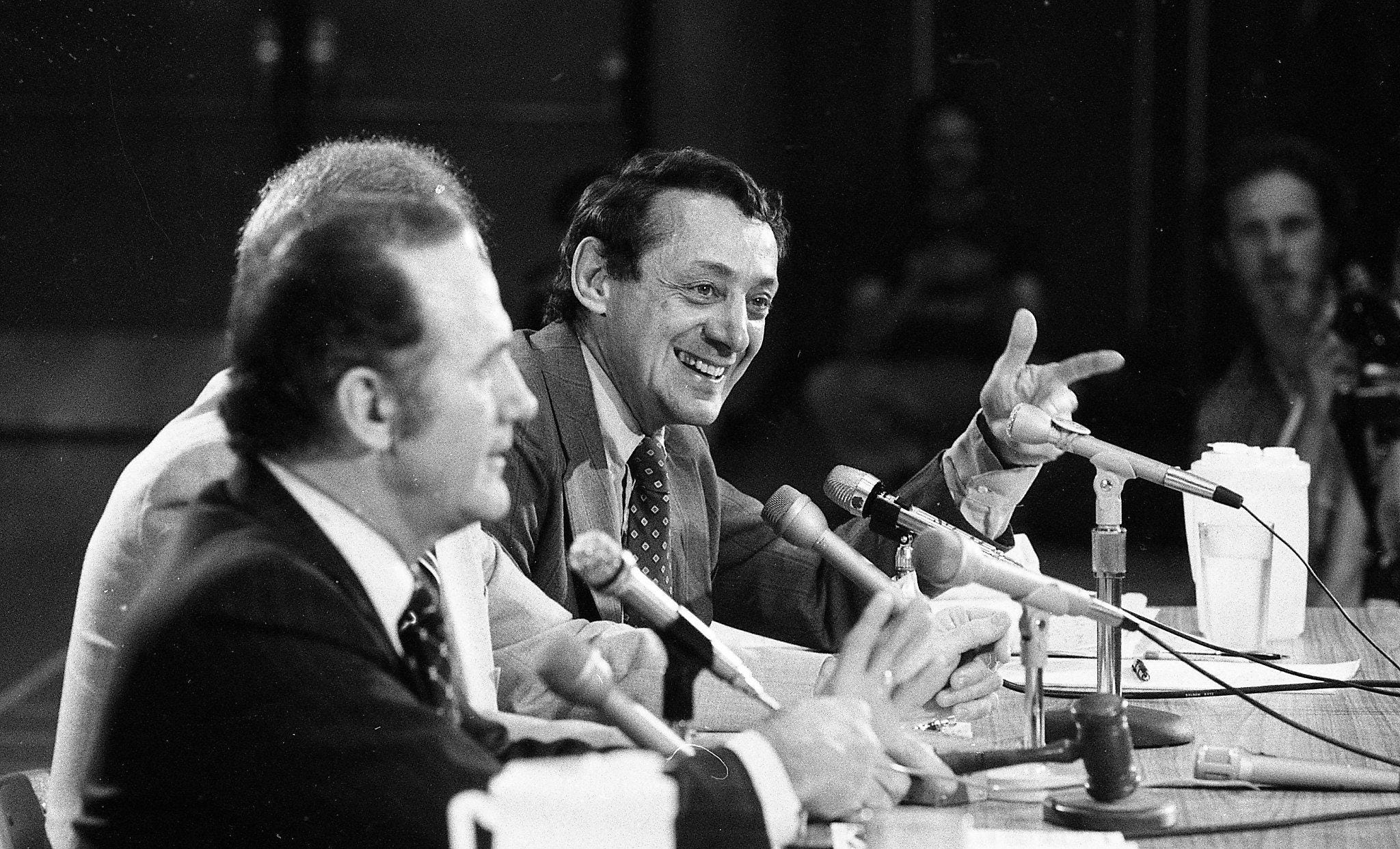
John Briggs thought he had the perfect plan. Fresh off Anita Bryant’s homophobic “Save Our Children” crusade in Florida, he figured California would be easy pickings. He was dead fucking wrong. On November 7, 1978, California voters didn’t just reject Proposition 6—they obliterated it. The Briggs Initiative went down by more than a million votes, losing even in Briggs’s own conservative Orange County stronghold.
Behind that victory was one of the most unlikely coalitions in American political history: a martyred gay supervisor, a future Republican president, grassroots activists, Catholic bishops, and thousands of teachers who refused to let fear win. This is the story of how they did it—and why it matters more than ever today. (snip-MORE)
Queer History 131: Michelangelo by Wendy🏳️⚧️🏳️🌈🌈
The Divine Cock: Why Michelangelo Was Almost Certainly Gay as Hell Read on Substack
You think you know Michelangelo? The guy who painted the Sistine Chapel ceiling and carved David from a massive chunk of marble? Here’s what they don’t teach you in art history class: the Renaissance master was probably queer as a three-dollar bill, and the evidence is splattered all over his life’s work like paint on a studio floor.
For nearly 250 years, Michelangelo’s own family censored his love letters and poems, changing every masculine pronoun to feminine ones to hide the uncomfortable truth that the “divine one” was divinely attracted to other men. When scholars finally uncovered the original texts in the 1890s, they found a treasure trove of homoerotic passion that would make even modern romance novels blush. (snip-MORE-do go read it!)
Queer History & Culture 127: Alan Turing by Wendy🏳️⚧️🏳️🌈🌈
A tortured genius whose code-breaking saved millions, only to be destroyed by the very society he protected Read on Substack
The bastards killed him. Not with bullets or blades, but with something far more insidious—the slow, methodical destruction of a man’s soul through legal persecution, chemical castration, and the systematic erasure of his humanity. Alan Mathison Turing didn’t just die on June 7, 1954; he was murdered by a society so goddamn backward that it chose to destroy one of the greatest minds in human history rather than accept that he loved men.

(snip)
The Making of a Revolutionary Mind
Born in 1912 to a British colonial family, Turing’s brilliance blazed early and fierce. At Sherborne School, while other boys were playing cricket and learning to be proper English gentlemen, young Alan was already wrestling with mathematical concepts that would have made university professors weep. His first love affair wasn’t with numbers, though—it was with Christopher Morcom, a fellow student whose death from tuberculosis would haunt Turing for the rest of his tragically short life.
That early loss carved something deep into Turing’s psyche. Here was a boy-genius, already grappling with his sexuality in an era when homosexuality was not just taboo but literally criminal, watching the person he loved waste away and die. The philosophical implications would torment him: if consciousness could be snuffed out so easily, what made it real in the first place? This question would drive his later work on artificial intelligence, but it also planted the seeds of a profound existential loneliness that would follow him like a shadow.
At King’s College, Cambridge, Turing found his intellectual home among the mathematical elite, but he also found something else: a community of gay men who lived in the shadows, speaking in codes, loving in secret. The irony is fucking brutal—here was a man who would become history’s greatest codebreaker, learning his first lessons in cryptography from the necessity of hiding his own identity. (snip-MORE, it should be known)
Queer History 129: The Genital Mutilation of the 1880s by Wendy🏳️⚧️🏳️🌈🌈
Read on Substack
In the fucking darkness of the 1880s, American medicine—that supposed bastion of healing and hope—turned into a goddamn chamber of horrors for LGBTQIA+ people. What began as medical “curiosity” quickly devolved into systematic torture disguised as treatment, launching over a century of medical persecution that would destroy countless lives and shatter the trust between queer people and healthcare forever.
The medical establishment, drunk on its newfound authority and desperate to appear scientific, decided that love between same-sex individuals was a disease to be cured. These weren’t healers—they were executioners in white coats, armed with instruments of torture and backed by the full weight of societal approval. The brutality that followed would make the Inquisition blush. (snip-MORE)
Queer History 130: The Lavender Scare by Wendy🏳️⚧️🏳️🌈🌈
When Joe McCarthy Declared War on America’s LGBTQIA+ Read on Substack
n 1950, Senator Joseph McCarthy stood before a crowd in Wheeling, West Virginia, and launched what would become the most sustained attack on LGBTQIA+ Americans in the nation’s history. While his speech focused on supposed Communist infiltration of the State Department, McCarthy’s paranoid rantings about “security risks” would soon expand into a full-scale witch hunt against homosexual federal employees. This wasn’t just political theater—this was the birth of the Lavender Scare, a systematic campaign of terror that would destroy thousands of lives and poison American democracy for decades.
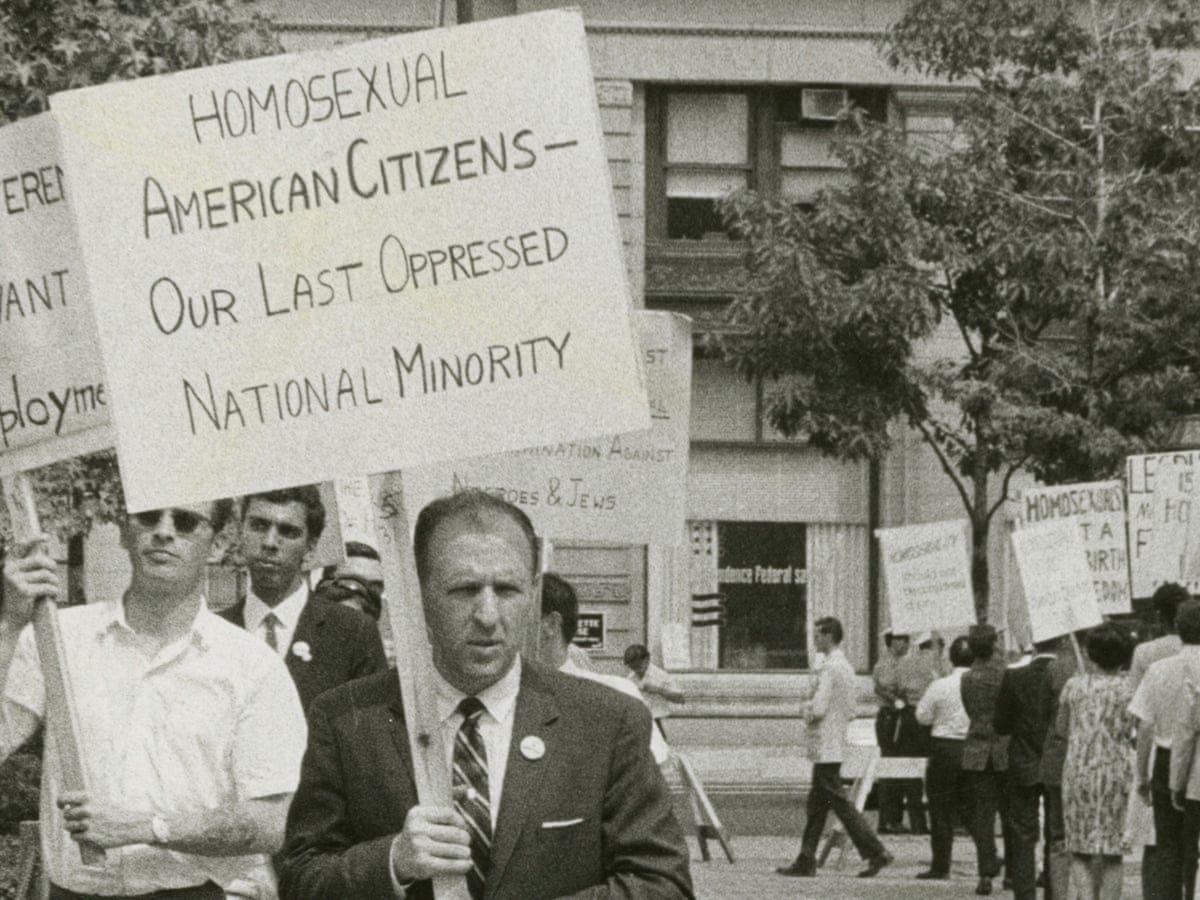
McCarthy didn’t just stumble upon anti-gay persecution as a political tool—he weaponized it with surgical precision. The bastard understood that while Americans might eventually get tired of hunting Communists, they would never tire of persecuting queers. Homophobia was the gift that kept on giving, a renewable resource of hatred that could fuel his political ambitions indefinitely. What began as anti-Communist hysteria quickly metastasized into something far more insidious: the systematic elimination of LGBTQIA+ people from American public life. (snip-MORE)
Peace & Justice History for 6/6

(https://www.peacebuttons.info/)
June 6, 1936 First issue of Peace News published in England. PeaceNews home page (Peace News subscriptions are no longer available. See this blog entry. -A. There is still useful information on its home page, etc.) |
| June 6, 1949 George Orwell’s dystopian novel, Nineteen Eighty-Four, was published. It described a world in which totalitarian government controls the behavior of all, including the way one thinks. This was summed up in the government’s slogans: War Is Peace, Freedom Is Slavery, Ignorance Is Strength.   George Orwell More about George Orwell |
| June 6, 1966 James H. Meredith, the first African American ever to attend the University of Mississippi, was shot by a sniper in the back and legs while on a lone “March Against Fear.”  He was walking the 220 miles from Memphis, Tennessee, to Jackson, Mississippi, to encourage others to stand up for their rights and self-respect, and to register to vote. Law enforcement officers and reporters following him witnessed the attack, and the shooter was arrested.  Read more |
June 6, 1968 Comedian Dick Gregory began a hunger strike in the Olympia, Washington, jail after his arrest with others at a fish-in, an act of civil disobedience in support of the fishing rights of the Nisqually Indian Tribe. See what happened after his arrest |
| June 6, 1971 40 members of the American Indian Movement camped in the sacred Black Hills, or Paha Sapa, atop Mount Rushmore; 20 were arrested. They were demanding the U.S. honor the terms of the 1868 treaty with the Sioux Nation granting them the Black Hills territory. Read more |
| June 6, 1989 The FBI and the Department of Energy, tipped off by plant workers, raided the Rocky Flats nuclear production facility. They found numerous violations of federal anti-pollution laws including massive contamination of water and soil. Rockwell International, the operator of the facility, was fined $18.5 million. |
https://www.peacebuttons.info/E-News/peacehistoryjune.htm#june6
 Scottie's Playtime