Beverage alert, as always!
This Week’s Josh Day Set
Beverage alert, as always!

Beverage alert, as always!
I read this over breakfast, and by 10 AM workout time, had seen it broadcast on 3 different shows.
America Brought to You by Bad Bunny by Charlotte Clymer
Hell of a choice. Read on Substack
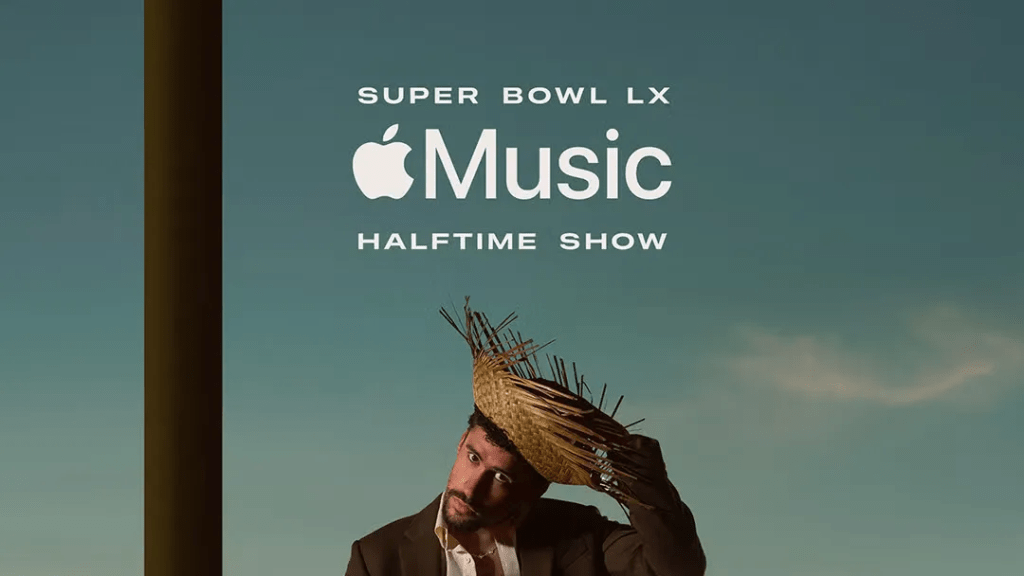
(image credit: Apple Music)
What is the biggest American cultural event?
There’s only one rational answer to this question. It’s the Super Bowl. Nothing else comes close. Not in size or grandeur or symbolism or global resonance.
This past February, for the first time, as many Americans watched Super Bowl LIX as those who watched the Apollo moon landing in 1969, long considered the biggest live audience draw in U.S. broadcast television history.
Neil Armstrong walking on the lunar surface was once indisputably the most-watched live event by Americans. This year, it officially had competition for that title. By 2030, it may not even crack the top five.
What will the top five otherwise be by then? All Super Bowl broadcasts. Right now, if you exclude the moon landing, the top ten live American television broadcasts are all Super Bowls, and the top three are all from the past three years.
Maybe you’re not into sportsball. Maybe you can’t stand the NFL. Maybe you have fond memories of watching the live series finales of M*A*S*H or Cheers or Seinfeld or Johnny Carson’s final Tonight Show appearance, and you’ll recall that it felt as though the entire country were watching those, too, at the same time you and your family were glued to the tube.
But those days are long gone. Network television has been cannibalized by satellite and streaming over the years. If a scripted network series draws ten million viewers for any given episode, it’s more than enough to take the crown over its competitors.
The Oscars draws 20 million. The Macy’s Thanksgiving Day Parade does better at 30 million. Trump’s inauguration in January had 25 million viewers, nearly ten million fewer than Pres. Biden’s in 2021.
There is no American cultural event that comes within shouting distance—much less spitting distance—of the Super Bowl. When you walk around today, wherever you are—at work or a café or a park or your kid’s school—keep in mind that, on average, at least a third of the adults around you were all watching the Super Bowl at the same time this year.
Consider the global audience: the Super Bowl is the most-watched live annual television event around the world. The Men’s World Cup Final draws as many as 1.5 billion live viewers, but that’s every four years. The Summer Olympics Opening Ceremony is capable of drawing half that, but it’s also every four years. The Super Bowl draws 200M live viewers globally every year.
No annual live television event in the world is bigger than the Super Bowl, and no other country can lay claim to having a live broadcast of this size that is so inextricably bound with a celebration of its culture.
The Super Bowl is a distillation of all things America: sports and celebrity and military pageantry and unabashed patriotism and unapologetic commercialism all being slammed together, and in terms of annual events, more human beings on this planet watch it live, together, than anything else.
And it’s because of all those elements that most American conservatives perceive it as a showcase of American exceptionalism. It’s not that it’s inherently conservative or that non-conservatives don’t watch it; it’s that the sheer scope of the Super Bowl combined with all the patriotic bits make it a crown jewel in their argument for American cultural hegemony.
That’s why when Apple Music and the NFL announced last night that Puerto Rican rapper Bad Bunny—Benito Antonio Martínez Ocasio—is headlining Super Bowl LX this upcoming February, my jaw dropped.
For those unfamiliar, Bad Bunny is one of the biggest entertainers in the world. Were you to remove Taylor Swift and Beyoncé from the metrics conversation, he’s easily the biggest. He led global streaming charts from 2020-2022, and he’s still among the top three even now. His Un Verano Sin Ti world tour in 2022 dominated that year, and only Taylor Swift has surpassed his touring numbers since.
Based on both merit and marketing, Bad Bunny is an obvious choice to headline the Super Bowl.
But he’s also an outspoken LGBTQ ally, particularly on trans rights. He has been consistently critical of Trump, especially in regards to immigration. Earlier this month, he announced he would not include any U.S. dates for his 2025-2026 Debí Tirar Más Fotos world tour out of fear for his fans given the fascistic crackdown by ICE. He notably endorsed Vice President Harris last year after Puerto Rico was mocked at Trump’s infamous Madison Square Garden campaign rally.
Oh, and he performs solely in Spanish. That’s right: he does not rap or sing in any language other than Spanish. He does speak English, but he’s not a “crossover” Latin artist as an intentional choice. He has made it clear that he wants Spanish-language music to be normalized in the global marketplace, and so, he only produces work in Spanish.
He is an avatar of Latin excellence in a moment when the U.S. government is violently hostile toward Latin people.
The biggest American cultural event—with massive global influence—is about to be headlined by an unapologetically proud Latin trans ally who can’t stand Trump and performs solely in Spanish.
Based on all this, the NFL selecting him to headline the Super Bowl is pretty damn surprising and may indicate no small measure of intended protest by those involved in the process.
What I wouldn’t give to have been a fly on the wall during the discussions that took place between the NFL and Apple and Jay-Z’s company Roc Nation—which advises the league on entertainment—in choosing Bad Bunny for the greatest entertainment gig in the world.
I suppose I’ll have to settle for Bad Bunny’s instantly iconic hint posted on social media just prior to the announcement last night:
“I’ve been thinking about it these days, and after discussing it with my team, I think I’ll do just one date in the United States.”
Goddamn. I love this guy.
Now the questions become: what does Trump do? Is there an online meltdown incoming? Will he attempt to pressure the NFL to cancel Bad Bunny? If he does, how will the NFL respond?
Trump may not want this fight. This may be one of those rare moments he wisely chooses to avoid controversy. His poll numbers are terrible, the Midterms are next year, and his party will need every vote they can get. Alienating young and Latin voters would be a massive, unforced error.
I guess we’ll see. In the meantime, we’re about to be treated to a hell of a show. (snip)
Introducing Medscape.com: Across Disciplines for the Public by Richard Hogan, MD, PhD(2), DBA

Vigilance Across Disciplines for the Public
I am sharing the Medscape resource that follows only because of misinformation arising from via Robert Kennedy and President Donald J. Trump (week of 9/22/2025)
Medscape.com is not merely a medical resource—it is a threshold of discernment for you, a corridor of clinical clarity.
For physicians, yes—but also for advocates, poets, policymakers, and stewards of care.
It offers daily rites of insight: peer-reviewed updates, diagnostic tools, and the pulse of global medicine.
I introduce it not as a site, but as a ceremonial scroll—for those who dignify care across disciplines, and who recognize that health is not confined to hospitals, but lives to support you, policy, poetry, and the architecture of belonging. (snip-graphic and comments on the page)
I’m Not Crazy by Jeannine Lawall
A story inspired by “Crazy Train,” by Ozzy Osbourne Read on Substack

I’m Not Crazy
People say I’m crazy. I don’t really know if I am; I just know that my brain doesn’t work like most people’s… so if that means I’m crazy, then I guess maybe I might be.
I was happily married, once upon a time, but it soured fast, and he didn’t stick around very long. Not that I can really blame him. I know that I’m hard to live with, but it hurt, because I couldn’t figure out what I’d done wrong.
Like the last time I wound him up: It was the day he left. I guess he couldn’t take it any longer. He marched out, screaming, “You’re driving me insane,” just before he slammed the front door… the very last words I would ever hear from his lips.
You know, he really should have known better than to have made me watch the election results that night. He knew how I hated politics, all that jibber jabber that makes no sense. People should be learning how to love, but instead the world is filling with hate. Crazy, crazy talk! I know now that it was wrong to throw the television out the window, but I’m sorry, I just snapped.
I mean, the television was evil. It blathered on and on, and millions of people just sat there, staring, drinking up whatever the media spooned out. So, yeah, it had to go. And Harry followed right after the telly — though he didn’t go flying out the window, he just slammed the door and walked away.
No, I’m not crazy! Our generation has inherited a nuclear arsenal that could easily destroy the world many times over. So yeah, I’m worried about it, but I figure that that’s a perfectly appropriate defense response. If you were to tell me that you’re not worried, I would figure that you’re mad, drunk, or lying… or maybe that you’d become just plain numb to everything.
Life isn’t fair. I can’t unknow what I’ve learned, and what I’ve learned has destroyed my faith in everything. It’s all lies. I know that I’m going off the rails, but there’s nowhere else to go. No. No, there’s no hope for me. My mind was too fragile and was cracked by watching evil people rule the world. But you… maybe your mind is made of sterner stuff. Please, listen to me. Please, help. We need to teach the world to love… before it’s too late.
Well I guess that’s it. Thanks for listening. I gotta go. The orderly is telling me that it’s time to go back to my room because it’s television time… and I’m not allowed near televisions anymore. And please remember: When you tell the others about this, make sure you tell them… I’m not the one who’s crazy. (snip-a bit more on the page. This writer is talented!)
I have read rumors about this guy for a long time. But I was always hopeful he played for the straight team because of how hateful he is. He is an all out racist. But they claim to have checked it out and it is true. There clearly is some excitement in Ryan’s pants.
Timely and informative, as only Josh delivers-enjoy!
The Supreme Court is expected to decide this fall whether they will formally take up a case that is asking them to reverse their decision in Obergefell v. Hodges.
By Nico DiAlesandro and Hope Pisoni, Uncloseted Media September 19, 2025
In the U.S. today, there are over 800,000 married gay couples. And 67% of Americans say they support marriage equality, including 50% of Republicans.
Despite this, many of the groups that fought to prevent the Obergefell ruling are now ramping up their ongoing fight to overturn it.
If Obergefell were overturned, it could become illegal for gay couples to marry in the 32 states that still have bans on the books. As the Supreme Court mulls over whether or not to take a case asking them to overturn the historic ruling, we’ve documented every step that has been taken in the past five years to threaten gay marriage in the U.S.
Oct. 5, 2020
The Supreme Court of the United States (SCOTUS) rejects a petition to hear former Kentucky County Clerk Kim Davis’ appeal in Ermold v. Davis, a case brought by a same-sex couple after Davis denied them a marriage license in 2015. Justice Clarence Thomas, joined by Justice Samuel Alito, writes that the Obergefell ruling has “ruinous consequences for religious liberty” and that it “enables courts and governments to brand religious adherents who believe that marriage is between one man and one woman as bigots.” They express their desire to see Obergefell overturned, writing that SCOTUS “has created a problem that only it can fix.”
The following day, Liberty Counsel, a Christian legal group and Southern Poverty Law Center (SPLC)-designated hate group, announces their intent to file a petition with the Supreme Court to “address Obergefell” after Davis’ case moves to a trial court.
Nov. 5, 2020
Nevada overturns an 18-year-old ban on same-sex marriage, making it the first state to enshrine gay couples’ right to marry in their constitution. Nevadans vote 62% in favor of the reversal.
“It feels good that we let the voters decide,” Equality Nevada President Chris Davin told NBC News. “The people said this, not judges or lawmakers. This was direct democracy—it’s how everything should be,” he said, adding that the LGBTQ community wants something concrete to protect same-sex marriage in case “the federal level ever revokes it—which is what a lot of folks are worried about with the new Supreme Court.”
June 17, 2021
SCOTUS rules in favor of Catholic Social Services (CSS), which sued the city of Philadelphia for ending its foster-care placement contract with CSS because of their refusal to certify same-sex couples as foster parents. The ruling, which states that Philadelphia’s termination of CSS’s contract violates the Free Exercise Clause of the First Amendment, provides a carve-out to Obergefell.
June 24, 2022
Roe v. Wade is overturned. In a concurring opinion with the majority, Thomas sets his eyes on Obergefell and Lawrence v. Texas—a ruling that in essence legalized gay sex. He writes that the Court should reconsider those cases since they used similar arguments to Roe v. Wade.
“[W]e should reconsider all of this Court’s substantive due process precedents, including Griswold, Lawrence, and Obergefell. Because any substantive due process decision is ‘demonstrably erroneous.’”
Despite Thomas’ opinion, the majority explicitly states that “[n]othing in this opinion should be understood to cast doubt on precedents that do not concern abortion.”
Dec. 13, 2022
President Joe Biden signs the Respect For Marriage Act into law. This solidifies federal and interstate recognition of same-sex marriages even if Obergefell is overturned. The law is a backstop to the attacks on same-sex marriage.
Dec. 19, 2022
In a response to the passage of the Respect for Marriage Act, SPLC-designated anti-LGBTQ hate group Alliance Defending Freedom (ADF) says that “the chances of the Supreme Court overturning Obergefell are (unfortunately) slim to none.”
June 30, 2023
SCOTUS rules 6-3 that Colorado cannot force a website designer, who is represented by ADF, to create wedding websites for same-sex couples. The Court says doing so would violate the designer’s First Amendment right to free speech because her work is considered creative expression. This decision narrows how public-accommodation laws apply and creates another carve-out for Obergefell to be overturned.
Sept. 13, 2023
After a court ruling holds Kim Davis liable for damages to gay couples who she refused to sign marriage licenses for, Liberty Counsel discusses the potential to appeal the case up to the Supreme Court and use it to argue for Obergefell to be overturned.
July 8, 2024
The GOP’s national party platform, Make America Great Again!, drops explicit anti-Obergefell language from its plank. Despite this, the fight to overturn same-sex marriage continues to heat up.
Jan. 22, 2025
Tennessee lawmakers introduce a bill that would allow for “covenant marriages,” an explicitly religious form of marriage license that can only be given to a man and a woman and does not allow for divorce in most circumstances. Covenant marriages already exist in Arizona, Arkansas and Louisiana. Oklahoma, Texas and Missouri have recently introduced similar bills.
Jan. 27, 2025
Idaho’s House of Representatives passes a resolution calling on the Supreme Court to overturn Obergefell. The resolution was drafted by MassResistance, a far right group that wrote a book called “The Health Hazards of Homosexuality” and that has 24 chapters around the world. One of their newest chapters is in Kenya, where the group says it holds trainings for youth to “resist the LGBT agenda” in schools.
The Idaho resolution would go on to create a domino effect. Lawmakers in Michigan, Montana, North Dakota and South Dakota introduce similar measures in their states asking SCOTUS to overturn Obergefell.
Republican Rep. Josh Schriver, who introduced the resolution in Michigan, had previously posted to X: “Make gay marriage illegal again. This is not remotely controversial, nor extreme.”
June 10, 2025
At the Southern Baptist Convention (SBC), a national meeting of more than 10,000 church representatives from America’s largest Protestant denomination, the convention’s resolutions committee introduces a resolution calling on lawmakers and SCOTUS to overturn laws and court rulings, “including Obergefell v. Hodges, that defy God’s design for marriage and family.”
SBC delegates overwhelmingly vote in favor of a gay marriage ban as well as the reversal of Obergefell.
June 12, 2025
Liberty Counsel releases a statement titled “Obergefell ‘Marriage’ Opinion Must Be Overturned.” The group’s founder and chairman, Mathew Staver, says:
“The U.S. Constitution provides no foundation for ‘same-sex marriage.’ Obergefell was wrongly decided whereby the Court created a right that is nowhere to be found in the text. We will petition the U.S. Supreme Court because Kim Davis’ case underscores why the High Court should overturn Obergefell v. Hodges. Obergefell threatens the religious liberty of Americans who believe that marriage is a sacred union between one man and one woman.”
June 23, 2025
ADF publishes an article titled “Despite 10 Years of Obergefell, Kids Still Need a Mother and Father.” The article outwardly condemns gay marriage as bad for children, marking the group’s most explicit statement of opposition to the ruling in years. Weeks later, the group’s vice president of appellate advocacy publishes an essay arguing a similar premise.
July 24, 2025
Kim Davis files a petition asking SCOTUS to revisit and overturn Obergefell, saying the case was wrongfully decided. The petition will need just four votes from the justices to be heard by the Court.
Aug. 15, 2025
On a podcast, Hillary Clinton expresses her concern that Obergefell will be overturned:
“American voters, and to some extent the American media, don’t understand how many years the Republicans have been working in order to get us to this point. … It took 50 years to overturn Roe v. Wade. … The Supreme Court will hear a case about gay marriage; my prediction is they will do to gay marriage what they did to abortion—they will send it back to the states. … Anybody in a committed relationship out there in the LGBTQ community, you ought to consider getting married because I don’t think they’ll undo existing marriages, but I fear they will undo the national right.”
Sept. 7, 2025
In an interview with CBS News, conservative Justice Amy Coney Barrett argues SCOTUS rulings should not be based on “opinion polls” and that the Court should not be imposing its own values on the American people.
Fall 2025
In fall 2025, SCOTUS is expected to decide whether or not it will revisit Obergefell. If it grants a review, oral arguments will likely be heard in spring 2026 with a decision by late June 2026, during Pride Month.
FWIW.
| September 21, 1963 The War Resisters League organized the first American anti-Vietnam War demonstration in New York City. The League, founded in 1923, was the first peace group to call for U.S. withdrawal from Vietnam, and played a key role throughout the war, organizing rallies, the burning of draft cards, civil disobedience at induction centers, and assisting resisters. History of WRL  WRL home |
September 21st (since 1982) The International Day of Peace was established by United Nations resolution in 1981 and first celebrated in 1982 (then as the 3rd tuesday of the month). Events are planned all over the world to promote peace and make it more visible. About Peace Day and plans around the world |
 Scottie's Playtime