One Of These Had Been Open For 47 Years!

U.S. Gay Bars Are Closing Their Doors at a Heartbreaking Pace

From coast to coast, they play a crucial role in the LGBTQ+ community, and they’re disappearing.

By Mathew Rodriguez

When it comes to the queer bar in the wild, so many threats exist, and it’s only gotten worse in the past few years. Higher upfront costs combined with lower foot traffic have caused a nationwide problem for the service and food industries, which is exacerbated in queer spaces, which deal with smaller demographics than the average bar or restaurant. And of course, there’s the fact that many people, especially younger people, just don’t go out or have a third space anymore.

It’s hard to say whether anything can economy-proof the gay bar. In the past year alone, the U.S. has seen closures of long-running queer spaces, such as the Bay Area’s Ginger’s, which was open for 47 years, or Rochester, New York’s, Avenue Pub, which just inched past five decades of serving queers. New businesses aren’t exactly faring better, with bars such as Michigan’s General Wood Shop and Brooklyn’s Club Lambda having opened and closed within the span of just a couple years.

In some cases, a bar’s public frankness about its financial difficulties can prompt a community response that allows it to stay open. In the last few years, many struggling spaces have turned to sites such as GoFundMe to make ends meet, keep creditors at bay and continue to sling food, drink and community to its underserved patrons. (Efforts on the fundraising platform saved East Nashville’s Lipstick Lounge and Washington, D.C.’s As You Are.) And, of course, there are organizations such as the Lesbian Bar Project looking to not only document queer history, but keep these spaces vibrant. But just as important to fight for new and existing queer spaces is commemorating those that were lost, for a myriad of reasons, in the past year.

Club Lambda (Brooklyn)

After opening Lambda Lounge in Harlem, married couple Charles Hughes and Richard Solomon expanded their brand, and the creation of safe spaces for queer people of color, to Brooklyn with the opening of Club Lambda in Williamsburg in 2022.

“We saw that a lot of urban communities didn’t have a location that they could go to every night of the week,” Hughes told amNY in 2022. “Brooklyn didn’t have this, so we are opening Club Lambda.”

The club announced that it would close at the end of February in an Instagram post.

(snip-embedded Insta post on the page; I can’t grab it. Click the title above to go to the story page)

“The past 5 years have been nothing more than exciting as we have hosted some of the most iconic and memorable events New York has seen!” Club Lambda wrote in the post. “Servicing celebrities, socialites and many from all walks of life within the community has imprinted many memories for us to hold on to for years to come!!”

Upon announcement of its closure, many in the LGBTQ+ community, especially Black LGBTQ+ people, mourned the loss of a space owned by Black people that catered to a Black queer crowd.

Denver Sweet (Denver, Colorado)

After six years of operating in Downtown Denver, Denver Sweet closed its doors in July 2025, citing increased labor costs and less foot traffic in the bar, per the Denver Post. “This was an incredibly difficult decision to make, but we believe the time has come,” owners Randy Minten and Ken Maglasang said in a statement to the Post. “Creating and running Denver Sweet has been a dream come true for us — and saying goodbye is heartbreaking.”

(snip-Insta post)

Sweet celebrated its farewell with a bottomless mimosa lumberjack brunch featuring pancakes and unlimited mimosas, as well as performances from two local drag kings, per its final Instagram post. Not only did it feature an upstairs patio, it was, per the Post, one of the only bars in Denver that catered to the bear community.

Ginger’s (San Francisco)

Ginger’s closed permanently after a brief resurrection in 2024. The bar, which had previously closed, reopened for Pride 2024, per Eater San Francisco, but following financial hardship had to close permanently in late 2025, despite being the last LGBTQ+ bar in the city’s Financial District, per the San Francisco Chronicle.

Prior to its final closing, Ginger’s had operated in the Bay Area for 47 years. As with other closures, the owners cited dwindling bar traffic for the closure.

(snip-Insta post)

“The traffic to Ginger’s has not been consistently strong,” Future Bars Group, which operated Ginger’s, owner Brian Sheehy told SFGATE. “Without enough customer support, our staff don’t earn enough tips, and Ginger’s operates at a loss. We have struggled to get people into Ginger’s, despite the valiant efforts of our entire team and the great shows being put on by the performers.” Per SFGATE, Ginger’s first opened in 1978 by owner Don Rogers, who named the bar after actress Ginger Rogers due to their shared surname.

Eagle Houston (Houston)

When Eagle Houston closed this past summer, it took the Texas city’s residents by surprise. It had just hosted a spat of LGBTQ+ pride events in June before news of its close started to spread in local Facebook groups for the bear community, per the Houston Chronicle. What followed was mostly silence: neither the bar’s owner nor its social media pages responded to several requests for comment from the Chronicle. However, at the time of its closing, a notice to vacate had been posted on its front door, which had also been plastered with a sign noting various violations and boarded up with a solid wooden plank. The bar first opened in 1984.

Barracuda (New York City)

Open since 1995, Barracuda was known in New York City as a drag hotspot. (And if you were going to see a diva at Madison Square Garden, you’d walk a few blocks down to an afterparty most likely happening within.) Over three decades, the bar has seen the likes of Sherry Vine, Jackie Beat, Hedda Lettuce and others grace its stage.

“Thirty years is a very long time,” owner Bob Pontarelli said in a statement to Eater upon its closing. Pontarelli cited the opening of a condo project next door, and the accompanying construction, as the reason for the bar’s closure. “The damage from the construction has significantly affected the interior and overall operation of the bar.” The ongoing drilling meant there was “no way to anticipate the additional damage and risks that could arise in the future. It is impossible to conduct business as usual,” Pontarelli wrote.

This Is It! (Milwaukee)

When This Is It! closed its doors in 2025, it wasn’t just the shuttering of a Milwaukee queer staple. It was the closing of the oldest gay bar in the state of Wisconsin: This Is It! Had started operating in 1968. The bar announced its closure on its Facebook page on March 9, citing the COVID crisis as bringing a financial hardship from which the bar couldn’t recover, as well as an 8-month closure of the bar’s street and sidewalk in 2024.

“It’s with much sadness, but with so much love, we bid all of you farewell,” the bar wrote. “Take care of each other, and please continue to support local and queer-owned businesses.” Drag superstar Trixie Mattel even became a co-owner of the bar in 2021; at the time, she said that she bought it because she didn’t want to see it suffer the same fate as so many other queer havens post-COVID.

Under the announcement of the closing, many patrons were confused as to why the bar closed so suddenly, without a chance to either fundraise to keep the bar open or send it off with a farewell event.

Macri Park (Brooklyn)

New Yorkers were shocked to find out about the surprise closing of Brooklyn-based Macri Park in January without much notice. In an Instagram post in January, the bar had announced that it had already closed, giving bargoers nary a chance to celebrate or mourn the space.

(snip-Insta post)

Macri Park did not begin as a gay bar, first starting at a dive bar before ownership passed to the same person who owned nearby Metropolitan, per Greenpointers, in 2015. From then on, Macri became a gay bar with a new aesthetic. When the bar shared news of its closing on social, many local drag icons flew to its comment section to mourn.

“The doors may close,” wrote drag queen Bible Girl, “but i’m still in the walls.”

The Ruby Fruit (Los Angeles)

The Ruby Fruit, a lesbian wine bar located in Los Angeles’s Silver Lake neighborhood, announced in January 2025 that it would close its doors; though the bar had been struggling financially for some time, business paused and then dropped precipitously during and after the LA wildfires, per Eater. “When we’re talking about being vulnerable, the line is so thin between being able to carry on and not,” owner Mara Herbkersman told the outlet. “It became really clear after two days of being open that if we were to go on one more day, we would run the risk of not being able to pay our employees, a nonnegotiable for us.”

News of the bar’s closure sent shockwaves throughout the Los Angeles sapphic community as well as the queer internet. It also spawned considerable drama. After crowd-sourcing funds to stay open, the bar finally closed, per the Washington Blade, leaving some to wonder where the community aid it had asked for had gone. After its abrupt closing, former employees spoke candidly with the Blade about lingering and long-running financial affairs that predated the fires and alleged mistreatment at the bar. There was also some alleged clash over whether the bar was a “lesbian bar” versus a “sapphically-inclined” bar that was ultimately for everyone, per one employee who spoke to Eater.

Also, several trans and POC patrons reported feeling unwelcome in the space. “I don’t think they purposefully didn’t include them,” Sienna Deadrich, a former line cook at The Ruby Fruit told Eater. “But from the perspective of someone who is POC and trans, it was very clear that they didn’t include them.”

Avenue Pub (Rochester, NY)

Citing concerns both economic and safety-related, Avenue Pub in Rochester, New York, shut its doors after five decades in business. “You know, just the economic times right now. Monroe Avenue and the violence on the weekends,” owner Peter Mohr told WHEC. “It’s just, it’s making a very unsafe place for my consumers.”

(snip-Insta post)

Mohr elaborated in an Instagram post issued on its final day open. “If I had more resources to keep it going, I absolutely would,” Mohr wrote. “But the reality is that I’ve invested my life savings into these businesses — and I may never see that return.”

General Wood Shop (Grand Rapids, Michigan)

General Wood Shop got its name from the furniture store that used to occupy its space in the 1940s. When it opened in 2023, the bar was hoping to bring an LGBTQ+ space to Grand Rapids, Michigan. By the time it closed, it had succeeded.

(snip-Insta post)

“When we opened in July 2023, our dream was to create a place where everyone could feel welcome, safe, and celebrated,” the bar wrote on its social media post announcing its closure. “Together, we built more than a bar; we built a community we will always be proud of.” The bar did not give a reason for its closure on Instagram, nor did it offer one to local news affiliate WoodTV.

City Side Lounge and Kurt’s Place (Tampa)

In an extremely rare occurrence, two separate bars in the same space closed their doors within the same year. After City Side Lounge closed in March, Kurt’s Place opened up in the former venue in August, then finally announced its permanent closure in November, per Watermark Out News.

When City Side announced that it would close in February, local talent bemoaned the loss of the space, which was especially known as a haven for Tampa’s Latinx community. One DJ, DJ Manne, even posted that the bar’s Latin Night would continue in another venue.

Prior to its closure, the Facebook page associated with Kurt’s Place posted a notice from the building’s landlord stating that Kurt’s owed more than $30,000 in rent and past due fees.

Get the best of what’s queer. Sign up for Them’s weekly newsletter here.

A Letter From God

Well, a video, anyway.

Tuesday Mix

Mewling About Mueller

Prez POS strikes again

Clay Jones


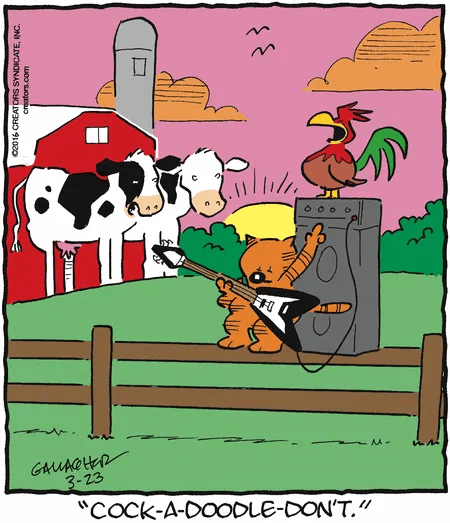
https://www.gocomics.com/heathcliff/2026/03/23


Josh Johnson

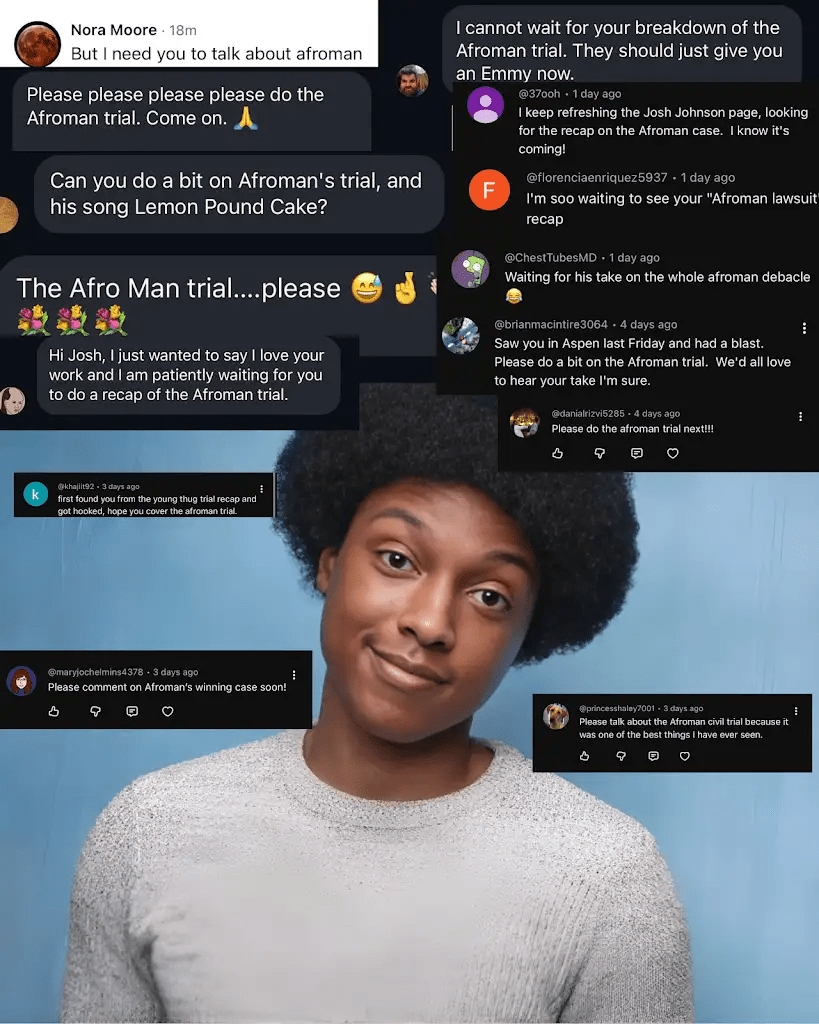
Josh Johnson11 hours agoProbably my most requested topic ever. Do your thing for the algo so everyone knows new set will be live premiering Tuesday at 9pm eastern Friends ❤️


Josh Johnson
7 hours agoH i Friends, good news! I am hosting ‪@TheDailyShow‬ this week Tuesday – Thursday. Do your thing for the algo so more people see it. Guests this week are Sterling K. Brown, Mero, and Eiza González. March 24-26 on Comedy Central and Paramount


Trump Buys His Cabinet Shoes, And It Goes Horrendously Awry

Maga is a cult.  tRump chose his cabinet on what compromising information he could get on them, either from his own sources or from Putin.  So they dare not disobey him even to the point of humiliating themselves.  Hugs

There’s Danger On The Right

Right-Wing Women Discover Misogyny Not As Fun As They Thought Part 378,272,347,230,326

The red pill, it turns out, is filled with rat poison.

Robyn Pennacchia Mar 13, 2026

I realized recently that it’s been a while since we’ve seen an incel mass murderer. Because, really, for a time there, it seemed like something of an endless parade of angry young men going on murder sprees over not being able to get laid. It occurred to me the reason for this may be that, while they’re probably still not getting laid, they’re certainly less alone now. “Incel culture” has become mainstream on the Right. They hate women like incels. They talk like incels. Terms like “foid” (short for “femoid” or “female android”), “looksmaxxing,” “______ mogged,” “the wall” have entered their lexicon. Many of them are straight up turning themselves into incels just by hating women and various other groups of people so much that they are repulsive to women.

These days, they don’t have to go to dark corners of the internet in order to share their insane theories about women, to be told by other men that they are inherently superior to women, that women are crazy and evil and that giving them rights has ruined everything. They just have to go over to X The Everything App or to YouTube or, you know, listen to a sizeable majority of the mainstream male Republican pundits.

There are even more than a few women they can listen to. Women who will gladly tweet and stream and podcast all about how they think feminism and the sexual revolution ruined everything for women as well, who will even claim they want to #RepealThe19th because of how stupid and crazy we all are.

But that sort of pretense isn’t easy to maintain, especially once it’s no longer serving you. Thus, we’ve increasingly seen stories about alt-right women defecting from the movement after they have “seen the light” and suddenly come to realize that these men don’t actually like them, either. This week, we’ve got one in New York mag.

They all have pretty much the same story at this point. They fell into all of it because they were mad about “woke scolds” and thought it was cool and rebellious to embrace far-right ideology, because they enjoyed the attention they got for repeating anti-feminist talking points and maybe even believed that they’d rather be stay-at-home moms — literally nothing wrong with that! No one cares! Go and be well! — or that working instead of raising children was making women “crazy.” Then they realized, at some point — whether because they ended up in a pretty bad domestic violence situation like Lauren Southern, or because their baby daddy let his acolytes post AI child sexual abuse images of them on his social media site as happened to Ashley St. Clair, or because they realized that the Right did not actually allow for differing opinions or criticism, or because they realized that the men they were sucking up to hated their guts as much as they hate ours.

“Anna,” a former “celebrated pundit of the New Right,” anonymously told New York her own version of this well-worn origin story. She was liberal when she was younger and living in a conservative town, but then she left and …

[D]uring college in the mid-2010s, she was exposed to the overweening, haughty moralism of Peak Woke.

“I’m somebody, dispositionally, who likes to have a good time,” she tells me. She found the humorlessness of the contemporary left more alienating than the conservatism of her youth.

She wasn’t attracted to the right by the romanticized aesthetic of “traditional America” — big beautiful houses and bread-making and families with half a dozen children. Rather, she says, “I was in love with the frisson of transgression.” The online right had begun to engage more explicitly with forbidden subjects: nativism, race science, and gender essentialism drawn from evolutionary psychology. “There was an element of gnosticism to it,” she says, “the sense that you know secret things that other people don’t know.”

Ah yes, the “frisson of transgression.” “Gnosticism.” What a fabulously intellectual way to say “I got tingly from being a bigot and didn’t actually care about who I harmed as long as I felt special.” Another woman who spoke to New York said about the same thing.

[Alex] Kaschuta [who hosted the alt-right podcast Subversive], like Anna, says she was initially attracted to the New Right out of curiosity, contempt for woke pieties, and a taste for transgression. “I’ve always liked edgy stuff, unfortunately — that’s one of my problems,” she says, laughing.

We’ve seen a lot of this. People attempting to write off racist, misogynistic or otherwise shitty views as some attempt to “freak out the squares” — as though it’s somehow similar to middle schoolers trying to convince their teachers that they are Satanists just to mess with them. The thing is, you don’t do the latter unless you think it’s dumb that people are freaked out by Satanists (which it is), and you don’t do the former unless you think it’s dumb for people to not want to be harmed by bigotry. This kind of thing doesn’t exist in a vacuum.

Anyway, “Anne” seems to have realized the error of her ways when they started to harm her.

“Over time, the language of New Right misogyny got way more tuned in to red-pill-type stuff,” she says. Among young MAGA men, there ceased to be a huge difference between self-understood trads — Christians who tend to (patronizingly) venerate women’s special contributions to family and religious life — and rageful incels, who see women as conspirators in a plot to deprive them of sex and status. Both groups, Anna says, came to see women as “these objects you can use at will. So if you want a marriage, if you want a lifelong ‘bang maid,’ then you can pursue that. And if you want to just have endless hookups, you can pursue that by using these dating tactics within the red-pill sphere.”

While the language has certainly become more coarse over time, while it’s much more “acceptable” on the Right to now say, as Nick Fuentes does, that you’d like to see women put in concentration camps, this really isn’t anything new. In fact, what many of these women imagined themselves “rebelling” against was the silly feminist notion that these men thought these things and behaved this way in the first place. That the “woke scolds” were imagining all of this sexism and racism that didn’t actually exist anymore. Indeed, the swiftness with which they waver between blatant misogyny and racism and claiming that these things are not a problem in today’s society will give you whiplash.

Now, I am always glad for people to defect from any bad way of thinking, whatever it is that wakes them up. The fewer of these fuckers, the better. That being said, I do think this is all bullshit. I do think that the reason they’re leaving is because they’re being pushed out, not because they are suddenly realizing that right-wing ideology is bad.

The Right has fallen in love with the narrative of “the woke scolds were too much and we were all rebels who would never be any good, so we had to become Nazis!” but that is, and always has been, absolute bullshit. If someone’s instinct is to “rebel” or even simply to be contrarian, they’re not going to be out here demanding that everyone go along with them — because once that happens, you’re not a rebel anymore, you’re not “transgressive,” you’re just like everyone else. Their anger wasn’t ever that they couldn’t use slurs. The power to do so was within them all along. What they were mad about was that it wasn’t socially acceptable for them to do so. That other people weren’t doing it.

Similarly, no one (other than companies that don’t want to pay people enough money to subsist on a single income) has done anything to prevent any of these women from becoming housewives or stay-at-home moms. I’ve been a feminist my entire life. I’ve been a feminist in a professional capacity for over a decade at this point. At no point have I ever heard any feminist disparage “stay-at-home moms.” Literally not once. Ever. This is a narrative that lives exclusively in the minds of paranoid conservatives who live in terror of someone policing their life choices the way they police the life choices of others.

But you know what? Even if they did! Even if absolute legions of feminist writers devoted themselves fully to proclaiming that stay-at-home moms should not exist … other people’s opinions are not the law.

The fact is, both the men and the women who participate in this bullshit are looking for the same thing — validation and self-esteem. They want to be told “you’re better than other people just by being you.” For all the talk of “merit” on the Right, this is what they’re most thirsty for. The men want to be told they’re inherently superior to women — as well as people of color, Jewish people, LGBTQ+ people, etc. depending on their personal identity — and the women wanted to be told they’re “not like the other girls!” or “so based!”

I suppose it is entirely possible that these women spent years in the dark and are just now realizing that the men in their movement really do hate women and really do want to deprive them of rights and that this would be unpleasant for them were it to actually occur — this seems to be what “Anna” feels happened to her.

“You almost don’t realize what’s happening until five years later,” Anna says, “when you look back and you’re like, Oh gosh, I was being used.” She also blames herself: “I was too frivolous with ideas.”

But I don’t think these defections are happening by coincidence at a time when shitty men now feel so “empowered” that they no longer require the permission of pick-me girls willing to say “I agree! Women are terrible and crazy and too emotional and shouldn’t have rights!”

Arguably, these women are no longer necessary to their movement and are being cast aside as such. Conservative men no longer feel like they need to be able to point to a woman and say “Look! She’s okay with it!” because they have gotten to the point where they do not care about that anymore.

This, indeed, is more or less what Kaschuta’s former compatriots had to say about her.

Many attacked her looks (Kaschuta is blond and conventionally attractive) and then attributed her defection to those same insults. Charles Cornish-Dale, a New Right figurehead who goes by the name Raw Egg Nationalist and appeared several times on Subversiveposted on X, “The truth about the whole saga … is that people (i.e., men) started calling Alex fat and telling her they didn’t want to be browbeaten and tone-policed by a woman.” This, he said, was the real reason she had turned against the right, “not principles or ideas.”

At this point in their evolution, they now feel free to denigrate those women just as furiously as they denigrate feminists, if not moreso.

They now take pledges to, as the article notes, “rape, kill and die” for Nick Fuentes (frequently abbreviated “RKD4NJF”). As “Anna” put it, they are “insisting that women subject themselves entirely to male authority, while advertising that male authority will be cruel and vicious and fickle.” They no longer feel the need to pretend that this is meant to be a good time for women as well. They’re just viscerally furious at women for existing and “ruining” everything for them by insisting upon being treated like human beings. They want to see us all punished for this and they no longer want to have to pretend to not hate a few women here and there.

In return, they are gaining power in the Republican Party. A follower of Fuentes’s was just elected as president of the College Republicans of America.

Granted, these defections and even these men outright saying that they want a world in which they get to be horrible to women will probably not deter other women from attempting to join in on all the #RepealThe19th good times. Because sure, they’ll still get a few “so based” and “If only all women were like you!” comments here and there and that will make it all worth it for them — for a while, at least, until they, too, experience the spontaneous revelation that they will have to also accept a much larger dose of disrespect in exchange.

A bunch of The Majority Report Clips on different subjects.


More For Readers To Check Up On With Their State Legislatures

Kansas Legislature plots election suppression, one careful building block at a time

by Robin Monroe, Kansas Reflector
March 11, 2026

Kansas is not rewriting its election system with one sweeping law.

It is doing so in pieces.

A deadline adjustment here. A database requirement there. A repeal of mail-in ballot authority. A restriction on ballot return methods. A new reporting mandate. A rule centralizing constitutional challenges in one county. A provision that repeals advance voting if courts intervene.

Individually, each bill appears technical. Administrative. Procedural.

Collectively, they form a kind of architecture, and architecture is never accidental.

The justification offered repeatedly is election integrity, specifically, noncitizen voting. Yet documented cases of noncitizen voting in Kansas have been counted in the single digits through the decades.

National reviews of millions of ballots have found similarly rare occurrences. The problem, statistically, is exceedingly small.

The legislative response, however, is structurally expansive.

Consider what is being built.

One bill requires certain public assistance agencies to report identifying information about noncitizen recipients to the secretary of state. Another one mandates recurring comparisons between Kansas’s voter registration system and the federal SAVE database.

Others expand the removal triggers to include driver’s license status or database mismatches.

In practical terms, that creates a dubious data pipeline: Public benefits system data is sent to the Secretary of State, where it is cross-referenced against the federal immigration database, then checked against the statewide voter rolls and then returned to the secretary of state, who has removal authority.

Public benefits databases were designed to determine eligibility for food, health care, and housing assistance. The federal SAVE system was designed to verify immigration status for entitlement programs. Kansas’s voter registration system was designed to facilitate elections.

Now, these systems are being interconnected for enforcement.

Even small database error rates become significant when the right to vote is at stake. Federal oversight reports have documented reliability and oversight concerns within SAVE.

Legislative testimony in Kansas has acknowledged audit-tracking issues within the state’s voter system. When automated cross-checking expands and removal authority increases, the margin for error shrinks, and the constitutional risk grows.

At the same time, access pathways are narrowing.

Deadlines for advance mail ballots are shortened. Remote ballot return boxes are eliminated. The statutory authority for certain mail ballot elections is repealed. These changes do not eliminate voting, but they constrict time and space.

When time compresses, errors matter more.

If a voter is flagged incorrectly due to a database mismatch, an outdated record or a clerical error, there is less opportunity to correct the problem. Fewer alternatives. Less flexibility.

Then there is process.

Several of these election bills have moved rapidly through the House, advancing from committee to floor debate to final action within compressed timelines. Emergency procedural tools reduce the space between debate and final vote. Hearings are scheduled even when broad support is thin.

Procedure is not neutral.

When legislative time is compressed, public scrutiny thins. Stakeholder response shortens. Amendments shrink. The result may comply with formal rules, but deliberative depth diminishes.

Finally, litigation itself is being reshaped. House Bill 2569 centralizes constitutional challenges to election laws in Shawnee County. Another contains a provision that would repeal advance voting statutes if courts invalidate certain signature verification requirements. These measures alter the terrain of judicial review, raising the stakes of constitutional challenges.

States unquestionably possess the authority to regulate elections. That authority is granted by the Constitution. But it exists alongside equal protection guarantees, due process protections, and the Voting Rights Act.

The question is not whether Kansas can regulate elections.

The question is whether it should construct an expansive enforcement and restriction architecture in response to a statistically rare problem.

From a social work perspective, policy is not evaluated solely by its stated purpose but also by its impact.

Who is most likely to be flagged incorrectly in database cross-checks? Who relies most heavily on mail voting? Who has the least time and fewest resources to correct administrative errors?

Who bears the burden when access narrows, and timelines tighten? When election administration shifts from facilitation to filtration, those questions matter.

This is not about one bill. It is about the convergence of data centralization, verification expansion, access contraction, procedural acceleration and litigation hardening, all moving in the same direction, creating a cumulative burden on Kansas voters.

Kansas may not rewrite its election system in a single dramatic stroke.

But architecture does not require drama. It requires design. And Kansans deserve to understand the structure being built in their name.

Robin Monroe is a native Kansan living and working in Wichita. Through its opinion section, Kansas Reflector works to amplify the voices of people who are affected by public policies or excluded from public debate. Find information, including how to submit your own commentary, here.

Kansas Reflector is part of States Newsroom, a nonprofit news network supported by grants and a coalition of donors as a 501c(3) public charity. Kansas Reflector maintains editorial independence. Contact Editor Sherman Smith for questions: info@kansasreflector.com.

Hundreds of US women charged with pregnancy-related crimes since fall of Roe

Sorry this article is so old.  I have dozens more older than this in open tabs with the hope of one day being able to get what I think is important news out to those who may have missed it at the time.  Here is the southern states patriarchy punishing women for not bringing forth a well formed offspring of a male who bred them.   That is the way this reads to me.  The woman means nothing, just the fetus, zygote, the failed issue of a man must be the fault of a woman.   Think of this being promoted as prolife while they are willing to torture live females for a few cells in the human body that act parasitic.   Remember no man is required to give any part of his body to another even his own dying child.  Tht is the law.  But a woman, a female is required to give her body over entirely and all actions of her life entirely to that male inserted parasitic entity that will drain her life force and can cause life long medical problems.  It tells you exactly how these male law makers and their Christian supports see women.  Hugs


 article is more than 5 months old

https://www.theguardian.com/us-news/2025/sep/30/pregnancy-us-women-crimes-study#:~:text=According%20to%20a%20report%20by%20Pregnancy%20Justice%2C,cases%2C%20law%20enforcement%20charged%20women%20with%20homicide

Hundreds of US women charged with pregnancy-related crimes since fall of Roe

Study finds prosecutors targeting low-income women mainly in US south – and figure likely to be an undercount
a person holds a sign that reads 'keep abortion legal'Abortion rights supporters protest outside the supreme court in Washington in June last year. Photograph: Aashish Kiphayet/Middle East Images/AFP via Getty Images

In the first two years after the US supreme court overturned Roe v Wade, prosecutors in 16 states charged more than 400 people with pregnancy-related crimes, new research released on Tuesday found.

Of the 412 cases tracked by Pregnancy Justice, the vast majority took place in the US south, targeted low-income women and involved allegations that women broke laws against child abuse, endangerment or neglect, according to the research, which was compiled by the reproductive justice group. About 300 prosecutions took place in Alabama and Oklahoma. In 16 cases, law enforcement charged women with homicide.

Because there is no national database of US arrest or court records, the group believes the tally is likely to be an undercount. In a report released in September 2024, Pregnancy Justice said it had recorded 210 pregnancy-related prosecutions in the first year after Roe fell – the highest number ever recorded at that time. Pregnancy Justice is now devoting more resources to unearthing records of pregnancy-related prosecutions, so the group can’t say for sure whether these prosecutions are on the rise post-Roe or whether they are simply tracking them more closely.

Mifepristone is the first drug used in a medication abortion.
Louisiana issues warrant for California doctor accused of mailing abortion pills
Read more

Nearly 400 of the cases included in the new report involved allegations of substance use during pregnancy. In an example described to the Guardian, after one woman gave birth, the hospital tested her umbilical cords for drugs. When the test came back positive for marijuana, the woman was arrested for felony child neglect, even though she had a medical marijuana card.

The laws used in most of these prosecutions, Pregnancy Justice pointed out, are typically meant to protect children, not fetuses. By prosecuting pregnant women under them, the group says, states are cementing the legal doctrine of “fetal personhood”, which seeks to grant embryos and fetuses full legal rights and protections – sometimes at the cost of the rights of the woman carrying them. Alabama and Oklahoma are both hubs for the growing fetal personhood movement.

“That is the ultimate goal of the anti-abortion movement,” said Dana Sussman, the senior vice-president at Pregnancy Justice, which scoured court and police records to find the cases. “It wasn’t just to overturn Roe. It is to establish full personhood, full rights for embryos and fetuses.”

Sussman said a number of women have faced criminal consequences for taking substances that were legal or prescribed to them. For that reason, Donald Trump’s claim last week that pregnant women who take Tylenol may give their children autism, raised alarms. Scientific research does not support this claim.

“It’s a perfect storm of all of the things that we work on: stigmatizing pregnant people for not being perfect pregnant people, blaming them for their perceived failures, and relying on misinformation and junk science to create a panic when there shouldn’t be one or isn’t one – while also increasing surveillance in the police state to monitor and potentially criminalize people when they don’t meet these impossible ideals,” Sussman said.

Only 31 of the cases documented by Pregnancy Justice included a stillbirth or miscarriage, while almost 300 of the cases led to a live birth.

A woman whose case was included in the Pregnancy Justice report reportedly didn’t realize she was pregnant until she started to feel intense pain in her stomach. The woman, a new immigrant to the US, suspected that she had food poisoning and decided to drive herself to the hospital.

Before she could get in the car, however, the woman started to give birth. She ultimately delivered what police records listed as a stillbirth. Pregnancy Justice did not factcheck the cases in the report and could not say whether the fetus was past 20 weeks of pregnancy, after which the term stillbirth is used. After police found the remains, the woman was charged with abuse of a corpse.

a woman holds a box with stacks of orange boxes behind her
Abortion pill providers targeted by new Texas law refuse ‘anticipatory obedience’
Read more

The report indicates there are far more cases of miscarriage criminalization than have made national headlines. In one widely covered case in late 2023, police charged an Ohio woman with felony abuse of a corpse after she miscarried into a toilet. In another, earlier this year, a Georgia woman who had been found bleeding and unconscious after a miscarriage faced one count of concealing the death of another person, and one count of throwing away or abandonment of a dead body. The charges against both women were ultimately dropped.

Nine cases discovered by Pregnancy Justice involved allegations that women had considered abortions, such as ordering abortion pills or looking for information about abortion online. Only one woman in those cases was charged with violating a criminal abortion ban, likely because it is legal in most states to “self-manage” one’s own abortion. US abortion bans tend to penalize providers and people who help abortion patients, not the patients themselves.

In 2025, lawmakers in at least 12 states – including Alabama and Oklahoma – introduced legislation that would treat fetuses as people, which would leave women who have abortions vulnerable to being charged with homicide. In several of those states, that charge would carry the death penalty.

“What our work has proven is that, unfortunately, anything is possible when it comes to policing pregnancy,” Sussman said.

Now I Wonder How The New Chiefs Stadium Is Gonna Work Out…

California activist urges national boycott of Kansas over new transgender law


by FOX Kansas News Sat, March 7, 2026 at 6:00 AM

A California activist is calling for a boycott of the entire state of Kansas because of a new law.

Last month, the law took effect requiring all transgender people to use the bathroom of their sex at birth. The same law also invalidated hundreds of transgender Kansans driver’s licenses.

San Francisco Pride released a statement calling for a national boycott of the state, saying transgender Kansans are being targeted for simply existing.

North Carolina passed a similar law back in 2016, and economic consequences followed. The NCAA pulled the first weekend of the men’s basketball tournament out of Greensboro, and the NBA moved the All-Star game out of Charlotte because of those laws.

FOX Kansas News at 9 anchor Jack Cooper shares more in the video posted at the top of this page.

Why It’s Good When Someone Pays Close Attention To Legislatures

Here’s an example of another “ingenious” bill in the Great State of Kansas. From my Topeka Buzz email, where there’s lots of similarly ingenious work. I post these because I’ve read that this stuff is being brought up in almost every state, so do all you can to keep track in yours.

Senate Passes Mail Voting Bill With Built-In Self-Destruct Clause
SB 394 passed the Senate 26-11 Thursday with one senator voting present and two absent. The bill adds signature requirements to mail ballot envelopes — spaces for the voter, any helper, and anyone signing on a voter’s behalf, plus a perjury-warning affidavit. But the headline provision is the court-triggered repeal: if any court issues a final, non-appealable order blocking the signature-check rule in K.S.A. 25-1124(h), the Secretary of State must publish notice in the Kansas Register and most state laws authorizing mail voting automatically void, except where federal law requires it. Three Republicans—Mike Argabright (R), Joseph Claeys (R), and Brenda Dietrich (R)—voted no alongside the Democratic caucus, while Ronald Ryckman (R) and Pat Pettey (D) were absent. The bill effectively tells the courts: strike down our signature rules and we’ll take mail voting with them. It now heads to the House.
Medicaid and SNAP Eligibility Overhaul Clears Senate
SB 363 — the Medicaid and SNAP eligibility-tightening bill we flagged when it came out of the Government Efficiency Committee — passed the Senate 25-12 Thursday with one present vote and two absent. The bill requires cross-agency data matching for eligibility verification, cuts retroactive Medicaid from three months to two, limits self-attestation, raises the SNAP work requirement age to 64, and mandates quarterly legislative reporting starting in 2027. One provision cuts the other direction: KDHE must seek federal approval for continuous Medicaid coverage for people with permanent intellectual or developmental disabilities who receive home services. The bill now heads to the House, where anti-hunger advocates and disability groups are likely to press their case that the eligibility barriers will cause coverage losses that outweigh any savings from reduced improper payments.
Identical Constitutional Amendments Filed in Both Chambers to Eliminate State Taxes
Legislators introduced matching constitutional amendments Thursday — SCR 1624 in the Senate and HCR 5034 in the House — proposing a “Freedom from Taxes Fund” in the Kansas Constitution. The plan would repeal certain sales and use tax exemptions and deposit the added revenue as untouchable principal in a state investment fund; only the interest earnings could be spent, and only to replace revenue from taxes being eliminated. The phased sequence: motor vehicle property taxes and registration fees first, then certain state-mandated property taxes, then state income and privilege taxes. A temporary Kansas Citizens Freedom Review Board would review exemptions, and each tax elimination would require the State Treasurer to certify sufficient interest earnings and the Legislature to approve by concurrent resolution. The dual filing signals serious intent, but both resolutions would need two-thirds votes in each chamber to reach the ballot — a high bar for a proposal that critics will argue relies on investment returns to replace billions in tax revenue.