
The middle of the video shows the ICE thug not giving the woman time to do as ordered. She was told to move her car and leave she was trying but got cut off by another auto, the ICE thug grabbed the door handle as she was starting to pull out and he already had his gun out. He stuck the gun into the open window and shot her point blank. He was in no danger as he was beside the car not in front of it. When Ron saw the video as I was watching the show on the kitchen TV while doing dishes and he broke down in tears over it. I was also very upset. Gang thugs rampaging in cities with no restraint on what they are allowed to do. These are gang members, militia members, and Jan 6th insurrectionists. They are Stephen Millers brownshirts and Gestapo. You know Miller the guy who said on national TV that the president must never be questioned and is a white supremacist Jewish Nazi. He has claimed he doesn’t consider him self a Jew but I be the Nazi’s do. Hugs
Category: News / Information
Here’s A Positive Thing We Can Do!
And, it involves Girl Scout cookies (😋)!
2026 Trans Girl Scouts To Order Cookies From!
This year, consider ordering your Girl Scout cookies from a trans girl scout to make their day!
PLEASE buy from people who have not filled their goals!
Did you know that for a long time, Girl Scouts has openly included transgender and nonbinary individuals in its membership? I first learned of this five years ago while searching for a source for my annual Girl Scout cookie purchase. At that time, a wave of anti-trans sentiment was intensifying, prompting me to seek out transgender Girl Scouts from whom to order. One major benefit of their online ordering system is that it allows for trans girl scouts to sell their cookies with relative privacy and no contact between the scout and the purchaser when it comes to online orders.
My initial effort was a success, meeting the goals of every single scout featured on the page. The achievement felt wonderful during what seemed like one of the most severe legislative attacks on transgender children in recent memory. Unbeknownst to us, each subsequent year would bring greater such attacks. Since then, every year I’ve repeated this initiative, we’ve surpassed our previous sales, leading to coverage in multiple major media outlets. Last year, scouts on our list sold 50,000+ girl scout cookies!
It is that time of year again. Please consider choosing a trans girl scout to get your cookies from this year – the kids are under attack this year more than ever, so lets give them some joy. And for those of you who have a trans scout yourself, you can submit your scout’s info here.
Note: When purchasing from one of these trans girl scouts, please choose the “ship the cookies” option and not the “deliver the cookies” by hand option. And make sure to refresh the page, more will be added every few days. I will also be rearranging their order periodically.
With no further adieu, here are the scouts! Please check back as many more often request to be added after publication, and I will keep this post updated with any that join in:
Troop 65426:
Troop 65426 is an inclusive troop with two trans scouts and two nonbinary scouts (Junior and Cadette levels). They’re raising funds for an educational trip to Europe and to support a local agency that trains service dogs for people with autism, PTSD, and other disabilities. You can buy cookies from them here!
Yaz:
Yaz is working on their Silver Award by running self-defense classes for local LGBTQIA+ youth. They’re also creating an LGBTQIA+ Acceptance patch. You can buy cookies from them here!
Omri:
Omri is a Brownie Girl Scout who loves gymnastics, figure skating, and swimming. She also enjoys researching the Titanic and mythical creatures, and her troop is saving cookie money for a trip to Rollhouse! You can buy cookies from her here!
Wxy:
Wxy is an 11-year-old nonbinary scout who loves cats (current obsession: Garfield). They helped start a kids filmmaking program for their troop’s Bronze Award project so everyone can tell their story, and they’re fundraising to replace seven refrigerators at Camp Hoover. You can buy cookies from them here!
Phoenix:
Phoenix is a first-year Junior, and their troop is saving up for a big Savannah trip next year. They’re also excited for horseback riding, camping, Sea World, and service projects. You can buy cookies from them here!
Ace:
Ace is an out-and-proud nonbinary scout who’s active with their troop, service unit, and council, and also shows up for their local LGBTQ youth group. They’re currently working on their Silver Award and leadership hours, always ready to support their rainbow friends. You can buy cookies from them here!
(snip-the rest of the list for this post is on the page. Please go check it out, and at least simply send some good energy into the universe for these kiddos! And thanks!)
Again tRump lies this time about the profit / good about our illegal attack on Venezuela
Israeli Influencer Uses Starving Gaza Children to Make Funny Video
Hi all. I hate to keep posting such negative awful stuff in the new year but what I always wanted to do with this blog is to give a voice to those that don’t have one. It is hard to read all these news articles but please remember while we sit comfortably in our homes there are others struggling to simply survive. The more we learn about these people the more we might be able to help. This shows how many of the Israeli population are complicit and simply don’t care about the suffering of the Palestinians. This is why I say it is not just the Israeli government but the countries media leading the population into compliance and hate for the Palestinian people. Remember they stormed the offices of the justice department of a judge trying to hold IDF soldiers to account for violently raping a Palestinian man causing life threatening injuries. Those IDF soldiers when on TV later to brag about what they did. Thanks for all who read / watch and add your voice to the conversation. Best wishes and hugs. Scottie
January 6, 2026
Israeli Influencer Uses Starving Gaza Children to Make Funny Video
Occupied Palestine (QNN)- An Israeli social media creator mocked Palestinian suffering by using footage of starving children lining up for a hot meal in Gaza during Israel’s blockade on aid in a funny video.
Morya Apple captioned the video: “Me on a normal day when I reach three in the afternoon without putting anything in my mouth” versus “Me on a fast day at 10 in the morning”.
Videos of Israeli content creators making fun of Palestinians suffering without water, food and electricity have gone viral over the past two years during the Israeli genocidal war on Gaza.
Last year, an Israeli Tiktok trend showed Israeli settlers prank-calling family members, pretending to seek donations for Palestinian children, to mock their suffering in Gaza.

Mamdani Hits The Ground Running
Let Them Fight…
Minnesota day care hoax is fueled by MAGA psychosexual weirdness
OK let’s discuss the hidden thing here. A 20 plus year old claims he has never had sex. I remember being a 16 yr old newly inducted into the SDA church. Any touching of your male members was a huge sin they constantly harped on. I did try, but seriously, a teen boy with my history but any normal teen boy is going to do the deed to get off. And for many of them it leaves them with after crippling guilt of not pleasing their god who watched them do it. God is a perv. I can’t tell you the number of boys in that church school I hugged with and they cuddled with me … but we never had sex. Two wanted to but if I got thrown out of the school I had to return to the brutal home I was using the school to escape from. But the idea of just ignoring one’s hormone driven sex drive is not healthy and the religious leaders pushing that all did it when they were teens. But the grift has to be kept up. Hugs
https://www.salon.com/2026/01/05/minnesota-day-care-hoax-is-fueled-by-maga-psychosexual-weirdness/
The racism underlying MAGA’s latest obsession is intertwined with misogyny
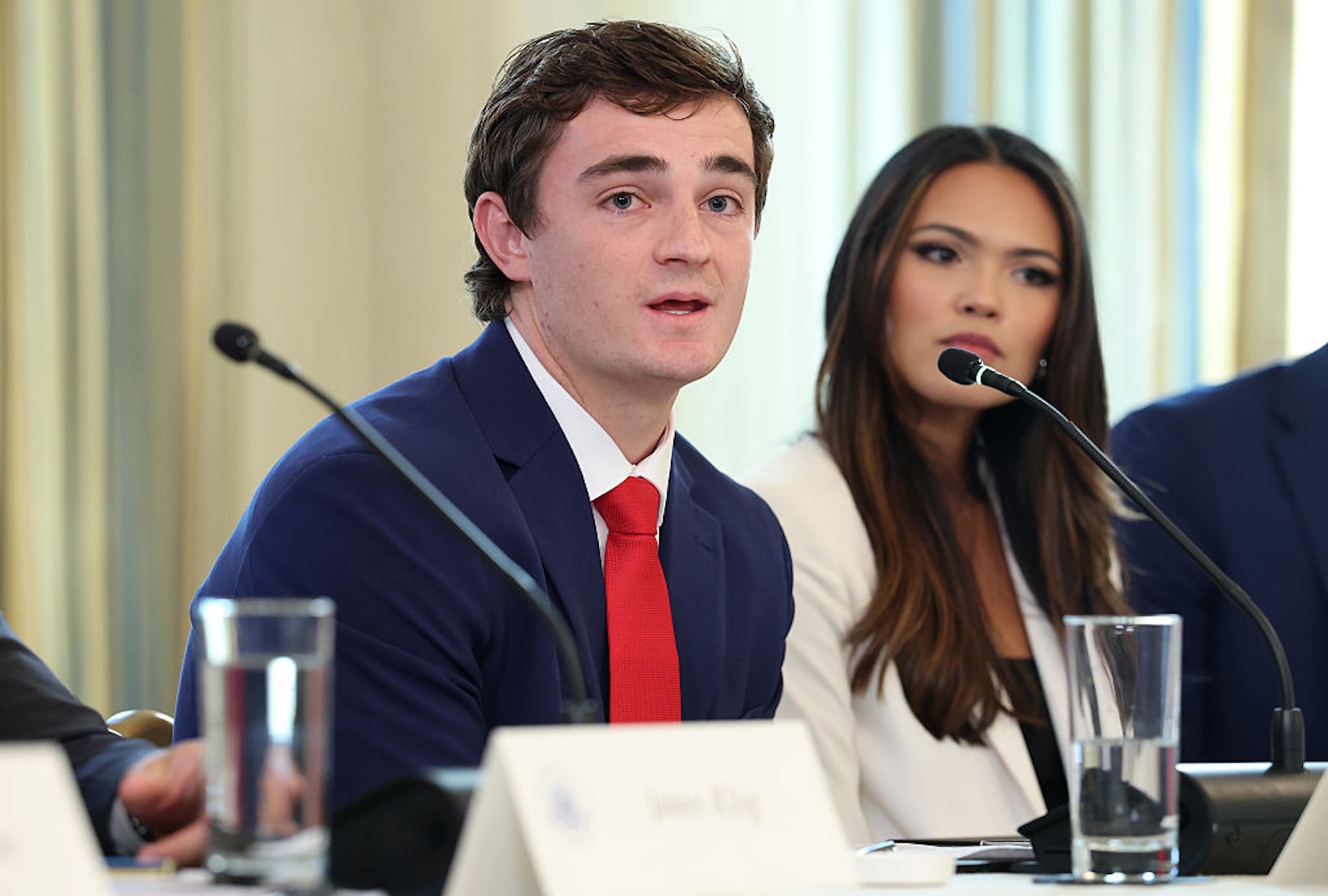
Senior WriterMAGA influencer Nick Shirley speaks during a roundtable discussion on antifa at the White House on Oct. 8, 2025. ( Anna Moneymaker/Getty Images)Nick Shirley really wants the world to know that he’s never had sex. The YouTuber who moved from “prank” videos to the more lucrative world of creating MAGA disinformation apparently believes that sexual inexperience is an armor against accusations that he’s a liar. “I’m a virgin. I don’t have sex with random girls. You’re not gonna catch me on those sexual allegation charges,” he rambled on “PBD Podcast,” insisting that he is “religious” and doesn’t “have any vices.”A deeper dig shows even more how ridiculous this situation is. Shirley has a history of dishonesty, which includes paying immigrant laborers to hold pro-Biden signs, clearly hoping voters would think they were self-motivated. In another video, he claimed Portland had “fallen” and “antifa” had taken “control of the city,” an unvarnished lie.
CNN verified that children were being dropped off at a day care center Shirley had targeted. The Minnesota Star Tribune visited the day cares in question and found, when they were allowed access, children playing and napping peacefully. CBS News reviewed security footage showing kids being dropped off at one targeted center. Others were indeed empty; they had gone out of business before Shirley filmed outside the buildings.
Shirley stands accused of lying for racist reasons, so his “but I’m a virgin” defense is irrational — at least on the surface. But it makes more sense, in a psychosexual way, in light of the right’s long-standing fear and loathing of day cares.
Shirley stands accused of lying for racist reasons, so his “but I’m a virgin” defense is irrational — at least on the surface. But it makes more sense, in a psychosexual way, in light of the right’s long-standing fear and loathing of day cares. After all, the scandal Shirley is exploiting isn’t really about day cares. It’s about a larger case in Minnesota of Feeding Our Future, a fraudulent food pantry that was run by Aimee Bock, a white woman who was convicted in March of cheating taxpayers out of nearly $250 million of pandemic funds. While Bock was the mastermind, other defendants in the case are Somali American. On Dec. 30, a federal judge cleared the way for the government to seize $5.2 million in assets from Bock.
If Shirley was only interested in building his hoax on that existing and very real case, he could have targeted anti-hunger charities for his fake sting. Instead, he went after day cares, which are only tangentially related insofar as they are — along with churches, mosques, schools and community centers — sites that were supposed to get assistance from the fraudsters but never received it.
These businesses were picked almost certainly because Shirley and his colleagues have tapped into the long-standing tendency of paranoid reactionaries to make day cares the subject of conspiracy theories. Along with birth control and abortion — whose providers are also smeared constantly with right-wing lies — day care is loathed on the right for allowing women to work instead of being financially dependent on a husband. In the 1980s, day care workers were accused of being Satanists. Now, during the MAGA era, the scapegoat for men’s fears of female independence has shifted from imaginary devil-worshippers to real immigrants. White women are implicitly accused of using immigrant labor as a cheat to avoid their god-given duty to quit work to stay home and raise babies. Vice President JD Vance has been especially loud with his belief that day care is pushing women away from their supposedly inherent desire to be housewives.
Want more Amanda Marcotte on politics? Sign up for her free newsletter, Standing Room Only, now also on YouTube or wherever you get your podcasts.
Vance almost certainly doesn’t believe his own narrative. For one thing, it’s illogical to believe women would think, “Gosh, I want nothing more than to stay at home, but if there’s a day care down the street, I guess I have to use it.” His own wife has been outspoken about how much she loved working at her law firm that offered on-site childcare — and how much she misses it. But Vance has apparently decided that the bulk of support for his 2028 presidential bid will be rooted in the world of extremely online, sexually dysfunctional misogynists that love shady influencers like Shirley. The vice president’s messaging strategy has long been focused on this loose conglomerate known as the “manosphere”: bitter divorced men, “incels” (involuntarily celibates) and devotees of the “red pill,” an ideology that holds that dating and marriage aren’t about love but about men tricking or forcing women into submission.
The manosphere isn’t just deeply misogynist; it’s also incredibly racist. For liberals taking a cursory glance into that world, it can be very confusing how MAGA men can somehow blame immigrants for their own dating woes. But in the cesspool of incoherent resentment that Vance is clearly absorbing, the alleged evils of feminism and immigration are seen as part of a larger “woke” conspiracy against the white man. Before he died, Turning Point USA founder Charlie Kirk often posted about how “who we actually can’t stand are angry, liberal, white women.” He would portray white women as idiots for not perceiving immigrants as a threat. “If woke is a mind virus,” he posted, “then white college indoctrinated women are the most susceptible hosts.” Influencers like LibsofTikTok hold up white women who resist mass deportations as selfish ninnies who just want to keep their babysitters.
Shirley has engaged in this rhetoric himself. “White liberal women tend to support the people that steal and rob from them,” he claimed in one post. Another was more ominous: “Liberal white womens [sic] logic and empathy will get them killed eventually.”
In this toxic stew of sexual resentment, misogyny and racism, it makes more sense that Shirley thinks his virginity is relevant. Anti-immigrant sentiment is woven into a larger MAGA narrative about expelling allegedly decadent and foreign influences. White male dominance, people like Shirley believe, can be restored by adhering to strict sexual and social mores prescribed by right-wing Christianity. Abstaining from sex until marriage is part of a larger program meant to produce male-dominated marriages, where wives are too busy with large broods of white children to hold jobs. Attacking Black immigrants at a day care center has powerful symbolic resonance; it’s seen as an important front in a war both to make America whiter and to restore white women to a submissive role in the home.
The irony is that Shirley’s diatribe about his sexual status only underscores how much the attack on the day cares is not, contrary to his claims, driven by a nonpartisan, disinterested desire to end fraud. That much was always obvious. Shirley loves Donald Trump, who is himself a convicted fraudster who continues to use his office to enrich himself in blatantly corrupt ways. Shirley has followed the president’s lead — he, too, has a long history of posting racist vitriol about immigrants.
But bringing his sexuality and views on gender relations into the discussion — when no one else has done so — suggests that those issues aren’t far from mind, either. The fixation on “purity” is a common fascist obsession, manifesting in backwards fantasies of racial and sexual purity. None of this has any relation to the real world where people of all races and genders are just trying to do their jobs, raise their children and live their lives.
Sen. Mark Kelly – “I’m Not Backing Down” | The Daily Show
Let’s talk about Trump, chess, Venezuela, Ajax….
THE HISTORY OF RELIGIOUS CONFLICT IN THE UNITED STATES: REVOLUTION TO SEPTEMBER 11TH
Roger sent this to me and I thought it was so grand and important that I want to share it before I shut down my blogging computer. Hugs
https://web.stanford.edu/class/e297a/The%20History%20of%20Religious%20Conflict.htm
Throughout its history, the United States has characteristically remained a country of two things: a country of immigrants, and a country of unmatched religious diversity. And yet when compared with the rest of the world – where these two very factors alone have so often engendered horrible religious wars and decades of enduring conflict – the history of religious conflict in the United States seems almost nonexistent.
That is not to say the United States has been immune to its share of conflict explicitly rooted in religion. This paper explores the various manifestations of religious conflict throughout the history of the United States, from the Revolutionary War to the attacks of September 11th and their fallout. A distinction is drawn between religious intolerance, which is not the focus of this paper, and outright religious persecution or violence. Similarly, the paper reflects efforts made to de-conflate religious conflict from ethnic and racial conflict, which has been much more prominent throughout the history of the United States. In examining the history of religious violence, intolerance, discrimination, and persecution in the United States, we arrive at some possible explanations for why the United States has seen such minimal religious conflict despite being so religiously diverse.
The Revolution
It has been said that the United States is a nation founded on religious conflict. The colonies were settled by those escaping religious persecution in Europe. There is even some evidence that religion played a major role in the American Revolution and that revolutionaries believed it was willed by God for the Americans to wage war against the British.[1]
As the Church of England was striving to establish one, uniform religion across the kingdom, colonial America was divided, each of the colonies being dominated by their own brand of Christianity. Due to the distance from England and the room in the colonies, many religions were able to establish themselves in America, colony by colony. For example, Anglicans, who conformed to the Church of England, populated Virginia. Massachusetts was home to the Puritans. Pennsylvania was full of Quakers. Baptists ruled in Rhode Island. And Roman Catholics found a haven in Maryland, where they could establish themselves amid the other colonists’ protestant majority. Each of these colonies maintained a distinct religious character and favored one religious denomination’s power.
The American colonists saw the revolution not only as a war for political independence, but to protect the religious diversity of the thirteen colonies. Put in other terms, it was a war for religious independence and freedom. To sever ties with Mother England would be to ensure that the various Christian denominations could co-exist on the American continent. The conflict was, in part, a conflict that pitted the various American religious denominations against the Church of England, who wanted to impose a uniform, Anglican religion on the colonies.
Early Religious Persecution
The period after the Revolutionary War saw a lot of infighting between the various states and Christian denominations. Virginia, which was home to the largest portion of Anglicans loyal to the Church of England, was the scene of notorious acts of religious persecution against Baptists and Presbyterians. Anglicans physically assaulted Baptists, bearing theological and social animosity. In 1771, a local Virginia sheriff yanked a Baptist preacher from the stage at his parish and beat him to the ground outside, where he also delivered twenty lashes with a horsewhip. Similarly, in 1778, Baptist ministers David Barrow and Edward Mintz were conducting services at the Mill Swamp Baptist Church in Portsmouth, Virginia.[2] As soon as the hymn was given out, a gang of men rushed the stage and grabbed the two ministers, took them to the nearby Nansemond River swamp, and dunked and held their heads in the mud until they nearly drowned to death.
The period during and soon after the Revolutionary War also saw abundant political manifestations of religious conflict. At the time, some states abolished churches, while supporting others, issued preaching licenses, and collected tax money to fund and establish state churches. Each state constitution differed in its policy on religious establishment, or state-supported religion. It would not be until well after the adoption of the Constitution of 1789 and the First Amendment religion clauses that the disestablishment for which the United States is so recognized became the de facto practice.
1800s
The early part of the 19th Century was relatively quiet in terms of religious conflict in America. The religious conflict that stands out in this period involves tensions between Catholics and Protestants, culminating in violence directed at Irish Catholic immigrants. The surge in immigration from Europe during the 19th Century coincided with and influx of Catholics and the rise of activist Protestantism in the U.S. As strong Protestant values permeated the country, immigrants who were Catholic also became viewed as outsiders and undemocratic. These views are separate from, but on top of, the harsh anti-Irish sentiment that also spread during the period.
In the 1830s and 1840s, anti-Catholic violence broke out in the Northeast and elsewhere. In 1835, one incident was ignited by a speaking tour by Lyman Beecher, who published Plea for the West, a book about a Catholic plot to take over the U.S. and impose Catholic rule. After Beecher’s speaking tour passed through Charlestown, Massachusetts, a mob set fire to the Ursuline convent and school.[3] In Philadelphia in 1844, pitched gun battles broke out between “native” Americans and mostly Irish Catholics. Martial law had to be declared in order to end the violence.[4]
The Mormon War, the Utah War
Around the same time as anti-Catholic violence broke out in the Northeast, another religious group was being chased out of the same area. The Mormons, who emerged after the 1830 discovery of The Book of Mormon, were a religious community chased out of New York, out of Ohio, out of Missouri, and out of Illinois, to Utah, where they finally settled.
In Illinois in 1839, the Mormons settled Nauvoo and built a thriving Mormon town there, complete with a large Mormon temple. In the short period of three years, the Mormons prospered, announced the doctrine of polygamy, and founder Joseph Smith announced his candidacy for president of the United States. Locals were intimidated and envious. Smith and his brother Hyrum were arrested on morals charges and held in jail. On June 27, 1844, an anti-Mormon mob attacked Nauvoo and burned it to the ground.[5] They also invaded the jail cells where Smith and his brother were being held, and executed them.
Shortly after the sacking of Nauvoo, Brigham Young announced his leadership of the Mormons and led them to Utah, where they flourished. In 1857, fears of a religious state of Mormons grew and the president ordered federal troops to enforce the installation of federal judges and a new non-Mormon governor. At some point in the interim, this is still a subject of debate, the infamous Mountain Meadow Massacre happened – in which local Mormons slaughtered a group of 120 California-bound pioneers who were openly hostile toward their religion and making threats to return from California to attack them.[6]
The massacre only fueled anti-Mormon sentiment. Tensions escalated. The Mormon army, also known as the Nauvoo Legion, was called out to respond to the imminent arrival of 2,000 U.S. Army troops. Salt Lake City was evacuated on standing orders to burn the city should an invasion occur. No violence was to break out, as attention was diverted to the Civil War.
As the federal government focused its energies on fighting the Civil War, legal sanctions and political oppression of the Mormons continued that virtually dissolved the church by 1887. It wasn’t until the 1890s, when the Mormons ended the practice of polygamy, that Utah finally achieved statehood in 1896.[7]
The Jewish Experience
At the end of the 1890s, the U.S. began seeing the first wave of anti-Semitism, just as the federal government began restricting immigration from Europe. While concentrations of Jews have lived in America since colonial times, they were largely tolerated and discriminated against in localized incidents. By the 1920s, immigration quotas had taken effect and limits on the basis of national origin. These quotas were not repealed during the Holocaust, even as Jewish refugees were fleeing Hitler’s Europe.
Between 1933 and 1939, the period of the Great Depression, anti-Semitic fervor reached heights never before seen or later seen in entire the history of the Jewish experience in America. In urban areas such as New York and Boston, Jews were violently attacked.[8] Most anti-Jewish sentiment was manifested in social and political discrimination. Assaults, propaganda and intimidation were mostly carried out by special societies, such as the Silver Shirts or the Ku Klux Klan.
Overall, the experience of Jews in America has been encouragingly free from the violent persecution seen elsewhere in the world. Indeed, racial and social intolerance persisted since the colonial days until the 1950s, as Jews were not allowed membership in country clubs, excluded from colleges, banned from practicing medicine, and from holding political office in many states. However, religious conflict rooted in anti-Semitism has been largely non-violent.
Hate Crimes as Religious Conflict
The incidents of violence against individual Jews that characterized the anti-Semitism of the Great Depression would have fallen under the category of religious hate crimes if the FBI, then known as the Bureau of Investigation, were collecting those statistics at the time. Despite the diversity of the United States, in all aspects such as race, national origin, religion and sexual orientation, the federal government (by way of the FBI) did not start keeping tabs on hate crimes until 1992. Religiously speaking, anti-Semitic hate crimes have always dominated the national hate crime statistics gathered by the FBI for the past ten years. However, the current numbers paint a changing landscape.
According to the ACLU, the U.S. is home to more than 1,500 religions and 360,000 religious centers.[9] Christianity has long dominated the country’s religious make-up, followed by Judaism. According to the latest statistics released by the Harvard University Religious Pluralism Project, Islam has surpassed Judaism and is the country’s Number Two religion.[10]
Following the terrorist attacks of September 11th, the FBI found that anti-Muslim sentiments spiked and verifiable, religiously motivated hate crimes against Muslims in the U.S. increased 1,600 percent in 2001 from the prior year.[11]
In fact, the FBI, which has tracked hate crimes since 1992, reports that Anti-Muslim hate crimes had previously been the second-least reported. But in 2001, they became the second-highest reported, second only to anti-Jewish hate crimes. It should be noted that these statistics are separate from crimes motivated against race, national origin or ethnicity – these are crimes against person and property in which religion was a motivating negative factor.
Conclusion
The U.S. has been fortunate in that it has not witnessed religious war and conflict of the scale seen in the Middle East and Europe. Although the number of different religions in the U.S. has steadily grown over the decades, this diversity has not let to conflict. Some propositions for why this may be:
The United States as a country of immigrants
This factor defuses historical and religious claims to territory, which are not as strong as they are in places such as the West Bank and Ireland. It also may explain a greater likelihood for a system of conflict to eventually resolve itself in favor of tolerance rather than further conflict, as each new group of immigrants to America has generally shared a story of persecution.
Constitutional protections and religious disestablishment
The American tradition of the separation of church and state cannot be overlooked in mediating and possibly preventing religious conflict to erupt. In many other parts of the world, religion is still highly influential and, in some cases, sponsored by the state. However, in a country with such religious diversity, religious disestablishment has proved necessary so that the government could not take sides in a religious conflict.
Diversity creates tolerance
The argument also exists that the immense diversity in and of itself has promoted tolerance among religions. Religious pluralism inspires attitudes that homogeneity is a natural part of the religious environment and that there is room for each religion to exist in America.
As the United States enters the 21st Century, these important factors will prove to be influential in the face of catastrophic events, and economic, social and political changes that challenge the level of religious tolerance the nation has maintained for over two centuries.
[1] Religion and the American Revolution. “Religion and the Founding of the American Republic.” Ed. James H. Huston. 1998. http://lcweb.loc.gov/exhibits/religion/rel03.html
[3] Encyclopedia of American Religious History, Revised Edition, Vol. II. “Religious violence.” Edward L. Queen II. Page 601. 2001.
[6] Emily Eakin. “Reopening a Mormon Murder Mystery.” The New York Times, section B, page 9, Oct. 12, 2002.
[8] “Antisemitism in the Depression Era (1933-1939),” Leonard Dinnerstein. Religion in American History, A reader. Page 413. 1998.
[9] “Religious Liberty.” American Civil Liberties Union. http://www.aclu.org/ReligiousLiberty/ReligiousLibertyMain.cfm
[10] “Geographic Distribution of Religious Centers in the U.S” Committee on the Study of Religion. Harvard University, Jan. 2002. http://www.plurarlism.org/resources/statistics/distribution.php
[11] “Foreword.” Department of Justice, Federal Bureau of Investigation. http://www.fbi.gov/ucr/01hate.pdf
 Scottie's Playtime