Governmental Overreach

Brendan Carr Isn’t Going to Stop Until Someone Makes Him

In the wake of Jimmy Kimmel’s suspension, experts say the FCC commissioner’s conduct is flatly unconstitutional. They also expect him to keep going.

In what has become an all-too-regular display from Brendan Carr, the Federal Communications Commission chairman used a podcast appearance Wednesday to flex his regulatory power. In this instance, he threatened action against broadcasters that refused to punish Jimmy Kimmel for remarks he made on his ABC show Monday night.

“We can do this the easy way or the hard way,” Carr said on former Turning Point USA contributor Benny Johnson’s podcast on Wednesday. “These companies can find ways to change conduct to take action, frankly, on Kimmel, or there’s going to be additional work for the FCC ahead.”

Since taking over the FCC at the beginning of the year, Carr has tested how far the agency can limit speech without ever quite formally censoring it. By leveraging his position as chairman, he has relied on informal threats and regulatory incentives to keep broadcasters in line with the Trump administration’s politics—and experts say Carr won’t end this campaign until someone stops him. For now, it’s not clear who’s even willing to try.

“He’ll push it until he’s stopped. Congress has been silent on this, and there hasn’t been a basis to get to court,” former FCC chair Tom Wheeler tells WIRED. “He’s been very artful in not making formal decisions that are appealable to the court, but instead having these informal, coercive activities that are not appealable, and so until Congress or the courts say he can’t, he’ll keep pushing.”

Over the past eight months, Carr—a formerly light-touch telecom regulator turned MAGA hardliner—has shown how far he’s willing to take this crusade. He has threatened to revoke broadcast licenses for outlets the administration sees as “distorting” news content, targeting Comcast outlets over news coverage of Kilmar Abrego Garcia’s deportation in April. He opened investigations into NPR and PBS underwriting announcements, alleging that they crossed into commercial advertising. Carr oversaw the merger between Paramount and Skydance and extracted concessions on CBS’s editorial work, pressuring the company to do away with its DEI policies and promise “viewpoint diversity” in coverage. (David Ellison, son of billionaire Trump supporter Larry Ellison, founded Skydance and became Paramount’s chair and chief executive officer following the merger.) At the same time, Donald Trump was suing CBS for having edited a 60 Minutes interview with Kamala Harris; after Paramount paid out $16 million to settle the suit, CBS said it would end Stephen Colbert’s show next spring.

“The FCC under Brendan Carr uses mergers and business interests of media companies as leverage to extract concessions, extract bribes, and extract censorship,” says Seth Stern, director of advocacy at the Freedom of the Press Foundation.

Carr did not immediately respond to a request for comment.

While Carr’s threats have chased social media companies and cable networks, they’ve hit companies with business before the FCC the hardest. Nexstar, which owns dozens of ABC affiliate networks, was one of the companies to pull Jimmy Kimmel Live! just hours after Carr’s Wednesday threat. The company is currently seeking approval from the FCC for a $6.2 billion deal to buy Tegna, which owns networks in major markets including Austin, Texas, and San Diego, California. Sinclair, another major broadcasting company, also relies on the FCC to periodically renew its licenses and allocate the company spectrum.

To Genevieve Lakier, a professor of law at the University of Chicago whose research focuses on free speech, Carr’s threats against ABC appear to be “a pretty clear-cut case of jawboning.” Jawboning refers to a type of informal coercion where government officials try to pressure private entities into suppressing or changing speech without using any actual formal legal action. Since jawboning is typically done in letters and private meetings, it rarely leaves a paper trail, making it notoriously difficult to challenge in court.

This Kimmel suspension is a little different, Lakier says. During the podcast appearance, Carr explicitly named his target, threatened regulatory action, and within a matter of hours the companies complied.

“The Supreme Court has made clear that that’s unconstitutional in all circumstances,” says Lakier. “You’re just not allowed to do that. There’s no balancing. There’s no justification. Absolutely no, no way may the government do that.”

Even if Carr’s threats amount to unconstitutional jawboning, though, stopping him could still prove difficult. If ABC sued, it would need to prove coercion—and however a suit went, filing one could risk additional regulatory retaliation down the line. If Kimmel were to sue, there’s no promise that he would get anything out of the suit even if he won, says Lakier, making it less likely for him to pursue legal action in the first place.

“There’s not much there for him except to establish that his rights were violated. But there is a lot of benefit for everyone else,” says Lakier. “This has received so much attention that it would be good if there could be, from now on, some mechanism for more oversight from the courts over what Carr is doing.”

Organizations like the the Freedom of the Press Foundation have sought novel means of limiting Carr’s power. In July, the FPF submitted a formal disciplinary complaint to the DC Bar’s Office of Disciplinary Counsel arguing that Carr violated its ethical rules, misrepresenting the law by suggesting the FCC has the ability to regulate editorial viewpoints. Without formal rulings, companies affected by Carr’s threats would be some of the only organizations with grounding to sue. At the same time, they have proven to be some of the least likely groups to pursue legal action over the last eight months.

In a statement on Thursday, House Democratic leadership wrote that Carr had “disgraced the office he holds by bullying ABC” and called on him to resign. They said they plan to “make sure the American people learn the truth, even if that requires the relentless unleashing of congressional subpoena power,” but did not outline any tangible ways to rein in Carr’s power.

“People need to get creative,” says Stern. “The old playbook is not built for this moment and the law only exists on paper when you’ve got someone like Brendan Carr in charge of enforcing it.”

This vacuum has left Carr free to push as far as he likes, and it has spooked experts over how far this precedent will travel. Established in the 1930s, the FCC was designed to operate as a neutral referee, but years of media consolidation have dramatically limited the number of companies controlling programming over broadcast, cable, and now streaming networks. Spectrum is a limited resource the FCC controls, giving the agency more direct control over the broadcast companies that rely on it than it has over cable or streaming services. This concentration makes them infinitely easier to pressure, benefitting the Trump administration, Carr, but also whoever might come next.

“If political tides turn, I don’t have confidence that the Democrats won’t also use them in an unconstitutional and improper matter,” says Stern. The Trump administration is “really setting up this world where every election cycle, assuming we still have elections in this country, the content of broadcast news might drastically shift depending on which political party controls the censorship office.”

Makena Kelly is a senior writer at WIRED focused on the intersection of politics, power, and technology. She writes the Politics Lab newsletter that helps you make sense of how the internet is shaping our political reality—sign up here. She was previously at The Verge, CQ Roll Call, and the … Read More
A Few Bits That Came Up On My Phone In The Past Coupla Days

Some George Carlin; I’m a huge fan:

==========

Don Lemon On The Street:

==========

Chelsea has a few free minutes for us:

What Always Happens, Explained

Politics / September 19, 2025

Threatening Vulnerable People Is No Way to Mourn Someone Who Was Murdered

Those who had nothing to do with the violence against Charlie Kirk are being menaced—just like always.

Elie Mystal

Charlie Kirk’s suspected murderer was a 22-year-old white guy from Utah, but in the week since he was shot, at least six Historically Black Colleges and Universities have been forced to cancel classes due to bomb threats made against their students and faculty. Columnist Karen Attiah got fired from The Washington Post. Representative Ilhan Omar was nearly censured. Countless Black people have been harassed and, worse, countless immigrants have been threatened with the possibility of deportation, all for insufficiently respecting the life and death of a white supremacist. 

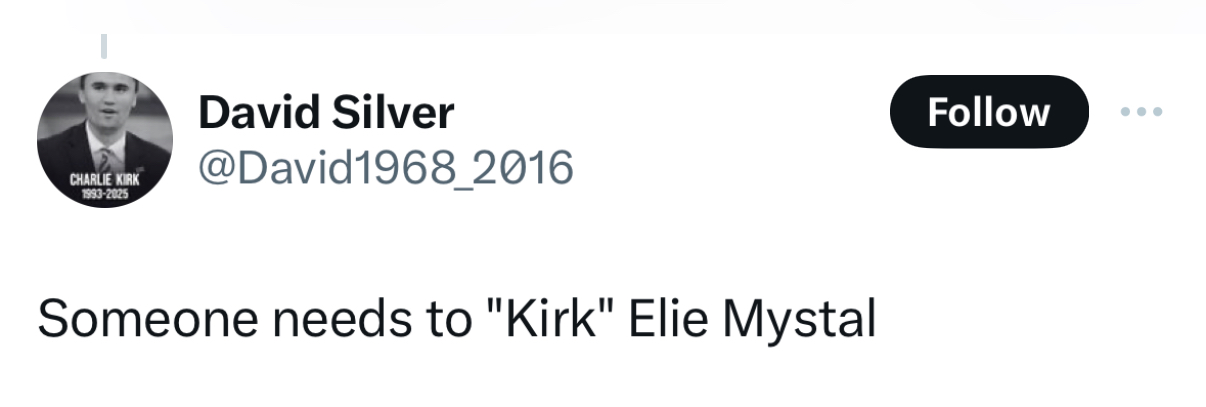
Charlie Kirk’s suspected murderer was, again, a 22-year-old white guy from Utah who, I’ll bet, does not own either of my books and has most likely never read a single word I have written over my nearly two decades of public life, but this is what my mentions on Elon Musk’s apartheid-curious platform have looked like for a week:

Not that we needed more evidence, but the past week has been Exhibit One that this country hates Black people, and will do everything it can to silence, harass, and even murder us. A white man killed another white man for reasons we still don’t know, with a gun I don’t think he should have had, but Black people are catching death threats. That doesn’t make sense, unless you understand how deeply racist this country is. Black people are being fired from jobs and harassed online for insufficiently venerating a white supremacist, and having the temerity to describe his beliefs in public. It’s as if we’re all being asked to say our name is “Toby” instead of Kunta Kinte while being informed that the beatings will continue until morale improves. The white-led government, and many white employers, white-owned sports leagues, white public intellectuals, and a non-zero number of Black assimilationists and assorted would-be overseers are largely playing along with this racist gaslighting, proving once again that Black people have few, if any, real allies.

Somebody who considers themselves a good-white-ally(™) is just about to type “not all white people” or “also Matt Dowd” or “look at what happened to Jimmy Kimmel” in response to this article, as if I give a shit. What’s happening to white folks is that they’re being made to feel like Black people are made to feel every freaking day. Whenever white people catch a cold, Black people catch the flu, but God forbid I do a bit of triage before handing out chicken soup and Sprite to white folks feeling a bit under the weather these days.

The same thing is happening to the trans community, and the LGBTQ community more broadly, because when Kirk wasn’t railing against Black people, he was trying to stamp the LGBTQ community out of existence.

At this point, I’m supposed to turn and analyze what makes white males violently erupt against vulnerable people who have nothing to do with their problems. I’m supposed to talk about white gun culture and how it inevitably leads to racial and cultural violence. I’m supposed to talk about how Trump and his white supremacist government have given the very worst people in this country permission to carry out violence against any person they don’t like, with the promise of pardons should they undertake violence that pleases him. I know I’m supposed to address these topics, because these are the questions that have been floating around my professional networks for a week.

But even addressing those questions recenters the conversation around white folks and whiteness. It’s asking, “Now why did the monkey throw its poop at that fellow?” before you secure soap and a shower for the person covered in feces. At the moment, I’m just a little too beset by threats against myself and even my mother to think deeply about why white people do this. Analyzing why young white men are so dangerous to me is an intellectual luxury I do not have right now. I’m just trying to survive America for another week. 

Luckily, after a fashion, I have some experience with this. This is not the first round of death threats I’ve gotten, and, unless they successfully kill me this time, it won’t be the last. I’ve been a Black man in the public eye for a while now, and you don’t get to be an old public Black person without developing a few coping mechanisms to keep you going. For a lot of people currently under threat, this is their first rodeo. There are, for instance, a number of staffers at The Nation who are for the first time having to live with what I live with every day, since the vice president went after our publication. There are folks who were never on the kind of violent watch lists Kirk created who now find themselves on the wrong end of the online rope. 

It is terrifying to be in the eye of violent white folks. You have to take them seriously when they say they want you to come to harm. I cannot promise that you, or I, will survive what they’ll do next, but here are some tips to make it through this current phase of white America.

  1. Stick Together

They cannot kill, fire, or silence all of us. The violent people are predators and if you look at every natural predator on this earth, their first move is always to separate their target from the herd.

People must resist the urge to say some people deserve to be harassed and menaced by the government and the online right, as if to distinguish the people who deserve death threats from those who are “doing it the right way.”

Silence in the face of white supremacy is complicity with white supremacy. If we all resolve to not stay silent, we become a truth-telling hydra. Every time the white wing gets one of us, there should be others ready to take our places. (snip-MORE-excellent information)

https://www.thenation.com/article/politics/black-people-threatened-after-assasination

Useful Info & Resource

Understanding the Legal Framework Governing a Shutdown

September 17, 2025 | By Sam Berger

The government funding deadline is fast approaching. With the Trump Administration’s continued efforts to impound and rescind funding, complicating Congress’s ability to reach an agreement on funding bills for the upcoming year, it is important to keep in mind the legal framework that governs a shutdown, and the limits a shutdown places on the executive branch.

This primer focuses on the activities that can (and cannot) legally continue during a shutdown; it does not address the impacts of a shutdown on government programs or the people who use them.

Critically, while the executive branch has some discretion as to what activities continue during a shutdown — and it is impossible to predict whether the Administration will take unlawful actions under the pretext of a shutdown[1] — a government shutdown does not provide the Administration any additional legal authority to fire federal employees, limit review of its actions by federal courts, or freeze funding once full-year appropriations are provided.

Activities That Can Continue During a Government Shutdown

Under the Antideficiency Act, agencies can neither spend, nor make commitments to spend, money without appropriations from Congress.[2]

Some activities continue during a shutdown because they are separately or already funded. For example, activities funded by multi-year or indefinite funding, such as disaster relief, continue, with payments made as normal. Likewise, if some appropriations bills have been enacted prior to a shutdown, activities funded by those enacted appropriations also continue (a scenario sometimes described as a “partial” government shutdown). The Administration has no legal authority to impound or freeze these funds.

Based on long-standing Department of Justice (DOJ) guidance, there are also a limited set of activities for which the federal government can make commitments to pay — though it still cannot make payments — during a shutdown[3]:

  • Activities expressly provided for in law to continue during a shutdown. Some laws expressly provide that certain activities can continue in the absence of appropriations, such as the Department of Defense’s “feed and forage” authority allowing it to obtain certain types of necessary supplies for military personnel.
  • Activities to protect against imminent threats to life or property. This includes activities related to law enforcement, national security, air traffic control, and federal prisons, among others.
  • Activities that are necessary to prevent significant damage to a funded program. For example, activities necessary to ensure Social Security payments (which themselves are funded under law) are made in a timely way can continue during a shutdown even if those activities themselves do not have funding.
  • Activities necessary to discharge the President’s constitutional duties. This includes, for example, the President’s Commander-in-Chief responsibilities.

Different administrations have interpreted these exceptions to apply more or less narrowly, meaning that the activities that continue during a shutdown have differed to some extent from administration to administration. The first Trump Administration took a more expansive view of the public services that should continue.[4] However, to date, a core set of services — such as defense, law enforcement, transportation safety, Social Security, and Medicare — have continued during every shutdown.

Executive Branch Restrictions During a Government Shutdown

While the executive branch has some latitude in what activities it continues during a government shutdown, there are clear limits on its actions.

If an activity is not funded, no actual payments can be made during a shutdown.

Even for activities that continue during a shutdown because they are subject to one of the exceptions described above, funding to pay for them cannot be provided without appropriations. The federal personnel required to work — including law enforcement, prison guards, and the staff that process Social Security benefits — only receive IOUs that will be paid when appropriations are enacted. Federal contractors required to work or provide services also go unpaid during the shutdown.

Under current law, when the shutdown ends all federal employees receive backpay for the time the government was shut down regardless of whether they were working on an activity that could continue during a shutdown or were forced to stop work until the shutdown ended. However, federal contractors do not receive pay for this time period except for any work they were required to perform during it.

Each branch of government determines which of its activities can legally continue during a shutdown.

Congress and the judiciary make their own independent determinations about what activities continue during a lapse. The executive branch is not involved in those determinations.

In prior shutdowns, the judiciary has had sufficient funding in the absence of new appropriations to continue normal operations for the duration of the shutdown. Courts have said in previous shutdowns that in the event they ran out of funding during a shutdown, they would continue to hear cases and otherwise fulfill their constitutional responsibilities.[5] Thus, litigants who are suing in federal court would be able to bring suits against the Administration during a shutdown.

When DOJ does not have funding during a shutdown, its lawyers may request extensions from courts for filing deadlines and other procedural steps. Individual courts have the discretion to determine whether to provide such extensions, and courts have both granted and denied such requests depending on the circumstances.

A shutdown would not provide the Administration with any additional legal authority to engage in widespread firing of federal employees.

A temporary lapse in funding does not provide grounds for an agency to fire employees. In addition, during a shutdown most agencies will not be able to legally conduct personnel actions unrelated to the shutdown itself because their HR departments will not be funded and these types of actions do not fall under any of the available exceptions.[6]

A shutdown would not impact the Administration’s legal obligations to spend money once full-year appropriations are provided.

While many activities would cease during a shutdown because of a lack of funding, the shutdown would not provide the Administration with any authority to impound or freeze funds once appropriations are provided.

While this primer focuses on the legal framework that governs during a shutdown, the Administration has shown itself willing to take actions that are inconsistent with the law, which presents major challenges for the country at all times, not just during a shutdown.

Topics:  Federal BudgetBudget Process

End Notes

[1] Sam Berger, “Trump is ignoring the law to keep the shutdown from causing him political pain,” The Washington Post, January 15, 2019, https://www.washingtonpost.com/outlook/2019/01/15/trump-is-ignoring-law-keep-shutdown-causing-him-political-pain/.

[2] Government Accountability Office, “Antideficiency Act,” https://www.gao.gov/legal/appropriations-law/resources.

[3] Walter Dellinger, “Government Operations in the Event of a Lapse in Appropriations,” Justice Department Office of Legal Counsel, August 16, 1995, https://www.justice.gov/sites/default/files/olc/opinions/attachments/2014/11/10/1995-08-16-lapse-in-appropriations.htm.

[4] Juliet Linderman, “Selective shutdown? Trump tries to blunt impact, takes heat,” Associated Press, January 13, 2019, https://apnews.com/article/66b50739f4b84063a2ff56dff3156712.

[5] United States Courts, “Judiciary Has Funds to Operate Through Jan. 31,” January 22, 2019, https://www.uscourts.gov/data-news/judiciary-news/2019/01/22/judiciary-has-funds-operate-through-jan-31

[6] Office of Personnel Management, “Guidance for Shutdown Furloughs,” January 2024, https://www.opm.gov/policy-data-oversight/pay-leave/furlough-guidance/guidance-for-shutdown-furloughs.pdf.

Good News! Get On The Phone-

Bipartisan bill seeks to reinstate national suicide hotline for LGBTQ+ youth

Sep 17, 2025

Orion Rummler

This story was originally reported by Orion Rummler of The 19th. Meet Orion and read more of his reporting on gender, politics and policy.

If you or a loved one are in crisis, please call or text 988 or text HOME to 741741 to connect with a live volunteer crisis counselor.

Sens. Tammy Baldwin, a Democrat, and Lisa Murkowski, a Republican, introduced a bipartisan bill on Wednesday to re-establish national emergency suicide prevention services for LGBTQ+ youth — which have been stripped by the Trump administration at a time when the vulnerable group needs it most. 

In July, the Trump administration terminated the 988 hotline’s LGBTQ+ services, which connected young people in crisis with counselors trained in supporting LGBTQ+ youth. This new bill, backed by the LGBTQ+ youth suicide prevention organization Trevor Project as well as the American Foundation for Suicide Prevention, would modify the Public Health Service Act to reinstate those services and require the Secretary of Health and Human Services to maintain them. The bill now moves to committee.

The Trevor Project estimates that more than 1.8 million LGBTQ+ young people seriously consider suicide each year in the United States, as they face high rates of bullying, assault and discrimination. And when the 2024 presidential race was called for Donald Trump, calls and texts to the Trevor Project’s own crisis hotlines spiked by 700 percent, as LGBTQ+ youth felt afraid about the outcome of the election. 

“Given that LGBTQ+ youth are more than four times as likely to attempt suicide than their peers, the need for these services remains pressing,” said Jaymes Black, CEO of The Trevor Project, in a statement. “This is not about politics, or identity; this is about doing what is best to support our country’s highest risk populations — and save young people’s lives nationwide.”

During his first term in 2020, President Trump signed a bipartisan law to create 988 as a more accessible resource for mental health emergencies. The free hotline launched in July 2022. Since then, millions of people in crisis have turned to 988. And nearly 1.5 million of those calls, texts and chats were sent by young Americans seeking specialized LGBTQ+ services. 

“We are in the middle of a mental health crisis, and the 988 lifeline saves lives, plain and simple,” said Baldwin, who wrote the original legislation to create the 988 hotline. Cutting funds for specialized services within 988 puts the lifeline in jeopardy, she said in a statement. 

“There is absolutely no good reason that Donald Trump took away this specialized help for our LGBTQ youth. Mental health does not see partisan lines or geography,” the Wisconsin Democrat added.

Rest In Peace, Robert Redford

I love all his work, including boosting the indies, and preservation/conservation of U.S. natural resources. I can’t pick a favorite, but the first movie I saw with Robert Redford in it was “Inside Daisy Clover.” He was a genius in that, and in all that he did. This is a pleasant tribute. (And Newman’s Own products are actually high quality, and quite good; beloved by both human and pet.🌞)

Robert Redford playfully mocked his late friend Paul Newman in this delightful resurfaced clip

“I love how he’s teasing his friend even beyond the grave.”

Cecily Knobler

Robert Redford, Paul Newman, icons, movies

commons.wikimedia.org

A photo of Robert Redford.

Robert Redford was many things to many people: husband, father, heartthrob, Oscar-winning actor, trailblazer. But to fellow actor Paul Newman, he was both co-star and dear friend.

When Newman passed away in 2008, Redford wrote a touching tribute to him for Time Magazine.

“I first met Paul Newman in 1968, when George Roy Hill, the director of Butch Cassidy and the Sundance Kid, introduced us in New York City,” Redford wrote. “When the studio didn’t want me for the film–it wanted somebody as well known as Paul–he stood up for me. I don’t know how many people would have done that; they would have listened to their agents or the studio powers.”

One of their most powerful connections was laughter. “Whenever he’d make a mistake on set, he would enjoy it more than anybody,” Redford wrote. “I’d look at him, and he’d look at me, and I’d say, ‘You’re not fooling anybody. You’re not staring at me intensely; you’ve lost your line.’ And he’d roar with laughter.”

Redford shared their heartfelt pranks: “We played lots of pranks on each other. I used to race cars, and after he took this rare Porsche I owned for a drive, he began to get into racing. He had incredible reflexes, and he got really good, but he talked so much about it that I got sick of it. So I had a beaten-up Porsche shell delivered to his porch for his 50th birthday. He never said anything, but not long after, I found a crate of molten metal delivered to the living room of my (rented) house. It dented the floor. I then had it turned into a really ugly sculpture and dropped it into his garden. To this day, neither one of us has ever mentioned it.”

View this post on Instagram

A post shared by Kevin McCarthy (@kevinmccarthytv)

So it wasn’t surprising that even after Newman died, Redford would lovingly tease him. In a now resurfaced clip from the Pete’s Dragon press junket in 2016, film critic Kevin McCarthy compliments Redford on his performance in Captain America: Winter Soldier. He says, “There’s a moment in that movie where you walk up to your fridge and you open it up – and in your fridge is Newman’s Own spaghetti sauce.” Redford gives his trademark sly smile.

So it wasn’t surprising that even after Newman died, Redford would lovingly tease him. In a now resurfaced clip from the Pete’s Dragon press junket in 2016, film critic Kevin McCarthy compliments Redford on his performance in Captain America: Winter Soldier. He says, “There’s a moment in that movie where you walk up to your fridge and you open it up – and in your fridge is Newman’s Own spaghetti sauce.” Redford gives his trademark sly smile.

“Have you ever gone out and purchased Newman’s Own, like salad dressing?” McCarthy asks. Again Redford smiles and jokes, “No. Are you kidding? No, I like good food.” His face continues to brighten on the topic.

Redford adds, “Ready for a funny story? My wife and I were in a restaurant in Napa Valley and there was a table next to us of about seven people. And they kept looking over and commenting. And I thought, ‘We’re not gonna be left alone, they’re gonna come over and bug me’ and so forth. And sure enough, this guy comes up from the table and says ‘I’m sorry, I hate to interrupt. We’re all here and we are such fans. I just wanted to tell you how much we love your work.’ And I said ‘Well thank you.’ And he said, ‘And we love your salad dressing.'”

McCarthy laughs, then confirms, “They thought you were Paul Newman? Did you correct him or did you let it go?” Redford dryly, without missing a beat, says, “No. I was so stunned, I just stared into space for a while. But it was a great moment.”

Commenters point out how special their friendship was. “I love how he’s teasing his friend even beyond the grave,” one wrote. “I like to imagine that in that moment he knew Paul heard that comment and smiled.”

McCarthy goes on to talk about the magic of Pete’s Dragon and how it changed Redford’s character’s worldview. He asked, “Do you have something like that in your own life? Something that magical that happened that essentially changed the way you saw life?”

Redford answers quickly. “I did.” He describes being taken to the library as a child and says of the children’s books he read, “All the stories in the children’s section were about a life bigger than the one you were living in. And I got really taken with that. And the idea of fantasy. The idea of seeing a world larger than your own is where the magic was.”

View this post on Instagram

A post shared by Robert Redford Daily (@robertredforddaily)

Tributes to Redford are flooding in after news of his death. Director Ron Howard took to X to write, “RIP and thank you Robert Redford, a tremendously influential cultural figure for the creative choices made as an actor/producer/director. And for launching the Sundance Film Festival, which supercharged America’s Independent Film movement. Artistic game changer.”

Governor Spencer Cox of Utah, where Redford spent many cherished years until his passing, wrote on X, “Decades ago, Robert Redford came to Utah and fell in love with the place. He cherished our landscapes and built a legacy that made Utah a home for storytelling and creativity. Through Sundance and his devotion to conservation, he shared Utah with the world.”

Shoemakers Organize, & Women Win, in Peace & Justice History for 9/18

October 18, 1648

I. Marc Carlson  
The Shoemakers Guild of Boston became the first labor union in the American colonies. 
Labor organization in colonial times 
October 18, 1929
The Persons Case, a legal milestone in Canada, was decided.
Five women from Alberta, later known as the Famous Five, asked the Supreme Court of Canada to rule on the legal status of women.
Some decisions of Magistrate Emily Murphy had been challenged on the basis that she was not a legal person, and she was a candidate for appointment to the Canadian Senate. After the Supreme Court ruled against them, they appealed to the British Privy Council.The Privy Council found for the women on this day (eight years after the case began and eleven years after women received the federal vote), declaring that women were persons under the law. October 18 has since been celebrated as Persons Day in Canada, and October as Women’s History Month.


Sculpture by Barbara Paterson of the Famous Five in Ottawa, first on Parliament Hill to honor women
The other women activists in the Famous Five: Henrietta Muir Edwards, Nellie McClung, Louise McKinney, and Irene Parlby.
The Persons Case 

https://www.peacebuttons.info/E-News/peacehistoryoctober.htm#october18

Clips about the democratic party and the leaders of the party from The Majority Report.

Clips from The Majority Report on the rights accusations about Charlie Kirks killer.

From CBPP re Food Security

Research Note: Nearly 2 Million Young Children in the U.S. Lived in Food-Insecure Households in 2023

September 15, 2025

| By Joseph Llobrera and Luis Nuñez

Food is an essential human need, and even more so for infants and toddlers during the critical early months of rapid growth and development. The United States has the resources to ensure everyone has enough to eat. Yet millions of people across the U.S. experience food insecurity, meaning they struggle to afford enough food for an active, healthy life year-round. In 2023, the most recent data available, 33.6 million adults and 13.8 million children — including nearly 2 million children under 3 years old — lived in food-insecure households, meaning more than 1 in 8 households (13.5 percent) in the U.S. had difficulty acquiring food due to lack of resources.[1]

Millions of Children in Households Struggling to Afford the Basics
Figure 1

Households with young children are more likely to experience food insecurity. More than 1 in 7 (15.5 percent) households with infants and toddlers under 3 were food insecure in 2023, compared to 11.9 percent of households without children and 13.5 percent of all households. Nationally, more than 1 in 6 (17.1 percent) children under 3 lived in food-insecure households in 2023 and this share varies across states. (See Table 1.) These shares also vary by race and ethnicity, with children under 3 in American Indian or Alaska Native (30.3 percent), Hawaiian or Pacific Islander (26.3), Black (25.9), and Hispanic (22.4) households more likely to live in food-insecure households than those in Asian (5.5) or white (10.9) households.[2]

Roughly half of the children under age 3 who lived in food-insecure households didn’t experience food insecurity themselves, but the adults in those households were food insecure. Parents often find ways to maintain normal meal patterns for their children, even when they are food insecure themselves; these families often face other challenges as a result of their precarious financial circumstances. And in many households, food insecurity among children is so severe that caregivers report that children were hungry, skipped a meal, or did not eat for a whole day because there was not enough money for food.

Children are especially vulnerable to poverty, financial strain, and hardship. For infants and young children, the lack of access to good nutrition can lead to less favorable life-long outcomes. Caregivers’ struggles paying for food and other bills are linked to worse child outcomes.[3] Material hardship such as the lack of food also increases the risk for child welfare involvement due to neglect and abuse.[4] There is growing awareness among researchers that the consequences of adversity — poverty, abuse or neglect, parental substance use disorder or mental illness, housing instability, and exposure to violence — during the early years of life can extend well beyond childhood and affect people’s physical, mental, and economic well-being as adults.[5]

Conversely, when public policies provide economic security for their families, children tend to have better educational, health, and behavioral outcomes.[6]

Positive Health and Well-Being Effects of SNAP and WIC Last a Lifetime

The Supplemental Nutrition Assistance Program (SNAP) delivers more nutrition assistance to low-income children than any other federal program, making it the nation’s largest child nutrition program. In 2024, SNAP helped about 16 million children each month — about 1 in 5 U.S. children — including 2.8 million children under the age of 3.

While SNAP provides only a modest benefit — just $6.20 on average per person per day — it forms a critical foundation for the health and well-being of children in the U.S., lifting millions of families and their children out of poverty and improving food security. Food insecurity among children fell by roughly a third after their families received SNAP benefits for six months, a USDA study found.[7]

For young children in particular, SNAP’s benefits last a lifetime. Studies have found children have improved birth outcomes and better health, education, and employment outcomes as adults if they had SNAP access during early childhood or if their parent had SNAP access during pregnancy.[8] Access to SNAP among families with children is associated with reductions in child maltreatment reports and child welfare involvement.[9] Emerging evidence also suggests that SNAP helps decrease decades-long racial inequities in food security, reducing the gap between white households and Black and Hispanic households, who are more likely to experience food insecurity because of starkly unequal opportunities and outcomes in education, employment, health, and housing.[10]

The federally funded WIC program — more formally known as the Special Supplemental Nutrition Program for Women, Infants, and Children — also improves lifetime health for low-income pregnant and postpartum parents, their infants, and young children. Among other health and developmental improvements, WIC participation is associated with reduced risk of premature birth, low birthweight, and infant mortality. This is especially important because pregnancy-related complications and mortality, as well as infant mortality, are higher for families of color than for white families, again due to unequal access to health care and broader inequities in health, economic, and other systems for people of color.

Despite these benefits, only about half of all people eligible for WIC were enrolled in 2022. Less than half (46 percent) of eligible pregnant parents participated in WIC. Only 64.1 percent of eligible infants and children under the age of 3 participated.[11] And participation declines as children grow older. While nearly 4 in 5 (78.4 percent) infants eligible for WIC participated in the program in 2022, the rate drops to 65 percent, 50 percent, 44 percent, and 25 percent among children 1 to 4 years old, respectively.[12]

There are many opportunities for state agencies to reach more eligible families with low incomes, and these efforts are showing promise, with take-up and participation increasing in recent years. While data on WIC coverage rates for 2023 and 2024 are not yet available, nationwide average monthly participation increased by 7.1 percent between fiscal years 2022 and 2024, suggesting that coverage rates may have increased modestly.[13]

Increasing WIC take-up across the board — and for pregnant parents of color and their infants in particular — can be an important part of a strategy to improve pregnancy-related and child health, mitigate the large pregnancy-related health disparities affecting these communities, and advance racial equity in other aspects of pregnancy-related and child health and food security.[14]

Megabill Cuts Threaten Access to Nutrition Assistance

The harmful Republican megabill, H.R. 1, enacted on July 4, 2025, will dramatically raise costs and reduce food assistance for millions of people by cutting federal funding for SNAP by $187 billion (about 20 percent) through 2034, the largest cut to SNAP in history. These cuts will increase poverty, food insecurity, and hunger, including among children.

The bill includes a major structural change that will cut billions in federal funding for most states’ basic food benefits, with a new requirement that most states will have to pay between 5 and 15 percent of SNAP benefits. This amounts to billions of dollars each year that states across the country would now be required to pay. If a state can’t or won’t make up for some or all of these massive federal cuts with tax increases or spending cuts elsewhere in its budget, it will have to cut its SNAP program or it could opt out of the program altogether, terminating SNAP food assistance entirely in the state, including to households with young children.

If children lose SNAP, they will also experience harmful ripple effects in other child nutrition programs, such as free school meals and summer EBT, due to the loss of automatic eligibility that comes from receiving SNAP. To make up for the federal cuts and avoid cutting nutrition assistance as well as other priorities affecting young children, such as health care or education, state policymakers will need to either raise new revenue or rollback recent tax cuts to raise the funds needed to prevent harmful cuts.

TABLE 1
Nearly 2 Million Children Under 3 Years Old Lived in Food-Insecure Households, Thousands Across Every State
 Children Under 3 Years Old in Food-Insecure Households
StateNumberShare
Alabama38,00021%
Alaska5,00016%
Arizona55,00023%
Arkansas21,00020%
California172,00013%
Colorado27,00014%
Connecticut17,00015%
Delaware5,00016%
District of Columbia3,00011%
Florida102,00016%
Georgia60,00016%
Hawai‘i6,00013%
Idaho14,00019%
Illinois45,00010%
Indiana45,00017%
Iowa15,00012%
Kansas16,00014%
Kentucky39,00025%
Louisiana35,00020%
Maine8,00021%
Maryland28,00012%
Massachusetts25,00012%
Michigan63,00019%
Minnesota32,00014%
Mississippi21,00020%
Missouri38,00017%
Montana5,00014%
Nebraska15,00019%
Nevada18,00018%
New HampshireNANA
New Jersey35,00013%
New Mexico16,00022%
New York95,00014%
North Carolina67,00018%
North Dakota6,00017%
Ohio59,00014%
Oklahoma29,00020%
Oregon19,00015%
Pennsylvania58,00016%
Rhode IslandNANA
South Carolina28,00016%
South Dakota5,00014%
Tennessee34,00014%
Texas237,00019%
Utah23,00015%
VermontNANA
Virginia36,00011%
Washington36,00013%
West Virginia11,00018%
Wisconsin27,00015%
Wyoming5,00023%
Total1,808,00016%

Note: Sum does not equal total due to rounding. Counts are rounded to the nearest 1,000, and shares to the nearest whole number. “NA” refers to states whose sample size was too small to calculate reliable estimates. These estimates rely on ten years of data due to small sample sizes in many states. However, for the 13 states that had large enough sample sizes, their five-year estimates of the share of children under 3 in food-insecure households were similar to the ten-year estimates presented here.
Source: CBPP analysis of 2014-2023 Current Population Survey Food Security Supplement

Topics: Food Assistance