This person Same is interviewing is from the Cato Institute. Sam and David talk about the bigotry and attempt to purify the country of non-white people. tRump and his racist administration claim to want to remove 100 million from the US. There is no where near that number of undocumented people in the country. That number is almost 1/3 of the US population. Undocumented immigrants were estimated at 14 million in 2023 at the highest. So where are the rest of these people coming from? Legal documented immigrants and non-white citizens born in the US. That is why they are rounding up brown people who immigrated here legally and why they are trying so hard to end birth right citizenship. The goal has become clear and it is scary to me. To cement the white majority for as long as possible and stop the slow decline of the white majority / rize of minority demographics. Stephen Miller and the other racists in tRump administration want an apartheid state like the former South African one was. They want no rights for non-whites. They want no non-whites in positions of authority. The administration is going after businesses and higher education for not prioritizing whites over any other group. They feel no white male is less qualified than any non-white. If a non-white person scored 95 and the white person scored 75, these racists feel the white person is still more qualified because of their skin color. The racists feel the only DEI that should be allowed is the promotion of white males over everyone else. Hugs
The game plan is clear and was used to accomplish the genocide of the LGBTQ+ from society in Russia. Attack the most vulnerable and smallest members of the LGBTQ+ trans people in the name of saving the most vulnerable, who are the little children espcailly little girls / daughters. Every study proves that the ones in real danger or under threat are not the kids but the trans people. Then use the momentum and rising bigotry to remove all rights and equality from the rest of the LGBQ+ based on the same lies. End goal is to create a straight cis country where the Christian white male is making the country safe / regressive enough for their bigoted view of Jesus to feel comfortable enough to return and pat them on their heads. Hugs
The Idaho Senate has widely passed a bill that would fine local and state governments for flying flags that aren’t on the Legislature’s pre-approved list.
The bill’s House sponsor, Rep. Ted Hill, an Eagle Republican, has said House Bill 561 is meant to target the city of Boise for flying an LGBTQ+ pride flag. Boise’s City Council voted to declare the pride flag and the organ donor flag as official flags, in an apparent move to work around the Legislature’s flag ban law passed last year.
The bill would add a $2,000 daily fine, per offending flag, to the flag ban law from last year, which lacked an enforcement process. The bill widely passed the House earlier this month. But since the Senate amended the bill, it must return to the House before it would go to Gov. Brad Little for final consideration.
Rep. Ted Hill [photo] appeared here yesterday for his successful bill that criminalizes using the “wrong” bathroom. Violating that law would be a misdemeanor punishable by up to one year in prison. A second offense within five years would be a felony, carrying up to a five-year prison sentence.
Hill appeared here in 2024 for his successful bill banning teachers from referring to students with their preferred pronouns.
Earlier this month, the Idaho House passed a resolution to petition the US Supreme Court on overturning Obergefell.
In February, the Idaho House advanced a bill to overturn all local LGBTQ rights ordinances statewide. Thirteen Idaho cities and counties, including Boise and its home county, have such laws on the books.
Project 2025 was very clear. The goal is to remove all representation of LGBTQ+ people from society. Pride flags are determined to be political incitement and agitation; media representation and books with even an LGBTQ+ character are called sexualizing children while the same with straight kids is not, and letting a child express how they deeply feel inside by letting them change their hairstyle and clothing is called child abuse while doing the discredited / harmful conversion therapy to force a person of any age to be straight and cis is considered to be healthy for the child. Lies are spread constantly about puberty blockers by people who misrepresent what these medical studies show or only claim in fake medical studies that have no peer reviewed status by medical personnel in that field of study. The goal is to do what Russia, Hungary, and several other highly religious authoritarian countries have done, which is to wipe the existence of anything not straight and not cis from being. I don’t know if this is due to their being highly religious and wanting to force everyone in the country to live by their church doctrines or if they just are straight / cis so they don’t think if they don’t feel it that it can’t be true. I ran into that decades ago as a gay man with straight people claiming everyone was straight because they were and that was normal, but some people choose to be weird deviants and have bad types of sex. But if you ask them when they chose to be straight they think it is a stupid question as they never chose; they just were. Clips below. Hugs
“They go in the bathroom they’re supposed to, they upset people. If they go in the one that they now look like, they’re breaking the law, which could include pretty severe penalties” Guthrie told senators. “ … We seem to be really focused on this space and ignoring the fact that there are people that are just like us, human beings, just like us. What are they supposed to do?”
‘Do I feel like going to jail today, or do I feel like being attacked?’ trans man testifies
The bill builds on a wave of anti-LGTBQ+ bills that the Legislature and the governor have approved in recent years.
“Over the last several years, legislators have gone from refusing to protect us to actively targeting us,” Nikson Mathews, who serves as chair of the Idaho Democratic Queer Caucus, said at a news conference in February.
“Every single day when I’m out in public, I have to decide: Do I feel like going to jail today, or do I feel like being attacked,” Mathews told lawmakers.
A bathroom sign as seen on March 16, 2026, at the State Capitol Building in Boise. (Photo by Pat Sutphin for the Idaho Capital Sun)
The Idaho Legislature widely approved a bill that would criminalize “willfully” entering public and government bathrooms and changing rooms designated for another sex.
The bill — which heads to Gov. Brad Little for final consideration — would effectively block transgender people from using their preferred public bathrooms in Idaho, expanding on the state’s transgender bathroom ban in public schools.
House Bill 752 would create criminal misdemeanor and felony charges for people who “knowingly and willfully” enter a bathroom or changing room designated for the opposite sex, with some exceptions. The bill would apply in government-owned buildings and places of public accommodations, like private businesses.
A first offense would carry a misdemeanor, punishable by up to one year in prison. A second offense within five years would be a felony, punishable by up to five years in prison.
Only three states — Utah, Florida and Kansas — have criminal bans on trans people using bathrooms that align with their gender identity, according to the Movement Advancement Project, an LGBTQ+ advocacy group.
In a statement, Planned Parenthood Alliance Advocates — Idaho called the bill “the most extreme anti-transgender bathroom ban in the nation.”
One Republican opposed the bill in the Senate
In the Idaho Senate, the bill passed on a near-party line 28-7 vote Friday, with all six Democrats opposing. One Republican, Sen. Jim Guthrie, from McCammon, broke with Republicans support of the bill.
He called legislation like it “harmful.”
“They go in the bathroom they’re supposed to, they upset people. If they go in the one that they now look like, they’re breaking the law, which could include pretty severe penalties” Guthrie told senators. “ … We seem to be really focused on this space and ignoring the fact that there are people that are just like us, human beings, just like us. What are they supposed to do?”
Idaho Sen. Ben Toews, R-Coeur d’Alene, walks through the halls at the State Capitol building on Jan. 9, 2023. (Otto Kitsinger for Idaho Capital Sun)
Bill sponsor Sen. Ben Toews, R-Coeur d’Alene, told senators that the bill protects “common sense realities.”
“The Legislature has a fundamental duty to protect the bodily privacy and safety of Idaho citizens,” Toews said. “House Bill 752 provides a clear, proactive tool to secure sex-separated private spaces in our state, while accommodating common-sense realities.”
Once the bill is transmitted to Little, he has five days to decide on it. He has three options: sign it into law, veto it, or allow it to become law without his signature.
In the House, the bill passed on a 54-15 vote earlier this month, with six Republicans joining the House’s nine Democrats in opposition.
‘Do I feel like going to jail today, or do I feel like being attacked?’ trans man testifies
The bill builds on a wave of anti-LGTBQ+ bills that the Legislature and the governor have approved in recent years.
And for more than a decade, efforts to add anti-discrimination protections for LGBTQ+ people to state law have failed.
“Over the last several years, legislators have gone from refusing to protect us to actively targeting us,” Nikson Mathews, who serves as chair of the Idaho Democratic Queer Caucus, said at a news conference in February.
Mathews, a trans man with a beard, told a House committee earlier this year that the bathroom bill would force him to use the women’s restroom.
“Every single day when I’m out in public, I have to decide: Do I feel like going to jail today, or do I feel like being attacked,” Mathews told lawmakers.
A 2025 study by the UCLA School of Law’s Williams Institute found “no evidence of increased harms to people who are not transgender when transgender people are allowed to use restrooms and other gendered facilities according to their identity.” But when trans people are refused access to facilities that align with their gender, the study found that trans people report verbal harassment and physical assault.
Bill is about discrimination, Democratic senator says
Sen. Ron Taylor, a Democrat from Hailey, said the bill is about discrimination. He said constituents told him that they’d move out of Idaho if it passed — because it would throw their transgender children in jail.
Idaho state Sen. Ron Taylor, D-Hailey, enters the House of Representatives chamber for the governor’s State of the State Address on Jan. 12, 2026, at the State Capitol in Boise. (Photo by Pat Sutphin for the Idaho Capital Sun)
“Now maybe that’s what some of us want, is to chase a population that’s marginalized out of Idaho,” Taylor said. “But that’s not Idaho. Idaho was founded by a population that was marginalized.”
Sen. Brian Lenney, a Republican from Nampa, said the bill is about keeping women and girls safe from having men in their spaces.
“Trans women aren’t women,” said Sen. Joshua Kohl, a Republican from Twin Falls. “They’re men. And they need to be treated as such.”
Sen. Jim Woodward, R-Sagle, listens to proceedings during the Joint Finance-Appropriations Committee meeting on Jan. 13, 2026, at the State Capitol Building in Boise. (Photo by Pat Sutphin for the Idaho Capital Sun)
Sen. Jim Woodward, a Republican from Sagle in North Idaho, said the bill is largely borne out of an event where he said a man was found in a women’s locker room in a YMCA in Sandpoint. He said he’d vote for the bill, but he had some reservations.
“What comes next and how much further do we venture inside of a private building?” Woodward said. “I don’t support the punitive measures in this bill, but the policy does reflect the sentiment of my community, and so for that reason, I will support it. It is the best for the most.”
Sen. Melissa Wintrow, a Boise Democrat, said she saw people crying after a recent committee hearing on the bill.
“They were crying because they just didn’t feel as if they were human. That a simple little thing they had to do, like go to the bathroom, would have to be in a law,” Wintrow said.
Idaho Fraternal Order of Police opposed the bill
The bill was opposed by some law enforcement groups and several transgender Idahoans.
The bill outlines several exceptions, including to give medical assistance, law enforcement assistance, and if someone “is in dire need of urinating or defecating and such facility is the only facility reasonably available at the time of the person’s use.”
The Idaho Fraternal Order of Police flagged that exception as concerning.
“Officers responding to a complaint would be placed in the difficult position of determining an individual’s biological sex in order to enforce the statute,” Idaho Fraternal Order of Police President Bryan Lovell wrote. “In many circumstances, there is no clear or reasonable way for officers to make that determination without engaging in questioning or investigative actions that could be viewed as invasive and inappropriate.”
Kyle Pfannenstiel
Kyle Pfannenstiel is a reporter for the Idaho Capital Sun, covering health care and state politics. He previously reported for the Post Register/Report for America, Idaho Education News and the Idaho Press. Kyle is a military brat who calls Idaho home. He has a bachelor’s degree in journalism and political science from University of Idaho.
Idaho Capital Sun is part of States Newsroom, the nation’s largest state-focused nonprofit news organization.
This is about the save act. Chip Roy and the republicans constantly say it is no problem for people in the US to get a identifcation or be able to vote if they have changed their name via marriage. Fact is even Chip Roy’s own staff is struggling to get it done. And as Sam says that staff member gets the time off work and has the backing of a high level boss. The Save Act allows states to let people use the marriage license as a document but doesn’t require it. So only the blue states run by democrats will. Florida wont. And the state I was born in doesn’t allow for birth certificate changes without a court order. Roy says he doesn’t want to publicize this flaw or give it credit because the republicans want women / and gay men who might have changed their names to be blocked from voting. Again it is about promoting their view of a perfect world / and voter. A straight cis Christian white male who votes only for restrictive republicans and has a right wing ideology. Hugs
and, I hope, NOT misogynist. The other Dem candidate still has some answering to do in regard to that. That being said, he’d still be better than Susan Collins.Emphasis below is mine.
On Monday, days after Republican Sen. Susan Collins voted in favor of an amendment to Trump’s SAVE Act that would ban transgender students from girls’ sports nationwide, Maine Gov. Janet Mills—who is running in a Democratic primary to unseat her—came out with a forceful statement in favor of transgender youth in sports. Mills was asked about her position on a new ballot referendum that will likely go before voters this November—which would ban transgender girls from sports, bar transgender students from bathrooms in schools across the state, and carve transgender students out of the Maine Human Rights Act in certain cases. It is Mills’ first time directly opposing the referendum, and a significant case of a Democratic candidate running for a swing seat standing up for transgender people.
“I would not support a ballot measure that demonizes children and demonizes and uses as a political ploy, as the Republicans have done, the right-wing Republicans have done, with this kind of initiative. It targets some of the most vulnerable people in our society,” Mills said at a press conference. “I brought up five daughters in Maine. They all played sports. They should all have an opportunity to play sports. My husband was a coach, a high school coach, and I saw, I always saw in the eyes of those kids, new energy, new feeling about life, a new way to engage in teamwork, to make new friends, and that’s what sports does—gives you a different perspective on life, makes you a better human being.”
Her statement was in response to a referendum from “Protect Girls Sports in Maine,” an anti-transgender organization funded by far-right Republican megadonor and billionaire Richard Uihlein, of Uline office supplies, who donated $800,000 to bankroll the signature drive. The referendum successfully collected enough signatures to appear on the ballot this November. It would define sex for school purposes as “a person’s biological status as male or female recorded at birth on the person’s original birth certificate”—a definition that would bar transgender students’ legal recognition. It would require schools to “maintain separate restrooms, locker rooms, shower rooms, and other private spaces for each sex,” going beyond sports, and would create a transgender sports ban across the state. It would also create a private right of action allowing individuals who encounter transgender students in bathrooms to sue the school that permitted their access—while carving all of these provisions out of the Maine Human Rights Act.
This is not Mills’ first foray into the fight over transgender athletes. In February 2025, Trump singled out Maine at a meeting with Republican governors, threatening to pull federal funding unless the state banned transgender girls from girls’ sports. The next day, Mills confronted Trump at the White House, telling him, “See you in court.” What followed was an unprecedented federal pressure campaign: six federal agencies launched investigations targeting the state—all over a handful of transgender athletes out of roughly 53,000 high school sports participants statewide. When Maine refused to comply, the Department of Justice sued the state in April 2025—that lawsuit is still ongoing.
Mills’ stance in support of transgender athletes is a notable position for a Democratic governor running for a purple Senate seat in an era where well-funded political pundits and organizations have aimed to push Democrats to the right on transgender issues. Her approach stands in stark contrast to that of fellow Democratic Governor California Gov. Gavin Newsom, a likely 2028 presidential contender, who has repeatedly thrown transgender people under the bus. In March 2025, Newsom told conservative activist Charlie Kirk on the debut of his podcast that trans participation in girls’ sports was “deeply unfair.” And just weeks ago, in an interview with Katie Couric, he said he could not see a way for trans women to fairly compete on women’s sports teams—while insisting he was not throwing the community under the bus. Mills, by contrast, is running toward the issue rather than away from it, and doing so in a competitive seat.
Mills, who is term-limited and cannot run for a third consecutive term as governor in 2026, is running against fellow Democrat Graham Platner for the chance to unseat Collins. Platner, for his part, has also been ardently pro-transgender rights. He opposed the referendum as early as November 2025, telling NOTUS that it “targets transgender kids and takes Maine backwards.” After Collins voted for the Tuberville amendment this weekend, Platner criticized her on social media, writing, “At a time when Mainers are dealing with rising gas prices and airport chaos, this is what she’s focused on—attacking kids and taking away your right to vote.” Of the referendum itself, Platner has said, “I think banning people from playing in sports in the gender that they see themselves as and identify as, doing that in a wholesale way, is going to be restrictive of people’s rights. So, I do not think that banning is the answer.”
The Maine Democratic primary is June 9, with the winner facing Collins in the November general election—the same ballot where voters will likely decide the fate of the anti-trans referendum. That means the fight over transgender rights in Maine will play out simultaneously on two tracks: the Senate race, where both Democratic candidates have now staked out firm positions in defense of transgender youth, and the referendum. How both play out could reshape the political calculus around transgender issues for Democrats nationwide.
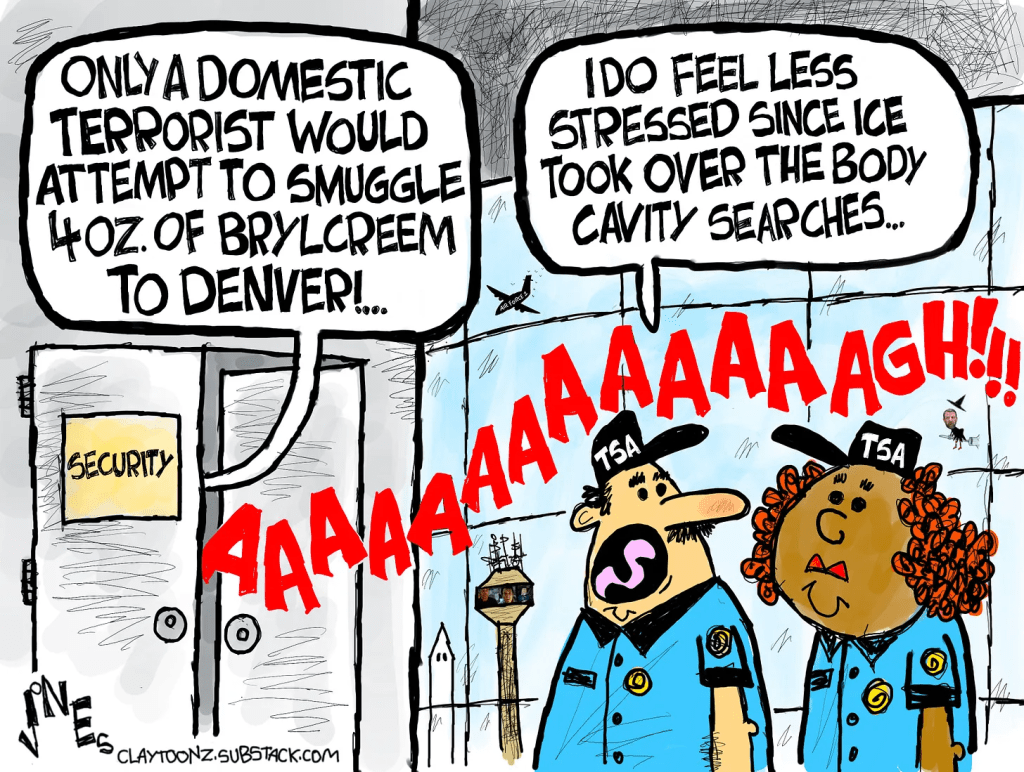
As Belle says tRump started a war and is blocking the funding for the very department in charged with securing the country against foreign threats until the all important trans people playing sports are banned. tRump is putting paid unmasked ICE agents in airports so why can’t they go unmasked on the streets of our towns and cities to stand around watching TSA agents work for free all because his feelings are hurt by trans people. She said something similar about FEMA but it all comes down to tRump using the scape goat of trans people and the Christian nationalists need to have a white male straight cis nation to live in even though those people are not representative of most of the nation nor of all Christians. But to not fund FEMA during horrific flooding and wildfires, to not fund DHS and TSA for security, to not fund the coast guard for our protection and assistance in local waters, and more just because he has a hard time understanding the truth that trans people exist and are normal members of society that deserve full unconditional civil rights and equality. Hugs
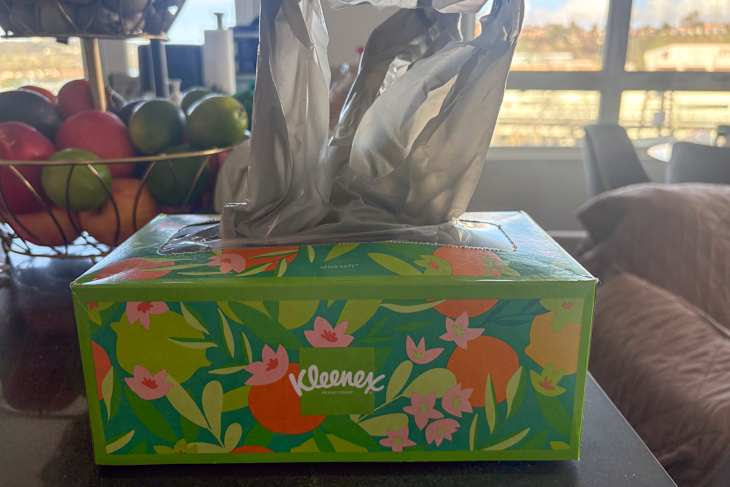
Here’s how I repurposed my empty tissue box as a plastic grocery bag dispenser in a few easy steps:
Take a plastic shopping bag and stuff it horizontally into the tissue box with the handles sticking out of the slit on top.
Grab another plastic bag and weave it through the handles of the bag sticking out of the box, then stop once it’s about three-quarters the way through.
Stuff both bags into the box, with the handles of the second bag sticking out again like you had before.
Repeat the process until all of the plastic bags are in the box (I was able to fit about 12 bags in mine!)
Gently pull a bag out of the box when you want to use it, just like a regular Kleenex box! Follow steps 1 through 4 to refill when you have more bags to store.