What a smarmy arrogant little prick this kid is. First he is wrong on the founders, but that he is so cock sure of himself he can’t imagine being wrong. Christ is king, only he is king, and how can you represent Ohio if you are not Christian. He is clueless that a religious test for office is strictly prohibited by the constitution. But even after being correct the kid repeats his wrong version forcefully. Hugs
ICE is a totally out of control rogue government agency that is simply lawless thugs. This was a civilian in medical distress in the ambulance. In a worse medical emergency the person could have died. The person was not in custody and a citizen but ICE demanded to be allowed to control them. Wake up people we have crossed all the lines. We barely have a functioning democracy. We all need to do what we can to fight this. Incredibly scary. ICE did not have the authority to hold the ambulance up but they did so at the point of a gun. What does that say about where the US is as “a nation of laws” and the republicans who for 50 years called themselves the party of law and order? Hugs
Late on Oct. 5, a Portland ambulance crew informed dispatchers over the radio that it was attempting to transport a patient from U.S. Immigration and Customs Enforcement to Legacy Emanuel Medical Center but that ICE officers were impeding its departure. Six minutes later, at 9:40 pm, according to publicly archived radio records, the medic driving the vehicle delivered an update: “We are still not being allowed to leave by ICE officers.”
Two confidential incident reports obtained by WW offer insight into what was going on inside the South Portland ICE facility at the time. The written accounts were filed by the ambulance crew members shortly after the incident—one report to their employer, American Medical Response, and another to a union representative—as documentation, as one report puts it, of a “conflict with federal agents.”
The two reports, filed by different medical workers, mirror each other’s accounts, and are consistent with publicly available audio recordings of emergency medical services radio communications, as well as 911 calls and dispatch reports obtained under public records law.
Both reports say that federal agents, in an effort to block the ambulance’s departure, stood directly in front of the vehicle. As the delay dragged on, according to the reports, the ambulance operator put the vehicle into park, causing it to lurch forward slightly.
The reports indicate the federal agents did not like this—so much so that an agent threatened to shoot and arrest the driver. The driver, frightened, asked why. An agent, according to the reports, responded that the driver had attempted to hit him with the ambulance.
“I was still in such shock,” the driver later wrote, “that they were not only accusing me of such a thing, but crowding and cornering me in the seat, pointing and screaming at me, threatening to shoot and arrest me, and not allowing the ambulance to leave the scene. This was no longer a safe scene, and in that moment, I realized that the scene had not actually been safe the entire time that they were blocking us from exiting, and that we were essentially trapped.”
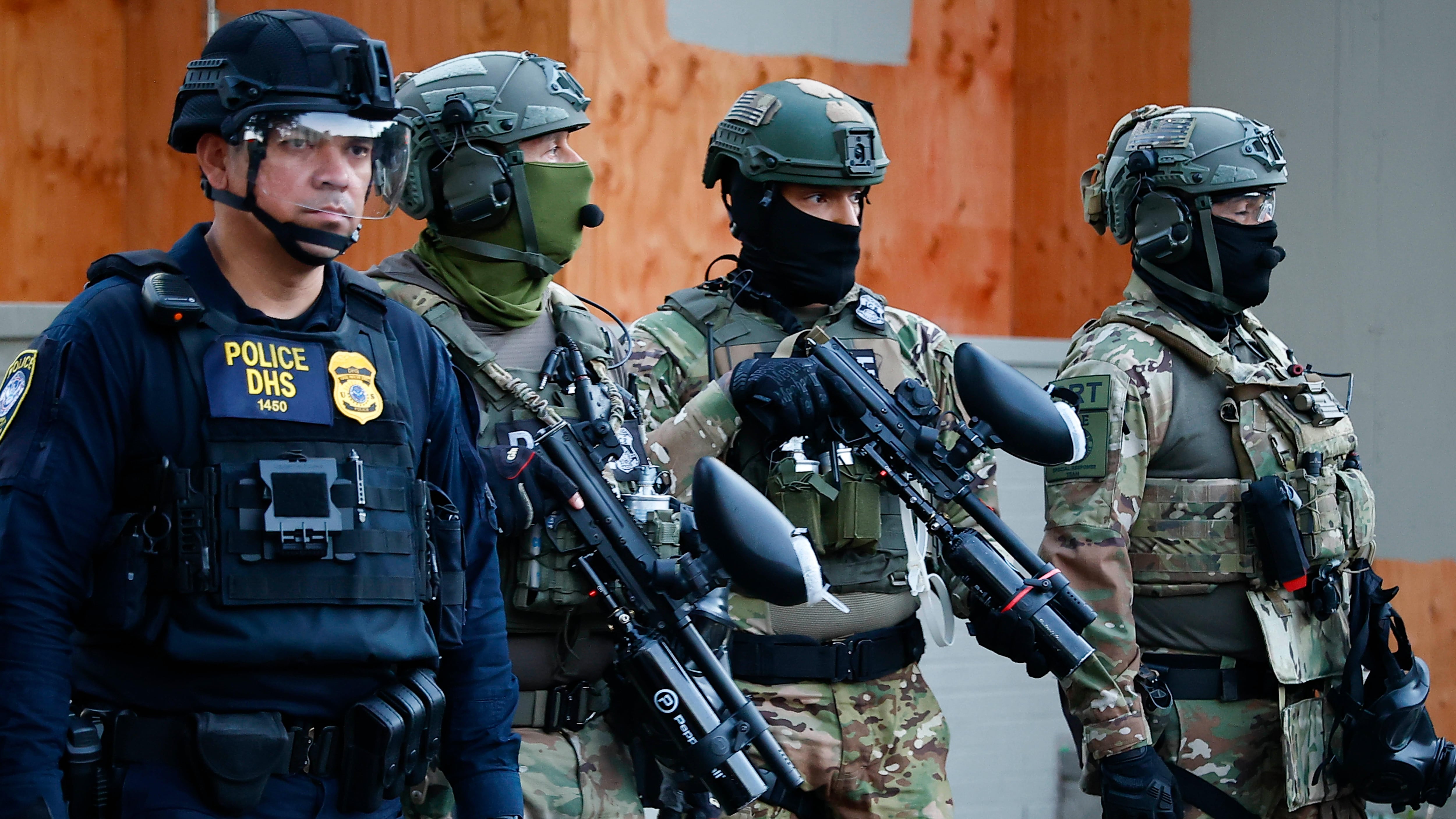
The incident occurred at a contentious spot in the city. The ICE facility on South Macadam Avenue has in recent months been the scene of frequent and persistent protests, typically small in scale, which President Donald Trump has lately used to justify his effort to deploy military troops to Portland to protect federal facilities and the personnel that work in them.
Meanwhile, many, including Portland city officials, have alleged that federal agents have in several cases needlessly intensified situations that might have easily remained far more calm.
The incident described in the crew members’ two reports suggests that such hostility has been directed not only at demonstrators, but at first responders who were asked by the feds to assist. The ambulance was eventually allowed to leave the building with the patient. But the crew’s written reports of the preceding minutes offer a small but revealing sign of how on edge some federal agents working in the ICE facility are feeling—and how quick they are to take an aggressive posture when they perceive a physical threat, even from a fellow emergency worker.
WW first contacted U.S. Immigration and Customs Enforcement about the incident early last week. When WW followed up Friday, Oct. 10, with more details about what it planned to report, an ICE spokesperson wrote: “Please contact the Federal Protection Services for response.”
A subsequent email that day to the U.S. Federal Protective Service went unanswered. A media contact for the U.S. Department of Homeland Security, which contains FPS and ICE, did not respond to a request for comment either. None of the agencies responded to a follow-up email Oct. 11 asking for comment.
WW also sought comment from the ambulance crew members, the ambulance company, and the union representing the workers. None denied that the incident had occurred as described in the documents. The union added that when armed agents interfere with medical transport, they “cross a moral line.”
Public records provide greater context to the incident detailed in the crew members’ reports. The ambulance was called late in the evening on Oct. 5 to the ICE facility at 4310 S Macadam Ave. According to a publicly available dispatch document, the crew was responding to a medical call for a protester with a broken or dislocated collar bone.
By 9:13 pm, the ambulance was en route. According to a dispatch document, federal officials suggested at first that the ambulance enter the ICE facility through a side door, but then determined it should come in the main gate. The ambulance arrived on scene at 9:19. By 9:22, it had entered the building.
AMR ambulance on NE 82nd Avenue (Brian Burk)
A two-member crew was aboard. Both later documented the event in confidential reports. One record, reviewed by WW, appears on an event summary form produced for American Medical Response—the company that contracts to run ambulance services in Multnomah County. The document lists Oct. 5—the same day as the incident in question—as the “date submitted.” The other document is an email, sent by a crew member to a union representative. It is time-stamped the evening of Oct. 6.
The reports indicate that when the ambulance arrived, the patient was transferred into the vehicle without issue, and soon the crew was preparing to depart. This is consistent with other publicly available records. At 9:30 pm, the ambulance operator indicated plans over the radio to head to Legacy Emanuel Medical Center. Around 9:33 pm, dispatch records say, the ambulance seemed to be getting ready to bring the patient out.
And yet it was not emerging. What was going on? One crew member worked largely in the rear of the ambulance, while the other was sitting in the driver’s seat. Their respective reports offer consistent accounts from different vantages.
An initial delay, the driver’s report indicated, stemmed from federal agents’ desire to ride in the ambulance to the hospital. The driver recalls responding that, in the absence of arrest paperwork, officers could not ride in the ambulance, and that an agent responded this was OK—that agents would follow the ambulance to the hospital instead.
But the point was evidently not resolved. Before long, a report says, an agent again said the ambulance needed to wait for an agent who would ride along.
“I repeated again,” the driver’s report recounts, “that no officer is permitted to ride in the ambulance and that they can meet us at the hospital and that we needed to be let out of the facility. Officers then began walking away from me whenever I spoke. At that point, a group of 5-8 civilian-dressed men walked into the garage and just stared at me. No identification on any of them. I walked back to the ambulance and got into the driver’s seat. I flipped the emergency lights on and put the car into drive. I inched forward slowly out of the garage.”
At this point, a report says, a man in civilian clothes with a neck wrap covering the lower part of his face stepped in front of the ambulance and told the driver to halt. The ambulance driver, in the report, recalls telling the man not to stand in front of the ambulance, and that the man then yelled at the driver to stop, citing the risk of hitting federal agents.
The driver recalled expressing skepticism about the risk of hitting the large group of officers in full riot gear, in plain view, about 15 feet in front and to the left of the ambulance. Sensing that departure was imminent, the driver inched forward further: “The group of about 30 officers in front of the ambulance were lining up in what I assumed to be preparation for the gate to open so they could escort the ambulance off of the property,” the report says.
Time went by. The crew was anxious to get the patient to the hospital. But they were still being impeded. Several federal agents, many in riot gear, moved to stand “incredibly close” to the front of the ambulance, the driver’s report recounts. An agent approached to inform the driver of the presence of “violent protesters” outside—a new reason the ambulance could not yet leave.
Around this time, dispatchers received one of the crew’s radio messages: The ambulance was still being held up.
Public records document this period as well: “50-60 fed agents completely blocking the road,” a dispatch report said at 9:39 pm, “but AMR still not driving out yet.”
The gate to the ICE facility had opened and dozens of officers in riot gear had marched out, revealing a clear exit path. Still, according to an incident report, the smaller group of officers continued to stand directly in front of the ambulance.
Around this time, the crew member in the rear, having determined, as a report says, that the “yelling and aggressive nature of the officers had created a scene safety issue,” exited the ambulance to have a word with them.
“My partner was still in the driver’s seat,” the crew member wrote, “and I left the ambulance to attempt to calm and deescalate the situation.”
In the other report, the driver recalled observing this and moving to secure the vehicle before also getting out: “I then placed the ambulance into park, took my foot off the brake, undid my seat belt and opened the driver’s side door. I looked up and suddenly the entire group of officers…were crowded around the open car door, some of them leaning forward towards me, inches from my face.”
An agent, the driver recalled, “pointed his finger at me in a threatening manner and began viciously yelling in my face, stating, ‘DON’T YOU EVER DO THAT AGAIN, I WILL SHOOT YOU, I WILL ARREST YOU RIGHT NOW.’”
According to the driver’s report, the crew member who had been in the rear of the ambulance told the agent that the vehicle rolled forward when the driver put it in park, and that no one was trying to hit him.
To this, the report recounts, another agent replied that this was not the first time this had happened.
According to the medics, the agents continued to yell. There was also further chatter of riding in the ambulance, but in time an accord was reached: Feds would follow along in their own car.
By 9:42 pm, a crew member radioed in: They were finally en route to the hospital. The driver, in the report, recounts making this radio call, and that dispatch copied. The report says an unmarked vehicle with state license plates followed closely behind the ambulance, and upon arriving at the hospital, multiple men in civilian dress exited the vehicle and walked in.
Presented by email with details of this story, a spokesperson for Global Medical Response, the parent company of American Medical Response, did not answer WW’s questions, but said, “We are reviewing the specifics of the situation and committed to a thorough review.”
WW reached out to the two ambulance crew members. Both declined to comment.
Asked for incident reports tied to the medical call, Austin DePaolo, a spokesman for Teamsters Local 223, which represents the ambulance workers, said in an email that the union “doesn’t have any incident reports that members have given us permission to share.”
DePaolo added: “Our Teamster EMS workers answer every call with courage and compassion. When armed agents interfere with medical care, they cross a moral line that could put lives at risk. We stand firmly behind our members who work in EMS.”
Andrew Schwartz writes about health care. He’s spent years reporting on political and spiritual movements, most recently covering religion and immigration for the Chattanooga Times Free Press, and before this as a freelancer covering labor and public policy for various magazines. He began his career at the Walla Walla Union-Bulletin.
Willamette Week’s reporting has concrete impacts that change laws, force action from civic leaders, and drive compromised politicians from public office.
Sakler says she was white knuckling it, trying to get through life as a “shell of a person.” She began cutting, hitting and hating herself because of the rejection from her church community.
He was given a treatment plan that involved limiting time with LGBTQ affirming friends, reading articles designed to redirect his attractions, and practicing what the therapist called “male characteristic activities,” such as taking charge and asserting control. He told his therapist that his marker of when things would be better was “life [going] back to normal.”
The therapist also worked with his parents, telling them they had failed by allowing the “gay agenda” to threaten their family and “let the devil get into the house.”
Editor’s note: This article includes mention of suicide and self-harm. If you are having thoughts of suicide or are concerned that someone you know may be, resources are available here.
“You don’t feel secure in your masculinity,” Sam Nieves remembers his licensed therapist telling him at Brigham Young University in Provo, Utah. “Go grab a Playboy and find a way to enjoy it,” the Mormon therapist told him.
“He told me I can’t be straight if I don’t go fishing with my dad,” says Nieves, who was 20 at the time. “He told me I needed to play more sports, listen to country music, stuff like that. He told me something was wrong with me.”
After these sessions, which lasted about a year and a half, Nieves started experiencing crippling shame and self-loathing. He eventually developed excruciating migraines and memory loss.
“My therapist just helped me find better ways to help me to hate myself,” Nieves, now 41 and living in Seattle, Washington, told Uncloseted Media.
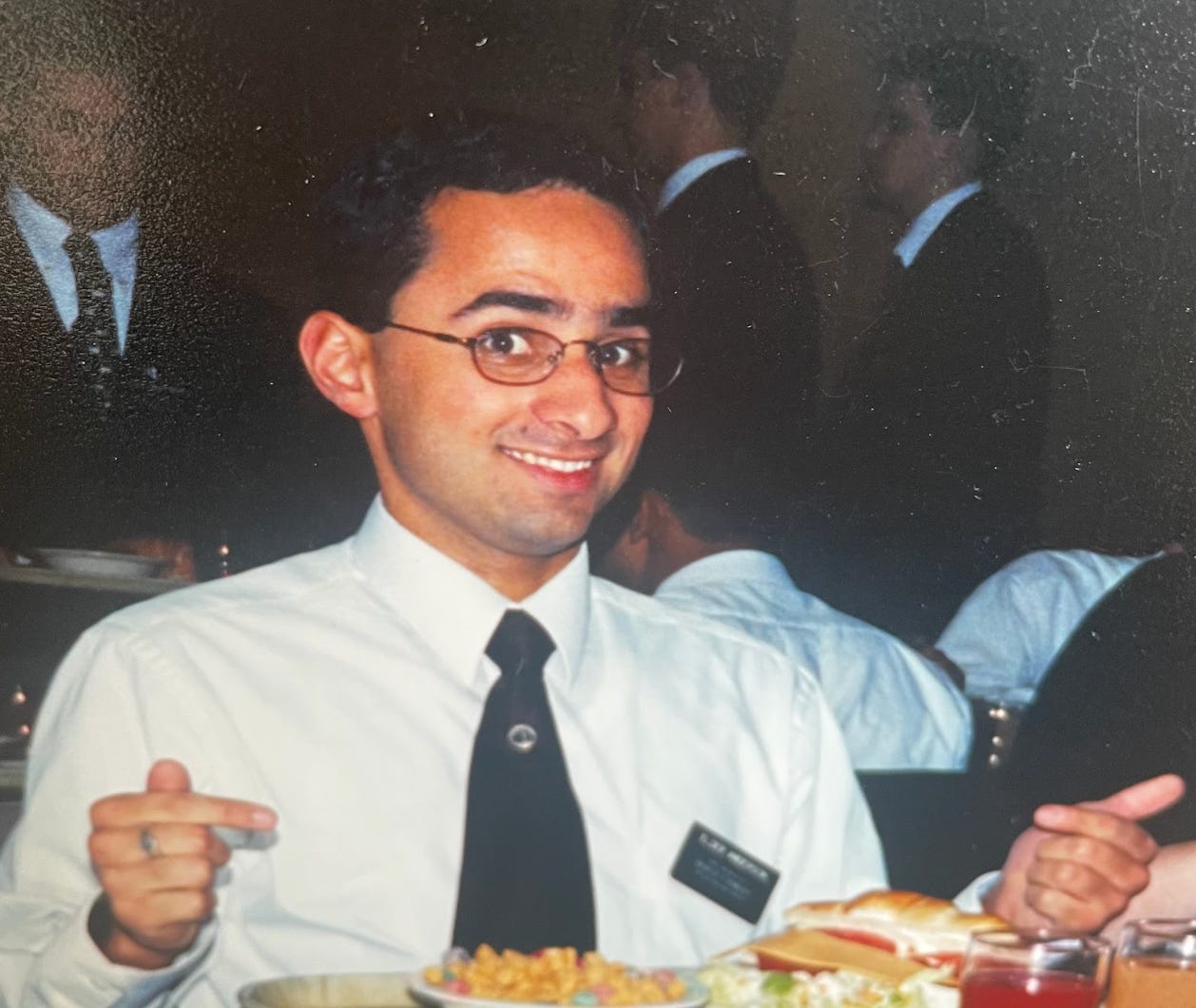
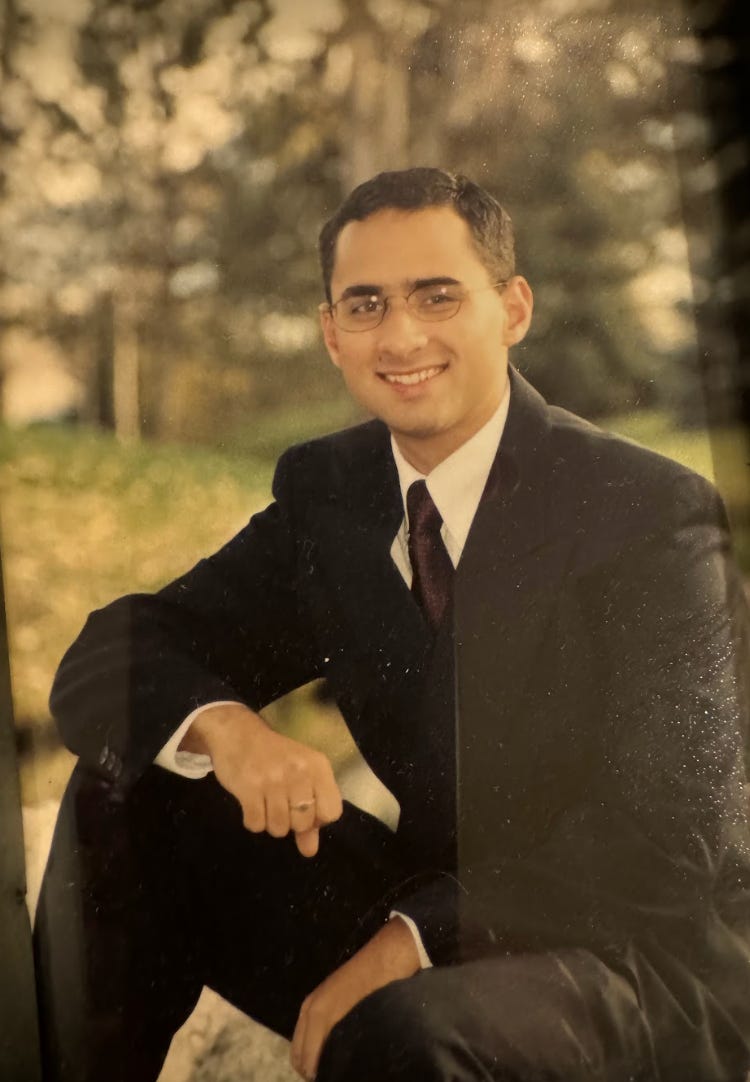
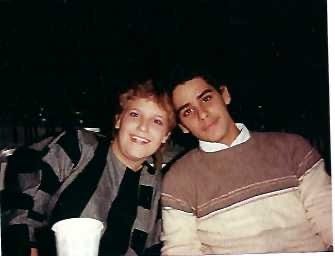
Sam Nieves as a young adult. Photo courtesy of Nieves.
Fourteen countries have a national conversion therapy ban, while many more have state or provincial bans. In the U.S., religious leaders can practice nationwide, though licensed therapists are not allowed to apply it to kids in 23 states.
While research around torture and mental health consistently suggests the practice should be banned, almost 700,000 LGBT adults have received conversion therapy at some point in their lives, including about 350,000 who received it as adolescents.
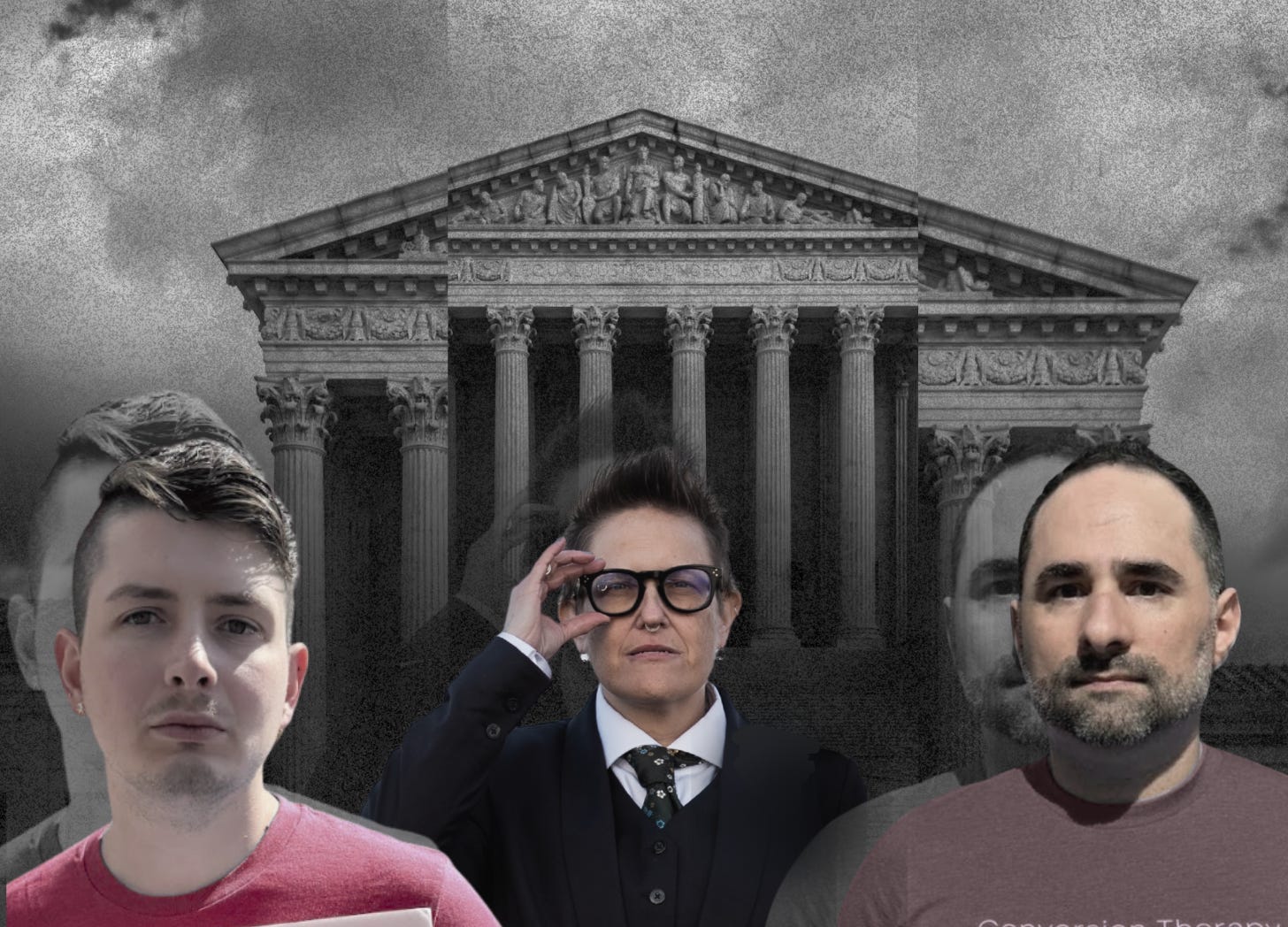
Despite all of this, on Oct. 7 the Supreme Court heard arguments in Chiles v. Salazar, a case that challenges Colorado’s conversion therapy ban and—if overturned—would have implications for the rest of the states with bans in place.
While the verdict will likely not be announced until June, the court seems poised to overturn it, suggesting that restrictions on therapists might violate the First Amendment’s free-speech clause.
“I’m emotionally devastated for the children who will lose the protections we fought so hard to give them,” says Nieves.
Conversion Therapy and Self-Hate
Unlike many young Americans who are forced into the practice by their parents, Nieves—who was raised Mormon—opted to see a conversion therapist because his church community said that if he didn’t change his sexuality, he was letting them down.
“I actively didn’t want to be attracted to guys,” he says. “And so it was always this confusing, gaslighting situation where they would tell me to stop being gay, even if I wasn’t doing anything. I was trying really hard not to. That’s when [the church] referred me to conversion therapy.”
Sam Nieves in his 20s. Courtesy of Nieves.
Nieves’ therapist insisted that his mom was too overbearing and his dad was not actively parenting, causing him to be gay. As his therapist continued to recommend that he engage in stereotypically masculine activities, he began to withdraw, cutting off friendships and avoiding community gatherings. His Mormon upbringing had taught him to feel shame, but conversion therapy solidified it.
“Conversion therapy gave me validation for why I hate myself. It was just building on top of what the church had already taught me,” he says.
Subscribe
Links to Dissociative Identity Disorder
Nieves became depressed and eventually developed a mild type of dissociative identity disorder (DID), where he experienced one persona that carried shame and recognized he was gay, and another that tried to act straight. Headaches and mental fog were persistent. Thoughts of ending his life flickered through his mind.
“It was just nonstop, massive disassociation,” he says. “There was the Straight Sam and the Gay Sam. And the whole time, everyone was telling me Satan was working on me because something inside me was trying to be gay. So it was insane making. They were making me clinically insane.”
According to medical experts, repeated trauma like medical procedures, war, human trafficking, conversion therapy and terrorism can cause DID when it overwhelms a child’s ability to cope, causing their sense of self to fragment into distinct identity states as a survival mechanism. The trauma disrupts the normal integration of self, leading to symptoms like memory gaps, dissociation and distinct personality states.
When Hunter Moore, a 29-year-old queer woman now living in Washington, was subjected to conversion therapy from her church and parents, she developed DID.
Raised in rural Idaho and immersed in an Independent Fundamental Baptist church that condemned queerness as sinful, the constant fear and shame brought on by her church’s conversion therapy program fractured her sense of self. She attributes her condition to repeated trauma that caused her brain to wall off painful memories.
“I didn’t know how to handle it other than just to check out,” Moore told Uncloseted Media. “I still have a lot of memory gaps from the conversion therapy because of how intense it was. … Once I didn’t have the restraints of that church anymore, the memories started to return.”
Fear, Shame and Suicidal Ideation
Similar to Nieves and Moore, Addy Sakler, who grew up in a conservative Protestant community in Ohio, says conversion therapy was “slowly killing” her.
“I figured I liked girls in kindergarten but did not have the language to describe it,” she told Uncloseted Media.
Sakler knew she wouldn’t be accepted at her church, so she put herself in conversion therapy throughout her young adulthood.
But it didn’t work. Sakler remembers the first sneaking moments of affection between grad school classes with her first crush. But after each kiss, the joy was followed by shame.
“We’d feel a lot of guilt and break up and immediately go repent,” she says. Both women were part of a church ministry that promised to “pray away the gay,” a 12-week program of lessons and deliverance sessions meant to convert them to heterosexuality. Instead, Sakler says, it nearly destroyed her.
Addy Sakler and her boyfriend before she came out. Photo courtesy of Sakler.
“I felt like a zombie walking around. I was depressed and I tried to commit suicide,” she says. “I was in the hospital for a month, two different times. It created a lot of trauma.”
Sakler says she was white knuckling it, trying to get through life as a “shell of a person.” She began cutting, hitting and hating herself because of the rejection from her church community.
Addy Sakler as an adult. Courtesy of Sakler.
“You believe what they’re saying. They’re telling you you’re broken and to be right with God you have to be heterosexual and if you’re not changing, then you’re being attacked by Satan.”
For nearly 15 years, Sakler attended conversion therapy conferences across the country, including one put on by the now dissolved Exodus International.
According to the Williams Institute, LGBTQ adults who have undergone conversion therapy have nearly twice the odds of attempting suicide and 92% greater odds of lifetime suicidal ideation compared to those who haven’t. Among LGBTQ youth, the numbers are higher, with 27% of those who experienced conversion therapy attempting suicide in the past year.
In addition, survivors experience disproportionately high rates of depression, PTSD and substance abuse. According to the findings from one Stanford Medicine study, the psychological harm caused by conversion therapy mirrors that of other severe traumas known to cause PTSD—like sexual or physical assault, the loss of someone close, or even experiences of war and torture.
Isolation and Families Torn Apart
When Curtis Lopez-Galloway told his parents he was gay at 16, they drove him two hours away from his house in southern Illinois to a conversion therapist who used the sessions to berate him for not trying hard enough to change into “the man that God wanted” him to be.
Curtis Lopez-Galloway as a teenager. Photo courtesy of Lopez-Galloway.
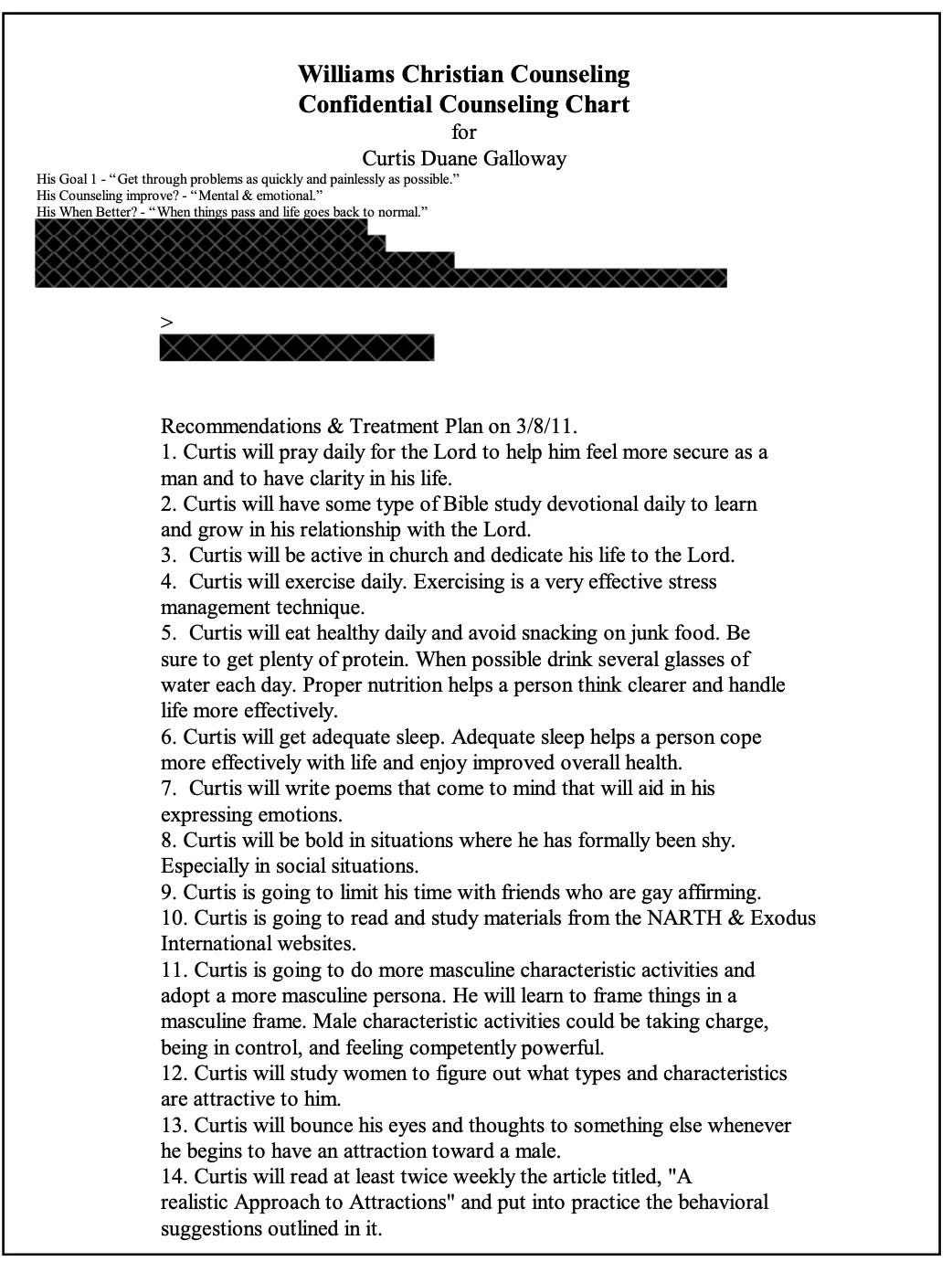
Lopez-Galloway remembers being told that his attractions to other men were a symptom of a deeper lack of masculinity, that he needed to “study women to understand what kind of man he was supposed to be” and that he should “bounce his eyes, and change his thoughts to something else whenever he begins to have an attraction toward a male.”
Curtis Lopez-Galloway’s treatment plan, courtesy of Lopez-Galloway.
He was given a treatment plan that involved limiting time with LGBTQ affirming friends, reading articles designed to redirect his attractions, and practicing what the therapist called “male characteristic activities,” such as taking charge and asserting control. He told his therapist that his marker of when things would be better was “life [going] back to normal.”
The therapist also worked with his parents, telling them they had failed by allowing the “gay agenda” to threaten their family and “let the devil get into the house.”
Lopez-Galloway, who now runs the Conversion Therapy Survivor Network, a nonprofit that connects survivors of the practice, recalls frustration and shame spilling into screaming matches that tore his family apart. “My parents were miserable, I was miserable, and we would just take it out on each other,” he says. “I went to [my therapist] for six months, and he just abused me and made life worse. It pushed me deeper into the closet and made me anxious and depressed.”
Curtis Lopez-Galloway as a teenager. Courtesy of Lopez-Galloway.
“[My therapist] would use therapeutic ideas but twist them in a way that was trying to change sexuality. … He would try to manipulate me in that sort of way and really broke me down as a person,” says Lopez-Galloway.
We reached out to the center Lopez-Galloway went to for treatment but they did not respond to a request for comment. Lopez-Galloway says his parents now acknowledge the harm the therapy caused, and he says their relationship has improved.
Subscribe
Life After Conversion Therapy
For many survivors of conversion therapy, the trauma can last a lifetime.
Even 21 years later, Nieves still gets triggered. He dropped out of college during his last semester of counseling school because the practices were too similar to those manipulated and weaponized by his therapist. “The hardest part was fighting … to no longer be suicidal every single day,” he says. “I would say that’s the hardest part. … It’s the suicidality that you fight with once it’s over.”
Nieves and Moore have both found support in Lopez-Galloway’s survivor network, where they meet weekly and heal together in community. Sakler has found healing in therapy for PTSD, and has found acceptance with her wife and her queer community in Sacramento, California.
Despite this, the trauma often requires undoing self-hatred and discovering self-worth.
“[We’re] constantly saying, ‘We don’t know who we are,’” Nieves says. “We don’t know how to enjoy life. We don’t know what the meaning of life is. We’re like The Walking Dead. Because just like how you break a horse, they broke our spirits. They told us everything about us was wrong and we needed to conform. But no matter what we did, we couldn’t conform.”
Even with these survivors’ experiences, along with countless testimonies from other Americans over decades, the Supreme Court looks poised to overturn Colorado’s ban, with multiple justices describing it as “viewpoint discrimination.”
Nieves strongly disagrees and advises kids who are experiencing conversion therapy right now to stay strong and ask for help when possible. “This may very well be the most difficult time of your life. For many of you, it’s going to feel like a living hell, and you may even pray for death every night. I know this, because this is how [I] felt too,” he says. “Often, [conversion therapists] break other laws. If you think someone might be breaking the law during your conversion therapy, please seek out a trusted adult and let them know,” he says.
Above all, Nieves tells kids to push through no matter what. “It can and will get better if you promise yourself that you deserve authentic joy, free of lies and coercion. Community is out there waiting for you, if you can just hold on for one more day, one more hour, or even just for one more minute.”
If objective, nonpartisan, rigorous, LGBTQ-focused journalism is important to you, please consider making a tax-deductible donation through our fiscal sponsor, Resource Impact, by clicking this button:
Most people know that Harry Houdini was a famous magician. Many people also know that Houdini devoted much of his life to debunking fake mediums during a time when Spiritualism had widespread acceptance.
But did you know that Houdini’s chief investigator was a woman named Rosa Mackenberg? I did not, but thanks to a Skeptoid podcast episode I do now!
Mackenberg began her career working as a private detective at a detective agency in New York. She was introduced to Houdini, who asked her to help expose fake mediums. Mackenberg believed that it was possible to communicate with the dead, but also agreed that mediums could be frauds. She started a partnership with Houdini that would last even after he died (in a sense).
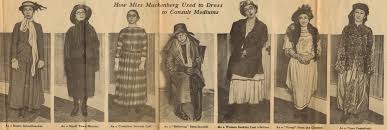
Mackenberg joined Houdini’s team in 1924. Mackenberg would adopt a costume and a backstory and meet with psychics before Houdini came to town. She took notes on their methods and passed them on to Houdini. Then when Houdini came to town, they would discredit the fake psychics publicly.
A newspaper clipping shows some of Mackenberg’s disguises.
Mackenberg testified before Congress hoping to convince them to pass a bill that would outlaw predatory practices among mediums. In the process, she divulged that multiple members of Congress, as well as President Calvin Coolidge, visited mediums in Washington, D.C.
After Houdini died in 1926, she continued her work, investigating fraudulent psychics and giving talks to professional and legal groups as well as the general public on how mediums were able to successfully swindle their victims. (snip)
In her work, she advanced not only the opportunities for women in investigative fields, but also some techniques of scientific investigation that are still used today. (snip-read MORE)
(Needless to say, state Republican legislators, with their supermajority here, are working to gerrymander her district to oblivion before the midterm filing deadline.)
The letter includes links for answers and help regarding the shutdown, seen below. If you click, those links will help all; Rep. Davids is a U.S. Rep and these are U.S. resources.
My actual rep did not send anything today. Over the weekend he referred to the “Schumer Shutdown” as if it was an inevitability; I’m sure he saw it that way as he’s all in on this administration’s actions (yep, Republican.) Anyway, here is this:
I know many people are worried and upset about this government shutdown. I am doing everything I can to push for a bipartisan solution to end this crisis as quickly as possible. I understand Kansans are frustrated with Washington and are demanding solutions instead of more partisanship.
Right now, many government agencies unfortunately may be operating with limited staff. This will impact a variety of crucial services people depend on. My team created this web page to help answer questions, connect people with assistance, and to ask for your thoughts.
This is an evolving situation, so my team will continue to update this page as events warrant. Please know that we’re here to help however we possibly can. You can find the below menu to get answers to your questions. Please also feel free to call my office at (913) 621-0832.
🇨🇦 Richard Hogan PhD (Mathematics) · MD (Neuroscience) · PhD (Ethics) · DBA (HRD) Architect of IGD & IBT | Rewriting the language of gender justice Essays, theory, and verse from the post-binary frontier
Keynote Address: Unscripted—Introducing Intergender Dynamics and and Reframing Gender-Type Prejudice
Good morning.
It is an honor to stand before you today—not to echo what has already been said, but to challenge what we’ve long accepted. To offer not just a critique, but a new vocabulary. A new lens. A new way forward. I hope you are ‘not toned deaf’.
For decades, we have used the term misogyny to name and confront systemic prejudice against women. It has served us well in many ways. But today, I ask you—academics, legal scholars, educators, and clinicians—to consider this: What if the language we use to fight injustice is now limiting our ability to understand it?
We are living in a post-binary world. Gender is no longer a fixed category—it is a spectrum, a performance, a negotiation. And yet, our frameworks remain tethered to binary logic. Misogyny is one such tether. It is gender-specific. Directionally fixed. It presumes a hierarchy that no longer reflects the lived realities of our students, our patients, our communities.
So today, I introduce a new term: Intergender Dynamics , or IGD .
IGD refers to the patterned, reciprocal, and often asymmetrical interactions between individuals and groups across the gender spectrum. It is not just about identity—it is about relationship . It is about how we perform, police, and punish gender roles in our daily lives. It is about the emotional labor we assign, the authority we grant, the empathy we withhold.
And this is not just a sociological insight—it is a medical one.
Recent research in gender-affirming care has shown that transgender and gender-diverse individuals face significant barriers in accessing health services, often due to systemic bias and relational discomfort within clinical settings. Studies have also revealed that patients with dynamic or evolving gender identities experience distress not only from institutional exclusion, but from interpersonal dynamics—how they are spoken to, validated, or dismissed by providers.
In pediatric and adolescent medicine, clinicians are now trained to recognize how gender-role expectations affect mental health, emotional development, and access to care. The World Professional Association for Transgender Health and The Endocrine Society have emphasized the importance of relational sensitivity—not just diagnostic accuracy—in improving outcomes.
What does this tell us?
It tells us that IGD is not just a theoretical tool—it is a clinical imperative . If we want to reduce disparities, improve mental health, and foster trust in care, we must understand how gender prejudice operates not only in policy, but in conversation. In tone. In silence.
To complement IGD, I also propose Intergender Bias Theory (IBT) —a framework for analyzing the structural architecture of gender-type prejudice. IBT examines how laws, curricula, and institutional norms enforce rigid roles and marginalize deviation. Together, IGD and IBT offer a dual lens: one that captures both the macro-level scaffolding of bias and the micro-level choreography of interaction.
Let me be clear: retiring the term misogyny is not an act of denial. It is an act of evolution. It is a recognition that our language must grow with our understanding. That our frameworks must reflect the complexity of the world we now inhabit.
So I call on you:
Academics , to revise your syllabi, your research, your theories.
Legal scholars , to expand your statutes, your protections, your definitions.
Educators , to teach emotional literacy, role deconstruction, and relational justice.
Clinicians , to recognize IGD in patient care and to train for relational sensitivity.
Let us move from naming contempt to understanding connection. Let us shift from binary blame to systemic insight. Let us unscript ourselves—and write a new language of liberation.
This is not the end of a conversation. It is the beginning of a movement.
Thank you.
(snip-To read in Latin, French, Spanish, or Arab, click through to the Substack)
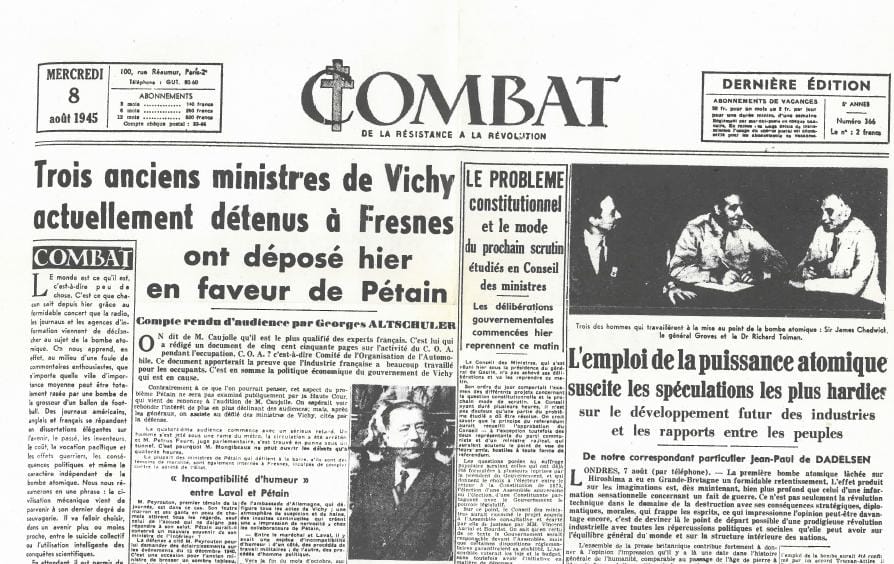
Combat, the underground paper edited by Albert Camus during the French Resistance
Jimmy Kimmel returned to the air on Tuesday and delivered a 28-minute monologue that set the record straight and sharply criticized the Trump administration. Sinclair and Nexstar, two TV networks whose affiliate stations collectively represent 25% of ABC’s broadcast audience, refused to transmit the show, pre-empting it with extended news programming instead. Trump, who is only increasing his authoritarianism, took to Truth Social to threaten ABC with new legal action for bringing it back.
If you believe that public service journalism is a load-bearing prerequisite for democracy, as I do, these are scary changes. These changes are particularly alarming because they’re happening just as the news industry overall has been contracting for decades, leaving fewer resources to fill the gaps. Other, larger, newsrooms could theoretically help fill the content and funding gaps, but there are fewer and fewer resources to share around.
The irony is that local news is the one place where this erosion of trust hasn’t been happening: local newsrooms know how to build community and are disproportionately trusted as a result. It’s also the one place where the broadcast medium is still important; in an emergency, or in a broadband desert, a radio signal can be the last source of real information. You can’t, yet, take a closed rural station and move it to YouTube without losing a large proportion of its audience. Around 90% of Americans have access to broadband internet, but that last 10% really matters.
Of course, if all the shuttered public media stations did move to YouTube, the government would go after that, too. As a service owned by a single corporation, it’s a central point of failure. Publishing on the open web would remove that risk, but the internet itself has been repeatedly under attack. In some areas, legislation has passed that effectively bans certain kinds of content (Bluesky is unavailable in Mississippifor this reason) and net neutrality has been decimated nationwide, making it far easier for an ISP to cut access to a particular service, perhaps in response to pressure from the government. With the government flexing severe restrictions to broadcast media, and nothing stopping severe restrictions to streaming media, there’s nowhere left for information to go.
In Cuba, the internet was legalized in 2019, although you need a permit to have a home connection, and connection quality is still intermittent. Starting long before that, people with access would download content to flash drives and then distribute them through a vast, illicit network called El Paquete Semanal, or The Weekly Package. You could think of it as a magazine: every week there would be a new issue of media that couldn’t be obtained any other way. It became so popular that the government tried to release its own competing USB drop containing approved media; unsurprisingly, it didn’t catch on.
We’ve become very reliant on the internet, but we may need to prepare for a post-broadcast, post-open-internet era. Ironically, newspapers, long the poster-child of media’s death throes, are semi-distributed and would be more resilient to this more restrictive media landscape, as the French resistance example demonstrates. (Of course, a newspaper that relies on a centralized printing press can always be shut down.) These are things that might happen, not things that definitely will, but it doesn’t hurt to consider this as a potential future that we might need to react to.
In a world where we succumb to truly authoritarian control over the media, I think there may be something to learn from El Paquete. A discrete bundle of digital media can be transmitted in multiple forms. It can be accessed via the web; consumed via an app that downloads the new bundle every week; transmitted over peer-to-peer networks; stored on resilient alternative file systems like IPFS; and even through sneakernet networks like Cuba’s. The bundle could contain archives of entire websites in the Internet Archive’s WARC format, downloads of video podcasts, and so on, linked with a web-based interface that would be somewhat akin to a DVD menu.
Such a bundle would probably not be collated inside the US. Instead, a group might be established in safe third-party countries like Switzerland, who could communicate securely with journalists on the ground in the US and elsewhere. They would bundle the release, publish it to various networks (the open social web, IPFS, p2p networks), publish a checksum hash, and publicize it in Signal channels.
It would be paid for in various ways. The central newsroom would need to be funded by international non-profits oriented towards re-establishing media freedom in the US (for example, the Committee to Protect Journalists and Reporters Without Borders). Individual journalists and creators in the US would need to be supported by communities more local to them and would likely take the form of mutual aid as much as direct support. Because traditional payment and crypto networks are both highly traceable, direct donations or subscriptions might not be feasible or safe.
I think it’s important to establish this ahead of time. By the time the internet is locked down and major restrictions have been applied to broadcast media, it’s too late. The good news is that it’s kind of cool in itself: the form of an online magazine that carries submissions from multiple news and media creators has a lot of scope for experimentation at every level, from content to design. It’s offline-first, which means you can interact with it on a plane and in other situations where internet is not an option. That’s neat in itself!
It also solves the problem of how this would be found by new readers to begin with. After a democratic collapse, discovery would need to be through word of mouth; before it, though, such a product could be promoted through more traditional channels (emphasizing the innovative nature of its issue-based format rather than its resiliency to authoritarian control). Early adopters who are attracted to the initial product would form the backbone of the word-of-mouth network later on. Just as newsrooms today thrive if they successfully build community, building trusted networks of people becomes vital for distributing underground material in an authoritarian environment. Historical underground media networks took years to establish, as all communities do; building community would need to begin immediately.
Our entire software stack — our content management systems in particular — are designed to be accessed through a functioning internet. Luckily, thanks to tools created by organizations like the Internet Archive, we can simply build websites locally on our own devices and create an archived version to distribute. The tools are there; the work to be done is all at the human level.








 Scottie's Playtime