Providing objective, nonpartisan, rigorous, original journalism that investigates America’s anti-LGBTQ landscape and elevates everyday American heroes. Expect two rigorously reported stories every weekend.
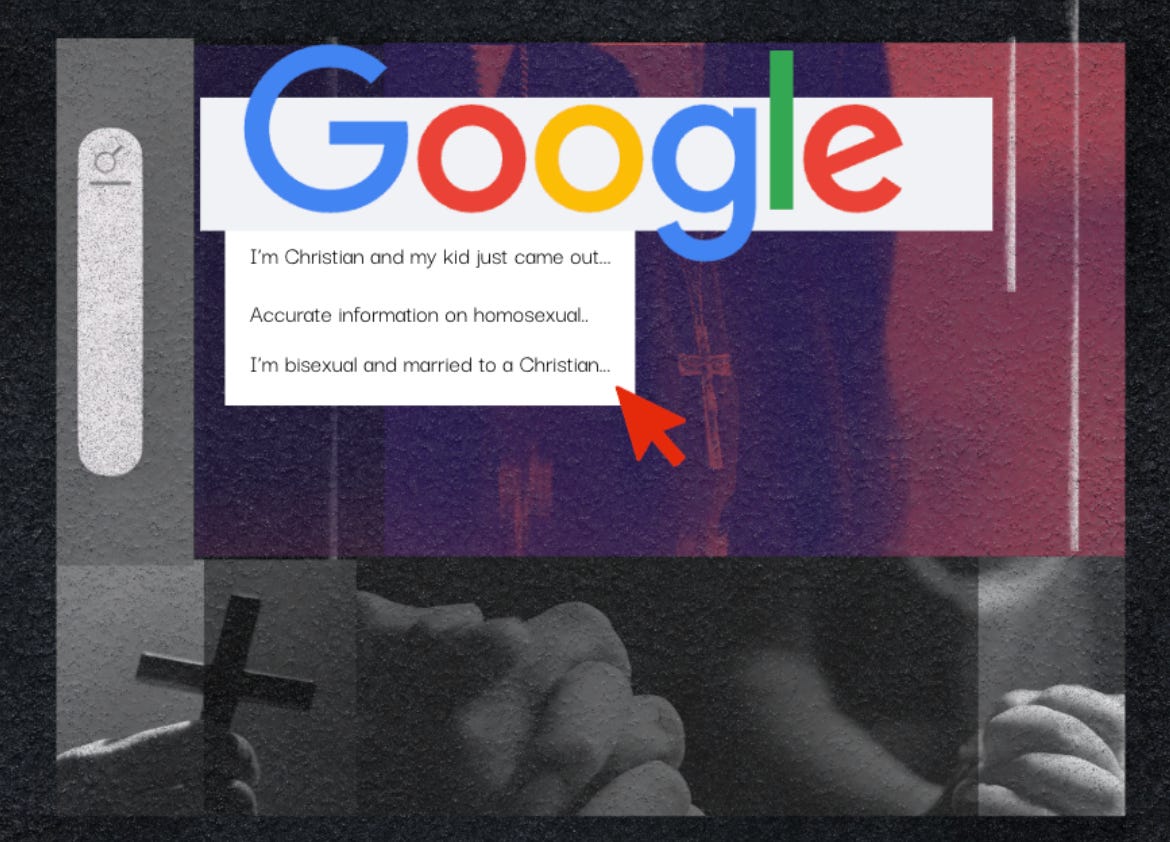
But how does Google’s algorithm decide which results show up? And how do these results influence LGBTQ kids, their parents and Americans at large who are searching for help?
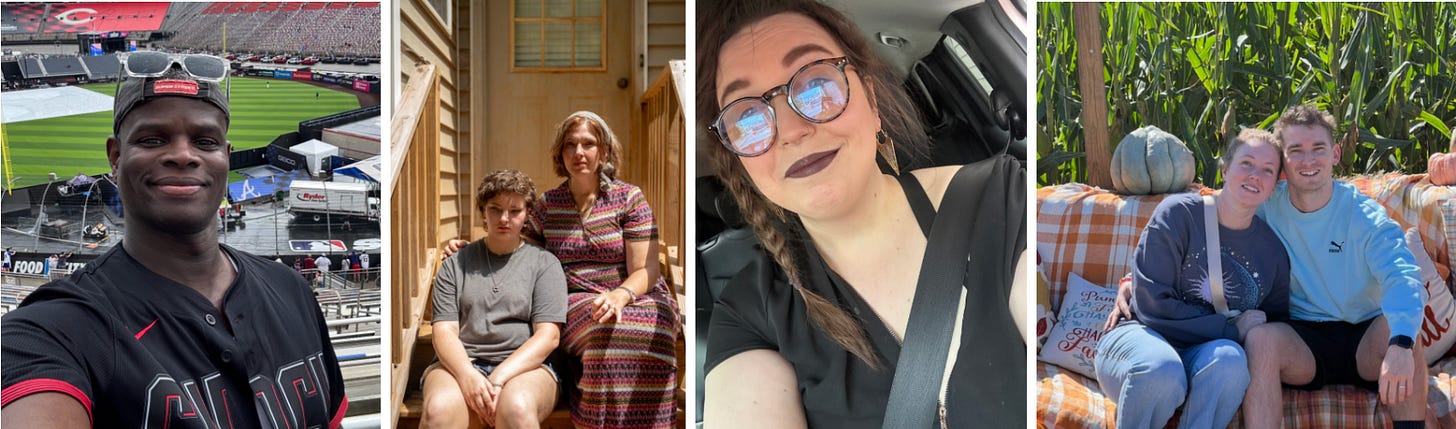
Uncloseted Media asked five Americans from around the country to Google five common queries related to LGBTQ identity, religion and parenting.
The results were alarming and raised an urgent question: With nearly 40% of LGBTQ youth seriously considering suicide just last year, what happens when a queer teen or the parent of a gay kid in crisis turns to Google?
Photos courtesy of participants Mark Just, Genna and Melanie Brown, April Samberg, Tommy O’Neil. Photo of Genna and Melanie by Kaoly Gutteriez.
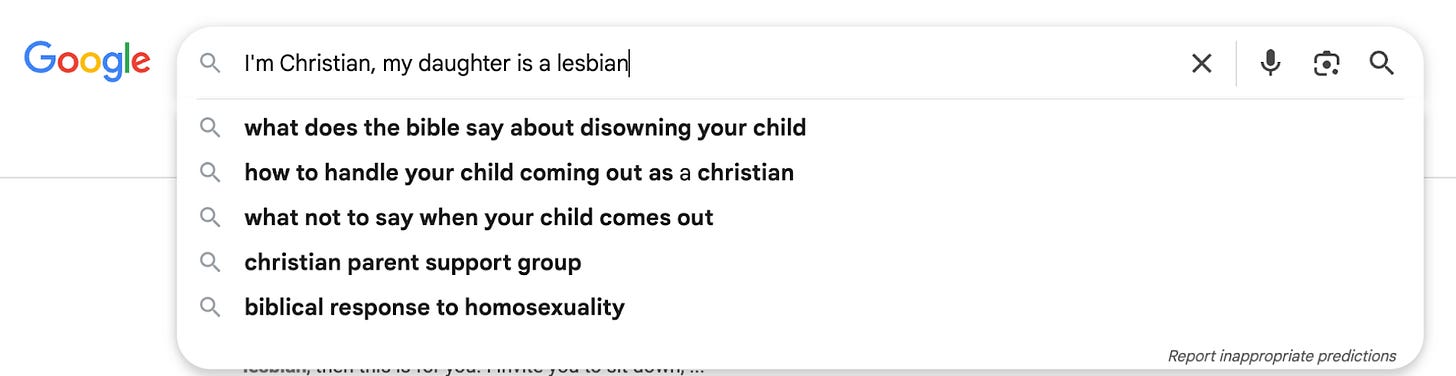
“I’m Christian, my daughter is a lesbian,” Melanie Brown, a Southern Baptist from High Point, North Carolina, types into Google.
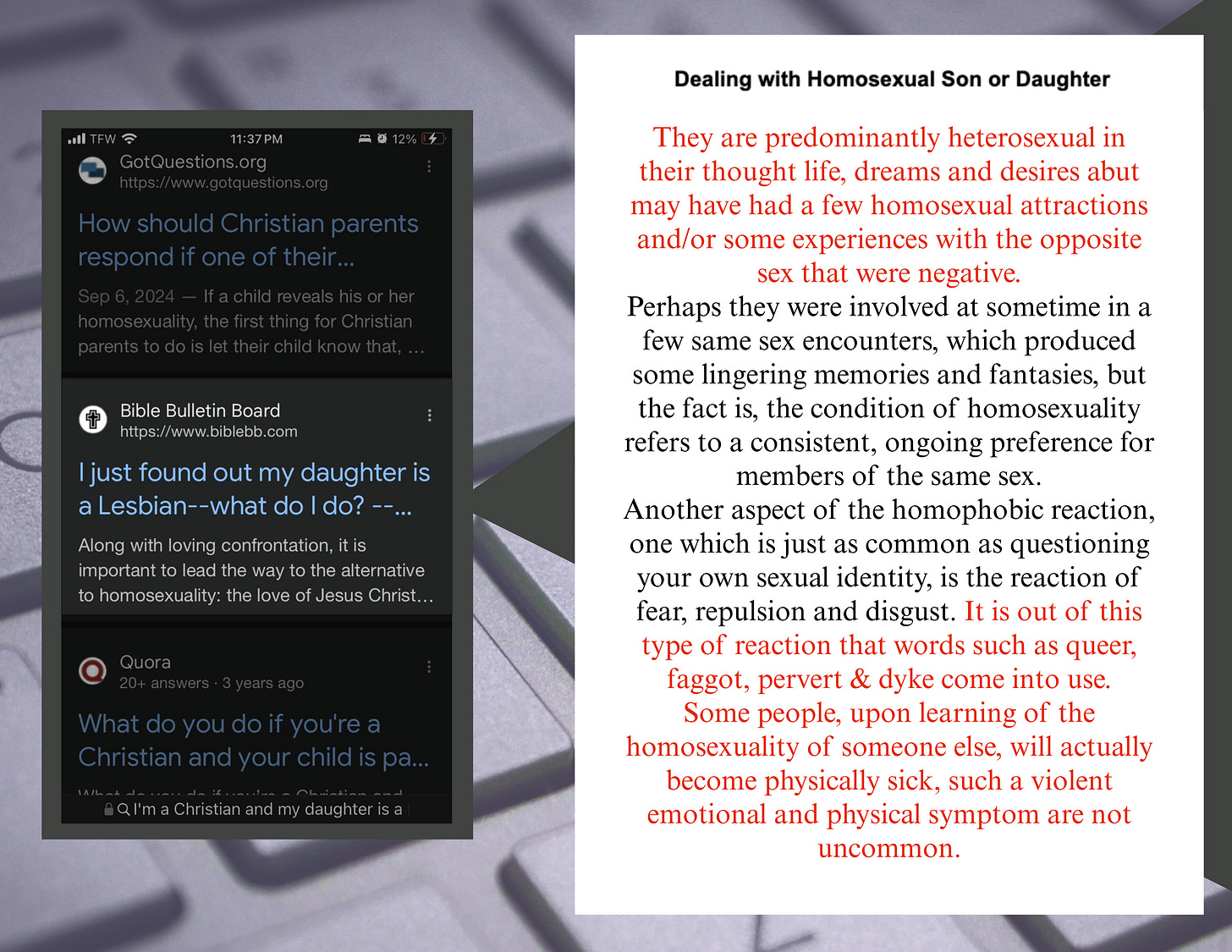
When Brown presses enter, Bible Bulletin Board comes up as the third result, with the suggestion of “offering hope for change,” and “lead[ing] the way to the alternative to homosexuality.” It goes on to explain that “homosexuality is contrary to God’s Word. It is sin and as always results in sin’s destructive effects on the individual and on those close to them.”
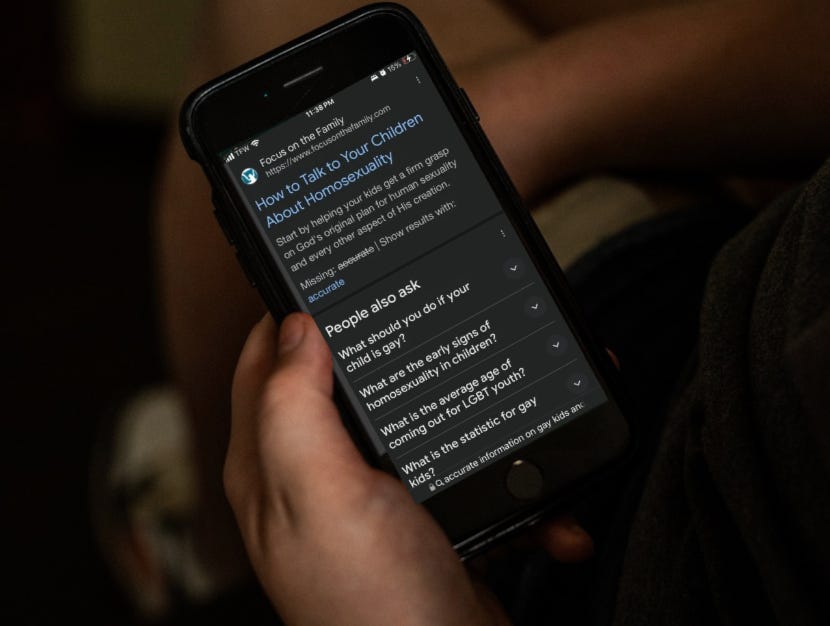
In the living room, Brown’s 15-year-old daughter Genna, with her dog on her lap, Googles “accurate information on gay kids and what to do.”
Focus on the Family (FOTF) is the first result. She clicks the link and lands on the platform of a hyper-religious organization known for promoting conversion therapy and labeling her sexuality as sinful.
The site, which presents itself as a reputable religious source, features a tab titled “Understanding Homosexuality” and a section under their resources for “Homosexuality.” It states: “[FOTF] is committed to upholding God’s design for the expression of human sexuality: a husband and wife in a marriage.”
It offers suggested reading on “redemption” from a gay lifestyle, along with 11 counseling resources aimed at changing sexual orientation, including The Alliance for Therapeutic Choice and Scientific Integrity, which guarantees “professional assistance … for persons who experience unwanted homosexual attractions.”
The language is intentionally padded, which means Genna and her mom—and many of the other millions of Christian parents of queer kids—may never know that Google led them to a Southern Poverty Law Center-designated anti-LGBTQ hate group. FOTF is known for its long-standing opposition to LGBTQ rights, for spreading anti-LGBTQ disinformation and for framing homosexuality and transgender identity as sinful and disordered.
Screenshot courtesy of Genna Brown. Photo by Kaoly Gutierrez.
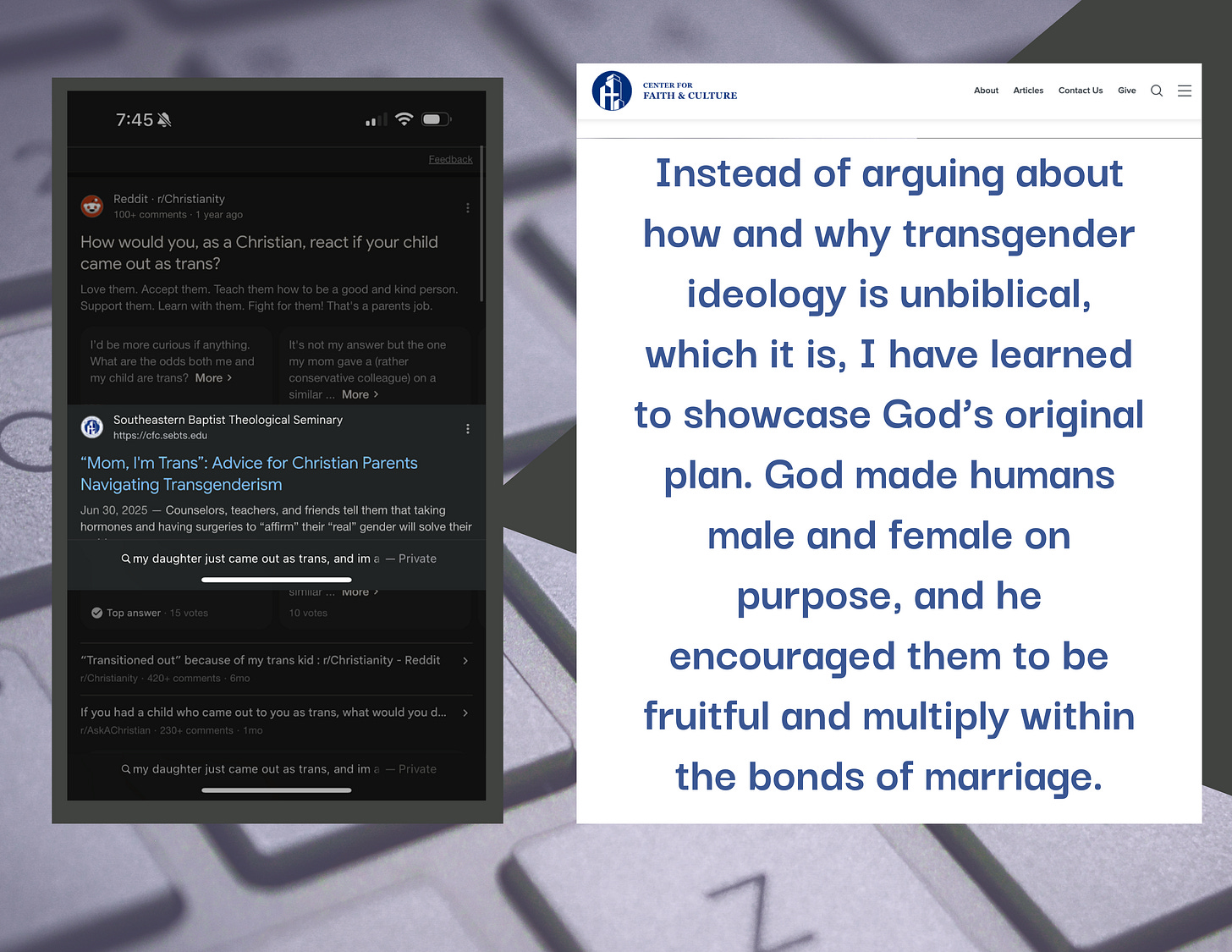
In South Boston, Virginia, Tommy O’Neil Googles, “My daughter just came out as trans and I’m a Christian.” As a father of two, he wants what’s best for his kids. According to Southeastern Baptist Theological Seminary, Google’s second result, O’Neil should recognize that God doesn’t make mistakes when assigning sex and give sympathy for those who are indoctrinated in the “transgender cult.”
Thousands of miles away in Anchorage, Alaska, 38-year-old bisexual woman April Samberg Googles, “I am bisexual and have a husband who is Christian, am I going to hell?”
The third result is once again an article by FOTF that tells April that “same-sex-attracted strugglers” and “transgender and homosexual lust and behavior are wrong.”
In Cincinnati, 44-year-old Mark Just Googles, “accurate information on homosexual kids and what to do.” FOTF is the top search result.
“I don’t feel good about it,” Just told Uncloseted Media. “It’s disturbing because if there are people out there who want to accept and understand their children or loved ones, this is what they’re being pointed to.”
“[I feel] fear for the queer kids with Christian parents who will be seeing that and thinking it’s good advice, and sorrow for the kids with parents who already have,” says Genna Brown, who was a “self-loathing, suicidal kid” who thought God would punish her for being gay before she came out to her now accepting parents. “It’s pretty awful that this is what’s being pushed for advice. This has no doubt harmed people.”
Uncloseted Media also asked folks in Taiwan, Lebanon, China, Hong Kong, Canada and India to Google similar queries. All of them had FOTF turn up as a top search result.
Subscribe
Why Does Google Allow This?
Google, like other search engines, compiles information and directs users to various websites by referencing the titles of web pages that it judges to be most reflective of what was searched.
“Google’s algorithm is notoriously a black box,” says Jesse Ringer, founder of Method and Metric, a search engine optimization (SEO) growth company. “That’s intentional to keep their competitive advantage.”
What we do know is that Google ranks search results by first crawling the web with an automated program called “spiders” to follow links from page to page and collect data.
It uses text matching to identify documents that it thinks are relevant to a query and then ranks them based on a combination of popularity, freshness, location and previous links clicked.
But for people searching for reliable information, its process can be problematic.
“Google doesn’t rank based on accuracy, but on popularity and query matching,” says Dirk Lewandowski, professor of information research and retrieval at the Hamburg University of Applied Sciences. “This is based on clicks and a network of how many other links are directed to this website. … Of course, users click what is shown in the first position. So we have kind of a rich get richer.”
How to Get a High Ranking
As websites with the highest rankings continue to receive more clicks, websites like FOTF can also employ other tactics to keep their prominent placement.
Backlinking—the process of having other web pages hyperlink back to your site—is one of the ways to maintain your high ranking.
“Backlinks are a big part of popularity. So the relationship between other websites linking to this source is a big part of Google’s algorithm,” says Ringer. “There are SEO businesses that build link farms so that the content of their clients can go higher. They create a network effect and they link to each other. It is not unreasonable to think that [FOTF] has hired either an SEO person or they’ve hired an external agency to contribute to that.”
According to Francesca Tripodi, assistant professor at the University of North Carolina School of Information and Library Science, ranking can also be gamed by matching keywords to content. Tripodi looked at the metadata of progressive and conservative companies and found that conservative content creators “are much better at doing this.”
“They are savvy at creating new sets of words and tagging their content with them,” she says. “That’s not something I’m seeing with progressive content creators.”
Tripodi says that not only does conservatism thrive online, it might be the only perspective returned.
Subscribe
“They are well-funded companies with large production budgets and effective digital marketing teams,” she wrote in a 2019 testimony about conservatism and Google searches. “This is why when you search for liberal phrases like ‘gender identity’ or ‘social justice’ the top returns … are conservative content creators.”
Google declined to speak on record with Uncloseted Media for this story.
In an email, a spokesperson said: “Like any search engine, Google indexes the content that’s available on the open web, relying on systems like keyword matching to surface relevant results. We are largely guided by local law when it comes to removing pages from search results.”
What If It’s Harmful or Illegal?
The United States notoriously protects harmful or misleading content—including anti-LGBTQ hate speech—under the First Amendment.
“The situation in [other countries] is a bit different than in America,” Lewandowski says. “For instance, Holocaust denial is illegal in Germany. So Google bans these sites, but they don’t ban them in the U.S.”
Section 230 of the U.S. law protects Americans’ freedom of expression online by implying that we should all be responsible for our own actions and statements on the internet. This law largely takes legal pressure off of Google.
And in 2003, an Oklahoma court ruled that Google’s rankings are subjective opinions and thus constitutionally protected.
Google’s policies for tamping down on harmful content “don’t apply to web results.” Thus, there is little moderation on the web pages that pop up for Americans who use the search engine.
The spokesperson for Google says that “[they] hold themselves to a high standard when it comes to legal requirements to remove pages from Google search results” and that “they don’t remove web results except for child sexual abuse, highly personal information, spam, site owner requests, and valid legal requests.”
But according to the company, “determining whether content is illegal is not always a determination that Google is equipped to make.”
Tripodi says this might be why groups like FOTF are still showing up, even though conversion therapy is illegal in 23 states. She says these groups may have found a loophole in Google’s policy by “tricking” the search engine into thinking they are providing “resources” and not simply a recommendation for conversion therapy.
Subscribe
What Can Google Do to Fix This?
“Google has a responsibility for what is coming up in their results because people trust [them],” says Lewandowski. “They think something is correct or accurate because it is number one in Google.”
Fifteen-year-old Genna Brown is one of the 85% of Americans who feel this way, according to a 2025 study.
“Isn’t the first result typically ranked most credible?” she says. “Because I typically trust the first result more.”
“It’s pretty concerning what comes up when you search for these things,” Ringer says. “There needs to be more done to educate the people who are doing the searches on understanding news and information.”
But vulnerable groups, like LGBTQ kids who are living in households where they are told they are going to hell and parents who are often confused and in crisis themselves, are being led by Google’s algorithm to believe that being queer is wrong.
“1000% yes, these results concern me,” says Genna Brown. “We’re talking about organizations that promote practices like conversion therapy, which is insane. … I wish there was some disclaimer. Like, ‘Google has determined this to be a subjective query. As such, we can’t verify the following results. Proceed with caution.’”
Tripodi says she thinks consumers are responsible for about 20% of the burden by researching and verifying the sources they learn from. But she agrees with Brown in that Google carries an ethical responsibility for the content it chooses to rank and promote.
“As a global corporation that gobbles up all other possibilities for information, Google has a responsibility to ensure that its content is accurate and not harmful,” Tripodi says. “[It’s their job] to ensure that the information that they surface is accurate and reliable because we know people trust that information.”
Uncloseted Media reached out to Focus on the Family, Southeastern Baptist Theological Seminary, and Bible Bulletin Board. They did not respond to our request for comment.
Additional reporting by Sophie Holland and Spencer Macnaughton.
If objective, nonpartisan, rigorous, LGBTQ-focused journalism is important to you, please consider making a tax-deductible donation through our fiscal sponsor, Resource Impact, by clicking this button:
September 1, 1939 Nazi Germany invaded Poland, overwhelming the Polish Army with 58 German divisions and air cover from the German air force, the Luftwaffe. This action started the second world war, prompting England and France to declare war on Germany two days later.
September 1, 1945 The Emperor of Japan surrendered unconditionally to the U.S. and its allies in a ceremony on the deck of the battleship U.S.S. Missouri, ending the second world war.
September 1, 1986 Angelo (Charlie) Liteky & George Mizo, both Vietnam veterans, began an open-ended Fast For Life on the steps of the U.S. Capitol.They were calling attention to their opposition to U.S. support of the Nicaraguan contras and repressive regimes in El Salvador and Guatemala. Charles Liteky “our expression of a deeply felt desire to do everything and anything we can . . . to stop the war with Nicaragua.” George Mizo Liteky was a Catholic chaplain in the Vietnam War and had received the Congressional Medal of Honor. Charles Liteky and his subsequent peace efforts
September 1, 1987 During a nonviolent protest at the Concord (California) Naval Weapons Station, a Navy munitions train ran over Brian Willson. An Air Force and Vietnam veteran, Willson and the other protesters were attempting to stop shipment of weapons to Nicaragua and El Salvador. Brian Willson bird-watching California, 1997. They considered U.S. policy in Central America a violation of the Nuremberg Principles. (Here is a link to those principles.) Willson lost both legs and suffered other injuries but has remained an active and articulate leader in the anti-military movement. Ron Kovic (author ‘Born on the Fourth of July’) and Brian Willson (also born on the Fourth of July) Willson’s testimony before the U.S. House Armed Services Subcommittee on Investigations
September 1, 1989 White House staffers decided to purchase some crack cocaine so President George H.W. Bush could hold the illegal drug in his hands during a national address. On the first attempt, the drug dealer didn’t show up. On the second try, an undercover drug agent’s body microphone didn’t work. Trying for the third time, Bush’s team managed to purchase the crack, but the camera operator videotaping the deal missed the action as a homeless person assaulted him.
September 1, 1997 Kurdish and British activists blockaded an arms trade exhibition outside London. 89 members of Campaign Against the Arms Trade (CAAT)were arrested for protesting the presence of Turkish, Chinese and Indonesian government representatives in Britain to purchase weapons. The Labour government had pledged “[We will] not permit the sale of arms to regimes that could use them for internal repression or external aggression . . . .” Great Britain is the world’s second largest arms manufacturer (by dollar volume) after the U.S.. Campaign Against the Arms Trade home
September 1 – International Day of War Tax Resistance. “Refusing to pay taxes for war is probably as old as the first taxes levied for warfare…” War Tax Resistance Coordinating Committee
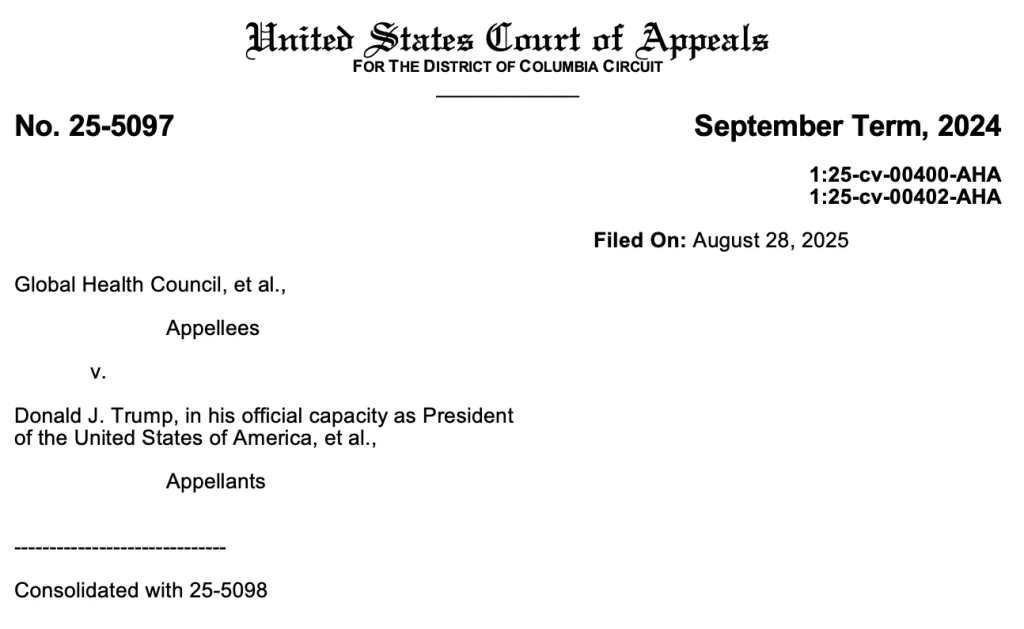
A federal appeals court on Thursday evening took steps that Democratic appointees wrote could represent that best possible way of helping organizations funded by foreign aid payments to get money before a quickly approaching September 30 deadline.
It was the latest unusual sets of rulings in a case challenging the Trump administration’s efforts to cut foreign aid funding — raising the “impoundment” question about the president’s ability not to spend money that Congress has, with its control over appropriations, directed the federal government to spend — that has been up to the U.S. Supreme Court already twice this year.
On Thursday evening over the course of 30 minutes, the U.S. Court of Appeals for the D.C. Circuit took seven actions that ultimately sent the case — technically, a pair of cases — back to the district court, where it is before U.S. District Judge Amir Ali.
It was a stark sign of where we’re at: Judges on the court generally thought of as second only to the Supreme Court taking strategic steps to try to protect people and organizations’ rights due to the ways other branches — and actors within their own branch — are failing to do so. (snip-go read the rest, if you’re interested. It’s very well-written.)
This is a thread on Bluesky. One doesn’t need an account to read there. It’s also an excellent explanation.
This was an extraordinarily shrewd *and* principled resolution by the en banc court, in a case in which the various arguments in the trial court and on appeal were *almost* hopelessly entangled and hard to parse. Of greatest importance are two things: [1]
This video means a lot to me. It explains how I felt and changed. People ask how I could care for my adopting parents and abusers at the end of their lives with all they had done to and caused to be done to me. As he says, I did not want to be them, I did not want to be like them, I did not want to replace them with myself. I am not a religious person, and I have seen no sign of higher beings, but I agree it wouldn’t be bad to be like the Jesus he talks about and the way he treated others. The question I never answered is did I forgive them? Hugs
Celeste Yim, the first out nonbinary writer for Saturday Night Live, announced they are leaving the show this week after five years.
Yim, who was hired as an SNL staff writer in 2020 and promoted to writing supervisor in 2023, announced their decision to leave the show after its 50th season in an Instagram post late Sunday night.
“Lorne [Michaels] hired me over the phone when I was 23 and the job literally made all of my dreams come true BUT it was also grueling and I slept in my office every week BUT my friends helped me with everything BUT I got yelled at by random famous men BUT some famous girls too BUT I loved it and I laughed every day and it’s where I grew up,” Yim wrote in the post.
(snip-embedded Instagram on the page)
“I hate when other people say this but it’s true that I was the first ever out trans person to be a writer for SNL,” the scribe wrote. “I always felt honored to be working within the long tradition of queer writing at the show,” Yim added, joking that “Chevy [Chase] is nonbinary!” (Chase was a cast member and hosted Weekend Update in the first season of the long-running series.) Yim also vowed to keep writing comedy in the face of anti-trans oppression. “I feel so powerless to protect trans people in the world but writing connects us and makes us permanent, so it’s what I will continue to do,” they wrote.
“Thank you Bowen for changing my life and for making me feel normal,” Yim wrote on Instagram this week. (Yim also recently wrote for Yang and Matt Rogers’ Las Culturistas Awards, held earlier this month.) Their statement also thanked “every SNL assistant and production crew member who ever made any part of anything I ever wrote.”
Yim’s time on SNL saw an influx of queer and nonbinary cast members like Molly Kearney and Punkie Johnson, both of whom have since left the show. At the same time, SNL also earned backlash from LGBTQ+ viewers by inviting hosts like Shane Gillis and Dave Chappelle, both of whom have made homophobic and transphobic comments on stage; when Chappelle hosted SNL in 2022, a nonbinary writer — widely believed, but not confirmed, to be Yim — asked to sit out for the week, after which Chappelle made a joke calling the writer “a they” during dress rehearsal (which did not appear in the final show).
“Thank you to my family and friends who love me still even though I did not see them very much,” Yim wrote in their departure announcement. “And thank you all for your support. For writing to me and for wearing my sketches as Halloween costumes. […] I try to imagine my younger self learning about me. I would be amazed. But then I’d be like…Wait, why are you dressed like that…”
Yim’s comments were full of current and former SNL cast members and writers expressing wholehearted support, including Yang, Ego Nwodim, and Jane Wickline, as well as non-SNL celebs like Padma Lakshmi, Jeremy O. Harris, and Ziwe.
“My baby,” cast member (and L’Eggs icon) Aidy Bryant wrote simply, summing it up.
The Breakfast Club’s Charlemagne Tha God delivers a devastating new nickname for Hakeem Jeffries. We explain why the Jeffries and the Democratic establishment are so afraid of being challenged from the left, especially on issues like Israel and the influence of AIPAC.
The 2025 Netroots conference is over and David Weigel joins to break down the key takeaways, from a surprising lack of donor support to the crucial debate over how politicians should communicate their message.



 Scottie's Playtime