Again the attempt to kill diversity and the LGBTQ+ representation. This may seem small potatoes but again this is about erasing the LGBTQ+ community. Hugs
We are writing with profound regret to inform you that the 17th annual Desperado LGBTQ+ Film Festival has been canceled. This decision comes in direct response to recent presidential executive orders impacting Diversity, Equity, and Inclusion (DEI) efforts at public institutions, including our community college district.
As a publicly funded institution, we must comply with these orders. Failure to do so would jeopardize the district’s federal funding, including student financial aid and grants that support over 300 positions across our campuses. The loss of such funding would create a ripple effect, significantly affecting students, faculty, staff, the community, and the educational services we provide.
Thank you to our audience that has made Desperado possible for the past sixteen years. You have helped us provide a platform for underrepresented voices and celebrate the richness of the LGBTQ+ community through the power of film. We are deeply grateful.
While we are heartbroken to pause this year’s event, we hope this is not a farewell but a momentary pause. We look forward to the possibility of resuming the festival when conditions allow.
Read the full press release. The festival is hosted by a student organization at Phoenix’s Paradise Valley Community College, which receives federal funds.
I went to bed about normal 7 pm for me. Surprisingly when I told Ron he said he wanted to go also. That was about 2 hours or earlier than he normally goes to bed. His normal time to go to bed is 9 or a bit later. But we went to bed together. Along with Tupac.
We cuddled several hours with me holding him and then us reversing and him cuddling me. We go back and forth during the night. We often fall asleep in each other’s arms, and I often get my most restful sleep while we cuddle. Which is going to seem strange with what I am going to write next.
After four hours of holding each other, I noticed Ron’s legs were fidgeting and fussing. I asked him if he legs were bothering him and he replied yes. I was a bit miffed he did not tell me before I noticed but I told him we needed to take some time off on our own sides and he asked if we could cuddle later to which I agreed.
At some point I started to have a bad memory nightmare. I know in the nightmare I was begging for help, I was screaming for help. Then I could hear Ron’s voice calling me begging me to wake up, but my fear / pain was too much and I still yelled for anyone to help me.
Then With Ron yelling next to me, as he knew better than to touch me when I am in that state, I started to hear him and even as I was still crying out for help I heard him beg me to follow his voice. When I came to he told me I was the loudest I had been in a long time, begging for help at one point I screamed out several times “help me, someone please help me”.
After he woke me I got out of bed and went to the bathroom. When I got back he asked if I wanted to talk. I said no. He told me Scottie that was bad, you were really upset and loud. I just got back into bed and faced away from him. He understood I was not ready to deal with it.
For the next couple of hours I lay there trying not to think of the memories I had just experienced in my nightmare. In the morning I got up early, when Ron got up he twice asked me to talk about what I went through. I told him I was not ready yet. I could see him wanting more but knowing pushing me would only cause me pain.
The memory / nightmare was a really bad hours long rapes by multiple people when I was a really young kid. I was young enough to think that screaming and yelling would get me help. As I got older I understood doing such things only brought more punishment. In the dream I was experiencing it as I did then, with all the pain, panic, desperation and then submission.
I have come to realize burdening Ron with these memories only causes him to feel pain thinking of what I went through with no way to stop it. Trust me my wonderful Ron would have killed to stop a child being abused. Yes he tries to be a grand husband to comfort me, but it is wrong of me to ask that of him I think. Is it transferring my pain on to him in the name of “sharing”, the same question could be asked of my sharing of it on the blog. But he can only take the pain and memories I share as I could only take the abuse. He is then stuck with them in his mind as I am with them in mine. Do I have that right? Is that not abusing my own husband the man I adore to do that, to ask that. Is that the same for when I share with everyone here on my blog. I am giving you my memories and pain with no way to stop it. Have I become a villain, an abuser?
Until I figure out if I am doing more damage than good I will have to keep telling him I just don’t want to talk. Better to suffer in silence than cause him a pain he can not rid himself of. Hugs
Israeli Prime Minister is such a liar that even Donald Trump is calling him out. Hell, Marjorie Taylor Greene is accusing him of committing genocide. Ouch.
Bibi denied claims that he’s starving Gaza, and said, “There is no policy of starvation in Gaza, and there is no starvation in Gaza. We enable humanitarian aid throughout the duration of the war to enter Gaza – otherwise, there would be no Gazans.”
He’s a liar. Israel has bombed convoys bringing in humanitarian relief to Gaza, and it won’t allow aid from the United Nations to enter Gaza half the time.
The World Health Organization said Sunday there have been 63 malnutrition-related deaths in Gaza this month, including 24 children under the age of 5, up from 11 deaths total in the previous six months of the year.
Gaza’s Health Ministry puts the number even higher, reporting 82 deaths this month of malnutrition-related causes: 24 children and 58 adults. Yesterday, it said that 14 deaths were reported in the past 24 hours. The ministry, which operates under the Hamas government, is headed by medical professionals and is seen by the U.N. as the most reliable source of data on casualties. U.N. agencies also often confirm numbers through other partners on the ground.
The WHO also said acute malnutrition in northern Gaza tripled this month, reaching nearly one in five children under 5 years old, and has doubled in central and southern Gaza. The U.N. says Gaza’s only four specialized treatment centers for malnutrition are “overwhelmed.” Children are going days without eating.
Palestinians want a full return to the U.N.-led aid distribution system that was in place throughout the war, rather than the Israeli-backed mechanism that began in May.
55 trucks from the United Nations’ food program entered Gaza yesterday, and they were all looted by starving Gazans. There are also food drops, but that’s not enough.
Witnesses and health workers say Israeli forces have killed hundreds by opening fire on Palestinians trying to reach food distribution hubs or while crowding around entering aid trucks. The Israeli Defense Force says it has fired warning shots to disperse threats. But as we’ve learned throughout this war, the IDF lies.
The UN needs the IDF’s permission to bring food into Gaza, and they claim the military denies them over half the time. The Hamas police would protect the trucks from being looted by hungry Gazans, but they stopped after being shot at by the IDF. (snip-MORE)
While meeting with the Prime Minister of the United Kingdom, Kier Starmer, Donald Trump said he had been invited to Epstein’s Island, but that he turned it down and “never had the privilege” of visiting the island. It was right then that PM Starmer realized he was sitting with a lunatic who is most likely a pedophile.
Trump deflected to other people, saying, “I never went to the island, and Bill Clinton went there supposedly 28 times. I never went to the island, but (former Treasury Secretary) Larry Summers, I hear, went there, he was the head of Harvard. And many other people that are very big people, nobody ever talks about them.”
That word salad makes you wonder how much Adderall Trump snorted before his meeting with Starmer.
There are no records of Bill Clinton ever going to Epstein’s private island, so I don’t know where Trump got the number 28 from when he can’t even find one visit. The thing is, Donald Trump is a liar and a golf cheat. More on that in a minute.
Trump said, “I never had the privilege of going to his island, and I did turn him down. But a lot of people in Palm Beach were invited to his island. In one of my very good moments, I turned it down. I didn’t want to go to his island.”
All of Donald Trump’s moments are pretty bad, at least for other people. Saying you never had the privilege of visiting a pedophile’s island is not a good moment. Neither are the moments he flew on Epstein’s private jet, or the times he partied with Epstein while they were ogling young women. (snip-MORE)
As I keep saying this is a small very loud mostly religious driven minority using ever tool and lie they can to change perception of the LGBTQ+ to erase them from society to create the cis straight society they want to force on everyone. We must counter them by being as loud and forceful to not only refute their lies but also promote the joy of living freely as an inclusive society. Hugs
Close-Up of rainbow flag with crowd In background during LGBT Pride Parade. Getty Images.
Ohio lawmakers on both sides of the aisle have introduced several LGBTQ-related bills so far this General Assembly.
Republicans have put forth a drag ban bill, a piece of legislation that would make it harder for a student to use a different name or pronoun at school, and a bill requiring transgender political candidates to list their deadname, among others.
On the other side of the aisle, Democrats have introduced the Ohio Fairness Act and a bill that would ban conversion therapy.
An Ohio court partially overturned a ban on gender-affirming care for LGBTQ youth earlier this year, meaning doctors can still prescribe puberty blockers and hormone therapy.
Anti-LGBTQ bills
Ohio House Bill 249 would ban drag performers from performing anywhere that is not a designated adult entertainment facility. State Reps. Angie King, R-Celina, and Josh Williams, R-Sylvania Twp., introduced the bill, which has had sponsor testimony.
This is a re-introduction of a bill from the previous General Assembly that did not make it out of committee and faced much opposition.
Ohio House Bill 190 would require parental permission for schools to use different pronouns or different names for students that don’t match up with the biological sex or birth name.
Williams and state Rep. Johnathan Newman, R-Troy, introduced the bill, which has had sponsor testimony.
Ohio House Bill 172 would ban children 14 and older from receiving mental health services without parental consent. Newman also introduced this bill, which has had sponsor testimony.
Ohio House Bill 196 would require political candidates to list their former names on candidacy petitions. This, however, would not apply to names that have been changed due to marriage. King and state Reps Rodney Creech, R-West Alexandria, introduced the bill, which has had sponsor testimony.
Ohio House Bill 262 would designate the weeks from Mother’s Day to Father’s Day as Natural Family Month. Williams and state Rep. Beth Lear, R-Galena, introduced the bill, which has had sponsor and opponent testimony.
Pro-LGBTQ bills
Ohio Senate Minority Leader Nickie Antonio, D-Lakewood, has introduced a few bills that support LGBTQ people. Antonio is the only openly gay lawmaker in the Ohio General Assembly.
Ohio Senate Bill 70, also known as the Ohio Fairness Act, would expand anti-discrimination laws to include sexual orientation and gender identity. House Bill 136 is a companion bill.
Antonio has introduced the Ohio Fairness Act in every General Assembly since she was elected to the Ohio House of Representatives in 2011 and this is the first time since 2018 the bill has no Republican support.
Ohio Senate Bill 71 would ban any licensed health professionals from doing conversion therapy when providing mental health treatment to minors. Antonio and state Sen. Beth Liston, D-Dublin, introduced the bill. House Bill 300 is a companion bill.
Ohio Senate Bill 211 would designate the first full week of June as “Love Makes a Family Week.” Antonio introduced this bill as well.
None of these bills have had any hearings so far this General Assembly. Ohio lawmakers are on summer break and will come back to the Statehouse this fall.
Mehdi moderates a panel with YouTube star Brian Tyler Cohen, LA city council member Nithya Raman, and podcaster Van Lathan, LIVE in Los Angeles!
Mehdi and Zeteo concluded our one-year anniversary tour last week, with a final stop in the city that has made headlines in recent days and weeks, after the Trump administration deployed the National Guard against protesters.
Yes, Los Angeles. Political commentator and YouTuber Brian Tyler Cohen: “If it was happening in another country… We would not hesitate for a single second to call it autocracy, authoritarianism, or a dictatorship”
In this special live recording, Mehdi sits down with Cohen, as well as LA City Council member Nithya Raman and “Higher Learning” co-host Van Lathan for a conversation on President Donald Trump’s targeting of LA protesters and immigrants, Democrats’ response, and the media’s handling of Trump 2.0.
LA Councilmember Nithya Raman: “There is an incredible amount of fear right now,” Raman tells Mehdi. “They’re [ICE] showing up at workplaces. They’re showing on street corners. They’re showing up taking street vendors who are selling outside of a Home Depot…
They showed up outside of an elder care facility in Santa Monica and took workers from there. I mean these are kidnappings.” Mehdi asks Lathan, who frequently appears on CNN, about whether he believes the media is meeting the moment right now when it comes to covering Trump’s second term.
Van Lathan: “The legacy media right now is made to serve a commercial break ‘I’m mad on the left,’ ‘I’m on the right,’ ‘I am the host, you two stop fighting! We’ll be right back,’ ‘Proctor & Gamble.’” Did you like this video? It was published on zeteo.com several days ago.
If you would like early access to more exclusive content like this, then do consider becoming a paid subscriber. It costs as much as a single coffee a month, gives you early access to all our fearless, independent reporting, and goes a long way in supporting our mission of bringing the best of journalism to YOU our subscribers. So what are you waiting for?
The minority groups trying to push hate on the LGBTQ+ are well funded by billionaires like J.K. Rowling and the Christian church. They are using every media they can to turn young people against the LGBTQ+ using the most misinformation they can generate. And as much as they want / demand society return to their fantasied Christian 1950s pro white cis straight only country it was not true then and can’t be true now. Their goal is the total erasure of the LGBTQ+ and also any rights for those gained in the civil rights act. Below is a quote from the article. Hugs.
“I’m almost 40 and have seen so much progress like equal marriage,” Kelly says. “But something is changing. Hatred towards people like me is becoming mainstream again.”
Demonstrators participate in an event called “Show the flag: For queer visibility in the Bundestag!” in front of the Reichstag building that houses Germany’s lower house of parliament, the Bundestag, in Berlin, on July 8. The conservative president of the Bundestag said the rainbow flag would no longer be raised on top of the parliament building during Pride month, which in Germany runs from June 28 until July 27.
Odd Andersen/AFP via Getty Images
The tree-lined neighborhood near Nollendorfplatz square in central Berlinis as gay today as it was a century ago.
It’s where Christopher Isherwood wrote novels chronicling the rise of the Nazis amid the city’s rich queer nightlife that inspired the musical Cabaret.
Every summer, the neighborhood throws its own smaller-scale LGBTQ+ Pride event separate from the city’s main annual parade taking place this weekend.
It’s just one of more than 200 Pride events taking place in Germany this year. But with far-right extremist groups staging anti-Pride protests, many Pride attendees fear for their safety.
Sipping on a cocktail as the street party gets underway, 62-year-old Georg Schmidt says he’s relieved that this event is a relaxed affair. He says he attended a different local pride parade last month across town in the district of Marzahn and the mood there was tense.
“There was a massive police presence to shield us from anti-Pride protests. We only felt safe because the police kept us apart,” Schmidt says.
Revelers march down the Leipziger Strasse street during a Pride parade in Berlin, July 23, 2022.
Markus Schreiber/AP
Sabine Volk, a researcher at the Institute for Research on Far Right Extremism at the University of Tübingen, says these groups attract young men who promote what they call traditional family values — a kind of pride that has little to do with rainbow flags.
“The key slogan is that the German flag and Germany itself is already colorful enough,” Volk says. “And the overall message is that queer life does not have a place in Germany.”
President of German Parliament Bundestag Julia Klöckner speaks to the media on July 8 in Berlin.
Thomas Trutschel/Photothek via Getty Images
Speaking on public broadcaster ARD, Merz signaled his support for the rule at Germany’s parliament, the Bundestag, with the words, “the Bundestag is not a circus tent” — a remark to which many have taken umbrage.
Merz backs his colleague’s argument that the lower house must maintain neutrality and cannot support events with a political agenda.
Nyke Slawik speaks during a parliamentary debate on queer hate crime in the Bundestag. Photo: Carsten Koall/dpa (Photo by Carsten Koall/picture alliance via Getty Images)
Carsten Koall/picture alliance via Getty Images
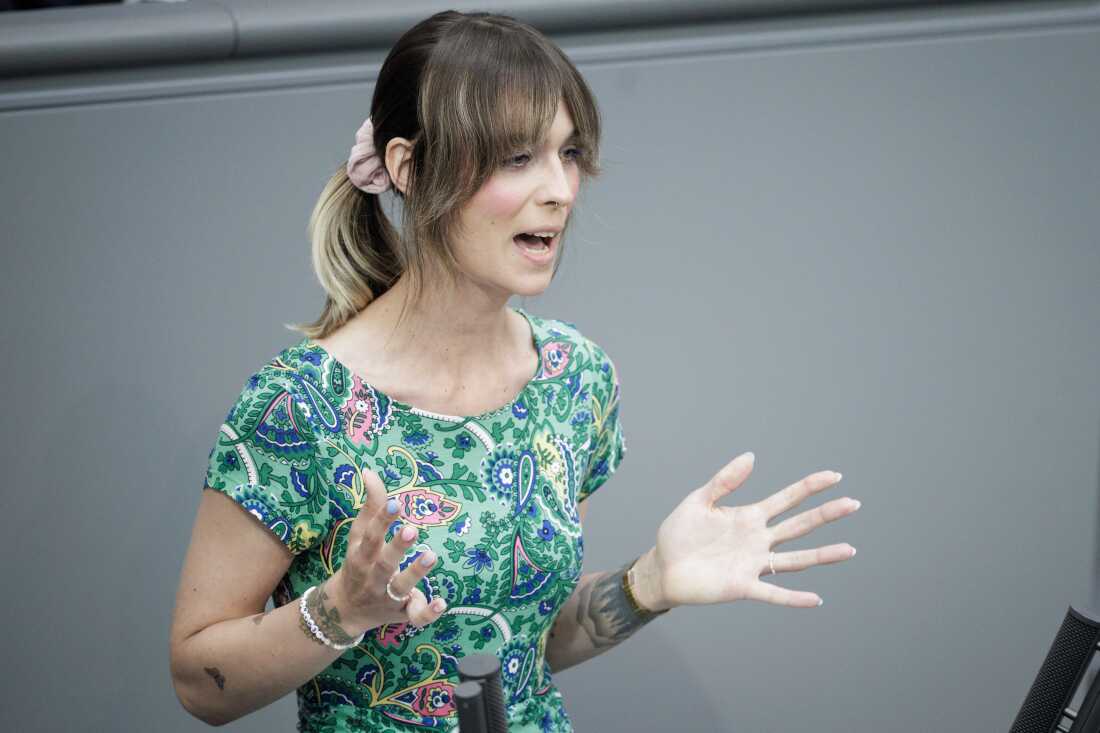
Opposition Green Party lawmaker Nyke Slawik criticized the move. “Declaring the rainbow a political symbol is highly problematic” stressing that “queer people are not an ideology; they are people!” Slawik told public broadcaster ZDF.
Slawik argues they are people increasingly in need of protection. Germany’s federal police report an almost tenfold increase in reported queerphobic hate crimes since 2010 and they believe the majority of cases go unreported.
The issue is not divided by party political lines; criticism of Merz’s choice of words has come from within his own party. Sönke Siegmann, the chair of the Christian Democrats’ LGBTQ+ Association, says some within his party are still catching up on terminology.
“If you say queer in my party, most people take a deep breath and say: ‘Oh, that’s a left-wing term,’ ” Siegmann observes. He says he has spoken with Merz since he made his “circus tent” comments.
“We explained to him what queer really means and two days later when asked in Parliament about LBGTQ+ hate crimes and what his government will do about them, Merz actually used the term queer,” Siegmann says.
Back inthe Nollendorfplatz area, rainbow flags fly every month of the year. But local resident Chris Kelly says the mood here is not as “live and let live” as it once was. He recently opened a boutique that sells high-end garments made from industrial strength rubber. He says business is good and he has a broad customer base, but it was almost impossible trying to find premises for the boutique.
“We found plenty of suitable spaces to rent and our finances are solid, but a lot of landlords rejected us, saying they didn’t want people like us,” Kelly remembers. “Real estate agents had warned us, but I was flabbergasted to encounter such prejudice in Berlin’s queerest, gayest neighborhood.”
Kelly’s store is located just down the street from Romeo and Romeo, a gay bar whose owner was attacked last month. Kelly says he too gets more verbal abuse than he used to and he hears again and again of attacks on members of the LGBTQ+ community.
“I’m almost 40 and have seen so much progress like equal marriage,” Kelly says. “But something is changing. Hatred towards people like me is becoming mainstream again.”
Kelly points out that a few doors down in the other direction is where the legendary nightclub Eldorado stood until the Nazis closed it down in 1933, eventually sending its queer clientele to concentration camps.
A commuter walks down the steps of Berlin’s Bundestag subway station, decorated with rainbow colors, the symbol of the LGBTQ+ community, on July 24.
John MacDougall/AFP via Getty Images
As preparations for Berlin’s main Pride parade get underway, the city police say they’ve received a permit request for a counterdemonstration protesting “against Pride terror and identity disorders.”
In reaction to the Bundestag president’s decision not to fly the rainbow flag on top of parliament this year, Berlin’s transport authority has decorated its Bundestag subway station stop in rainbow colors, writing on Instagram: “So our Bundestag is ready for Pride.”
Kelly urges people to attend Pride and stand up to a new generation of the far-right. He has no desire to say Goodbye to Berlin and the neighborhood around Nollendorfplatz, as Isherwood was forced to do.
I wasn’t an adult in 1972, but it was a relief to me, that there was no more death penalty! Four years later, it was back, and I cannot explain how that happened. My town had a death penalty trial almost immediately. A teacher had access to an execution film; the state was required to keep that on record for a while, whenever anyone sat on Ol’ Sparky; we viewed it before the trial (no one present was on the jury, of course.) It was medieval. And, here we still are in 2025, killing people in the names of everybody who lives here. There are ways to work against it; let me know if there is interest in comments.
July 29, 1970 Signing the contract After a five-year strike, the United Farm Workers (UFW) signed a contract with the table grape growers in California, ending the first grape boycott. Exploring the United Farm Workers’ History
July 29, 1972 The U.S. Supreme Court ruled the death penalty to be cruel and unusual punishment by a 5-4 vote. The Court called the wide discretion in application of capital punishment, including the appearance of racial bias against black defendants, “arbitrary and capricious” and thus in violation of due process guarantees in the 14th Amendment [see July 28, 1868]. Influence of race on imposition of the death penalty
FOX HOST BILL HEMMER: “Did President Trump have anything to do with the cancellation of Stephen Colbert’s show?”
BRENDAN CARR: “I think there are a lot of consequences that are flowing from President Trump deciding, ‘I won’t play by the rules of politicians in the past and let these legacy outfits dictate the narrative and terms of the debate.’ He is succeeding. Look at what is happening. NPR has been defunded, PBS has been defunded, Colbert is getting canceled. You’ve got anchors and news media personalities losing jobs downstream of President trump’s decision to stand up. He stood up for the American people. American people don’t trust the legacy gate keepers anymore.”
BILL HEMMER: “I asked a very direct question. I did not hear a yes or a no in your answer. I heard a maybe. Is The View now in the crosshairs of this administration?”
BRENDAN CARR: “Look, it’s entirely possible that there’s issues over there. I mean, again, stepping back, this broader dynamic, once President Trump has exposed these media gatekeepers and smashed this facade, there’s a lot of consequences. I think the consequences of that aren’t quite finished.”
FOX: Is The View now in the crosshairs of this administration?
FCC CHAIR BRENDAN CARR: It's entirely possible there are issues over there … the consequences aren't quite finished pic.twitter.com/sDZAbtf07I
Trump doesn’t rule out pardon for Epstein co-conspirator Ghislaine MaxwellIt comes as Deputy Attorney General Todd Blanche met with Maxwell – who’s serving 20 years in prison for sex trafficking – for a second time.
Ghislaine Maxwell, who sources told ABC News initiated the meetings with the Department of Justice, answered questions for about nine hours over two days after being granted a limited form of immunity, the sources said.
The immunity allowed Maxwell to freely answer Deputy Attorney General Todd Blanche’s questions without fear that her responses could later be used against her, the sources said.
The so-called proffer immunity is commonly granted to individuals prosecutors are seeking to make cooperators in a criminal case. Maxwell has already been tried, convicted and sentenced for sex trafficking underage girls.
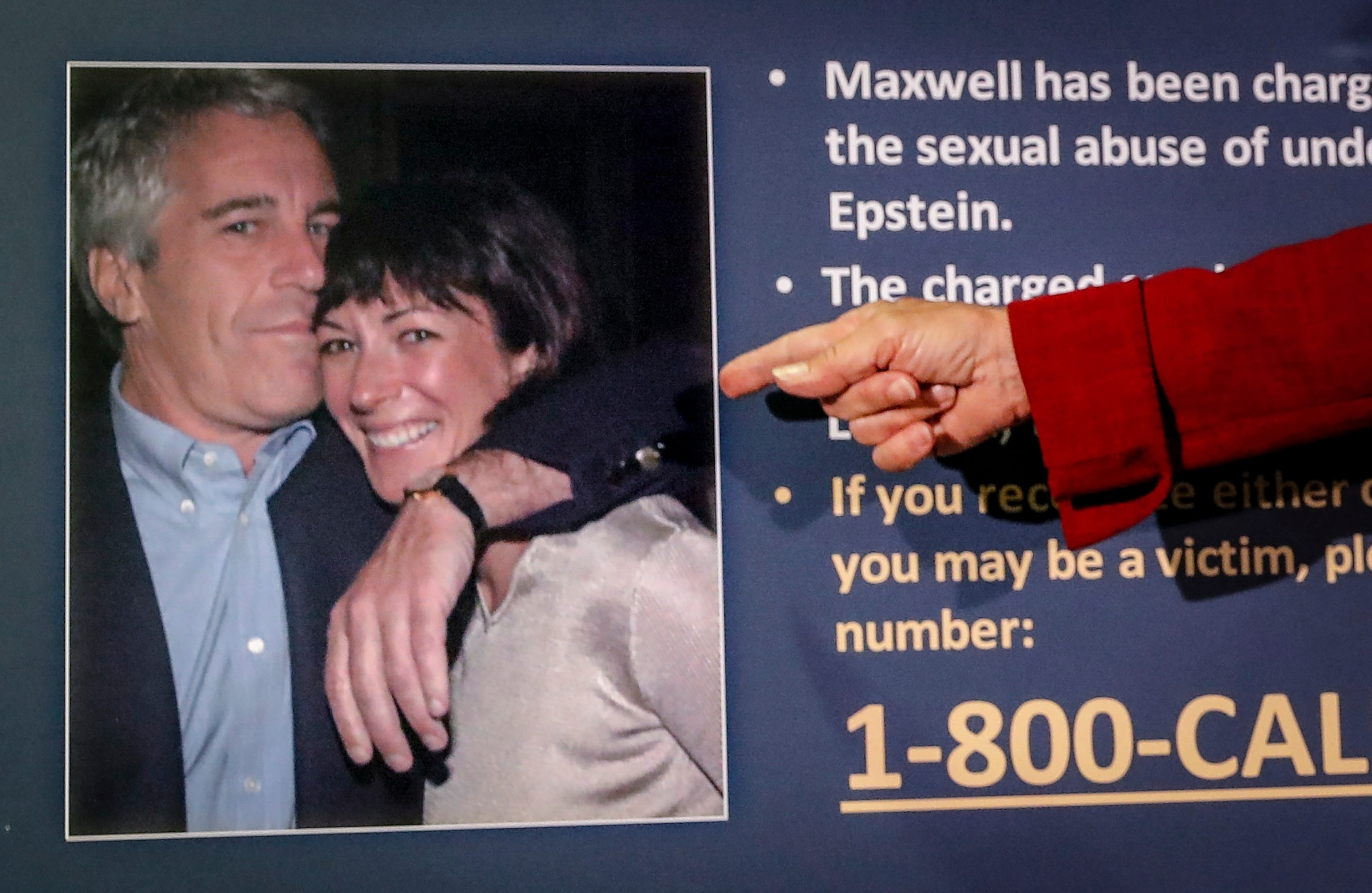
FILE – Audrey Strauss, acting U.S. attorney for the Southern District of New York, points to a photo of Jeffrey Epstein and Ghislaine Maxwell, during a news conference in New York on July 2, 2020.
John Minchillo/AP
DOJ did not immediately respond to request for comment. A lawyer for Maxwell did not immediately respond.
The second meeting between Maxwell and Blanche lasted for about three hours.
Maxwell’s attorney, David Markus, told ABC News afterward, “There have been no asks and no promises.”
Markus said Maxwell was asked about “maybe 100 different people” during her interview with the deputy attorney general. He said she answered every question.
“She didn’t hold anything back,” Markus said.
He declined to be specific about who Maxwell was asked about or whether she provided information about others who might have allegedly committed crimes against victims, as Blanche said he was seeking.
“We haven’t asked for anything. This is not a situation where we are asking for anything in return for testimony or anything like that,” Markus added on Friday. “Of course, everybody knows Ms. Maxwell would welcome any relief.”
Blanche didn’t speak to reporters upon his arrival at the federal courthouse in Tallahassee, Florida. On social media, Blanche said he would reveal what he learned from Maxwell “at the appropriate time.”
FILE – Audrey Strauss, acting U.S. attorney for the Southern District of New York, points to a photo of Jeffrey Epstein and Ghislaine Maxwell, during a news conference in New York on July 2, 2020.
John Minchillo/AP
The first meeting between Maxwell and Blanche on Thursday lasted six hours.
Maxwell is currently appealing her 20-year prison sentence for child sex trafficking and other offenses in connection with Epstein, the deceased financier and convicted sex offender.
“We don’t want to get into the substance of the questions,” Markus had said about Thursday’s meeting. “There were a lot of questions and we went all day and she answered every one of them. She never said ‘I’m not going to answer,’ never declined.”
It is almost unheard of for a convicted sex trafficker to meet with such a high-ranking Justice Department official, especially one who used to be the president’s top criminal defense attorney.
ABC News Chief White House Correspondent Mary Bruce asked President Donald Trump on Friday if clemency is on the table for Maxwell.
“I can’t talk about that now because, you know, it’s a very sensitive interview going on,” Trump responded. He went on to call Blanche a “great attorney” and said “I don’t know exactly what’s happening. But I certainly can’t talk about pardons.”
Trump was also pressed by ABC News’ Bruce if he can trust what Maxwell is telling the DOJ during these interviews.
“Well, he’s a professional lawyer. He’s been through things like this before,” Trump said, referring to Blanche.
After Trump’s comments on Friday about clemency, ABC News asked Maxwell’s attorney whether that gave her an incentive to tell Blanche what he wanted to hear.
“No,” Markus answered. “She wants to tell the truth.”
Markus said Maxwell’s legal team has not approached Trump about a pardon, but suggested it could happen in the future.
“We haven’t spoken to the president or anyone about a pardon just yet. And listen, the president this morning said he had the power to do so we hope he exercises that power in the right and just way,” he said.
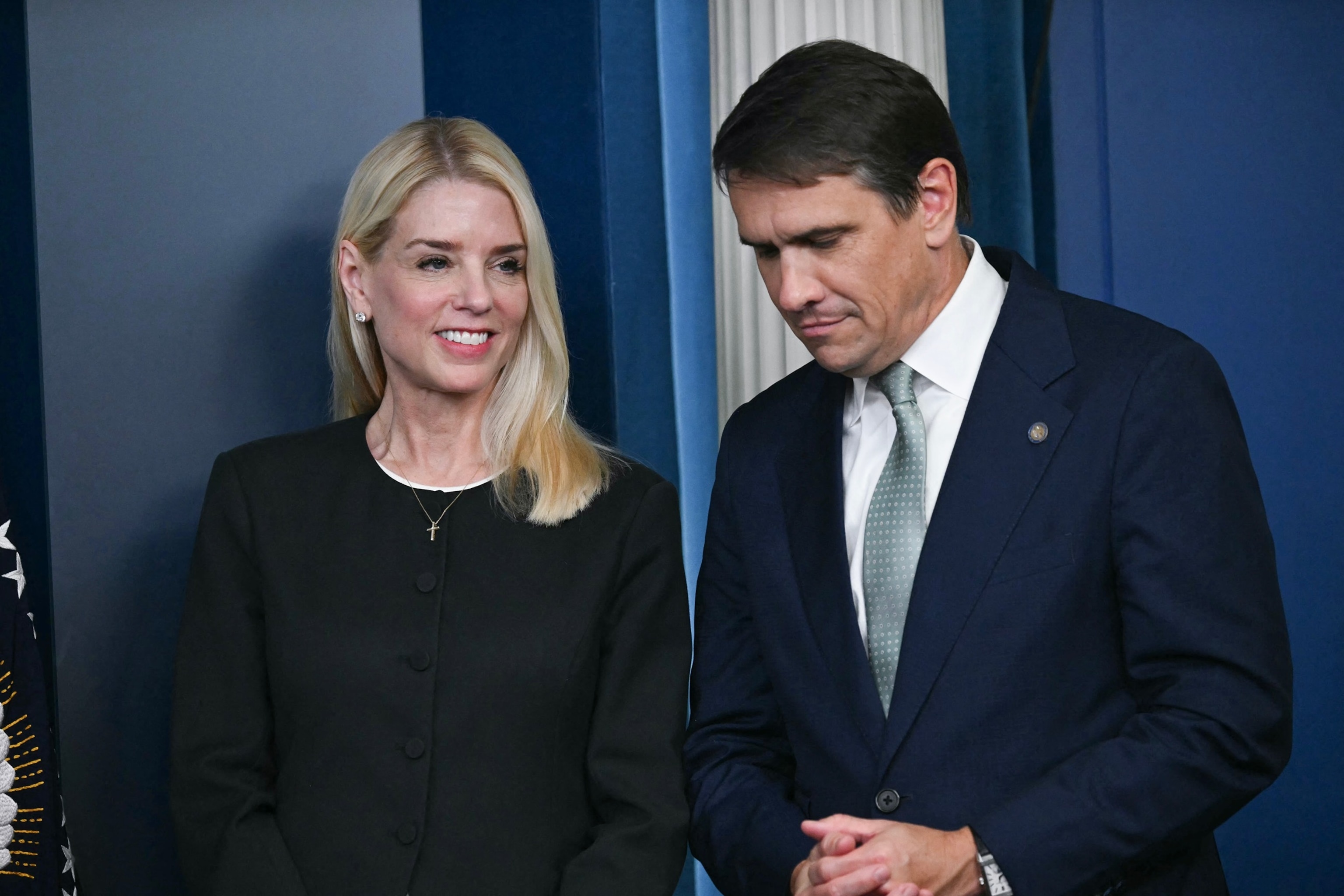
Attorney General Pam Bondi and Deputy Attorney General Todd Blanche look on as US President Donald Trump (not on frame) speaks during a news conference in the Brady Briefing Room of the White House on June 27, 2025, in Washington, DC.
Andrew Caballero-reynolds/AFP via Getty Images
Annie Farmer, who testified against Maxwell at trial, questioned why Maxwell was granted a meeting with the deputy attorney general in the first place.
“It’s very disappointing that these things are happening behind closed doors without any input from the people that the government asked to come forward and speak against her in order to put her away,” Farmer said. “There were so many young girls and women that were harmed by her.”
Maxwell’s attorney said on Friday she’s been treated poorly for the last five years and is grateful to be able to meet with Blanche as she appeals her sex trafficking conviction and seeks to leave prison.
“If you looked up scapegoat in the dictionary, her picture would be next to the definition,” Markus said. “She’s keeping her spirits up as best she can.”
Blanche’s meetings with Maxwell comes as the Justice Department has tried to quiet calls from Senate Republicans to release more information about Epstein and his interaction with high-profile figures.
And it comes as questions swirl about Trump’s connections to Epstein and reports that his name appeared in the Epstein files.
The Wall Street Journal reports that Attorney General Pam Bondi told Trump in May that his name was mentioned in the Epstein files multiple times, along with other high-profile people.
Trump has denied that account, and appearing in the files is not necessarily indicative of any wrongdoing.
“I want all the information out,” said Republican Sen. Josh Hawley.
“Just put everything out, make it as transparent as you can,” echoed Republican Sen. Lindsey Graham.
The Justice Department said earlier this month that it planned to release no additional information despite an earlier commitment to do so.