One voice was yelling he was a US citizen. The conditions are horrible. They get their drinking water from the toilet. Maxwell Frost is a progressive treasure. Hugs
Noem is more interested in her face than in providing assistance to the Texas flood survivors Read on Substack
ICE Barbie, Kristi Noem, the Director of Homeland Security, is failing at her job miserably.
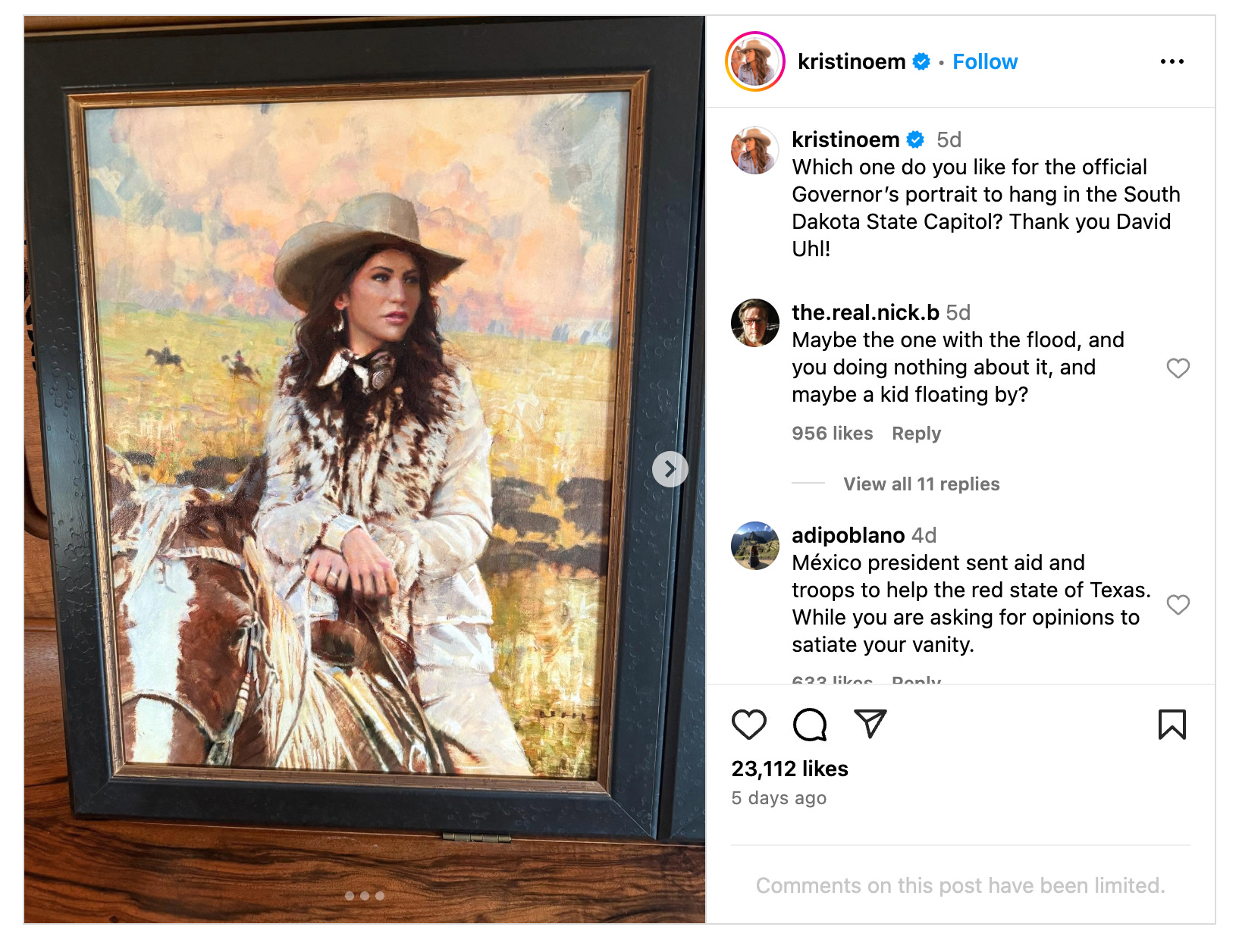
A portrait of Noem is going to be displayed in the South Dakota Capitol building, and there are three options. Who gives a shit, right? Kristi Noem, that’s who. Noem went on Instagram and posted to her creepy followers, “Which one do you like for the official Governor’s portrait to hang in the South Dakota State Capitol? Thank you David Uhl!” She added the three paintings of herself on horseback by artist David Uhl.”
She did this five days ago, during the floods in Texas that have killed at least 120 so far.
Here are the other two portraits.
I wonder how much South Dakota tax money was spent on this.
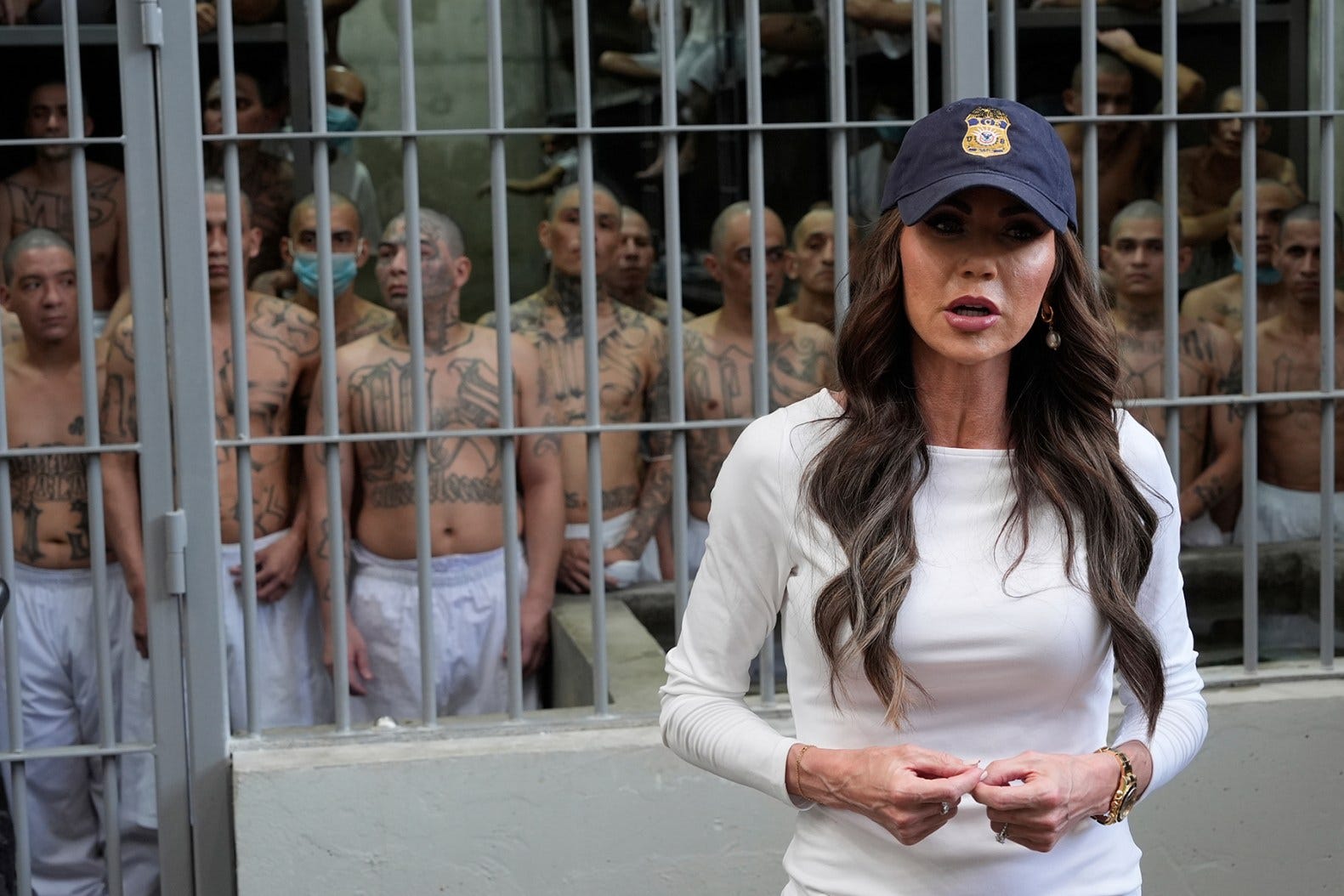
Before Noem’s survey about herself, Puppy-Killah Kristi did her stupid photo-op in El Salvador with the notorious prison behind her, with Trump deportees as props. She was in full makeup while making sure her shiny $10,000 Rolex was visible, which is probably less than her teeth cost.
She’s done other photos with guns, posing as an ICE agent. In one of them, she wasn’t holding the gun correctly and got roasted for it online. I bet she can’t ride a horse either.
We should be relieved that she didn’t shoot that ICE agent in the face. In her defense, she does know how to shoot a gun because that’s how she murdered her puppy. So there, critics.
Kristi is the kind of person that if you went out to dinner with her, she’d humbly say at some point, “Enough of me talking about myself. Now let’s hear you talk about me.” She can’t get over herself. She might be the female equivalent of Donald Trump. She already has the fake hair, and now she just needs the ridiculous tie, the orange make-up, and an adult diaper that hasn’t been changed since his first flip-flop on tariffs.
Remember, Kristi used to look like this…
…before she looked like this.
She definitely went for the Melania look, which is an improvement over the look for hunting wolves from a helicopter. She even got free dental work while she was governor, on the condition that she make a commercial for the Texas dentist who did her work.
It seems that’s the only time she’s interested in Texas, when she can get free dental work, but not when there’s a disaster.
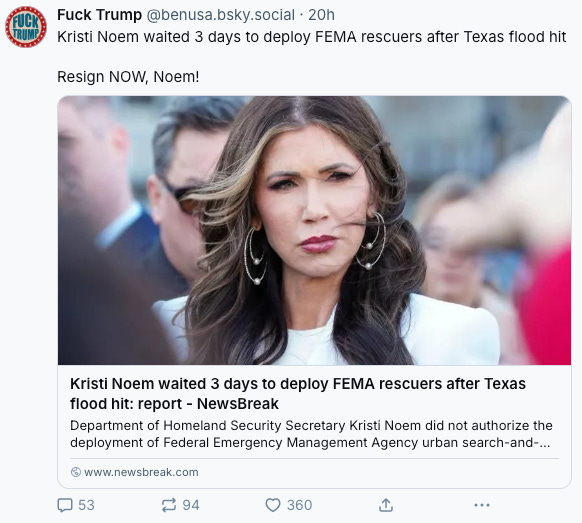
According to The New York Times, two days after catastrophic floods roared through Central Texas, the Federal Emergency Management Agency (FEMA) did not answer nearly two-thirds of calls to its disaster assistance line.
An anonymous source close to the issue said the lack of responsiveness happened because the agency had fired hundreds of contractors at call centers.
FEMA, which is a part of Homeland Security (I have to include that because trolls are commenting on this cartoon on Facebook asking, “What’s DHS got to do with FEMA?”), laid off the contractors on July 5 after their contracts expired and were not extended, according to the documents and the person briefed on the matter. Noem, who has instituted a new requirement that she personally approve expenses over $100,000, did not renew the contracts until Thursday, five days after the contracts expired, and about a week after the floods started.
Where was ICE Barbie? She was probably spending her time looking at herself in a mirror, or maybe she confused Texas for one of the seven Native American tribes that banned her from their reservations.
Adam Zyglis: There’s a part of this cartoon that is my standing in solidarity with my colleague Adam Zyglis. So what happened with Adam? Adam, who works for the Buffalo News, drew a cartoon mocking Republican hypocrisy, asking for federal aid after protesting against federal disaster relief for other states. This has upset Republicans, which shows more hypocrisy for the gang that shouts “snowflake” at their political opponents. They even cried on Fox News about it.
Now, an event at the Buffalo History Museum by the Buffalo News Guild, which was to feature Adam among other journalists, has been postponed because of “credible” death threats toward Adam and his family.
And just today, a MAGAt posted on one of my client’s shares of a cartoon of mine about how Democrats are the violent ones. (snip-MORE, and it’s great)
There is a video at the link below. I watched this. ICE went in to terrorize and prove they could. They had a military style attack helicopter. This is going to get worse. They are the tRump admin Gestapo, armed thugs who follow no rules attacking people who have violated no criminal laws. Even if they were undocumented they had broken no laws as crossing the border illegally is a civil offense like speeding. Hugs
Border Czar Tom Homan on Friday angrily condemned the violence at a California pot farm as proof anti-ICE protests will turn deadly, blaming the inflammatory rhetoric of Democrats comparing agents to Nazis.
Homan spoke out the morning after protesters were seen hurling rocks — and one even appeared to fire a gun — at agents stamping down on a massive marijuana operation where they found 10 illegal-migrant juveniles, eight of whom were there without an adult.
“What happened in California is just another example of protesters becoming criminals, and they’ve been emboldened by even members of Congress who compare ICE to Nazis and racists and terrorists,” Homan said on “Fox & Friends” Friday morning.
A protester flees as ICE officers fire chemical agents into the crowd during a raid in Camarillo, California.AFP via Getty Images
“I said months ago, it’s going to end up with a loss of life — and we had one the other day in Texas, and it’s not over,” he said, referencing the gunman who opened fire on border patrol agents walking into work in McAllen Monday.
Immigration agents who descended on Glass House Farms in the city of Camarillo — one of the biggest cannabis farms in Southern California — were met by dozens of demonstrators gathered on a road between fields where the uniformed officers stood in a line across from them.
A military-style helicopter flew overhead, video shows.
Tear gas billows from canisters thrown by federal agents toward protesters in Camarillo, California.via REUTERS
Protesters shouted and screeched until agents used canisters with an unknown substance and fired less-than-lethal rounds, forcing them to retreat. Several of the protesters threw what appeared to be rocks back at the officers, according to ABC 7.
As they retreated, a masked man in all black appeared to let off a few shots among a crowd of other protesters scampering away from advancing agents.
The FBI has now launched an investigation into the alleged shooting and is offering a reward up to $50,000 for information leading to a conviction.
An individual was spotted allegedly firing a weapon toward federal agents.ABC 7
The clash lasted four hours as US Customs and Border Protection set up a blockade with military-style vehicles in the pastoral region.
Video from ABC 7 shows numerous workers being taken into custody at the scene. It’s unclear exactly how many were detained.
Five people were taken to the hospital, according to the Los Angeles Times.
The farm is now under investigation for child labor violations, CBP Commissioner Rodney Scott announced late Thursday night after 10 juveniles — “all illegal aliens” — were found at the facility, including eight without an adult, he said.
Protesters stand in front of ICE agents near a pot farm in Camarillo, California.Getty Images
Glass House Farms said it “fully complied with agent search warrants.”
The stand-off drew widespread criticism from California leaders, including U.S. Congressman Salud Carbajal, who was denied entry when he tried to get past federal agents into the farm.
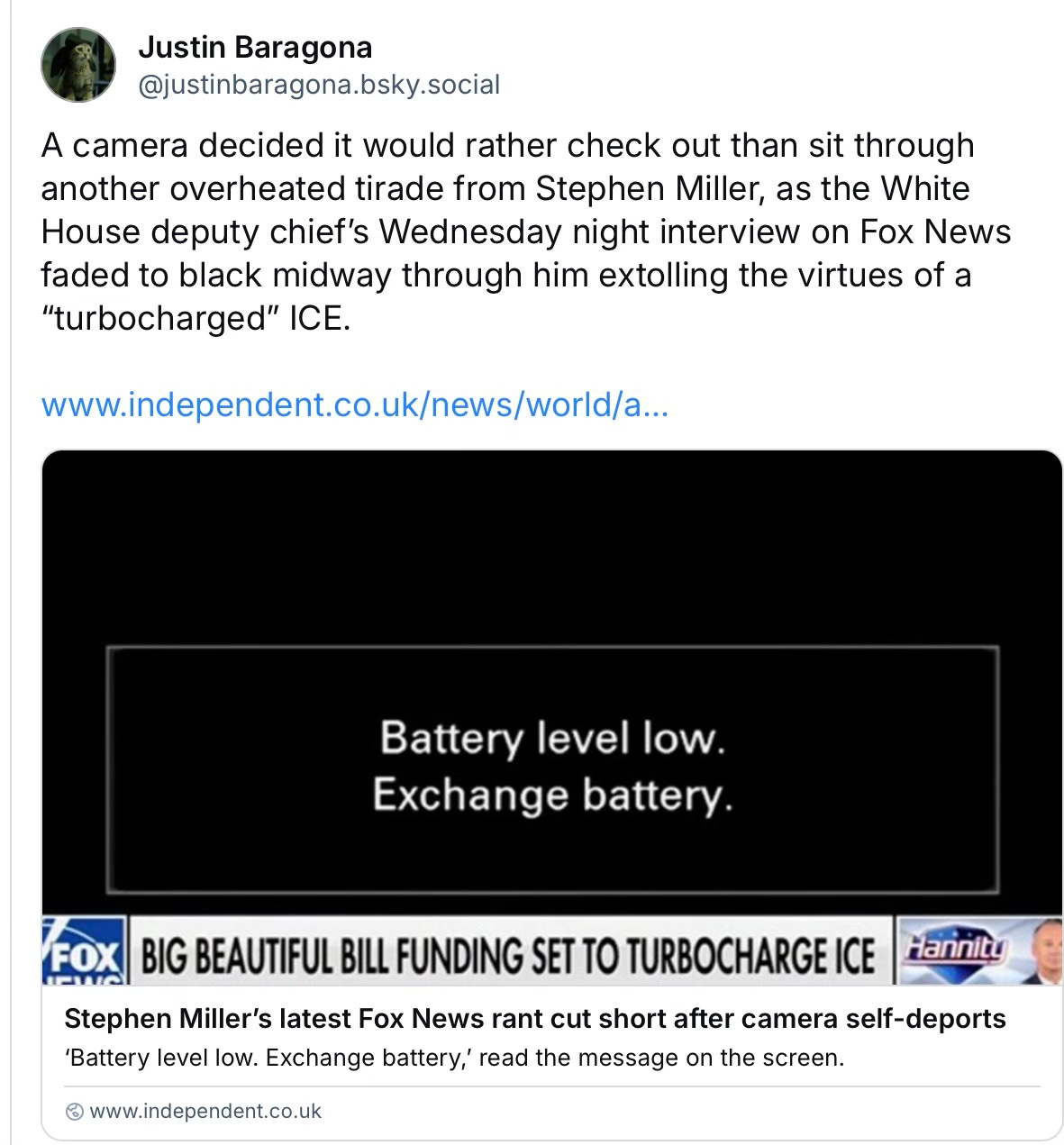
Newsom’s office accused President Trump’s advisor, Stephen Miller, of sparking “terror” in local communities.
A protester washes eye with milk after federal immigration agents tossed tear gas during a raid in Camarillo, California.AP
“There’s a real cost to these inhumane immigration actions on hardworking families and communities, including farmworker communities, across America,” Newsom’s office said.
“Instead of supporting the businesses and workers that drive our economy and way of life, Stephen Miller’s tactics evoke chaos, fear and terror within our communities at every turn.”
I see that our recycling center has closed until further notice. International Paper, downsizing, has closed its recycling plant in Wichita, laying off all those employees, I saw on the newscast from the station I linked. Their story links a release from IP about all their closures and their plans for the year. The release is dated Feb. 13, of 2025. There’s another release from the Wichita Business Journal about the Wichita plant, but it says little to nothing. (No link from them; they’re mostly Kansans and Americans For Prosperity, anyway.)
Earlier, I got the idea to search if IP’s downsizing is due to recission of tax cuts and to tariffs. Gemini (who always volunteers though I never ask, preferring to find a link to a known source) says that while it cannot state that those things cause the downsizing in full, it also cannot state that those aren’t in the mix. (Because I do skim Gemini’s stuff.)
So, this hurts a bit: the closing of our recycling facility, as well as the Wichita one. During the first Trump admin, when POTUS began that trade war with China, China reciprocated by, possibly among other things, refusing anymore plastic recycling from the US. Our facility couldn’t find a place that did the recycling; no one else does it. China does it very economically though of course there is the question of what it’s really doing with the plastic, but another story for another time.
Anyway, in those days, I was an active BPW member. One of the things we worked hard on was getting a recycling collection facility here in town. We lobbied hard, both the public and the council, for use of an unused building (the former firehouse,) and possibly the use of a big truck for hauling the recycling collected to the recycler. We asked for no funding, we had willing volunteers; all the civic organizations set up volunteer schedules. We just needed the facility and a way to haul. Before the facility came about, I became a member of the city Planning Commission, so I couldn’t continue in that effort until after it was decided by the council. But, it was a happy circumstance that there was a plan for recycling in the existing Strategic Plan, even then! That’s always a big help, when something’s in the Strat Plan.
So, this was not a thing that came before the Planning Commission. I was not on Zoning Appeals at that time, so I have no idea if they got it, but as it came to reality, that wouldn’t have been necessary. It was decided that that firehouse building would become the collection facility, it would be staffed with volunteers but with a city worker or two there because it’s city property and insurance insists on that, and a city worker would do the hauling. Yay! It was open each Saturday from 9 until noon, and people needed to bring their recycling, preferably sorted, to the facility where volunteers then helped getting things where they went.
Eventually it grew, and there weren’t enough volunteers every Saturday to keep the lines moving reasonably. It went before the council to staff another one or two. There would still be volunteers there to keep things moving without too much staff. (People here in town like nice things, but don’t like paying for them.) The council approved, and the facility also opened on Mondays from 11 AM to 1 PM. That way, downtown business, who go through a lot of corrugated cardboard and bubble wrap, could get theirs done without as many of the public. Also, the staffers could actually get the stuff loaded in time for it to go to the recycler.
I just went there last week to drop recycling. We usually accrue enough corrugated cardboard and chipboard to unload at least once per month. We’ve cut paper back a lot, and again, plastic hasn’t been accepted since Trump p.o.’d China last term, so that’s not so much. Even so, where we usually have a single trash bag to go out for pickup, I think we’re going to have more that now has to go to the landfill.
I may be taking it too seriously, but I feel the way I did when the SCOTUS overturned their own decision in Roe v. Wade. We worked hard for it, we had it, it was good for all, and now it’s gone.
I hope this hasn’t bored anyone very much. It’s more sentimental than I usually am when posting such stuff. Still, our recycling collection facilities closing, or really, any big companies downsizing, is happening everywhere, and is affecting many, many people. I feel for all the Wichita workers who will have no jobs just in time for school shopping. So, I thought I’d post, because we all have to keep our eyes open for this happening around us everywhere. Thanks for your time! 🌞
I was struck by the backlash to the Texan pediatrician who was ostracized and lost her job because she pointed out that decisions have consequences, and all those who voted for drumpf in Texas are experiencing those painful consequences. Painful words uttered in despair, but damn – that doesn’t make them any less true.
How many times have we heard the line that “now isn’t the time to talk about this”? We’ve seen it with the debate on gun laws, and now we see it on this horrible consequence of firing those who warn us of dangerous weather.
But once again people have died, children have died, destruction and despair are gripping our nation, and the cause of that horror is not open for discussion? It’s being political in a time of national mourning? It’s insensitive? Decisions made in comfort and greed by those untouched by the disaster have exacted the ultimate cost, and they once again seek to control the conversation by denying the ability to explore how it happened!
So, is it safe to talk about these things now? Is it ok to talk about how stripping the social safety nets have consequences? Is it ok to seek to examine what we as a country believe in now, or are we waiting for the next disaster to blow through, the NEXT time parents weep looking for lost and dead children, or will it be one of the times after that? How long must we listen to the powerful deny the impact of greed, arrogance and ignorance.
And, to respond to this fool Abbott; Smart teams look to see if the wrong plays were called, or more likely, the wrong people were making the wrong decisions.
Far from the front lines of the climate crisis, 100 men and women in air-conditioned offices, 61 of them millionaires, are making decisions that could increase United States carbon dioxide emissions, and the warming of the climate they are driving, for decades to come.
In the latest political wrangle over energy and climate policy, a group of Republican senators over the weekend added provisions to the US federal budget bill that, as currently written, would end clean energy tax credits at the personal level and at utility scale and increase taxes on foreign-made parts for solar power equipment.
Ending federal subsidies for most renewable energy projects, including residential heat pumps, for example, would affect thousands of projects that are already in planning or development and jeopardize future investments in manufacturing renewable energy equipment.
Friday, June 27, hours before the Senate released the latest draft of the reconciliation bill just after midnight, US Secretary of Energy Chris Wright claimed on the Department of Energy website that wind and solar are unreliable and that federal subsidies have made energy more expensive, although he did not cite any official reports or peer-reviewed studies to support that claim.
On the Department of Energy website, Wright wrote, “wind and solar brings us the worst of two worlds: less reliable energy delivery and higher electric bills …If sources are truly economically viable, let’s allow them to stand on their own,” he wrote, ignoring that the fossil fuel industry gets annual subsidies of about $20 billion annually, according to estimates by Oil Change International, a nonprofit watchdog group.
But hundreds of studies show that renewable energy is much less expensive and, in a well-planned grid, can make energy supplies more secure.
“The proposed GOP tax on wind and solar is a danger to the United States,” Mark Z. Jacobson, a Stanford University renewable energy researcher who has authored numerous studies on wind and solar power, wrote via email.
The new tax provisions “lock in death and illness to up to 100,000 Americans every year due to fossil-fuel and bioenergy-fuel air pollution that wind and solar help to eliminate,” he said.
An early evaluation shows the administration’s planned energy policies would result in the drilling of 50,000 new oil wells every year for the next few years, he said, adding that it “ensures the continuation of land devastation… the poisoning of soil and groundwater due to fossil fuels and the continuation of gas blowouts and fires.”
There is nothing beneficial about the tax, he said, “only guaranteed misery.”
An analysis by the Rhodium Group, and energy policy research institute, projected that the Republican regime’s proposed energy policies would result in about 4 billion tons more greenhouse gas emissions than a continuation of current policies—enough to raise the average global temperature by .0072° Fahrenheit.
The overall budget bill was also panned in a June 28 statement by the president of North America’s Building Trades Unions, Sean McGarvey.
McGarvey called it “a massive insult to the working men and women of North America’s Building Trades Unions and all construction workers.”
He said that, as written, the budget “stands to be the biggest job-killing bill in the history of this country,” potentially costing as many jobs as shutting down 1,000 Keystone X pipeline projects, threatening an estimated 1.75 million construction jobs and over 3 billion work hours, which translates to $148 billion in lost annual wages and benefits.
“These are staggering and unfathomable job loss numbers, and the bill throws yet another lifeline and competitive advantage to China in the race for global energy dominance,” he said.
Research in recent years shows how right-wing populist and nationalist ideologies have used anti-renewable energy arguments to win voters, in defiance of environmental logic and scientific fact, in part by using social media to spread misleading and false information about wind, solar and other emissions-free electricity sources.
The same forces now seem to be at work in the US, said Stephan Lewandowsky, a cognitive psychologist at the University of Bristol who studies how people respond to misinformation and propaganda, and why people reject well-established scientific facts, such as those regarding climate change.
“This is a bonus for fossil fuels at the expense of future generations and the future of the American economy,” he said. “Other countries will continue working towards renewable-energy economies, especially China. That competitive advantage will eventually pay out to the detriment of American businesses. You can’t negotiate with the laws of physics.”
We did not record a podcast last week because Donna was traveling to Austin, where her family was celebrating Fourth of July AND the arrival of a new baby (her grand-niece!).
She expected hot, humid weather. What she got was four days of torrential rain, and the specter of over one hundred deaths from flooding in the nearby hill counties – including children at a sleep away camp that was overcome by the deluge.
One week later, this tragedy is ongoing. People are wondering how much DOGE’s cuts to the National Weather Service and NOAA factored into it. Journalist Marisa Kabas has reported that as of Monday, only 86 FEMA employees were on the ground in Texas (they usually deploy hundreds of people to disaster zones like this). “We are doing a lot less than normal,” a FEMA staffer told her.
No shit.
In the meantime, $450 million from FEMA’s budget has been allocated to that concentration camp in the swamps of Florida. And Trump’s big, ugly budget bill allocates billions to expand ICE and build more “detention centers” throughout the country.
ICE continues to terrorize immigrant communities, kidnapping law-abiding parents, gardeners, day laborers, and others who just happen to have brown skin (including US citizens).Donna returned home to Los Angeles in time for a show of military cosplay in MacArthur Park. No one got hurt in that one – but it felt like a dress rehearsal for something worse.
We talked about that and more in this week’s podcast.
We are living through history and it really sucks. Aliza says that the best way to deal with the continual onslaught of terrible events is to DO something. Anything. Volunteer in the community. Participate in events. Write postcards for candidates, donate to good causes.
And allow yourself the down time you need to muster up the energy to do it again.
We talked about some of the everyday heroes who are helping us all muster through this.
Like Joshua Aaron, the developer of the ICEBlock app that alerts people of ICE activity in their area. (Currently just for iPhones; we are anxiously awaiting news that this app will become available to Android users.)
The ACLU has done heroic work for over a century. After recording this week’s podcast, we were dismayed to learn that their Mobile Justice app Aliza has relied upon for years is no longer available.
To ensure compliance with a growing number of consumer privacy laws and the ACLU’s own privacy policies and to minimize risk with surveillance technologies currently used by law enforcement, the national office has made the decision not to renew our contract with Quadrant 2, the vendor behind Mobile Justice, and shut down the app on February 28, 2025.
But the ACLU is still a source of valuable information. Here are a couple of pages that you may want to bookmark:
There are things you can do as a bystander, too. This Yahoo article talks about New York City, but much of it applies anywhere in the U.S. It’s completely legal to film an ICE encounter, and the article has great suggestions for how to narrate and what details to include. There is advice on how your video can help, but it’s also important not to post your videos online without the consent of the person being detained.
The National Immigrant Justice Center is just one of many organizations with so much information on how to handle encounters with ICE or DHS, whether you are the target or a bystander.
The coalition of anti-authoritarian groups that has risen since the start of this regime continue to organize. The next big nationwide gathering is “Good Trouble Lives On,” which will be held in honor of the late John Lewis, around the July 17 anniversary of his death. Find an event near you here.
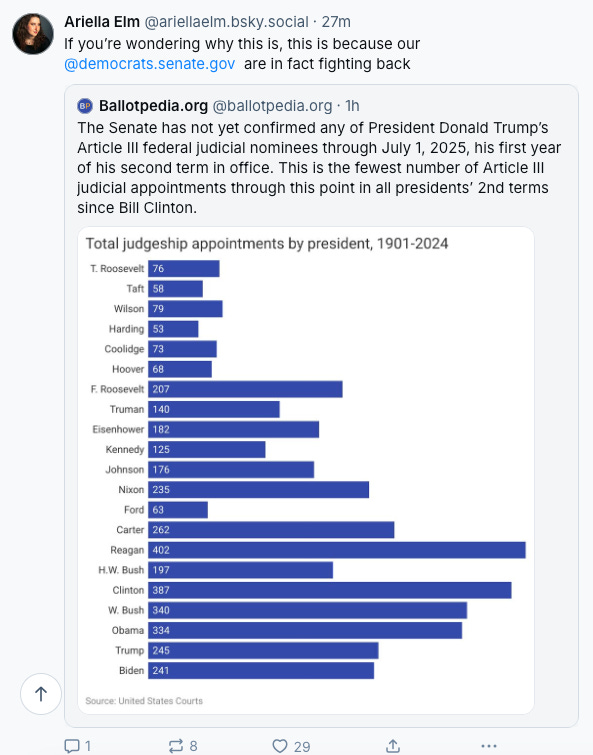
And in case you’re one of those “DO SOMETHING” people who love to bash Democrats, remember that they ARE doing something. A LOT. If you want to know what, you should follow Ariella Elm on any of the socials. She makes posts like the ones below, and daily posts like this one that list the wins for democracy and actions all over the country that are helping stem the tide of fascism, and we need to thank and elevate these soldiers for democracy.
Community activists in San Francisco are rallying to support Hilary Rivers, an immigrant drag queen who was arrested by ICE agents after an asylum hearing nearly two weeks ago — one of the latest LGBTQ+ victims of the Trump administration’s campaign for mass deportations.
Rivers fled his home in Guatemala due to “traumatic and severe” persecution for being gay, as the San Francisco Chronicle reported last week. (His legal name is not being widely reported to protect his confidentiality, advocates told the nonprofit news platform 48Hills.org shortly following the drag performer’s arrest.) On June 26, Rivers attended a scheduled asylum hearing, where the government’s motion to dismiss his case was denied; Rivers was then arrested by ICE agents as he left the courtroom. That combination — in which the government attempts to dismiss an asylum case, then immediately arrests the asylum seeker for deportation — has become an increasingly common tactic for U.S. immigration police in the past several months, and one that is sometimes conducted with cooperation from courthouses themselves. (snip-MORE)
Transgender pilot Jo Ellis was falsely accused of killing 67 people earlier this year — and unfortunately, she isn’t alone: right-wing hoaxers have blamed trans people for at least 12 incidents of violent death in the U.S. since 2022, according to a new analysis in Wired.
Ellis, a part-time pilot in the Virginia Army National Guard, filed suit against right wing influencer Matt Wallace in April, after Wallace shared false claims that Ellis was responsible for the January helicopter crash at Ronald Reagan International Airport that killed dozens. The crash was later determined to be an accident caused by years of poor safety practices at the airport. But Ellis soon found herself on the receiving end of right-wing hatred thanks in part to people like Wallace, who posted on Elon Musk’s X platform that the crash “may have been another trans terror attack.”
Wallace has since deleted the post about Ellis, as Wired noted. But the key word in that post was “another.” In the past two years, right-wing disinformation accounts — such as Chaya Raichik’s “Libs of TikTok” — have spread similar false accusations against trans people on at least a dozen occasions, according to Wired’s analysis of news reports across that period. (snip-MORE)
I know in the last few days I have posted a lot of what I think is important stuff. But if you have ever wanted to hear a grand response to a hate preacher calling for the death of gay people then you need to watch this video. The reverend is as upset and agitated as I have ever seen him. He not only debunks the hate preachers arguments but uses the verses before and after to show how wrong people that use that to hate on gays are. Hugs.