Discover the cosmos! Each day a different image or photograph of our fascinating universe is featured, along with a brief explanation written by a professional astronomer.
Explanation: Apollo 14’s Lunar Module Antares landed on the Moon on February 5, 1971. Toward the end of the stay astronaut Ed Mitchell snapped a series of photos of the lunar surface while looking out a window, assembled into this detailed mosaic by Apollo Lunar Surface Journal editor Eric Jones. The view looks across the Fra Mauro highlands to the northwest of the landing site after the Apollo 14 astronauts had completed their second and final walk on the Moon. Prominent in the foreground is their Modular Equipment Transporter, a two-wheeled, rickshaw-like device used to carry tools and samples. Near the horizon at top center is a 1.5 meter wide boulder dubbed Turtle rock. In the shallow crater below Turtle rock is the long white handle of a sampling instrument, thrown there javelin-style by Mitchell. Mitchell’s fellow moonwalker and first American in space, Alan Shepard, also used a makeshift six iron to hit two golf balls. One of Shepard’s golf balls is just visible as a white spot below Mitchell’s javelin.
I love Erin’s posts and reporting. The attack on trans rights and health was planned and coordinated by religious conservatives who felt they lost the culture war on gay acceptance and same sex marriage so they decided to jump quickly on the trans issue with lots of money. Their first attempt failed because they went after the idea of trans people itself. So then they changed to the old “protect the children” play book with the entire focus on protecting little cis girls but they never mention the trans boys that cis boys need to be protected from. See how patristical it is? It is all about males needing to protect the little womans. They don’t care about trans kids, they don’t care about female sports. It is about not letting trans kids transition with puberty blockers and the correct hormones as then the kids will grow up as they are fitting the societal view of what men and women look like. That scares the straight cis male religious guys because they are terrified they will be attracted to a trans woman. Imagine the horror if trans people moved freely in society not raising any question of their gender because they conformed to how society sees each gender. That sounds like a grand thing to me, but it terrifies these fanatical religious grifters that want to control how everyone lives to please their god. They make up untrue and scary what ifs, what if a man uses the letting trans people use the bathroom of their gender ID to go into a girls … notice they phrase it girls not womans because that make people more protective from the start, and they harm a little girl, your little girl? Well nothing stops a man from doing that now! Predators don’t need permission and won’t wait for it. And that has happened where a straight cis male dragged a little girl into the male bathroom and raped her while his friend watched. There was a famous court case on it. Look it up if you want. Want to know what has not happened, a trans woman going into the female’s bathroom and assaulting a female. Sorry. The right has tried hard to make one happen, but each claim of a trans person in a locker room or bathroom acting inappropriate has been debunked and disproven. This is all a made up scandal and crisis by people who can not accept the society progressing beyond the old traditional binary they grew up with and they think their holy books claim must be as their god insists on it. Weird how it is always how their god insists on what they already believe or promote. Handy that. So many people can not move past the idea that if it dangles you MUST be a boy regardless of how you feel and if it is an inny you must be a girl regardless of anything else idea. They can not seem to grasp personal feelings, needs, or medial science. Hugs
The bill would establish the Affirming Health Care Trust Fund, administered by the State Treasurer, to support clinics and providers outside the reach of federal funding threats.
Vermont Bill Would Create State Trust Fund For Private Trans Youth Care Clinics As Trump Threatens Hospital Funding
The bill would establish the Affirming Health Care Trust Fund, administered by the State Treasurer, to support clinics and providers outside the reach of federal funding threats.
Erin In The Morning is a reader-supported publication. To receive new posts and support my work, consider becoming a subscriber.
Across the United States, gender-affirming care has come under sustained attack in Republican-led states and from the Trump administration. For transgender youth, those attacks have been especially severe, with roughly half of U.S. states now banning such care outright. At the federal level, the administration has waged an intense pressure campaign against hospitals, threatening funding and prompting many systems to drop their care programs altogether. That campaign has now escalated further, with the federal government moving to threaten hospitals’ entire Medicaid and Medicare funding if they continue providing transgender youth care. In response, some states and cities are beginning to fight back by establishing their own funding mechanisms for trans healthcare. The latest example comes from Vermont, where lawmakers have introduced a bill to create a trust fund for gender-affirming care designed to be entirely insulated from federal funding threats.
H.576, introduced by Representatives Daisy Berbeco, Tiffany Bluemle, and Troy Headrick, would establish the Affirming Health Care Trust Fund. Administered by the State Treasurer, the fund would provide direct monetary support to healthcare providers and nonprofits offering gender-affirming care in Vermont. It would cover costs for patients who would otherwise go without treatment, fund the establishment of Vermont-based clinics, and pay for malpractice and liability insurance for clinicians who continue offering care. The bill is part of an increasing movement towards private clinics as a mechanism to survive federal threats.
The bill also includes provisions designed to protect patient information from both federal pressure and out-of-state threats, going further than the recent “refuge” or “shield” laws passed in several blue states to protect transgender youth care. It explicitly bars the board and other state actors from disclosing patient-identifiable data, the identities of providers, or the identities of award recipients to the federal government. This is a significant protection given the wave of abusive legislation and attempts to subpoena transgender healthcare records nationwide. While federal preemption may ultimately be litigated, these provisions give clinics a stronger legal footing to resist such demands—particularly as similar subpoenas have been repeatedly quashed in recent court cases.
The bill comes as families scramble to locate alternatives to hospital systems that are abandoning them. With more than 20 hospitals closing their doors to transgender youth care out of fear and preemptive compliance with the Trump administration, many families have been forced to seek alternatives. Just this week, major hospital systems across Colorado, for example, have stopped providing care. Groups like the Trans Youth Emergency Project say they have the capacity to refer displaced patients to private clinics, and in many places those clinics do exist and are absorbing demand. But as hospital-based programs continue to shut down and demand rises, those private providers will need sustained support—and more clinics will need to be created. Bills like this are a targeted way to do exactly that.
If this bill passes, Vermont would be the latest state to protect care in this way—but it would not be the only one. Massachusetts passed a similar measure last year, allocating $1 million toward transgender youth care clinics, though that funding has already come under criticism as insufficient to meet statewide need in the wake of major clinic closures. In New York City, newly elected mayor Zohran Mamdani has pledged $65 million for transgender healthcare. If that funding is realized, it would position New York City as a major hub for private clinics capable of absorbing demand created by hospital closures across the country. This strategy could prove to be a critical backstop for private providers that are already emerging—and that are likely to come under increasing strain in the years ahead.
The bill allows funding from state appropriations, private donations, grants, and—importantly—federal funds under a future administration that is protective of transgender healthcare. It would take effect immediately upon passage, with the board required to convene by August 1, 2026. There are still hurdles ahead: the bill must advance through committee, pass both chambers, and ultimately receive meaningful funding to function as intended. But its introduction alone signals something important. At a moment when hospitals are retreating and families are being forced into crisis planning, Vermont lawmakers are putting forward a concrete framework to protect access to care rather than surrender it. For Vermonters who want to see their state take a clear stand, residents can find and contact their legislators through the Vermont General Assembly website to make clear where they stand on protecting transgender healthcare.
Erin In The Morning is a reader-supported publication. To receive new posts and support my work, consider becoming a subscriber.
According to a new study published in the Journal of Mammalogy, the number of living mammal species has increased by 25% since 2005 — meaning that more than 1,300 new species have been added to the scientific record.
“Our recognition of 25% more mammal diversity now than 20 years ago indicates an overall improvement in our understanding of how global mammals interact with their environments,” Dr. Nathan Upham, lead researcher and Arizona State University professor, told A-Z Animals.
“Each species is genetically unique, not interbreeding with their close relatives, and thus presumably doing something unique on the landscape — specializing in different food or habitat type or location of activity,” he explained.
Upham’s research centered on a series of mathematical equations.
Since 2005, the Mammal Diversity Database has listed an additional 1,579 species.
Of those new species, 805 were newly described and 774 were “splits,” or offshoots, of what was originally thought to be a single species. 226 species were also merged after new evidence came to light.
In total, that means 1,353 species have been discovered since 2005, amounting to an average of 65 new mammal species being introduced to the scientific record every year.
In his interview with A-Z Animals, Upham emphasized that species are not evolving at a faster rate; they are simply becoming easier to find and identify.
“Next-generation DNA sequencing technologies have dramatically lowered the cost of obtaining DNA across the genomes from hundreds of individuals simultaneously,” Upham said.
Upham’s spotlight on mammalian research is supported by a larger, separate study published in Science Advances by John Wiens, a professor in the University of Arizona Department of Ecology and Evolutionary Biology.
“These thousands of newly found species each year are not just microscopic organisms, but include insects, plants, fungi, and even hundreds of new vertebrates,” Wiens told the University of Arizona.
In 2025, Wiens also spearheaded research on the rate of species extinction and found that it lags significantly behind new species identification.
“Our good news is that this rate of new species discovery far outpaces the rate of species extinctions, which we calculated to about 10 per year,” Wiens said.
“Discovering new species is important because these species can’t be protected until they’re scientifically described,” he added. “Documentation is the first step in conservation – we can’t safeguard a species from extinction if we don’t know it exists.”
Photograph of a newly discovered mammal, the Bassaricyon neblina, or “Olinguito,” taken in the wild at Tandayapa Bird Lodge, Ecuador. Header image via Mark Gurney / Wikimedia Commons (C. C By 3.0)
The Naked Pastor’s art has been posted here more than once. I receive newsletters since he got off Substack, (I think that’s how it happened? Or someone on Substack linked him.) Anyway, today’s newsletter is really nice to post with today’s news. I don’t have a link for the newsletter, so I’ll copy-paste it below. This is the link to his About page on his site. His site where all the art is!💖
Now here comes the letter. Many of the links go to his art pages, or authors’s Amazon pages, and he does sell his art to sustain his work (his work is not on Amazon, to be clear.) It doesn’t hurt to windowshop, but it’s perfectly fine to not click the links (except his About page!) I wanted to say something just in case going to a page might put someone off that this is all about advertising; it’s not. Again, here’s the newsletter! (And Bless The Badass is a fine piece of art!)
=====
I’ve been thinking a lot lately about how deep some of our cultural assumptions run, especially the ones that have shaped how women are treated. Some of these ideas are so old, so embedded, we don’t even notice them. But they are still here, quietly shaping how we build our systems, our theology, our science, and even our car seats. Let me show you what I mean. Cartoon: Bless The Badass! Dad Joke: ‘Jod’ Quote: Violence against women Original: All I Need is a Sliver of Light Merch of the Week: Question Everything T
Cartoon of the Week Bless the Badass! I bless the badass that you are! I am so inspired by so many women to be a badass myself! (BTW… several people have commissioned me to draw “Badass” for a loved one to make the person look like them.)
Dad Joke What if God just came down one day and said, “It’s pronounced ‘Jod’! and then left?
Quote From an expert criminologist on violence against women: “Statistically, we know now that once the hands are on the neck, the very next step is homicide… They don’t go backwards!” – Kate Manne, Down Girl: The Logic of Misogyny. This next one is a fascinating book because it exposes just how thoroughly embedded is the patriarchy in our thoughts, attitudes, and treatment of women. “… if a woman became pregnant following her rape, it meant she had ultimately enjoyed herself.” – Eleanor Janega, The Once and Future Sex: Going Medieval on Women’s Roles in Society.
Women Suffer The above quote about a woman getting pregnant from her rape meant that she enjoyed it is based on the “two seed theory”. This theory, which lasted more than 2,000 years, taught that the man and the woman each contributed a seed when they both orgasmed, that these two seeds mixed, and that the dominant one determined the formation of the child. The only way a woman could get pregnant then was if she orgasmed. How condemning! I believe the residue of that bad theology and science is still deeply embedded in the patriarchal psyche. Janega’s research also reveals that whenever women began to succeed, men would attempt to put an end to it. For example, it was believed that embroidery was a woman’s task. But when women began to build successful businesses by embroidering clothing for the wealthy… that is developing a fashion industry… the men took over the businesses, and put the women to work as labourers. There are so many stories like that. Interestingly, though, all of this patriarchal maneuvering is rooted in philosophy, theology, and even science. It wasn’t just the ancient philosophers who proposed and espoused the two-seed theory, but theologians like Tertullian and Augustine, and scientists like Hippocrates. The assumption was that man was the gold standard of what it meant to be a person, and women were a spin-off of that ideal and therefore second-rate. This, of course, is rooted in the creation story of Adam and Eve. But once this assumption of supremacy is embedded in our thinking, then it determines every other thought that follows. I have a personal story. Lisa and I finally got a new car… something we’ve needed for a long time. It’s a Toyota Rav4. We need a reliable All Wheel Drive because Lisa often drives to work as a nurse before the plows clear the roads of snow. I want her to be safe and secure. We love it. Or, I should say, I love it, and Lisa isn’t so sure anymore. Why? Because she can’t get the driver’s seat comfortable. I was talking to a neighbour about her work car, also a Rav4, and she said she wouldn’t get one. Why? Because she can’t get the driver’s seat comfortable. I’ve heard of a few other women with the same complaint. I googled it, and it is a thing. This reminded me of another book I read by Caroline Criado Perez, Invisible Women: Data Bias in a World Designed For Men. As the title suggests, the book is filled with data illustrating how the world is designed by men for men. It’s not necessarily malicious. But when a car seat used to be designed, manufactured, and tested by men, women inevitably suffered. (Is this still going on?) This included seatbelts, especially for pregnant women. As well as little things like lower temperature settings in offices where men warmly wear suits or at least sleeves, while women are expected to bare their arms, upper chests, and legs. Like I said, it’s not necessarily malicious, but women suffer as a result. Just like science believed that women could only get pregnant if they orgasmed. It wasn’t necessarily malicious, but women suffered for centuries. This is why I think it is so important to question everything, including our most cherished assumptions, and to consider the consequences these assumptions have on those around us.
So my friend, if we want to build a more just, compassionate world, we have to be willing to ask hard questions about where our ideas come from and who they are leaving out. It is not just about our personal beliefs. It is about recognizing the ripple effects those beliefs have on others. Sometimes the harm was not intentional. But it is harmful nonetheless. I say, let’s ask more questions!!!
As the flu and covid are on the rise again vaccines are on the decline due to the tRump admin claiming that the best science we have is wrong based on feelings and in the case of the people like JFK Jr it is greed. People don’t realize he makes his money suing drug manufacturers that produce vaccines. Every time he thinks he has some wacked out idea he sues and nothing they can show him will matter to him, all he wants is money and to stop vaccines for other people, as his families kids are protected. Think on it, he is vaccinated, their family has the money to get the vaccines without medical insurance, all he is doing is making it harder and more costly for your kids to get them because you need the medical insurance to help pay for it. Hugs
Under Robert F. Kennedy Jr.’s guidance, the CDC no longer recommends routine vaccination to protect against meningococcal disease.
Jan. 11, 2026, 7:00 AM EST
By Kaitlin Sullivan
Deaths from a rare and dangerous bacterial infection could rise if fewer teens are vaccinated, doctors warn.
After the Centers for Disease Control and Prevention recommended that all adolescents get vaccinated against meningococcal disease in 2005, cases of the potentially deadly illness plummeted in the United States by 90%.
However, cases have sharply risen since 2021, likely due to a combination of mutating bacteria and declining rates of vaccination overall, especially among teens getting a booster dose for bacterial meningitis, doctors suggest.
Dr. Luis Ostrosky, an infectious disease doctor at UT Health in Houston, is concerned that as cases of bacterial meningitis climb in the United States, the CDC’s recent overhaul of the childhood vaccine schedule could lead to more deaths.
Under Health Secretary Robert F. Kennedy Jr.’s guidance, the CDC is no longer recommending a meningitis vaccine for all adolescents. The vaccine and booster protect against the most common types of the infection in the U.S., serogroups A, C, Y, W.
“We see quite a few cases of meningitis per year,” Ostrosky said.
Under the new guidance, the vaccines will be recommended for “high-risk groups,” although parents can still ask doctors to vaccinate their children through a process called “shared clinical decision making.”
Teenagers and college-age adults, who often spend a lot of time in groups or communal living spaces such as dorms, and people with HIV are considered at highest risk for the infection, caused by a group of bacteria called Neisseria meningitidis.
Vaccination is important not because the disease is common — around 3,000 people are diagnosed with bacterial meningitis in the U.S. each year — but because the infection is both extremely serious and fast-moving.
Bacterial meningitis can progress quickly, causing the brain to swell and limbs to develop gangrene and sepsis, and can kill within 24 hours.
Symptoms such as headache, stiff neck, vomiting and fever come on suddenly, and may be mistaken for other minor illnesses. It can be treated with antibiotics, but even with rapid diagnosis, about 15% of patients die.
Fast-acting and life-threatening
Why some people are susceptible isn’t well understood. The infection develops when usually harmless bacteria travel through the respiratory tract and infiltrate the membranes surrounding the brain and spinal cord, causing severe inflammation. These bacteria, which commonly live in the back of the throat, can spread from person to person through close contact.
It can lead to a life-threatening infection in someone whose immune system is compromised — sometimes by a simple cold or flu virus — or who doesn’t have immunity to those bacteria. Viruses and fungi can also cause meningitis, but bacterial meningitis is the most serious.
Among patients who survive, as many as 20% have lifelong disability or complications, including amputated limbs, hearing impairment and neurological problems.
“You can die from a brain hernia, or from sepsis,” Messacar said. “And if you survive a brain hernia, you will most likely have severe complications.”
In 2024, the CDC issued an alert about a rise in cases of a type of invasive meningococcal disease. More than 500 cases were reported, the highest since 2013. Most of the infections were due to a specific strain of the Y serogroup of bacteria, which is included in the previously recommended vaccine. The cases were more common in adults ages 30 to 60, in Black people and in people with HIV.
“It’s even more important now that we get meningococcal vaccines out to people given that we are seeing a spike in this Y strain,” Messacar said.
The Food and Drug Administration has approved three types of meningitis vaccines. In 2005, the CDC began recommending that 11- and 12-year-olds get vaccinated against the most common meningococcal serotypes, A, C, Y and W. Because of waning immunity, the CDC in 2011 added a booster recommendation for 16-year-olds to protect them through young adulthood. A vaccine for meningitis B and a combined shot are available for children or babies who are considered at high risk.
In a statement Monday, Kennedy said that the CDC’s new childhood vaccine schedule was “aligning the U.S. childhood vaccine schedule with international consensus.”
Dr. Peter Chin-Hong, an infectious disease doctor at the UCSF School of Medicine in San Francisco, said the new approach to meningitis vaccination in the U.S., which is based on Denmark’s, is flawed.
“You can’t just look at another country’s vaccine approach and photocopy it. You really have to look at what is happening in your own country,” Chin-Hong said. Given the safety of meningitis vaccines, “it makes sense to vaccinate.”
Alicia Stillman, who serves on a World Health Organization task force for eliminating meningitis, worries that by moving the vaccine into shared decision making, the CDC is creating hurdles for parents who want to protect their children.
Stillman’s daughter, Emily, died from meningitis B in 2013. Emily had been vaccinated against meningitis A, C, W and Y, but the FDA didn’t approve a vaccine for meningitis B until 2014.
Emily Stillman, pictured with her mother, Alicia, was 19 when she died from meningitis B. Courtesy Alicia Stillman
Because many types of bacteria can cause bacterial meningitis, different vaccines are needed. The meningitis B vaccine hasn’t been recommended for all children but is available for people at high risk through the shared decision making process.
“I have watched medical professionals not bring [meningitis B vaccination] up,” said Stillman, who is the co-executive director of the American Society for Meningitis Prevention. “I have watched parents who are maybe a little less educated and not know how to ask about it, or they go to a public clinic instead of a private clinic where they have less time with a provider.”
She believes that could happen more broadly with the changed guidance.
What the research says
A CDC statement said the changes to the recommendation reflect the need for more data on certain vaccines, “including placebo-controlled randomized trials and long-term observational studies to better characterize vaccine benefits, risks, and outcomes.”
While there haven’t been placebo-controlled trials for meningitis vaccines — which would test how well a vaccine works either by deliberately infecting people with bacteria or by seeing how well they fare if they are infected in the real world — there have been many randomized clinical trials and other studies that use decades of data collected from both vaccinated and unvaccinated individuals in the real world.
Chin-Hong said placebo-controlled trials aren’t realistic or ethical for every drug, especially for life-threatening and rare diseases.
“A well-designed observational study, especially using decades of experience, can be just as informative as a randomized controlled trial,” Chin-Hong said.
A 2020 CDC report analyzed 20 clinical trials on meningococcal disease vaccines, including data from the Vaccine Adverse Event Reporting System (VAERS) and the Vaccine Safety Datalink (VS). The most common reported side effects were “mild to moderate,” and included swelling, fever and headache.
In 2005, Katie Thompson, now 39, was infected with an antibiotic-resistant strain of bacterial meningitis when she was a college freshman, the same month the FDA approved the first MenACWY vaccine.
“I don’t know how to describe it besides it’s pure hell,” she said.
After five weeks in the hospital and nearly dying, she went home, but not without lifelong complications. Thompson, who lives outside of Charleston, South Carolina, still struggles with migraines and vestibular disorders that cause vertigo and nausea. The infection was hard on her organs and she uses a bladder stimulator that helps regulate both her bladder and nerves in the base of her spine.
“It’s just not a disease that you want to take a risk on,” she said. “It’s not one that you want to gamble with your child’s life.”
Two vaccines that remain universally recommended by the CDC — the Haemophilus influenzae type b, or Hib, vaccine and the pneumococcal vaccine — protect against some causes of bacterial meningitis. However, these vaccines don’t protect against meningitis A, C, W, Y or B.
Kaitlin Sullivan
Kaitlin Sullivan is a contributor for NBCNews.com who has worked with NBC News Investigations. She reports on health, science and the environment and is a graduate of the Craig Newmark Graduate School of Journalism at City University of New York.
Randy in a post asked the question I think many ask here. Why do I champion the trans community so forcefully? Nan asked me a few years ago if I was feeling like I was trans, and no I am a cis gay male and happy in it. Although if not for my past I would have liked to be free to explore a more feminine side of myself. Ron and I do have trans people in our family but I have never met them. The truth is in the page why I do this. I want to give a voice to those that have no voice and right now the most targeted unfairly groups are trans people / kids and brown skinned people ICE is going after. Why do I put so much effort in to giving them a voice? Because as an abused little boy people in my town knew I was being abuse but no one gave me a voice, no one spoke up for me. Hugs.
How Americans are manipulated by online misinformation and political rhetoric.
Joseph McConville’s first memory of being online was at 13 years old when he started playing Neopets, a virtual pet game, at his home in Boynton Beach, Fla. At the time, he had no clue that just months later, the internet would suck him into the alt-right.
As a young, white man, McConville says he was taught to believe that he’d have everything he wanted.
He started to realize this dream wouldn’t come to fruition when he was pulled out of private school as his parents struggled during the 2008 recession.
McConville quickly graduated from kids games to popular social media sites like Myspace and Facebook. But it was when he found FunnyJunk.com in ninth grade that he started being exposed to alt-right content.
The website gave users the ability to upload memes and upvote popular content. When McConville began using it, he was initially exposed to dark humor and edgy right-wing memes.
He then migrated to 4chan, a website known for hosting anonymous, fringe, right-wing communities, where he started engaging with content used to stoke extremist meaning —pushing us vs. them narratives that alienated McConville from his multicultural South Florida community.
“Everyone else is wrong. … These guys are right. These guys get it,” says McConville. The deeper he got, the more anger he felt—especially towards transgender people.
“It’s all a psyop … there’s a big trans psyop to destroy manhood,” McConville remembers believing for nearly a decade. “It’s all about making men hate themselves, to become women, to weaken the American hegemony.”
McConville, now 30, eventually found his way out of the alt-right world around 2018 when he was deradicalized by a friend who had previously been a part of the community.
But since then, the pervasiveness of this thinking has grown. What was once conspiratorial thinking on fringe websites has now become commonplace. “The [2016] Trump election changed a lot of things, it all became serious,” McConville told Uncloseted Media and GAY TIMES. “You feel like, ‘Wow, we’re actually being listened to—we’re changing the mainstream talking points.’”
Transgender Americans have been one of the biggest targets of this alt-right rhetoric, and it’s effective. Since 2022, Americans have increased their favorability towards laws limiting protections for trans people and have become less favorable towards policies safeguarding them.
The site of Charlie Kirk’s assassination after it took place. (KSL News Utah)
This change in public perception may be because of the growing claims that falsely link transgender people as perpetrators of mass violence and domestic terrorism. After Charlie Kirk’s death in September, these narratives reached a boiling point.
But how did Americans get taken to believe this anti-LGBTQ lie? And what does it say about how people can be brainwashed to hate?
Who’s Pushing the False Link Between Trans People and Domestic Terrorism?
One reason many Americans began to believe that trans people are more likely to be linked to terrorism is because trusted sources in mainstream conservative spaces are telling them it’s true. Even though the overwhelming majority of mass shooters are cisgender men, the Heritage Foundation, notably behind Project 2025, recommended the FBI create a category of domestic terrorism called Transgender Ideology-Inspired Violent Extremism, which suggests transgender people pose an imminent threat.
“I think some people know that this is false, but push it,” Thekla Morgenroth, a professor of psychology at Purdue University, told Uncloseted Media and GAY TIMES. “It’s worth giving false information if you get people on your side and support your opinion, and I think that is malicious.”
Unlike when McConville was in the alt-right, many of the people behind the rhetoric today hold powerful positions in the government. After a shooting in August at a Minnesota Catholic school perpetrated by a transgender person, Rep. Lauren Boebert falsely said there was a “pattern of transgender violence in our country.” Trump officials and other members of Congress used this as an excuse to attack gender-affirming care. And Harmeet Dhillon, an assistant attorney general at the Department of Justice, has insisted that hormone replacement therapy played a role in the shooting, although officials do not believe the perpetrator was using hormones.
This narrative has bled into the mainstream media who are used to trusting government sources. Just a few hours after Kirk was pronounced dead, The Wall Street Journal and other media outlets picked up claims from the Bureau of Alcohol, Tobacco, Firearms and Explosives that the bullet case engravings pointed to a motive related to “transgender ideology,” a term coined by transphobic commentators. The bullet casings ultimately did not have any reference to transgender people.
Nevertheless, suspicions around this shooter being connected to the transgender community spread like wildfire.
Megyn Kelly in her video. (Megyn Kelly on YouTube)
Former Fox News personality Megyn Kelly posted a video titled “Megyn Kelly Reveals the Truth About the ‘Trans’ Phrases Found on Ammo of Gun Which Shot Charlie Kirk,” to YouTube on Sept. 11, 2025, where she falsely told over 4 million subscribers, “There’s a particularly high percentage [of transgender people] committing crimes these days and it is responsible and important to say so.” The video now has 2.1 million views and Kelly has not retracted these comments.
Her followers—who believed her false claims—began calling for extreme action in the video’s comment section. @WonkoTheDork wrote, “Trans insanity needs to end. I don’t care how, this has to stop.” And @kathleenbarton-m6c wrote, “As an American, I completely agree that this [Trans] movement needs to be completely eradicated.”
Referencing Kirk as a martyr, Texas Attorney General Ken Paxton took it a step further, writing in a press release that “corrupted ideologies like transgenderism and Antifa are a cancer on our culture and have unleashed their deranged and drugged-up foot soldiers on the American people.”
The Social Psychology of Transphobia
Morgenroth thinks many people who endorse rhetoric around transgender domestic terrorism are threatened or afraid of otherness and of the breaking of traditional gender norms.
“People are very attached to the way that they think about gender because it gives them a sense of certainty—it gives them a sense of who they are and who they’re not,” they say.
Morgenroth says people come up with justifications for their discomfort, even if they don’t make sense.
“‘Here’s an explanation for why I should be scared. I’m gonna endorse that and I’m gonna believe that regardless of whether that makes logical sense or not,’” they told Uncloseted Media and GAY TIMES. “I think that’s what’s happening and why people are so willing to endorse these conspiracy beliefs or theories about trans people.”
Joseph Vandello, a psychology professor at the University of South Florida, says that when influential figures ramp up a threat, it triggers an emotional response of fear or anger, which leads to a desire to punish or exclude people.
“This is the same playbook that people were using against gay people going back to the 1970s or against other kinds of marginalized or minority groups like Jews,” Vandello told Uncloseted Media and GAY TIMES, referencing the gay panic of that era. “I think there’s this idea that if you frame the issue in terms of a threat, then it becomes an issue of moral protection of the community.”
Another One Down the Rabbit Hole
Vandello says many young men fall for anti-trans narratives because they confirm their place of privilege in the world and validate their insecurities. He coined the term “precarious manhood,” which is the idea that manhood is a social status that has to be won and can be lost. His research indicates that threats to one’s sense of manhood—like trans and queer identities—provoke not only insecurity, but aggression.
Jordan Peterson (right) being interviewed by Sean Hannity in 2025. (Fox News)
Ten years ago, Justin Brown-Ramsey became a case study of precarious manhood, lashing out when he began thinking that trans people were a threat. At 18 years old, and in search of an escape from his parents’ divorce, he started binge-watching YouTube lectures from Jordan Peterson, a clinical psychologist who’s best known as an outspoken anti-trans thought leader and has said that using someone’s preferred pronouns is the road to authoritarianism.
“He has a degree, he’s working at an institution, it seems like if that’s the kind of guy that has this opinion, I should probably also have that opinion,” Brown-Ramsey told Uncloseted Media and GAY TIMES.
This intellectualized version of transphobia appealed to the sense of insecurity Brown-Ramsey faced growing up in a household with strictly enforced gender roles.
Eventually, Brown-Ramsey became an active participant in anti-trans rhetoric. As an anonymous keyboard warrior, he’d fight in the YouTube comments against the #MeToo, feminist and trans rights movements.
Near the end of his senior year of high school, Brown-Ramsey brought this hatred into the real world against another classmate.
“They mentioned they were trans, and I recall always taking issue with that for seemingly no reason, and being just generally antagonistic about that,” says Brown-Ramsey, now 28.
He purposefully misgendered the student in class and started lashing out against friends, family and romantic partners until he was almost totally isolated.
“I think over time, the less acceptable my behavior was for people in person, the more it became acceptable to lean into the online version of that,” he says. “It went from those lecture videos to watching long rant videos about trans people and gay people, or seeking out stuff that was more 4chan-adjacent.”
Brown-Ramsey, who eventually left the alt-right after deeply engaging with U.S. history in college, believes he was manipulated to hate trans people because it helped him displace his anger about other elements of his life. “I think it was the fact that I was lower working class or lower middle class, and didn’t have an economic future ahead of me,” he says. “I was like, ‘Well if the world is that way then I just might as well be hateful and try to be more powerful than somebody.’”
Undercover in the Alt-Right
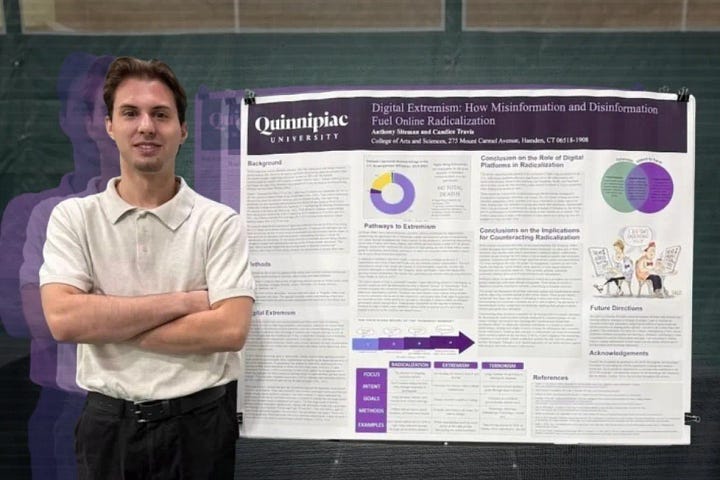
Anthony Siteman (Photo courtesy of Siteman, design by Sam Donndelinger)
This phenomenon of young men getting drawn in by alt-right algorithms fascinated 21-year-old Anthony Siteman, who started investigating online extremism ahead of the 2024 presidential election.
“My main goal was to understand how and why people became radicalized,” Siteman, a senior at Quinnipiac University, told Uncloseted Media.
Siteman immersed himself on right-wing sites like Rumble and Gab as well as encrypted messaging apps like Telegram where he joined channels that included Proud Boys. He noticed trends that draw people in: all caps text, red alarm emojis and inflammatory language, which all trigger a sense of urgency and concern.
He saw constant racist, sexist and transphobic language, but also violent videos and memes created from the livestreamed footage of the 2019 mosque shootings in New Zealand that left 51 people dead.
Even though he entered this project to learn about indoctrination, sometimes he felt his own views slipping. “ I was really questioning myself and what I believed,” he says, adding that he had to turn to his professor to keep him grounded. “They make you really question all of reality.”
“Social media companies are feeding people more extreme content, more emotional content,” Vandello says. He explained that emotionality is what has made the online alt-right successful at manipulating users against transgender people.
Siteman agrees: “ It’s always framed about fear, anger, and just some sense of belonging.”
The Way Out
Siteman believes that to exit these spaces, people outside the alt-right should use empathetic communication to help those in their network who have been radicalized.
For Brown-Ramsey, it was a professor that pulled him out.
“Unlike online spaces, where I curated the information that I wanted to see, and the algorithm fed me more of the same bigoted, hateful content, college was perhaps the first time I was required to engage with media outside of my usual diet,” Brown-Ramsey published in an essay about his experience.
Brown-Ramsey had to read books aloud in class like “Narrative of the Life of Frederick Douglass,” which detailed the abolitionist’s experience being born into slavery. “The narrative turned a mirror onto me and, in upsetting detail, showed me that my inclinations toward antagonizing those who looked, acted, or believed differently than myself [were the same beliefs that] led to Douglass’ dehumanization,” he wrote.
“That trajectory is really just me learning, ‘Why should I be at odds with a trans person if both of us work crappy jobs and can’t pay our bills?’ Obviously, that’s not who I should be angry at, but it took a while to get around to that,” Brown-Ramsey says.
If objective, nonpartisan, rigorous, LGBTQ-focused journalism is important to you, please consider making a tax-deductible donation through our fiscal sponsor, Resource Impact, by clicking this button:
Discover the cosmos! Each day a different image or photograph of our fascinating universe is featured, along with a brief explanation written by a professional astronomer.
2026 January 7 Simeis 147: The Spaghetti Nebula Supernova Remnant Image Credit & Copyright: Saverio Ferretti
Explanation: Its popular nickname is the Spaghetti Nebula. Officially cataloged as Simeis 147 and Sharpless 2-240, it is easy to get lost following the looping and twisting filaments of this intricate supernova remnant. Seen toward the boundary of the constellations of the Bull (Taurus) and the Charioteer (Auriga), the impressive gas structure covers nearly 3 degrees on the sky, equivalent to 6 full moons. That’s about 150 light-years at the stellar debris cloud’s estimated distance of 3,000 light-years. The supernova remnant has an estimated age of about 40,000 years, meaning light from this powerful stellar explosion first reached the Earth when woolly mammoths roamed free. Besides the expanding remnant, this cosmic catastrophe left behind a pulsar, a fast-spinning neutron star that is the remnant of the original star’s core. The featured image was captured last month from Forca Canapine, Italy.
Portal Universe: Random APOD Generator Tomorrow’s picture: hidden galaxy in the giraffe
Tiny, nimble, and sporting a bold black mask and “bib” under its bill, the Golden-winged Warbler might be mistaken for a Black-capped Chickadee at first glance. But it’s the long, thin bill and the splashes of vivid golden-yellow on its crown and wings that distinguish this long-distance migratory warbler.
Though they are denizens of shrubby, early successional habitats (areas that are in the early stages of regenerating following a disturbance, such as a fire or a clearcut) in the nesting season, Golden-winged Warblers and their recently fledged young relocate to nearby mature forests that provide adequate cover for fledglings from predators. The loss of quality brushy, young forest habitat across much of its breeding range has contributed to sharp declines in an already uncommon warbler.
Another threat comes from a close relative, the Blue-winged Warbler, which shares more than 99 percent of its genetic material with the Golden-winged Warbler. The two species regularly hybridize, and the once-uncommon Blue-winged Warbler has surged northward into the Golden-winged’s range. The Golden-winged Warbler has become much scarcer and is at risk of being genetically “swamped” by its more numerous and widespread relative where their ranges meet.
To gain a foothold and begin to recover from the loss of more than 60 percent of its population, the Golden-winged Warbler needs active habitat conservation throughout its annual life cycle, from the shrubby, early successional habitats where it nests to the open forests of Latin America and the Caribbean, where it spends its nonbreeding season.
Threats
Birds around the world are facing threats, and many species are declining. The Golden-winged Warbler has experienced a drop in its population of more than 60 percent, including a loss of nearly all of its population in the Appalachians. In addition to competition and hybridization with the Blue-winged Warbler, the Golden-winged Warbler faces challenges throughout its full annual cycle from habitat loss and degradation, and collisions. (snip-More on the page, including the songs)
Why I do these posts. This is three days of Joe My God that got away way from me. So why do I do these long news posts? Because I comb the Joe My God comment section for the best memes and snarkiest comments. It dawned on me I could post his news articles for those that want to read them. But three days is a lot to go throw and it is much easier just to quickly scan and snatch the comments rather than post them. So I need some inputs from everyone. Are these posts worth it? Or would you rather go to Joe My God yourselves. Or I can keep doing these. Up to you. Hugs
—————————————————————————————————————————-
tRumps Grifts / Scams / Ripping off the rubes / tRump’s ego / tRump’s Crimes / tRump’s health / Republican grifts & payouts for supporting tRump / other trump scammers
The Trump Golf Tracker estimates that the president’s golf trips have cost taxpayers some $110,600,000 so far in 2025. But that estimate, which was based on a 2019 Government Accountability Office (GAO) report on four golf trips during his first term, doesn’t even take into account the month of December.
The right wing media / the media arms of the GOP & Republican Party / The over the top thuggery and complete disrespect for common decency / Ask if you would like your child to act this way …. because maga does want their kids to be this crass as it makes them feel good / Kennedy Center debacle
The video was shared by Vice President JD Vance. FBI director Kash Patel said he is aware of the video and the FBI is investigating. The YouTuber says he is uncovering new fraud in Minnesota, but media outlets like KSTP reported more than a year ago about more than 62 investigations into Minnesota child care centers.
What this is really about is they are afraid Walz will run for office and win as he is so well liked. They are trying to gin up a fake scandal to Benghazi him like they did with Hillary Clinton. I posted yesterday how fake and full of lies / misinformation the “report” the YouTuber did was. In the article above this one you can see how the Republican Party had a hand in helping the right wing influencer to push a fake story. The state has been investigating these things for several years. Hugs
$175 billion for a “golden dome” that experts doubt would actually work, but only $2 billion in humanitarian aid for the United Nations. It’s what Jesus would want.
Space based weapons are forbidden by treaties that the US signed. That said do we have space based weapons … well I was sending commands somewhere for something when I was in the Army Sat coms / intel unit. You decide. Hugs
Maga hate fail / tRump lost in court / tRump supporters doing what they do not want you to know about / ICE lies / tRump’s DOJ / Misinformation / Trying to change history by spewing & omitting facts or what really happened
The emails, which were made public as part of a newly unsealed judicial order, largely reflected communications about the case that Robert E. McGuire, the acting U.S. attorney in Nashville, had with members of his staff and with Aakash Singh, a top official in Mr. Blanche’s office. They raised serious questions about whether the Justice Department had misled Judge Waverly D. Crenshaw Jr., who is overseeing the case, by telling him that local prosecutors had acted alone in charging Mr. Abrego Garcia.
Hate / Bigotry / DEI / White Supremacy / Christian Nationalism / US aid to only white countries or white dominated areas / US Healthcare / For Profit drug prices rip off the US public /
The civil probes are proceeding under the umbrella of the False Claims Act, which has traditionally been used to go after contractors who bill the government for work that was never performed or inflate the cost of services rendered.
The U.S. slashed its aid spending this year, and leading Western donors such as Germany also pared back assistance as they pivoted to increased defense spending, triggering a severe funding crunch for the United Nations.
U.N. data shows total U.S. humanitarian contributions to the U.N. fell to about $3.38 billion in 2025, equating to about 14.8% of the global sum. This was down sharply from $14.1 billion the prior year, and a peak of $17.2 billion in 2022.
The idea behind the legislation originated with the Alliance Defending Freedom, a conservative Christian legal advocacy group that has gained prominence for its work to incorporate religion in public spaces.
West last appeared here for his bill that would create a database of abortion patients.
In 2024, we heard from West for his bill to ban Pride flags at public schools and government buildings.
He appeared here in 2023 for his bill that would make it a felony to perform drag in the view of minors. His bill called for a $20,000 fine and up to two years in prison.
West first appeared here in 2021 when Gov. Kevin Stitt signed his bill making it legal to run over protesters.
The tweet below refers to West’s attempt to pass this same bill earlier this year.
tRump’s attack on Colorado because they won’t bow to the whim of the tyrant. His withholding money is illegal but no republican will stand up to the demented king.