
I read the article linked below. To show how badly these papers were done one paper used reports made in the Vaccine Adverse Event Reporting System (VAERS) to find what he said were “unusual patterns and safety signals highly suggestive of a causal relationship” between vaccination and Sids. VAERS is a vaccine safety monitoring program where anyone can submit a report about any suspected adverse health event that happens after a vaccination. Morgan McSweeney, a scientist who posts on social media as Dr.Noc said of the people running the CDC “They have a strong opinion about what is true. And then they go looking for whatever scrap of low-quality evidence they can find to support that opinion,” McSweeney said. “If that finding supports the story that they believe, they’re willing to overlook data points from hundreds of thousands or millions of children and go with the one that fits their story.” “This was a low-quality, very small study that was not replicated. So yeah, the CDC page now says that some studies supporting a link have been ignored by health authorities,” McSweeney said in the video, which now has more than 5m views between Instagram and TikTok. “And maybe that’s a little bit true, because the studies they’re showing here are worth less than a fart in the summer breeze.” Hugs
Category: Science / Medical Information
Happy PRIDE On Friday
in Hawai’i!
Hawai’i Governor Signs Powerful Trans Shield Law Bill Just In Time For Pride
“Parents and caregivers who affirm, support, and seek medically appropriate care for their keiki [child] are exercising their fundamental right.”
After a three-year push, Hawai’i officially has implemented a shield law to explicitly protect providers and patients of gender-affirming care for the trans community.
House Bill 1875, also known as Act 059, was signed by Governor Josh Green—himself a physician—late last week. The bill explicitly adds gender-affirming care to its existing shield law, which broadly covered reproductive health, and established safeguards from “abusive litigation” coming from outside states.
Shield laws create “legal protections for patients, health care providers, and people assisting in the provision of certain health care in states where that care is legal from the reach of states with civil, criminal, and professional consequences related to that care,” according to the Center for Reproductive Health, Law and Policy at UCLA. For example, it means Hawai’i state actors may not aid out-of-state attacks—such as, say, through the extradition of health care providers—over lawful care rendered in Hawai’i.
“The legislature finds that the people of Hawai’i have a long tradition of protecting an individual’s right to privacy and bodily autonomy independently of, and more broadly than, the United States Constitution,” the bill reads. It emphasized that the right to privacy and bodily autonomy extends to minors.
“It is the policy of this State that the rights of equality, liberty, and privacy guaranteed under […] the Hawaii State Constitution are fundamental rights and that those rights include an individual’s right to make health care decisions about one’s own body, including the right to seek and receive health care services that affirm their expressed gender.”
The signing was a resounding victory for LGBTQ activists on the islands. Hawai’i was among the last of the blue states to enact a shield law for the transgender community and their providers.
“We’ve heard from legislators that this is considered a controversial topic and that they’d rather not engage in bills that could draw attention to Hawai’i from the Trump Administration,” Abby Simmons, Chair of the Stonewall Caucus of the Democratic Party of Hawai‘i, told Erin in the Morning last year.
Now, she’s singing a more triumphant tune. “This bill truly was a team effort,” she said in an interview this week. “Lawmakers wanted to understand the legal implications, hear from stakeholders, and make sure they were crafting legislation that would withstand challenges. While that process can sometimes feel slow, it also means that when legislation succeeds, it often has a stronger foundation.”
Simmons also said the playbook for getting the bill over the finish line was rooted in building a big tent. “I think what finally made HB1875 successful was that supporters increasingly focused on a message that resonated far beyond the LGBTQ+ community,” she continued.
“The conversation wasn’t simply about gender-affirming care. It was about protecting patients, families, and healthcare providers who are following Hawaiʻi law. It was about preventing out-of-state actors from interfering with healthcare decisions made here in Hawaiʻi. It was about provider stability at a time when Hawaiʻi already faces healthcare workforce shortages. And it was about preserving Hawaiʻi’s ability to govern itself.”
The bill arrived on the Governor’s desk amid rising federal threats from the Department of Justice against hospitals, including the use of judge and forum shopping to prosecute gender-affirming care providers in conservative jurisdictions based outside of their state. Last month, the Northern District of Texas—an infamously conservative federal court—ordered Rhode Island Hospital, which is almost 2,000 miles away, to hand over patient records from its transgender youth care program. That legal battle is ongoing.
“Gender-affirming care is lawful in Hawaiʻi, grounded in established medical standards, and essential to the well-being of transgender, nonbinary, māhū, and gender-diverse people,” Hawai’i’s LGBTQ political action committee, HOKU, wrote in submitted testimony from when the bill was being considered by the legislature.
“Failure to protect access to gender-affirming care is not only an attack on patients and providers; it is a violation of parental rights,” reads another submission from Pride at Work Hawai’i. “Parents and caregivers who affirm, support, and seek medically appropriate care for their keiki [child] are exercising their fundamental right.”
Donavan Kamakani Albano, Policy Fellow at the ACLU of Hawaiʻi, further spoke to the importance of gender diversity in Hawaiian tradition. Some right-wing officials may push the myth that transness is somehow novel or a “trend.” But Hawai’i has especially rich ties to its pre-colonial culture—including non-binary concepts of gender.
“In Kanaka Maoli culture, māhū describes someone who embodies kāne and wahine [the masculine and feminine] energies,” Albano’s testimony said. “While the visibility of māhū individuals has recently increased, ongoing barriers to gender-affirming care remain.”
This united LGBTQ advocacy with other causes. “Those principles brought together a broad coalition of supporters and helped lawmakers see the bill as a matter of healthcare access, privacy, and state sovereignty,” Simmons said.
2 For Science On Tuesday
New solar desalination breakthrough makes fresh water without toxic brine
This sunlight-powered desalination breakthrough turns seawater into fresh water while harvesting valuable minerals.
Date: May 31, 2026
Source:University of Rochester
Summary: Scientists have developed a solar desalination system that turns seawater into drinking water without creating environmentally damaging brine. Special laser-textured metal panels use sunlight to evaporate water while automatically moving salt deposits away from the working surface, preventing clogging. The process was successfully tested with water from three oceans and can recover nearly all salts as solids. Those leftover materials could even become a source of valuable lithium for batteries.
‘This is a tragedy’: swimming snakes open new front in battle with Balearic lizards
Sam Jones in Madrid
Irrefutable proof of what Spanish researchers and wildlife experts had long suspected, and long feared, finally presented itself in the form of a grainy video that was shot on a minuscule island in the Balearics in April 2024.
Ribboning its way through the turquoise waters that separate the east coast of Ibiza from the islet of Santa Eulària 450 metres away, came a pale and solitary horseshoe whip snake in search of new territory and fresh sustenance.
The arrival of the snake on Santa Eulària, recorded by a local wildlife ranger, confirmed that the insatiable invader from the Spanish mainland – which has almost wiped out Ibiza’s endemic population of dazzlingly coloured wall lizards – had opened up a new front.
“There’d been increasing anecdotal evidence from fishermen and tourists who’d seen the snakes swimming, so we’d thought it was happening very often,” said Oriol Lapiedra, a biologist at the Centre for Ecological Research and Forestry Applications (Creaf) in Catalonia. “But this was the first proper [evidence] we’d had of a snake swimming from Ibiza to the islet.”
The horseshoe whip snake, a non-venomous reptile found across southern and eastern Spain, has become an existential threat to the lizards since it began appearing on the island two decades ago.
Its rapid colonisation has been attributed to the fashion among wealthy property owners in Ibiza for importing ancient olive trees from mainland Spain to adorn the grounds of their homes. Unbeknown to them, however, the trees – replete with their nooks and hollows – have provided ideal travel berths for hibernating snakes and snake eggs. (snip-MORE)
Winning Elections Against Autocrats
It means we have to show up. Not only to vote, but to phone bank, write postcards, talk up the candidates every chance we get wherever we are, and anything else we can do. It’s how they did it in Hungary; people showed up, which extended the candidate’s reach. Thanks to Wonkette’s Evan Hurst for the link.
Opinion M. Gessen
This Is the Formula That Defeated Orban. It Would Defeat Trump, Too.
By M. Gessen
Visuals by Máté Bartha
M. Gessen, an Opinion columnist, and Mr. Bartha reported from Budapest.
- May 29, 2026
Starting early in the morning on the second Saturday of May, first hundreds and then thousands of people gathered in the square in front of Hungary’s majestic Parliament building to celebrate the start of a new political era. This was the square where tens of thousands gathered in 1956 and 1989 to demand an end to the Soviet occupation and in 2006 to protest a discredited government. It was the square on which Prime Minister Viktor Orban’s regime imposed a major redesign more than a decade ago — with traffic rerouted away, a large reflecting pool and raised beds installed, narrow pathways laid down — apparently to ensure that no such mass gathering could take place again. Today it was the square where Peter Magyar, a former Orban loyalist, would be sworn in, promising a rebirth of democracy and liberty after 16 years of autocratic control.
Squeezing into the available spaces and gradually filling up nearby cafes and streets, the crowd absorbed people of all ages: young people who didn’t remember a time before Orban and who had voted in unprecedented numbers; aging intellectuals who didn’t think they’d ever celebrate their country again; multigenerational families who had arrived by bus after seeing Magyar in their hometowns and villages. During his campaign, Magyar had traveled to an estimated 700 locations, turning many of them into “Tisza islands” — outposts of support for his party. By the end, Magyar was holding five or more rallies a day.
It had looked like an impossible quest. Orban and his cronies dominated the media, persecuted and smeared opposition politicians and changed election laws to benefit his party, Fidesz. Orban had seemed to achieve what the Hungarian sociologist and political theorist Balint Magyar (no relation) calls “autocratic breakthrough” — the point after which it’s impossible to unseat an autocrat using elections. Illiberal politicians from other countries made pilgrimages to Hungary to learn from Orban; CPAC, the gathering for American national conservatives, started staging an annual convention there; and Vice President JD Vance visited Budapest in advance of the election, in a show of support for Orban. And yet Hungarians handed Tisza not just a victory but a constitutional majority, enough power to reverse Orban’s changes to Hungarian laws and institutions. The triumph was stunning — unique in our era of democratic backsliding — and it holds clear lessons for the United States.
One obvious lesson of Peter Magyar’s success lies in the scale, reach and relentlessness of his organizing network. “They had 2,000 Tisza islands with between 30,000 and 50,000 volunteers,” Balint Magyar told me, in evident awe. “Just in their call centers, they had 3,000 to 4,000 people in the last week of the campaign.” We talked two days before the swearing-in ceremony, at his office in the spectacular but largely empty building of Central European University. In 2018, Orban’s government forced most of the university’s operations into exile amid an antisemitic scare campaign focused on the Hungarian American philanthropist George Soros, the C.E.U.’s founder and principal funder. Some of Orban’s many other scare campaigns targeted migrants, “the Brussels elites” and L.G.B.T.Q. people. During the latest election campaign, billboards and A.I.-generated social media posts warned Hungarians they were in danger of being overtaken by Ukraine and only Orban could protect them. It should have seemed absurd — it was absurd — but outlandish xenophobic and antisemitic propaganda had served Orban well for years. It didn’t work against Peter Magyar — probably because so many Hungarians got to see him in person, many of them repeatedly. This is another lesson of his success: Old-fashioned in-person politics can be a powerful antidote to media fearmongering.
In his inaugural speech to Parliament, broadcast on giant screens set up around the square, Peter Magyar said that voters had handed him a mandate “not just to change the government, but to change the system. To start over.”
Magyar enumerated the ways in which Orban had damaged Hungary: a stalled economy in which a third of the population lives in poverty, inadequate health care, low-quality schools, child welfare institutions plagued by abuse, an atmosphere of hatred and fear. Orban’s regime had “stolen from the common good of the Hungarian nation — from the pockets of the Hungarian people, and from the tables of Hungarian children and the elderly,” Magyar said, “an estimated 20 trillion Hungarian forints,” or some $65 billion, over the last decade and a half.
Previous opposition politicians had described Orban’s regime as “corrupt,” a relatively mild term suggesting some aberration from the government’s intended function. Peter Magyar made no such accommodation. Borrowing a term coined by Balint Magyar, he has called it a mafia state — a fundamentally criminal enterprise. Third lesson: Don’t mince words.
Instead of shrinking away from direct confrontation, he fortified himself against it. By getting elected to the European Parliament, in 2024, he secured immunity from prosecution in Hungary. When rumors circulated of an intimate video that would be used to blackmail him, he went on the offensive, accusing Orban of using “Russian-style kompromat” (no video was released). Knowing that he would probably be blocked from registering a new political party, he took over one that had become dormant. Even more important, instead of trying to build coalitions among other parties, he focused on conscripting as many actual people as possible, from across the political spectrum, ultimately building a giant organization capable of taking down Orban’s political monopoly.
One could say — and some have — that Magyar won at least in part because he was a former insider of Orban’s Fidesz party. But my interlocutors in Hungary emphasized that Magyar’s credibility lay in the fact that he was not a member of the old opposition, whose policies had led to the discontent that made Orban’s rise possible and whose timidity had helped perpetuate Orban’s power. That’s a lesson, too: The person best positioned to break the power of Donald Trump would not be an anti-Trump Republican but an outsider to the Democratic establishment, someone who can credibly claim that Trump didn’t happen on his watch — a Graham Platner rather than a Thomas Massie.
For all his tireless work over the last two years, Magyar did not create his political machine from scratch. Like Zohran Mamdani, Magyar excelled at converting potential supporters into campaign volunteers. An existing news distribution service provided an initial skeleton of the organizing network. A panoply of grass-roots protest movements joined, too. On the day of Magyar’s inauguration, a parallel, smaller commemoration organized by the city of Budapest celebrated those organizations. One by one, people took the microphone to give a short speech about their cause and their part in the electoral victory: teachers who had organized against a unified state-dictated curriculum; a young man who spoke up against abuses in the child care system; a high school student persecuted for reciting an anti-Orban poem; organizers of Budapest’s L.G.B.T.Q. Pride celebration. The speakers stayed onstage, gradually forming a crowd of the kind — the many kinds — of ordinary Hungarians who had ended the Orban era.
That’s a fifth lesson: Grass-roots organizations that have little or no connection to electoral politics — in the United States, that might be the networks formed by the No Kings rallies, ICE-resistance groups and so on — can matter as much as or more than those already focused on winning votes.
Another lesson lies in the issues that motivated Magyar’s voters. Hungary’s economy is a mess, but post-election polling by Median, an organization that had predicted election results with uncanny accuracy, shows that voters saw corruption as the most important issue by far. Asked why they thought Orban had lost, 49 percent cited corruption, and only 18 percent thought it was the “worsening economic situation, rising cost of living.” The next three reasons cited were “lies” (15 percent); “fearmongering, war rhetoric” (11 percent); and “people got fed up” (10 percent). In other words, Hungarians seemed to see the damage that Orbanism had done to the nation as more important than any harm they felt they had suffered as individuals. They were united by a sense of moral outrage — “value choices,” as one person close to the incoming government described it to me.
Polls have consistently shown that even Fidesz voters generally want Hungary to stay in the European Union. Some surely just want the ease of travel and residency, but others probably have in mind the loftier ideals of the E.U., such as the rule of law, human rights and the essential purpose of the E.U., which is peace.
Hungary is one of the poorer countries in the union, and in the early years of his regime, Orban was able to use E.U. membership to secure funding, and thereby power, even as he railed against the Brussels bureaucracy. But in 2022, the European Union started withholding funding, citing corruption. And in 2024, after Hungary ignored a European Court of Justice ruling that compelled it to process asylum applications, the court ordered Hungary to pay 200 million euros and imposed a daily fine of 1 million euros. (When Orban refused to pay, Brussels deducted the money from E.U. funds earmarked for Hungary.) These actions didn’t just hurt the Hungarian economy — they also allowed Magyar to draw a causal connection between Orban’s policies and the well-being of ordinary voters. One of his major campaign promises was to unlock E.U. funding.
Hungary joined the European Union in 2004. The E.U. flag — 12 gold stars on a blue background — adorned the facade of the Hungarian Parliament building alongside the nation’s red, white and green standard. But Orban’s politics, like the politics of most autocrats, was the politics of grievance. Under his regime, the E.U. flag was removed and replaced with the flag of the Szekelys, a Hungarian minority that found itself living in Romania when World War I’s victors redrew the region’s borders. Orban’s symbolic gesture helped fan resentment against the E.U. and what he claimed were a new generation of attacks on Hungarian sovereignty.
Peter Magyar scheduled his inauguration for Europe Day — the 76th anniversary of the declaration that created the road map for a united continent. Before he was sworn in, the European flag was raised again. But the Szekely flag remained, signaling that Magyar seeks to represent all Hungarian citizens, including those who supported Orban. In some U.S. coverage, Magyar has been labeled centrist or right-of-center. What his politics actually are — and this is another lesson of his victory — is pluralist. (snip-MORE)
Got Bread?
The early start of wheat harvest in Sumner County isn’t a good thing
June 01, 2026 Cueball

By James Jordan, Sumner Newscow — The month of May is barely over, and the wheat harvest has already started in Sumner County. That is not a good thing. Last year, the harvest didn’t get going well until mid-June, which is still on the early side.
Drought conditions over the winter and early spring caused the wheat to mature earlier than it should have, resulting in poorer yields.
Recent rains are likely too little too late; wet conditions may even hamper the harvest.
Last year, there was good wheat in the fields, but wet conditions prevented a bumper harvest.
State and local wheat officials say the wheat that is out there is not in very good shape.
According to the Kansas Wheat Association, the crop generally looked good as it went into its dormant stage in the late fall. There was not much rain in March and April, which is the primary growing stage, turning a promising crop into a dismal one.
The drought conditions in that growing stage force the wheat to develop faster. It limits the yield and accelerates growth, which is why we have wheat ready to harvest so early.
There are still some areas in Sumner and Cowley County that may get good yields. Conditions are much worse in western and central Kansas.
According to USDA statistics, as of the beginning of May, 41 percent of the wheat was very poor or poor, with 35 percent being fair. Only 24 percent was rated good or excellent.
As of last week, the wheat commission reported 55 percent as poor to very poor, and 30 percent as fair. Only 15 percent was rated good.
Last year at this time, 48 percent was rated as good to excellent.
The USDA estimates that this year’s crop could be the smallest nationwide since 1965 and 25 percent smaller than last year.
There’s A Moon Out Tonight-

Supermoon Versus Micromoon
Image Credit: Soumyadeep Mukherjee
Explanation: What is so micro about tonight’s blue micromoon? Just after sunset, a full moon will appear slightly smaller and dimmer than usual. The reason is that the Moon’s fully illuminated phase occurs within a short time of apogee – when the Moon is farthest from the Earth in its elliptical orbit. In fact, tonight’s micromoon will be the farthest, smallest, and dimmest Moon this year. But tonight’s micromoon is notable for yet another reason: it is also a blue moon, meaning that it is the second full moon in the same month (moon-th). Pictured here, a supermoon — when the full moon appears near its largest — is compared to a micromoon as photographed from Kolkata, India in May and December of 2021. Although the next micromoon occurs next month, and the next blue moon at the end of 2028, the next blue micromoon will not occur until 2053.
(And in case you got an unwanted earworm from the title, maybe try this lively one, instead! – Ali)
OK, Yeah, There’s Still A Bird Post-
It’s Saturday, after all.
Nashville Warbler
Leiothlypis ruficapilla
Also Known As
- Chipe Cabeza Gris (Spanish)
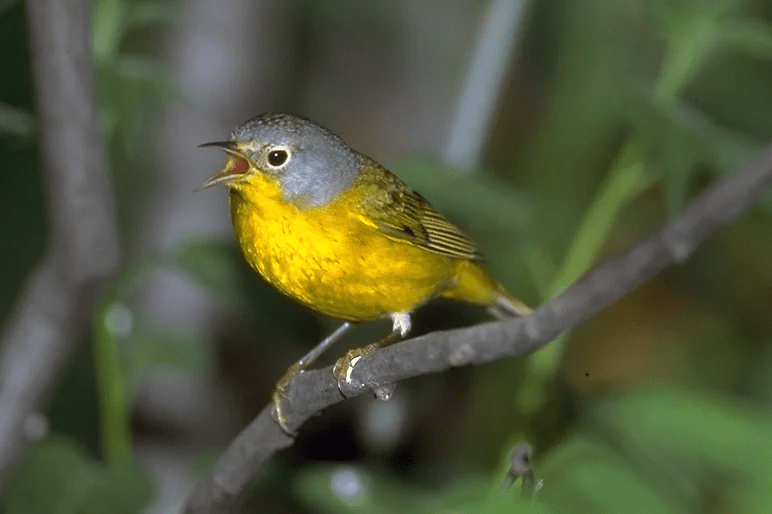
The Nashville Warbler is a lively songbird with elegant, understated plumage and a special fondness for sunny forests, brushy undergrowth, and juicy caterpillars. It is also one of several birds in the Western Hemisphere with a rather misleading name. This bird is only in the southeastern United States for a few weeks during migration on its way between the northern forests where it breeds and its wintering grounds in Mexico, Central America, and the California coast. The species was first documented in Tennessee, and the “Nashville” name stuck, although it only stops over in the area during migration.
The Latin name is also rather misleading to anyone watching this bird in the field — the species epithet ruficapilla refers to a small patch of reddish feathers on the bird’s crown, usually invisible among the gray feathers of the rest of the head. Like the Ruby-crowned Kinglet, Orange-crowned Warbler, and Yellow-rumped Warbler (scientific species name coronata, for the rarely seen yellow crown), this name may be mystifying to beginning birders, but it might also provide an avenue into the secret social life of the bird.
The ability to hide and reveal this bright, contrasting color patch allows these birds to produce a striking visual signal, which they use to communicate agitation and excitement, particularly in aggressive interactions between males at close range. The closely related Lucy’s and Virginia’s Warblers also have hidden reddish crowns, apparently used in similar contexts. In fact, colorful hidden crown patches have also evolved in distantly related species, like the Western Kingbird, suggesting they may play important roles in these birds’ lives. However, birds are rarely seen actually raising their crowns, and our understanding of their social use is only rudimentary.
Nashville Warblers are quite social. Once the young of the year are independent from their parents, these warblers begin to form large foraging flocks, numbering up to 100 birds. On their nonbreeding grounds, these birds are often at the center of equally large flocks with dozens of species, their persistent contact calls allowing other birds — and birders — to locate them in the forest canopy. In fact, Nashville Warblers may be a “nuclear species,” facilitating the formation of these large and diverse flocks with help from another energetic northern migrant, the Blue-gray Gnatcatcher. Typically, nuclear species are resident birds, not migrants. But when this warbler-gnatcatcher pair comes to town, they bring the party. (snip-MORE)
(Well, it Is Scottie’s Playtime, after all … )
It’s Not A Bird!
It’s a tiny blue octopus:
‘Never seen anything like it.’ Scientists discover brand new species of octopus.
This tiny blue creature is making a big splash.
By Heather Wake
Imagine being a scientist scanning the ocean floor when suddenly a powder blue, golf ball-sized, eight-legged critter that looked like it’s been put through a kawaii filter shows up. Obviously, all professionalism goes out the proverbial window.
That is exactly what happened for the Charles Darwin Foundation when they unexpectedly discovered a brand new species of (very cute) octopus deep below the water’s surface near the Galapagos Islands.
A tiny scene-stealer enters the underwater chat
“He’s tiny!” “It’s blue!” These are the remarks that can be heard over the audio of footage captured by a remotely operated vehicle (ROV) camera as the cerulean cephalopod made its grand entrance.
Unsure which species this mysterious and adorable creature belonged to, the team sent octopus expert Janet Voight, who immediately knew “it was something really special.”
“I’d never seen anything like it,” noted Voight, who used X-Ray images from CT scans to make a 3D model of the octopus, revealing its insides, rather than cutting open the one specimen she had.
A built-in survival superpower that feels like a fashion statement
While its top side features blue, nature’s rarest hue, the new species, dubbed Microeledone galapagensis, has a “very deep purple” underside, which researchers believe is to camouflage itself while eating.
“We think this color pattern helps keep it safe. If the octopus grabs a prey item that emits light, that light may attract predators that might then eat the octopus. So the octopus puts its dark-colored web over the prey item, keeping itself safe,” explained Voight.
This little guy showed up where nobody expected it
But unusual coloring aside, what’s also remarkable about this newly discovered octopus is that no other similar species lives anywhere near it. Members of the Megaleledonidae family, distinguished by their single row of suckers, are normally much larger and inhabit cold Antarctic waters…a little ways away from the Galapagos.
The Microeledone galapagensis joins the four new species of octopus that were discovered in Costa Rica in 2024, all of which are part of a 300-ish species of octopus family living throughout all of the world’s oceans.
The ocean still has plenty of surprises left
The wild thing about ocean exploration is how much remains hidden from us. Scientists estimate that huge portions of the deep sea are still largely unexplored. Entire landscapes, unusual animals, and species no one has documented yet may still be waiting below. (snip-a bit MORE)
Some Good Climate News
Nobody Expected The Spanish (Energy) Transition!
The grid in Madrid is where prices have slid.
As we like reminding you, with Donald Trump trying to kill clean energy, Europe has become the source of much of our clean energy Nice Times lately. Here’s one more example: Spain is among the big sleeper hits on Europe’s energy transition pop chart. In just a decade, Spain has ramped up its use of wind and solar power, resulting in some of the lowest wholesale electricity prices on the continent.
Oxford prof and energy policy analyst Jan Rosenow gets into the details at his “Bright Spots” newsletter, which we’ll recommend for folks who need a dose of climate optimism about now:
In the first four months of 2026, the average wholesale electricity price in Spain was €44 per megawatt-hour. In Italy, it was €127. In Germany, €96. In the UK, €103. Spain is now cheaper than France, well below the central-European bloc, and within striking distance of the Nordic hydro-and-nuclear heavyweights that have always topped the cheap-power league.
The basic reason is pretty simple, Rosenow explains, although he also goes into further detail beyond this. “Spain increasingly pushed gas increasingly out of its electricity supply, and the price of electricity followed.”
Over the last 25 years, Spain has gone from getting a third of its electricity from coal to effectively having zero coal power. Spain replaced most of that capacity with cheaper (and relatively cleaner but still climate-unfriendly) fossil gas, and it’s now replacing gas with renewables. Gas peaked at about 30 percent of Spain’s energy mix near the end of the 2000s, and is now down to about 19 percent. Another 19 percent comes from nuclear, which hasn’t changed over the last few decades and 14 percent is from hydro and bioenergy. The rest has been solar and wind, which combined are up to 42 percent of the mix in 2026. Here’s a pretty chart, with cheerful yellow solar energy and cool blue wind energy growing, and icky grey coal rapidly fading into nothing.

Here’s why the replacement of gas with renewables matters so much: Because wholesale electricity prices at any given time are set by the most expensive energy plants needed to meet demand, and gas is usually that most expensive source, getting more solar and wind on the grid during high-demand daylight hours brings down wholesale prices a lot. (snip-MORE)
Go and read, and click the links if you have time. It is heartening, even though it’s not happening here.
How About A Little Science On Tuesday?
(Click through right here to listen to the article while enjoying the photos, 2 of which are included below.)
Snuffleupagus, a newly described species, is an adorable little predator
The seahorse cousin is named for its ‘uncanny’ resemblance to the Sesame Street character
Sheena Goodyear · CBC Radio · Posted: May 21, 2026 4:01 PM CDT | Last Updated: May 21
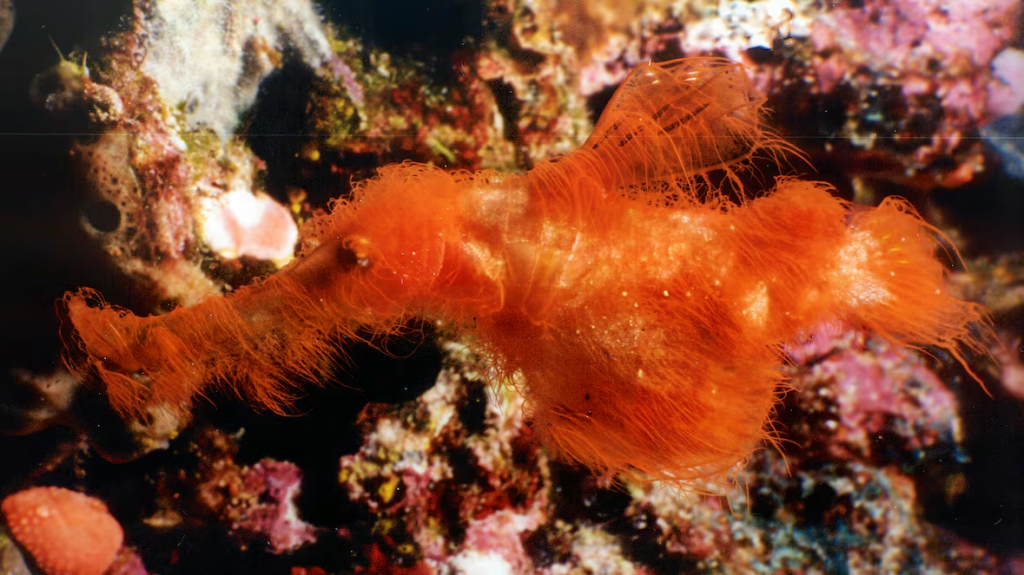
Solenostomus snuffleupagus, a newly described species of fish, is named after the beloved Sesame Street character, Mr. Snuffleupagus. (David Harasti)
Scientist David Harasti never had any doubt what he would name the tiny orange creature he first spotted on a diving expedition in Papua New Guinea in 2003.
But it would take another two decades for Harasti and his colleague Graham Short to find the elusive fish again, study it, and officially designate it a new species.
Meet Solenostomus snuffleupagus, namedafter the beloved Sesame Street character, Mr. Snuffleupagus.
“Snuffy for short,” Short, an ichthyologist at the California Academy of Sciences and the Australian Museum, told As It Happens host Nil Kӧksal. “The resemblance was quite uncanny.”
Short and Harasti have now written a new paper, published in the journal Fish Biology, describing S. snuffleupagus as a new species of ghost pipefish that makes its home along coral reefs, and disguises itself as red algae.
‘The awesome power of natural selection’
The fish has quite a few things in common with its namesake — mainly its orange-brown colouring, the long filaments that look like shaggy hair, and its elephant-like snout.
Milton Love, a marine biologist at the University of California’s Marine Science Institute in Santa Barbara, Calif., says the fish’s muppet-like appearance demonstrates “the awesome power of natural selection.”
“Clearly, all of the morphological features that we find endearing are of some value to the animal,” Love, who was not involved in the research, said in email.
“Or, and here is another hypothesis, Gaia created this fish after having one too many of those rum drinks that come with those little umbrellas.”
But its similarity to Snuffleupagus goes deeper than meets the eye.
It’s also extremely elusive, much like Mr. Snuffleupagus, who, in his early appearances on Sesame Street, was only ever seen by Big Bird, leading the other characters to mistakenly suspect he was imaginary.
Harasti and Short tried for years to spot a snuffy fish again after that first 2003 sighting to no avail.
Their luck changed in 2021 when some scuba diver buddies started seeing the little creatures on the Great Barrier Reef and got in touch. The scientists headed to Australia to see for themselves, and on their second dive, they found the fish.
“It’s an understatement to say that we screamed under water,” Short said. “We high-fived, gave each other a hug, and we were just so excited.”
An itty-bitty carnivore
In order to describe the fish and confirm it as a previously undocumented species, the scientists looked at CT scans of specimens first collected in 1993 during exhibition to far north of Queensland, Australia, in the Torres Strait.
Short says they were collected alongside several hundred other fish specimens and tucked away until he and his colleague came looking. But even back then, he says ichthyologist Helen Larson, who was part of the expedition, suspected it was a new species.
S. snuffleupagus, like other ghost pipefish, is a cousin of the seahorse.

The newly described Snuffleupagus fish is smaller than a matchstick. (Darren Rice/Matafonua Lodge)
Using iNaturalist, the citizen science platform, the scientists confirmed sightings of it in Tonga, Papua New Guinea and New Caledonia, suggesting distribution across the southwestern Pacific.
And while it may look like Big Bird’s beloved bestie, there are a few significant differences between S. snuffleupagus the fish and Snuffleupagus the muppet.
While Snuffleupagus is famously big — bigger even than Big Bird — S. snuffleupagus is roughly four to five centimetres long, about the size of an airpod.
And while Snuffleupagus would never harm a fly, S. snuffleupagus is a natural-born killer.
“They look adorable, very cute. They’re very delicate and slow moving in the water. And it’s been assumed that they only eat small crustaceans like small shrimp,” Short said.
Not so, he says. The CT scans found tiny fish skeletons in the specimens’ stomachs.
“Every fish has a role, and they are either eating or being eaten. It turns out, ghost pipe fish and in particular, snuffy … they’re just like other fish,” Short said. “They’re predators.”
Short says the widespread interest in S. snuffleupagus has been a delight, and he hopes it won’t be the last fish he brings attention to.
He and his colleague already have their eyes on another species of ghost pipe fish that is known to divers around the Pacific, but hasn’t been formally described.
If it works out, they plan to name it after another muppet, but Short wouldn’t say which one.
“Not yet, because I need approval,” he said.
Interview with Graham Short produced by Leslie Amminson


