Erin In The Morning is a reader-supported publication. To receive new posts and support my work, consider becoming a subscriber.
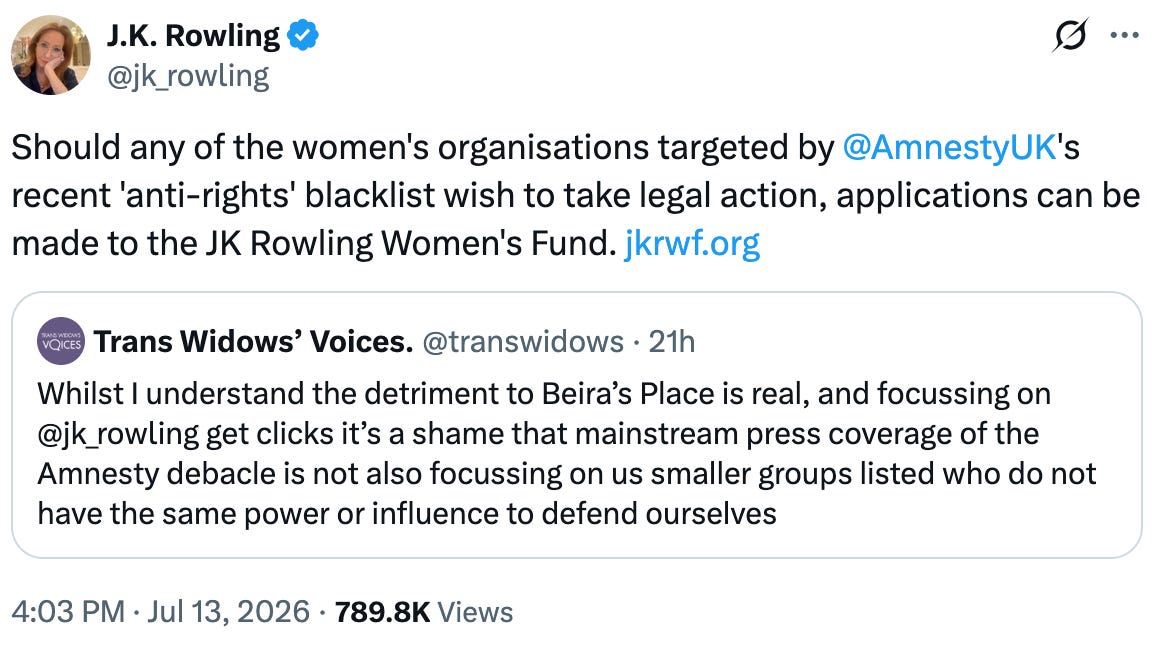
Billionaire TERF influencer J.K. Rowling has announced that she will cover the legal costs of anti-trans groups named in a report by Amnesty International (UK), which called them “anti-rights.”
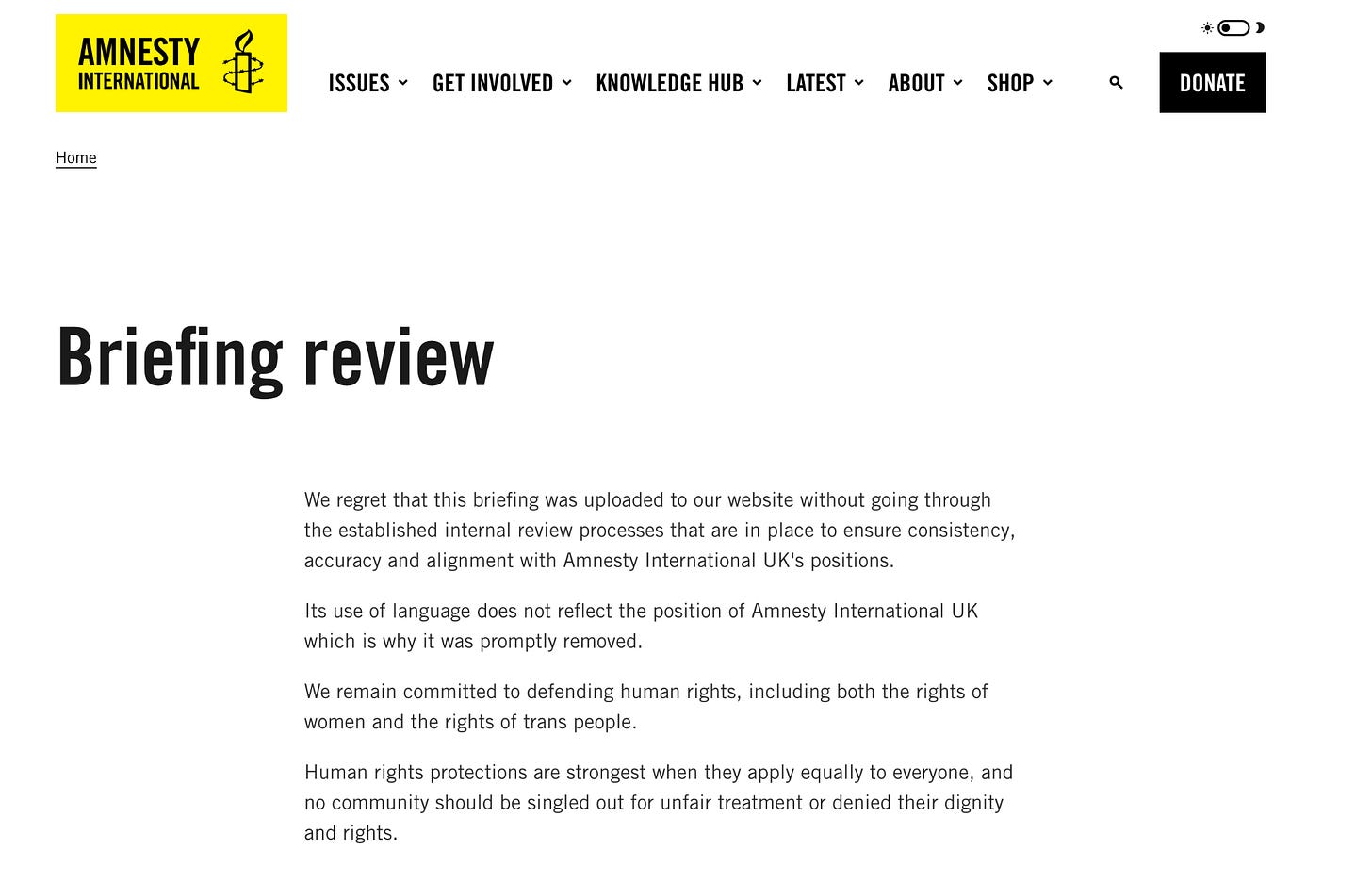
The report was retracted shortly after publication and replaced with a statement from the organization saying the report was uploaded “without going through the established internal review processes” and that its “language does not reflect the position of Amnesty International UK, which is why it was promptly removed.”
But the withdrawal and public acknowledgement was not enough to sate the organizations that have fought tooth and nail to exclude and/or antagonize the transgender community in the United Kingdom. The United Kingdom is notoriously more perilous for free speech than the United States. For our neighbors across the pond, the burden of proof lies with the defendant to prove the statement is true; here in the United States, the burden of proof lies with the aggrieved to prove that a statement is categorically false, and published knowingly or at least recklessly regardless. The US also benefits from “anti-SLAPP” laws to prevent such frivolous lawsuits waged by wealthy individuals or powerful corporations against those who criticize them.
So Rowling capitalized on the spectacle to, in essence, help dozens of groups in what appears to be an attempt to sue Amnesty into oblivion.
CAPTION: Screenshot from Rowling’s Twitter, where she offers “women’s organizations” backing to sue Amnesty International (UK) through her own charitable fund. She quote tweets a group of people who self-identify as “trans widows”—referring to cisgender people whose spouses or ex-spouses came out as transgender.
The saga began earlier this month, when Amnesty International (UK) released a report titled “A growing threat: the anti-rights movement in the UK.” It released a similar report last year, but this year, it added a new category for what appears to be the anti-rights movement’s most rapidly growing sector: “Gender critical” groups, or groups that are antithetical to transgender rights and inclusion.
Rowling rushed to tweet about the situation.
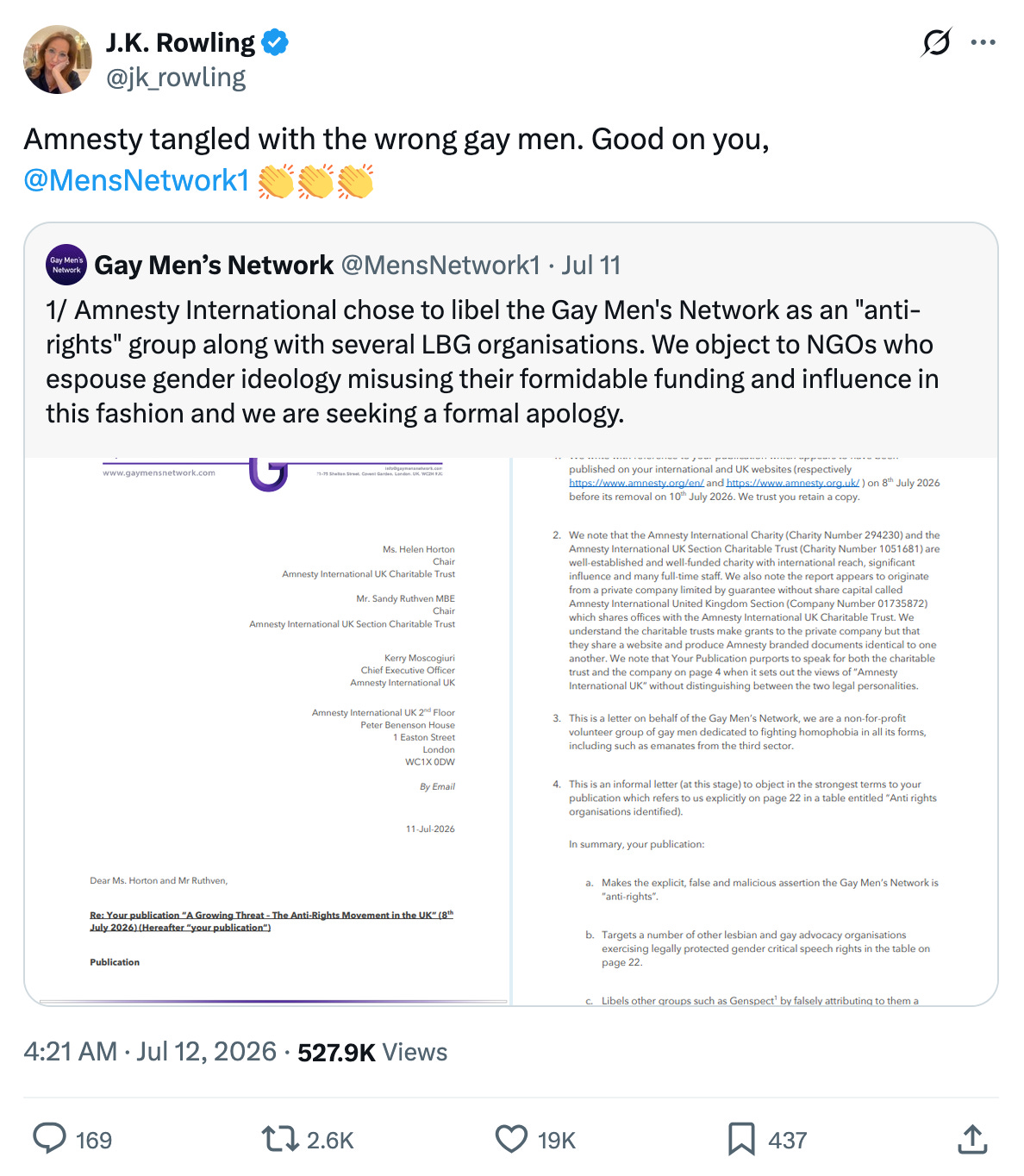
CAPTION: Rowling tweets a group’s response to Amnesty International (UK)’s report on “anti-rights” groups.
She lauded “LGB” groups—another anti-trans buzzword, which, as the name suggests, describes groups that wish to erase transgender people from the queer liberation movement—like the Gay Men’s Network, an organization that has pushed for anti-trans policies. That group posted a public letter indicating it might sue Amnesty International for defamation. The Network demanded a retraction of the report and then claimed that Amnesty is guilty of “trying to control gay and lesbian free speech.”
In the day or so that followed, Rowling retweeted around a dozen similar letters. The posted letters include groups like Genspect, a Southern Poverty Law Center-designated hate group that threatened Amnesty International with legal action, as well as groups like LGB Alliance and Sex Matters.
Amnesty International (UK) did not formally reply to a request for comment for this piece.
Gender critical activists, often financed by Rowling, rely on legal “guerilla warfare” said one U.K.-based trans rights organizer, who could only speak to Erin in the Morning if granted anonymity. The tactic is familiar: Wear down non-profits and individuals who dare speak out against anti-trans and anti-rights groups. They don’t have to win a lawsuit; they can just file again, and again, and again, draining valuable time and resources.
“They have sued organizations into the ground,” the advocate said.
Some context for just a handful of these groups so up in arms about being labeled as hateful: Helen Joyce, the director of advocacy for Sex Matters, gave a speech at a Genspect conference (both are groups on the anti-rights list) about how “beauty” is “inimical to trans bullshit.
She also boasted about manufacturing a moral and medical panic about how, although only a “small” segment of trans kids are prescribed puberty blockers, it has been a strategic “rhetorical device” to erode the rights of transgender people more broadly.
Depending on who you ask, TERFs are considered either a self-branded liberal faction of gender critical ideology, or a different term for what is essentially the same movement. TERF stands for “trans exclusionary radical feminist,” a term to describe self-proclaimed “feminists” who oppose giving transgender women and cisgender women equal rights.
Many of these TERF or “gender critical” groups have close ties to far-right Christian groups. DonorsTrust, the conservative donor behemoth and primary financier of initiatives like Project 2025, also forked over hundreds of thousands of dollars to groups like the Society for Evidence-based Gender Medicine and Thoughtful Therapists, both of whom made the “anti-rights” list because, as Amnesty International (UK) among many others have put it, they promote “conversion practices.”
One major point of contention was the inclusion of Rowling’s own organization, Beira’s Place. It does not primarily seem to function as any sort of advocacy organization. Rather, it’s a women’s shelter for those fleeing domestic violence, but it also has an explicit anti-trans policy, banning transgender women from accessing its services.
However, as the report explained, none of these groups exist in a vacuum. “These entities must be understood as an ecosystem sharing values, goals, strategy and tactics and, for some of them, formal collaboration,” it reads.
Amnesty isn’t the first or last institution or expert to call out gender critical ideology for being anti-rights. UN Women has published materials saying as much.
Meanwhile, University of Sheffield sociologist Dr. Sally Hines has called this framework “deeply conservative.” In the Journal for Gender Studies, she writes that “despite its origins within a branch of radical feminism, [gender-critical ideology] has a profoundly misogynist agenda that stands opposed to the rights of women.” It is a “key force within a current conservative pushback against the rights of women and minoritized sexual groups.”
Gender critical activists continue to use the language of oppression to characterize their plight. Many say “TERF” is a slur. Others believe criticizing a group because of its arguably regressive politics is grounds for a lawsuit.
Despite the fact that the report was pulled down, Erin in the Morning was able to retrieve a copy reposted by an anti-trans news outlet. You can read a full version of that archived version below.
Report A Growing Threat The Anti Rights Movement In The Uk July 2026
Wow. There is a lot of historic information in this video. The author / presenter has quick cuts to other personality characters she plays to highlight the absurdity of some positions held by the hierarchy. She delvesdeeply into the idea of what is proper femininity, who steps outside it, and who thinks they are responsible for judging or enforcing it. She delves into how many fights against change and equality are about fears by men of emasculation. The lowering of men’s status. When she elaborates on suffrage, all the fears seem to be that allowing women to vote would give women the right to be men and force men to be women. Seem familure? She goes into detail on how each repressive opressive responce to equal rights comes down to the same phrases such as save the children, save the family, or the claims that society it self will end. The clips she intersperses go by far too quickly so I had to stop the video to read them but she does describe what is on them. The begining was choppy and it took me a bit to get her style of presentation but once I did I found it very informative fillwed with facts, history, and fun to watch. Hugs
The transgender bathroom ‘debate’ isn’t new (but it is stupid). I’m looking at you TERF’s…
Looking back through history, gender politics is consistently entangled with race, class, misogyny, and disability. Minority groups existing outside the ‘norm’ are attacked as ‘radicals’ or menaces to society…
But what prevails each time we face oppression AND causes real change in our society?
These complete no exception bans have pretend exceptions that no doctor can trust. These paws and the people who push them do not see a woman as a whole real person, just a vessel for a possible offspring. Women are dying when there is no viable fetus to protect because these laws do not see women as people. Only men are human people. Plus these laws are pushed by religious fanatics and not doctors. Hugs
Texas resident Lynn Callaway filed a federal complaint against two Texas area hospitals that denied her treatment while she was having a miscarriage. “It has been a whirlwind, very traumatic,” Callaway said. In order to treat her miscarriage, she needed to receive the same procedure used in abortions. “I was someone who also did not realize that the abortion ban, particularly how it bans the pill, as well as the D&C, could also impact miscarriage care. That just never came to my mind, and that’s why it’s very important to understand these laws and understand how they impact everyone.”
Under a single spotlight, a tall figure in a hooded robe strutted onto the stage, their back to the audience. After a suspenseful beat, three words in large bolded lettering lit up the screen behind them: “NATURE IS GAY.”
With a twirl to the crowd, Pattie Gonia unveiled their ginger-red hair and matching mustache, dancing in an earthy blue-and-green crop top and skirt barely covering their chiseled body. The crowd of over a thousand broke into roaring applause.A 2019 video of Bill Nye the Science Guy, pulled from his appearance on John Oliver’s “Last Week Tonight,” punctuated the dramatic reveal. “By the end of the century, if emissions keep rising, the average temperature on Earth could go up another 4 to 8 degrees,” Nye said. “What I’m saying is, the planet’s on fucking fire.”
These are just the first few seconds of environmental activist and drag queen Pattie Gonia’s “Save Her” tour, a one-of-a-kind show that calls for the protection of the dolls — and the planet. The drag queens and kings who created and star on the tour aim to counter the exclusion of their communities by promoting the inclusion of everyone.
For eight years, Pattie Gonia, who goes by Wyn Wiley out of drag, has amassed an impressive following of over 2 million people across their social channels and through their environmental activism on and off the stage. They’ve pushed boundaries, set records and earned accolades, including being featured as one of TIME’s most influential creators in 2025, named as one of National Geographic’s 33 “agents of change” and invited to speak at TED Talk. They have also raised millions of dollars for environmental and social justice non-profits, co-founded the environmental equity organization Outdoorist Oath and a job board to help the queer community and allies find work in the environmental sector.
Last year, Pattie Gonia completed a 100-mile trek from Point Reyes National Seashore to San Francisco’s Golden Gate Bridge in full drag — hair, heels and all — to raise $1 million for non-profit environmental and social justice organizations.
Pattie Gonia performs at the “Save Her! Environmental Drag Show” during Climate Week, Tuesday, Sept. 24, 2024, in Brooklyn, New York. (Alyssa Goodman/AP Photo)
Last month, they did it again, completing a five-day hike at Yosemite.
As show attendee and D.C. drag king Lionel Bitchie said, “She’s not one of the most followed drag queens for no reason.”
But they haven’t done all this work without ruffling a few orange-tinted feathers — and sparking division even among their own fans. During the 2024 presidential campaign season, they were targeted in a Trump campaign ad. Most recently, Pattie Gonia has been in the news for getting sued by the clothing brand Patagonia.
The lawsuit arose after Pattie Gonia filed a trademark application for exclusive rights to use the Pattie Gonia brand on commercial products and events, a move that Patagonia claims would compromise its brand identity. The drag queen responded on social media, posting that suing a climate activist is a “betrayal” of Patagonia’s core mission. Patagonia, for its part, acknowledged their shared goal of caring for the planet and the outdoors, but has held firm on the conditions to end the litigation.
Online, people in Pattie Gonia’s own fanbase have expressed conflict. While some view the lawsuit as harmful to the queer community and stopped using Patagonia’s products as a result, others disagree the clothing brand unfairly sued the drag artist.
Pattie Gonia said the timing of the lawsuit, filed on January 21, hits especially hard because it has come at a time when marginalized communities have been under fire. Several climate, gender and equity-related terms have been erased and banned from federal agencies. The Trump administration has rolled back key protections and visibility for LGBTQ+ communities, including limiting access to gender affirming care, removing mentions of LGBTQ+ history in national parks and banning transgender service members in the military. It also has slashed environmental safeguards for clean air and water, gutted funding for national parks and public lands, and expanded the use of polluting fossil fuel industries.
All the while, Pattie Gonia has embraced their own form of protest in the national “Save Her” tour, focusing it on climate activism and partnering with local drag queens at each of the tour’s stops, in more than 20 cities. At the 9:30 Club in Washington, D.C. — a historically inclusive space for Black performers steps from U Street’s former Black Broadway and a 20-minute drive from the White House — artists and attendees weren’t afraid to get political.
“A lot of time drag can be escapist, and not confronting the reality of dealing with fascism and climate decline, so I like drag that is a call to action and inspiring,” local drag artist and attendee Brooke N. Hymen said. “Pride month can be a celebration and it should be, but it should also be resistance against the forces that want to see us eliminated. And I feel like climate activism goes hand in hand with trans and queer activism.”
“Drag is political, so in a way this is like a rally,” Lionel Bitchie added.
One by one, each act gave their own climate-themed performance, with the majority of them stripping down to their “Fuck Donald Trump” pasties and underwear. Between acts, a parodied Smokey the Bear logo on stage read: “Only you can prevent fascist liars.”
Drag artists Brooke N. Hymen (left) and Lionel Bitchie (right) attended Pattie Gonia’s 9:30 Club show. “Drag is political, so in a way this is like a rally,” Bitchie said. (Jenae Barnes for The 19th)
“It’s a fantastic outlet for joy and rage all in one,” said attendee Kirby Callaway, who works in the environmental space. She said when she saw Pattie Gonia perform at a previous drag show, her “cheeks were hurting because I was smiling so much.”
“It’s so unique, [and] so much of the way that I interact with it in the real world is very doom and gloom,” Callaway said. “I don’t feel like a lot of places get to celebrate and find joy and laugh at these issues.”
Co-headliner and drag queen Sequoia (yes, like the tree) donned an upcycled outfit made of clothing relics from their closeted past and did a performance about the gender fluidity of plants and animals. The screen behind them displayed the words, “Nature is queer, and so am I.”
Going for a wildly humorous take on the issue, drag king Uncle Freak shuffled on stage to perform a striptease as a geriatric man, complete with a fake white mustache and a receding hairline that even NASA couldn’t find on the Hubble telescope. The environmental theme? How climate change worsens the effects of aging.
“Climate change accelerates biological aging in older adults by increasing vulnerability to extreme heat, dehydration and air pollution,” read the screen they pointed at with their cane on the stage.
But the show wasn’t all fun, games and nipple tassels. D.C. drag royalty King Molasses performed to Phil Collins’ ‘80’s hit “In the Air Tonight,” using the tune’s famous crescendo of intensity to parallel the “rising tension” of the climate crisis.
“In the Air felt very correct, in the sense of this urgency that we are now as a people finding ourselves in when it comes to saving the planet. By saving, I mean the impact of technology, of data centers, the climate skewing hotter, the ice caps melting, storms getting more severe,” the inaugural winner of the “King of Drag” reality TV show told The 19th. “There are so many things that are becoming more and more pressing at an alarming rate. And there will be a point where the consequences of our actions will be impossible to ignore.”
King Molasses performs to Phil Collins’ ‘80’s hit “In the Air Tonight.” (Maya Lopez)
Pattie Gonia came on and sang a heartfelt “bird song” about resilience and visibility in times of hardship. “No one can erase us, we’re here and we’re staying, we sing cause we made it, we made it through the night,” they sang as the crowd softened during the piano-accompanied tune and several people melted with tears and hugs.
Co-headliners Sequoia and Vera! joined Pattie at the climax of the show to perform a piece on social justice in front of the backdrop of an American flag. Written on each stripe, a different call to action: “Eat the rich. Protect the dolls. Free Palestine. Black lives still matter. No one is illegal on stolen land.”
Amid rampant erasure, censorship and oppression of the queer community and environmental advocates, the tour is more than a late-night rendezvous; it’s a rallying cry, Molasses said.
“The opportunity that this tour gives all of us artists is that drag allows us to play and show something that feels like entertainment,” Molasses said. “But if we can do it in a particular way, we are able to not only entertain but are able to call our community to action.”
While I detest the end song he plays I love Mark’s take on issues. He doesn’t pull his punches and lays out the facts. In this case it is important to watch to the end where he elaborates on the current attempt to genocide trans people by making them illegal as Russia has. Now requiring that no business, event or medical facility that takes any government money can allow any kind of support or positive affirmation of trans people. He talks about how important it is to let trans youth socially transition and live as the gender they identify with, and to get puberty blockers to not go through the wrong puberty. He mentions trans children figure out their gender the same way and ages that cis kids do. Hugs
Panic over the existence of LGBTQ+ people is becoming so ridiculous it’s almost impossible to tell if it’s satire or not. In this video we’ll look at some of the most ridiculous examples of right-wing hysteria over queer people. Well also talk about how conservatives have successfully weaponized their outrage against queer people and how culture influences politics.
The Humanist Report (THR) is a progressive political podcast that discusses and analyzes current news events and pressing political issues. Our analyses are guided by humanism and political progressivism. Each news story we cover is supplemented with thought-provoking, fact-based commentary that aims for the highest level of objectivity.
I was to have an appointment this morning with my pain clinic provider. My pain medication and steroid shot provider. But first thing this morning I called into the clinic and got a less than understanding person who would only tell me her screen was different from mine and was rude, belligerent, and not really on the same brain level as I was. The result was I had no appointment today that would give me relief and let me walk.
This was important to me because my ability to walk or even function is getting less and less, but the clinic has been in the process of moving and has been the target of anger from the largest profitable medical providing system in our county. Ron and I worked for that system. They don’t like any company that provides services they have in house or contracted doctors to do so they try to either take them over, have cooperative agreements with them (meaning they get a cut of the cash) or destroy the competition. Thier responce is to try to either ruin any competition or to fold it into their company. So my pain providers who once worked in partnership with that hospital system but then refused to submit to them agreeing to be folded into the hospital system the hospital system is endeavoring to destroy. Sadly for the hospital system the patients like me were loyal and stayed with the providers we had instead of abandoning them.
The pain group grew and merged with some other groups because they needed protection from the hospital system that runs the majority of medical services in our area and provides the only hospitals for doctors that business requires access to hospital type services. Blackmail on display for the for profit healthcare system in the US.
The building they had was far too small, so they are moving. I had my last visit on the first of June as a telehealth because they couldn’t get the city inspection certificate to allow them to use the new building. My pain doctor listened to me and said I needed the next in person visit to get muscle injections and then an appointment with my pain surgeon for spine shots.
That has led to this where I get multiple emails and texts of appointments that then never appear on my patient portal. So today I got showered and dressed and Ron put my walker in the car. But then the appointment disappeared from my patient portal list and several new appointments were listed.
Which leads me to the point of this post. I was emotionally rocked at 7:45 this morning after finding out I did not have an appointment for the relief I needed and was depending on. I went to work doing the cartoons / memes / news post for today. But by 10 I was in serious pain. I took my noon medications early. It did not help and by noon I couldn’t walk. At 1 pm I took an additional 15 miligarm extended relief morphine and another 15 miligarm instant relief.
At this point Ron had done everything all day in the house and seeing how much pain I was in wouldn’t even let me do the easiest things. Ron had been doing that for weeks now trying to make sure I did not do anything that might cause me pain even to the point of getting into arguments if I should do the dishes even though for the washing part I could use my grand rolling stool.
That did not help so at 3 pm I took another 30 miligarm exstened relief morphine and another 20 miligram backlofen muscle relaxer. That did the trick. It was slow in helping but by 4 pm I could feel the relief and the frantic desperate need for the pain to stop was dissipating. By 5 pm I felt almost pain free, as pain free as I can ever be.
So why this post you might be wondering. Several reasons. I still have to finish tomorrow’s cartoons / memes / and news posts and want everyone to understand why it might be late. But most important are the draconian laws about pain medications that have swept the country mostly driven by republicans but also some democrats that want to look tough on drug abuse since they got caught doing nothing over the OxyContin scandal. So if one company convinced doctors on lies to overprescribe medication leading to massive addiction issues when those pain drugs were withdrawn politicans with no medical backgrounds or information just started setting abartary rules which made no medical sence.
So state legislators who had no expertise started to push laws that limited the amount of medications that doctors could prescribe. I want you to understand how that affected me. I was receiving a combination of medication that made it so with all my dying bones, all my bones growing in very painful ways, my immune system attacking my own body that let me live a normal life. I could walk, I could garden, I could grocery shop.
But then those drugs were taken away or reduced by nonmedical people in the Florida legislature who wanted to look tough on illegal drugs. Remember my legal drugs were prescribed by doctors that had years of experience in pain medication. So for a politician to run for reelection on being tough on illegal drug use I had my medications reduced and restricted. That was the start. Over the years legislators who were realtors or other wealthy people with no medication criteria or education background created more laws in Florida resticted my pain medication amounts that could be prescribed to me.
Which leads me to this year. I was down to the barest amount of pain medication daily along with having to have trigger point muscle injections every two months and every 6 to 8 months having spine epidurals. That of course increased the cost of each visit to my pain doctors. Grand how the government is looking after the lower incomes. But I no longer could do any yard work, couldn’t do any real house work other than folding clothing or doing a small amount of dishes. I had been basicly reduced to sitting in my chair at my desk. Then came the new fuck you from the tRump people.
RFK Jr. decided that people like me were getting too much pain relief and all we needed to do was live like he did. So he sent out a directive to all doctors that they had to get all their patients to 100 morphine equivalent levels with the goal of taking them to less than 50 morphine equivalent levels or those that did not comply would be fined and possibly lose their license.
I was well above that limit set by a toilet seat snorting cocaine addict that made his millions refuting real medical science while playing off his family name. So I got taken down another 15 milligrams of instant release with the pain doctors having to keep every visit to justify my being over that and risking their license and practice. To day I had to dip into my saved medication to function. What am I to do when they are gone?
My primary pain doctor along with my pain surgeon has recommended and sent a referral to a neurosurgeon to have some of the vertebrae/nerves repaired. But I have to have eye surgery, Ron needs eye surgery, and all of this is not covered completely by medicare. So we are on the hook for the costs. We recently paid $2,800 for Ron’s heart catheterization, which thankfully turned out he did not have any real blockages. Was that collusion between the people who did the scan and those that did the heart catheterization?
But his eye surgery will be at least $ 1,000 and mine for my eyes will be at least twice that. So my back surgery is not going to happen anytime soon. As I let everyone know my eye doctor would not even give me a prescription for glasses as she said my vision is far too compromised. Yes I will address that issue, I promised Randy after he chewed my ass off for a long time over the issue. My point is that we have a lot of medical issues and it will take time.
That flows to my last point. Tomorrows cartoons / memes / news post. It is not done yet but I am working on it. Now that I am not in excruciating pain with every breath I will try to finish up and get it scheduled. However, and I am going to regret mentioning this. Due to the medication and pain I did eat anything but a small breakfast. I simply can not stomach food now. I know the wonderful people here will tell me to use MDavis’s grand advice to use a nutritional shake and I will do so. But I wanted to be honest as I am always here even when it is painful for me, I just can’t stomach food now. Best wishes for everyone and hugs for those that want them.