Markwayne Mullin! (And I know the consequences of this could be somewhat worse than so far, because he’s yet more natively stupid. But at the moment, LMAO!)
Trump says he’s replacing Homeland Security Secretary Noem with GOP Sen. Markwayne Mullin
WASHINGTON (AP) — President Donald Trump said he’s replacing his embattled Homeland Security Secretary Kristi Noem and will nominate in her place Oklahoma Republican Sen. Markwayne Mullin.
Trump made the announcement on social media on Thursday, two days after Noem faced a grilling on Capitol Hill from GOP members as well as Democrats.
Trump says he’ll make Noem a “Special Envoy for The Shield of the Americas,” a new security initiative that he said would focus on the Western Hemisphere. (snip-fluffy stuff we already know.)
Mullin would need to be confirmed by the Senate, but under a federal law governing executive branch vacancies, he would be allowed to serve as an acting Homeland Security secretary as long as his nomination is formally pending.
The point is both cruelty and wiping trans people from public society. The not only don’t understand being trans, don’t feel trans so it must not be real, and being transgender seems to upset their god they feel. Their god created the trans person trans but that doesn’t fit with the world view of these Christians. So if their god is not powerful enough to get rid of trans people then the entire LGBTQ+ they will do it for him. Sound like they created god in their image rather than being in his. Hugs
A trans Kansas resident recently changed her name but not her gender marker on her license, fearing what Kansas may do if she did. The Kansas DMV still flagged her ID.
by Nate Zuke
Andrea Ellis of Wellington, KS was one of many transgender Kansans who opened her mail on February 25 to learn that in less than 24 hours, her driver’s license would be invalid. The letter, issued by the Kansas Department of Revenue, informed her that because House Substitute for Senate Bill 244 (S.B. 244) “requires Kansas-issued driver’s license and identification cards to reflect the credential holder’s sex at birth,” her current license would become “invalid immediately” on February 26.
Ellis had been following the news closely in the past few months. She knew S.B. 244 would be going into effect. But she never expected the state to send her a letter invalidating her license.
That’s because Ellis had never changed the sex marker on her license in the first place.
Ellis last updated her driver’s license on January 7, 2026, after completing a legal name change in December 2025. Fearing her license would be revoked if she updated her sex marker, she deliberately held off on doing so.
“I saw the writing on the wall after listening to [Attorney General] Kobach’s testimony for H.B. 2426,” she said. H.B. 2426, containing the original transphobic legislation sponsored by Republican Kansas Representative Susan Humphries, would later be repurposed as S.B. 244 using the Kansas State Legislature’s “gut and go” trick. This allowed legislators to strip the original contents of S.B. 244, replace it with the contents of H.B. 2426, and pass S.B. 244 without giving the public time to weigh in, dodging accountability for the bill’s contents.
Most bills being passed during this session of the Kansas Legislature won’t go into effect until July 1, 2026. S.B. 244, however, contains a provision that allowed it to go into effect as soon as it was published in the Kansas Register, the state newspaper of record, on February 26. This tactic echoed 2025, when the Kansas Legislature made the same maneuver with Senate Bill 63 to rapidly ban gender-affirming care for minors in Kansas.
On February 25, transgender Kansans like Ellis started receiving letters in the mail informing them that as of February 26, their licenses would be rendered invalid. With no grace period, many recipients of these letters found themselves with less than 24 hours to figure out what to do in a rural state where driving is necessary for most people.
Ellis was confused about the letter she received, but felt as though she had no choice but to comply. She spends nearly an hour and a half each day driving to and from her job in Park City. Thursdays are one of her days off, so she didn’t have to call out of work on the 26th to go to the DMV. Still, having to suddenly get a new driver’s license was extremely inconvenient, as it would be for anyone.
“Wellington doesn’t have a DMV, so when I got the letter in the mail, I had to decide between going to the DMV in Winfield or the DMV in Derby,” said Ellis. Both locations were over thirty minutes away.
When Ellis left her house on Thursday morning, her license was officially invalid. She couldn’t comply with the new law unless she was able to get to a DMV, but in order to get to the DMV, she was forced to break the law. Every minute she was on the road, she was at risk of being arrested, jailed, or fined. Fortunately, she reached her destination without any trouble.
Once Ellis arrived at the DMV, she presented the letter to a confused employee. “It seemed like none of the DMV staff had any idea what was going on. I don’t think there was time for them to have any training on how to handle the SB244 stuff,” Ellis said. After presenting her letter, she was forced to surrender the license she had been issued less than two months ago and watch as the DMV employee cut a large chunk out of it, rendering it officially invalid. Her altered license was returned to her alongside her new temporary paper license. Both credentials designated her sex as “M.”
Paper license in hand, Ellis got in her car and started driving northeast to El Dorado, a town roughly 40 minutes away. “With a background like mine, I have to do something when there’s a crisis going on. I can’t just sit still,” Ellis said, referencing her past military service and reflecting on her deployments to Afghanistan. That morning, Equality El Dorado, the town’s local LGBTQ+ organization, had posted on Facebook asking for volunteers to help drive trans Kansans to the DMV, as well as cash donations to help people cover the unexpected cost of a replacement license. Other organizations, such as the LGBTQ Foundation of Kansas, also sprung into action to try and help transgender community members.
Ellis was ready to pitch in once she arrived in El Dorado, but she was stopped in her tracks. When she parked her car and checked her phone, she learned the Derby DMV had called her and left a message requesting that she come back to the DMV as soon as she could. Apparently, there was a problem with the new license she had just been issued. She tried to call the DMV back to get more information, but no one answered her calls. Frustrated, she got back in her car, canceled a doctor’s appointment she had scheduled for later that afternoon, and resigned herself to the fact that she was going to have to spend the majority of her day off at the DMV.
The DMV employee had to call a manager over for assistance, and Ellis waited patiently as the DMV staff tried to solve the issue. “They didn’t tell me what the problem was, but I overheard them saying there was a ‘flag’ tied to my ID in their system that they had to remove,” Ellis explained. Eventually, she was given another temporary paper license. Just like the license that had been cut up that morning, just like the first temporary paper license she had been issued as a replacement, and just like her original Alabama birth certificate, the sex marker printed on her newest paper license identified her as “M.”
By the time Ellis met up with me at Pennant Coffee/Good Company in Wichita, a local queer spot, a coffee shop by day and bar by evening, she’d driven a total of over 131 miles and spent close to three hours on the road. Sitting at Pennant, surrounded by pride flag decorations and chatting with the visibly queer and trans staff, it felt surreal to think that we were in one of the worst states in the U.S. to be transgender. But Ellis’s story proved the extent the state was willing to go to torment its transgender residents.
“I had never even changed my sex marker. All I did was change my name in December, so that’s the only way they could’ve flagged me,” Ellis said.
The fact that Ellis was flagged for her name change alone suggests the state of Kansas is intensely monitoring transgender citizens. In a state where changing one’s legal sex marker has now been rendered impossible, Ellis’s story shows that even just changing one’s name can be enough for a transgender person in Kansas to be identified, targeted, and forced to surrender their legal documents.
On February 27, 2026, the ACLU of Kansas announced it would be filing a lawsuit challenging S.B. 244. However, for the time being, S.B. 244 remains in effect. With the 2026 Kansas gubernatorial election looming large in November, it is extremely concerning to see the way the state is already using its power to not only disenfranchise its citizens, but effectively immobilize them in a state where driving is so essential to daily life.
Nate Zuke (he/him) is originally from Omaha, Nebraska. He has lived in Wichita, Kansas since 2016. His Bluesky handle is @natezuke.bsky.social
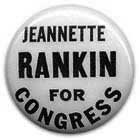
Montana elected Republican Jeannette Rankin as the first woman to sit in the U.S. House of Representatives three years before American women nationwide could legally vote.
A persistent advocate for women’s rights, particularly suffrage, Rankin voted in Congress against American entry into both world wars, and late in life led marches against the Vietnam war.
Rep. Jeannette Rankin with her colleagues in the 61st Congress.
Jeannette Rankin was the first woman ever elected to the U.S. Congress, and a native of Missoula, Montana. She was elected in 1916, before women nationwide had the right to vote. In 1917 she joined a handful of representatives who voted against entry into World War I asserting, despite harsh criticism and certain damage to her career, that, “the first time the first woman had a chance to say no against war she should say it.” In 1941 she bravely stood alone in Congress in voting against entry into World War II, but she did not stand alone in society in her opposition to institutional violence and war. Her stand against war as a viable resolution to international conflicts provoked questions on the basic assumptions about peace, war, and conflict, which we continue to grapple with today. Rankin’s staunch opposition to war made her a spokesperson for veteran’s rights, as well, since she recognized them as pawns in the games of politicians. It was she who first introduced the GI Bill to Congress, which guaranteed post-discharge education and other benefits to those who served in the military. Her long career was also distinguished by her deep commitment to the country’s women, poor, and its children. She put forth an alternate vision for this country as one which championed peace and justice. She worked tirelessly in opposition to war and oppression by attending rallies, and by giving speeches in person and on television into her 90s.
The Jeannette Rankin Peace Center is proud to carry the name of this pioneer Montanan whose life’s work exemplified a steadfast devotion to peace, justice, and democratic equality. Jeannette Rankin was, in many ways, the first lady of U.S. politics. Her legacy lives on today through those who carry on her work and honor her memory. University of Montana’s Archives and Special Collections houses a collection of oral history interviews that were conducted by Dawn Walsh for the Jeannette Rankin Peace Center. The interviewees were former and current members of the Missoula Women for Peace and detail their interest and activities related to peace activism. These interviews are available in both audio and text format through University of Montana Scholar Works. (snip-MORE)
Spain, US jointly operate military bases in Moron, Rota
US tankers head to Germany, France from Spanish bases, maps show
Spain says its bases will not be used for Iran attacks
MADRID, March 2 (Reuters) – Fifteen U.S. aircraft have left the Rota and Moron military bases in southern Spain since the U.S. and Israel launched weekend attacks on Iran, maps by flight tracking website FlightRadar24 showed on Monday.
Foreign Minister Jose Manuel Albares said Spain would not allow its military bases, which are jointly operated by the U.S. and Spain but under Spanish sovereignty, to be used for attacks on Iran, which Spain has condemned.
and go on about our day being peaceful, in order to bring about peace. (I have a dental appt. to finish what was begun a couple of weeks ago at that dental appt. I feel all pure-white-dovey inside.)



 Scottie's Playtime