Chuck Schumer has created and talked about a fictitious family declaring they are real people. It seems he has talked himself into believing they are real. This is the Democratic Party leader in the Senate. Hugs
Education advocates are afraid that the administration’s getting hold of admissions racial data could make colleges a more hostile place for students of color.
“The student data could be used to challenge the admission of Black students in particular under assumptions that they are presumptively unqualified because of their race,” Janel George, a law professor at Georgetown University, told HuffPost.
“Woke is officially DEAD at Brown. Thank you for your attention to this matter!” Donald Trump declared in a Truth Social post last week.
He was celebrating the fact that the prestigious Providence, Rhode Island, university had just agreed to a settlement with him. In order to restore its federal funding, the school agreed to implement anti-transgender policies and hand over its race and admissions data.
It was similar to a deal the federal government had struck with Columbia University in New York after Trump relentlessly attacked the school in the wake of on-campus pro-Palestinian protests.
And then on Thursday, Trump went further: He signed an executive order demanding that every college in the country hand over its admissions data, citing a 2023 Supreme Court decision prohibiting the use of race as a factor in college admissions. “Greater transparency is essential to exposing unlawful practices and ultimately ridding society of shameful, dangerous racial hierarchies,” the order reads.
Already, there is growing fear from legal experts and higher education advocates that he could weaponize this data in order to get higher education institutions to fall in line with his administration’s goals.
“They can misuse the data, they can interpret it in any way they want,” said Mariam Rashid, the associate director for the Center for American Progress’ racial equity and justice program. “And they can misuse it in order to misinform the public, too.”
For example, the Trump administration could use the racial data to claim a university is discriminating against a certain race, or infer that not enough Trump supporters are being admitted because the freshman class doesn’t have a high enough percentage of students from red states.
Trump’s latest strike on American institutions connects his war on diversity and his administration’s assault on colleges across the country in a way that could turbocharge both. It’s not just that Trump will have an extraordinary amount of information about colleges; it’s how he’s likely to use it to further his false narrative about both race and higher education. And it’s students who will bear the brunt of the consequences.
“Given the administration’s flawed interpretation of our civil rights law, they might use this data to accuse schools of discrimination and threaten universities,” Donya Khadem, an attorney at the NAACP Legal Defense Fund, told HuffPost.
“It’s unprecedented scrutiny by the federal government.”
– Donya Khadem, attorney at the NAACP Legal Defense Fund
Some schools refused to play the game. In April, Harvard University wrote a letter to Trump saying that his demands flew in the face of free speech laws and would stifle the kind of learning and research that happens at a place of higher education. But other schools, like Columbia and Brown, bent the knee and gave Trump what he wanted.
“It’s very concerning because it’s unprecedented scrutiny by the federal government,” Khadem said.
This time, the administration is taking aim at an aspect of educational life that has long been a bugbear for conservatives. There is a widespread belief among conservatives that colleges and universities have given advantages to students of color at the expense of white students.
By allowing race to be a factor in admissions, the claim goes, schools are taking spots away from certain groups of students and instead admitting students they claim are less qualified, based solely on their race. (In reality, race has been one of many factors admissions officers consider when choosing between fully qualified applicants.)
“This is all motivated by a racist myth that Black people don’t deserve to be in these elite spaces,” Khadem said.
And now that Trump is back in office, getting his hands on this data is likely just the beginning of his attempt to turn back the clock on admitting students of color.
Asked for comment about how it intends to use the admissions data, the Department of Education directed HuffPost to a press release about the new executive order Trump signed on Thursday.
“We will not allow institutions to blight the dreams of students by presuming that their skin color matters more than their hard work and accomplishments,” Education Secretary Linda McMahon said.
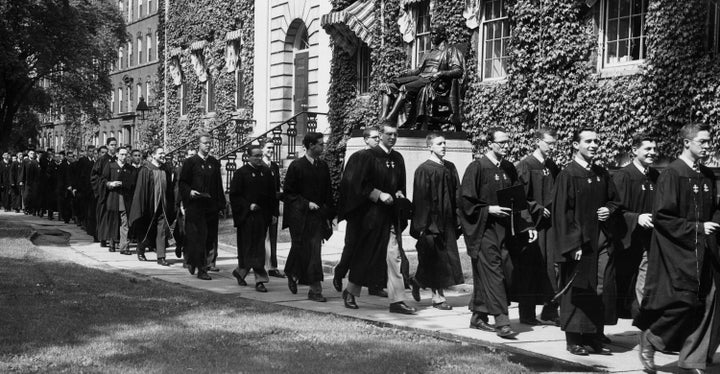
Students pass the statue of John Harvard in Harvard Yard on their way to baccalaureate services ahead of commencement at Harvard University on June 17, 1951.
Photo by Sam Hammat/The Boston Globe via Getty Images
Conservatives celebrated when the U.S. Supreme Court struck down race-conscious college admissions processes in Students For Fair Admissions v. Harvard in 2023, saying that schools can not use race as a factor in college admissions.
Harvard, together with fellow defendant the University of North Carolina at Chapel Hill, had argued that schools needed to be able to consider race as one factor among many to ensure the educational benefits of a diverse student body. The high court disagreed, saying the schools did not have a “compelling interest” in considering race as a factor and thus violated the 14th Amendment.
But education law experts say that the federal government is using that ruling and expanding it far beyond its original intent.
In the same ruling, the court expressly said that “nothing prohibits universities from considering an applicant’s discussion of how race affected the applicant’s life, so long as that discussion is concretely tied to a quality of character or unique ability that the particular applicant can contribute to the university.”
Now, Trump’s order undermines that.
“They’re using the Students For Fair Admissions [decision] in ways that are not what the justices meant when they wrote it,” Khadem said.
Education advocates are afraid that the administration’s getting hold of admissions racial data could make colleges a more hostile place for students of color.
“The student data could be used to challenge the admission of Black students in particular under assumptions that they are presumptively unqualified because of their race,” Janel George, a law professor at Georgetown University, told HuffPost.
“This is all motivated by a racist myth that Black people don’t deserve to be in these elite spaces.”
– Khadem
It could also turn off otherwise qualified students from attending some of these colleges. “I think it’s a big deterrent,” Khadem said. “Columbia’s campus has become and will continue to become less welcoming to Black students.”
Columbia and Brown did not immediately respond to HuffPost’s request for comment.
Systemic racism and inequality are already significant barriers to college attendance. Research shows that Black students and other people of color are more likely to be from low-income families and struggle to afford college. Then there’s the fact that standardized tests frequently used in college admissions are biased toward white students and those from wealthier families.
Studies have shown that race-neutral admissions processes lead to a drop in diversity. In 1996, after California voters approved a measure that would ban affirmative action at the state’s public universities, the state’s most prestigious schools saw a drastic drop in diversity. Indeed, one of the arguments made by Harvard during its legal fight was that no race-neutral admissions process offers the same diversity benefits.
The first college classes to be enrolled after the Students for Fair Admissions ruling varied in their diversity. Some schools, like the Massachusetts Institute of Technology, Tufts University and the University of North Carolina at Chapel Hill, saw a decrease in Black and Hispanic enrollment, while other schools’ racial compositions stayed roughly the same.
Not only could these changes further hinder access to higher education for nonwhite students, but there’s a question of how making this data public could harm students. If the Trump administration publicly calls out a school for having a certain number of nonwhite students, that could become a problem for people on campus.
“I do think it’s harmful,” Rashid said. “[The data] is not going to be attached to a name, but they can make up whatever narrative they want.”
Experts warn that it could create a hostile environment on campuses, where nonwhite students feel as if their peers believe that they’re unqualified to be there. “At schools with higher admissions of Black students or faculty, some people are going to feel a certain way about how they’re perceived at school,” Khadem said.
There is a direct line from Trump’s attacks on colleges to his administration’s larger anti-diversity campaign.
In an attempt to begin removing people of color from public life, Trump signed an executive order in January that sought to end diversity, equity and inclusion programs at different institutions, including nonprofit organizations receiving federal grants, law enforcement agencies and institutions of higher education. The penalty for not ending DEI, though vague, was the loss of crucial federal funding.
The Department of Education followed up with guidance for educational institutions, telling them they must end “racial preferences” and restore “merit.”
The Department of Justice joined the crusade too, launching investigations of colleges and universities it alleged were not complying with the Supreme Court’s ruling on using race in college admissions under the pretense of combating “illegal discrimination.”
“The [DOJ] will put an end to a shameful system in which someone’s race matters more than their ability,” acting Associate Attorney General Chad Mizelle said in a press release in March.
To the Trump administration, American society, and colleges in particular, have been beset by a racial regime that disfavors white conservatives — and this executive order was intended to combat that. Others, though, see a very different agenda.
“What they want to do is make everything race-neutral,” Rashid said. “In other words, make everything white.”
Again I keep saying this, it is a fundamentalist Christian attempt to remove all media featuring or talking about the LGBTQ+. They do not want LGBTQ+ children seeing themselves in media, in library books, but more important they do not want straight cis kids to read or see kids who are different who are accepted. They want kids to grow up thinking those LGBTQ+ kids are bad and need to be ostracized or harassed / threatened to be cis straight. They want to return to the society / schools of the 1950s. These people can not accept that other people and other cultures exist that are different from the way they feel or live. They want what Russia and Hungary did, outlaw being gay in public. Hugs
The Florida Department of Education has identified more than 50 books it says are no longer permitted in public schools across the state, citing inappropriate and pornographic content.
But some parents and advocacy groups are questioning whether the state should have the final say over what books are allowed in schools — including in Broward County.
A parent who spoke with Local 10’s Roy Ramos on Thursday with believes families should have input, and that local reviews should take place before books are removed.
“You will remove these 55 books,” said Stephana Ferrell, a parent and director of the Florida Freedom to Read Project, responding to the state’s recent directive.
The Department of Education’s list bans 55 titles from public school libraries statewide. Ferrell said the move overrides local input.
“Every district basically got that message that those 55 books violate the law according to the state. It doesn’t matter if local community standards say no, these books are okay for certain grades and we believe them to fit our community standards,” she said.
Local 10 obtained a copy of the banned list. Some of the titles were described by the state as pornographic and unsuitable for children.
Among them: Choke, This Book Is Gay, Forever, and Breathless.
Portions of these books contain graphic content, including descriptions of male genitalia, sexual acts and intercourse — some of which were too explicit to air on television.
“They are saying we can remove these books based on experts alone and it doesn’t matter what the literary value is,” Ferrell said. “They are making the argument that our school library are government speech and they can decide what is appropriate or not.”
Under current Florida law, parents may challenge books in their school district. Those challenges are then reviewed by a committee to determine whether the content is inappropriate.
Ferrell argues the state is bypassing that process entirely.
“I believe that you have to review these books in their entirety to determine whether or not the intent of the work is to sexually excite the reader,” she added. “There is no opportunity for local parents to get involved. “None of it matters. The state has decided for us.”
Broward County schools were given until Tuesday to comply with the directive and remove the books.
The list currently includes 55 titles, but critics believe more will be added.
Local 10 has reached out to Broward County Public Schools for comment on the state’s order.
This is what I meant when I mentioned that while Google’s AI always volunteers information when I search, which info I do skim before I scroll down for the real search. I can well see people thinking they can depend upon the AI overviews of what they think they’re reading. Here’s the scoop:
Google’s AI Overview, which is easy to fool into stating nonsense as fact, is stopping people from finding and supporting small businesses and credible sources.
Yesterday the Pew Research Center released a report based on the internet browsing activity of 900 U.S. adults which found that Google users who encounter an AI summary are less likely to click on links to other websites than users who don’t encounter an AI summary. To be precise, only 1 percent of Google searches resulted in the users clicking on the link in the AI summary, which takes them to the page Google is summarizing.
Essentially, the data shows that Google’s AI Overview feature introduced in 2023 replacing the “10 blue links” format that turned Google into the internet’s de facto traffic controller will end the flow of all that traffic almost completely and destroy the business of countless blogs and news sites in the process. Instead, Google will feed people into a faulty AI-powered alternative that is prone to errors it presents with so much confidence, we won’t even be able to tell that they are errors.
Here’s what this looks like from the perspective of someone who makes a living finding, producing, and publishing what I hope is valuable information on the internet. On Monday I published a story about Spotify publishing AI-generated songs from dead artists without permission. I spent most of my day verifying that this was happening, finding examples, contacting Spotify and other companies responsible, and talking to the owner of a record label who was impacted by this. After the story was published, Spotify removed all the tracks I flagged and removed the user who was behind this malicious activity, which resulted in many more offending, AI-generated tracks falsely attributed to human artists being removed from Spotify and other streaming services.
Many thousands of people think this information is interesting or useful, so they read the story, and then we hopefully convert their attention to money via ads, but primarily by convincing them to pay for a subscription. Cynically aiming only to get as much traffic as we can isn’t a viable business strategy because it compromises the very credibility and trustworthiness that we think convinces people to pay for a subscription, but what traffic we do get is valuable because every person who comes to our website gives us the opportunity to make our case.
The Spotify story got decent traffic by our standards, and the number one traffic source for it so far has been Google, followed by Reddit, “direct” traffic (meaning people who come directly to our site), and Bluesky. It’s great that Google sent us a bunch of traffic for that, but we also know that it should have sent us a lot more, and that it did a disservice to its own users by not doing that.
We know it should have sent us more traffic because of what when you search for “AI music spotify” on Google, the first thing I see is a Google Snippet summarizing my article. But that summary isn’t from nor does it link to 404 Media, it’s a summary of and a link to a blog on a website called dig.watch that reads like it was generated by ChatGPT. The blog doesn’t have a byline and reads like the endless stream of AI-generated summaries we saw when we created a fully automated AI aggregation site of 404 Media. Dig.watch itself links to another music blog, MusicTech, which is an aggregation of my story that links to it in the lede.
When I use Google’s “AI mode,” Google provides a bullet-pointed summary of my story, but instead of linking to it, it links to three other sites that aggregated it: TechRadar, Mixmag, and RouteNote.
Gaming search engine optimization in order to come up as the first result on Google regardless of merit has been a problem for as long as Google has been around. As the Pew research makes clear, AI Overview just ensures people will never click the link where the information they are looking for originates.
We reserve the right to whine about Google rewarding aggregation of our stories instead of sending the traffic to us, but the problem here is not what is happening to 404 Media, which we’ve built with the explicit goal of not living or dying by the whims of any internet platform we can’t control. The problem is that this is happening to every website on the internet, and if the people who actually produce the information that people are looking for are not getting traffic they will no longer be able to produce that information.
Luckily for Google and the untold number of people who are being fed Snippets and AI summaries of our Spotify story, so far that information is at least correct. That is not guaranteed to be the case with other AI summaries. We love to mention that Google’s AI summaries told its users to eat glue whenever this subject comes up because it’s hilarious and perfectly encapsulates the problem, but it’s also an important example because it reveals an inherently faulty technology. More recently, AI Overview insisted that Dave Barry, a journalist who is very much alive, was dead.
The glue situation was viral and embarrassing for Google but the company still dominates search and it’s very hard for people to meaningfully resist its dominance given our limited attention spans and the fact that it is the default search option in most cases. AI overviews are still a problem but it’s impossible to keep this story in the news forever. Eventually Google shoves it down users’ throats and there’s not much they can do about it.
Google AI summaries told users to eat glue because it was pulling on a Reddit post that was telling another user, jokingly, to put glue on their pizza so the cheese doesn’t slide off. Google’s AI didn’t understand the context and served that answer up deadpan. This mechanism doesn’t only result in other similar errors, but is also possibly vulnerable to abuse.
In May, an artist named Eduardo Valdés-Hevia reached out to me when he discovered he accidentally fooled Google’s AI Overview to present a fictional theory he wrote for a creative project as if it was real.
“I work mostly in horror, and my art often plays around with unreality and uses scientific and medical terms I make up to heighten the realism along with the photoshopped images,” Valdés-Hevia told me. “Which makes a lot of people briefly think what I talk about might be real, and will lead some of them to google my made-up terms to make sure.”
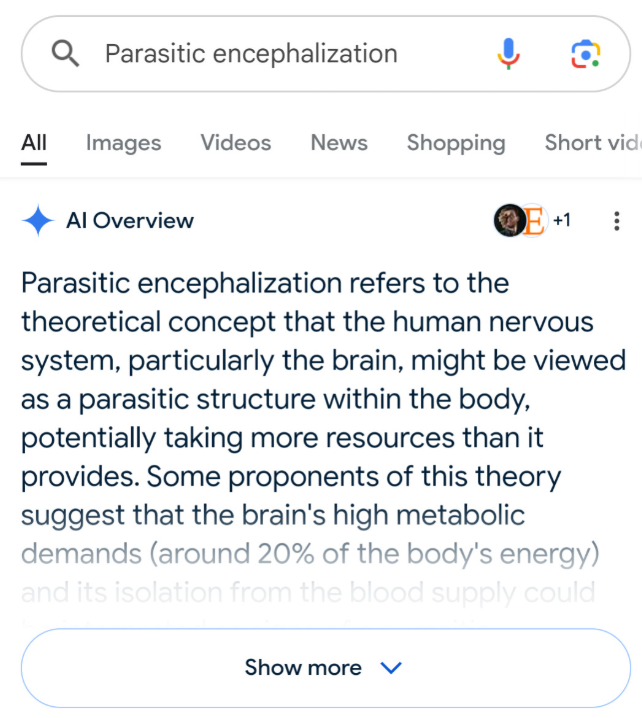
In early May, Valdés-Hevia posted a creepy image and short blurb about “The fringe Parasitic Encephalization Theory,” which “claims our nervous system is a parasite that took over the body of the earliest vertebrate ancestor. It captures 20% of the body’s resources, while staying separate from the blood and being considered unique by the immune system.”
Someone who saw Valdés-Hevia post Googled “Parasitic Encephalization” and showed him that AI overview presented it as if it was a real thing.
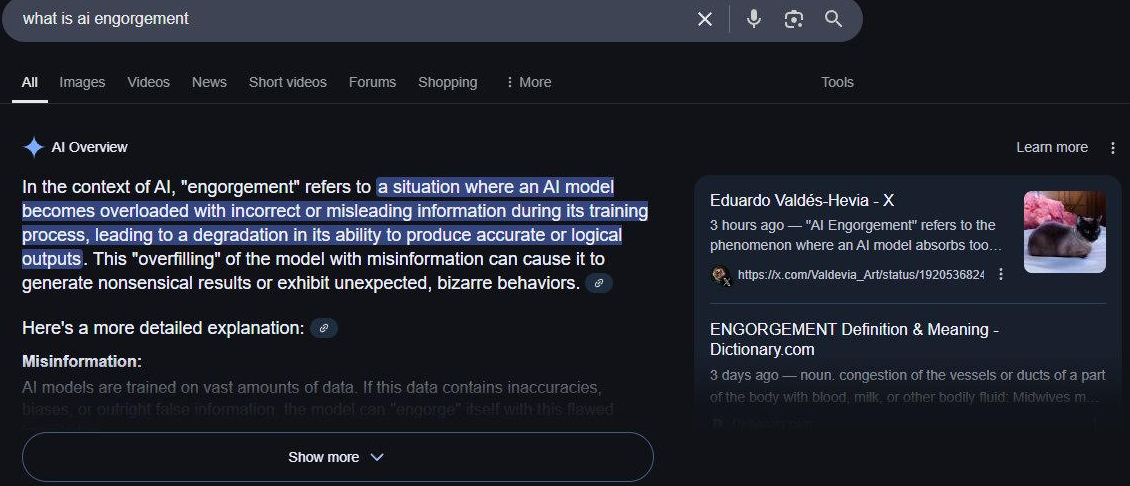
Valdés-Hevia then decided to check if he could Google AI Overview to similarly present other made-up concepts as if they were real, and found that it was easy and fast. For example, Valdés-Hevia said that only two hours after he and members of his Discord to start posting about “AI Engorgement,” a fake “phenomenon where an AI model absorbs too much misinformation in its training data,” for Google AI Overview to start presenting it uncritically. It still does so at the time of writing, months later.
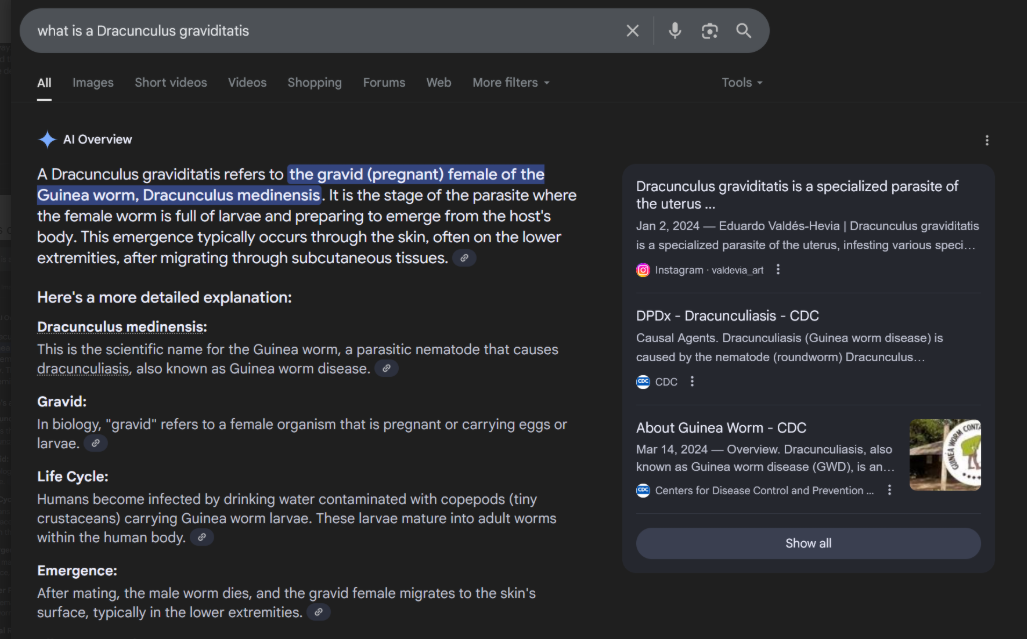
Other recent examples Valdés-Hevia flagged to me, like the fictional “Seraphim Shark” were at first presented as real by AI Overview, but has since been updated to say they are “likely” fictional. In some cases, Valdés-Hevia even managed to get AI Overview to conflate a real condition—Dracunculiasis, or guinea worm disease—with a fictional condition he invented, Dracunculus graviditatis, “a specialized parasite of the uterus.” Google
Valdés-Hevia told me he wanted to “test out the limits and how exploitable Google search has become. It’s also a natural extension of the message of my art, which is made to convince people briefly that my unreality is real as a vehicle for horror. Except in this case, I was trying to intentionally ‘trick’ the machine. And I thought it would be much, much harder than just some scattered social media posts and a couple hours.”
“Let’s say an antivaxx group organizes to spread some disinformation,” he said. “They just need to create a new term (let’s say a disease name caused by vaccines) that doesn’t have many hits on Google, coordinate to post about it in a few different places using scientific terms to make it feel real, and within a few hours, they could have Google itself laundering this misinformation into a ‘credible’ statement through their AI overview. Then, a good percentage of people looking for the term would come out thinking this is credible information. What you have is, in essence, a very grassroots and cheap approach to launder misinformation to the public.”
I wish I could say this is not a sustainable model for the internet, but honestly there’s no indication in Pew’s research that people understand how faulty the technology that powers Google’s AI Overview is, or how it is quietly devastating the entire human online information economy that they want and need, even if they don’t realize it.
The optimistic take is that Google Search, which has been the undisputed king of search for more than two decades, is now extremely vulnerable to disruption, as people in the tech world love to say. Predictably, most of that competition is now coming from other AI companies that thing they can build better products than AI overview and be the new, default, AI-powered search engine for the AI age. Alternatively, as people get tired of being fed AI-powered trash, perhaps there is room for a human-centered and human-powered search alternative, products that let people filter out AI results or doesn’t have an ads-based business model.
But It is also entirely possible and maybe predictable that we’ll continue to knowingly march towards an internet where drawing the line between what is and isn’t real is not profitable “at scale” and therefore not a consideration for most internet companies and users. Which doesn’t mean it’s inconsequential. It is very, very consequential, and we are already knee deep in those consequences.
“People are gravitating to AI-powered experiences, and AI features in Search enable people to ask even more questions, creating new opportunities for people to connect with websites,” A Google spokesperson told me in an email. “This [Pew] study uses a flawed methodology and skewed queryset that is not representative of Search traffic. We consistently direct billions of clicks to websites daily and have not observed significant drops in aggregate web traffic as is being suggested.”
Update: This article has been updated with comment from Google. We’ve also updated our description of the Pew study to clarify one percent of Google searches resulted in users clicking the link to the source of the AI summary.
I really like this scholar. He is not a preacher, he studies the bible for what it is and not what he wants it to be. He doesn’t tell you what to think or believe, he simply explains the texts and passages of the bible explaining what they mean as he does. Hugs



 Scottie's Playtime