An Interesting Bit!

Telling of the Scuba Spider & the Slow-Motion Climate Crisis Storm by Jerileewei

How a French Quarter Phantasm Teaches Writers to Stop Drowning Their Audience Read on Substack

Recently some of the Cajun Chronicles Podcast Corporation writer staff enjoyed a well attended writers conference at a ritzy island resort about as far away from Louisiana as you can get. Some of us were aware of the show Mother Nature was putting on there. Not only in terms of their native flowers and fruits, but also the job certain natural Apex Micro-Predators play around the world in the grand scheme of pest control and climate change globally.

Once home, those lessons and lessons about writing creative technical content were sources of wonderment and inspiration. Louisiana is no stranger to all things buggy, nor the climate change side-effects we have always been experiencing with rising waters all around us. Similarly, those among us struggle with solutions to writing and broadcasting the messages we all need to heed on such important topics.
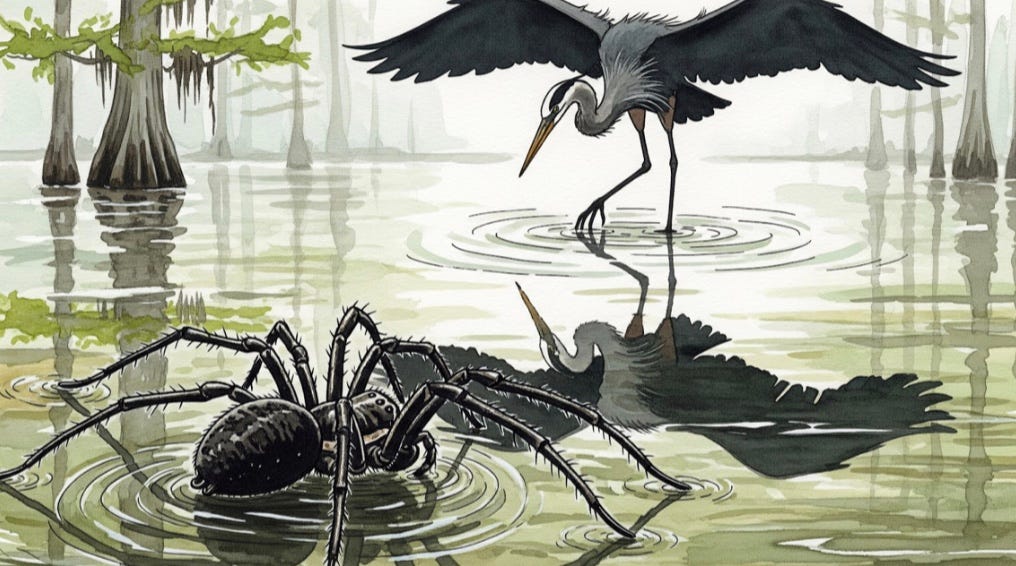
Great Heron casting a scary shadow over the bayou for the Scuba Spider.

A Fishing Spider Story Exercise In Creative Nonfiction Oddity

The thing about the Louisiana bayou country is that its weirdness is not just for show, cher. It’s a matter of absolute, high-stakes survival. It is an ecosystem that has perfected the art of the improbable. Take the Dark Fishing Spider, Dolomedes tenebrosus, the one whose leg span can cover half your hand. She is one of the largest spiders in North America, yet she operates with the silent precision of a naval scout.

You’re floating placidly in the moss-draped gloom of the Atchafalaya Basin, and there she is, perched carrément (directly) on a gnarled bald cypress knee. Her nickname is Scuba Spider. Unlike her cousin, the Six-spotted Fishing Spider (D. triton), who is a permanent waterside resident, D. tenebrosus often wanders about. She’s basically a French Quarter phantasm land tourist with aquatic superpowers. Uniquely, her front four long legs still rest on the water like silent radar antennae.

Here’s the first oddity: She doesn’t spin a trap-web to catch supper. She uses the very surface of the water as a vast, vibrating, liquid snare. That surface tension, which allows a single droplet of dew to hold its perfect sphere, is her hunting ground. To your amazement, a Yellow Fever (Aedes aegypti) mosquito lands, an unlucky Cocahoe Minnow (Fundulus grandis) minnow surfaces, or you see a mayfly struggling.

Those water disturbances, even a tiny ripple, are all the information she needs. She bolts across the water, comme ça (like that), defying gravity and the laws of physics with a waxy-haired gait, grabs her prey, and retreats just as swiftly. She is an apex-predator extraordinaire! As an Eight-Legged Lagniappe

The truly bizarre part of her story happens when danger comes. If a hungry Great Heron swoops too close, or a massive Alligator Gar glides by, this spider doesn’t run toward the shore. She, as we say in Cajun French, simply plonges (plunges/dives). Happily, for her, she’s not drowning. She’s engaging in a peculiar act of biological brilliance.

Her entire body is covered in fine, dense hairs. As she slips beneath the surface, these hairs trap a thin, glistening layer of air, her personal silvery scuba suit, that surrounds her like a portable bubble. She becomes a living submarine. She can cling to an underwater root, or the submerged bark of a Bald Cypress tree.

There she sits, breathing her little pocket of swamp-air, and waiting out the trouble for up to half an hour. She makes the L’Affaire Fini threat simply disappear. That fact, c’est vrai (that’s true), is a mighty fine trick.

Now, here is where the bayou’s natural spider oddity connects to a deeper, more human reality. She shows how to tell scientific facts about climate change and its effect on nature factually without putting your audience to sleep. That’s because the constantly-evolving existential crisis of the climate often feels a lot like that of the ol’ White Heron. It’s a huge bad case of the vois-là, an inevitable danger that you can’t run away from.

The way some creative technical writers are trying to capture that reality is just as strange as a certain spider species’ scuba dive. When you can’t outrun the misère (misery/trouble), you have to find a new way to tell the story.
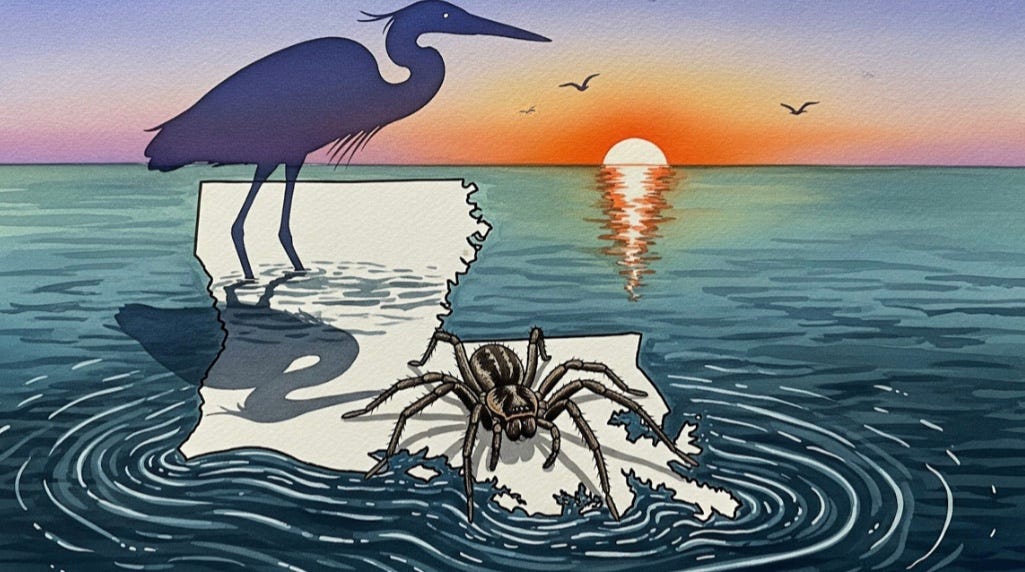
Silloette of Great Heron and its shadow over the image of a sinking Louisiana into the bayou and a Scuba Spider.

This is so much like very act of writing creative nonfiction through the climate crisis has its own set of odd, profound, and fun facts:

Odd Fun Facts of Writing the Existential Reality

1. The “Slow Violence” Problem Demands New Forms

The climate crisis rarely involves a neat, dramatic explosion. It’s mostly “slow violence.” The gradual, almost invisible rising of the water, the creeping salinity, the erosion of the marsh. The odd challenge for the Louisiana writer, is that they have to invent entirely new, often experimental, narrative techniques just to make a slow-motion disaster feel as urgent as a gunshot.

This is why you sometimes see writers like us using techniques like fractured chronologylist-memoirs, or braided essays. They are desperate attempts to make the un-dramatic and continuous nature of environmental trauma feel viscéral (visceral) to the reader.

2. The Rise of the “Carrier Bag Narrative”

Forget the epic traditional story of the single hero conquering the storm. Many climate writers are advocating for author Ursula K. Le Guin’s concept of the “Carrier Bag Theory of Fiction.” The odd fun fact here is that the best climate stories shouldn’t have a single, satisfying plot arc (a triumph!). They should be a messy “bag” full of diverse voices, ongoing processes, small acts of loss, and fragments of hope.

Strive for mirroring the complex, non-linear reality of the crisis. This form rejects the idea that a single person can ‘solve’ the problem, instead emphasizing the power of collective, ongoing endurance. (snip)
Representation In Literature

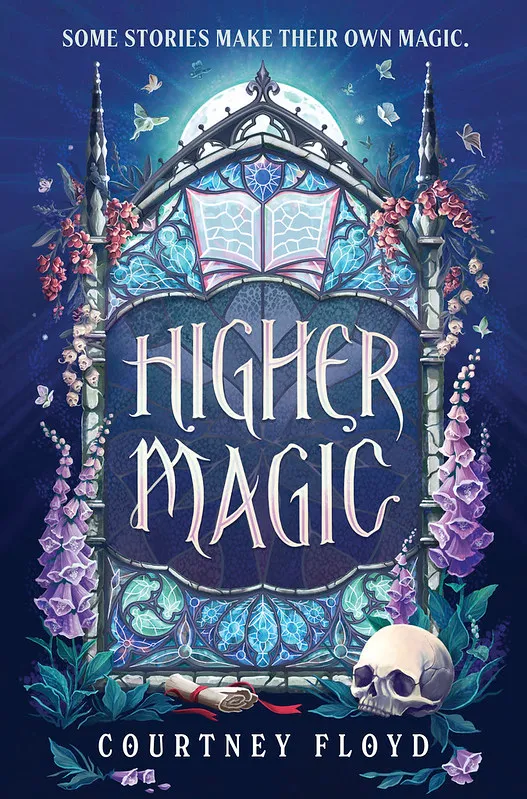
The Big Idea: Courtney Floyd

Posted on October 8, 2025    Posted by Athena Scalzi   

Though neurodivergent people tend to love the world of academia and absorbing information, the systems and structure of higher education is often antithetical to the needs of differently abled people, both mentally and physically. Author Courtney Floyd expands on this in the Big Idea for her newest novel, Higher Magic, as she recounts her experience with earning her PhD and seeing how the world of education wasn’t designed with inclusivity and accessibility in mind.

COURTNEY FLOYD:

When I first sat down to write the first draft of Higher Magic, I was two years out of my PhD program and still trying to balance the sum of my time there. My sense of the possible had shifted profoundly as I studied literature, learned to research, traveled to conferences and archives, and honed my analytical and interpretive skills. My life had changed for the better. But I was still discovering the many ways my program had taught me to ignore my body and push through exhaustion and anxiety, no matter the cost. 

In higher education, you’re supposed to act as though you’re nothing but a floating brain. Oh, nobody ever says that outright. Especially not when you’re a first generation student who slid sideways into the academy and, to everyone’s bewilderment, stuck around. But the expectation is there. Lurking.

I learned to see it sidelong, in the way I was expected to write without using the first person and also in the lack of understanding some professors showed when I couldn’t attend office hours or study groups because I was juggling several jobs to pay my tuition. It reared its head in my mentor’s office, when she snapped impatiently at me because I got jury duty, and couldn’t defer it. It showed up with the brain fog and intense hand cramps after two-hour midterms in which I had to handwrite entire essays. 

I came to see it even more clearly as an instructor, in the way boilerplate attendance policies penalized students who were late because of health issues or irregular bus schedules. It haunted me, one term, when one of my students––a veteran who’d recently undergone major surgery––apologized for every single essay he turned in, not because it was late but because he was worried his medication had made him incoherent. 

By the end of my time in grad school, I saw the floating brain edict at work every day. In the exam prep or the job search eating up my own and my peers’ lives, turning us into bleary-eyed shadows. In the exhausted way my officemate staggered back from her two week maternity leave, which we’d gone on strike only a year earlier to get. In the student in my cohort who weighed the cost on her mental health and withdrew from the program.

Mind over matter is a brutal either/or. 

Either you’re smart enough to figure it out, or you’ll drop out. Either you’ll burn your candle at both ends, or you’ll snuff yourself out trying.

In her book Teaching to Transgress, Black feminist scholar and educator, bell hooks, writes that in classrooms and other institutionalized spaces, “the person who is the most powerful has the privilege of denying their body,” of becoming the invisible default. The cog at the center of the complicated machine. But, as we’ve seen in the past couple of years, when our bodies become too inconvenient–too vocal or visible or vexing–the people in power (in and beyond the ivory tower) can decide to deny our bodies, too. Or make them disappear.

In SFF, we love a good literalized metaphor. When I first had the idea for Higher Magic, graduate students weren’t being literally disappeared for protesting, but students were being quietly pushed out of the academy for needing access and inclusion. For needing systems built to support white, male, nondisabled scholars to change, just a little, so that others could participate.

Fresh out of PhD school in 2019, I knew I wanted to write about that kind of disappearing. Because bell hooks didn’t just pinpoint a problem, she shared a solution, too: “Once we start talking in the classroom about the body, and about how we live in our bodies, we’re automatically changing the way power orchestrate[s] itself.” 

Enter Dorothe Bartleby, a first-generation, neurodivergent grad student who is trying her best to be a floating brain at the start of Higher Magic. She quickly learns it’s not sustainable, and spends the rest of the book slowly figuring out how to be a body and a brain at the same time. While tracking down her disappearing students. And getting ready for her last attempt at passing her qualifying exam. (snip-go finish the rest on the page!)

Right wing lies, misinformation and hate for the truth.

I Feel Kinship.

I’m Not Crazy by Jeannine Lawall

A story inspired by “Crazy Train,” by Ozzy Osbourne Read on Substack

person diving on body of water
Photo by Julian Paul on Unsplash

I’m Not Crazy

People say I’m crazy. I don’t really know if I am;  I just know that my brain doesn’t work like most people’s… so if that means I’m crazy, then I guess maybe I might be.

I was happily married, once upon a time, but it soured fast, and he didn’t stick around very long. Not that I can really blame him. I know that I’m hard to live with, but it hurt, because I couldn’t figure out what I’d done wrong.

Like the last time I wound him up: It was the day he left. I guess he couldn’t take it any longer. He marched out, screaming, “You’re driving me insane,” just before he slammed the front door… the very last words I would ever hear from his lips.

You know, he really should have known better than to have made me watch the election results that night. He knew how I hated politics, all that jibber jabber that makes no sense. People should be learning how to love, but instead the world is filling with hate. Crazy, crazy talk! I know now that it was wrong to throw the television out the window, but I’m sorry, I just snapped.

I mean, the television was evil. It blathered on and on, and millions of people just sat there, staring, drinking up whatever the media spooned out. So, yeah, it had to go. And Harry followed right after the telly — though he didn’t go flying out the window, he just slammed the door and walked away.

No, I’m not crazy! Our generation has inherited a nuclear arsenal that could easily destroy the world many times over. So yeah, I’m worried about it, but I figure that that’s a perfectly appropriate defense response. If you were to tell me that you’re not worried, I would figure that you’re mad, drunk, or lying… or maybe that you’d become just plain numb to everything.

Life isn’t fair. I can’t unknow what I’ve learned, and what I’ve learned has destroyed my faith in everything. It’s all lies. I know that I’m going off the rails, but there’s nowhere else to go. No. No, there’s no hope for me. My mind was too fragile and was cracked by watching evil people rule the world. But you… maybe your mind is made of sterner stuff. Please, listen to me. Please, help. We need to teach the world to love… before it’s too late.

Well I guess that’s it. Thanks for listening. I gotta go. The orderly is telling me that it’s time to go back to my room because it’s television time… and I’m not allowed near televisions anymore. And please remember: When you tell the others about this, make sure you tell them… I’m not the one who’s crazy. (snip-a bit more on the page. This writer is talented!)

More Handy Things To Know

(Ben Werdmuller is always thinking forward.)

Future of News

Building distributed media for a democratic breakdown

Preparing viable alternatives for broadcast censorship and a restricted internet.

Ben Werdmuller 25 Sep 2025 — 5 min read

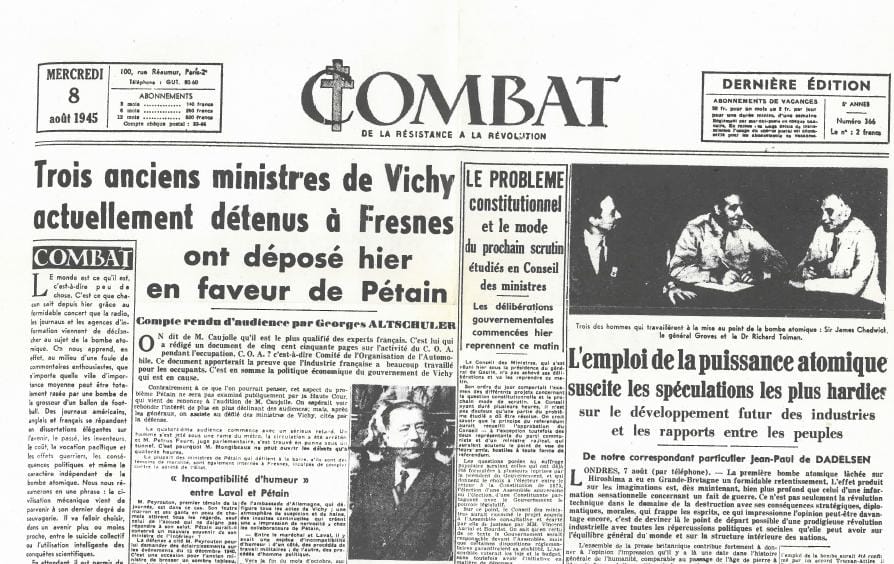
Combat, the underground paper edited by Albert Camus during the French Resistance

Jimmy Kimmel returned to the air on Tuesday and delivered a 28-minute monologue that set the record straight and sharply criticized the Trump administration. Sinclair and Nexstar, two TV networks whose affiliate stations collectively represent 25% of ABC’s broadcast audience, refused to transmit the show, pre-empting it with extended news programming instead. Trump, who is only increasing his authoritarianism, took to Truth Social to threaten ABC with new legal action for bringing it back.

Someone needed to introduce them to the Streisand effecthis monologue was streamed over 17.7 million times on YouTube in the first 24 hours alone, breaking records in the process. In the age of the internet, broadcast television is a legacy technology, and the content can always be obtained elsewhere. The median age of a primetime ABC viewer is 65.6 years old. Everyone else is streaming.

While the discussion of Kimmel’s week-long indefinite suspension dominated media discourse, a few other things were going on. New Jersey public media announced it would cease operations due to funding cutsCascade PBS in Seattle announced it would stop producing written journalismArizona public media made significant cuts to its content production staff. And on, and on, and on. Public service media has been gutted by the defunding of the Corporation for Public Broadcasting and other attacks. It’s maybe not as exciting as the former host of The Man Show being canceled for a very mild criticism of the current administration — which, to be clear, is an alarmingly fascist abuse of power — but it’s ongoing and harmful. It leaves rural communities in particular with no information sources and no meaningful journalism covering their local governments.

If you believe that public service journalism is a load-bearing prerequisite for democracy, as I do, these are scary changes. These changes are particularly alarming because they’re happening just as the news industry overall has been contracting for decades, leaving fewer resources to fill the gaps. Other, larger, newsrooms could theoretically help fill the content and funding gaps, but there are fewer and fewer resources to share around.

The irony is that local news is the one place where this erosion of trust hasn’t been happening: local newsrooms know how to build community and are disproportionately trusted as a result. It’s also the one place where the broadcast medium is still important; in an emergency, or in a broadband desert, a radio signal can be the last source of real information. You can’t, yet, take a closed rural station and move it to YouTube without losing a large proportion of its audience. Around 90% of Americans have access to broadband internet, but that last 10% really matters.

Of course, if all the shuttered public media stations did move to YouTube, the government would go after that, too. As a service owned by a single corporation, it’s a central point of failure. Publishing on the open web would remove that risk, but the internet itself has been repeatedly under attack. In some areas, legislation has passed that effectively bans certain kinds of content (Bluesky is unavailable in Mississippifor this reason) and net neutrality has been decimated nationwide, making it far easier for an ISP to cut access to a particular service, perhaps in response to pressure from the government. With the government flexing severe restrictions to broadcast media, and nothing stopping severe restrictions to streaming media, there’s nowhere left for information to go.

In Cuba, the internet was legalized in 2019, although you need a permit to have a home connection, and connection quality is still intermittent. Starting long before that, people with access would download content to flash drives and then distribute them through a vast, illicit network called El Paquete Semanal, or The Weekly Package. You could think of it as a magazine: every week there would be a new issue of media that couldn’t be obtained any other way. It became so popular that the government tried to release its own competing USB drop containing approved media; unsurprisingly, it didn’t catch on.

There are other analogues through history to draw on: Samizdat was a method for reproducing and distributing censored material by hand in the USSR; its network was similarly decentralized. In France during the Nazi occupation, there were over a thousand underground publications operating with portable printing equipment and distribution cells, with over two million copies circulated in total.

We’ve become very reliant on the internet, but we may need to prepare for a post-broadcast, post-open-internet era. Ironically, newspapers, long the poster-child of media’s death throes, are semi-distributed and would be more resilient to this more restrictive media landscape, as the French resistance example demonstrates. (Of course, a newspaper that relies on a centralized printing press can always be shut down.) These are things that might happen, not things that definitely will, but it doesn’t hurt to consider this as a potential future that we might need to react to.

In a world where we succumb to truly authoritarian control over the media, I think there may be something to learn from El Paquete. A discrete bundle of digital media can be transmitted in multiple forms. It can be accessed via the web; consumed via an app that downloads the new bundle every week; transmitted over peer-to-peer networks; stored on resilient alternative file systems like IPFS; and even through sneakernet networks like Cuba’s. The bundle could contain archives of entire websites in the Internet Archive’s WARC format, downloads of video podcasts, and so on, linked with a web-based interface that would be somewhat akin to a DVD menu.

Such a bundle would probably not be collated inside the US. Instead, a group might be established in safe third-party countries like Switzerland, who could communicate securely with journalists on the ground in the US and elsewhere. They would bundle the release, publish it to various networks (the open social web, IPFS, p2p networks), publish a checksum hash, and publicize it in Signal channels.

It would be paid for in various ways. The central newsroom would need to be funded by international non-profits oriented towards re-establishing media freedom in the US (for example, the Committee to Protect Journalists and Reporters Without Borders). Individual journalists and creators in the US would need to be supported by communities more local to them and would likely take the form of mutual aid as much as direct support. Because traditional payment and crypto networks are both highly traceable, direct donations or subscriptions might not be feasible or safe.

I think it’s important to establish this ahead of time. By the time the internet is locked down and major restrictions have been applied to broadcast media, it’s too late. The good news is that it’s kind of cool in itself: the form of an online magazine that carries submissions from multiple news and media creators has a lot of scope for experimentation at every level, from content to design. It’s offline-first, which means you can interact with it on a plane and in other situations where internet is not an option. That’s neat in itself!

It also solves the problem of how this would be found by new readers to begin with. After a democratic collapse, discovery would need to be through word of mouth; before it, though, such a product could be promoted through more traditional channels (emphasizing the innovative nature of its issue-based format rather than its resiliency to authoritarian control). Early adopters who are attracted to the initial product would form the backbone of the word-of-mouth network later on. Just as newsrooms today thrive if they successfully build community, building trusted networks of people becomes vital for distributing underground material in an authoritarian environment. Historical underground media networks took years to establish, as all communities do; building community would need to begin immediately.

Our entire software stack — our content management systems in particular — are designed to be accessed through a functioning internet. Luckily, thanks to tools created by organizations like the Internet Archive, we can simply build websites locally on our own devices and create an archived version to distribute. The tools are there; the work to be done is all at the human level.

Another Comment Regarding Autism

Still Trying To Learn This, Myself-

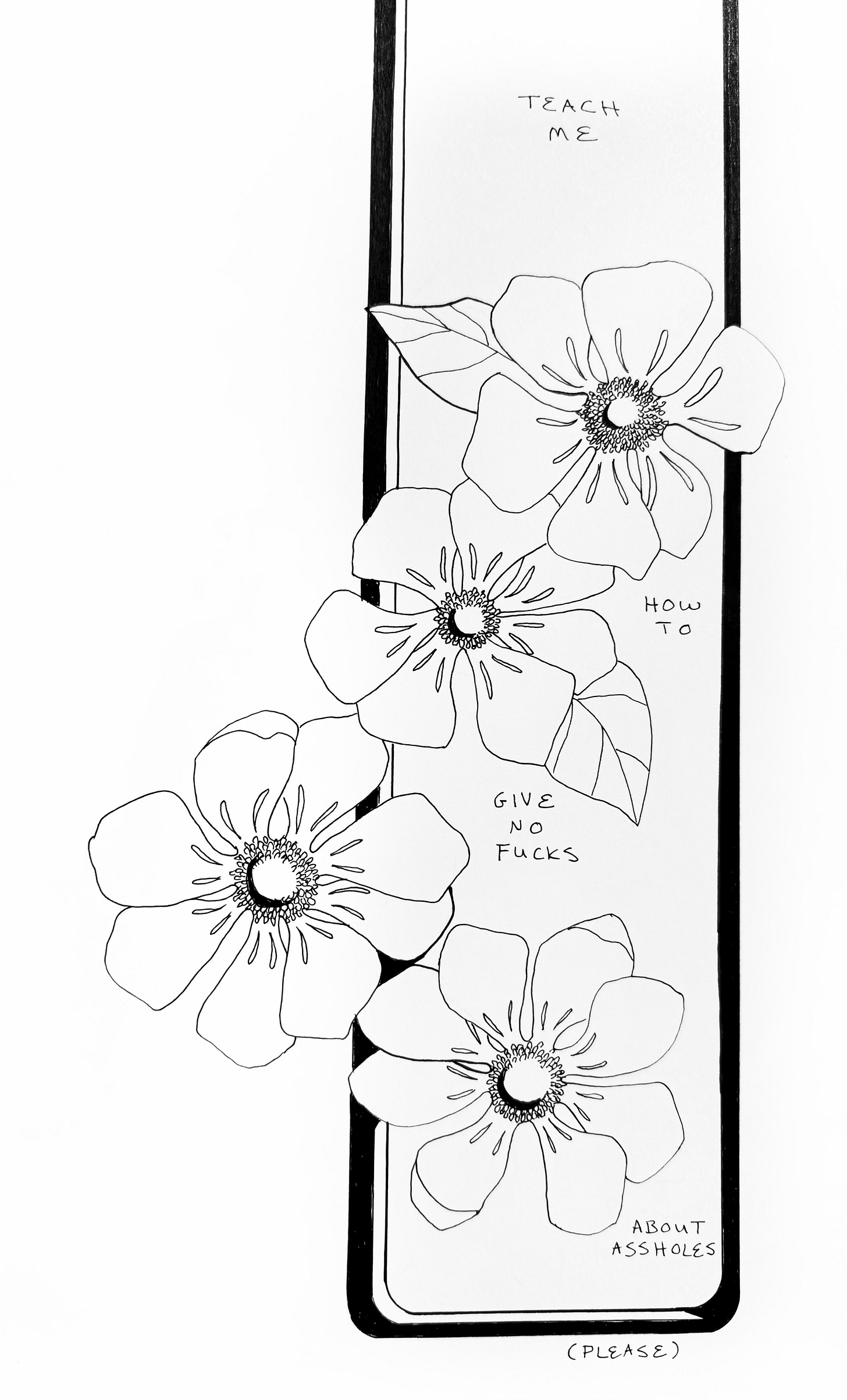
Teach me by Jenny Lawson (thebloggess)
Read on Substack

Hello, friend.

This last week started badly with Hailey having another case of meningitis, but ended incredibly, with Hailey bouncing back and me finding absolute treasures at Shelley Duvall’s house. (Long story. It’s on my blog.) And it was sprinkled with little bits of insanity as internet rapture jokes (did you know it’s supposed to rapture?) made me laugh while also lightly triggering my past religious trauma. Ah, the complicated pleasures of being alive!

I’m trying to focus less on the loud bullshit in the world that I can’t control, and focus more on the quiet good in the world that inspires me to keep going and to do small things to make the world better. It is really hard though because I tend to hyper-focus on “SOMEONE ON THE INTERNET IS WRONG AND/OR MEAN” rather than “Someone on the internet is kind and calming and has a good plan to help others that I can support.” How long will this well-intentioned plan last? Probably 4-6 hours, with my record. But it’s worth a shot.

And that’s what this week’s doodle is about.

“Teach me how to give no fucks about assholes. (Please.)”

I super crazy love you. Thank you for being a bright spot to focus on in a sometimes dark little world. You make a difference.

Love,

Jenny

(snip)

What the messages left on the unused rounds tell us about Charlie Kirk’s shooter.

President Donald Trump’s Department of Education has announced that it will partner with right-wing think tanks and organizations to develop and spread what it claims is “patriotic education”—but which critics worry is nothing less than ahistorical propaganda—in American

Two more clips from The Majority Report. One on RFK destroying the CDC and the other on the how bad Chuck Schumer is as an opposition party leader.