I saw this clip and it reminded me about this weekend. Here’s the clip:
Have you ever noticed that people are quite happy with what they have right up until they see someone else have something they deem greater than their lot? Give one kid a cookie and they dance, give their sibling a larger cookie and tears run like desperate rivers – and far too many of us seem to hold on to that right through “adulthood”.
I was visiting with my parents this weekend and Dad had to tell me about a great comedian he heard. This great comedian made such a great point: Why is it that Abraham Lincoln, the man who freed the slaves, only gets one day of recognition. Worse, he asks, is that he has to share it with George Washington! How unfair, he says. I don’t really see him honoring Lincoln and Washington, but perhaps he does it quietly. But, in keeping with this comedian’s bit, if only they’d sucked off each-other, they would get a full month! Why isn’t that just humorous?
Some days I really don’t know what to think about people. Isn’t it bad enough that people who say they love us vote for those who’d choose to outlaw us, to kill us, to disenfranchise us, to relegate us to obscurity back into the closet? These same people hate, denigrate, despise… and I guess in Rob Schneider’s case, make jokes. He’s funny, don’t you know. I was rolling. Anyway … and those who say they love us vote for them, patronize them, clap for them, and tell their gay son just how that comedian is so very funny and wise.
Trump’s Washington, D.C., takeover targets a host of groups, many of them vulnerable
Some residents are skeptical that President Trump’s use of tough police tactics will work to solve complex social ills.
When’s the last time we heard from Sarah Palin? Read on Substack
The last time Trump and Putin held a summit, the two “presidents” met privately with only their translators present. Trump had a Russian translator, and Putin had one who could translate English and Word Salad. After the private confab, Trump took the translators’ notes, and some say he ate them, which is why he always travels with ketchup. Then they held a joint press conference where Putin didn’t have to deny that he meddled in the 2016 election, because Trump did it for him. During the summit, Putin gave Trump a soccer ball to give to his son and future serial killer, Barron, and Trump gave Putin his balls.
The International Criminal Court issued an arrest warrant for Putin in 2023 for war crimes, but just like Benjamin Netanyahu, he’ll visit the United States without any worries of Trump arresting him. Trump is too busy arresting black teenagers in the District anyway.
The major issue in this summit is ending the war, or at least obtaining a ceasefire between Russia and Ukraine, but they’re doing this without the involvement of Ukrainian president Volodymyr Zelensky. Trump has done this before, making a deal with the Taliban for the US withdrawal from Afghanistan, without involving the government of that nation at the time. Don’t expect a peace deal to come out of this.
Maybe on the side, they’ll negotiate a new Trump Tower for Moscow. I mean, Trump negotiated business deals with Saudi Arabia, Qatar, and the UAE last time he was in the Middle East. Now I think that’s really going to happen. Maybe Putin will give him a used plane nobody else wants.
What will come out of it will be Donald Trump appeasing Putin and further embarrassing the United States in front of the world. Trump has already embarrassed us by choosing Alaska for the summit.
The US bought Alaska from Russia in 1867, which Russia has regretted ever since. Holding the summit in who-knows-where in Alaska gives Putin a nod that borders can change and land can be bought, sold, and conquered. Will Putin ask Trump to give Alaska back? Maybe he’ll convince TACO that it would be a historic deal. Or maybe Trump will trade Alaska for an Eskimo pie.
And no, we don’t know where in Alaska this summit is going to be planned. Will it be in Fairbanks, Juneau, or Anchorage? If it’s held in Sitka, it’ll be a huge gift to Putin, as that city was where the ceremony was held for Russia’s transfer of Alaska to America. Now, I think it’s going to be held in Sitka. (snip-MORE)
=================================
Trump and his NFP hold a news conference by Ann Telnaes
The autocrat in chief announces his takeover of D.C.’s Metropolitan Police Department Read on Substack
August 12, 1953 The first Soviet hydrogen (thermonuclear or fusion) bomb, far more potentially damaging than those dropped on Japan, was exploded in the Kazakh desert, then part of the Soviet Union. Igor Vasziljevics Kurcsatov, head of the Soviet Uranium Committee, said to Josef Stalin at the time: “The atomic sword is in our hand. It is time to think about the peaceful use of nuclear energy.” The Soviet Nuclear Weapons Program
August 12, 1982 Open missile tubes on Trident sub Twelve were arrested in an attempted blockade of the first Trident submarine, the USS Ohio, entering the Hood Canal in the state of Washington. In motorboats, sailboats and small handmade wooden vessels, the demonstrators were objecting to the presence of nuclear weapons in Seattle. The Coast Guard overturned some of the vessels with water cannon.
August 12, 1995 Thousands demonstrated in Philadelphia and other cities in support of journalist and former Black Panther Mumia Abu-Jamal (on death row for murder since 1982) in the largest anti-death-penalty demonstrations in the U.S. to date. All Out For Mumia Abu-Jamal
(Seriously, go read this. You’ll get great laughs, and the oxygen will be so good for the brain! -A)
Snippet:
Amanda: Does she have to pee?
Claudia: Yes! Also, his left pant leg is missing?
Sarah: Why is the perspective weird? Their legs look so short and their heads are so large?
Okay taking another look, I think the angle of her hip looks too low.
So it looks like her legs are short and her midsection is bizarro long, and her head is sized correctly, just looks out of whack with the leg. (snip-I cannot overstate the gold: go read it! And no drinks over your keyboard… )
Cosmos: Cosmos is a quarterly science magazine. We aim to inspire curiosity in ‘The Science of Everything’ and make the world of science accessible to everyone.
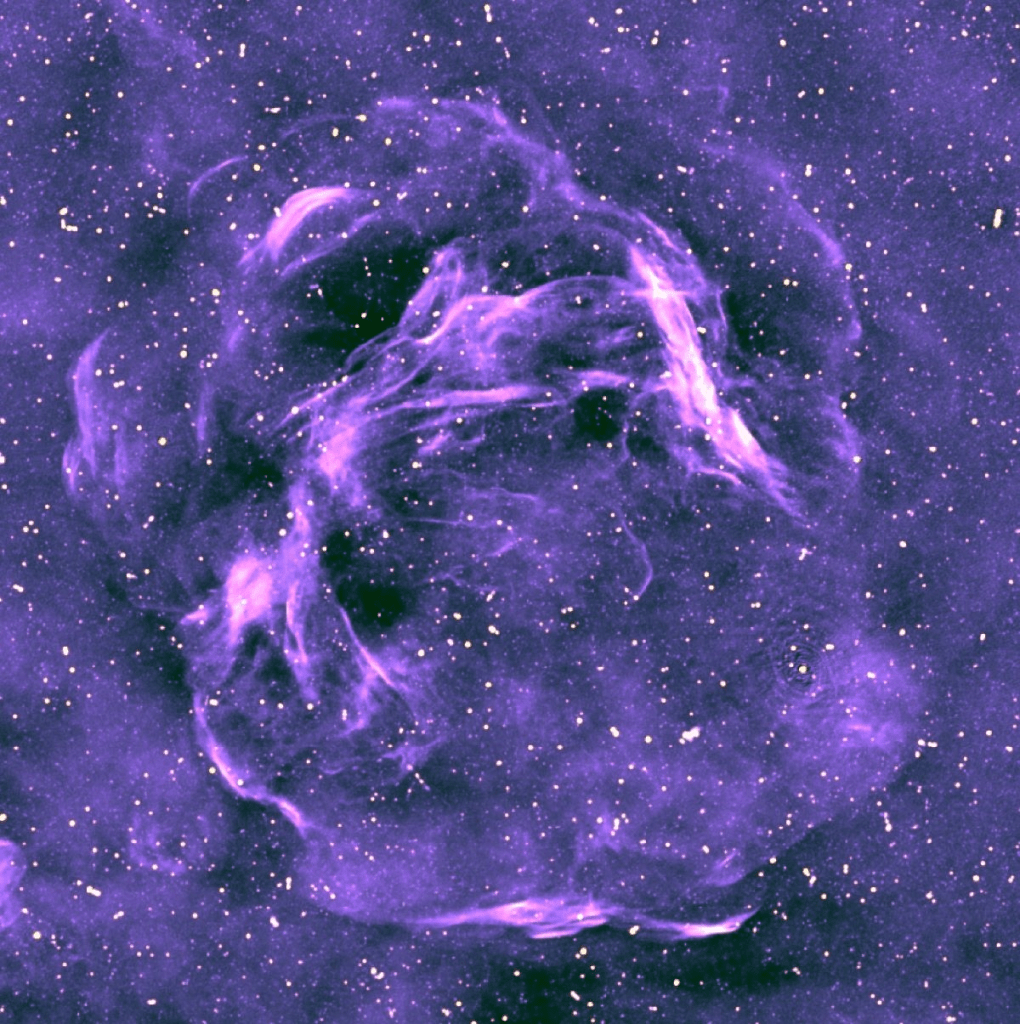
Supernova remnant G278.94+1.35, dubbed ‘Diprotodon’, captured by CSIRO’s ASKAP radio telescope. Credit: Sanja Lazarević
Supernova remnants are some of the most visually impressive objects in space. Astronomer Kovi Rose offers us a unique window into these violent and powerful celestial events.
Something explosive always seems to be happening in space. We often see headlines in the news about dramatic events like a flaring star, a gravitational wave from colliding neutron stars, or the latest supernova erupting in a galaxy far, far away.
The stories normally tend to focus on the peak periods of these energetic events, which generate in a week roughly a trillion-trillion times as much energy as we generated on Earth last year. But what remains after a star’s collapse – a supernova remnant, as astronomers call it – is both spectacular and scientifically interesting.
Supernova remnant G295.5+09.7 captured by the ASKAP radio telescope at Inyarrimanha Ilgari Bundara, CSIRO’s Murchison Radio-astronomy Observatory. Cloud-like ripples and filaments of interstellar gases are illuminated along the boundaries of the supernova remnant. Credit: ASKAP Evolutionary Map of the Universe (EMU) Team & Kovi Rose
The end of a star
Stars are endlessly collapsing under gravity. This immense pressure drives a fusion reaction, where hydrogen particles join together into heavier elements. The energy produced by this fusion reaction pushes outwards, stopping the star from collapsing in on itself. However, when a star starts to run out of fuel for its fusion engine, the balance breaks down and things get interesting.
For stars roughly the size of our Sun, there is no big explosion as they reach their final years. Instead, when they run out of fuel, they gently shrink into a glowing lump of carbon and oxygen called a white dwarf. White dwarfs don’t collapse entirely under the force of gravity, because the electrons in the remaining atoms are strong enough to push back. This is thanks to a quirky quantum effect called electron pressure.
A white dwarf can produce a supernova, but only under very specific circumstances, when the white dwarf is orbiting another star. When a white dwarf gets too close to the other star – which could even be another white dwarf – its gravitational influence will start to pull in material from the other star. This breaks the balance between gravity and those simmering electrons, ultimately causing the white dwarf to explode!
Bigger stars do end their lives in a supernova, and usually without any outside help. These stars – with more than 8 times the mass of our Sun – live fast and die young. They burn through their nuclear fuel faster than their smaller cousins, with lifetimes of millions (not billions) of years. These stars start by fusing hydrogen into helium in the core. As that runs out, they start fusing helium atoms together instead. And so it continues up the periodic table. The heavier the element, the faster the star runs out of fuel – with carbon and oxygen burning for mere years and months, respectively. But this can’t go on forever.
Once the core is made of iron, the fusion process grinds to a halt. With no new energy keeping the star inflated, its layers suddenly collapse. The rush of material inwards hits the remaining iron core and produces a shockwave that moves outwards at speeds nearing a quarter of the speed of light. These aptly named core-collapse supernovae usually leave their densely packed remains behind in the form of a neutron star – or, depending on how massive they were, a black hole.
Tuning the radio
For both classes of supernova, the stellar matter from the explosion is launched out across space at thousands, or even tens of thousands, of kilometres per second. Moving at these speeds, the leading front of the supernova can take tens of thousands of years to slow down, usually after spreading out across several light-years of space (one light-year is about 9.5 trillion kilometres) and sweeping up any additional material they encounter along the way. This is a supernova remnant: an interstellar bubble created by the wake of one of nature’s most energetic explosions.
This powerful blast wave contains fast-moving electrons that interact with nearby material in a fascinating way. The space around a supernova is filled with magnetised matter, and because of the special relationship between electricity and magnetism, the electrons curve rather than flying straight. As their paths change, the electrons are forced to slow down. Some of their energy is converted into light – but not always as light our eyes can see.
Supernova remnant SN1006 captured by CSIRO’s ASKAP radio telescope. SN1006 is the remnant of a supernova that was observed in the year 1006 by astronomers all over the world, from Egypt to China. It was first recognised as a supernova remnant in 1965, following radio observations at Murriyang (the Parkes radio telescope). Credit: Dr Emil Lenc & Kovi Rose.
Visible light is just one window into the full spectrum of electromagnetic waves. It has a short wavelength of a few hundred nanometres; for context, the average width of a single human hair is nearly 100,000 nanometres. Most of the light in supernova ‘bubbles’ has much less energy, with a wavelength of tens of centimetres or even metres. This particular type of light is called radio.
Radio astronomers have built just the right instruments to detect this kind of light emitted by supernovae. From the initial blast to the giant bubble-like structures they create as the explosion moves out through space, radio telescopes can detect these explosive supernova ‘bubbles’ expanding and eventually slowing down as they become a remnant.
We also see the brightness and energy of the light changing depending on how much material the shockwave sweeps up as it expands, or how strongly magnetised the surrounding material is. By studying the radio light generated by supernova remnants, we can learn when and how they formed, as well as what kind of dense objects the explosion left behind.
Australia’s view
Radio astronomy has a long, continuous history in Australia. We were one of the first countries in the world to use radio instruments to study celestial objects. The American radio engineer Karl Jansky, widely considered the founder of radio astronomy, first detected radio emission in 1933 from a dense region somewhere in the Milky Way. However, in 1954, CSIRO astronomers in Sydney figured out that the source of Jansky’s detection was located right at the centre of our galaxy.
As the field of radio astronomy developed, astronomers and engineers began exploring different types of telescopes that could be used to study a range of objects in the sky. Depending on the design of the instrument, we can use them to detect point-like radio sources – like the centres of distant galaxies – or diffuse clouds and filaments, like the boundaries of a supernova remnant. And using advanced image-processing techniques and modern telescopes like CSIRO’s ASKAP radio telescope, we can create images that show the beauty of the radio sky at both small and large scales.
This 24-metre-wide ‘hole-in-the-ground’, originally dug out by a few radio astronomers during their lunch breaks, was used to locate Sagittarius A. At the time it was the second-largest radio telescope in the world. Credit: CSIROCSIRO’s ASKAP is a telescope made of 36 smaller (12-metre) dish-like antennas spread over a large area on Wajarri Yamaji Country in Western Australia. Credit: Laura Driessen
Exploring our galaxy
Supernova remnants are stunning markers of the explosive history of our galaxy. And luckily for astronomers, we’ve already discovered hundreds of them. Observations of that white road of stars that runs across the sky, the Milky Way, have revealed a foamy sea of interstellar bubbles created by ancient supernovae.
The shapes of supernova remnants reflect the circumstances of their formation and their encounters with neighbouring objects, including cosmic clouds of gas and dust. Some appear symmetrical, while others take on distorted forms, moulded by interactions with nearby material or overlapping with other expanding bubbles. In fact, our whole solar system sits near the centre of a ‘superbubble’ – a vast cavity containing most of the stars visible to the naked eye. Scientists reckon the superbubble was carved out by the cumulative explosions of multiple supernovae over millions of years.
Radio astronomers estimate that as many as 1,500 supernova remnants may be still hiding in our galaxy undiscovered. New observations with highly sensitive radio instruments like ASKAP and the upcoming SKA telescopes will help us uncover these elusive interstellar bubbles, and reveal more details about the energetic processes that shaped the Milky Way.
The central band of the Milky Way seen at radio wavelengths. This image combines observations from the Parkes and ASKAP radio telescopes to reveal the network of supernova remnants and gas clouds in the central region of our galaxy. Credit: R Kothes (NRC) and the PEGASUS team.
Kovi Rose is an astrophysics PhD candidate at the University of Sydney who studies the radio light from nearby dwarf stars and distant supernovae.























 Scottie's Playtime