Despite repeatedly promising not to cut Social Security, the Trump Administration is reportedly preparing a proposed rule that could reduce the share of applicants who qualify for Social Security Disability Insurance (SSDI) by up to 20 percent, according to an Urban Institute report that cites writing by a former Trump Administration official and interviews with former staff at the Social Security Administration (SSA). This would be the largest cut in SSDI history.
SSDI is an integral part of Social Security. It provides essential benefits to workers who cannot support themselves through earnings due to severe and long-lasting disabilities that significantly impede their ability to work, and it helps to prevent beneficiaries and their families from experiencing poverty.
The rule would make it much more difficult to qualify for both SSDI and Supplemental Security Income (SSI). Because it would dramatically change the eligibility criteria for older applicants, the losses among people over age 50 would be much deeper.
The rule is likely to be the largest-ever cut to Social Security Disability Insurance. A 20 percent cut in the share of applicants who qualify for SSDI would be larger than any previous change to the program. It would be even larger than the Reagan-era disability cuts, which the Reagan Administration was forced to reverse amid fierce opposition from governors, courts, beneficiaries, and advocates. According to an Urban Institute analysis, even a cut half the size of what the Trump Administration is considering would mean 750,000 fewer people would receive SSDI benefits within ten years. In addition to reducing the share of applicants who receive benefits, some current beneficiaries could see their benefits taken away when their eligibility is reviewed.
The rule would particularly hurt older workers. Like the rest of Social Security, SSDI serves largely older people; nearly 80 percent of disabled workers are aged 50 or older. SSDI benefits provide vital support to people whose careers are cut short by severe medical impairments. The rule is expected to target older applicants already determined to have significant medical impairments by discounting the barriers they face due to their age in continuing to do substantial work — despite the law’s requirement that the Social Security Administration (SSA) consider how age, education, and skills might make working harder, in addition to considering health conditions.
It’s already difficult at any age to qualify for disability benefits, given their stringent rules. Research shows applicants whose impairments are not severe enough to qualify for SSDI fare poorly in their attempts to return to work — especially if they’re older. Rejecting more older applicants will cause more hardship for people who would be eligible for benefits under the existing rules.
The rule will likely cause disproportionate harm to people living in the South and Appalachia. Some states have a higher share of people receiving disability benefits, particularly those with more older workers with fewer years of formal education, and who are more likely to have worked in physical jobs like manufacturing or mining. That is true of many Southern and Appalachian states, as well as Maine and the Rust Belt states of Michigan, Ohio, and Pennsylvania. The proposed rule drafted during the first Trump Administration would reportedly change the way SSA considers education as well as age, and because residents of these states are on average older and less educated, these changes will hit them doubly hard.
In addition to cutting Social Security and SSI, the rule would threaten retirement security, access to health care, and other supports. Workers who become disabled and qualify for SSDI are significantly worse off in retirement: they are poorer, experience more hardship, and have lower savings. Disabled workers will fare even worse in retirement if their eligibility for disability benefits is stripped. They would be forced to spend any retirement savings faster and claim their Social Security retirement benefits at a younger age, permanently reducing their — and possibly their family’s — monthly Social Security retirement benefits by up to 30 percent. For hundreds of thousands of older people, this rule would create long-term financial insecurity as they age.
In addition, applicants who do not qualify for disability benefits may face significant challenges accessing health care. SSDI recipients typically receive Medicare 24 months after they begin to receive benefits; if someone no longer qualifies for these benefits, they won’t be able to get Medicare until they turn 65. And, SSI recipients receive Medicaid, so those who lose SSI benefits may also lose Medicaid (particularly in states that have not adopted the Medicaid expansion). Most rejected applicants under the new standard will have very significant medical impairments, and many will struggle to access health care without those benefits — particularly after the steep Medicaid cuts in the Republican megabill.
Finally, restricting eligibility for disability benefits will make it more difficult for rejected applicants to access other key supports, such as food assistance, which has increasingly strict time limits for most non-elderly individuals without younger children who are not receiving disability benefits. New Medicaid work requirements could also pose significant impediments to people who lose disability benefits.
This rule is the latest in a series of harmful actions by the Trump Administration that threaten access to Social Security. This year, the Administration has forced SSA through a radical downsizing that has disrupted services for the largely older and severely disabled people who rely most on the agency, indiscriminately pushing out 7,000 workers in the largest staff cut in SSA’s history. This realignment has resulted in fewer staff serving Social Security applicants and beneficiaries, and huge cuts to staff supporting the agency’s customer service mission. These cuts have been coupled with inexplicable new restrictions — some of which have already been partially rolled back — for how the public can engage with SSA for assistance, creating additional access barriers.
At the same time, the Administration is working to advance changes that would make it harder for hundreds of thousands of eligible people to receive or continue receiving SSI, creating additional red tape for beneficiaries and more work for depleted and overburdened SSA staff.
I recently transferred to the rehab center, which is just across the street from the hospital. Today I took a cognitive test, I took a speech pattern test, and I took a physical test. Every day from here on out, I will be taking a physical test, which we call PT. They usually wanna work people till they wanna quit, but they haven’t had that problem with me yet, not because I’m super amazing or awesome, but because I really want to beat this shit as quickly as I can.
My friend Melissa Colombo came by and brought me some clothes. Nobody can go on Facebook and ask people to bring them shorts, T-shirts, and underwear while they’re in a rehab center, but I can. Hell, I once got people to send me self-addressed stamped envelopes for messed-up business cards. But I sent out a request on Facebook for someone to bring me some shorts and T-shirts to the rehab center. All I had this morning was just a road in the hospital, and my ass was hanging out.
A few people offered to ship me stuff, but that wasn’t the issue. I have money. I could easily order something. But I need something now because, let me put that again, my ass was hanging out. So my friend Melissa brought me some clothes. Funny thing is, someone else went ahead and quickly ordered me some stuff, and that was Leslie Elliott.
I want to thank Melissa and Leslie for literally saving my ass.
The next 10 days are going to be more PT. I am expected to be in this place for at least 10 days. After that, I’m expected to go home. The thing is, I live in a second-level apartment, and I want to be able to walk into my apartment and take care of myself again. Unfortunately, I’m nowhere close to that yet. Walking, taking steps, things are extremely difficult right now, and even grabbing things is impossible, but I am further today than I was yesterday.
If you have donated to me either by becoming a paid subscriber to my Substack, or donated through PayPal, or donated through Venmo, or donated through Zelle, and I have not sent you a message, please accept my apologies. I want to thank everybody who has supported me through this. The outpouring of support has blown me away. In fact, it’s blown away the entire cartooning community. We are all very impressed and overwhelmed by your support, especially me. I just wanna say thank you. I’m never going to stop saying thank you.
And on that note, I was just visited by a former photographer from the Free Lance-Star, Suzanne Carr Rossi. She brought me pants.
And now the Facebook updates from the past few days.
Today, October 16, 2025
Remember when Donald Trump took that cognitive test and bragged about it? Remember that he had to repeat “person, woman, man, camera, TV”. Trump said. “They said nobody gets it in order, it’s actually not that easy. But for me it was easy. And that’s not an easy question.” He is right.
It’s not an easy question when you have to answer five minutes later.
It’s not easy when the question is “bridge, Sarah, justice, banana.” It’s not easy when you have to remember photos that include car keys, a comb, and a helicopter five minutes later.
It’s not easy when you have to remember letters and numbers in the sequence of 1, A, 2, B, 3, C, 4, D, etc, to ten.
It’s not easy to count backwards from 20.
It’s not easy to have to draw a clock and other shapes with your left hand when you’re handed and your right hand is kind of dead from a stroke.
It’s not easy to do any of the stuff after having a stroke, but I did it. The thing is, nobody told me I was great or amazing for it. Sicophants didn’t fawn over me for it. Nobody threw a parade for me because I remembered five words. Idiots didn’t go until late-night TV to tell me I was a genius for it.
Donald Trump wants you to treat him like a baby for remembering five words.
Donald Trump never suffered from a stroke.
So why was Donald Trump given this cognitive test?
Who knew that my stroke would become part of my research?
October 16, 2025
Ok, Peezeheads!!! Who wants to volunteer to help out a stroke victim, and possibly an opportunity to see my ass?
I am at Encompass in Fredericksburg. I need someone to bring me a few button-up shirts. I can’t use a T-shirt because my shoulder is messed up from the stroke. I also need a pair of shorts. I just need athletic shorts, nothing with buttons or belts, or zippers. 
I could also use some underwear.
At this time, I am still wearing the gown from the hospital, and my ass is hanging out. Fortunately, the entire nursing staff has told me that my butt is not too hairy, but maybe they’re just being nice. 
Update: I am only asking local people to help. I need this stuff today, not delivered by Amazon. Thank you.
Update update: Melissa Colomboto the rescue, and then Leslie Elliott, and my friend Suzanne.
October 15, 2025
So many people have touched me this week, and I’ll never be able to you how much it means to me.
As I was being rolled out on a gurney to be taken to the rehab center, an old friend I hadn’t seen in nearly a decade was waiting outside my hospital room to see me.
I want to cry. I love you, Rhonda.
October 15, 2025
I had an MRI this morning after the procedure scan my heart. They were looking to see if there was a hole or any other abnormalities in my heart that may have caused the stroke. As it turns out, there’s nothing wrong with it.
But the MRI was brutal. You can’t move, your back hurts, you don’t know when it’s going to end, you are continuously being asked to hold your breath, and they’re playing 90s music made by other people. Instead of Pearl Jam, you’re getting Pearl lame.
It’s time to go. They want more blood.
October 15, 2025
I am being moved tonight to a rehab facility. I think this is good news. 
October 15, 2025
One of my nurses was training another nurse this morning. Just as the trainee was applying alcohol to my skin, in order for me to inject myself with insulin (yes they are making me inject myself), I decided let out a little scream. AAAAAGH! The trainee jumped, and the other nurse laughed her ass off, and said that was great.
They both said that they’re going to remember me.
Damn straight.
This is the GoFundMe set up by Kevin Necessary and Jack Ohman
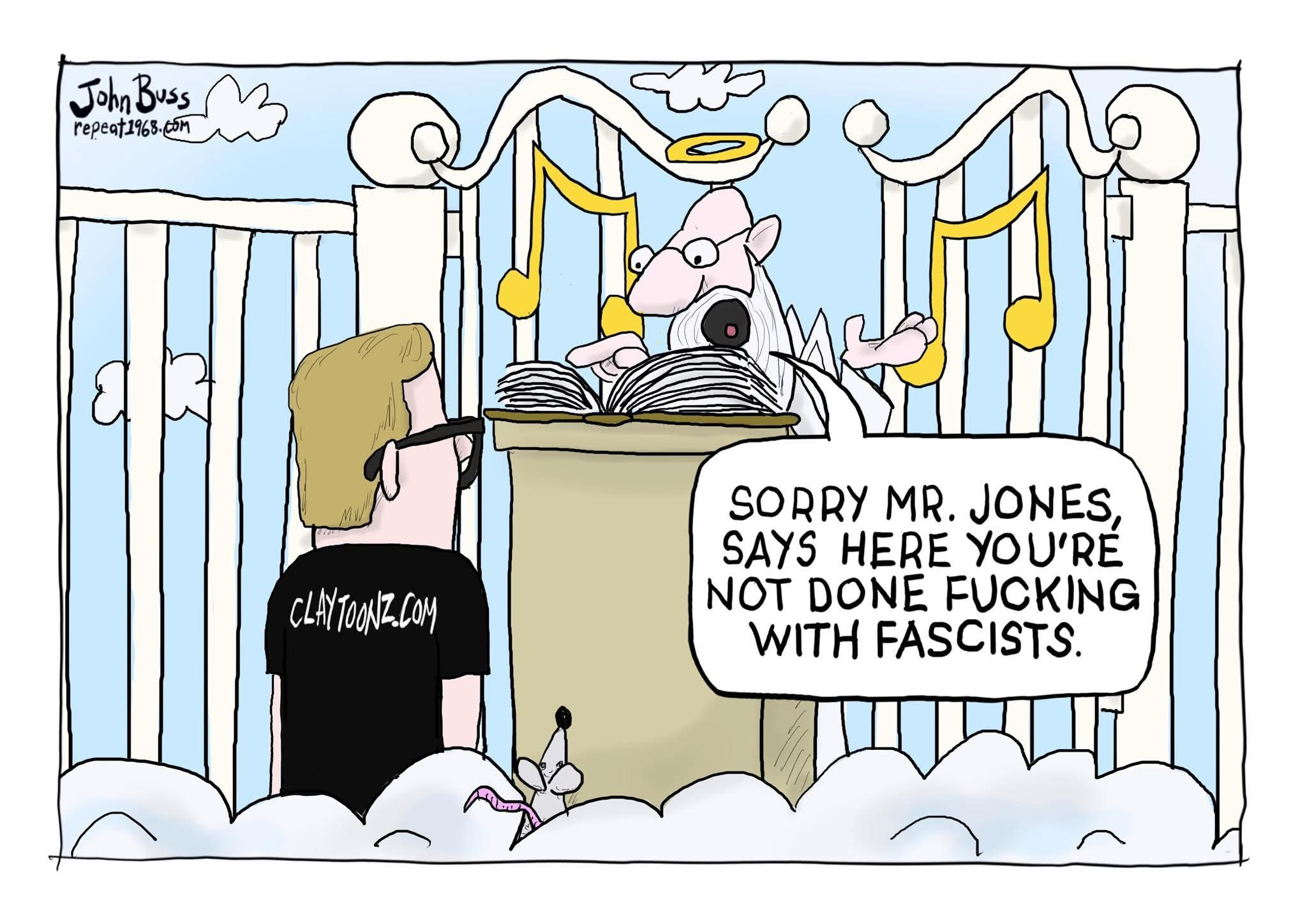
This is a cartoon drawn by John Buss.
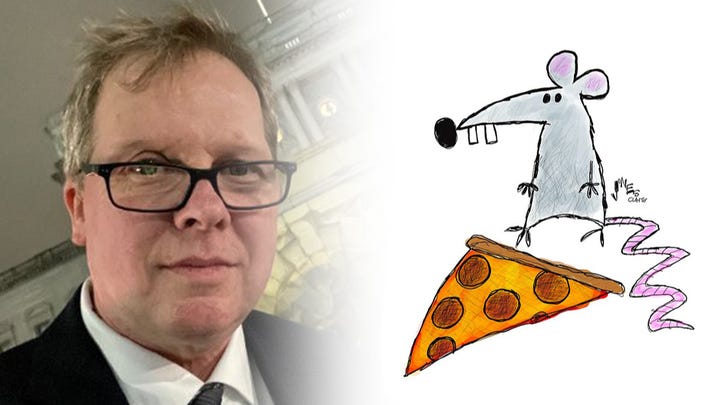
How to draw Peezy by Dave Whammond, and he’s trying to get more cartoonists to join in. I hope it happens because I would love to see more of my colleagues’ renditions of our favorite pizza.
I am not trans even though I have been asked because of my super strong support of trans people. I have lost friends who wouldn’t accept trans people using a public bathroom with them even though all private functions happen in enclosed little stalls. I do have distant family members who are trans and fully supported by family. More important I can clearly see the same negative vile things said about trans people are the same things pushed against gay people when I was a struggling gay teen being pushed by the same groups on the same ideas of victimhood. They were mostly driven by hyper Christian Nationalist religious groups and those who demanded that traditions along with society never change from when they were young and happy. These same groups and feelings are in play against trans people. They are simply the homosexual aids scare of the 1980s. Just as I as a young gay person needed allies and support so do trans people today. Please give as much vocal and upfront support for trans people you can. It is easier to make progress as a society if we don’t have to undo hateful laws outlawing our very existence. Hugs
The video below is about ICE and their illegal detention of people. In this one ICE rushes out of their compound to snatch a protestor off the PUBLIC sidewalk and drag him back into their compound to then charge him with trespass. It is pure harassment of a member of the public exercising their right to protest peacefully. Now he has to find a lawyer and pay for a defense, he was booked with an arrest record now. When he did not commit a crime other than insult the NAZI thugs breaking the laws in the US. Also another part of the video shows a woman leaving a court stands up to ICE thugs and cusses them out. They order her to leave and tell her if she doesn’t leave a public space they will arrest her. They threaten to beat her. One last point, in that big Chicago building raid they found only one person who may be a gang member but even that is in doubt. Hugs
(I love the top piece, but after reading the story, I also love the second one! Wouldn’t they be great to color? -A.)
Another project I will start and probably never finish, but will enjoy until I forget to do it again. by Jenny Lawson (thebloggess) Read on Substack
Hello love!
It is spooky season and so I’ve been doodling dark little things. Last year I started writing and illustrating an eerie little children’s book that I will almost certainly never finish because I am the queen of distraction. I have a true crime story about my family I’ve written but has never published. I’m working on another weird project now about invisible women that I suspect will never find a publisher but is a passion project I can’t let go of. And then this week I started doodling and found myself accidentally making an alphabet book for dark children.
Will any of these projects ever get further than being shared with friends like you and then packed into a box for my maybe-grandchildren to be baffled by when I am gone? Doubtful. But still, I create. And I hope you do too. Because there is such delight in seeing something strange come out of your head and become real, even if no one ever sees it but you.
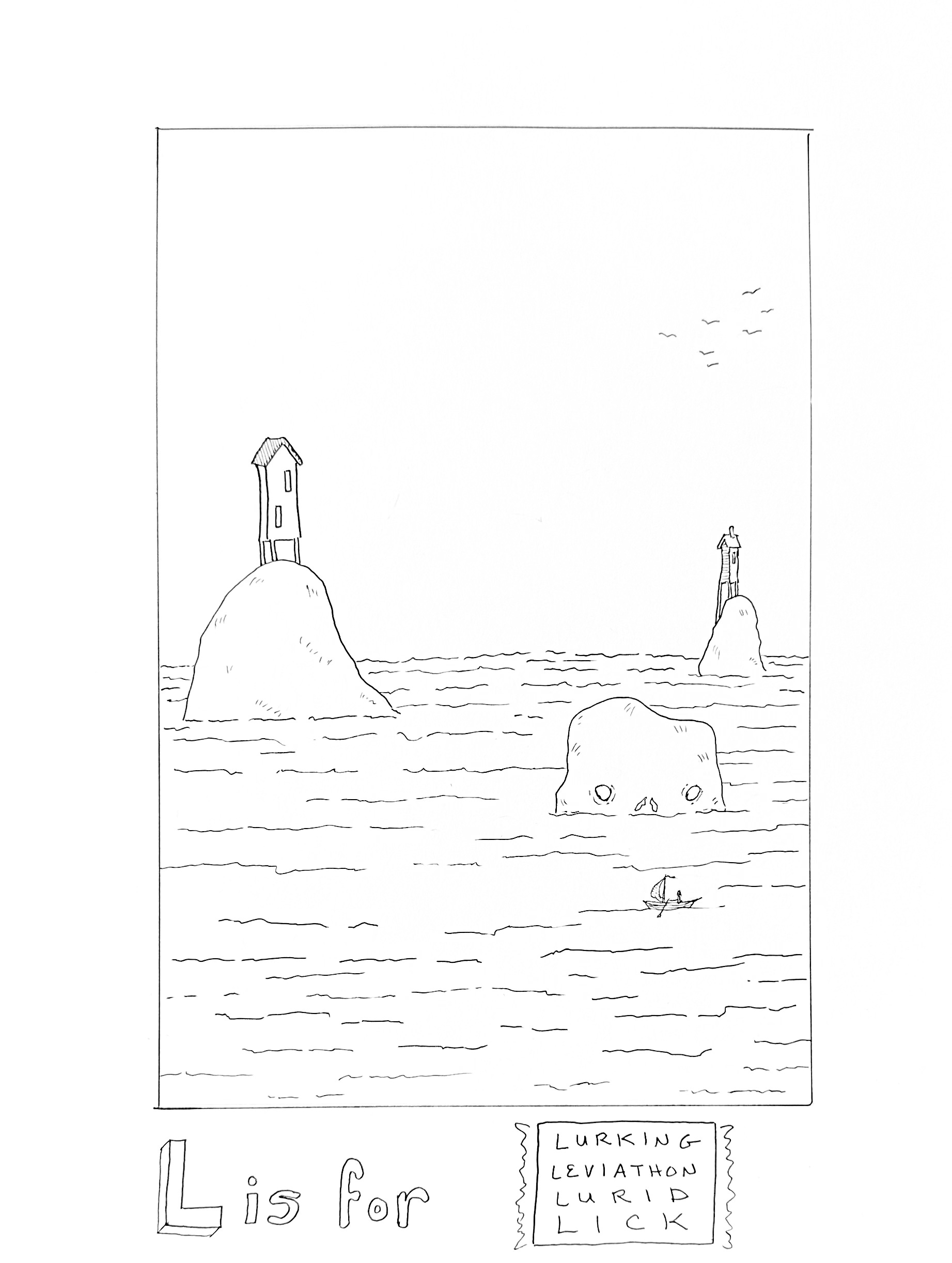
The doodle above this sentence came with a story in my head about a monster named Fred who was sad that none of the tiny beings ever built a hat on him. I wanted to find a way to show him licking the little boat but every time I tried to draw a tongue coming up from the water it looked like a penis and that’s not really the story I wanted to tell (but is one I’d read) so instead I’m imagining that his tongue is under the water and is keeping the little boat afloat because the man inside doesn’t realize there’s a hole in the bottom of his boat. He floats along…keeping his eyes peeled for sea monsters…unaware that he’s only alive because of one. There’s a story there. Maybe one day I’ll write it.
But not today because today I’m doing final-final-final edits on my new book (did you know that you have to do edits over and over with different types of editors?) and I’m STILL finding stuff to fix. I’m so worried about this book. It’s so different from anything I’ve written before. I hope it finds a safe harbor, with people who will love it even though it is so very strange. But no matter what, I’m giving myself a high-five for finally (almost) finishing a project. Celebrate those wins, y’all.
Robin Abcarian, Los Angeles Times on Published in Op Eds
I had a difficult time reading the gut-wrenching accounts from the parents of gay children who are part of the Supreme Court case about conversion therapy bans and freedom of speech.
All claim their family relationships were seriously damaged by the widely discredited practice, and that their children were permanently scarred or even driven to suicide.
The case, Chiles vs. Salazar, arose from a 2019 Colorado law that outlaws conversion therapy, whose practitioners say they can change a minor’s sexual orientation or gender identity to align with heterosexual and cisgender norms. The therapy is considered harmful and ineffective by mainstream medical and mental health organizations.
At least two dozen other states have similar laws on the books, all of them good-faith attempts to prevent the lasting harm that can result when a young person is told not just that they can change who they are, but that they should change because God wants them to. The laws were inspired by the horrific experiences of gay and transgender youths whose families and churches tried to change them.
The case was brought by Kayley Chiles, a licensed counselor and practicing Christian who believes, according to her attorneys, that “people flourish when they live consistently with God’s design, including their biological sex.”
Colorado, incidentally, has never charged Chiles or anyone else in connection with the 2019 law.
Chiles is represented by the Alliance Defending Freedom, a conservative Christian law firm known for its challenges to gay and transgender rights, including one brought to the Supreme Court in 2023 by Christian web designer Lorie Smith, who did not want to be forced to create a site for a gay wedding, even though no gay couple had ever approached her to do so. The Court’s conservative majority ruled in Smith’s favor. All three liberals dissented.
As for conversion therapy, counselors often encourage clients to blame their LGBTQ+ identities on trauma, abuse or their dysfunctional families. (If it can be changed, it can’t possibly be innate, right?)
In oral arguments, it appeared the conservative justices were inclined to accept Chiles’ claim that Colorado’s ban on conversion therapy amounts to viewpoint discrimination, a violation of the 1st Amendment’s free speech guarantees. The liberal minority was more skeptical.
But proponents of the bans say there is a big difference between speech and conduct. They argue that a therapist’s attempt to change a minor’s sexual orientation or gender identity amounts to conduct, and can rightfully be regulated by states, which, after all, lawfully impose conditions on all sorts of licensed professionals. (The bans, by the way, do not apply to ministers or unlicensed practitioners, and are generally not applicable to adults.)
Each competing brief whipsawed my emotions. The 1st Amendment is sacred in so many ways, and yet states have a critical interest in protecting the health and welfare of children. How to find a balance?
After reading the brief submitted by a group of 1st Amendment scholars, I was convinced the Colorado law should be ruled unconstitutional. As they wrote of Chiles, she doesn’t hook her clients to electrodes or give them hormones, as some practitioners of conversion therapy have done in the past. “The only thing she does is talk, and listen.”
Then I turned to the parents’ briefs.
Linda Robertson, an evangelical Christian mother of four, wrote that she was terrified when her 12-year-old son Ryan confided to her in 2001 that he was gay. “Crippling fear consumed me — it stole both my appetite and my sleep. My beautiful boy was in danger and I had to do everything possible to save him.”
Robertson’s search led her to “therapists, authors and entire organizations dedicated to helping kids like Ryan resist temptation and instead become who God intended them to be.”
Ryan was angry at first, then realized, his mother wrote, that “he didn’t want to end up in hell, or be disapproved of by his parents and his church family.” Their quest to make Ryan straight led them to “fervent prayer, scripture memorization, adjustments in our parenting strategies, conversion therapy based books, audio and video recordings and live conferences with titles like, ‘You Don’t Have to be Gay’ and ‘How to Prevent Homosexuality.’ ”
They also attended a conference put on by Exodus International, the “ex-gay” group that folded in 2013 after its former founder repudiated the group’s mission and proclaimed that gay people are loved by God.
After six years, Ryan was in despair. “He still didn’t feel attracted to girls; all he felt was completely alone, abandoned and needed the pain to stop,” his mother wrote. Worse, he felt that God would never accept him or love him. Ryan died at age 20 of a drug overdose after multiple suicide attempts.
As anyone with an ounce of common sense or compassion knows, such “therapy” is a recipe for shame, anguish and failure.
Yes, there are kids who question their sexuality, their gender identity or both, and they deserve to discuss their internal conflicts with competent mental health professionals. I can easily imagine a scenario where a teenager tells a therapist they think they’re gay or trans but don’t want to be.
The job of a therapist is to guide them through their confusion to self-acceptance, not tell them what the Bible says they should be.
If recent rulings are any guide, the Supreme Court is likely to overturn the Colorado conversion therapy ban.
This would mean, in essence, that a therapist has the right to inflict harm on a struggling child in the name of free speech.
There is a video at the link below showing the restraint. Because of being restrained during abuse as a child I can not stand anything pinning my legs or arms down. When I had my left hip done the doctor required patients to be strapped into an immobilizing device. When I woke up in the hospital with it on I totally lost my shit and they had to remove it. But the doctor wouldn’t allow anyone to lay flat or sleep without it. So for weeks I slept upright in Ron’s recliner. There is no need for a torture device such as this used by ICE. It is designed to be punitive and cause people harm. Hugs
The Nigerian man described being roused with other detainees in September in the middle of the night. U.S. Immigration and Customs Enforcement officers clasped shackles on their hands and feet, he said, and told them they were being sent to Ghana, even though none of them was from there.
When they asked to speak to their attorney, he said, the officers refused and straitjacketed the already-shackled men in full-body restraint suits called the WRAP, then loaded them onto a plane for the 16-hour-flight to West Africa.
Referred to as “the burrito” or “the bag,” the WRAP has become a harrowing part of deportations for some immigrants.
“It was just like a kidnapping,” the Nigerian man, who’s part of a federal lawsuit, told The Associated Press in an interview from the detainment camp in which he and other deportees were being held in Ghana. Like others placed in the restraints interviewed by the AP, he spoke on the condition of anonymity for fear of reprisals.
The AP identified multiple examples of ICE using the black-and-yellow full-body restraint device, the WRAP, in deportations. Its use was described to the AP by five people who said they were restrained in the device, sometimes for hours, on ICE deportation flights dating to 2020. And witnesses and family members in four countries told the AP about its use on at least seven other people this year.
The AP found ICE has used the device despite internal concerns voiced in a 2023 report by the civil rights division of its parent agency, the U.S. Department of Homeland Security, in part due to reports of deaths involving use of the WRAP by local law enforcement. And the AP has identified a dozen fatal cases in the last decade where local police or jailers around the U.S. used the WRAP and autopsies determined “restraint” played a role in the death.
The WRAP is the subject of a growing number of federal lawsuits likening incorrect usage of the device to punishment and even torture, whether used in a jail or by immigration authorities during international flights. Among advocates’ concerns is that ICE is not tracking the WRAP’s use as required by federal law when officers use force.
DHS has paid Safe Restraints Inc., the WRAP’s California-based maker, $268,523 since it started purchasing the devices in late 2015 during the Obama administration. Government purchasing records show the two Trump administrations have been responsible for about 91% of that spending. ICE would not provide AP with records documenting its use of the WRAP despite multiple requests, and it’s not clear how frequently it has been used in the current and prior administrations.
The WRAP’s manufacturer says it intended the device to be a lifesaver for law enforcement confronting erratic people who were physically attacking officers or harming themselves.
But ICE officials have a much lower threshold for deploying the WRAP than the manufacturer advises, the AP found. Detainees interviewed by the AP said ICE officers used the restraints on them after they had been shackled. They said this was done to intimidate or punish them for asking to speak to their attorneys or expressing fear at being deported, often to places they fled due to violence and torture.
The West African deportee described a terrifying, hourslong experience that left his legs swollen to the point where he walked with a limp.
“They bundled me and my colleagues,” he said, “tied us up in a straitjacket.”
ICE and DHS would not answer detailed questions from the AP and refused a request for the government’s policy for when and how to use the WRAP.
“The use of restraints on detainees during deportation flights has been long standing, standard ICE protocol and an essential measure to ensure the safety and well-being of both detainees and the officers/agents accompanying them,” Tricia McLaughlin, DHS’ spokesperson, said in an email to AP. “Our practices align with those followed by other relevant authorities and is fully in line with established legal standards.”
The agency would not specify those authorities or describe its practices.
“The use of these devices is inhumane and incompatible with our nation’s fundamental values,” said Noah Baron, an attorney for the West African deportees.
Charles Hammond, CEO of Safe Restraints Inc., said his company has made a modified version of the device for ICE, with changes meant to allow people to be kept in it during flights and long bus trips.
ICE’s version includes a ring on the front of the suit that allows a subject’s cuffed hands to be attached while still allowing for limited use to eat and drink, he said. In addition, the ICE version has “soft elbow cuffs,” Hammond said, which connect in the back so a person can move for proper circulation but can’t flip an elbow out to hit someone.
This photo provided by Safe Restraints Inc., in October 2025, shows a custom version of the WRAP restraining equipment made for the U.S. Immigration and Customs Enforcement agency. (Safe Restraints via AP)
This photo provided by Safe Restraints Inc., in October 2025, shows a custom ICE version of the WRAP with soft elbow cuffs that keep the arms against the body but allow relatively free use of the hands. (Safe Restraints via AP)
An AP reporter recounted for Hammond some of the allegations made by people who had been placed in the WRAP for long flights. All of those interviewed by AP said their hands and feet were already restrained by chains. All denied fighting with officers, saying they were either crying or pleading against their deportation to countries they deemed dangerous.
Hammond said that, if true that some people were not being violent and simply protesting verbally, putting them in the WRAP could be improper use.
“That’s not the purpose of the WRAP. If (the deportee) is a current or potential risk to themselves, to officers, to staff, to the plane, restraints are justified. If it’s not, then restraints aren’t.”
‘Please help me’
Juan Antonio Pineda said he was put into “a bag” in late September and driven by immigration officers to the Mexico border. It was black with yellow stripes and had straps that immobilized his body and connected over his shoulders — the WRAP.
Pineda, who is from El Salvador, was in the U.S. legally, he said in a video from an ICE detention center in Arizona. On Sept. 3, he went to an appointment in Maryland to get permission for another year, his wife, Xiomara Ochoa, said in an interview from El Salvador. Instead, he was detained by ICE and told he’d be deported to Mexico, but the documents he was shown had someone else’s name, he said. Even so, he was sent to the Florence Service Processing Center detention facility in Arizona.
In this image from video provided by Xiomara Ochoa, Juan Antonio Pineda shows a cast for his arm as he speaks during an interview from the ICE detention center in Florence, Ariz., on Sept. 29, 2025 .(Xiomara Ochoa via AP)
Early morning on Wednesday, Sept. 24, he said officers tied his hands and legs, placed him into the “bag” and drove him four hours to the border. When he refused to sign the deportation papers, Pineda alleges officers broke his right arm and gave him a black eye before driving him back another four hours in the “bag.” The AP was unable to independently confirm how he was injured. Pineda’s video shows him with a cast on his arm and bruising on his face.
The next day, Thursday, Sept. 25, they tied him up again, put him in the bag and drove him to the border, where Mexican immigration officials turned him away, he said.
“Eight hours there and back and they don’t give me food or water or anything,” he said in the video, which his wife shared with the AP. “Please help me.”
He was ultimately deported to Mexico, Ochoa said.
ICE did not respond to multiple requests for comment from the AP regarding Pineda’s case.
In addition to the Nigerian man flown to Ghana, four others interviewed by AP said they were placed in the WRAP and carried onto deportation flights since the first Trump administration.
As U.S. immigration officials move aggressively to meet the president’s deportation goals, advocates and attorneys for immigrants are echoing the concerns of the government’s own civil rights inquiry that ICE officers aren’t trained on how to use the restraints.
“This should be a last resort type of restraint after they’ve already tried other things,” said Fatma Marouf, a Texas A&M law professor who has sued ICE over its use of the device. “Just being bound up like that can inflict a lot of psychological harm.”
Some deportees said they were left in the WRAP for an entire fight. A lawsuit filed on behalf of the Nigerian man and four others currently detained in Dema Camp, Ghana, included the allegation from one that ICE left the restraint suit on him for 16 hours, only once undoing the lower part so he could use the bathroom.
“No one should be put into a WRAP. I don’t even think they strap animals like that,” recalled a man who said he suffered a concussion and dislocated jaw being placed into the device in 2023 before a deportation flight to Cape Verde, an African island nation. AP’s review of his medical records confirmed he suffered those injuries in 2023.
“It was the most painful thing I’ve been through,” said the man, adding he was restrained most of the 10-hour flight. “Forget the assault, forget the broken jaw. Just the WRAP itself was hurtful.”
Also, the man said, the metal ring his cuffed hands were attached to — one of the ICE modifications to the WRAP designed to increase comfort — injured him. “When they slammed me face forward on the floor, that metal ring dug into my chest causing me bruising and pain which was part of my injuries that I complained about.”
ICE’s current use of the WRAP comes amid an unprecedented wave of masked federal immigration officers grabbing suspected immigrants off the street, and mounting accusations that the Trump administration has dehumanized them, including by subjecting them to cruel and unusual detention conditions.
ICE’s use of the WRAP has continued despite a 2023 report by DHS’s Office for Civil Rights and Civil Liberties, or CRCL, that raised serious concerns over the lack of policies governing its use.
ICE agreed with the internal findings on some points, a then-DHS official involved in the review said, but challenged the notion that the WRAP should be classified as a “four-point restraint,” a designation that would place more limitations on its use. The person spoke on condition of anonymity because they weren’t authorized to discuss the inquiry.
DHS largely dismantled the office that produced the 2023 report earlier this year amid widespread government firings, calling it a roadblock to enforcement operations.
“Without changes to the current training, and the lack of policy, CRCL has serious concerns about ICE’s continued use of the WRAP,” wrote the report’s authors, who cited a news article mentioning lawsuits claiming the device had led to deaths.
Use by police and in jails
Last year police officers in Virginia Beach, Virginia, placed Rolin Hill in the WRAP, saying he was being combative during an arrest at a convenience store. The officers left Hill in the device when they dropped him at the jail. Video from the jail shows deputies punching the WRAP-immobilized Hill in the head and back. Hill died in a hospital, and while the WRAP’s exact role is unknown, Hill’s death was ruled a homicide by “positional and mechanical asphyxia due to restraint with neck and torso compression.” Three of the deputies are now charged with his murder, and five were removed from their jobs.
Also last year, in Missouri, prosecutors charged five jailers in the death of Othel Moore Jr., who according to an autopsy asphyxiated in the WRAP. Jailhouse footage showed Moore, who’d also been sprayed with tear gas and placed in a “spit mask” covering his face, repeatedly told officers he couldn’t breathe.
In this image from surveillance video provided by Jefferson City Correctional Center, jailers examine Othel Moore Jr., at the Jefferson City Correctional Center in Jefferson City, Mo., on Dec. 8, 2023, who according to an autopsy asphyxiated in the WRAP restraint. (Jefferson City Correctional Center via AP)
While Hammond insists the WRAP has never been determined as the cause of death when used properly, the AP identified 43 times in which the WRAP was used by police or correctional officers in a case in which someone died. In 12 of those cases the official autopsy determined that “restraint” played some role in the death.
It was often impossible to determine the exact role the WRAP may have played, as deaths often involved the use of other potentially dangerous force on people who in several cases were high on methamphetamine.
The WRAP first appeared in law enforcement in the late 1990s, presented as an alternative to tying a subject’s hands and feet together in a practice known as “hog-tying.” It first found widespread use in California jails and today is used by more than 1,800 departments and facilities around the country, according to the manufacturer, which says it has sold more than 10,000 devices.
Many of these cases have drawn little media attention, such as the 2020 case of Alberto Pena, who was jailed on a misdemeanor criminal mischief charge after getting drunk and damaging the walls and doors at his parents’ home outside Rio Grande City, Texas. The 30-year-old became erratic on the way to the Starr County Jail, beating his own head against the inside of the patrol unit and, later, the wall of his cell.
Deputies placed Pena in the WRAP for more than two hours, where he repeatedly cried out for help and complained he could not breathe. But he was left unattended in the device for significant periods of time, court records show, and no medical attention was provided for his self-inflicted head injuries.
An autopsy ruled Pena’s death “accidental,” but a forensic pathologist hired by the family attributed Pena’s death in part to the WRAP’s “prolonged restraint” and said it “could have been averted” with proper medical care.
“The WRAP should have never been used in this situation. It was a medical emergency and he should have been taken to the hospital,” said Natasha Powers-Marakis, a former police officer and use of force expert who reviewed the case on behalf of Pena’s family as part of their wrongful death lawsuit against the county and officers who placed him in the device. The arresting officers had been told Pena suffered from bipolar disorder.
The Starr County Sheriff’s Office has denied wrongdoing and maintained Pena did not require medical care. Robert Drinkard, an attorney for the county, told AP the use of the WRAP “was neither improper nor caused Mr. Pena’s tragic death.” He added that each deputy involved in placing Pena in the WRAP had been trained in its application.
A federal judge recently dismissed the Pena family’s lawsuit, ruling the deputies were shielded from liability.
‘Carrying me like a corpse’
In the context of an ICE deportation flight, the use of restraints like the WRAP can be justified, Hammond, the manufacturer’s CEO, argues.
ICE officers have to ensure that they secure anyone who could pose a fight risk on a long flight, he said. Given the high stakes of a violent confrontation on an airplane, Hammond believes cases like those described to the AP can warrant the WRAP’s use, even if the person is already in chains.
However, properly trained agents are supposed to loosen the straps and allow enough movement so the subject can eat and drink, as well as use the bathroom.
“With the WRAP, when it is used properly, it’s a shorter fight, which is good for everybody. It prioritizes breathing, which is good for everybody. And you have no more fight and can provide medical care or mental health care or de-escalation efforts,” Hammond said.
Those placed in one of Hammond’s restraint suits, however, recount the experience as traumatic.
One of these people was first put into five-point shackles when he became dizzy and tripped while ascending the stairs to board the ICE flight to Cameroon in November 2020. The officer mistook his stumbling as resistance, he said. Immediately, camouflage-clad ICE officers quickly pushed him to the tarmac and onto a WRAP device, he said.
Soon, he felt the straps cinching around his legs and upper body.
“They bundled me like a log of wood from all the sides and they were just carrying me like a corpse,” he said.
Another man interviewed by the AP said ICE officers put him in the WRAP after he initially resisted efforts to move him onto a deportation flight in Alexandria, Louisiana, in 2020. He’d fled political violence and persecution in his native Cameroon, and was afraid to go back. He said officers took him out of his cell in front of the other detainees and put him in the WRAP, leaving him for hours in view of the others as a warning to them not to speak up.
“I told him ‘I can’t breathe,’” the man said. “He responded, ’I don’t care, I’m doing my job.’”
___
Dearen and Pineda reported from Los Angeles and Mustian reported from New York. AP journalists Ope Adetayo in Abuja, Ghana, Obed Lamy in Indianapolis and Ryan J. Foley in Iowa City, Iowa, contributed to this report. Dan Lawton also contributed.
There is a brutal video at the link that shows her detainment / arrest. She was peacefully protesting. At one point ICE agents rushed out of the gates, jumped the woman who was just playing her clarinet. She was not doing anything wrong. She was in a public space exercising her 1st amendment rights. Then ICE took her across state lines and put her in a jail with no charges and no bail. She is being held incommunicado not allowed to talk to anyone which means no lawyer. The video reporter says that the peaceful protestors were hit with pepper balls. The US is being run by a mob boss wannabee racist white nationalist authoritarian who doesn’t want any rights for anyone not white and wealthy. The people of this country have lost all civil rights. One of the people arrested was white so it doesn’t matter race. Please watch the video. We are at a point where any protest against the government can get you disappeared Russia style. Hugs
A clarinet player is apparently being held without bail on no specific charges at the Clark County Jail in Vancouver after her husband said she was arrested Sunday during a protest across the street from the ICE facility in South Portland. The woman’s husband — who asked KOIN 6 News not to identify either of them for safety reasons — said his wife was tackled by federal agents while she was playing her clarinet around 5 p.m.
“It is a beautiful party atmosphere. Everybody’s really excited. Then the band hits into ‘Ghostbusters’, and then at ‘Ghostbusters’, that’s when ICE start storming in,” the husband said. “Why are they targeting a clarinet player? A clarinet player standing on the sidewalk far away from the street, following instructions.” Video of the arrest obtained by KOIN 6 News shows the woman face down in the mud with her clarinet on the ground next to her.













 Scottie's Playtime