
Tag: History
Indigenous People Find Chris Columbus, A C.O. Is Awarded The Congressional Medal Of Honor, “A Call To Resist Illegitimate Authority,” & More, In Peace & Justice History For 10/12
October 12, 1492 Natives of islands off the Atlantic shore of North America came upon Italian explorer Christopher Columbus, who was searching for a water route to India for Spanish Queen Isabella.  |
| October 12, 1945 Pfc. Desmond Doss became the first conscientious objector ever to be awarded the Congressional Medal of Honor. Doss, a Seventh Day Adventist, enlisted in 1942 but refused to carry a rifle or train on Saturdays. On the island of Okinawa, under heavy Japanese fire, he saved the lives of 75 sick and wounded soldiers by lowering them, one by one, down a 400-foot cliff.  The guest house at Walter Reed Army Medical Center is Doss Memorial Hall in his honor. Read more (includes movie trailer) |
| October 12, 1958 A Reform Jewish Temple in Atlanta (the city’s oldest) was firebombed with fifty sticks of dynamite in retaliation for Jewish support of local black civil rights activists. The Temple’s Rabbi, Jacob Rothschild, was outspoken in his support of civil rights and integration, and was a friend of Reverend Martin Luther King, Jr. before he became well known nationally.  From Georgia PBS |
| October 12, 1967 British zoologist Desmond Morris stunned the world with his book, “The Naked Ape,” a frank study of human behavior from a zoologist’s perspective. Morris had earlier studied the artistic abilities of apes and was appointed Curator of Mammals at the London Zoo. Read more |
| October 12, 1967 “A Call to Resist Illegitimate Authority” appeared in The Nation and the New York Review of Books. 20,000 signed it, including academics, clergymen, writers. It urged “that every free man has a legal right and a moral duty to exert every effort to end this war [Vietnam], to avoid collusion with it, and to encourage others to do the same.” This document became the main basis for the federal government’s criminal prosecution (for encouraging draft evasion) of five of the signers: Dr. Benjamin Spock, Marcus Raskin, Mitchell Goodman, Michael Ferber, and the Reverend William Sloane Coffin. Read the Call |
| October 12, 1970 Lt. William Calley was court-martialled for the massacre of 102 civilians in the Vietnamese village of My Lai; far more actually died during the incident.  The full sad story  Lt. Calley |
| October 12, 1977 “Regents of the University of California v. Bakke” was argued in front of the U.S. Supreme Court. The question: Did the University of California violate the Fourteenth Amendment’s equal protection clause, and the Civil Rights Act of 1964, by practicing an affirmative action policy that resulted in the repeated rejection of Bakke’s application for admission to its medical school? Read more |
https://www.peacebuttons.info/E-News/peacehistoryoctober.htm#october12
Mmm. Popsicles.
The Boy Who Accidentally Invented the Popsicle
120 years ago, 11-year-old Frank Epperson left his drink on the front porch on a chilly night. That accident became one of the most successful frozen dessert brands in the nation.

An early advertisement for Popsicle (National Archives)
Whether their favorite is ice cream, popsicles, or gelato, most people would agree that frozen treats are delicious.
While the origins of frozen desserts are unclear, they likely trace their roots back to the Ancient Persians, who used ice houses to produce and store faloodeh and sorbets. First-century Roman cookbooks included recipes of sweet desserts sprinkled with snow. Marco Polo is (probably falsely) credited for introducing frozen desserts to Italy after his travels in China, and Thomas Jefferson popularized ice cream in the United States — his handwritten vanilla ice cream recipe from the 1780s was one of the earliest in the nation.
But one story in frozen dessert history stands out, and it is not about a United States president or a Silk Road explorer: It’s about an 11-year-old boy.
On a winter day in 1905, young Frank Epperson made a beverage mixing soda powder with water to stay hydrated. One night, he accidentally left his cup on the porch overnight with a stirring stick inside, according to popsicle.com. Temperatures dropped during the night, and the next morning, Epperson found his cup where he had left it, no longer liquid, but now an icy snack. He ran the cup under hot water, pulled it out using the wooden stick, and tasted the new frozen dessert. He named it the Epsicle — a combination of “Epperson” and “icicle” — but unlike the process of its invention, the product didn’t turn into a national success overnight.
Epperson continued making Epsicles for his friends, and later, his children — who began calling the treat “Pop’s Sicle” or “Popsicle,” the name the brand keeps to this day — for many years. He also sold popsicles around his neighborhood until 1923, when he decided to expand his market to Neptune Beach — known as the “West Coast Coney Island” — where it became a beloved treat, selling as many as 8,000 in one day.
Following this popularity, Epperson applied for a patent on June 11, 1924, describing the Popsicle as a “frozen confection of attractive appearance, which can be conveniently consumed without contamination by contact with the hand and without the need for a plate, spoon, fork or other implement.”

Epperson’s request was approved two months later, and he immediately sold all of the rights to the invention that had defined much of his life to the Joe Lowe Co., which later started a subsidiary called the Popsicle Industries. Epperson later regretted the loss, saying: “I was flat and had to liquidate all my assets. I haven’t been the same since,” according to NPR. The frozen dessert brand, however, continued on without him.
A few years later, the Great Depression began to weigh heavily on the American public. As the stock market crashed and employment declined, struggling families had to cut out the ten-cent popsicles from their purchases. In response, the Popsicle Corporation devised the first two-stick popsicles so that two children could enjoy a snack for the price of one. According to a 1931 advertisement, “People who could not afford dimes, quarters and halves for ice cream gladly bought Popsicles at a nickel each for children, family and friends.” The two-stick popsicle became a huge success, doubling the company’s sales in a year. The Popsicle Corporation later declared itself “Depression Proof.”
But not everything was as sweet as the dessert itself for the Popsicle brand. The Popsicle Corporation also had rivalries with the company Good Humor — a brand known for their chocolate-coated bars and the first ice cream trucks. The dispute resulted in a series of court cases over patent violations. The initial conflict ended with a compromise: The Popsicle Corporation would sell iced treats with no milk, and Good Humor would sell products containing milk. However, with the drop of dairy prices in 1932, Popsicle ignored the agreement and decided to tap into the ice cream market — coming out with a “Milk Popsicle” that included 4.48 percent butter fat.
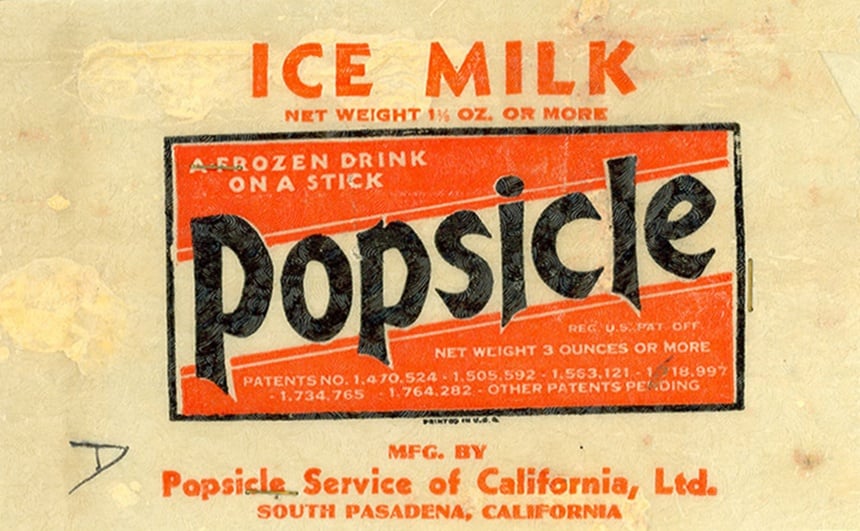
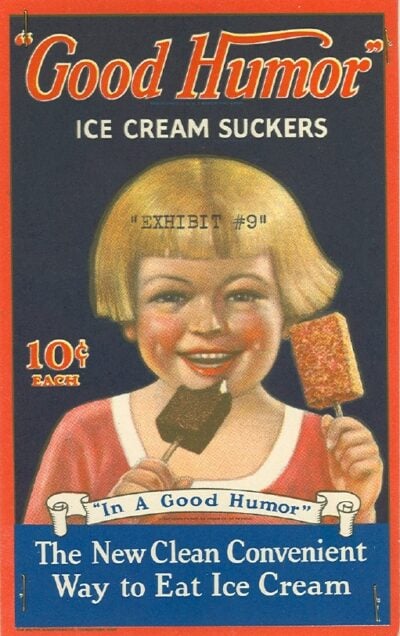
Good Humor filed a lawsuit immediately. Both sides fought to define “sherbet.” Good Humor strictly defined it as “flavored water ice,” but Popsicle rebutted, claiming that most state regulators did not categorize the Milk Popsicle as ice cream, but with terms such as “imitation ice cream,” “frozen custard,” “milk sherbet,” or “ice milk.” The judge ruled for Good Humor, and both companies signed their new court-approved agreement on April 7, 1933. Ironically, over the next six decades, Unilever — one of the largest global consumer goods companies — bought the rights to both Good Humor and Popsicle, ending the Cold War between the two companies.
If you remember buying a cold treat from a neighborhood ice cream truck on a hot summer day, eating a Firecracker during a Fourth of July party, or splitting a two-stick pop with a friend, you’re one of millions that probably has nostalgic memories of Popsicles. It continues to be one of the most popular frozen dessert brands, and for that, we have an 11-year-old Frank Epperson to thank.
Heather Cox Richardson (From Yesterday)
The Great Chicago Fire by Heather Cox Richardson Read on Substack
Today is the anniversary of several deadly wildfires that took place in 1871. While it was not the deadliest— that label went to the Peshtigo Fire in Wisconsin— the Great Chicago Fire tends to be the one people remember, not least because observers turned it into anti-immigrant propaganda even before the flames had died out.
A short history of the facts behind the popular memory of the Great Chicago Fire.
(This is not tonight’s letter, by the way. It’s just cool history, and I don’t get to do enough of that lately.)
“Howl”ing Peace & Justice History for 10/6
I’m so glad the newsletter is back! I’d missed it in my Inbox. Although, we can see all of it anytime we want to, at The Year In Peace & Justice History. That’s where I got them for a few months before I took a break on them. I figure it’s a sign I should pick it back up, that I’m getting newsletters again.
| October 6, 1683 Thirteen Mennonite families from the German town of Krefeld arrived in Philadelphia on the ship Concord. Having endured religious warfare in Europe, the Mennonites were pacifists, similar to the Society of Friends (often known as Quakers) who opposed all forms of violence. The first Germans in North America, they established Germantown which still exists as part of Philadelphia. Modern Mennonite peace activism: (The page is from Quaker History.) More about the Mennonites in America |
| October 6, 1955 Poet Allen Ginsberg read his poem “Howl” for the first time at Six Gallery in San Francisco. The poem was an immediate success that rocked the Beat literary world and set the tone for confessional poetry of the 1960s and later. “Howl and Other Poems” was printed in England, but its second edition was seized by customs officials as it entered the U.S. City Lights, a San Francisco bookstore, published the book itself to avoid customs problems, and storeowner (and poet) Lawrence Ferlinghetti was arrested and tried for obscenity, but defended by the American Civil Liberties Union (ACLU).  Working on Howl in San Francisco, circa June, 1956 Following testimony from nine literary experts on the merits of the book, Ferlinghetti was found not guilty.  Lawrence Ferlinghetti outside City Lights More about City Lights Read Howl Read more about Allen Ginsberg |
| October 6, 1976 An airliner, Cubana Airlines Flight 455, exploded in midair, killing 73 mostly young passengers including the entire Cuban youth fencing team. The plot was engineered by Orlando Bosch and Luis Posada Carriles, a Cuban former CIA agent, who was based in Venezuela at the time. The Posada Carriles file from the National Security Archive (It’s still there!) |
| October 6, 1978 346 protestors were arrested at the site of the proposed Black Fox Nuclear Power Plant in Inola, Oklahoma. In 1973 Public Service of Oklahoma announced plans to build the Black Fox plant about 15 miles from Tulsa. It was also near Carrie Barefoot Dickerson’s family farm. She became concerned, as a nurse and a citizen, about the potential health hazards.  Carrie Barefoot Dickerson Through her group, Citizens’ Action for Safe Energy (CASE), and the consistent opposition of informed and persistent allies, the project was canceled in 1982. There are no nuclear plants in the state of Oklahoma, and no nuclear plant has been built in the U.S. since then. Carrie Dickerson Foundation |
October 6, 1979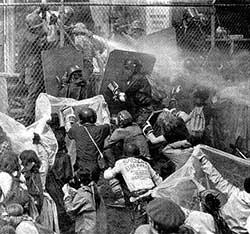 Seabrook Nuclear Power Plant protest – late 1970s Over 1400 were arrested at Seabrook, New Hampshire, the construction site of two new nuclear power plants. The occupation was organized by the Clamshell Alliance. Clamshell history |
https://www.peacebuttons.info/E-News/peacehistoryoctober.htm#october6
Responding to claims about homosexuality & the Bible
Some clips from recent Majority Report that I enjoyed.
Let’s talk about Trump’s government shutdown….
Let’s talk about Russian MiGs entering NATO airspace….
So is tRump compromised, and asset, or just an useful idiot? Hugs
 Scottie's Playtime