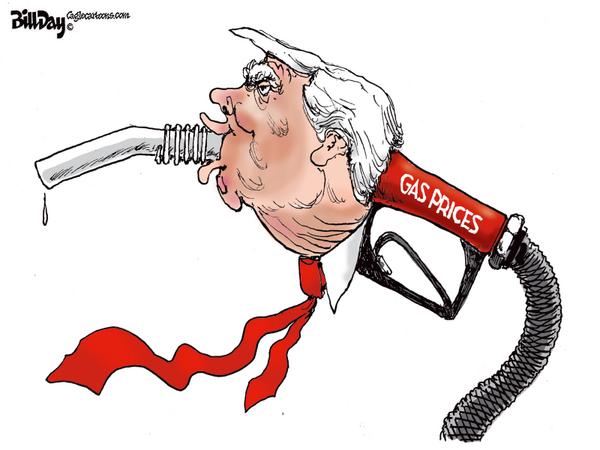
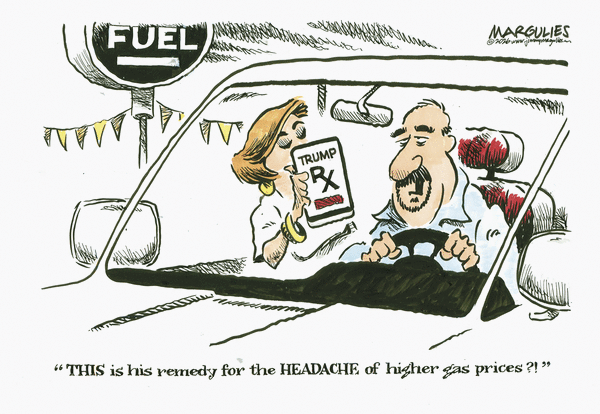
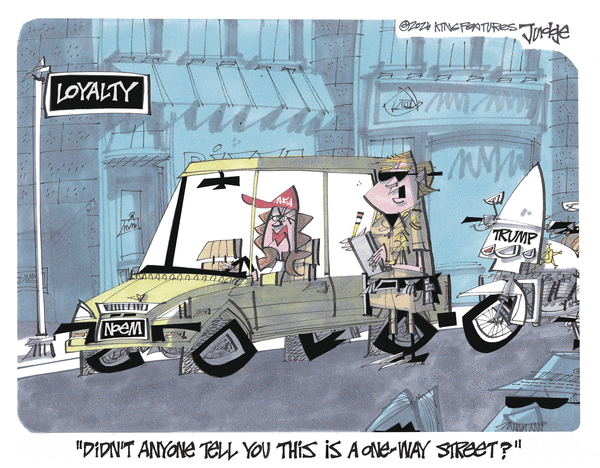
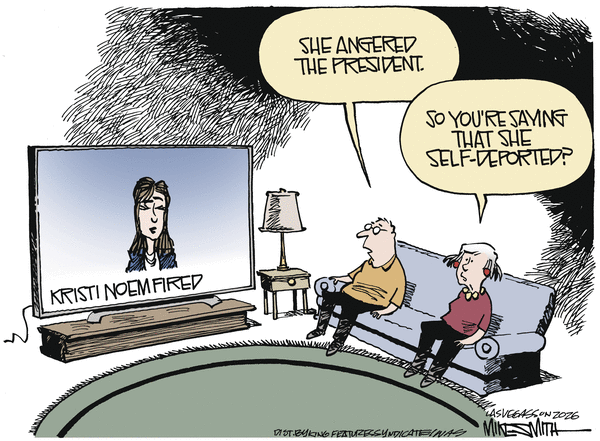
The collective wealth of US billionaires surged to $8.1 trillion in 2025 as working-class Americans faced a cost-of-living crisis made worse by President Donald Trump’s tariff regime and unprecedented assault on the social safety net.
An analysis released Friday by the Institute for Policy Studies (IPS) found that the top 15 US billionaires saw the largest wealth gains last year, with their collective fortune growing from $2.4 trillion to $3.2 trillion. That 33% gain was more than double the S&P 500’s 16% increase in 2025.
What IPS describes as the “elite group” of US billionaires includes Tesla CEO Elon Musk, the richest man in the world; Google co-founder Larry Page; Amazon founder Jeff Bezos; and Oracle executive chairman Larry Ellison.
IPS emphasized that “these staggering combined billionaire wealth totals come as the Trump-GOP budget bill passed in 2025 defunded health insurance, food stamps, and other vital anti-poverty safety net programs, in order to pay for tax cuts for the wealthy and budget increases for militarism and mass deportations.”
“The affordability crisis is hitting ordinary Americans particularly hard as we head into the new year, but not everyone is feeling the pain: Billionaires are raking in staggering profits off the backs of ordinary workers,” Chuck Collins, director of the Program on Inequality and the Common Good at IPS, said in a statement.
“These extreme concentrations of wealth and power,” Collins added, “undermine our daily lives and further rig our economy in favor of the ultra-rich and corporations, while ordinary Americans get a raw deal once again.”
IPS released its analysis days after Bloomberg reported, based on its Billionaires Index, that the world’s 500 richest people gained a record $2.2 trillion in wealth last year.
Omar Ocampo, an IPS researcher, said that in the US, billionaires are “paying far less in taxes compared to the huge amount of wealth they amass,” allowing them to continue accumulating vast fortunes, supercharging inequality, and using their wealth and influence to subvert reform efforts.
“Not only are a small number of Americans holding more wealth than the rest of America, but they’re also not paying their fair share in taxes,” said Ocampo.
The new report comes as families across the US struggle to make ends meet amid high and still-rising prices for groceries, housing, and other necessities. A Century Foundation survey released last month found that “roughly three in 10 voters delayed or skipped medical care in the past year due to cost, while nearly two-thirds switched to cheaper groceries or bought less food altogether.”
“In my day, we had to use the C.I.A. to secretly finance military coups if we wanted to steal a country’s resources.”
Maduro was not in the US he was in a country that our law enforcement people had no authority to enforce laws. This was the kidnapping of a foreign leader which is a war crime. Hugs
In a Wall Street Journal op-ed published last week, Speaker Mike Johnson, R-La., declared 2025 “a great year” for House Republicans, calling it “one of the most productive first years of any Congress in our lifetimes.”
But in interviews with more than a dozen House Republicans last week, a far less rosy picture emerged. And as lawmakers prepare to return for what could be the final year of unified Republican control in Washington during Donald Trump’s presidency — if current polling holds — some members are already talking privately about new House leadership in the next Congress.
For Johnson, the case for GOP success rests almost entirely on one accomplishment: the reconciliation bill. Republicans passed the legislation this summer, with Trump signing it into law on July Fourth. In his op-ed, Johnson highlighted the package’s tax cuts, the billions in new border enforcement funding and the more than $1 trillion in cuts to Medicaid.
The House Republicans who spoke to MS NOW agreed the reconciliation bill was a major accomplishment for their party. (It’s worth noting that no Republican took issue with any of the policies that became law in the reconciliation bill, like the tax cuts that are projected to reduce tax revenue by $4.5 trillion over the next decade or those Medicaid cuts that are projected to cause 10.9 million Americans to lose health insurance coverage over that same time period.) But many of these Republicans wondered what the GOP had accomplished since.
Beyond overseeing the longest government shutdown in history and passing a few mandatory bills, many Republicans said they have little to show for their time controlling the White House and both chambers of Congress.
“The latter half of the year, in particular, starting with the speaker’s baffling decision to keep the House out of session for two months while the country was mired in a very harmful shutdown, that did not really match the tone of the op-ed,” Republican Rep. Kevin Kiley of California told MS NOW.
Kiley, a frequent Johnson critic, said the low productivity during the second half of the year was a consequence of the speaker choosing to keep the House out of session during the historic 43-day government shutdown.
“The decision to absent the House from Washington for two months and cancel six great weeks of session,” Kiley said, “I’m not sure the speaker or the House really recovered from that at the end of 2025.”
A second House Republican, who spoke to MS NOW on the condition of anonymity, said the tax cuts delivered through the reconciliation bill were good. “But other than that, like, what else have we done?” the member asked. “Like, I can’t tell you, because we haven’t.”
This GOP lawmaker added that Trump had been very productive, particularly calling out what the Treasury Department, the Department of Homeland Security and the Justice Department had been doing. “Quite the opposite story when you get to both chambers of Congress,” this member said.
“I understand the point Johnson is trying to make here,” another House Republican told MS NOW, “but I don’t think his claims ring true for most Americans. With all due respect, this characterization does not reflect the reality facing the American people.”
This member added that Trump won “a resounding victory in 2024 with a clear mandate,” and yet now, Congress’ approval rating is near all-time lows and the American people are “rightly frustrated that we have not delivered more boldly on that mandate.”
And asked for their thoughts on Johnson’s op-ed, another House Republican called it “a very rosy way of writing their own story.”
The frustration isn’t particularly surprising, given the lack of legislative progress in the second half of last year. But what may be notable, however, is that Republicans are now discussing new leadership in the next Congress.
Yet another House Republican, who asked to remain anonymous to discuss the sensitive conversations, told MS NOW that the current GOP leadership team “is generally viewed as weak, reactive and unintelligent.”
“It is the increasing sense across the entire continuum of the Republican Conference, from the Freedom Caucus to the Tuesday Group, that there is a need to elect an entirely new leadership team in the 120th Congress,” this member said, referring to the hard-line conservative and moderate GOP groups.
“Expect the silent majority in the GOP conference to push for entirely new faces, and an entirely new approach, in the next Congress,” this lawmaker added. “We are already hearing from those who will move to force the legacy figures to step aside at the end of this Congress, and replace them with new, fresh faces — new ideas and a new approach.”
While these conversations are mostly happening behind the scenes — with little appetite to change leadership in the middle of this Congress — some of the chatter has been making its way into public view.
In early December, Rep. Elise Stefanik of New York, a member of House GOP leadership and a close Trump ally, told The Wall Street Journal in an interview that Johnson “certainly wouldn’t have the votes to be speaker if there was a roll-call vote tomorrow.”
Of course, there isn’t a vote tomorrow. And if Johnson loses the House majority, he would obviously face challenges to retain his position as the No. 1 Republican. But if the GOP were to somehow hold on to the majority, removing Johnson would be difficult.
Still, another GOP lawmaker agreed with Stefanik’s assessment that Johnson would lose a vote tomorrow: “A good attorney. A good man. A bad politician,” this member said.
Kiley said there were “definitely frustrations” with Johnson’s leadership among a cross section of the conference. “I don’t discount how challenging the job is, but he seems to have done the one thing that frustrates pretty much everyone in our conference, by simply making the House of Representatives a lot less relevant in recent months,” Kiley said.
That decaying relevance has come as Johnson has deferred much of Congress’ power to the executive branch. The legislative branch’s reduced role in the checks-and-balances system of government came into greater focus over the weekend, when Trump bombed Venezuela and put U.S. boots on the ground to capture Venezuelan president Nicolás Maduro — without congressional authorization.
Where congressional leaders of previous eras might take issue with the president conducting offensive strikes without authorization — or at least insist on congressional input — Johnson applauded the president Saturday for a “decisive and justified operation that will protect American lives.”
“President Trump is putting American lives first, succeeding where others have failed, and under his leadership the United States will no longer allow criminal regimes to profit from wreaking havoc and destruction on our country,” Johnson wrote on X.
Johnson has seemed to grasp that his power as a Republican leader depends greatly, if not entirely, on Trump’s approval. And as Trump has seized power from the legislative branch — through tariffs, through impoundments, through executive orders, through emergency declarations and by his administration ignoring congressional orders — Johnson has been an enthusiastic partner of the president.
Reached for comment, the speaker’s office referred MS NOW to the message in the op-ed and the more than 100 influential conservative and industry and community leaders touting the House GOP’s accomplishments in 2025.
Still, the numbers paint a more humble picture.
With Republicans controlling the House, Senate and White House, 38 bills became law this year — exactly half of the 76 bills that were enacted under full Democratic control in 2021 and far short of the 74 bills that were signed under full GOP control in 2017. (In 2009, when Democrats also had unified control of Congress and the White House, they passed 115 bills into law.)
Johnson wasn’t without defenders. Several Republicans pointed out that Johnson was grappling with a razor-thin majority — decreasing to a two-vote cushion at one point — which makes passing major legislation difficult.
Rep. Eric Burlison, R-Mo., a second-term lawmaker who is part of the Freedom Caucus, called 2025 “one of the best years Congress has had.”
“While we may not have passed a bunch of individual bills, the amount of legislation, and good legislation, that was passed in the ‘one big, beautiful bill’ is quite a bit,” Burlison said.
He did, however, push back on Johnson’s description of 2025 as “one of the most productive first years of any Congress in our lifetime.”
“I don’t know if you’d say the most productive,” Burlison said. “I’d say it’s the best in at least a generation. And by best, I mean we didn’t pass a bunch of swampy things; we passed really good legislation.”
Rep. Don Bacon, R-Neb., a retiring moderate, similarly touted the breadth of policy in the reconciliation bill, as well as the annual defense policy bill, which Congress has passed every year for more than six decades.
“If you just look at the number of bills passed, it’s easy to say, I guess, that’s a low production, but I think if you have a little bit of nuance, it was probably more than just that low number, because the reconciliation bill had tons of tax policy in it,” Bacon said, though he added that “the real answer” is that “I sure wish we could have got more done.”
Notably absent from the list of accomplishments? A fix for health care, as Obamacare subsidies expired, driving up prices for tens of millions of Americans.
“Substantively, what we’ve done, the biggest thing is that ‘big, beautiful bill,’” one of the previously quoted lawmakers said. “And the biggest deficiency is certainly the health care.”
At the end of his op-ed, Johnson said “the best is yet to come.” But some House Republicans are just wishing for some normalcy.
Asked what they were most hopeful for in the second half of the 119th Congress, another one of the previously quoted lawmakers had a modest ambition: “Little or no drama.”
It was all a lie. Rubio has always pushed for regime change in Cuba, and may experts say it should start with Venuzalia. Rubio doesn’t care about the oil, he wants all support for Cuba stopped so the US can go into Cuba and return it to what his family fled so many years ago when they were abusing the locals for profit. It is all a personal agenda he hopes will lead him to the presidency. Hugs
The Trump administration has set its sights on Venezuela in its latest campaign against illegal drugs, but data shows that the country is responsible for just a sliver of drug trafficking directly to the United States.
The Get the Facts Data Team analyzed data on cocaine and fentanyl trafficking. While Venezuela is a player in cocaine manufacturing and trafficking, drug seizure data shows that it’s not as prominent a supplier of cocaine to the U.S. as other South American and Latin American countries.
There is also no evidence that any significant level of illegal fentanyl — the primary killer in U.S. overdose deaths — is produced in South America, according to the United Nations Office on Drugs and Crime (UNODC).
UNODC analyzes global drug trafficking based on reporting from its member states, open sources and drug seizure information.
Yet President Donald Trump has linked his administration’s attacks on drug vessels in Latin America to the fentanyl crisis, among other drugs.
After the Sept. 19 attack on a boat in the Caribbean that killed three people, Trump posted on Truth Social, claiming that the boat was carrying drugs and headed for America. “STOP SELLING FENTANYL, NARCOTICS, AND ILLEGAL DRUGS IN AMERICA,” his post said.
The next day, in a speech, Trump said that thousands are dying because of “boatloads” of fentanyl and drugs. He’s also repeatedly said that each boat strike would save 25,000 lives.
As of Friday, the number of known boat strikes was 35, and the number of people killed stands at least 115, according to the Trump administration.
Previously, Trump said that the U.S. is engaged in an “armed conflict” with drug cartels and has justified the boat strikes as necessary to stem the flow of drugs into the U.S. Hearst Television’s partner PolitiFact labeled that 25,000 number mathematically dubious.
Maduro’s capture on Jan. 3
On Saturday, the Trump administration struck Venezuela in a new, stunning way, capturing its leader, Nicolas Maduro, and his wife. Both are being taken to the United States to face charges related to drug trafficking.
The strike followed a monthslong Trump administration pressure campaign on the Venezuelan leader, including a major buildup of American forces in the waters off South America and attacks on boats in the eastern Pacific and Caribbean accused of carrying drugs. Last week, the CIA was behind a drone strike at a docking area believed to have been used by Venezuelan drug cartels — the first known direct operation on Venezuelan soil since the U.S. began strikes in September.
Venezuela’s role in cocaine trafficking
Venezuela is not among the primary direct traffickers of cocaine to the U.S.
Like fentanyl, most cocaine enters the U.S. from Mexico and typically gets to Mexico via maritime transportation on both the Pacific and Caribbean sides, according to UNODC research officer Antoine Vella. Some also arrives in Mexico via land transportation.
While the Trump administration’s early September attacks targeted Venezuelan boats, there is no known direct cocaine trade route from Venezuela to the U.S. via sea. The only known direct Venezuela to U.S. trafficking route is via air, according to drug seizure data from UNODC. Cocaine could still arrive from Venezuela to the U.S. through intermediary countries.
Colombia, Ecuador and Panama are among the main direct traffickers of cocaine to the U.S. via boat.
From harvest to production
Coca, the plant that cocaine is made from, is grown primarily in Colombia, Peru and Bolivia.
Once coca is harvested, the cocaine in the leaf needs to be extracted. That processing occurs at illegal manufacturing facilities around the globe.
The three coca-growing countries also have the most illegal processing facilities. Colombia had by far the most of any country at about 26,400 detected and dismantled from 2019 to 2023, according to UNODC data. It’s followed by about 3,200 processing facilities in Bolivia and 2,400 in Peru.
Venezuela, which neighbors Colombia, had about 260 illegal processing facilities detected and dismantled from 2019 to 2023, according to UNODC data. It’s ranked fifth among countries with the most processing facilities.
“Every country that borders Colombia has an issue with cocaine in terms of cocaine trafficking,” Vella said.