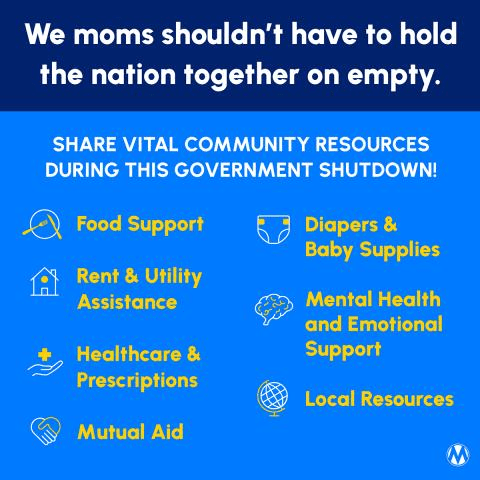
These are among the truest words ever spoken. From Momsrising’s blog, here are resources: we should share them far and wide so that people can at least get by. I write letters and make phone calls with Momsrising; this is good and vital information. And, you don’t have to be a mom to use, share, or help anyone with this info! It’s for all. -A
We moms shouldn’t have to hold the nation together on empty.
Yet here we are in the middle of a government shutdown that has thrown families into chaos. SNAP benefits are being cut; air traffic controllers,
We moms shouldn’t have to hold the nation together on empty.
Yet here we are in the middle of a government shutdown that has thrown families into chaos. SNAP benefits are being cut; air traffic controllers, military school teachers, families in several states are losing child care as Head Start centers start to close; and other federal employees are facing another missed paycheck (while still showing up every day, keeping our country running!). WIC is barely hanging on by thread, and rising costs are pushing families past the brink.
Moms are holding it all together and we see you!!
We see your strength. We see your exhaustion. And we know that love shouldn’t have to come with this kind of struggle.
While the Trump Administration continues to play politics with families’ livelihoods, we want to make sure you have support right now while we keep up the fight.
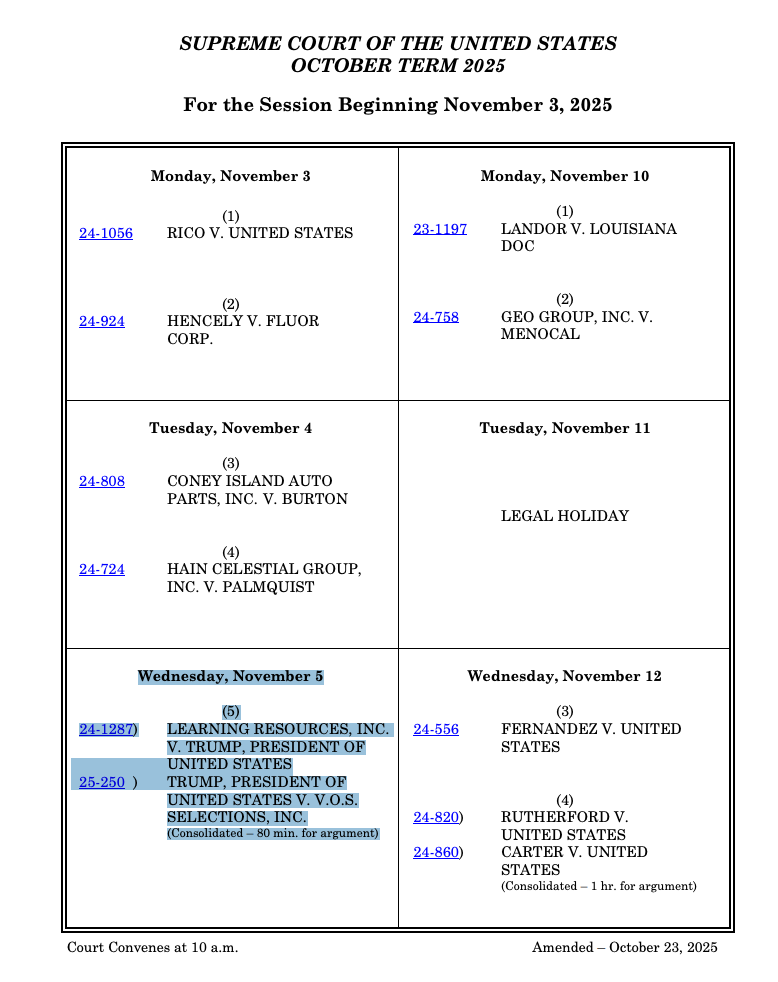
This Wednesday, the Supreme Court will hear the Trump tariffs case, arguably one of the most important cases it will hear all term.
But, it’s important to understand that this is not a case about tariffs in general or about whether they are good policy. It’s a case about specific tariffs that President Trump imposedin February and whether he had the statutory authority to impose them. In other words, this is yet another example of Trump attempting to seize power that neither the Constitution nor our laws grant him and going to the Supreme Court in hopes they will validate it nonetheless. After argument, the Supreme Court will decide whether Trump had the legal authority to impose these tariffs in two cases.
We’ve been tracking this issue since Trump first threatened to impose tariffs, waffling back and forth seemingly from minute to minute. We studied the U.S. Court of Appeals for the Federal Circuit’s decision that rejected Trump’s effort to impose tariffs using IEEPA (I-E-Pa), the 1977 International Emergency Economic Powers Act, for the very simple reason that the Act, unlike other statutes that do give a president the right to impose tariffs, doesn’t mention tariffs at all. It does not give the president any authority to impose them under the statute that he has expressly said he used to do so. This is the kind of textualist argument conservative justices have backed in other cases, and to abandon that approach here would be a sharp and hypocritical departure for them. Last term, Justice Gorsuch wrote that the justices’ primary focus should be on the text of the statute.
The Constitution gives the power to impose taxes, which includes tariffs, to Congress. Because IEEPA doesn’t extend that power to the president, his use of it here is just a power grab, the kind of practice the Supreme Court should push back against if it intends to remain relevant to the American experiment. The Federal Circuit’s decision pointed out that while other laws expressly give the president the power to impose tariffs, IEEPA does not. Congress knows how to give the president the power to impose tariffs when it wants to and because it did not do so here, that should be the end of the inquiry. The administration should lose here. So what we hear in oral argument, even though it won’t necessarily signal where individual judges will end up, is worth following closely to see what tea leaves can be read for this case. It may also give us some sense of whether the Court intends to act as a check in other cases involving Trump’s power grabs.
The “major questions” will also be in play on Wednesday. You may recall it from recent terms of Court, where a conservative majority has recently used it to say there must be clear guidance from Congress before a federal agency can act on a major question of economic or political significance. Here’s the wrinkle: The Court has only used the doctrine to hamstring the Biden administration, and not to hinder Trump.
In 2022, the Court decided West Virginia v. Environmental Protection Agency, rejecting the EPA’s authority to regulate greenhouse gas emissions from coal-fired power plants because Congress had not specifically authorized a regulation with such major political and economic consequences.
In 2023, the Court rejected Biden’s student loan relief package in Biden v. Nebraska, holding that even though a federal statute allowed the Secretary of Education to “waive or modify” student loan debt, that authorization was insufficient for the Biden policy because this was a major question.
The Federal Circuit used these cases as precedent against the Trump administration. “Tariffs of unlimited duration on imports of nearly all goods from nearly every country with which the United States conducts trade” is “both ‘unheralded’ and ‘transformative,’” the court wrote, concluding that as a result, the administration needed to be able to “point to clear congressional authorization” for its tariffs. The absence of any language in the statute authorizing them was fatal to Trump’s case in the lower court. But the sardonic joke among appellate lawyers has been that the major questions doctrine only applies to Democratic administrations. On Wednesday, we will see whether that holds up and if the Court’s conservative majority is willing to twist itself into pretzel logic to support this administration’s political objectives.
There are other issues to look at this week:
As the Trump administration continues its extraterritorial strikes on supposed drug traffickers, there is increasing concern about the legality of that conduct. Georgetown law professor Steve Vladeck and I will take up that issue on Monday evening at 9 p.m. ET/8 CT in a Substack Live (if you subscribe to Civil Discourse, you’ll receive an email inviting you to join us when we go live, so mark your calendars and be ready).
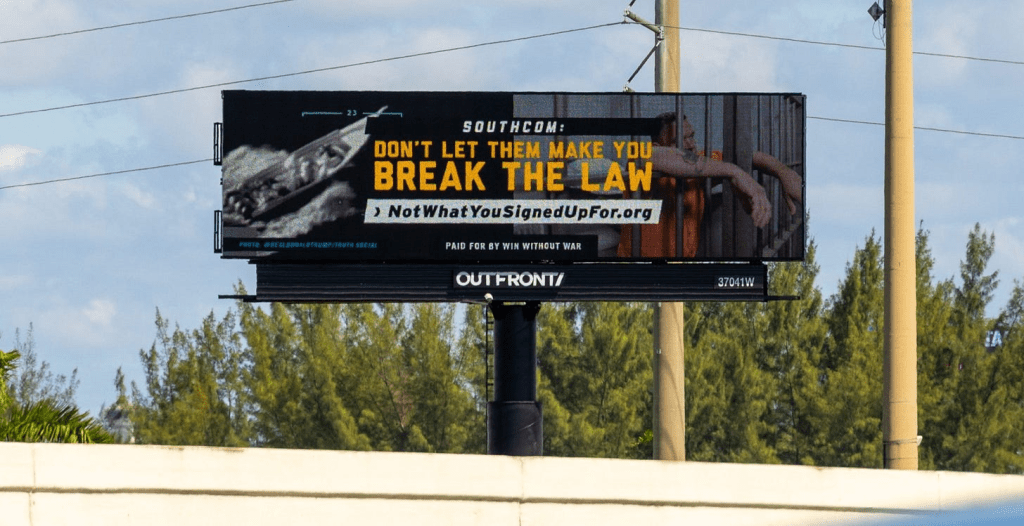
As we head into the week, there are billboards up on the expressway heading toward U.S. Southern Command, in Doral, Florida, that tell troops “Don’t let them make you break the law” in response to those attacks.
New billboards are going up near Miami, Chicago, and Memphis, Tennessee, as well, a warning to troops being deployed in American cities. The billboards are part of a campaign by veterans to support and encourage the troops to uphold military order.
If you’ve forgotten about DOGE, unfortunately, it’s time to remember. There are reports that the Pentagon’s DOGE unit “is leading efforts to overhaul the U.S. military drone program, including streamlining procurement, expand homegrown production, and acquire tens of thousands of cheap drones in the coming months.” And the Bulwark reported that Rear Admiral Kurt Rothenhaus was recently removed from his post as chief of naval research, the top post at the Office of Naval Research (ONR), and replaced by Rachel Riley, who has been working in DOGE-related roles in the Trump administration. Although she was a Rhodes Scholar, Riley, 33, has “no apparent naval experience.”
There are also reports of DOGE interfering with the Department of Agriculture. Senator Dick Durbin tweeted that “President Trump and the DOGE cowboys want to close and diminish critical agricultural research at the University of Illinois. The only other soybean lab like that in the world is in…China. Our President is ceding our agriculture research leadership to China.”
Remember back in February, when Trump floated the idea that everyone could get a $5,000 check from all of DOGE’s “savings”? That didn’t work out so well, did it? You may want to remember this for Thanksgiving dinner.
Tuesday is election day. There is the Virginia governor’s race and the New York City mayoral race. Also, the governorship is at issue in New Jersey. A California ballot initiative will determine whether that state will engage in defensive redistricting designed to offset the aggressive way the Trump administration has demanded Republican states use it to spike the balance between the two parties in the House in their favor, effectively letting politicians choose their voters, instead of the other way around. There is also a race in Pennsylvania, where three Democratic members of the state Supreme Court face retention votes that could be highly significant in the potential 2028 battleground state.
Vote.org, a nonpartisan voter registration and engagement platform, announced a “huge spike” in voter registration ahead of the elections, with their online registration platform being used more than twice as many times as they were during the comparable 2021 election cycle.
They reported that:
More than 80% of those users are under the age of 35
Nearly half (46%) are just 18 years old
Compared to 2021, there are more young voters, more women, and more voters of color using the platform
It’s good news for pro-democracy Americans.
The house will remain out of session, yet again this week.
Epstein. Epstein. Epstein.
But as we all know, that means SNAP is still in danger, which means many of our fellow citizens could begin to go hungry this week if the administration tries to skirt compliance with or obtains an injunction staying decisions by a court in Massachusetts, and a more specific one in Rhode Island, which require the administration to use emergency dollars to fund SNAP. There, Chief Judge John J. McConnell Jr. ordered the USDA to distribute contingency funds and to report to the Court on its progress by 12:00 p.m. on Monday, November 3. Expect more litigation this week.
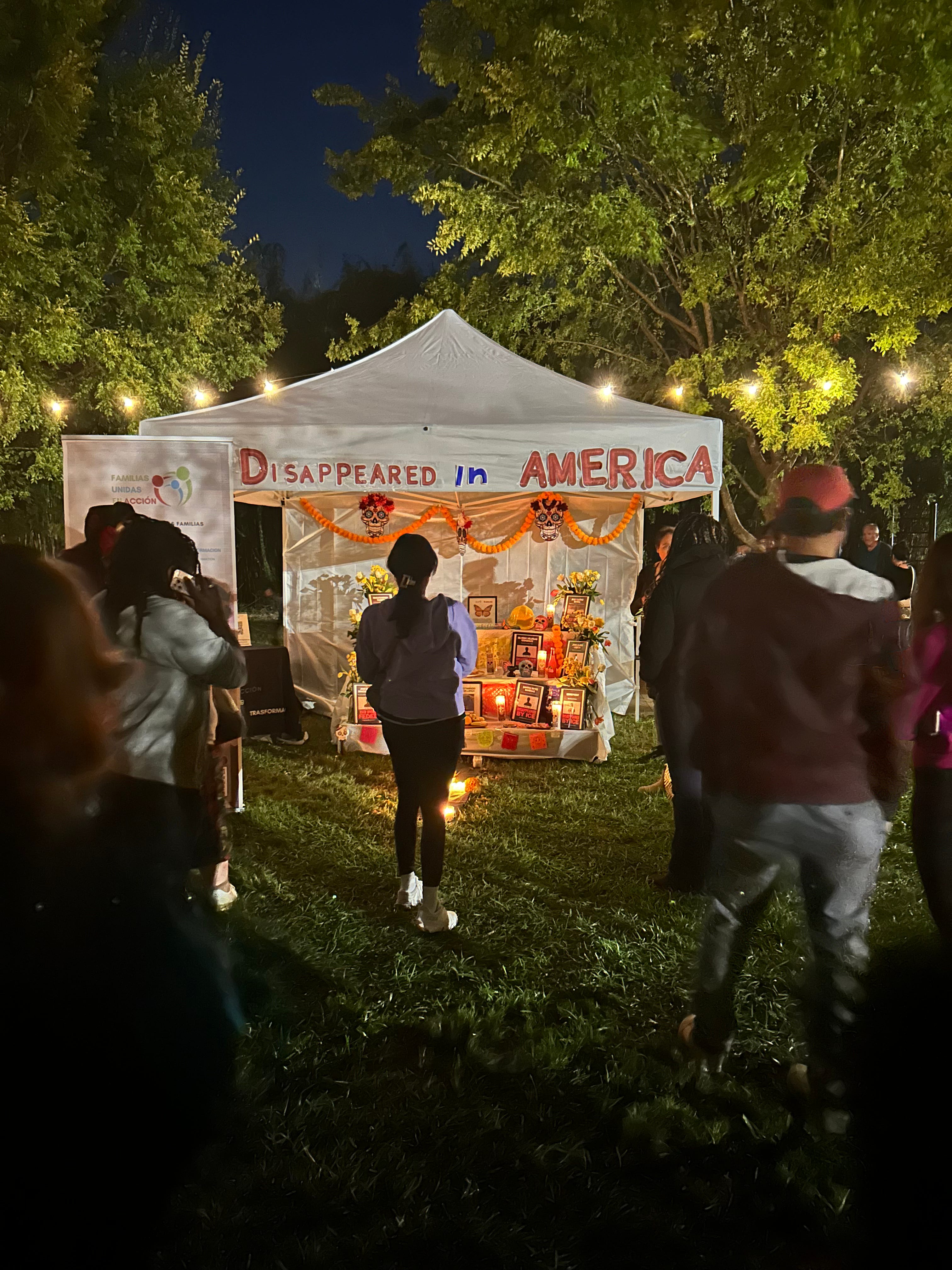
ICE agents are still engaging in “enforcement actions” in American communities and residential neighborhoods. Stories of abuses are circulating; it’s a critical moment for using our skills to ferret out misinformation and focus on the truth. This photo is from a Day of the Dead celebration in New Orleans.
It is clear that this is a week that will require us to summon our courage and continue to pay close attention. The times are far too important for us to look away. Remind yourself that dictators use overwhelm as a tactic for getting people to give up and submit to their rule. Let’s not do that to us.
The items don’t have to do with each other; they interested me or looked like something I ought to know about, so I read them and thought someone else might like to read one or another or maybe all of them.
The 1947 partition of the South Asian subcontinent into India and Pakistan led to the world’s largest mass migration. Populations from both sides of newly formed demarcations suffered in heinous riots. Women in particular were subjected to extreme violence. Yet, the severity of gendered crime during Partition wasn’t caused by an arbitrary upsurge of madness. Systemic patriarchy in South Asia had long reduced women to male-owned property. They were objectified to such an extent that a woman’s sexual “purity” became a metonym of her husband’s and kinsmen’s honor (izzat). In other words, male respectability was gauged by how successfully women’s bodies were regulated. With Partition, this dynamic became a forum for contesting powers and prestige at the communal and national levels.
To assert manhood and symbolize triumphal power over the enemy, rivaling sides opted for sexually charged violence, grotesquely marking, mutilating, and branding the bodies of women. According to historian
were abducted, raped, forced to convert, forced into marriage, forced back into what the two states defined as “their proper homes,” torn apart from their families once during Partition by those who abducted them, and again, after Partition, by the state which tried to “recover” and “rehabilitate” them.
In the guise of celebrating independence from British rule, official narratives of nationalism largely omitted female experiences of such violence during the divisive convulsions of 1947. Among the earliest Partition texts that documented gory details which would have otherwise slithered into oblivion is Pinjar (which can translate to both “Skeleton” and “Cage”), a novella by Amrita Pritam that captures the cataclysmic years of Partition via a series of abductions.
A writer celebrated for both powerful poetry and prose, Amrita Pritam (1919–2005) is a well-known figure in South Asian literature. Inspired by real life, much of her work serves as testimony. Pritam witnessed firsthand the horrors of Partition—communal riots forced her to migrate to India from Pakistan in 1947 with nothing but her two small children and a red shawl. She never returned home. (snip-MORE on their page linked above)
The Intersex Human Rights Fund (IHRF) at the Astraea Lesbian Foundation for Justice is celebrating its 10th year of funding intersex liberation efforts across the globe. Join us in reflecting on the IHRF’s many accomplishments, intersex movement successes, and our vision for the future of intersex organizing.
Created in 2013 by Morgan Carpenter, an intersex man based in Australia, the intersex flag was intentionally designed to stand out, communicate values important to intersex communities, and be used widely and freely. The intersex flag has a simple design: a bold purple circle on a bright yellow background. The circle represents many things, including wholeness and bodily autonomy, while the colors yellow and purple both represent the strength and diversity of intersex communities while avoiding all references to gender.
Plenty of us are living back at home, adopting ‘traditional’ duties in exchange for free accommodation – Charlie Aslet
When I read the term “trad sons” on my phone, I spat the hot cocoa my mother had prepared for me out onto the screen. “What fresh torture will the live-at-home generation be subjected to next?” I cried. It only got worse when I scrolled to see that mothers were calling their stay-at-home sons “hubsons”, a play on the word husbands. “Has the whole world gone Oedipal?” I exclaimed in horror.
Following on from the trend of the “tradwife”, the internet has coined the term trad sons for children who stay at home with their parents and adopt “traditional” sonly duties in exchange for free accommodation. (Snip-MORE, it’s not long)
ChatGPT, Gemini, DeepSeek, and Grok are serving users propaganda from Russian-backed media when asked about the invasion of Ukraine, new research finds.
Snippet:
“It raises questions regarding how chatbots should deal when referencing these sources, considering many of them are sanctioned in the EU,” says Pablo Maristany de las Casas, an analyst at the ISD who led the research. The findings raise serious questions about the ability of large language models (LLMs) to restrict sanctioned media in the EU, which is a growing concern as more people use AI chatbots as an alternative to search engines to find information in real time, the ISD claims. For the six-month period ending September 30, 2025, ChatGPT search had approximately 120.4 million average monthly active recipients in the European Union, according to OpenAI data.
The researchers asked the chatbots 300 neutral, biased, and “malicious” questions relating to the perception of NATO, peace talks, Ukraine’s military recruitment, Ukrainian refugees, and war crimes committed during the Russian invasion of Ukraine. The researchers used separate accounts for each query in English, Spanish, French, German, and Italian in an experiment in July. The same propaganda issues are still present in October, Maristany de las Casas says.
Amid widespread sanctions imposed on Russia since its full-scale invasion of Ukraine in February 2022, European officials have sanctioned at least 27 Russian media sourcesfor spreading disinformation and distorting facts as part of its “strategy of destabilizing” Europe and other nations.
A database containing information on people who applied for jobs with Democrats in the US House of Representatives was left accessible on the open web.
Snippet:
“Today, our office was informed that an outside vendor potentially exposed information stored in an internal site,” Joy Lee, spokesperson for House Democratic whip Katherine Clark, told WIRED in a statement on October 22. DomeWatch is under the purview of Clark’s office. “We immediately alerted the Office of the Chief Administration Officer, and a full investigation has been launched to identify and rectify any security vulnerabilities.” Lee added that the outside vendor is “an independent consultant who helps with the backend” of DomeWatch.
There are many unsecured and publicly accessible databases across the internet, and the researcher says that they might not have paused to investigate the DomeWatch data had they not noticed key words involving top-secret security clearances. This underscores the concern, the researcher says, that while the database is small, it contains information that would be potentially valuable in nation-state espionage. One entry, for example, listed a person who had “intelligence” and “US-China relations” experience.
“Exposed databases are a widespread, non-partisan cybersecurity problem. Left unchecked, they enable targeted espionage, fraud, and identity abuse,” says Alexander Leslie, senior advisor for government affairs at the threat intelligence firm Recorded Future, who was not involved in the research. “If accurate, this dataset would be extremely sensitive. Military histories and clearance status give adversaries precise reconnaissance and pretexting opportunities, and foreign espionage actors could further use this data for spear-phishing, impersonation, and targeted social-engineering to gain access or compromise accounts.” (snip-MORE)
OK, so we’ve posted about this here at least a couple of times, and now we’re in the week where people will not be receiving benefits on which they depend, to eat. Here’s one more story. And, yes, this is a particular cause of mine, so I want to note that I’ve been looking around town to see where I might be able to help out should this come to fruition, as it appears to be doing. My posting may be sparser, because trying to help people get enough to eat will take up more time now. But, as we’ve also written here, building and sustaining community is important during times such as those we in the US find ourselves, and for me, helping people get enough to eat is sustaining community. So, while I’ll still be around, I may not post as often; the energy only goes so far. Here’s today’s AP story:
The new notice comes after the Trump administration said it would not tap roughly $5 billion in contingency funds to keep benefits through the Supplemental Nutrition Assistance Program, commonly referred to as SNAP, flowing into November. That program helps about 1 in 8 Americans buy groceries.
“Bottom line, the well has run dry,” the USDA notice says. “At this time, there will be no benefits issued November 01. We are approaching an inflection point for Senate Democrats.”
The shutdown, which began Oct. 1, is now the second-longest on record. While the Republican administration took steps leading up to the shutdown to ensure SNAP benefits were paid this month, the cutoff would expand the impact of the impasse to a wider swath of Americans — and some of those most in need — unless a political resolution is found in just a few days.
The administration blames Democrats, who say they will not agree to reopen the government until Republicans negotiate with them on extending expiring subsidies under the Affordable Care Act. Republicans say Democrats must first agree to reopen the government before negotiation.
Democratic lawmakers have written to Agriculture Secretary Brooke Rollins requesting to use contingency funds to cover the bulk of next month’s benefits.
Government shutdown The AP has journalists around the country covering the shutdown of the federal government. What questions do you have for them?
But a USDA memo that surfaced Friday says “contingency funds are not legally available to cover regular benefits.” The document says the money is reserved for such things such as helping people in disaster areas.
It cited a storm named Melissa, which has strengthened into a major hurricane, as an example of why it’s important to have the money available to mobilize quickly in the event of a disaster.
Some states have pledged to keep SNAP benefits flowing even if the federal program halts payments, but there are questions about whether U.S. government directives may allow that to happen. The USDA memo also says states would not be reimbursed for temporarily picking up the cost.
Other states are telling SNAP recipients to be ready for the benefits to stop. Arkansas and Oklahoma, for example, are advising recipients to identify food pantries and other groups that help with food.
Sen. Chris Murphy, D-Conn., accused Republicans and Trump of not agreeing to negotiate.
“The reality is, if they sat down to try to negotiate, we could probably come up with something pretty quickly,” Murphy said Sunday on CNN’s “State of the Union.” “We could open up the government on Tuesday or Wednesday, and there wouldn’t be any crisis in the food stamp program.”
The man who brought two federal criminal cases against Donald Trump wants to testify publicly, as two of his top deputies set up a law firm to take on public corruption issues.
Molly Gaston and J.P. Cooney, both former top deputies to special counsel Jack Smith, launched their own firm this week.Gaston & Cooney PLLC
She and fellow Smith team alum J.P. Cooney rolled out a new law firm this week focused on helping state and local governments fill the void created by the Justice Department’s retreat from public corruption work. Gaston & Cooney PLLC will also represent the targets of criminal and congressional investigations as Trump flexes his ability to use federal law enforcement and his allies in Congress to target his political opponents.
Also this week, Smith’s lawyers informed Congress that he’s ready to re-enter the limelight, telling Trump allies Rep. Jim Jordan, R-Ohio, and Sen. Chuck Grassley, R-Iowa, that he’d be happy to testify before Congress. But he requested to do so publicly rather than behind closed doors to help combat the “many mischaracterizations” about his investigations into Trump, his attorneys said.
(snip-a video, tangentially related, on the page)
The public emergence of Smith and two of his top deputies comes as Trump has remade the Justice Department, tearing down the wall between the DOJ and the White House with open calls to go after his opponents; pardoning all participants in the Jan. 6, 2021, attack on the U.S. Capitol whom the department had spent years arresting and prosecuting; and firing scores of nonpolitical DOJ and FBI employees.
Gaston and Cooney told NBC News that none of this — leaving the Justice Department and the relative anonymity of the life of a federal prosecutor to launch a law firm — was part of the plan. They had both expected to stay on at the Justice Department after Trump took office.
In retrospect, it may have been naive, but Gaston said they joked about getting demoted to work on misdemeanor cases in Superior Court in Washington, the low-level positions where many brand-new federal prosecutors start their careers.
They were fired in January. (Gaston and Cooney are challenging their firings, saying they are illegal and violate long-standing civil service protections.)
Initially, they sought to work with universities to launch academic initiatives focusing on public corruption, with Gaston noting that’s what they spent most of their careers working on and were “really passionate about.” But it didn’t pan out.
“There were a lot of schools that were enthusiastic, but also anxious about working with us because of the environment right now,” Gaston said, adding they were unable to secure funding to launch the project.
Cooney said they want to “try and meet this moment,” which they think “is a particularly challenging one for our country in many respects.”
“Specifically in the area of the cost exacted by public corruption and turning a blind eye to it,” he said, there’s a real need for “independent, conflict-free representation and advocacy across many spectrums.”
The firings and departures of federal employees who worked on cases against Trump or the Jan. 6 prosecutions have been celebrated by many MAGA supporters. Current employees wonder if they’re next on the firing list, and those who departed face daunting challenges, including being targeted on social media, a heightened threat environment and a tough job market, with many employers hesitant to draw the Trump administration’s ire.
The campaign against Smith’s team hasn’t let up since Cooney and Gaston left. The Trump administration, just this month, fired FBI special agents and even administrative staffers who worked with Smith’s office. Gaston called the firing of “model public servants … outrageous” and sad.
“People who load documents into document review platforms were fired for no reason, except that they had worked for — done work for — the special counsel’s office,” Gaston said. “Those were the hardest moments for us in the last nine months.”
Gaston said she has “immense respect” for those still inside the DOJ who continue to follow the facts and the law.
“Career civil servants who are dedicated to doing their jobs without fear or favor — whether it’s judges or career prosecutors or FBI agents, or people who work at HHS and the like — are just now routinely the subject of such vehement personal attacks on social media and otherwise by politicians and public figures who know better,” Cooney said. “It really has no place in a civil society, and we are so inspired by the career civil servants who, under circumstances like that, go to work every day and do their job faithfully under the law and without fear or favor.”
Acting on Donald Trump’s orders, the FBI has reportedly begun showing up at the homes of peaceful protesters — a chilling escalation against Americans exercising their rights.
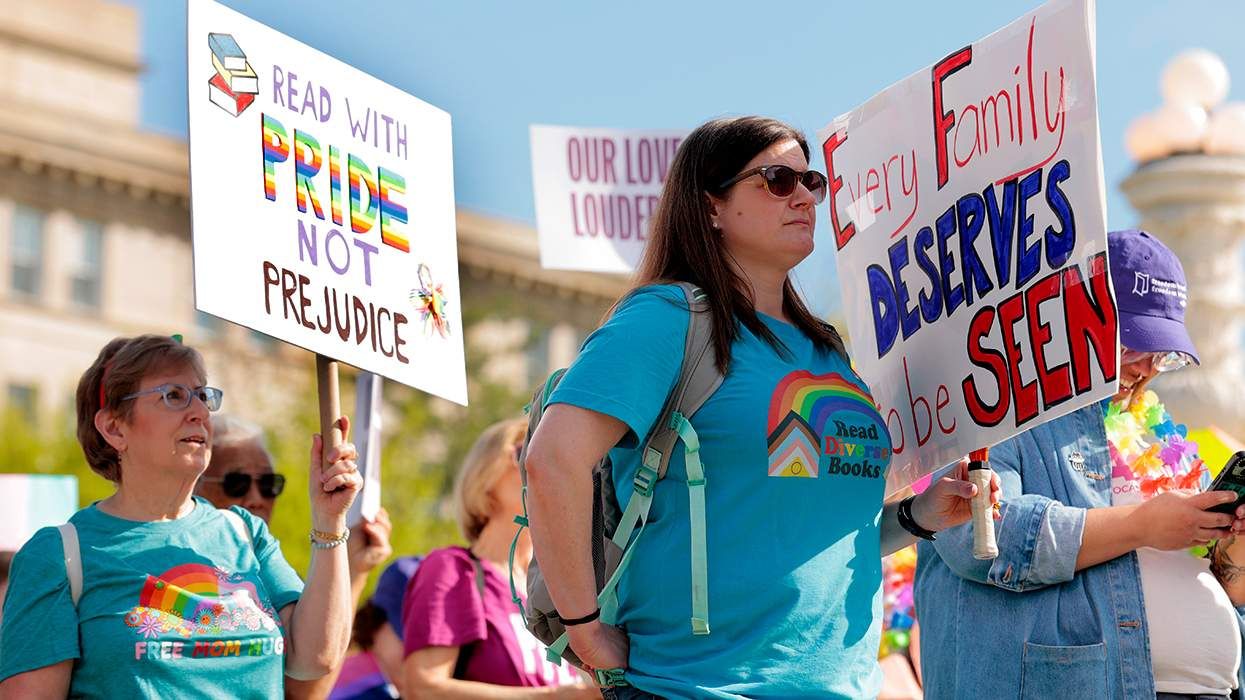
Protesters in support of LGBTQ+ rights and against book bans demonstrate outside of the U.S. Supreme Court Building while the justices heard arguments for the case of Mahmoud v. Taylor in Washington, DC., April 2025
Opinion: In Mahmoud v. Taylor, the justices gave bigotry a permission slip and ruled that parents can “opt out” of LGBTQ-inclusive lessons, further diminishing lessons and practices on inclusivity in civic society, argues Darek M. Ciszek.
The U.S. Supreme Court made a decision earlier this summer that has a significant impact on classrooms nationwide. In their 6-3 decision in Mahmoud v. Taylor, the majority completely missed the point as to why LGBTQ-inclusive education matters. By giving parents the option to pull their kids out of lessons that include LGBTQ+ characters or content, the Court prioritized personal religious objections over creating schools where students can learn without feeling invisible.
Justice Alito‘s majority opinion is especially troubling. He treats LGBTQ-inclusive education as if it were some optional “add-on” that schools can easily work around. As a former teacher, I can confidently say that is not how education works, especially when it comes to curriculum and lesson planning. And while Justice Thomas calls LGBTQ-inclusive education “ideological conformity,” he fails to see that most LGBTQ+ adults today grew up in a school system that forced us to conform to a cisgender and straight worldview. Ironically, I’d consider the Court’s narrow view of public education to be ideologically driven.
Let’s be clear about what LGBTQ-inclusive education is and isn’t. When teachers include books like Uncle Bobby’s Wedding in their curriculum, they are not trying to convert anyone’s child or attack anyone’s faith. They are trying to show students that families come in all colors, shapes, and sizes, reflecting our diverse society.
LGBTQ+ people are also part of every community. We have always been a part of human history, and we deserve to be represented in our nation’s schools. The goal is not to change what students believe at home; it is to teach them how to be respectful in a democratic and diverse world. Luckily, in her dissent, Justice Sotomayor got it right when she said that LGBTQ-inclusive education is “designed to foster mutual civility and respect.”
I could not agree more.
But here’s what the Court’s majority really got wrong: they ignored the anti-bullying efforts that motivate many LGBTQ+ inclusive education programs in the first place. According to the latest National School Climate Survey from GLSEN, 68% of American students reported feeling unsafe in school due to their SOGIE (sexual orientation, gender identity, and/or gender expression) characteristics.
That is two out of three LGBTQ+ youth.
These aren’t just statistics. These are real children trying to learn while dealing with a school environment that tells them, whether implicitly or explicitly, that their identities or families are somehow wrong or shameful.
When schools include diverse families in their lessons, they are not pushing an agenda. They are teaching kids that being different does not mean bad. They are giving LGBTQ+ students a chance to see themselves reflected in their education and helping other students see and understand those who are different from them.
Research shows inclusive education works. Studies have found that an LGBTQ-inclusive curriculum can improve the social and emotional well-being of LGBTQ+ youth. When kids learn about different types of families early on, they are more likely to treat their classmates with kindness instead of cruelty. In other words, when implemented correctly, LGBTQ-inclusive education can be an essential anti-bullying and student well-being strategy.
For instance, as a result of my doctoral research, I have learned that some schools around the world are starting to address LGBTQ+ bullying head-on, and, not surprisingly, it’s through curriculum and instruction. In Scotland, LGBTQ-inclusive education became required in 2021 across both primary and secondary, and most major subject areas. When I interviewed government staff about their experience implementing the new policy, I learned that they even worked with religious groups to inform the effort. Faith communities could agree that inclusion was important for reducing homophobic bullying, even if they had some religious concerns. Scottish students now learn how homophobic language hurts people and develop the social-emotional skills needed for creating safer schools. It’s not ideological instruction; it’s teaching kids critical peer relationship skills.
Similar to the Scottish experience, the U.S. Supreme Court could have left the door open for education authorities to find a balance that respects both religious families and vulnerable LGBTQ+ kids. Real inclusion programs do not ask anyone to abandon their faith. They ask people to treat others with respect and dignity, a lesson I believe everyone should support in class. Kids can learn that some families have two moms without being told their family is wrong. They can remember that using “gay” as an insult hurts people without abandoning their religious beliefs. Getting to know your neighbor does not go against faith.
Unfortunately for the U.S., the impact of the Court’s decision may be severe and widespread, especially in ideologically conservative states. Instead of dealing with complicated opt-out policies, I fear many school districts will probably remove LGBTQ+ inclusive materials entirely. Unfortunately, it can be easier to bow to political pressures than to fight, especially when faced with potential lawsuits or a loss of school funding. This means LGBTQ+ kids lose representation, and all students miss out on critical lessons in diversity and inclusion.
The Court’s decision also has broader implications beyond the LGBTQ+ community. By way of a new precedent, the case approves a heckler’s veto, allowing parents to claim a religious objection to any educational content they may not align with at home. This is because the majority opinion wasn’t apparent on how opting out of inclusive education would work in practice, or what would even qualify as a personal religious objection. We might start seeing opt-out forms for instruction on topics like human evolution, women’s rights, or civil rights history. Thanks to the Court, there is no line in the sand.
When we remove students from lessons about diverse communities, we fail everyone. But the call for truly inclusive education is not going anywhere. Our kids—all of our kids—deserve better.
Darek M. Ciszek is a PhD Candidate in Education at UCLA with a research focus on curriculum, learning, and social development.
Voices is dedicated to featuring a wide range of inspiring personal stories and impactful opinions from the LGBTQ+ community and its allies. Visit Advocate.com/submit to learn more about submission guidelines. Views expressed in Voices stories are those of the guest writers, columnists, and editors, and do not directly represent the views of The Advocate or our parent company, equalpride.
October 25, 1955 Sadako Sasaki Sadako Sasaki, following the Japanese custom of folding paper cranes – symbols of good fortune and longevity – persisted daily in folding cranes, hoping to create senbazuru (1000 paper cranes strung together) when a person’s dream is believed to come true, died. The Sadako story Sadako was two years old when the atom bomb was dropped on Hiroshima and at 12 was diagnosed with Leukemia, “the atom bomb” disease. Children’s Peace Monument in Hiroshima showing Sadako holding a golden crane Photo: Mark Bledstein
If you listen to the GOP, they will tell you this shutdown is the fault of the Dems. In a sense, they are correct. The Dems aren’t allowing the budget to go forward without ACA Healthcare Subsidies. They tell us that they will be more than happy to discuss the topic once the budget is signed. This is analogous to “…the beatings will continue until morale improves…”, and asks the Dems to give up the only tool they have to stop the gop’s continuing efforts to destroy the ACA and have the suffering of millions of people who don’t get their healthcare insurance from their employers or their personal wealth. The goopy is lying to us all, again, still, and the damn fools who routinely vote against their own personal interests believe them. Again. Still.
Simply said: The goopy ones have believed the lies because it is more important to them to believe the lies than to put out the effort to look further into the issues. They value the shared identity and emotional tickle of “getting the libs” over their own needs, their own health, and even the care of the community’s children.






 Scottie's Playtime
