



In this interview Graham Platner responds to his detractors accusations against him. He discusses the tattoo and the Jewish times report that says he had talked about it while working at a bar during the time frame he was not working there. So there is not any credible evidence that he knew what the tattoo was. As he said why would he have danced with it in full display to his extended Jewish family? He makes sense. He understands that people may not like him because he is not polished as a politician. He also says he stumbles verbally and struggles to correct and improve himself. It was a hard hitting interview and Platner came off as very reasonable. Hugs
Now, in this must-watch interview, Mehdi Hasan speaks to Platner not just about his vision for a progressive “political revolution” in Washington DC but also about some of his controversies, including his social media and his tattoo that resembled a Nazi symbol.
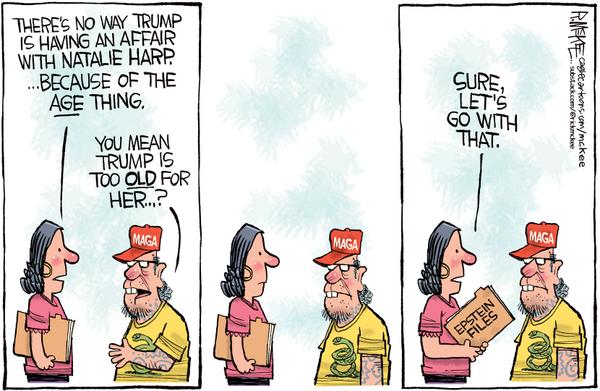
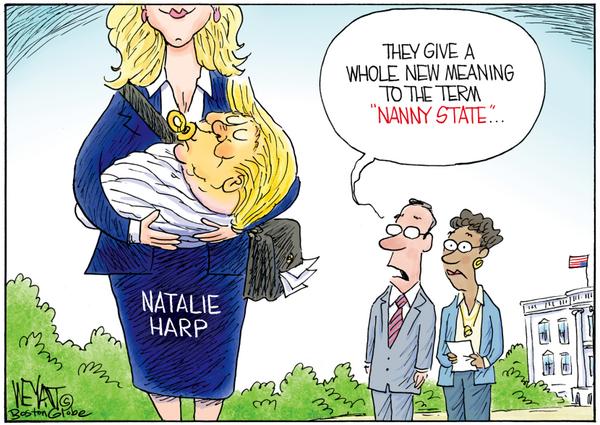
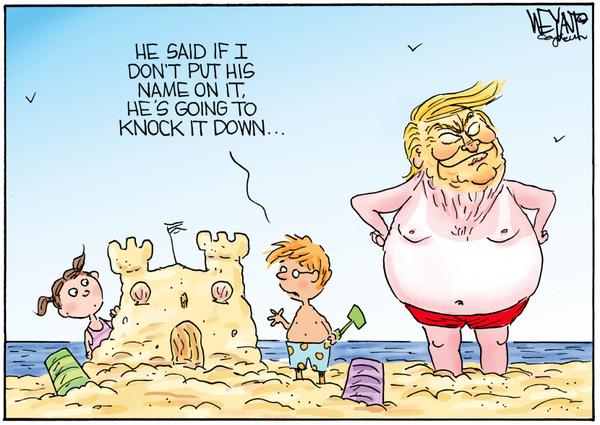
Anytime Donald Trump is accused of being a pedophile, his base runs to the rescue as if they were personally slapped in the face. Currently, there are over 80 comments on this cartoon on my Facebook page, with the bulk of them being MAGAts demanding “verifiable” evidence that Trump is a pedophile. Of course, the same people who are demanding “verifiable” evidence are posting memes with fake quotes about Joe Biden and his daughter.
But how is this for verifiable evidence? Donald Trump went on the Howard Stern show in 2005 and bragged about walking into dressing rooms for teenage contestants in his beauty pageants. He bragged about it as if he had just won Michigan.
When Spirit Airlines shut down on Saturday, it left thousands of customers and employees stranded. Customers finding themselves without a flight couldn’t even complain at the ticket counter, as there were no employees there. So basically, the quality of Spirit’s customer service didn’t change because of the bankruptcy.
Spirit, a budget airline whose business model forced other airlines to change the way they did business, had a reputation as the worst airline. If you ever purchased a flight on Spirit and told a friend, their reply was probably, “I’m so sorry.”
I did fly on Spirit once from Washington to Atlanta, which, fortunately, is a very short flight. But yeah, it was cheap. The seats don’t recline, and they feel very cheap, as though they might break underneath you.
Spirit had been in financial trouble since at least the pandemic, and there are several reasons why it went out of business so suddenly. Many blame a court that would not allow them to merge with JetBlue, but Spirit itself cites the “megaspike” in fuel prices caused by Donald Trump’s chosen war with Iran. There was also an attempt by the government to bail Spirit out, but since Donald Trump is not the best negotiator in the world, those talks collapsed. Maybe Trump should have brought in his negotiating dream team of Steve Witkoff and Jared Kushner. (snip-MORE)
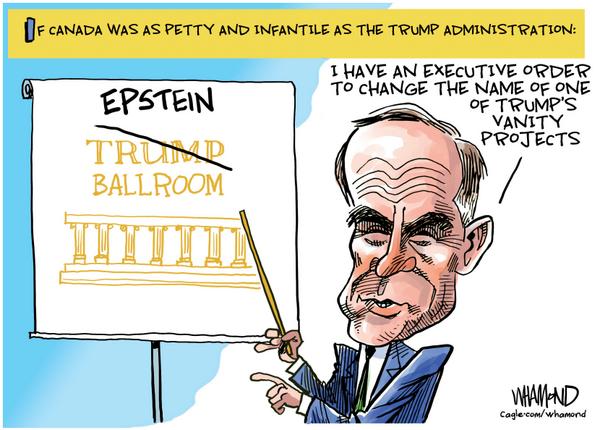
For months, anytime Donald Trump’s planned ballroom, which he destroyed the East Wing, was criticized, a MAGAt would come along and point out that it was only being paid for by donors and Donald Trump himself. Now that we know that is no longer true, where are those guys?
Of course, it’s not new that what Trump was telling us was a lie. We always knew it was a lie. Remember the lie that Mexico was going to pay for the border wall? Trump began his 2016 campaign on that lie, along with telling us that Mexico was sending us rapists and murderers.
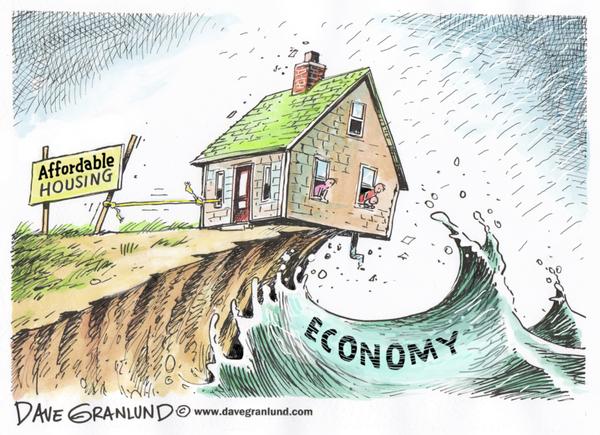
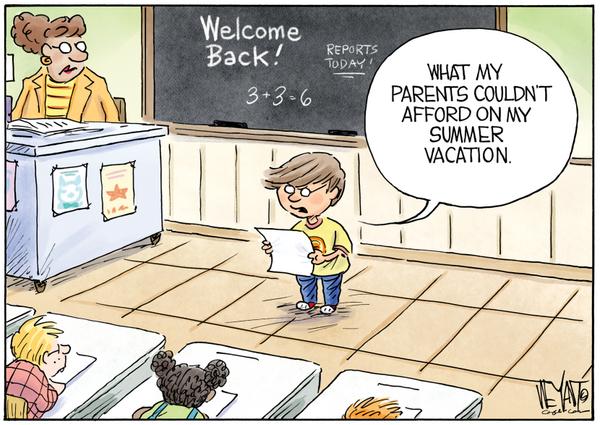
When a promise by Donald Trump falls apart, and it is undisputed that it is a lie, we’re supposed to forget about it. We’re supposed to forget that Donald Trump promised that he would be “too busy” to play golf if he won the presidency. We are supposed to forget that he would eventually release his taxes. We are supposed to forget that he was going to give us a brand new healthcare plan in two weeks, way back in 2016. We are supposed to forget that Donald Trump was going to lower the price of gasoline. We are supposed to forget that promise about no new wars. We are supposed to forget that Donald Trump was going to make housing more affordable. We are supposed to forget that Donald Trump was going to drain the swamp. We are supposed to forget that Donald Trump was going to lower the price of groceries. We are supposed to forget that he was going to release the Epstein files. We are supposed to forget that he was going to end the Russia/Ukraine war in his first 24 hours back in office. And we are supposed to forget that Mexico was going to pay for his racist border wall. (snip-MORE)
I have appointments throughout today, so I’ve set up a few things to read. This one is interesting in that it ties several things together to show us how not only our government but our companies are selling us into thinking we might actually get some fair treatment. It piqued my interest because of the strike last week; it seems “brands” are trying to work against being seen as part of those needing to understand what we the people don’t like how things are and that we expect change. Resist-
Red Lobster wants your attention. You can tell, because their current ads deploy not one but two separate announcers. There’s the expository guy. He’s a little pushy but at least he sticks to the facts. And then there’s the loud guy. He’s got a deep voice. He sounds like he’s broadcasting live from the submerged city of Atlantis. He says it with feeling, and also reverb.
“Because you’ve been asking… a lot… and we made it happen.”
So claims the not-from-Atlantis announcer. But what’s he talking about? We have been asking for many things. To be able to afford homes, for example, or not to have war crimes committed in our names, or to have our planet still exist twenty years from now.
Oh, this is about shrimp. Endless shrimp. It’s back, or so I’m told, in multiple forms. Every time the less pushy guy shares one of the currently available shrimp offerings, his partner pipes up with a complementary point straight from the bottom of the sea.
“Walt’s favorite shrimp.”
“ ENDLESS!”
“Garlic shrimp scampi”
“ENDLESS”
“Shrimp linguini alfredo”
“ENDLESS?”
“And all new marry me shrimp”
“ALL ENDLESS!”
The duo isn’t wrong. Endless shrimp is back. While the previous iteration didn’t technically bankrupt the chain (the real culprit was private equity and real estate chicanery) it was, by all accounts, an absolute mess. American consumers, who rightfully identified that they were getting ripped off in every facet of their lives, leapt at the opportunity to get one over at least one big business.
Back when Endless Shrimp was a permanent feature, shrimp hoarders would occupy tables for hours at a time, not leaving until they beat the house. The real victim of this behavior was, of course, the chain’s underpaid servers (if you walk into a restaurant with “me against these suckers” mindset, you’re less likely to view your waiter as a fellow victim of capitalism and you’re definitely not going to tip well). For the C-Suite, though, the larger concern wasn’t the dignity of their employees. It was a jumbo-sized hole in their bottom line.
It’s like The Boss once sang. Endless shrimp dies baby, that’s a fact. But maybe the endless shrimp that dies, some days comes back. Put your make-up on, do your hair up pretty, and meet me tonight at the only Red Lobster still open in your city.
I’m not all that interested in the relative success or failure of chain restaurant promotions, but I do care about the various ways corporations try to win our affection (meaningful cultural signifiers, or so I’d argue). And contra the two announcer voices, the most interesting thing about Red Lobster’s promotion isn’t the shellfish, either of the Walt’s Favorite or Marry Me varieties. It’s what’s whispered rather than shouted.
You see, the biggest difference between the current iteration of Endless Shrimp and its unprofitable predecessor is that now Red Lobster wants you to know that you (the shrimp-loving consumer) and they (the company) are in this together.
If you want the full story, I highly recommend this piece by Luke Winkie in Slate, but here’s the truncated version. There are varieties of shrimp on the Red Lobster menu that aren’t officially part of the promotion. They’re on the menu, but excluded from the benevolent blanket of endlessness. But if a customer were to ask for unlimited quantities of a non-official item (for example, Crispy Dragon Shrimp, a food item that I’m assured contains no actual dragon), the server is to welcome them into a cool secret. Their official, handbook-mandated line? “These items aren’t on the menu for this promotion, but I would be happy to make an exception for you.”
It’s like they say, “the exception is the rule.” Except literally, and by mandate. Servers are required by corporate policy to act like you and they are cheating the system, in hopes that when you remember the night you rode the dragon (shrimp), you remember it not as a conspiracy-of-one, but a sneaky secret between you and your best friend (Red Lobster restaurants, a subsidiary of the Thai Union Seafood Company).
This is not a new psychological trick. It’s a classic low stakes confidence game. The most effective way to a mark is to convince them that they are, in fact, in on the con themselves. It’s the same move that car salesmen use when they leave the room to “talk to their manager” before returning with a report that “he didn’t want me to give you this deal, but…”
It’s still striking, though, to see the strategy laid out in grandiose internal strategy documents. A beleaguered but iconic American brand name, flailing for its survival, hedges its survival on two bets. First, that you are tired, angry and aware that you’re on the wrong side of a rigged game (correct). And second, that, by offering you a facsimile of camaraderie and a very real pile of seafood, that they can win your loyalty (huh).
“[This is] about more than just shrimp,” the document proclaims. An absolute work of art, that sentence.
“[It’s] about creating an experience that says, ‘We listen to you.”
“When guests see Endless Shrimp back on the menu, they feel heard and valued.”
I have never addressed a sit-down chain’s internal strategy document, but I’m sure I speak for all of us when I say, tears in my eyes: Red Lobster, thank you. THIS is what democracy looks like.
As Eli Zeger argued in his 2020 essay about companies that talk like snarky teens on social media, this particular iteration of the “brand as friend” canard is the product of the marriage of late stage capitalism (and its reliance on the selling of “ideas” rather than goods and services) and the post-Citizen United codification of corporate personhood. Red Lobster isn’t a restaruant anymore. It’s your rule-breaking, shrimp loving, newly empathetic pal. It sees you. In fact, it is the only one who see you. It gets that you’re broke, but more so that you’re alone. It’s no longer offering you cheap shrimp (the price tag for the promotion has risen markedly since its last iteration). It’s promising you something more important– belonging, connection, a port in the storm of alienation and precarity we’re all weathering.
But Red Lobster isn’t alone, in surveying a landscape of mass alienation (economic, relational, spiritual) and seeing a business opportunity. Advertising agencies are publishing unironic blogs chillingly titled “the loneliness crisis: how brands can step up?” Silicon Valley’s greatest minds heard that you wanted community and responded with sycophantic AI chatbots. Apparently, our tech overlords’ understanding of human relationships is a robot who agrees with you all the time, including when you muse about harming yourself. Even the outright scammers get it. Gone are the days of far flung princes offering you a financial windfall. As you may have experienced personally, the hot new con is… pretending to be an acquaintance and inviting you to a party.
This is a step beyond the classic commodification funnel, as documented in nineties leftist classics like No Logo and The Conquest of Cool. The brands are no longer promising a great deal, or even hipness. What’s on offer now is the dream of a welcoming community, one deep enough to solve for the isolation that the companies themselves helped create.
That’s very depressing, of course, both the reminder that our economy has always been built on the exploitation of vulnerability, and the reality that there’s just so much more vulnerability to be exploited at this particular moment.
But there’s another truth, not a counterpoint, but a complement. How fortunate, for those of us who actually want to connect with other human beings, rather than just make a quick buck off of them. We already have what every corporation in the world wishes they had– the fact that, when we offer a space by our side, to either a stranger or a friend, we actually mean it. We’re not trying to trick you into springing for a Main Deck Margarita Flight to go along with your shrimp. We’re not trying to mine your data or add you to a marketing funnel or load you up with debt and junk. We just think this world would be more navigable together rather than apart.
And as an organizing opportunity? From union drives to neighbor-to-neighbor activism to the precious few political campaigns that care more about building community than personal brand building? My goodness. Why do you keep hearing about neighborism these days, and not just from true believers like me? Because more people are admitting every day how hungry they are for connection, and then taking the risk of making an offering.
The terrible news right now is that the hucksters are going to keep selling us a flim flam simulacra of belonging. Yes, the consultants, but also (I fear) the politicians. I strongly suspect the 2028 Democratic primary to feature a million text messages about “neighbors” and “community” penned by a well-heeled K-Street consultants. But the good news is that we aren’t that dumb. We know the brands aren’t our friends. We’ve lived through the great social media con together. We know what the lie looks like, and now we’d much prefer the deeply imperfect, thoroughly messy alternative.
“This idea of, ‘I won’t be erased,’ that’s something that brewed in my childhood,” she said. “I think that’s where the fight comes from. … I don’t want to fail, and I haven’t failed yet. I think that’s the scary part. I’ve never, ever had a floor beneath me.”
Brady-Davis is currently the only Black trans person holding public office in the United States, serving on the Metropolitan Water Reclamation District of Greater Chicago. She previously shared that title with Minneapolis City Councilor Andrea Jenkins, who retired in January.
And while water reclamation commissioner, a job that involves juggling budgets and managing wastewater and stormwater for Cook County, might not sound like a big title, those in the know are eyeing Brady-Davis carefully. She recently toured Washington, D.C., with Rep. Sarah McBride, who made history herself as the first trans person elected to Congress.
Brady-Davis doesn’t rule out the possibility of a congressional run. But she’s coy about her ambitions, talking around a bid for national office.
“For now, my focus is on being effective at the local level — but I’ve thought about how that work could expand to have a broader impact on issues like the environment, LGBTQ rights, and education,” she said.
“I absolutely think she could be a congressperson,” said Tracy Baim, co-founder of Chicago’s LGBTQ+ newspaper Windy City Times, who has watched Davis’ rise. “There’s no doubt in my mind she has the qualifications.”
Precious Brady-Davis speaks during an interview in her office. (Erin Hooley/AP)
Early life
Brady-Davis largely grew up with her grandparents but eventually wound up in foster care, where she was confronted with a version of Christianity that saw homosexuality as sinful.
In her memoir, “I Have Always Been Me,” Brady-Davis recalls going to a Pentecostal youth retreat and having a pastor call her out specifically: “I bind the foul spirit of homosexuality out of you,” she recalled him saying. “You are not a woman. You are a man.”
The preacher and others in the group lunged toward her; Brady-Davis later awoke prostrate on a kitchen floor, traumatized from the experience.
While she worked to conform for a while, as she learned about the world and herself, she gradually rejected those ideas. In college, she began performing in drag, first in her home state of Nebraska and then in Chicago.
At this time, two transitions were taking place. Brady-Davis was starting to live full-time as a woman. And her professional career was starting.
She took a job doing HIV prevention work among youth of color at Chicago’s Center on Halsted, the LGBTQ+ community center in the heart of Chicago’s Boystown neighborhood, amid tension over violence at the 2011 Pride parade and the subsequent crackdown on crime.
Center on Halsted, an LGBTQ+ community center in Chicago’s Northalsted neighborhood, where Precious Brady-Davis worked in HIV prevention among youth of color early in her career. (Jamie Kelter Davis for The 19th)
The job would prove difficult to impossible. While residents were angry with the Center, youth advocates claimed that the Center over-policed young people, calling law enforcement on homeless kids looking for safe places to sleep. Brady-Davis was forced to defend an institution that was being attacked from all sides. It would be her first political test.
“I advocated for those young people the best I could,” she said. “It was just cruel. … When I think that something is wrong, I’m going to speak up about it.”
Baim said she watched Brady-Davis turn every challenge into an advance.
“Precious has managed to navigate so many of the land mines that others have not survived, and came from a very, very grassroots approach to the work, and has really reimagined herself for each iteration,” Baim said.
Brady-Davis would do a stint with About Face Theatre, the LGBTQ+ youth theatre troupe in Chicago, and then join the Sierra Club, where she eventually became northeast communications director and battled President Donald Trump’s Environmental Protection Agency during his first term.
It was work that made sense for her, she said.
“How can I say that my work is invested in diversity, equity and inclusion when I’m not working in all kinds of diversity?” she asked. “Environmental justice felt like another kind of diversity.”
A family legacy
During Brady-Davis’ stint at Center on Halsted, a young man came literally knocking at her door without an appointment. The man, Myles Brady, was bald and eager to chat. He wanted to get involved in programs with youths. He shared that he was transgender, too. The fact surprised Brady-Davis. But he was so talkative that Brady-Davis didn’t know what to make of him.
“Like it was weird to me, and I was very protective of the young people at the Center,” said Brady-Davis. She decided to never follow up with him again.
Brady was persistent. He kept appearing at events. One night he asked Brady-Davis to dinner. She reluctantly agreed.
“I was like, at least I’ll get dinner out of it, right?” she said laughing. “I was like, I’ll go on this date, and I’ll never have to see him again.”
But a few months later Brady-Davis was headed to the Philadelphia Health Conference. She got an email from Brady. “I can’t wait to see you in Philly,” it said.
The message struck her as cute. Later that night while she was out to dinner with trans friends Brady walked in and sat down. Brady-Davis didn’t know it, but he had been invited by others at the table. She was being set up. Brady told Brady-Davis she was the most beautiful woman he had ever seen and that he wanted to build a life with her and take care of her.
“I saw him so differently that night,” she said. “It was the first time that I truly saw him.”
The two left the conference together and have been together ever since. They were married in 2016, and Brady-Davis appeared on TLC’s “Say Yes to the Dress,” the first transgender bride to be featured on the show.
Precious Brady-Davis and her husband, Myles Brady-Davis, wave to the crowd during the Chicago Pride Parade. The couple were the first transgender parents in Illinois history to be listed as their accurate genders on their children’s birth certificates. (Chicago Pride)
They had two daughters, Zayn and Zyon.
The birth of their first daughter, Zayn, provided another opportunity for advocacy. Brady, who was carrying the child, learned in 2019 that the state of Illinois would list him as a “mother” on the birth certificate and Brady-Davis as “father.” The two teamed up with Lambda Legal and petitioned the state, successfully changing the policy. Brady would be recognized as Zayn’s father, and Brady-Davis was listed as her mother.
“I always say it brings me the most joy to take my kids to school in the morning,” said Brady-Davis. “It’s one of the most normal things that I get to do as a human being. And it’s not about me being trans at all. It’s about me being a mom. …I’m proud of the ways in which I’m parenting my girls to be a part of a world that I hope is more inclusive, diverse.”
Into politics
Sierra Club positioned her well for her next big move, into electoral politics. In 2022, she vied for a spot as a commissioner on the Water Reclamation District. Though she fell short in the primary, the next year Gov. JB Pritzker appointed her to finish the term of the candidate who had beaten her, who had since joined the state legislature.
“Precious Brady-Davis distinguished herself as a trailblazer even before her historic appointment to public office in Cook County,” Pritzker said of Brady Davis in a statement to The 19th. “Throughout her political and nonprofit career, Precious consistently stepped up as the first — first to speak up for the LGBTQ+ community, first to share the story of her path to activism and public office, and first to encourage others to claim their seats at the table.”
Precious Brady-Davis speaks at a Metropolitan Water Reclamation District of Greater Chicago board meeting. After being appointed to the board in 2023, Brady-Davis won her primary this year by large margins. (Courtesy of Precious Brady-Davis)
When time came for her reelection bid this year, Brady-Davis won her primary by large margins.
But whether she finishes her six-year term remains to be seen. Apart from her time in D.C. with McBride, she has been chatting up major political donors. McBride says she would not be surprised to see Brady-Davis serving alongside her in Congress.
“I think the sky is the limit for her, and she is someone who I respect deeply,” McBride said. “It was personally meaningful to walk these halls with a trailblazer whose story is only just beginning.”
Sorry this is not as long as I normally do. Ron found me sleeping at my desk an d only gave me a few minutes to finish before he forced me to bed physically. Hugs

The house below was once owned by Scott Bessent the current Secretary of Treasury under tRump. I would love to own a home like this or at least be able to afford one like it. It is a famous home called the Pink House. Hugs

These are fake The first three were posted by tRump but the left is the one that has to turn down the rhetoric.
This is the real Obama bowing picture.
And this guy posted 86 46 during Bidens term and the post is still up. But Comey is on trial for threatening the cult leader and not Posobiec who did the same to Biden.
And this one is real. tRump suluted an enemy general from North Korea.
And this one is real also.
“The more likely prospect, they say, is that he becomes an independent who caucuses with the GOP, or simply casts his vote to ensure Thune remains majority leader. Ensuring control of the Senate could be especially critical should there be a Supreme Court vacancy http://www.politico.com/news/magazin…
NEW: A Republican U.S. Senate candidate said he's recruiting off-duty police officers to serve as poll watchers in Detroit for the 2026 midterms — and suggested they could flash their badges at voters.Intimidating voters is illegal. Interfering with someone's right to vote is a federal crime.
🚨BREAKING: Florida voters and pro-voting group Equal Ground Education Fund filed a lawsuit Monday challenging the GOP’s new congressional gerrymander, urging a court to block the map for violating the state constitution’s ban on partisan gerrymandering. http://www.democracydocket.com/news-alerts/…
Judge mulls contempt over DHS’ ‘patently false’ allegation in deportation caseThe Trump administration attacked a judge for releasing an accused murderer, but it withheld existence of the foreign warrant.www.politico.com/news/2026/05…
You see this press release from DHS about a federal judge? The agency pushed it out 5 days ago. Today, a DOJ attorney admitted to the judge that it “simply was not true.”(It’s also still online at DHS dot gov as of 540 pm Monday)1/
* SOUTH KOREA'S FOREIGN MINISTRY: FIRE AND EXPLOSION HAPPENED ON A KOREAN VESSEL IN STRAIT OF HORMUZ* SOUTH KOREA FOREIGN MINISTRY: CHECKING CAUSE OF FIRE AND DETAILS ON DAMAGE AT THE KOREAN VESSEL* SOUTH KOREA FOREIGN MINISTRY: TO CLOSELY COMMUNICATE WITH RELEVANT COUNTRIES@reuters.com
President Donald Trump threatened Iran, saying it will be 'blown off the face of the Earth' if it doesn't stop attacking ships in the Strait of Hormuz.
More Than 150 Wind Projects Stall as Pentagon Delays ReviewsThe delays, which companies say have worsened significantly in recent weeks, are the latest step in the Trump administration’s efforts to block wind power.www.nytimes.com/2026/05/04/c…
“While my opponent obsesses over my gender and uses cowardly tricks to try to avoid facing me, I will continue to fight for practical solutions to problems that actually impact our communities.”
Michigan Democrats are firing back after one of their own—a candidate in a state representative race—filed a complaint with the Wayne County Division of Elections, aiming to boot his primary opponent, Joanna Whaley, from the ballot. This is because Whaley is transgender and went through a legal name change process.
It seems that another contender for Michigan’s 2nd State House District seat, Frank Liberati falsely believed Whaley’s name change hadn’t gone through. So, last week, he accused her of running under a false name in violation of election procedures, official documents show, which were provided to Erin in the Morning by Whaley.
They also showed that Liberati went even further in his anti-trans rhetoric. The complaint invoked Whaley’s deadname (a given name a trans person no longer uses) at every turn, consistently misgendered her, or called Whaley “she/he.”
The Michigan Legislative LGBTQ+ Caucus denounced Liberati’s “transphobic tactics.”
“During a time of increasing and relentless attacks on the trans community, submitting this sort of meritless challenge to the Wayne County Clerk serves no purpose but to stoke the flames of transphobia for personal political gain,” a statement from the Caucus reads.
Democratic lawmakers further called on officials to throw out the complaint. “The Clerk should promptly reject this baseless challenge to Whaley’s candidacy and allow the voters of 2nd State House District to decide this election at the ballot box. Weaponizing transphobia as an electoral tactic has no place whatsoever in Michigan politics, and certainly not in a Democratic Party primary,” the statement said.
Whaley told Erin in the Morning that she expected to encounter transphobia when running for office, but she was shocked when she learned it was from a fellow Democrat.
At the same time, she also said she has been flooded with support from voters, Party members, and leaders who were outraged by Liberati’s maneuver.
“I spoke with the chair of the Michigan Democratic Party, and we are united across the state that this is not how Democrats act,” Whaley said. “This is not what we represent.”
Whaley said Liberati’s complaint was based on outdated court filings. When Whaley first came out, excessive state fees ended up delaying aspects of her legal transition. Since then, the state legislature has passed laws to make name changes less burdensome. Whaley filed again, got her name successfully updated, and has been going by Joanna ever since.
“When a candidate cannot run on their own merits, they resort to lies and distractions,” Whaley said in a public response when news of the challenge first broke. “Our campaign remains focused on the issues that matter to the residents of this district: lowering water and utility bills, expanding healthcare access, fixing our infrastructure, and protecting our freedoms.”
“While my opponent obsesses over my gender and uses cowardly tricks to try to avoid facing me, I will continue to fight for practical solutions to problems that actually impact our communities,” she continued.
This isn’t the first time that issues with name changes and state identification laws have been weaponized against trans voters and/or candidates. Gendered party seat positions, which were initially created to advance the representation of women in office, have since become a barrier for people of marginalized genders who want to run for a position.
Meanwhile, stringent voter ID policies are poised to hinder trans and gender nonconforming people’s ability to vote if their current documentation or gender expression doesn’t match their name and gender assigned at birth. (The name change issue extends beyond trans people; married women who take their husband’s last name have also reported barriers to voting.)
In addition to her candidacy, Whaley is a parent, a hospital chaplain, and a proud Democrat. She told Erin in the Morning she was in part inspired to run for office by Liberati’s brother: Sitting member Tullio Liberati, who crossed party lines last year to vote in favor of a bill that discriminated against transgender women and girls in sports.
Transphobia, it seems, runs in the family. Frank personally signed off on the complaint submitted to officials, notary and all.
Liberati did not immediately respond to a request for comment. Prior to this race, he had served for six years as a state representative in Michigan’s 13th District.
Whaley said she expects the complaint to be resolved and that she hopes to bring the conversation around her candidacy back to the issues that impact everyday voters.
“[Resorting to] this move in the first place shows that we are the campaign to beat,” Whaley said. These are tactics to “knock me out of the race, because [Liberati] can’t win on the issues.”
A quarter of immigration arrests since August were labeled by U.S. Immigration and Customs Enforcement as “collateral,” a type of arrest and detention that’s been challenged in court as an end run around civil rights.
Public outrage and lawsuits over the arrests may be tamping down the large-scale sweeps that foster them, but tens of thousands were arrested this way between August and early March.
Immigration arrests are usually based on warrants obtained ahead of time, showing either a removal order from immigration court or evidence of a crime or charge that makes the person subject to deportation.
But collateral arrests can result from street sweeps and raids in which a person is singled out for questioning based on appearance or proximity to someone wanted on a warrant. That person could be taken into custody if agents think they may be subject to deportation and also likely to flee if released.
Labeled for the first time ever, the collateral arrests are reported from August to early March in ICE arrest data obtained by the Deportation Data Project and analyzed by Stateline. In that time there were about 64,000 collateral arrests, a quarter of the 253,000 total arrests by ICE.
About 70% of the collateral arrests were for people with immigration-related crimes or violations alone, compared with 41% for arrests with warrants. Less than 2% of those with collateral arrests were convicted of a violent crime, one-third the rate of other arrests, and only 18% were convicted of any crime, compared with 33% for other arrests.
The collateral arrests contributed to an overall pattern of lower and lower shares of arrests for serious crimes, and more for immigration offenses alone.
Arrests climbed from about 12,000 in January 2025 to more than 40,000 in December, but fell back to 30,000 this February. The share of people with only immigration-related crimes and violations rose to more than half in December and January, the peak months for collateral arrests, and the share of violent criminals fell from 10% to 4% of arrests in that time.
(This chart is interactive. If you can’t see the arrest data here by mousing over states, you can on the page, linked in the title above, & also at the end of this post.)
New policy
ICE announced a new policy in January to issue warrants in real time if agents think an immigrant is deportable and “likely to escape,” though that policy faces a court challenge.
Total arrests and collateral arrests have been falling since December, whether because of the new policy or because of cutbacks in the large-scale street sweeps that tend to produce them.
One factor is public outrage over raids sweeping up noncriminals in places like Minneapolis and Chicago, said Colleen Putzel-Kavanaugh, an associate policy analyst for the nonpartisan Migration Policy Institute.
“The sort of large operations within big cities, as they were occurring, seems to have subsided somewhat,” Putzel-Kavanaugh said. “After the kind of public outcry following Minneapolis, it seems as though, at least for now, that tactic has kind of been paused.”
The Trump administration’s focus on mass deportation opened the way for more collateral street arrests with less investigation, she added.
“If it’s a more targeted arrest, they would take the time to sort of essentially have an investigation. It’s a pretty resource-intensive way that just would not yield the kind of numbers ICE was being told to produce,” she said.
The new policy was filed in court papers in February as a response to a lawsuit over ICE sweeps in the District of Columbia last year, alleging ICE agents “have flooded the streets of the nation’s capital, indiscriminately arresting without warrants and without probable cause District residents whom the agents perceive to be Latino.”
The case resulted in a preliminary injunction in December requiring a halt to warrantless arrests without establishing probable cause that the person is living here illegally and is a flight risk.
One plaintiff in the class-action case, José Escobar Molina, said in the lawsuit that agents in two cars pulled up to him as he approached his work truck on Aug. 21, grabbing him by the arms and legs and handcuffing him without asking any questions. Escobar, 47, said in the court papers that he’s lived in the district for 25 years and has had temporary protected status as a Salvadoran native the whole time. He was held overnight in Virginia before being released.

Other lawsuits are also challenging collateral arrests, such as an incident in Idaho in which agents with warrants for five people ended up arresting 105 immigrants at a Latino community event in October.
“I have a lot of fear that this will happen to me again. I was essentially kidnapped based only on the color of my skin. That really weighs on me,” said Yoshi Cuenca Villamar, one of the citizens and a North Carolina native, in a statement announcing the lawsuit. He said he was doing landscaping work Nov. 15 when agents pushed him to the ground and handcuffed him, then held him in a car before releasing him.
One Illinois case that started in the first Trump administration challenged warrantless arrests and traffic stops used as a pretext for immigration arrests. A 2022 settlement required ICE to document “reasonable suspicion” of illegal status before arresting somebody. The case continues since a judge found in February that the new ICE policy of issuing warrants in real time after a detention violates the consent decree.
Shares of collateral arrests
In the months since August where collateral arrests are now labeled, the District of Columbia and Illinois stand out with high shares of collateral arrests. More than half the arrests in the district were collateral, as were 41% of those in Illinois. There were eight states in which at least 30% of arrests were collateral: Alabama, Maryland, West Virginia, Arizona, Pennsylvania, New Hampshire, Maine and Minnesota.
West Virginia, where there was a “statewide surge” of immigration enforcement in January with state and local cooperation, stands out for its high rate of total arrests as well as a large share of collateral arrests.
For the eight months between August and early March, West Virginia had 1,831 arrests, or 1 in 10 of the state’s noncitizen population as of 2024, the latest data available. That’s by far the largest share in the country, followed by 7% in Wyoming (where truck drivers were targeted for immigration arrests in February) and 4% in Mississippi.
West Virginia Republican Gov. Patrick Morrisey, in a statement, cited the cooperation of state and local agencies with ICE through the 287(g) program that assists with immigration enforcement. He praised ICE, saying “they have removed dangerous illegal immigrants from our communities and made our state safer for families and law-abiding citizens.”
Few of those arrested in the surge were violent criminals, however. More than half of those arrested during the surge were collateral arrests, and only 1% — nine immigrants — had a violent crime conviction, according to the Stateline analysis. More than three-quarters, about 500 people, had only an immigration-related violation or crime.
Judges didn’t always agree that collateral arrests and detentions in the West Virginia surge were legal under the U.S. Constitution. U.S. District Judge Joseph Goodwin, a Clinton appointee, ordered two detainees released in January. He noted that “similar seizures and detentions are occurring frequently across the country” without any evidence they’re necessary as required by the Constitution.
*** Scottie’s personal note here. From the youngest age I was called queer and this was in the 1960s. The first memory of being called that which I had no clue as to what it meant was when I was being held down and punched by my five-year-older hellspawn sibling who was telling me I was “queer”. I was only 3 or 4 at the time and was being trafficked to the man across the street along with her siblings boy friends / and taken to parties where I was drugged so I wouldn’t remember. Also at the same time along with her and her sister on cold nights when I begged for a warm place to sleep in their bed rather than the cold blanketless mat in the hallway that was my bed. I would have to “make them happy” for the privilege of a warm place to sleep in the Vermont winters. So when she called me that I asked what that was. She replied it was letting boys put their dicks in me and me sucking their dicks. I then said, but that is what I am told to do and I was very confused. This niceness of being punched and insulted lasted only a short while as the most understanding of my abusive hellspawn siblings who then became like the rest. She then became like the rest. She gloried over tiny me and the things I was made to do. She took my toys and gifts as the rest did. She later said I did not understand what it was like to live with her siblings who were also abusing me and farming me out. I asked her if she understood how hard it was for me to live among them during that time. She had no answer, because like in my childhood it was all about her. Hugs***
State rep reacts to DOJ investigation into Illinois schools over gender ideology in classrooms
🚨 The fate of abortion pills is back at the Supreme Court. The pharma company Danco, which makes mifepristone, filed an emergency appeal just now asking SCOTUS to hit pause on Friday's 5th Circuit ruling that cut off telehealth nationwide. http://www.politico.com/news/2026/05…

“Try to reduce your stress level, and if you somehow succeed please let me know how in God’s name you did it.”
“It’s like the sun comes out and you forget all about the impending doom!”
“After this, things are going to calm down for a little while, right?”
“Frankly, he’s so loud I think he must be compensating for something.”
Pew Research finds a majority of Americans believe ethics and honesty in the federal government have declined since the start of Trump's second term.Brought to you by resist47.news — tracking threats to democracy.#resist47 #GovernmentEthics#TrumpAdministration#PewResearch#PoliticalHonesty
We in the United States are living through what is arguably the biggest financial scam in America’s history. Led by the Reality TV New York City mobster thug occupying the White House.

Do you think Donald J. Trump gives a flyin’ fuck about “American heroes” or the like?
If Donald J. Trump and his sycophant billionaire buddies could make money off it, he’d create a “Garden of Jeffrey Epstein’s Underage Girls.”
“I love this time of the year—you know, when you make sense of all our spending.”
Hassett: "53 million people have benefited from no tax on tips, no tax on overtime, no tax on social security."Brennan: "Just to clarify, the tax law that the president signed doesn't eliminate taxes on social security. It gives an enhanced deduction through 2028."
Also, “no tax on tips” and “no tax on overtime” have significant eligibility requirements so far fewer than 53 million people have benefitted from these three initiatives…but no one in the smoke-blowing Trump administration will admit to that.
“They’re looking for ten thousand passengers who are willing to give up their seats.”
“We could drive to spring break and spend hundreds on gas, or fly and never actually get there.”
“Will you be using my story as a foil to reveal one of the doctor’s flaws, or is this a regular E.R.?”
“Looks like they’re rolling out the new food pyramid.”
“I understand there’s a problem you need made a million times worse?”
U.S. Fast-Tracks Arms Deals Valued at $8.6 Billion to Mideast PartnersThe State Department announced the sales on Friday night. The sales would entail the transfer of rockets to Israel, Qatar and the United Arab Emirates and air-defense equipment to Qatar and Kuwait.tinyurl.com/dUnGq4