The Young GOPer Behind “Alligator Alcatraz” Is the Dark Future of MAGA
James Uthmeier is the real brains behind this notorious migrant detention camp in the Everglades. The more barbarities that emerge, the brighter his star will no doubt shine.
The other day, Stephen Miller went on Fox News and offered a plea that got surprisingly little attention given its highly toxic and unnerving implications. Miller urged politicians in GOP-run states to build their own versions of “Alligator Alcatraz,” the state-run immigration detention facility that officials just opened in the Florida Everglades.
“We want every governor of a red state, and if you are watching tonight: pick up the phone, call DHS, work with us to build facilities in your state,” Miller said, in a reference to the Department of Homeland Security. Critically, Miller added, such states could then work with the federal government by supplying much-needed detention beds, helping President Trump “get the illegals out.”
Keep all that in mind as we introduce you to one James Uthmeier.
Uthmeier, the attorney general of Florida and a longtime ally of Governor Ron DeSantis, is widely described in the state as the brains behind “Alligator Alcatraz.” Peter Schorsch, the publisher of Florida Politics, sums him up this way: “In Uthmeier, DeSantis found his own Stephen Miller.”
Uthmeier is indeed a homegrown Florida version of Miller: Only 37 years old, he brings great precociousness to the jailing of migrants. Like Miller, he is obscure and little-known relative to the influence he’s amassing. Also like Miller, he is fluent in MAGA’s reliance on the spectacle of inhumanity and barbarism.
“You don’t need to invest that much in the perimeter,” Uthmeier said of “Alligator Alcatraz” in a slick video he recently narrated about the complex, which featured heavy-metal guitar riffs right out of a combat-cosplay video game. “People get out, there’s not much waiting for them other than alligators and pythons. Nowhere to go, nowhere to hide.”
Any migrant who dares escape just might get devoured alive by an animal—one animal eating another. Dehumanization is so thrilling!
The real-world “Alligator Alcatraz” is already gaining notoriety for its very real cruelties. After Democratic lawmakers visited over the weekend, they sharply denounced the scenes they’d witnessed of migrants packed into cages under inhumane conditions. Meanwhile, detainees and family members have sounded alarms about worm-infested food and blistering heat. And the Miami Heraldreports that an unnervingly large percentage of the detainees lack criminal convictions.
But Uthmeier is getting feted on Fox News and other right wing media for this new experiment in spite of such notorieties—or perhaps because of them. There’s good reason to think more red state politicians will seek to create their own versions of “Alligator Alcatraz” or get in on this action in other ways—and that more young Republican politicians will see it as a path to MAGA renown and glory.
For one thing, the money is now there. Buried in the big budget bill that Trump recently signed is a little-noticed provision that immigration advocates increasingly fear could fund more complexes like this one. It makes $3.5 billion available to “eligible states” and their agencies for numerous immigration-related purposes, including the “temporary detention of aliens.”
When Miller told GOP politicians to follow Uthmeier by collaborating with federal officials to develop new versions of “Alligator Alcatraz,” he was probably talking about this slush fund. State officials can try to tap into it for building out such facilities. “For Republican states across the country that want to copy the ‘Alligator Alcatraz’ model, this bill will give them that money,” immigration analyst Austin Kocher tells me.
What’s more, red state politicians are paying attention. Fox News contacted numerous gubernatorial offices to ask if they intend to take up Miller’s invitation. The responses were positive, with many eagerly touting plans for detention complexes. While it’s unclear if these will resemble “Alligator Alcatraz,” the underlying impulse is clear: Many red states want to expand state-run detention efforts. And again: The money is there.
This is a bad development. “Alligator Alcatraz” should not be the model for the future of migrant detention in much of the United States.
Here’s why. The facility is funded and operated by the state of Florida, but the state can use it to detain undocumented people under a federal program that allows ICE to authorize local law enforcement to carry out immigration crackdowns. That puts “Alligator Alcatraz” in a grey area: Local law enforcement agencies are using it to carry out Trump’s immigration detention agenda even as ICE does not run the facility.
Lauren-Brooke Eisen of the Brennan Center, who specializes in criminal justice, points to a toxic combination built into the idea of more versions of this arrangement. ICE detention is subject to federal oversight. But huge influxes of federal money for migrant detention—as in Trump’s new bill—could create new incentives for states to ramp up their own detention efforts. Yet because “Alligator Alcatraz” is a new experiment, she says, it’s unclear what sort of federal oversight future imitation efforts would receive, even if they get some federal money.
“What will access to counsel look like for detainees?” Eisen asks. “What will access to family members look like? It’s difficult to imagine state-run facilities where conditions and due process are prioritized.”
Illustrating the point, when a reporter recently asked ICE for comment on what’s going on inside “Alligator Alcatraz,” ICE said, well, it isn’t their facility. In other words, the federal government is not responsible for what happens inside those walls—even as Miller and Trump call on other states to build more of them.
Which brings us back to Uthmeier and the future of MAGA.
It’s easy to see Uthmeier and his “Alligator Alcatraz” becoming a model for other young Republicans seeking a route into MAGA celebrity. Consider his career trajectory: It’s fairly conventional establishment-Republican stuff. A native of Destin, a small beach city in the deep red Florida panhandle, he earned a law degree from Georgetown and then worked for the Commerce Department in the first Trump administration—and then for the ultra-establishment D.C. law firm Jones Day.
Uthmeier has also made appearances at the conservative Federalist Ssociety, which is as establishment-conservative as it gets. He joined DeSantis’s first administration as a senior legal adviser, and then got appointed as attorney general when the slot was vacated by the appointment of former AG Ashley Moody to now-Secretary of State Marco Rubio’s Senate seat.
All in all, it’s in some ways a conventional path to GOP success. In fact, Uthmeier actually has a track record of criticizing Trump in the past on things like Covid-19 and abortion. But J.D. Vance survived such heresies, and now, in the party that Trump remade, Uthmeier apparently recognizes that “Alligator Alcatraz” is his big ticket. It’s a reminder that in today’s GOP, the MAGA and older-line Republican establishments are bleeding into one another—and that getting attached to such an idea is a path to national MAGA stardom.
Put another way, in the cut-throat world of the MAGA attention economy, association with things like “Alligator Alcatraz” can carry enormous weight. It’s hard for people who don’t swim in MAGA’s rancid information currents to grasp, but when Trump recently toured the facility with DeSantis, it was a huge MAGA propaganda coup for the Florida governor (yes, he apparently still harbors national ambitions).
Indeed, one person who very much noticed this was apparently Uthmeier himself. According to one Florida operative in touch with Uthmeier’s staff, there’s considerable sensitivity in his inner circle over who is getting credit for “Alligator Alcatraz,” with some worrying that Uthmeier isn’t reaping enough of it.
Uthmeier needn’t worry, however. When Trump toured the facility, he said of Uthmeier: “That guy’s got a future.” In this, the MAGA God King himself gave a big boost to Uthmeier’s 2026 electoral bid to keep his appointed AG role, which will be a platform for even higher ambitions. And if more barbarities emerge from “Alligator Alcatraz,” as they surely will, his MAGA future will only get that much brighter.
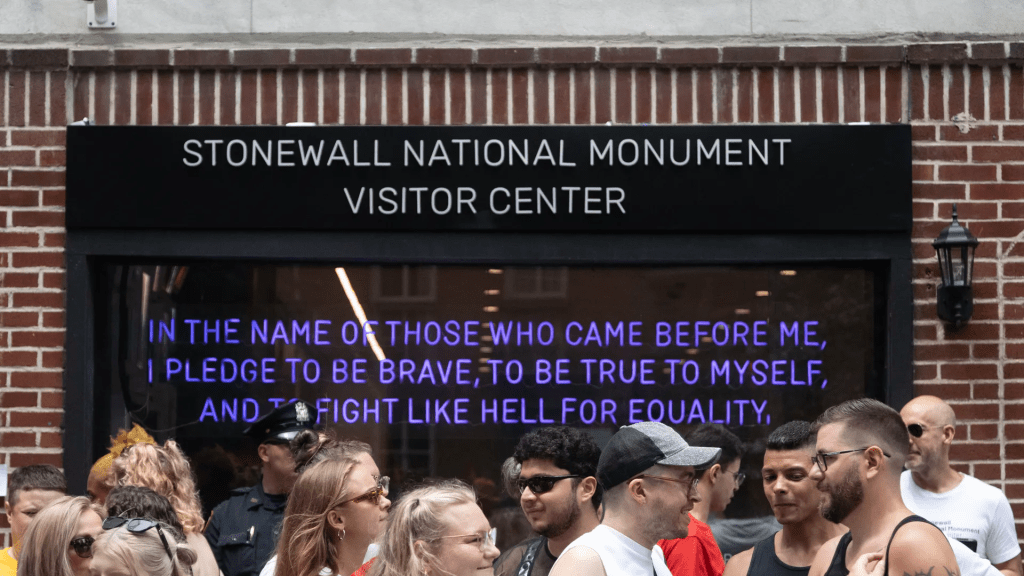
NEW YORK, NEW YORK – JUNE 30: People stand outside Stonewall National Monument Visitor Center during the 2024 NYC Pride March on June 30, 2024 in New York City. (Photo by Noam Galai/Getty Images)Noam Galai/Getty Images
The Stonewall National Monument website seemingly erased most mentions of bisexuality from its website right before Pride month. This comes after the site erased all mentions of trans people from the same “.gov” earlier this year.
The changes appear to have been made on May 27, according to the website itself, which notes the date that each page was last updated. But they largely went unnoticed until independent journalist Erin Reed reported on them on Thursday in a post on her Substack. As of July 11, the homepage on the website, which is run by the National Parks Service (NPS), reads, “Before the 1960s, almost everything about living authentically as a gay or lesbian person was illegal. The Stonewall Uprising on June 28, 1969 is a milestone in the quest for civil rights and provided momentum for a movement.”
But a version of the homepage from May 26, accessed via Wayback Machine, reveals a previous version of that same statement: “Before the 1960s, almost everything about living openly as a lesbian, gay, bisexual (LGB) person was illegal. The Stonewall Uprising on June 28, 1969 is a milestone in the quest for LGB civil rights and provided momentum for a movement.”
Similarly, the “history and culture” page on the website was also updated to remove references to bisexuality on May 27. Where an archived version of the page from May 26 uses the acronym “LGB” numerous times, the most recent version of the page says “gay and lesbian,” and even uses the euphemism “the Stonewall community” in one instance. However, the “virtual fence exhibit” page on the website, which was updated on May 13, still uses the “LGB” acronym, as does the education page. (Though only time will tell how long those mentions will stay.)
As previously reported by Them, these changes come after NPS removed most mentions of trans people from the Stonewall National Monument website in February.
In June, the NPS also told activist Steve Love Menendez, who has been installing hundreds of Pride flags at the monument annually since 2017, that he should only install rainbow flags this year, and that they would not be covering the cost of trans or progress Pride flags, as they had done since 2023. (Visitors brought their own trans flags to place at the monument anyway.)
Though it’s unconfirmed whether the Trump administration is directly responsible for these changes, they are in line with the anti-trans executive orders that the President issued earlier this year, which sought to redefine gender as binary and determined at birth on all federal websites, among other anti-DEI efforts.
The letter “T” was also removed from instances of the acronym “LGBTQ+.”
In a statement emailed to Them, Stacy Lentz, the co-founder and CEO of The Stonewall Inn Gives Back Initiative, took care to note that neither the bar itself nor its affiliated charity are associated with NPS. “That said, we find it deeply troubling that any government agency would erase bisexual people from their public-facing materials,” she said. “Stonewall has always welcomed and celebrated the full spectrum of our community — and that will never change.”
Kurt Kelly, owner of the Stonewall Inn, told Them, “The erasure of bisexual people from federal websites is not just a digital oversight — it’s a deliberate act of invisibility that harms an already marginalized part of our LGBTQ+ community.”
“We must unite as a community to always fight to ensure every identity under our rainbow is seen, heard, and protected. Bi visibility matters. Lives depend on it,” he added. “The fact they continue to do this on the Stonewall National Monument website is even more troubling knowing what Stonewall means to our community around the globe. “
Them has reached out to the National Parks Service for comment.
That pesky thing called the US CONSTITUTION says that the people have a right to protest the government. The last ten or more years the federal government has been trying to restrain the rights of the people to protest or have their voices heard. This is another example. Hugs
DHS is urging law enforcement to treat even skateboarding and livestreaming as signs of violent intent during a protest, turning everyday behavior into a pretext for police action.
The Department of Homeland Security is urging local police to consider a wide range of protest activity as violent tactics, including mundane acts like riding a bike or livestreaming a police encounter, WIRED has learned.
Threat bulletins issued during last month’s “No Kings” protests warn that the US government’s aggressive immigration raids are almost certain to accelerate domestic unrest, with DHS saying there’s a “high likeliness” more Americans will soon turn against the agency, which could trigger confrontations near federal sites.
Blaming intense media coverage and backlash to the US military deployment in Los Angeles, DHS expects the demonstrations to “continue and grow across the nation” as protesters focused on other issues shift to immigration, following a broad “embracement of anti-ICE messaging.”
The bulletins—first obtained by the national security nonprofit Property of the People through public records requests—warn that officers could face assaults with fireworks and improvised weapons: paint-filled fire extinguishers, smoke grenades, and projectiles like bottles and rocks.
At the same time, the guidance urges officers to consider a range of nonviolent behavior and common protest gear—like masks, flashlights, and cameras—as potential precursors to violence, telling officers to prepare “from the point of view of an adversary.”
Protesters on bicycles, skateboards, or even “on foot” are framed as potential “scouts” conducting reconnaissance or searching for “items to be used as weapons.” Livestreaming is listed alongside “doxxing” as a “tactic” for “threatening” police. Online posters are cast as ideological recruiters—or as participants in “surveillance sharing.”
One list of “violent tactics” shared by the Los Angeles–based Joint Regional Intelligence Center—part of a post-9/11 fusion network—includes both protesters’ attempts to avoid identification and efforts to identify police. The memo also alleges that face recognition, normally a tool of law enforcement, was used against officers.
Vera Eidelman, a senior staff attorney with the American Civil Liberties Union, says the government has no business treating constitutionally protected activities—like observing or documenting police—as threats.
DHS did not respond to a request for comment.
“Exercising those rights shouldn’t be justification for adverse action or suspicion by the government,” Eidelman says. Labeling something as harmless as skateboarding at a protest as a violent threat is “disturbing and dangerous,” she adds, and could “easily lead to excessive force against people who are simply exercising their First Amendment rights.”
“The DHS report repeatedly conflates basic protest, organizing, and journalism with terroristic violence, thereby justifying ever more authoritarian measures by law enforcement,” says Ryan Shapiro, executive director of Property of the People. “It should be sobering, if unsurprising, that the Trump regime’s response to mass criticism of its police state tactics is to escalate those tactics.”
Fusion centers like JRIC play a central role in how police understand protest movements. The intelligence they produce is rapidly disseminated and draws heavily on open-source data. It often reflects broad, risk-averse assumptions and includes fragmentary and unverified information. In the absence of concrete threats, bulletins often turn to ideological language and social media activity as evidence of emerging risks, even when tied to lawful expression.
DHS’s risk-based approach reflects a broader shift in US law enforcement shaped by post-9/11 security priorities—one that elevates perceived intent over demonstrable wrongdoing and uses behavior cues, affiliations, and other potentially predictive indicators to justify early intervention and expanded surveillance.
A year ago, DHS warned that immigration-related grievances were driving a spike in threats against judges, migrants, and law enforcement, predicting that new laws and high-profile crackdowns would further radicalize individuals. In February, another fusion center reported renewed calls for violence against police and government officials, citing backlash to perceived federal overreach and identifying then-upcoming protests and court rulings as likely triggers.
At times, the sprawling predictions may appear prescient, echoing real-world flashpoints: In Alvarado, Texas, an alleged coordinated ambush at a detention center this week drew ICE agents out with fireworks before gunfire erupted on July 4, leaving a police officer shot in the neck. (Nearly a dozen arrests have been made, at least 10 on charges of attempted murder.)
In advance of protests, agencies increasingly rely on intelligence forecasting to identify groups seen as ideologically subversive or tactically unpredictable. Demonstrators labeled “transgressive” may be monitored, detained without charges, or met with force.
Social movement scholars widely recognize the introduction of preemptive protest policing as a departure from late-20th century approaches that prioritized de-escalation, communication, and facilitation. In its place, authorities have increasingly emphasized control of demonstrations through early intervention, surveillance, and disruption—monitoring organizers, restricting public space, and responding proactively based on perceived risks rather than actual conduct.
Infrastructure initially designed to combat terrorism now often serves to monitor street-level protests, with virtual investigations units targeting demonstrators for scrutiny based on online expression. Fusion centers, funded through DHS grants, have increasingly issued bulletins flagging protest slogans, references to police brutality, and solidarity events as signs of possible violence—disseminating these assessments to law enforcement absent clear evidence of criminal intent.
Surveillance of protesters has included the construction of dossiers (known as “baseball cards”) with analysts using high-tech tools to compile subjects’ social media posts, affiliations, personal networks, and public statements critical of government policy.
Obtained exclusively by WIRED, a DHS dossier on Mahmoud Khalil, the former Columbia graduate student and anti-war activist, shows that analysts drew information from Canary Mission, a shadowy blacklist that anonymously profiles critics of Israeli military action and supporters of Palestinian rights.
In federal court Wednesday, a senior DHS official acknowledged that material from Canary Mission had been used to compile more than 100 dossiers on students and scholars, despite the site’s ideological slant, mysterious funding, and unverifiable sourcing.
Threat bulletins can also prime officers to anticipate conflict, shaping their posture and decisions on the ground. In the wake of violent 2020 protests, the San Jose Police Department in California cited the “numerous intelligence bulletins” it received from its local regional fusion center, DHS, and the FBI, among others, as central to understanding “the mindset of the officers in the days leading up to and throughout the civil unrest.”
Specific bulletins cited by the SJPD—whose protest response prompted a $620,000 settlement this month—framed the demonstrations as possible cover for “domestic terrorists,” warned of opportunistic attacks on law enforcement and promoted an “unconfirmed report” of U-Haul vans purportedly being used to ferry weapons and explosives.
Subsequent reporting in the wake of BlueLeaks—a 269-gigabyte dump of internal police documents obtained by a source identifying as the hacktivist group Anonymous and published by transparency group Distributed Denial of Secrets—found federal bulletins riddled with unverified claims, vague threat language, and outright misinformation, including alerts about a parody website that supposedly paid protesters and accepted bitcoin to set cars on fire, despite a clear banner labeling the site “FAKE.”
Threat alerts—unclassified and routinely accessible to the press—can help law enforcement shape public perception of protests before they begin, laying the groundwork to legitimize aggressive police responses. Unverified DHS warnings about domestic terrorists infiltrating demonstrations in 2020, publicly echoed by the agency’s acting secretary on Twitter, were widely circulated and amplified in media coverage.
Americans are generally opposed to aggressive protest crackdowns, but when they do support them, fear is often the driving force. Experimental research suggests that support for the use of coercive tactics hinges less on what protesters actually do than on how they’re portrayed—by officials, the media, and through racial and ideological frames.
Dell Cameron is an investigative reporter from Texas covering privacy and national security. He’s the recipient of multiple Society of Professional Journalists awards and is co-recipient of an Edward R. Murrow Award for Investigative Reporting. Previously, he was a senior reporter at Gizmodo and a staff writer for the Daily … Read More
Pedro Pascal has once again stood for trans rights (Gerald Matzka/Getty Images)
Our lord and saviour Pedro Pascal has showed his trans-ally credentials in public once again.
Speaking at the premiere of his latest film, The Fantastic Four: First Steps, Pascal said the trans community filled him with inspiration.
Pascal, whose sister Lux is trans, has long been an advocate for the LGBTQ+ community and in recent months has been vocal in his support of trans people, catching heat from certain people for calling gender-critical author JK Rowling’s actions those of a “heinous loser”.
On the red carpet in Berlin, he said: “It’s important to protect people, especially those simply asking for the right to exist in bodies that belong to them and in the world that they never asked to be brought into.
Pedro Pascal has once again spoken out for the trans community at the premier of The Fantastic Four: First Steps. On the red carpet for the film in Berlin, Pascal was asked why it’s so important to stand up for the trans community, to which he responded: “It’s important to stand up for those who are simply asking for the right to exist.” This isn’t the first time Pedro Pascal has stood up for the trans community. Earlier this year he trolled transphobes in his Instagram comments, he regularly shows support for his trans sister, Lux Pascal, and has most recently spoken out multiple times against JK Rowling. #pedropascal#jkrowling#fantasticfour#transcommunity#transrights#lgbtqia
Pedro Pascal has once again spoken out for the trans community at the premier of The Fantastic Four: First Steps.
On the red carpet for the film in Berlin, Pascal was asked why it’s so important to stand up for the trans community, to which he responded: “It’s important to stand up for those who are simply asking for the right to exist.”
This isn’t the first time Pedro Pascal has stood up for the trans community. Earlier this year he trolled transphobes in his Instagram comments, he regularly shows support for his trans sister, Lux Pascal, and has most recently spoken out multiple times against JK Rowling.
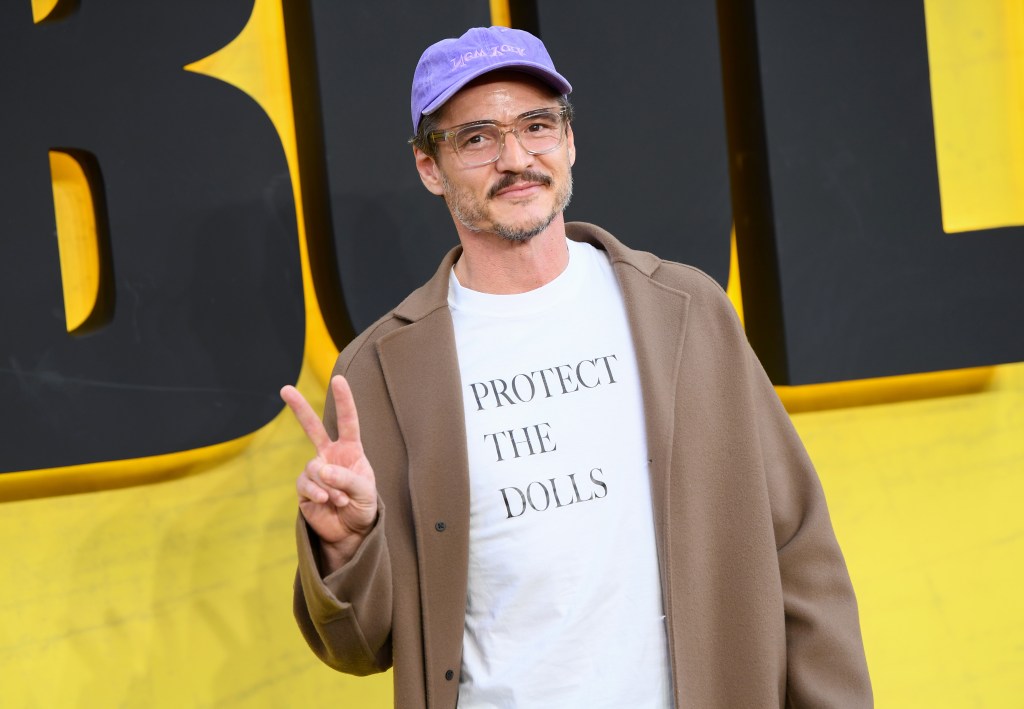
Earlier this year, Pascal wore a Protect The Dolls t-shirt, in support of trans rights, at the Thunderbolts* premiere in London.
“Dolls” is term used mainly by the LGBTQ+ community to describe transgender women. Its roots lie in ballroom culture.
Pascal’s wardrobe choice came just days after the UK Supreme Court handed down an 88-page judgement deeming the legal definition of the words “sex” and “woman” in the 2010 Equality Act referred to “biological sex” and “biological women”, thus excluding transgender people.
The ruling was the culmination of legal action by gender-critical group For Women Scotland, who were backed in their case by Harry Potter author Rowling to the tune of £70,000 (more than $95,000).
After the verdict was announced, Rowling, well-known for her gender-critical views, posted a photo on social media of herself celebrating with a cigar and a cocktail. “I love it when a plan comes together,” she wrote, before revealing that her husband has dubbed the announcement date TERF VE Day.
In response to a viral video post by writer Tariq Ra’ouf, in which Rowling’s celebration was branded “serious Voldemort villain sh*t, Pascal wrote: “Awful, disgusting sh*t is exactly right. Heinous loser behaviour.”
Pedro Pascal is a long-time supporter of trans rights. (Joe Maher/Getty Images)
Following his comment, which was widely praised by LGBTQ+ people, but criticised by the anti-trans brigade, Pascal told Vanity Fair that he was wondering if it had been the right thing to do in terms of helping the transgender community.
He felt like “that kid [who] got sent to the principal’s office a lot for behavioural issues in public schools in Texas, feeling scared and thinking: what’d I do?”
The star, who will be seen reprising his Fantastic Four Reed Richards role in next year’s Avengers: Doomsday, went on to say: “The one thing I agonised over a little bit was: am I helping? Am I f**king helping? It’s a situation that deserves the utmost elegance so that something can actually happen and people will actually be protected.
“I want to protect the people I love. But it goes beyond that, bullies make me f**king sick.”
Rowling responded to Pascal’s comment by saying: “Can’t say I feel very shut down but keep at it, Pedro. God loves a trier.”
Noem is more interested in her face than in providing assistance to the Texas flood survivors Read on Substack
ICE Barbie, Kristi Noem, the Director of Homeland Security, is failing at her job miserably.
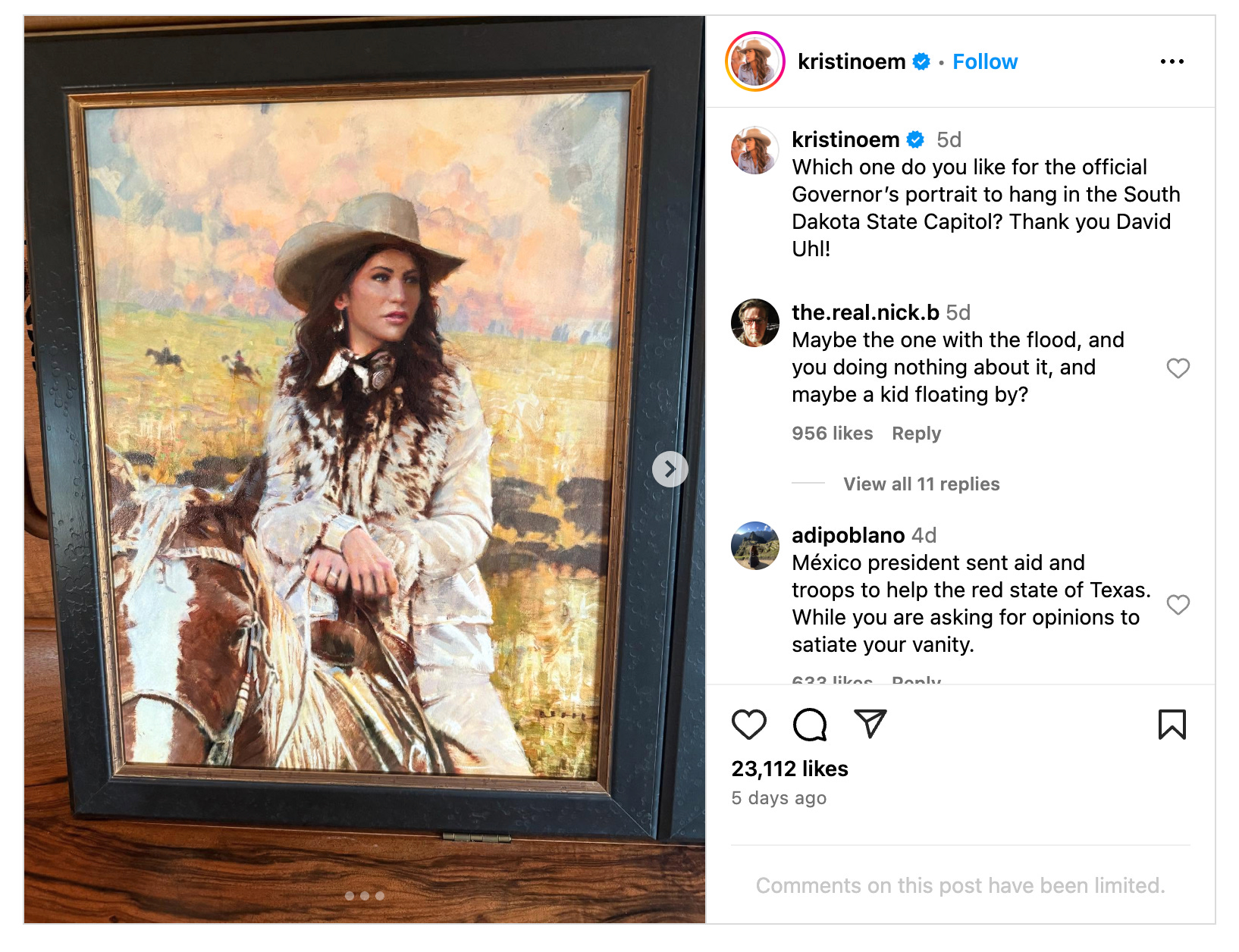
A portrait of Noem is going to be displayed in the South Dakota Capitol building, and there are three options. Who gives a shit, right? Kristi Noem, that’s who. Noem went on Instagram and posted to her creepy followers, “Which one do you like for the official Governor’s portrait to hang in the South Dakota State Capitol? Thank you David Uhl!” She added the three paintings of herself on horseback by artist David Uhl.”
She did this five days ago, during the floods in Texas that have killed at least 120 so far.
Here are the other two portraits.
I wonder how much South Dakota tax money was spent on this.
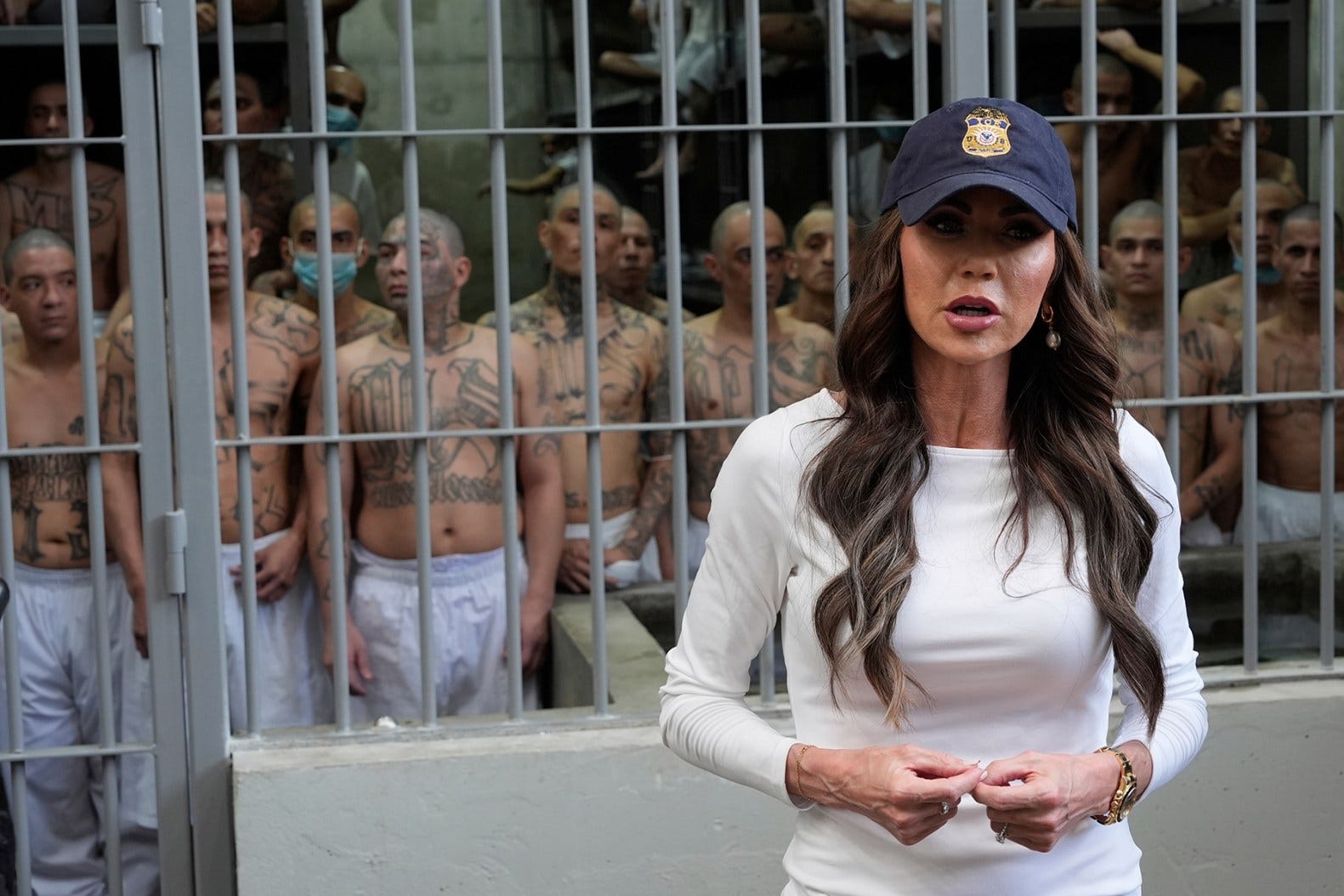
Before Noem’s survey about herself, Puppy-Killah Kristi did her stupid photo-op in El Salvador with the notorious prison behind her, with Trump deportees as props. She was in full makeup while making sure her shiny $10,000 Rolex was visible, which is probably less than her teeth cost.
She’s done other photos with guns, posing as an ICE agent. In one of them, she wasn’t holding the gun correctly and got roasted for it online. I bet she can’t ride a horse either.
We should be relieved that she didn’t shoot that ICE agent in the face. In her defense, she does know how to shoot a gun because that’s how she murdered her puppy. So there, critics.
Kristi is the kind of person that if you went out to dinner with her, she’d humbly say at some point, “Enough of me talking about myself. Now let’s hear you talk about me.” She can’t get over herself. She might be the female equivalent of Donald Trump. She already has the fake hair, and now she just needs the ridiculous tie, the orange make-up, and an adult diaper that hasn’t been changed since his first flip-flop on tariffs.
Remember, Kristi used to look like this…
…before she looked like this.
She definitely went for the Melania look, which is an improvement over the look for hunting wolves from a helicopter. She even got free dental work while she was governor, on the condition that she make a commercial for the Texas dentist who did her work.
It seems that’s the only time she’s interested in Texas, when she can get free dental work, but not when there’s a disaster.
According to The New York Times, two days after catastrophic floods roared through Central Texas, the Federal Emergency Management Agency (FEMA) did not answer nearly two-thirds of calls to its disaster assistance line.
An anonymous source close to the issue said the lack of responsiveness happened because the agency had fired hundreds of contractors at call centers.
FEMA, which is a part of Homeland Security (I have to include that because trolls are commenting on this cartoon on Facebook asking, “What’s DHS got to do with FEMA?”), laid off the contractors on July 5 after their contracts expired and were not extended, according to the documents and the person briefed on the matter. Noem, who has instituted a new requirement that she personally approve expenses over $100,000, did not renew the contracts until Thursday, five days after the contracts expired, and about a week after the floods started.
Where was ICE Barbie? She was probably spending her time looking at herself in a mirror, or maybe she confused Texas for one of the seven Native American tribes that banned her from their reservations.
Adam Zyglis: There’s a part of this cartoon that is my standing in solidarity with my colleague Adam Zyglis. So what happened with Adam? Adam, who works for the Buffalo News, drew a cartoon mocking Republican hypocrisy, asking for federal aid after protesting against federal disaster relief for other states. This has upset Republicans, which shows more hypocrisy for the gang that shouts “snowflake” at their political opponents. They even cried on Fox News about it.
Now, an event at the Buffalo History Museum by the Buffalo News Guild, which was to feature Adam among other journalists, has been postponed because of “credible” death threats toward Adam and his family.
And just today, a MAGAt posted on one of my client’s shares of a cartoon of mine about how Democrats are the violent ones. (snip-MORE, and it’s great)
The Canadian province of Manitoba is suffering through its worst wildfire season in its history, and to add insult to injury, several U.S. lawmakers are complaining that smoke wafting south is making it difficult for Americans to enjoy summer.
Six Republican Congress members shared their concerns in a letter addressed to Canadian Ambassador Kirsten Hillman on Monday, July 7, asking for more information about how the government plans to mitigate wildfires and the smoke that travels south. Since January, over 3,000 wildfires have consumed more than 5 million acres, killed two people, and displaced tens of thousands more in Canada. The lawmakers explain that resulting poor air quality in the U.S. has prevented Americans from partaking in outdoor summer activities. Compared to the devastation Canadians have faced this year, these issues are glaringly trivial.
“This is what turns people off politics. When you’ve got a group of congresspeople trying to trivialise and make hay out of a wildfire season where we’ve lost lives in our province,” Wab Kinew, premier of Manitoba, said during a press conference Thursday, July 10. Manitoba had just declared a state of emergency for the second time this year due to unprecedented wildfire activity. The province’s wildfire service reported 105 active fires burning on Thursday, including 14 that were listed as “out of control” across the eastern, western, and northern parts of the province. (snip-MORE on the page)
And, well-informed Canadians have opinions! We should be aware of this. The comments thread is fine. Go. Read. Comment, if you will.
July 11, 1905 The Niagara Movement, precursor of the National Association for the Advancement of Colored People (NAACP), was formed in Buffalo, New York. Meeting at the home of Mary Burnett Talbert were W.E.B. DuBois, John Hope and 30 others who rejected the accommodationist approach of Booker T. Washington (“The wisest among my race understand that the agitation of questions of social equality is the extremest folly . . . .”) Founders of The Niagara Movement at Niagara Falls The Niagara Movement’s manifesto was, in the words of DuBois, “We want full manhood suffrage and we want it now . . . We are men! We want to be treated as men. And we shall win.“ The Niagara Movement and its founding principles
July 11, 1968 The American Indian Movement (AIM) was founded in Minneapolis, Minnesota, by George Mitchell, Dennis Banks, Clyde Bellecourt and 200 others. They gathered to organize in order to deal with widespread and persistent poverty among native Americans, and unjust treatment from all levels of government. American Indian Movement background
July 11, 1969 The federal appeals court in Boston reversed the convictions of Dr. Benjamin Spock and Michael Ferber who had been found guilty of conspiring to counsel evasion of the military draft in 1968. The judges considered their activities opposing the Vietnam War covered under the 1st Amendment right to free speech. Dr. Benjamin Spock and Dr. Martin Luther King Jr. Read “A Call to Resist Illegitimate Authority” co-authored by Dr. Spock (1967)