Community activists in San Francisco are rallying to support Hilary Rivers, an immigrant drag queen who was arrested by ICE agents after an asylum hearing nearly two weeks ago — one of the latest LGBTQ+ victims of the Trump administration’s campaign for mass deportations.
Rivers fled his home in Guatemala due to “traumatic and severe” persecution for being gay, as the San Francisco Chronicle reported last week. (His legal name is not being widely reported to protect his confidentiality, advocates told the nonprofit news platform 48Hills.org shortly following the drag performer’s arrest.) On June 26, Rivers attended a scheduled asylum hearing, where the government’s motion to dismiss his case was denied; Rivers was then arrested by ICE agents as he left the courtroom. That combination — in which the government attempts to dismiss an asylum case, then immediately arrests the asylum seeker for deportation — has become an increasingly common tactic for U.S. immigration police in the past several months, and one that is sometimes conducted with cooperation from courthouses themselves. (snip-MORE)
Transgender pilot Jo Ellis was falsely accused of killing 67 people earlier this year — and unfortunately, she isn’t alone: right-wing hoaxers have blamed trans people for at least 12 incidents of violent death in the U.S. since 2022, according to a new analysis in Wired.
Ellis, a part-time pilot in the Virginia Army National Guard, filed suit against right wing influencer Matt Wallace in April, after Wallace shared false claims that Ellis was responsible for the January helicopter crash at Ronald Reagan International Airport that killed dozens. The crash was later determined to be an accident caused by years of poor safety practices at the airport. But Ellis soon found herself on the receiving end of right-wing hatred thanks in part to people like Wallace, who posted on Elon Musk’s X platform that the crash “may have been another trans terror attack.”
Wallace has since deleted the post about Ellis, as Wired noted. But the key word in that post was “another.” In the past two years, right-wing disinformation accounts — such as Chaya Raichik’s “Libs of TikTok” — have spread similar false accusations against trans people on at least a dozen occasions, according to Wired’s analysis of news reports across that period. (snip-MORE)
It isn’t timidity. It’s a complete reconstruction of what is acceptable rhetoric, and it makes gentler more collegial conversation and work impossible.
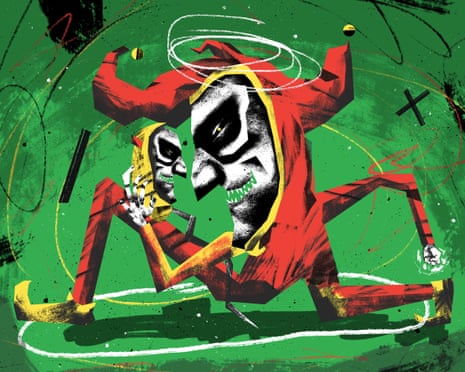
Whether it’s bloodshed at Glastonbury or starving people on benefits, their ‘irony poisoning’ seeps obscene ideas into the range of the possible
Illustration: Nate Kitch/The Guardian
Imagine the furore if a Guardian columnist suggested bombing, say, the Conservative party conference and the Tory stronghold of Arundel in Sussex. It would dominate public discussion for weeks. Despite protesting they were “only joking”, that person would never work in journalism again. Their editor would certainly be sacked. The police would probably come knocking. But when the Spectator columnist Rod Liddle speculates about bombing Glastonbury festival and Brighton, complaints are met with, “Calm down dear, can’t you take a joke?” The journalist keeps his job, as does his editor, the former justice secretary Michael Gove. There’s one rule for the left and another for the right.
The same applies to the recent comments on GB News by its regular guest Lewis Schaffer. He proposed that, to reduce the number of disabled people claiming benefits, he would “just starve them. I mean, that’s what people have to do, that’s what you’ve got to do to people, you just can’t give people money … What else can you do? Shoot them? I mean, I suggest that, but I think that’s maybe a bit strong.” The presenter, Patrick Christys replied, “Yeah, it’s just not allowed these days.”
You could call these jokes, if you think killing people is funny. Or you could call them thought experiments. Liddle suggested as much in his column: “I am merely hypothesising, in a slightly wistful kinda way.” This “humour” permits obscene ideas to seep into the range of the possible.
Academic researchers see the use of jokes to break taboos and reduce the thresholds of hate speech as a form of “strategic mainstreaming”. Far-right influencers use humour, irony and memes to inject ideas into public life that would otherwise be unacceptable. In doing so, they desensitise their audience and normalise extremism. A study of German Telegram channels found that far-right content presented seriously achieved limited reach, as did non-political humour. But when far-right extremism was presented humorously, it took off. (snip-MORE)
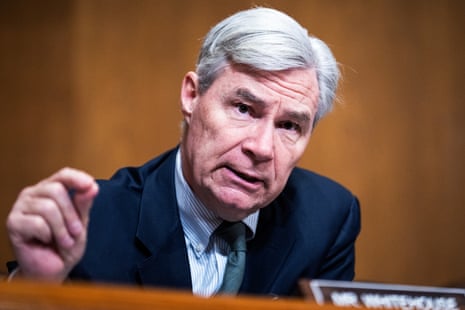
Sheldon Whitehouse of Rhode Island gives 300th climate speech on the US Senate floor
Sheldon Whitehouse at a Senate confirmation hearing on 6 February 2025. Photograph: Tom Williams/CQ-Roll Call via Getty Images
The Democratic party and the climate movement have been “too cautious and polite” and should instead be denouncing the fossil fuel industry’s “huge denial operation”, the US senator Sheldon Whitehouse said.
“The fossil fuel industry has run the biggest and most malevolent propaganda operation the country has ever seen,” the Rhode Island Democrat said in an interview Monday with the global media collaboration Covering Climate Now. “It is defending a $700-plus billion [annual] subsidy” of not being charged for the health and environmental damages caused by burning fossil fuels. “I think the more people understand that, the more they’ll be irate [that] they’ve been lied to.” But, he added, “Democrats have not done a good job of calling that out.”
Whitehouse is among the most outspoken climate champions on Capitol Hill, and on Wednesday evening, he delivered his 300th Time to Wake Up climate speech on the floor of the Senate.
He began giving these speeches in 2012, when Barack Obama was in his first term, and has consistently criticized both political parties for their lackluster response to the climate emergency. The Obama White House, he complained, for years would not even “use the word ‘climate’ and ‘change’ in the same paragraph”.
While Whitehouse slams his fellow Democrats for timidity, he blasts Republicans for being in the pocket of the fossil fuel industry, an entity whose behavior “has been downright evil”, he said. “To deliberately ignore [the laws of physics] for short-term profits that set up people for huge, really bad impacts – if that’s not a good definition of evil, I don’t know what is.” (snip-MORE)
July 8, 1917 The Women’s Peace Crusade organized a protest against the first world war in Glasgow, Scotland. Processions from two sides of the city, accompanied by bands and banners, wound their way toward the Glasgow Green where they merged into one demonstration of some 14,000 people. Read about the Women’s Peace Crusade
July 8, 1958 “Omaha Action” protestors march from Lincoln, Nebraska to the Mead ICBM construction site in 1959. Source — NSHS. In an effort called “Omaha Action,” by the Committee for Nonviolent Action (CNVA), anti-nuclear activist Don Fortenberry was arrested after climbing a fence to protest against the building of ICBM sites in Nebraska. Also arrested during this series of actions was internationally known peace activist A. J. Muste. More about Omaha Action
July 8, 1959 Vietnamese guerillas ambushed two U.S. advisors, Major Dale Buis and Sgt. Chester Ovnand, are killed by Viet Minh guerrillas at Bien Hoa, South Vietnam, making them the first U.S. casualties in Vietnam since 1946.
July 8, 1965 Roy Wilkins became the executive director of NAACP, the National Association for the Advancement of Colored People. He had edited the organization’s magazine, Crisis, for fifteen years, and was one of the most articulate of civil rights leaders. Roy Wilkins the Roy Wilkins Memorial in Minneapolis
July 8, 1996 The International Court Of Justice declared that, in almost all circumstances, use of nuclear weapons is illegal.
There are videos at the link below. I don’t know where we are a species right now. It seems more and more people are willing to give in to the lowest of our natures while mocking those who try to live up to the best we could be. The Christians trying to keep books that have LGBTQ+ characters out of schools can’t be bothered by the shooting of starving people including kids trying desperately to get something to eat. They are not doing anything to help, just everything they can to lash out bashing a minority group just for existing using their god to do it. Yet did not their god say to feed the hungry? To help the immigrants among you? They are so desperate to control others sexuality but they don’t care about those acting cruelty to the ones most needing help. Hypocrites, which side of god do they get to sit on? Hugs
American contractors guarding aid distribution sites in Gaza are using live ammunition and stun grenades as hungry Palestinians scramble for food, according to accounts and videos obtained by The Associated Press.
Two U.S. contractors, speaking to the AP on condition of anonymity because they were revealing their employers’ internal operations, said they were coming forward because they were disturbed by what they considered dangerous and irresponsible practices. They said the security staff hired were often unqualified, unvetted, heavily armed and seemed to have an open license to do whatever they wished.
They said their colleagues regularly lobbed stun grenades and pepper spray in the direction of the Palestinians. One contractor said bullets were fired in all directions — in the air, into the ground and at times toward the Palestinians, recalling at least one instance where he thought someone had been hit.
“There are innocent people being hurt. Badly. Needlessly,” the contractor said.
He said American staff on the sites monitor those coming to seek food and document anyone considered “suspicious.” He said they share such information with the Israeli military.
Videos provided by one of the contractors and taken at the sites show hundreds of Palestinians crowded between metal gates, jostling for aid amid the sound of bullets, stun grenades and the sting of pepper spray. Other videos include conversation between English-speaking men discussing how to disperse crowds and encouraging each other after bursts of gunfire.
The testimonies from the contractors — combined with the videos, internal reports and text messages obtained by the AP — offer a rare glimpse inside the Gaza Humanitarian Foundation, the newly created, secretive American organization backed by Israel to feed the Gaza Strip’s population. Last month, the U.S. government pledged $30 million for the group to continue operations — the first known U.S. donation to the group, whose other funding sources remain opaque.
A spokesperson for Safe Reach Solutions, the logistics company subcontracted by GHF, told the AP that there have been no serious injuries at any of their sites to date. In scattered incidents, security professionals fired live rounds into the ground and away from civilians to get their attention. That happened in the early days at the “the height of desperation where crowd control measures were necessary for the safety and security of civilians,” the spokesperson said.
Aid operation is controversial
Gaza’s more than 2 million Palestinians are living through a catastrophic humanitarian crisis. Since Hamas attacked Israel on Oct. 7, 2023, setting off the 21-month war, Israel has bombarded and laid siege to the strip, leaving many teetering on the edge of famine, according to food security experts.
For 2 1/2 months before GHF’s opening in May, Israel blocked all food, water and medicine from entering Gaza, claiming Hamas was stealing the aid being transported under a preexisting system coordinated by the United Nations. It now wants GHF to replace that U.N. system. The U.N. says its Gaza aid operations do not involve armed guards.
Over 57,000 Palestinians in Gaza have been killed since the war erupted, according to the territory’s Health Ministry, which does not distinguish between civilians and militants.
GHF is an American organization, registered in Delaware and established in February to distribute humanitarian aid during the ongoing Gaza humanitarian crisis. Since the GHF sites began operating more than a month ago, Palestinians say Israeli troops open fire almost every day toward crowds on roads heading to the distribution points, through Israeli military zones. Several hundred people have been killed and hundreds more wounded, according to Gaza’s Health Ministry and witnesses.
In response, Israel’s military says it fires only warning shots and is investigating reports of civilian harm. It denies deliberately shooting at any innocent civilians and says it’s examining how to reduce “friction with the population” in the areas surrounding the distribution centers.
AP’s reporting for this article focuses on what is happening at the sites themselves. Palestinians arriving at the sites say they are caught between Israeli and American fire, said the contractor who shared videos with the AP.
“We have come here to get food for our families. We have nothing,” he recounted Palestinians telling him. “Why does the (Israeli) army shoot at us? Why do you shoot at us?”
A spokesperson for the GHF said there are people with a “vested interest” in seeing it fail and are willing to do or say almost anything to make that happen. The spokesperson said the team is composed of seasoned humanitarian, logistics and security professionals with deep experience on the ground. The group says it has distributed the equivalent of more than 50 million meals in Gaza in its food boxes of staples.
GHF says that it has consistently shown compassionate engagement with the people of Gaza.
Throughout the war, aid distribution has been marred by chaos. Gangs have looted trucks of aid traveling to distribution centers and mobs of desperate people have also offloaded trucks before they’ve reached their destination. Earlier this month, at least 51 Palestinians were killed and more than 200 wounded while waiting for the U.N. and commercial trucks to enter the territory, according to Gaza’s Health Ministry and a local hospital. Israel’s military acknowledged several casualties as soldiers opened fire on the approaching crowd and said authorities would investigate.
Videos, texts, internal reports document havoc at food sites
AP spoke to the two contractors for UG Solutions, an American outfit subcontracted to hire security personnel for the distribution sites. They said bullets, stun grenades and pepper spray were used at nearly every distribution, even if there was no threat.
Videos of aid being dispensed at the sites seen by the AP appear to back up the frenetic scenes the contractors described. The footage was taken within the first two weeks of its distributions — about halfway into the operations.
In one video, what appear to be heavily armed American security contractors at one of the sites in Gaza discuss how to disperse Palestinians nearby. One is heard saying he has arranged for a “show of force” by Israeli tanks.
“I don’t want this to be too aggressive,” he adds, “because this is calming down.”
At that moment, bursts of gunfire erupt close by, at least 15 shots. “Whoo! Whoo!” one contractor yelps.
“I think you hit one,” one says.
Then comes a shout: “Hell, yeah, boy!”
The camera’s view is obscured by a large dirt mound.
The contractor who took the video told AP that he saw other contractors shooting in the direction of Palestinians who had just collected their food and were departing. The men shot both from a tower above the site and from atop the mound, he said. The shooting began because contractors wanted to disperse the crowd, he said, but it was unclear why they continued shooting as people were walking away.
The camera does not show who was shooting or what was being shot at. But the contractor who filmed it said he watched another contractor fire at the Palestinians and then saw a man about 60 yards (meters) away — in the same direction where the bullets were fired — drop to the ground.
This happened at the same time the men were heard talking — effectively egging each other on, he said.
In other videos furnished by the contractor, men in grey uniforms — colleagues, he said — can be seen trying to clear Palestinians who are squeezed into a narrow, fenced-in passage leading to one of the centers. The men fire pepper spray and throw stun grenades that detonate amid the crowd. The sound of gunfire can be heard. The contractor who took the video said the security personnel usually fire at the ground near the crowds or from nearby towers over their heads.
During a single distribution in June, contractors used 37 stun grenades, 27 rubber-and-smoke “scat shell” projectiles and 60 cans of pepper spray, according to internal text communications shared with the AP.
That count does not include live ammunition, the contractor who provided the videos said.
One photo shared by that contractor shows a woman lying in a donkey cart after he said she was hit in the head with part of a stun grenade.
This photo, provided by an American contractor on condition of anonymity because they were revealing their employers’ internal operations, shows a woman slumped over in a donkey cart after the contractor said she was hit in the head with part of a stun grenade at a food distribution site in Gaza run by the Gaza Humanitarian Foundation in June 2025. (AP Photo)
An internal report by Safe Reach Solutions, the logistics company subcontracted by GHF to run the sites, found that aid seekers were injured during 31% of the distributions that took place in a two-week period in June. The report did not specify the number of injuries or the cause. SRS told the AP the report refers to non-serious injuries.
More videos show frenzied scenes of Palestinians running to collect leftover food boxes at one site. Hundreds of young men crowd near low metal barriers, transferring food from boxes to bags while contractors on the other side of the barriers tell them to stay back.
Some Palestinians wince and cough from pepper spray. “You tasting that pepper spray? Yuck,” one man close to the camera can be heard saying in English.
SRS acknowledged that it’s dealing with large, hungry populations, but said the environment is secure, controlled, and ensures people can get the aid they need safely.
Verifying the videos with audio analysis
To confirm the footage is from the sites, AP geolocated the videos using aerial imagery. The AP also had the videos analyzed by two audio forensic experts who said they could identify live ammunition — including machine-gun fire — coming from the sites, in most cases within 50 to 60 meters of the camera’s microphone.
In the video where the men are heard egging each other on, the echo and acoustics of the shots indicate they’re fired from a position close to the microphone, said Rob Maher, a professor of electrical and computer engineering at Montana State University and an author and research expert in audio forensic analysis. Maher and the other analyst, Steven Beck, owner of Beck Audio Forensics, said there was no indication that the videos’ audio had been tampered with.
The analysts said that the bursts of gunfire and the pop sequences in some of the videos indicated that guns were panning in different directions and were not repeatedly aimed at a single target. They could not pinpoint exactly where the shots were coming from nor who was shooting.
GHF says the Israeli military is not deployed at the aid distribution sites. Lt. Col. Nadav Shoshani, an army spokesman, said the army is not stationed at the sites or within their immediate proximity, especially during operating hours. He said they’re run by an American company and have their own security.
One of the contractors who had been on the sites said he’d never felt a real or perceived threat by Hamas there.
SRS says that Hamas has openly threatened its aid workers and civilians receiving aid. It did not specify where people were threatened.
Palestinians carry boxes containing food and humanitarian aid packages delivered by the Gaza Humanitarian Foundation, a U.S.-backed organization approved by Israel, in Rafah, southern Gaza Strip, Tuesday, May 27, 2025. (AP Photo/Abdel Kareem Hana,File)
American analysts and Israeli soldiers work side by side, contractors say
According to the contractor who took the videos, the Israeli army is leveraging the distribution system to access information.
Both contractors said that cameras monitor distributions at each site and that American analysts and Israeli soldiers sit in a control room where the footage is screened in real time. The control room, they said, is housed in a shipping container on the Israeli side of the Kerem Shalom crossing into Gaza.
The contractor who took the videos said some cameras are equipped with facial recognition software. In live shots of the sites seen by the AP, some videos streams are labeled “analytics” — those were the ones that had the facial recognition software, said the contractor.
If a person of interest is seen on camera — and their information is already in the system — their name and age pops up on the computer screen, said the contractor. Israeli soldiers watching the screens take notes and cross-check the analysts’ information with their own drone footage from the sites, he said.
The contractor said he did not know the source of the data in the facial recognition system. The AP could not independently verify his information.
An internal SRS report from June seen by the AP said that its intel team would circulate to staff a “POI Mugs Card,” that showed photos of Palestinians taken at the sites who were deemed persons of interest.
The contractor said he and other staff were told by SRS to photograph anyone who looked “out of place.” But the criteria were not specified, he said. The contractor said the photos were also added to the facial recognition database. He did not know what was done with the information.
SRS said accusations that it gathers intelligence are false and that it has never used biometrics. It said it coordinates movements with Israeli authorities, a requirement for any aid group in Gaza.
An Israeli security official who was not named in line with the army’s protocol, said there are no security screening systems developed or operated by the army within the aid sites.
July 2, 1776 New Jersey became the first British colony in America to grant partial women’s suffrage. The new constitution (temporary if there were a reconciliation with Great Britain) granted the vote to all those “of full age, who are worth fifty pounds proclamation money,” including non-whites and widows; married women were not able to own property under common law.
July 2, 1777 Vermont became the first of the United States to abolish slavery.
July 2, 1809 Alarmed by the growing encroachment of whites squatting on Native American lands, the Shawnee Chief Tecumseh called on all Indians to unite and resist. By 1810, he had organized the Ohio Valley Confederacy, which united Indians from the Shawnee, Potawatomi, Kickapoo, Winnebago, Menominee, Ottawa, and Wyandotte nations. For several years, Tecumseh’s Indian Confederacy successfully delayed further white settlement in the region. Chief Tecumseh Tecumseh’s efforts
July 2, 1839 Slave ship Early in the morning, captive Africans on the Cuban slave ship Amistad, led by Joseph Cinquè (a Mende from what is now Sierra Leone), mutinied against their captors, killing the captain and the cook, and seized control of the schooner. Jose Ruiz, a Spaniard and planter from Puerto Principe, Cuba, had bought the 49 adult males on the ship, paying $450 each, as slaves for his sugar plantation. More about Amistad Joseph Cinquè
July 2, 1964 Jobs and Freedom march April 28, 1963, Washington DC U.S. President Lyndon B. Johnson signed the Civil Rights Act of 1964 into law, thus barring discrimination in public accommodations (restaurants, stores, theatres, etc.), employment, and voting. The law had survived an 83-day filibuster in the U.S. Senate by 21 members from southern states. “I think we just delivered the South to the Republican party for a long time to come,” said President Johnson to his press secretary, Bill Moyers later that day. He anticipated a shift in white southern voting from the Democratic to the Republican party in response to the law. Massive demonstrations a year earlier ensured passage of the Act.
July 2, 1992 President George H.W. Bush (the elder) announced that the United States had completed the worldwide withdrawals of all its ground- and sea-launched tactical nuclear weapons [see September 27, 1991].
Yes, this passed in the Senate, thanks to the VP’s tiebreaking vote. However, it’s still got rows to hoe in the US House; Spkr. Johnson wants to vote tomorrow. The thing to remember about our US Reps is, they’re up for election each 2 years. So, while firmly directing them in dealing with this dreadful bill, also firmly yet lovingly remind them that the OBBB will be hanging around their necks every step of the way of their campaigns like a bubblegum machine golden giant dollar sign necklace, if they vote in favor.
(Actually, if you didn’t when you contacted your Senators last week, you can still remind them of the same thing, unless they voted against, in which case, Thank Them. It took bravery to vote against, and they need to know we have their backs. And thank you very much. Now call.)
Crackdown on Pride is part of effort to curb democratic freedoms ahead of a hotly-contested election next year
Tens of thousands march against Hungary’s government for LGBT rights – video
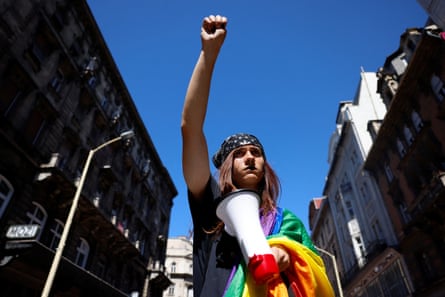
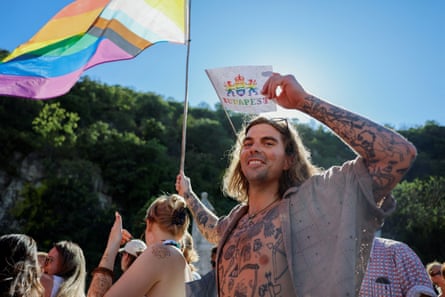
Tens of thousands of people have taken to the streets of Budapest in defiance of the Hungarian government’s ban on Pride, heeding a call by the city’s mayor to “come calmly and boldly to stand together for freedom, dignity and equal rights”.
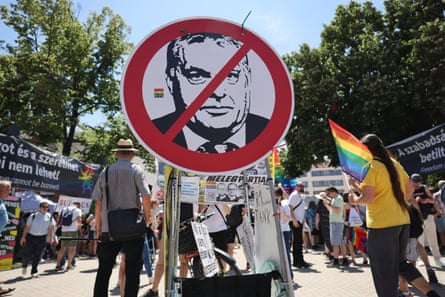
Jubilant crowds packed into the city’s streets on Saturday, waving Pride flags and signs that mocked the country’s prime minister, Viktor Orbán, as their peaceful procession inched forward at a snail’s pace.
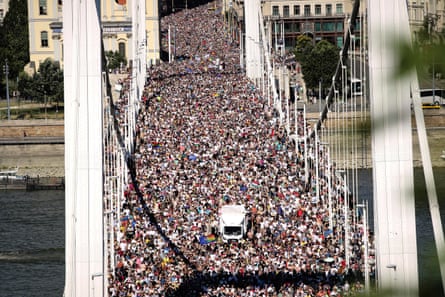
Organisers estimated that a record number of people turned up, far outstripping the expected turnout of 35,000-40,000 people.
“We believe there are 180,000 to 200,000 people attending,” the president of Pride, Viktória Radványi told AFP. “It is hard to estimate because there have never been so many people at Budapest Pride.”
The mass demonstration against the government was a bittersweet marking of Budapest Pride’s 30th anniversary; while the turnout on Saturday was expected to reach record levels, it had come after the government had doubled down on its targeting of the country’s LGBTQ+ community.
Hungary Pride participants in the march cross the Elisabeth Bridge in Budapest, Hungary. Photograph: Rudolf Karancsi/AP
“We came because they tried to ban it,” said Timi, 49. The Hungarian national was marching with her daughter, Zsófi, 23, who had travelled from her home in Barcelona to join the rally.
After the ruling Fidesz party, led by the rightwing populist Orbán, fast-tracked a law that made it an offence to hold or attend events that involve the “depiction or promotion” of homosexuality to minors, many Hungarians vowed to show their disapproval by attending Pride for the first time.
Viki Márton was among those who had made good on the promise, turning up with her nine-year-old daughter.
The pair had come equipped with hats, water spray, and a swimsuit, more worried about heat than rightwing protesters. “I want her to see the reality,” said Márton. “And I’m so excited to be here!”
Tens of thousands of Hungarians took to the streets on Saturday, despite Orbán’s warning on Friday that those who attend or organise the march will face ‘legal consequences’. Photograph: János Kummer/Getty Images
Earlier this month, police announced they would follow the government’s orders and ban the march. The progressive mayor of Budapest, Gergely Karácsony, was swift to respond, saying that the march would instead go ahead as a separate municipal event, with Karácsony describing it as a way to circumvent the need for official authorisation.
On Saturday, the mayor reiterated why the city had decided to host the event, hinting at how the march had become a symbol of discontent against a government that has long faced criticism for weakening democratic institutions and gradually undermining the rule of law.
“The government is always fighting against an enemy against which they have to protect Hungarian people,” said Karácsony.
“This time, it is sexual minorities that are the target … we believe there should be no first and second class citizens, so we decided to stand by this event.”
Akos Horvath, 18, who had travelled two hours from his city in southern Hungary to take part in the march, described it as an event of “symbolic importance”.
Speaking to news agency AFP, he added: “It’s not just about representing gay people, but about standing up for the rights of the Hungarian people.”
The sentiment was echoed by fellow marcher Eszter Rein-Bódi. “This is about much more, not just about homosexuality,” Rein-Bódi told Reuters “This is the last moment to stand up for our rights.”
‘This is about much more, not just about homosexuality,’ one participant told Reuters. Photograph: Lisa Leutner/Reuters
Tens of thousands of Hungarians, including senior citizens and parents with their children, plus politicians and campaigners from 30 countries, took to the streets on Saturday, despite Orbán’s warning on Friday that those who attend or organise the march will face “legal consequences”.
The Hungarian prime minister sought to minimise concerns over violence, however, saying that Hungary was a “civilised country” and police would not “break it up … It cannot reach the level of physical abuse”.
Still, in a video posted to social media this week, the country’s justice minister, Bence Tuzson, warned the Budapest mayor that organising a banned event or encouraging people to attend is punishable by up to a year in prison.
Speaking to reporters on Friday, the mayor brushed off the threat and downplayed concerns that police would later impose heavy fines on attende s. “Police have only one task tomorrow: to guarantee the safety and security of those gathered at the event,” said Karácsony.
The potential for violence had been amplified after three groups with ties to the extreme right said they were planning counter-marches. As the Pride march got under way, local news site Telex reported that the route of the march had to be changed after one of these groups blocked off a bridge.
Analysts had described the government’s bid to crackdown on Pride as part of a wider effort to curb democratic freedoms ahead of a hotly contested national election next year.
Orbán is facing an unprecedented challenge from a former member of the Fidesz party’s elite, Péter Magyar, leading Pride organisers to suggest they are being scapegoated as Orbán scrambles to shore up support among conservative voters.
Orbán’s government had also prompted concerns across Hungary and beyond after it said it would use facial recognition software to identify people attending any banned events, potentially fining them up to €500 (£425).
Ahead of the march, as campaigners scrambled for clarity on whether or how this technology would be used, AFP reported that newly installed cameras had appeared on the lamp-posts that dotted the planned route.
The threat had been enough to rattle some. Elton, 30, a Brazilian living in Hungary wore a hat and sunglasses as he took part on Saturday, explaining that he had been worried about jeopardising his job and immigration status, but that his Hungarian boyfriend had persuaded him to attend.
“This is my second time at Pride, but the first time I feel insecure about it,” he said.
Orbán’s government had also prompted concerns across Hungary and beyond after it said it would use facial recognition software to identify people attending any banned events. Photograph: Lisa Leutner/Reuters
Mici, a 21-year-old Budapest resident, said she had attended Pride marches in the past but this time had weighed whether to join in after she was spooked by reports of the facial recognition system.
“At first, I was scared to come out because of the news, but I feel safe with so many people.”
She hoped that the massive turnout for the march would be enough to push the Orbán government to change its stance.
“I think the crowd that has come from across Europe, the record numbers, will make Hungarian people see that this cause is well-supported.”
June 29, 1925 The South African parliament passed a bill excluding black, coloured (mixed race) and Indian people from all skilled or semi-skilled jobs.
June 29, 1963 A mass “walk-on” (trespass) was organized at a chemical and biological warfare facility in Porton Down, England. These weaponized agents had been researched and produced there since 1916; it’s now known as the Defence Science and Technology Laboratory. Protesters demand an end to germ warfare in 1963 at Porton Down (Getty) Unconscionable activities at Porton Down (From 2004)