Three Belle of the Ranch videos that are important to watch

Before the establishment of the Hollywood Production Code in the 1930s, filmmakers deployed gender and sexuality stereotypes for glamour, humor, and drama alike.

With Pride month in full swing, it’s an ideal moment to look at historical queer representation, particularly in the early days of Hollywood cinema. The first few decades of the twentieth century were not only an active time for a growing medium, but also one in which crises of confidence, economy, masculinity, and culture changed how filmmakers presented queer characters and how (or if) audiences received them. Film professor David Lugowski summed up queer representation in early film neatly, writing that “[a]s cinema learned to talk, so did it also ‘speak’ about the gender roles so crucial to Hollywood film.”
Cinema moved from silent film into “talkies” in the late 1920s, with Al Jolson’s The Jazz Singer typically credited as the first feature to integrate sound and dialogue (it may, however, be a more complicated exercise to locate a true “first”). The late twenties also saw the onset in America of the Great Depression, and, at least as far as entertainment is concerned, many scholars link displays of sexuality and queerness in films in the late 1920s and early 1930s to a larger crisis in masculinity. Economic collapse, the story goes, leads to a broader crisis of identity and gender role. “In short,” Lugowski writes, “men found their gender status, linked to notions of ‘work’ and ‘value’ promulgated by capitalist structures and ideologies, in jeopardy.”
As film became more pervasive and culturally integrated under these circumstances, stereotypes started to be read as evidence that gender performance was equivalent to sexual orientation. Basic types in Hollywood films were clear. For men, queer types were usually either the “dithering, asexual ‘sissy,’” writes Lugowski, or “the more outrageous ‘pansy,’ an extremely effeminate boulevardier type sporting lipstick, rouge, a trim mustache and hairstyle, and an equally trim suit, incomplete without a boutonniere.” Lesbian representation favored masculine drag—tailored suits, hair cut short or slicked back, and sometimes male-coded accessories like a monocle or a cigar. “Objections arose,” Lugowski explains, “because she seemed to usurp male privilege; perhaps the pansy seemed to give it up.”
Prior to the 1930s, these stereotypes appear to have been commonly understood and deployed, for glamour, humor, and drama alike. Audiences may have responded variably—with titillation, acceptance, or shock, depending on the individual—but no one could say the film industry wasn’t inclusive of different relationship story arcs.
In a Code world, no film should risk lowering an audience’s moral standards nor should evil or immorality be presented except as a cautionary tale.
In Pandora’s Box (1929) Louise Brooks wooed a father and son as well as a countess in a tuxedo. Greta Garbo portrayed the title character Queen Christina in a 1933 film about the seventeenth-century Swedish monarch, widely assumed to have been queer. Garbo, along with Marlene Dietrich and other leading ladies such as Joan Crawford, Myrna Loy, and Barbara Stanwyck, were members of a private professional group of Hollywood women—all of them quietly bisexual or lesbian—known as the “Sewing Circle.” Palmy Days (1931) features not only a proud flower-wearing “pansy” character, but drag, donuts, and a sexy Busby Berkeley dance number.
These portrayals took on new weight and context with the passage of the Hollywood Production Code. The Code, a set of self-regulatory guidelines applied to film production, was begrudgingly accepted by film execs, writes Steven Vaughn. That industry figures would accept content restrictions seems strange, until you consider that it was a hold-your-nose solution preferable to either intrusive government regulation or control by investment banks or funders, who preferred their investments be as stable as possible. The Production Code of 1930 therefore came into being, heavily influenced by religious collaborators and proclaiming two linked truths: “Motion pictures are very important as Art,” and “The motion picture has special Moral obligations.” In a Code world, no film should risk lowering an audience’s moral standards nor should evil or immorality be presented except as a cautionary tale.
The Production Code embraced a list of “don’ts” and “be carefuls.” On the “don’ts” list, films were to eliminate blasphemy and profanity, depictions of drug use, miscegenation, and “any inference of sex perversion,” which implied homosexuality. “Be carefuls” enumerated in the 1956 version of the Code urged “the careful limits of good taste” around bedroom scenes, hangings, liquor, childbirth, and “third degree methods.”
The well-known English critic Anthony Slide explains that the Code particularly targeted queer representation in film.
“Words such as ‘fairy,’ ‘nance,’ ‘pansy,’ and ‘sissy’ were banned from the screen vocabulary,” Slide writes. “Homosexuality, identified by the Production Code as ‘sex perversion,’ was outlawed: ‘No hint of sex perversion may be introduced into a screen story.’”
At first, to be honest, not much changed. Hollywood cinema remained as queer as ever, and during the harshest years of the Depression, the industry engaged in some of its most boundary-pushing and queer storytelling efforts.
“Not only does the number of incidents increase,” writes Lugowski,
but we also see more explicit references, longer scenes, and sometimes surprisingly substantial characters. Perhaps most important, the pansy and lesbian characters of the period remain, respectively, effeminate and mannish but become increasingly sexualized in 1933–34.
To wit: in 1934, Jack Warner (of Warner Brothers Studio) felt perfectly comfortable ignoring enforcer Joseph Breen’s firm letter and repeated phone calls about that year’s Wonder Bar. Starring Al Jolson and based on a Broadway musical of the same name, the film included a scene in which a tuxedo-clad man glides onto a busy dance floor and taps the shoulder of another man dancing with a blonde in finger waves and a white gown. He asks, “May I cut in?” The woman answers, “Why, certainly!” and reaches out her arms expectantly, at which point the two men embrace each other and whirl off down the dance floor. Jolson, from the bandstand, observes the exchange and quips, “Boys will be boys. Woo!”
By the end of 1934, though, the Code was more than just a feel-good document for moralists. It was enabled with specific enforcement machinery in response to religious lobbying and the threat of significant industry opposition from the Catholic church.
“[R]ather than risk possible state and federal censorship,” notes Chon Noriega, “as well as anticipated boycotts by the ten-million-member Catholic Legion of Decency, Hollywood studios proferred [sic] strict self-regulation, empowering the Hays Office—now under Joseph Breen—to enforce its four-year-old Production Code.”
Once the Production Code had teeth, filmmakers were restricted in what they could include in their work. If they violated Code standards, the Production Code Administration (PCA) could withhold its seal of approval, making distribution difficult. The possibility of appeal was slim to none, with a board of PCA directors making the call, not fellow filmmakers. In 1947, with the Code not even fifteen years in effect, writer and censor Geoffrey Shurlock noted with some pleasure that
Queer characters and storylines were less common, or circumscribed, until the Code weakened and ultimately fell in the 1960s (the success of boundary-pushing films like Some Like It Hot only helped in this regard). It remained true in film that villains, especially, were more likely to be accepted with queer coding. But a large number of films—more than perhaps one might expect—remain a testament to Hollywood’s longtime engagement with queer characters and themes. (snip)







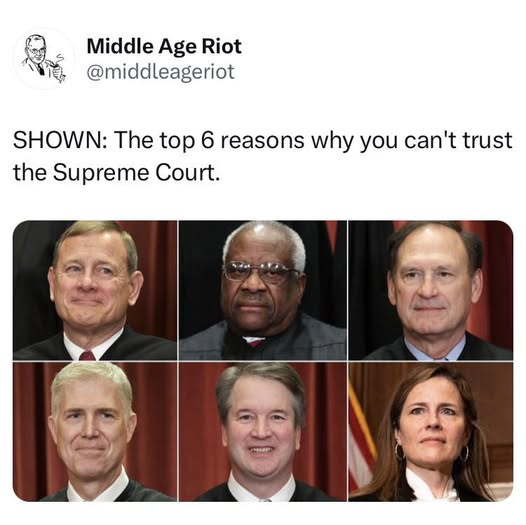
Why does he advertise his IQ range on his hat?












https://liberalsarecool.com/post/787549086507237376/all-these-justices-are-going-against-their


All these justices are going against their previous opinions now that a Republican is in the White House.
The lying, the perjury, the deception. MAGA101
Here’s how the deficit performed under Republican and Democratic presidents, from Reagan to Trump
This article was updated Aug. 2 to include a graph with the annual federal deficit in constant dollars. A viral post portrays Democrats, not Republicans, as the party of fiscal responsibility, with numbers about the deficit under recent presidents to make the case.
Alex Cole, a political news editor at the website Newsitics, published the tweet July 23. Within a few hours, several Facebook users posted screenshots of the tweet, which claims that Republican presidents have been more responsible for contributing to the deficit over the past four decades.
Those posts racked up several hundred likes and shares. We also found a screenshot on Reddit, where it has been upvoted more than 53,000 times.
“Morons: ‘Democrats cause deficits,’” the original tweet reads.
Screenshots of the tweet on Facebook were flagged as part of the company’s efforts to combat false news and misinformation on its News Feed. (Read more about our partnership with Facebook.)
At PolitiFact, we’ve reported extensively on how Republicans and Democrats often try to pin the federal deficit on each other — muddying the facts in the process. So we wanted to see if this Facebook post is true.
We reached out to Newsitics, the media outlet that Cole founded and works for, to see what evidence he used to compose the tweet and didn’t hear back. Our review shows the numbers basically check out, but they don’t tell the full story.
What even is the deficit?
Some people confuse the federal deficit with the debt — but they’re two separate concepts.
The Department of the Treasury explains it like this: The deficit is the difference between the money that the government makes and the money it spends. If the government spends more than it collects in revenues, then it’s running a deficit.
The federal debt is the running total of the accumulated deficits.
Following the money
Now let’s take a closer look at each president’s impact on the federal deficit.
To check the numbers in Cole’s tweet, we went to the Federal Reserve Bank of St. Louis, which has an interactive database for these kinds of figures. Here’s what we found for each claim:
“(President Ronald) Reagan took the deficit from 70 billion to 175 billion.” This is more or less accurate. The federal deficit went from about $78.9 billion at the beginning of Reagan’s presidency to $152.6 billion at the end of it. At points between 1983 and 1986, the deficit was actually more than $175 billion.
“(George H.W.) Bush 41 took it to 300 billion.” Close, but not exactly. The number was around $255 billion at the end of Bush’s term. The deficit spiked at around $290.3 billion the year before he left office.
“(Bill) Clinton got it to zero.” This is true. During his presidency, Clinton managed to zero out the deficit and end his term with a $128.2 billion surplus.
“(George W.) Bush 43 took it from 0 to 1.2 trillion.” This is in the ballpark. Ignoring the fact that he actually started his presidency with a surplus, Bush left office in 2009 with a federal deficit of roughly $1.41 trillion.
“(Barack) Obama halved it to 600 billion.” This is essentially accurate. Obama left the presidency with a deficit of approximately $584.6 billion, which is more than halving $1.41 trillion. The deficit was even lower in 2015 at around $441.9 billion.
We had to look for more recent data to back up Cole’s allegation that “Trump’s got it back to a trillion.”
Featured Fact-check
A Treasury Department statement from June put the federal deficit at about $747.1 billion so far this fiscal year. But the agency also reported that Washington is on track to post a $1.1 trillion deficit by the end of September, which backs up Cole’s claim.
After we published this story, some readers asked us to look at the annual deficit in terms of constant dollars, which adjust for inflation. Data since 1940 show that the deficit was highest in 2009, 2010 and 2011 — the height of the Great Recession and the aftermath of the 2009 stimulus package.
Presidential power
How much power do presidents have to change the deficit anyway?
The president does affect the budget by negotiating and signing appropriations bills. But there’s a lot more to it.
First, the country’s economic situation has a big impact on the federal deficit. The Great Recession affected the deficit near the end of George W. Bush’s administration and the beginning of Obama’s, said Stephen Ellis, executive vice president of the nonprofit Taxpayers for Common Sense. There was more spending on safety net programs like food stamps and Medicaid and less income from taxes.
Second, new presidents take office in January and, for the most part, inherit the budget from the previous administration for the remainder of the fiscal year — not to mention legislation passed in years prior. “Even the ‘dream budget’ that the president proposes is tied by all sorts of historical obligations and economic conditions,” Tara Sinclair, an associate professor of economics and international affairs at George Washington University, told PolitiFact.
None of that is to say that the president doesn’t have any effect on the deficit, Ellis said. He used Reagan’s tax cuts and Obama’s stimulus package as examples of how the president can affect deficit spending.
The combination of spending hikes and tax cuts amplifies deficits. Trump oversaw both. While the rise in spending was bi-partisan, the tax cuts were a Republican effort that Trump championed. In the time since Trump signed his landmark Tax Cuts and Jobs Act in December 2017, the deficit has increased by more than $100 billion. A Congressional Budget Office report from April 2018 found that the law could add almost $1.9 trillion to the deficit over 10 years.
But Cole’s tweet still lacks some nuance.
Our ruling
A viral tweet made several claims about how the deficit has grown under Republican presidents and shrunk under Democrats.
On the whole, the numbers presented for each president are basically accurate. However, it’s worth clarifying that presidents alone are not responsible for the rise and fall of the federal deficit.
The tweet is accurate but needs additional information. We rate it Mostly True.
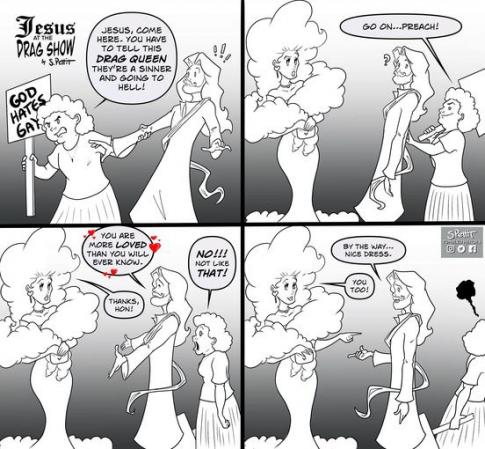
This church is also pro LGBTQ+ including having a drag queen event. Hugs
Allendale United Methodist Church in St. Petersburg, Florida. | Screenshot: Google Maps
A church in Florida has sent the local sheriff’s office an invoice after law enforcement officials parked their vehicles in its parking lot against the pastor’s wishes as they sought to carry out an unspecified investigation.
Allendale United Methodist Church in St. Petersburg, Florida, posted a photograph to Facebook on June 17 showing an invoice addressed to the Pinellas County Sheriff’s Office. The invoice requests a payment of $10,000 for “unauthorized use of [the] private church parking lot beginning at 6:00 AM.”
The invoice maintained that the presence of “13 vehicles occupying 17 parking spots” resulted in a “disruption to community access, operations, and congregational use of property.”
The document stressed that “continued use without coordination or consent may result in legal action or additional penalties,” vowing that the church will use payment received from the law enforcement agency to pay for “legal services for immigrants.”
Andy Oliver, the pastor of Allendale, who has been outspoken in his advocacy against U.S. Immigration and Customs Enforcement, posted a video to Facebook on June 17 documenting the presence of law enforcement vehicles in the church parking lot.
The video shows Oliver asking law enforcement officials if he could help them. One of them responded by telling Oliver, “We’re just waiting for an operation.”
“Is this involving ICE?” Oliver asked. Multiple law enforcement officials denied that the operation in question involved ICE but declined to provide further details other than stating, “It’s a Sheriff’s Office investigation.” After the official informed Oliver that the investigation did not involve anything on his property, the pastor asked the law enforcement officials to leave: “I don’t want policing to be staged here. Definitely, ICE is not welcome here.”
The officers agreed to leave, and a subsequent video posted to Facebook shows a dozen vehicles, both marked and unmarked, exiting the property.
Oliver’s Facebook page makes the dislike of ICE at his church clear. The cover photo features an image of the church taken at night with the words “Abolish ICE” displayed on the side of the building.
The most recent public post on Oliver’s Facebook page links to a TikTok video showing the pastor speaking at an anti-ICE protest outside the Pinellas County Jail while wearing an “Abolish ICE” shirt on June 14, three days before law enforcement officials showed up on his property.
During his remarks, Oliver denounced ICE as a “weapon” that is “soaked in white supremacy.”
“It is the child of manifest destiny and Jim Crow, the bastard cousin of slave patrols and Indian removal,” he added. “ICE is the cold breath of empire whispering ‘You don’t belong.'”
Oliver referred to the Bible as he attempted to make the case against ICE.
“Jesus fled to Egypt as a refugee. Jesus knew what it meant to hear soldiers marching with orders signed in the blood of empire and Jesus, he was executed by the state, hung between thieves as a warning to the masses. His death was legal.”
“So, don’t you dare tell me that the Gospel is neutral. Don’t you dare sanitize the cross while ICE cages children under fluorescent lights. I believe in resurrection, but too many are still hanging on crosses of barbed wire borders, prison buses, ankle monitors and courtroom numbers that decide who gets to stay and who gets disappeared. ICE disappears people. And if your theology doesn’t scream for abolition, then your theology is frozen,” he proclaimed.
Oliver shared his belief that “this nation has built its wealth on stolen land and stolen labor, and ICE is just the newest name for the oldest sin.” He described ICE as “white supremacy in a windbreaker, colonialism with a clipboard” and “hatred with a hollowed-out smile.”
“Our God does not deport, our God delivers,” he said. “Our God does not separate families, our God sets captives free.”
“ICE is sin, borders are a lie, cages are the devil’s architecture and silence is complicity. We won’t be silent. We won’t be complicit. We won’t stop until every child is reunited, every detainee is released and every system built on hate melts into history,” he vowed.
Oliver’s advocacy against ICE is not the only example of the pastor’s progressive activism.
In 2023, after the Florida Department of Education rejected an Advanced Placement African-American Studies course over concerns it promoted critical theory, Oliver offered the class at his church.
Since returning to the White House in January, President Donald Trump and his administration have ramped up enforcement of immigration law, which has seen waves of ICE raids seeking to detain immigrants who are in the U.S illegally.
While some have defended the measure as a bid to enforce the country’s immigration laws, as millions of immigrants are in the country illegally, some Christian leaders have voiced their displeasure with church properties being used in immigration raids.
In a January directive, the Trump administration rescinded the U.S. Department of Homeland Security’s policy limiting the deportation of illegal immigrants in so-called “sensitive areas.”
The Roman Catholic Diocese of San Bernardino in San Bernardino, California, issued a statement this week criticizing the “change and increase in immigration enforcement in our region and specifically our diocese.”
“We have experienced at least one case of [Immigration and Customs Enforcement] agents entering a parish property and seizing several people,” Bishop Alberto Rojas wrote.
“While we surely respect and appreciate the right of law enforcement to keep our communities safe from violent criminals, we are now seeing agents detain people as they leave their homes, in their places of work and other randomly chosen public settings.”
Ryan Foley is a reporter for The Christian Post. He can be reached at: ryan.foley@christianpost.com
Do Trump supporters have regrets? by Ann Telnaes
Not as many as there should be Read on Substack
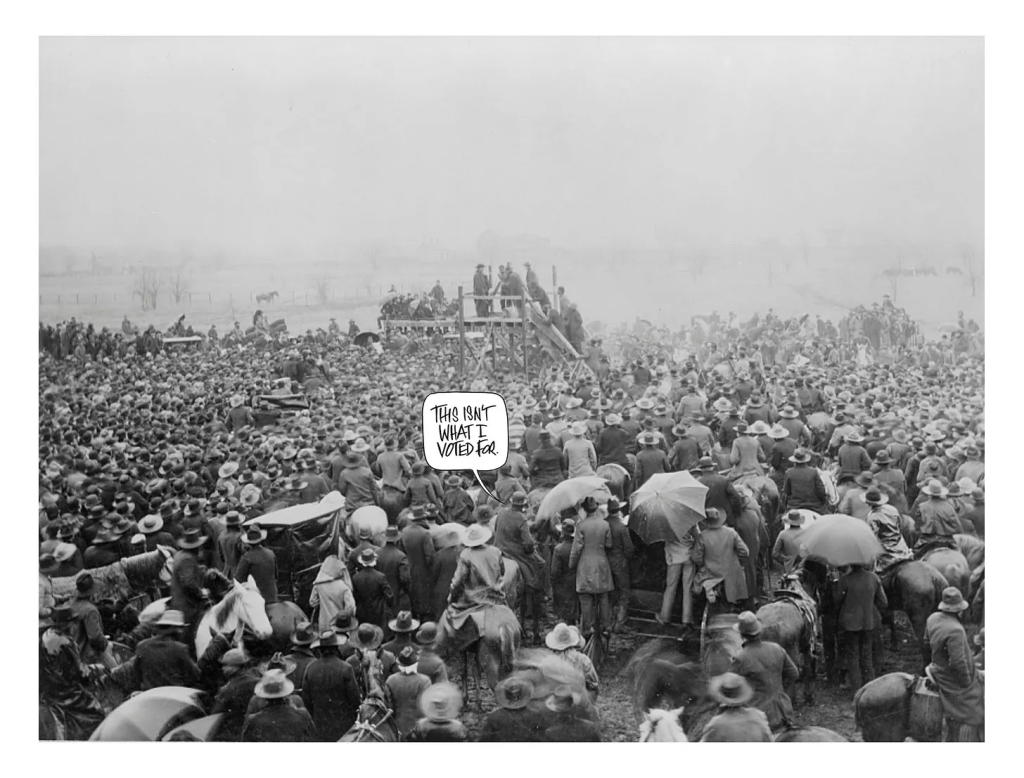
(photo: J.L. Mertins/ Library of Congress)
Trump has always played to Americans’ fears and prejudices.
===============================================
Totally Obliterated by Clay Jones
Stinky Pete rises again Read on Substack

I’ve had this idea for a few days, but I wasn’t sure about it. Then Defense Secretary Pete Hegseth unfairly exploded on a reporter for merely doing her job, so I decided he deserves this. Fuck Pete Hegseth (but not literally).
Stinky Pete attacked a reporter, from Fox News of all places, for doing her job. Her crime was asking Pete a question.
Jennifer Griffin of Fox News asked about whether there was any certainty that highly enriched uranium was stored at the mountain bunker bombed by the US, given that satellite photos showed more than a dozen trucks were seen there two days in advance.
Pete replied, “Of course, we’re watching every single aspect,” Hegseth said. “But, Jennifer, you’ve been about the worst, the one who misrepresents the most intentionally what the president says.”
How did Griffin misrepresent anything that Trump has said with that question? The question was based on the fact that satellite photos showed trucks at the site days before the bombing,” and while Trump was publicly mulling over whether or not to bomb it. In fact, it’s a very important question and there’s nothing wrong with it, even to the point that it shouldn’t piss anyone off, even a goose-stepping drunky fascist who can’t keep his dick in his pants. But, I guess the question does challenge the talking points and propaganda the regime has put out. This question was apparently worse than the time Sean Spicer was asked about crowd sizes. How dare you!!!!
After the bombing, Trump said Iran’s nuclear program was “totally obliterated.” As it turns out, not so much unless “totally” doesn’t mean totally anymore. Maybe they could say it was slightly obliterated. This is like the time when the military killed ISIS leader Abu Bakr al-Baghdadi, and Trump said he “died like a dog,” while telling other huge lies about the operation.
An early intelligence assessment leaked to media outlets on Tuesday suggested that the strikes only set Iran’s enrichment program back by a few months and did not destroy its core components.
Any challenge to the narrative that the sites weren’t “totally oblitereated” pisses TACO off nearly as much as being called TACO.
The preliminary analysis was produced by the Defense Intelligence Agency, the Pentagon’s intelligence arm, and reportedly found that the bombing of Iran’s nuclear sites sealed off the entrances to two facilities but did not collapse their underground buildings. Basically, Trump bombed the fuck out of their doors.
One of the idiot trolls at GoComics claimed the media was following Iran’s talking points, but no…we’re following US intelligence on this. By the way, US intelligence, or any other intelligence, doesn’t include Donald Trump. This is not the first time Trump has had issues with American intelligence. He once sided with Putin over US intelligence.
I don’t know which makes the regime angrier, the analysis or the leak. It sure pissed off White House SpokesBarbie Karoline Leavitt.
Leavitt rejected the intelligence report and accused CNN, which first revealed it, of “fake news.” She later sent a tweet. (snip-MORE, tweet’s on the page)
How is this possible in the land of the free and the home of the brave? Is this a democracy anymore? Have we become a thug nation of lawlessness? Hugs
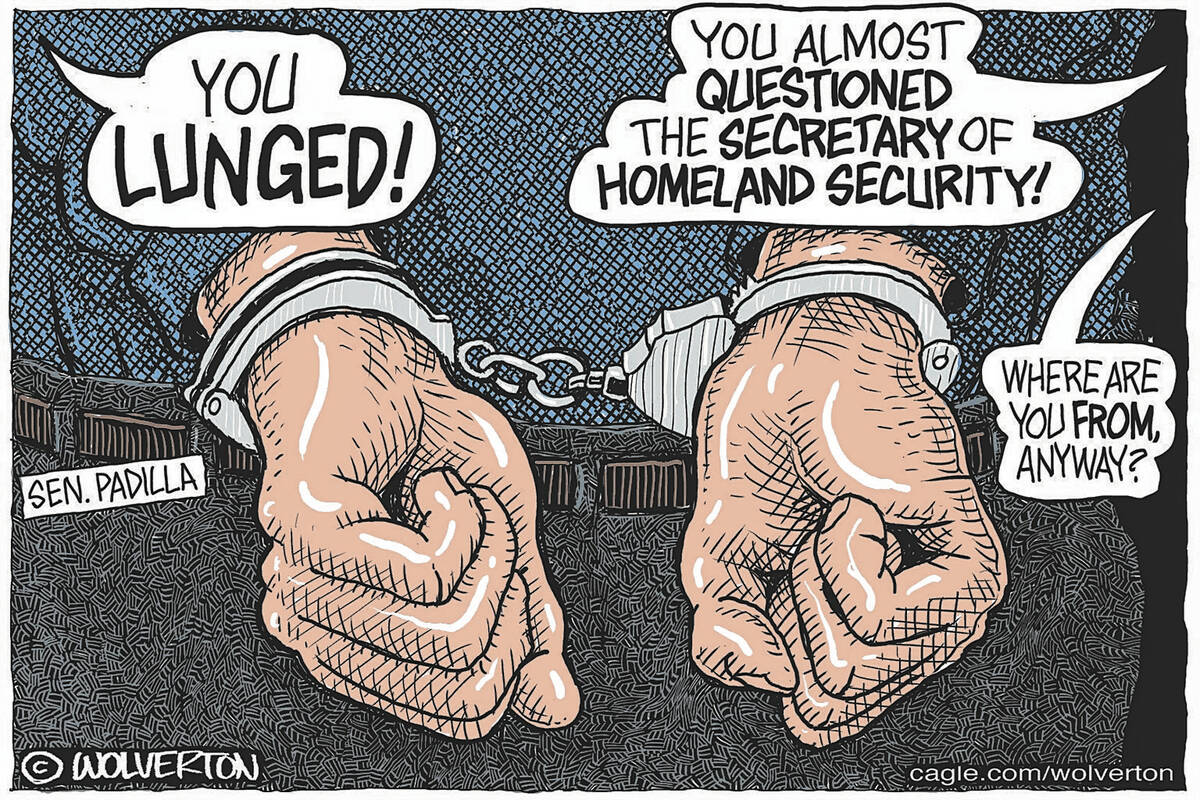
He has no citizenship to any country, despite SCOTUS case
By Maggie Quinlan, 1:08PM, Wed. Jun. 4, 2025
Jermaine Thomas, who says he was deported to Jamaica without a passport though he’s never been to the country (Provided by Jermaine Thomas)Ten years ago, Jermaine Thomas was at the center of a case brought before the U.S. Supreme Court: Should a baby born to a U.S. citizen father deployed to a U.S. Army base in Germany have U.S. citizenship?
Last week, Thomas was escorted onto a plane with his wrists and ankles shackled, he says. He arrived in Jamaica, a country he’d never been to, a stateless man.
“I’m looking out the window on the plane,” Thomas told the Chronicle, “and I’m hoping the plane crashes and I die.”
Thomas has no citizenship, according to court documents. He is not a citizen of Germany (where he was born in 1986) or of the United States (where his father served in the military for nearly two decades) or of his father’s birth country of Jamaica (a place he’d never been).
Thomas doesn’t remember Germany. He says he thinks his first memory is in Washington state, but he moved around so much in his military family that it was hard to keep track.
He spent most of his life in Texas, much of it homeless and in and out of jail, he says. His parents divorced when he was too little to remember. His mother, a nurse, remarried to another man in the Army. They moved a lot, and as she and the stepfather had their own kids, Thomas says he struggled in the new family setup.
So at about about 11 years old, he went to stay with his biological father in Florida. By then, his dad was retired from an 18-year career in the U.S. military, he says. His dad died from kidney failure not long after, in 2010.
“If you’re in the U.S. Army, and the Army deploys you somewhere, and you’ve gotta have your child over there, and your child makes a mistake after you pass away, and you put your life on the line for this country, are you going to be okay with them just kicking your child out of the country?” Jermaine says, phoning the Chronicle from a hotel in Kingston, Jamaica. “It was just Memorial Day. Y’all are disrespecting his service and his legacy.”
From Killeen to Kingston
Thomas says it all began with an eviction in Killeen, Texas, which is about an hour north of Austin. Thomas didn’t know where he’d go next, so to get things out of the apartment quickly, he says he moved all of the stuff into the front yard.
While he was gathering things up in the yard, he was joined by his rottweiler, Miss Sassy Pants, whose leash he had tied to a pole.
Then Killeen police showed up. Thomas says they asked for his ID without telling him what he was in trouble for. He says he responded: I haven’t committed a crime and I don’t want to talk to you. They told him that they’d gotten a call about a dog being tied up. Next, they asked if he had the dog’s immunization records or chip number. He said they checked her chip and didn’t see Sassy’s name, so they told Thomas they’d be taking her to the pound.
The dog was loaded into a truck, and Thomas says at this point, he was arrested. Killeen police confirmed that he was arrested for suspected trespassing with no other charges. That’s a misdemeanor in Texas. He went to the Bell County Jail, where he says a court-appointed lawyer told him he could be sitting in a cell for eight months if he wanted to take the case to trial.
After about 30 days in jail, which resulted in losing his job as a janitor, Thomas says he signed paperwork to be released with conditions. But instead of being released, he was transferred to an Immigration and Customs Enforcement detention center in Waco. He was there only a few hours before being transferred again to an ICE detention camp in Conroe, Texas, just north of Houston.
He says he spent two and half months incarcerated in Conroe, and it seemed like no one knew the status of his case. According to Thomas, a deportation officer told him repeatedly that he had a very unique case, and that it was out of their hands in Texas, and now in the hands of “Washington, D.C.”
“You keep explaining to me that I’m being detained in suspended custody, in detention, but if I don’t have a release day and I don’t get to see a judge, that’s pretty much a life sentence,” Thomas says.
Feeling frustrated with his indefinite imprisonment, Thomas says he called the Department of Homeland Security and the Office of the Inspector General to file a report about what he thought was unlawful detention.
His case only got more confusing after that, he says. After a guard told him he would soon be released, Thomas was allowed a mesh bag to put his property in. He says all he had was some paperwork from his citizenship case and a phone. The phone didn’t have service – naturally, as he hadn’t been able to pay his phone bill since being incarcerated.
Officers brought Thomas to a room full of Spanish speakers. Thomas says he found one man who spoke “broken English” who said they were all being deported to Nicaragua. “So I get to banging on the door, and I’m like: Hey, why am I in here with them?”
 Jermaine Thomas in Kingston (Provided by Jermaine Thomas)
Thomas says he decided then that if officers asked him to put his hands behind his back, he just wouldn’t. “I thought, I’m not gonna do it,” he says. “I’m gonna refuse to do it: Respectfully, I don’t mean to be a problem or anything like that, but you’re not gonna just kidnap me and traffic me across the lands and international lines and deport me like I’ve been seeing y’all do on the news.”
The Back of the Airbus
At least they sent him to Jamaica, says Thomas’ new friend and fellow deportee Tanya Campbell. It may be a country he’s never stepped foot in, and it may be he’s only there because of his “appearance,” as she puts it, but at least the language is English. Campbell, who actually grew up in Jamaica, was imprisoned for manslaughter more than a decade ago in New York. Upon her release from prison a few weeks ago, ICE picked her up. On May 29, she says she was one of roughly 100 people brought to a plane on a tarmac in Miami, bound for Kingston.
At the airport, as she exited a van and was being shackled, she noticed a man surrounded by between eight and 10 officers. That’s how she describes first seeing Jermaine. He was the last to board the plane, “And it was like a walk of shame,” she says. He was seated at the back with officers on either side. She assumed he was a fugitive.
Thomas says he sat in the 31st row. Landing was “bizarre, too real,” he says. “It was like a stampede. Everybody just got up and got off the plane.”
Thomas waited in the last row.He says an ICE officer got on the plane and said: “I don’t have records for more than half of these people. There’s something wrong.”
ICE and DHS did not respond to our questions.
Thomas says he doesn’t know what to do in Jamaica. He finds people difficult to understand, plus many speak Patois, and he doesn’t. He doesn’t know how to get a job. He doesn’t know if it’s the Jamaican or U.S. government paying for his hotel room, and for how long that will last. He’s not sure if it’s even legal for him to be there.
Editor’s Note Friday, June 6, 4:44pm: This story has been updated to correct the year of Thomas’ father’s death. The Chronicle regrets the error.
I could have written large parts of this myself. It is scary to be in our position and at the mercy of those who have so much money they will never understand our needs or it seems even care. Most of congress are multimillionaires. They see their jobs not to look out for people like me, but to gain ever more wealth and power for themselves. Which leads to the billionaire bailout bill the republicans are pushing to pass right now. Hugs
Opinion: Struggling to get by on programs on the chopping block
The author asserts cuts to programs such as Social Security Disability Insurance will make it difficult for her to afford basic necessities The program provides month payments to people who have a disability that stops or limits their ability to work. (Dreamstime/TNS)
Being a care provider in a nursing home is backbreaking work. It includes heavy lifting and spending all day on your feet, helping patients eat, dress and use the bathroom while keeping track of dozens of patients who all have different needs, medicines and preferences. It’s never easy, but during my career I held myself to the standard of providing the care I would want someone to give to one of my family members.
I was a certified nursing assistant and medication aid in nursing homes before retiring due to health problems. I loved my job. It provided me with more than a paycheck; it gave my life meaning. It felt good to be someone people could depend on, especially in times of need. I loved being the first face my patients would see in the morning and the last at night. It was physically and emotionally draining at times, but always worth it. I’ve learned that anything in life worth having is a struggle to obtain. I miss working every day.
Now, my main source of income is Social Security Disability Insurance. Without it, I wouldn’t be able to cover my rent or help take care of my daughters, grandchildren or father. My monthly disability check, which I put toward rent, laundry, bills and other necessities, goes fast. The only way I am able to cover the rest of my expenses each month is through programs such as the Supplemental Nutrition Assistance Program and the Low Income Energy Assistance Program and Medicaid.
I’m prediabetic, so I have to be mindful about what I eat. SNAP is the only way I am able to afford healthy food. Lately, the price of everything in the grocery store has gone up. I shop carefully, but some weeks I have to forego buying meat to save money. My SNAP benefits have gone down significantly in recent months, which has already made it harder for me to afford the food I need. Across Pennsylvania, over 2 million people receive SNAP benefits. That’s thousands of families in our state, just like me, who depend on this program to put food in the mouths of their children.
I’ve received Medicaid on and off for over 20 years. It has helped me pay for important surgeries including a vision surgery, cystoscopy and a hysterectomy. Medicaid helps me cover copays and deductibles and access mental health services. Losing Medicaid would mean sacrificing health care and having to pay my medical costs out of my own pocket, which I cannot afford.
Every winter, LIHEAP benefits help me keep my home warm. It keeps my heating bill manageable so that I don’t have to use the stove to generate heat. Without LIHEAP, I would need to make tough decisions about which bills to pay, whether that’s rent, electricity or gas. It would be a situation of robbing Peter to pay Paul. My monthly budget is extremely fragile and the possibility of losing LIHEAP, which provides me about $200 each winter, is enough to put my whole financial situation at risk. When I hear that politicians in Washington want to make billions of dollars worth of cuts to SNAP, Medicaid, LIHEAP and other programs, it makes me incredibly anxious. Without these programs, I wouldn’t be able to stock my fridge, go to the doctor or heat my home.
I spent decades caring for patients in need and did it with pride. No one ever expects to be disabled and suddenly have to stop working. You never know what could happen and never think it could happen to you until it does. I didn’t think I would ever need back the tax dollars I put into the system. But God had a different plan for me. These programs are so important for me and millions of Americans.
But the programs are also part of what makes America a great and a caring nation. They ensure that any American — our neighbor, our family member, or a co-worker — who gets sick can live with dignity in the richest nation on earth. It seems like Republicans in Congress have no interest in supporting everyday people. They just want to make the rich richer.
By voting in favor of cuts to Medicaid and SNAP, my Congressional representative, Rep. Ryan Mackenzie, voted to turn his back on constituents like me. With these cuts, people will suffer and end up on the streets. People like me, who are already doing everything we can to make it work, will struggle even more.
I am calling on Sens. Fetterman and McCormick to chart a different path and put an end to these proposed cuts. Lives are on the line. It’s time for our leaders to show that they care and that they are willing to stand up against billionaires. On behalf of the millions of Pennsylvanians who rely on these SNAP, Medicaid and LIHEAP, I urge you to protect these programs and our ability to provide for our families.
This is a contributed opinion column. Pamela Berman is a Bethlehem resident and former certified nursing assistant. The views expressed in this piece are those of its individual author, and should not be interpreted as reflecting the views of this publication. Do you have a perspective to share? Learn more about how we handle guest opinion submissions at themorningcall.com/opinions.