This is an article but one I wanted to share as I will soon be posting on what is a corporate democrat. The Democratic Party went to the right under Pelosi’s management / guidance. She pushed that for two reasons, one to chase the mythical center voters that as the republicans went ever harder right the center moved and the Democratic Party rather than staying where they were moved right to keep the “center voters”. Also Pelosi and the older elected members of congress felt they needed corporate money so they had to stop fighting businesses so hard to help the workers and the poor to instead play nice with the upper incomes. Hugs
Ever since Donald Trump won the election last month, bringing the GOP not just the White House but the House, the Senate, and the popular vote for the first time in 20 years, Democratic pundits, consultants, elected officials, and influencers have written think pieces, taken to social media, and sat down on podcasts to theorize why Democrats lost in the spectacular fashion they did. They blame this constituency group or that constituency group, this policy tweak or that policy tweak, this campaign decision or that campaign decision, but the truth is very simple:The Democratic Party is trying to serve two masters—the people and the corporate donors. And until it picks the people over its corporate masters, the Democratic Party will keep losing.
For as long as I can remember, the Democratic Party has marketed itself as the party of working class people, while the Republican Party has been painted as the out-of-touch, elitist, uncool party. When you’ve marketed yourself as the party of the working class, you cannot spend years in power and say the economy is booming while people struggle to afford rent and groceries. It was out of touch, and Democrats lost credibility by claiming “Bidenomics” was successful.
While some will point to the fact that the U.S. economy fared better than others during the pandemic in terms of inflation, that does not mean the economy is “good.” Working-class Americans from all backgrounds have been hurting. I cannot go to someone’s doorstep in my hometown of Cleveland, Ohio, one of the poorest big cities in America where one out of every two children lives in poverty, and tell them that the economic pain they are feeling is not bad because other countries have it worse.
US President Joe Biden speaks to the press during his visit to the National Slavery Museum in Morro da Cruz, near Luanda, on December 3, 2024. ANDREW CABALLERO-REYNOLDS/AFP via Getty Images
Democrats should have spent the past four years tackling corporate greed aggressively, fighting for those communities hit hardest by this greed. They should have championed bold policies like Medicare for All and tuition-free college, things that would ease economic burdens on working class Americans.
“You should not go into debt if you get sick or pursue an education” would be one hell of a rallying cry for the Democratic Party. Currently, the Democratic Party cannot stand for policies that get at the root causes of corporate greed.
Why? Because the corporate donor class, those who write the checks, have ensured that those who hold titles in the Democratic Party do not champion policies that might hurt their profits.
When I hear from Democratic voters as I travel this country, I notice that most believe that Democrats broadly support things like universal healthcare and raising the minimum wage, but the Republican Party is standing in the way. While the Republican party does stand in the way of those policies, so too does the Democratic Party establishment. For instance, when Democrats held power in the Senate in 2021, the unelected Senate Parliamentarian, the official advisor to the United States Senate on the interpretation of Standing Rules of the United States Senate and parliamentary procedure, would not allow the Senate to vote on raising the federal minimum wage to $15 per hour. However, the Senate Parliamentarian can be overruled by the Vice President. The Biden-Harris administration decided against overruling the decision and allowing the Democratic-controlled Senate to vote on raising the minimum wage.
Decisions like these are made with donors in mind. I always say that inaction is bought. Eventually in politics, inaction catches up to you. On November 5, inaction caught up to the Democratic Party.
Everyday Americans do not live the same lives as the ultra-wealthy donor class. Everyday Americans sit at tables and make tough budget cuts for things they may need because bills start piling up. Sixty percent of Americans are living paycheck to paycheck. If Democrats continue to prioritize policies that benefit their ultra-wealthy donors over policies that help the working class, they can expect to see Republicans harness the anger of those feeling left behind.
On February 1, the Democratic National Committee will meet in Maryland to elect a new party Chair. Currently, the DNC Chairman is Jaime Harrison, formerly a lobbyist for tobacco companies, coal producers, and big banks. These are industries that have repeatedly hurt the working class.
If Democrats want to win back the trust of the people, they must champion bold policies that help people. To do that, they cannot take money from the very corporations that stand in the way of those bold policies.
When the Democratic National Committee votes on a new chair, it must be someone who commits to getting corporate money out of the party. Otherwise, Democrats will be stuck in the same position: fighting for corporate interests while trying to convince the people the party is on the side of the working class.
Nina Turner is a former Ohio state senator, a senior fellow at the Institute on Race, Power and Political Economy at the New School, and the founder of We Are Somebody.
The views expressed in this article are the writer’s own.
August 29, 1758 The first Indian reservation, Brotherton, was established in New Jersey. A tract of three thousand acres of land was purchased at Edge Pillock, in Burlington County. The treaty of 1758 required the Delaware Tribes, in exchange for the land, to renounce all further claim to lands anywhere else in New Jersey, except for the right to fish in all the rivers and bays north of the Raritan River, and to hunt on unenclosed land. History Of The Brotherton Reservation
August 29, 1957 Following consultations among the NATO allies and other nations, the Western (non-Communist) countries presented to the United Nations a working paper entitled, “Proposals for Partial Measures of Disarmament,” intended as “a practical, workable plan to start on world disarmament.” The plan proposed stopping all nuclear testing, halting production of nuclear weapons materials, starting a reduction in nuclear weapons stockpiles, reducing the danger of surprise attack through warning systems, and beginning reductions in armed forces and armaments.
August 29, 1957 African Americans in Milledgeville, Georgia, wait in line to vote following the Civil Rights Act of 1957. The U.S. Congress passed the Civil Rights Act, the first such law since reconstruction. The bill established a Civil Rights Commission which was given the authority to investigate discriminatory conditions. A Civil Rights Division was created in the Department of Justice, allowing federal prosecutors to obtain court injunctions against interference with the right to vote, among other things. In an ultimately futile attempt to block passage, then-Democrat, former Dixiecrat, and later Republican Senator Strom Thurmond of South Carolina set the all-time filibuster record: 24 hours, 19 minutes of non-stop speaking on the floor of the Senate. A filibuster is the deliberate use of prolonged debate and procedural delaying tactics to block action supported by a majority of members. It can only be stopped with a 60% majority voting to end debate. Senator Strom Thurmond with his 24-hour filibustering speech
August 29, 1961 Robert Moses,leader of SNCC The Student Nonviolent Coordinating Committee (SNCC) was pursuing its voter registration drive in Amite County, Mississippi. Of 5000 eligible Negro voters in the county, just one was registered to vote. SNCC leader Robert Moses was attacked and beaten this day outside the registrar’s office while trying to sign up two voters. Nine stitches were required but the three white assailants were acquitted. Bob Moses recorded the incident Hear Moses recall the time
August 29, 1970 Between 15 and 30 thousand predominantly Chicanos (Americans of Mexican descent) gathered in East LA’s Laguna Park as the culmination of the Chicano National Moratorium. It was organized by Rosalio Munoz and others to protest the disproportionate number of deaths of Chicano soldiers in Vietnam (more than double their numbers in the population). There had been more than 20 other such demonstrations in Latino communities across the southwest in recent months. Three died when the anti-war march turned violent. The Los Angeles Police Department attacked and one gunshot, fired into the Silver Dollar Bar, killed Ruben Salazar, a Los Angeles Times columnist and a commentator on KMEX-TV (he had been accused by the LAPD of inciting the Chicano community). The Chicano Moratorium Ruben Salazar LA Times
Chef Jose Andres with World Central Kitchen visits a temporary shelter for the victims of the Southern California wildfires at the Pasadena Convention Center in Pasadena, Calif., Thursday, Jan. 9, 2025. (AP Photo/Damian Dovarganes)
Celebrity chef and local D.C. icon Jose Andres is pushing back against Trump’s claim that his federal takeover and law enforcement surge in the nation’s capital has resulted in a “boom town” for the city’s restaurants.
Trump on Monday rejected reports that the flood of federal agents and National Guard troops had hurt D.C. restaurant and nightlife industry.
“Half the restaurants closed, because nobody could go, because they were afraid to go outside,” Trump said. “Now those restaurants are opening and new restaurants are opening up. It’s like a boomtown.”
Andres, in a Tuesday post on X, directly and sarcastically addressed Trump, saying: “I understand why you are confused…all your time in DC you haven’t eaten ONCE outside the White House or your own hotel. I’ve lived here for 33 years, and it’s a flat out lie that half the restaurants have closed because of safety…but restaurants will close because you have troops with guns and federal agents harassing people…making people afraid to go out.”
The Spanish-American restaurateur and founder of the global food charity World Central Kitchen and Trump have exchanged public hostilities in the past.
When a grand jury returns an indictment, it’s called a true bill. On those exceedingly rare occasions where they decline to sign off on an indictment prosecutors present to them, it’s called a no bill. In 25 years at DOJ, I never had a grand jury no bill one of my cases. And I can only recall a couple of instances where it happened in the entire district.
Donald Trump’s new U.S. Attorney in the District of Columbia can’t say that. Former judge, Fox News host, and defendant in a defamation case where she is accused of spreading false information about voter fraud, Jeanine Pirro, recently received three no bills—all in the same case. The U.S. Attorney’s Office tried to charge Sydney Lori Reid with felony assault on three separate occasions this month, but the grand jury declined to do so. CNN reports that “In one case this month — related to an FBI agent and an immigration officer allegedly scrapping with a detainee — the federal grand jury in Washington voted ‘no’ three times.”
Proceedings inside of the grand jury are conducted in secret, so there is no way of knowing why the grand jury rejected the charge. Typically, if a grand jury expresses some hesitation over a case, prosecutors will bring in additional witnesses or offer counsel about relevant laws to help alleviate their concerns. To fail to indict not once, but three times, indicates a failure of both competence and judgment.
When asked about her failure, Pirro responded, “Sometimes a jury will buy it and sometimes they won’t. So be it, that’s the way the process works.” But that’s not true. The standard for obtaining an indictment is a low one: The prosecution need only persuade the grand jury that probable cause to proceed on the charges exists. That’s a far lower bar than the requirement that the government prove a crime was committed beyond a reasonable doubt before a trial jury can convict. Any prosecutor who doesn’t back off of a case where they can’t even convince grand jurors that probable cause exists, knowing that much more will be expected of them at trial, is wasting taxpayer resources. Prosecutors have plenty of cases. Move on and do a righteous one. But apparently, that’s not how the D.C. U.S. Attorney’s Office operates these days.
Prosecutors, who have 30 days following an arrest like Reid’s to obtain an indictment, told a judge they now plan to bring misdemeanor charges against Reid. Misdemeanor charges can be brought by prosecutors without the need to present them to a grand jury for approval. But we already know at least some of the facts in the case, because a statement of facts was filed in support of the arrest warrant.
The affidavit alleges that Reid assaulted FBI agent Eugenia Bates. Reid was video recording agents outside of the D.C. jail, where at least two individuals were being arrested as “known gang members” and transferred into ICE custody. Reid was directed to step back, and according to the affidavit, she “got in Officer Lang’s face.” He said she smelled of alcohol and tried to interfere with the transfer of custody. According to the government, an officer pushed her against a wall, but she continued to struggle after being told to stop.
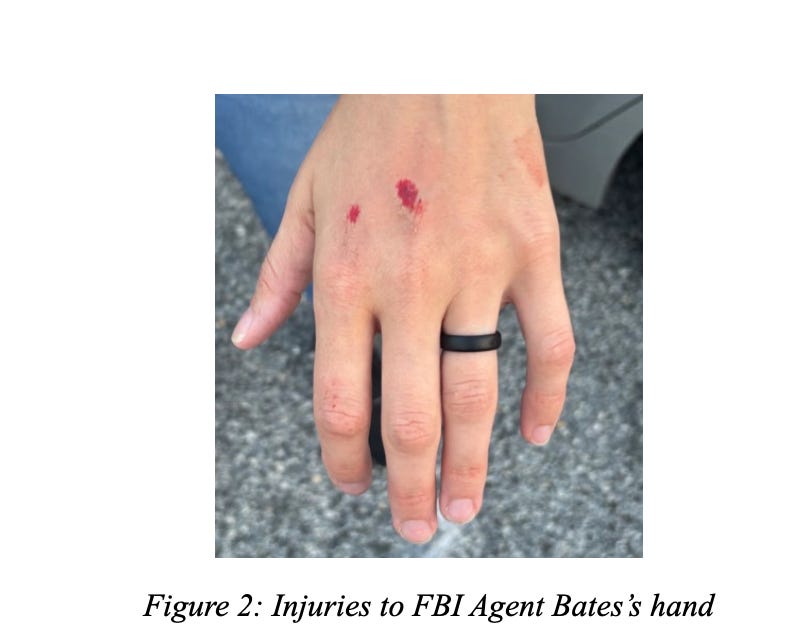
Here’s the heart of the allegation against Reid: “Agent Bates came to Office[r] Lang’s assistance in trying to control REID. REID was flailing her arms and kicking and had to be pinned against a cement wall. During the struggle, REID forcefully pushed Agent Bates’s hand against the cement wall. This caused lacerations on the back side of Agent Bates’s left hand.”
To convict on the federal felony assault charge, the government would have to establish that Reid forcibly assaulted a federal agent. A “forcible assault” is an intentional threat or attempt to cause serious bodily injury by a person who has the apparent ability to do so, including any intentional display of force that would cause a reasonable person to expect immediate and serious bodily harm or death. The statement of facts alleges that Reid “intentionally and forcibly obstructed the transfer of suspects into FBI custody and made physical contact with FBI Agent Eugenia Bates and inflicted bodily injury in violation.” The grand jury didn’t buy, despite having three opportunities to do so, that there was probable cause, let alone proof beyond a reasonable doubt, to believe that some or all of that happened.
The lacerations, which were pictured in the statement of facts and presumably shown to the grand jury, seem relatively minor. And it’s difficult to see, at least with this statement of the facts, how a grand jury could conclude, as it must, that Reid was the cause of those “lacerations” or even acting voluntarily when they happened. Assuming they could prove all of that, even small cuts like these could hypertechnically constitute assault. But it’s easy to imagine a grand jury viewing charging it as a felony as overreaching.
Judge Sparkle L. Sooknanan will hold a hearing in the matter on Thursday morning at 11:30.
The grand jury process still works as a check and balance on prosecutors, as the Constitution intends. Trump may want you to think he’s all-powerful, but guardrails are still in place. His administration can’t bring felony charges without a grand jury’s approval, an important protection not just for Ms. Reid but for others, as DOJ’s portfolio of revenge investigations continues to grow.
We talked previously about a grand jury in Los Angeles that declined to indict. Now, it’s spread to D.C. And grand juries are only the first layer of guardrails in the criminal justice system, where they are joined by trial juries, judges, and the appellate process.
You’ve heard the line—the one that says prosecutors can indict a ham sandwich, that it’s just that easy. Next stop in D.C., seeing whether they can indict a Subway sandwich. They should think twice after their experience in Ms. Reid’s case with bringing marginal prosecutions to please the president. That’s not justice.
By CBS Chicago Team Updated on: August 26, 2025 / 9:16 AM CDT / CBS Chicago
Illinois Governor JB Pritzker spoke at a news conference Monday afternoon, addressing reports President Trump is planning to send the military to Chicago. Here is the full text of his remarks.
I want to speak plainly about the moment that we are in and the actual crisis, not the manufactured one, that we are facing in this city, and as a state, and as a country. If it sounds to you like I am alarmist, that is because I am ringing an alarm, one that I hope every person listening will heed, both here in Illinois and across the country.
Over the weekend, we learned from the media that Donald Trump has been planning, for quite a while now, to deploy armed military personnel to the streets of Chicago. This is exactly the type of overreach that our country’s founders warned against, and it’s the reason that they established a federal system with a separation of powers built on checks and balances.
What President Trump is doing is unprecedented and unwarranted. It is illegal. It is unconstitutional. It is un-American.
No one from the White House or the executive branch has reached out to me or to the mayor. No one has reached out to our staffs. No effort has been made to coordinate or to ask for our assistance in identifying any actions that might be helpful to us. Local law enforcement has not been contacted. We have made no requests for federal intervention. None.
We found out what Donald Trump was planning the same way that all of you did: We read a story in The Washington Post.
If this was really about fighting crime and making the streets safe, what possible justification could the White House have for planning such an exceptional action without any conversations or consultations with the governor, the mayor, or the police?
Let me answer that question: This is not about fighting crime. This is about Donald Trump searching for any justification to deploy the military in a blue city, in a blue state, to try and intimidate his political rivals.
This is about the president of the United States and his complicit lackey, Stephen Miller, searching for ways to lay the groundwork to circumvent our democracy, militarize our cities and end elections.
There is no emergency in Chicago that calls for armed military intervention. There is no inter- insurrection. There is no insurrection. Like every major American city in both blue and red states, we deal with crime in Chicago. Indeed, the violent crime rate is worse in red states and red cities.
Here in Chicago, our civilian police force and elected leaders work every day to combat crime and to improve public safety, and it’s working.
Not one person here today will claim we have solved all crime in Chicago, nor can that be said of any major American metro area. But calling the military into a U.S. city to invade our streets and neighborhoods and disrupt the lives of everyday people is an extraordinary action, and it should require extraordinary justification.
Look around you right now. Does this look like an emergency? Look at this. Go talk to the people of Chicago who are enjoying a gorgeous afternoon in this city. Ask the families buying ice cream on the Riverwalk. Go see the students who are at the beach after school. Talk to the workers that I just met taking the water taxi to get here. Find a family who’s enjoying today sitting on their front porch and ask if they want their neighborhoods turned into a war zone by a wannabe dictator. Ask if they’d like to pass through a checkpoint with unidentified officers in masks while taking their kids to school.
Crime is a reality we all face in this country. Public safety has been among our highest priorities since taking office. We have hired more police and given them more funding.
We banned assault weapons, ghost guns, bump stocks, and high-capacity magazines. We invested historic amounts into community violence intervention programs. We listened to our local communities, to the people who live and work in the places that are most affected by crime and asked them what they needed to help make their neighborhoods safer.
Those strategies have been working. Crime is dropping in Chicago. Murders are down 32% compared to last year and nearly cut in half since 2021.
Shootings are down 37% since last year, and 57% from four years ago. Robberies are down 34% year over year. Burglaries down 21%. Motor vehicle thefts down 26%.
So in case there was any doubt as to the motivation behind Trump’s military occupations, take note: 13 of the top 20 cities in homicide rate have Republican governors. None of these cities is Chicago.
Eight of the top 10 states with the highest homicide rates are led by Republicans. None of those states is Illinois.
Memphis, Tennessee; Hattiesburg, Mississippi have higher crime rates than Chicago, and yet Donald Trump is sending troops here and not there? Ask yourself why.
If Donald Trump was actually serious about fighting crime in cities like Chicago, he, along with his congressional Republicans, would not be cutting over $800 million in public safety and crime prevention grants nationally, including cutting $158 million in funding to Illinois for violence prevention programs that deploy trained outreach workers to deescalate conflict on our streets. Cutting $71 million in law enforcement grants to Illinois, direct money for police departments through programs like Project Safe Neighborhoods, the state and local Antiterrorism Training Program, and the Rural Violent Crime Reduction Initiative, cutting $137 million in child protection measures in Illinois that protect our kids against abuse and neglect.
Trump is defunding the police.
To the members of the press who are assembled here today, and listening across the country, I am asking for your courage to tell it like it is.
This is not a time to pretend here that there are two sides to this story. This is not a time to fall back into the reflexive crouch that I so often see, where the authoritarian creep by this administration is ignored in favor of some horse race piece on who will be helped politically by the president’s actions.
Donald Trump wants to use the military to occupy a U.S. city, punish his dissidence, and score political points. If this were happening in any other country, we would have no trouble calling it what it is: a dangerous power grab.
Look at the people assembled before you today, behind me. This is a full cross-section of Chicago’s leaders from the business world, the faith community, law enforcement, education, community organizations, and more. We sometimes disagree on how to effectively solve the many challenges that our state and our city face on a daily basis. But today, we are standing here united, in public, in front of the cameras, unafraid to tell the president that his proposed actions will make our jobs harder and the lives of our residents worse.
Earlier today in the Oval Office, Donald Trump looked at the assembled cameras and asked for me personally to say, “Mr. President, can you do us the honor of protecting our city?” Instead, I say, “Mr. President, do not come to Chicago.”
You are neither wanted here nor needed here. Your remarks about this effort over the last several weeks have betrayed a continuing slip in your mental faculties and are not fit for the auspicious office that you occupy.
Most alarming, you seem to lack any appropriate concern as our commander-in-chief for the members of the military that you would so callously deploy as pawns in your ever-more-alarming grabs for power.
As a governor, I’ve had to make the decision in the past to call up members of the National Guard into active service, and I think it’s worth taking a moment to reflect on how seriously I take that responsibility, and on the many things that I consider before asking these brave men and women to leave their homes and their communities to serve in any capacity for us.
As I’ve said many times in the past, members of the National Guard are not trained to serve as law enforcement. They are trained for the battlefield, and they’re good at it. They’re not trained to arrest people and read them their Miranda rights. They did not sign up for the National Guard to fight crime. And when we call them into service, we are reaching into local communities and taking people who have jobs and families away from their neighborhoods and the people who rely upon them.
It is insulting to their integrity and to the extraordinary sacrifices that they make to serve in the Guard to use them as a political prop, where they could be put in situations where they will be at odds with their local communities, the ones that they seek to serve.
I know Donald Trump doesn’t care about the well-being of the members of our military, but I do and so do all the people standing here.
So let me speak to all Illinoisans and to all Chicagoans right now. Hopefully the president will reconsider this dangerous and misguided encroachment upon our state and our city’s sovereignty. Hopefully rational voices, if there are any left inside the White House or the Pentagon, will prevail in the coming days. If not, we are going to face an unprecedented and difficult time ahead.
But I know you Chicago, and I know you are up to it. When you protest, do it peacefully. Be sure to continue Chicago’s long tradition of nonviolent resistance. Remember that the members of the military and the National Guard who will be asked to walk these streets are, for the most part, here unwillingly. And remember that they can be court martialed and their lives ruined if they resist deployment. Look to the members of the faith community standing behind me today for guidance on how to mobilize.
To my fellow governors across the nation who would consider pulling your National Guards from their duties at home to come into my state against the wishes of its elected representatives and its people, you would be failing your constituents and your country. Cooperation and coordination between our states is vital to the fabric of our nation and it benefits us all. Any action undercutting that and violating the sacred sovereignty of our state to cater to the ego of a dictator will be responded to.
The State of Illinois is ready to stand against this military deployment with every peaceful tool we have. We will see the Trump administration in court. We will use every lever at our disposal to protect the people of Illinois and their rights.
Finally, to the Trump administration officials who are complicit in this scheme, to the public servants who have forsaken their oath to the Constitution to serve the petty whims of an arrogant little man, to any federal official who would come to Chicago and try to incite my people into violence as a pretext for something darker and more dangerous: we are watching and we are taking names.
This country has survived darker periods than the one that we are going through right now, and eventually the pendulum will swing back, maybe even next year. Donald Trump has already shown himself to have little regard for the many acolytes that he has encouraged to commit crimes on his behalf.
You can delay justice for a time, but history shows you cannot prevent it from finding you eventually. If you hurt my people, nothing will stop me, not time or political circumstance, from making sure that you face justice under our constitutional rule of law.
As Dr. King once said, “The arc of the moral universe is long, but it bends toward justice.” Humbly I would add, it doesn’t bend on its own. History tells us we often have to apply force needed to make sure that the arc gets where it needs to go. This is one of those times.
To me, it seems damned important. We the people have all become owners/stockholders of Intel. What I get for avoiding the Friday evening news dump; it is in today’s newsletter.
WASHINGTON (AP) — President Donald Trump on Friday announced the U.S. government has secured a 10% stake in struggling Silicon Valley pioneer Intel in a deal that was completed just a couple weeks after he was depicting the company’s CEO as a conflicted leader unfit for the job.
“The United States of America now fully owns and controls 10% of INTEL, a Great American Company that has an even more incredible future,” Trump wrote in a post.
The U.S. government is getting the stake through the conversion of $11.1 billion in previously issued funds and pledges. All told, the government is getting 433.3 million shares of non-voting stock priced at $20.47 apiece — a discount from Friday’s closing price at $24.80. That spread means the U.S. government already has a gain of $1.9 billion, on paper.
The remarkable turn of events makes the U.S. government one of Intel’s largest shareholders at a time that the Santa Clara, California, company is in the process of jettisoning more than 20,000 workers as part of its latest attempt to bounce back from years of missteps taken under a variety of CEOs.
Intel’s current CEO, Lip-Bu Tan, has only been on the job for slightly more than five months, an d earlier this month, it looked like he might be on shaky ground already after some lawmakers raised national security concerns about his past investments in Chinese companies while he was a venture capitalist. Trump latched on to those concerns in an August 7 post demanding that Tan resign.
August 22, 1958 President Dwight Eisenhower announced a voluntary moratorium on nuclear weapons testing. A report outlining a system for monitoring and verifying compliance of a complete ban on such testing had been released just the day before. The Conference of Experts, as it was known, had been meeting in Geneva, Switzerland, to work out the details on detection of violations of such a treaty. The U.S. delegation was led by Nobel physics laureate Ernest Lawrence from the University of California (the Lawrence Livermore National Laboratory is named after him). Eisenhower predicated his moratorium on U.S.S.R. and U.K. agreement to the same limitations. All three countries agreed to the one-year halt in testing and to begin negotiations on a complete test ban at the end of October; all three performed last-minute (atmospheric) tests before the opening of talks.
August 22, 1964 Singing at a boardwalk demonstration: Hamer (with microphone), Stokely Carmichael, (in hat), Eleanor Holmes Norton, Ella Baker. Fannie Lou Hamer, leader of the Mississippi Freedom Democratic Party (MFDP), testified in front of the Credentials Committee at the Democratic National Convention. She was challenging the all-white delegation that the segregated regular Mississippi Democrats had sent to the presidential nominating convention. Mississippi’s Democratic Party excluded African Americans from participation. The MFDP, on the other hand, sought to create a racially inclusive new party, signing up 60,000 members. The hearing was televised live and many heard Hamer’s impassioned plea for inclusion of all Democrats from her state.The hearing was televised live and many heard Hamer’s impassioned plea for inclusion of all Democrats from her state. In her testimony she spoke about black Mississippians not only being denied the right to register to vote, but being harassed, beaten, shot at, and arrested for trying. Concerned about the political reaction to her statement, President Lyndon Johnson suddenly called an impromptu press conference, thereby interrupting television broadcast of the hearing. Hear her testimony Link to photo gallery
August 22, 1971 The FBI (Federal Bureau of Investigation) arrested twenty in Camden, New Jersey, and five in Buffalo, New York, for conspiracy to steal and destroy draft records. Eventually known as the Camden 28, most were Roman Catholic activists, including four priests, and a Lutheran minister.“We are not here because of a crime committed in Camden but because of a war committed in Indochina….” Cookie Ridolfi The Camden 28
August 22, 1972 Rhodesia’s team was banned from competing in the Olympic Games with just four days to go before the opening ceremony in Munich, Germany. The National Olympic Committees of Africa had threatened to pull out of the games unless Rhodesia was barred from competing. Though the Rhodesian team included both whites and blacks, the government was an illegal one, controlled by whites though they represented just 5% of the country’s population. It had broken away from the British Commonwealth over demands from Commonwealth member nations that power be yielded to the majority. Read more
August 22, 1986 The Kerr-McGee Corporation agreed to pay the estate of the late Karen Silkwood $1.38 million ($2.68 in 2008), settling a 10-year-old nuclear contamination lawsuit. She had been active in the Oil, Chemical and Atomic Workers union, specifically looking into radiation exposure of workers, and spills and leaks of plutonium. The story of Karen Silkwood

 Newsweek Is A Trust Project Member





 Scottie's Playtime