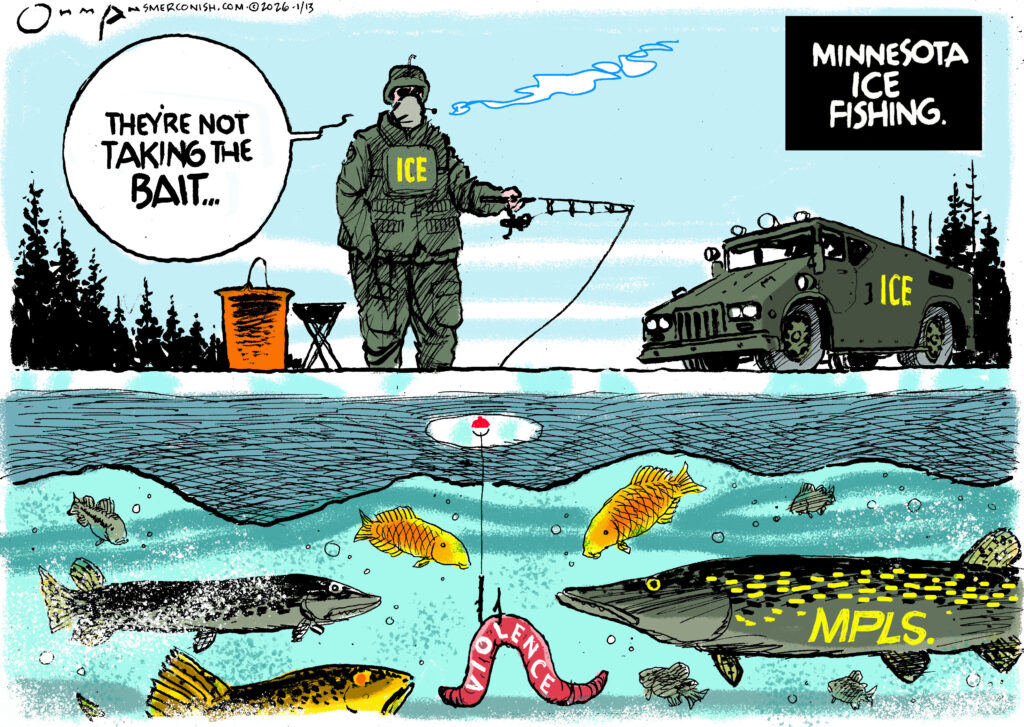
I think a lot of these TV people are missing one other reason tRump / Stephen Miller / Russell Vought is using an unrestrained ICE thug army loyal only to tRump is the midterms. He is sending them to blue cities and blue states. I fear he will use them to scare and intimidate people at voting polling stations in those same blue cities. Putting ICE in voting places to detain and keep from voting any non-white person or simply scare them from showing up. Also what about white people. Well they are assaulting, killing, and snatching white people now so … Hugs
I love Erin’s posts and reporting. The attack on trans rights and health was planned and coordinated by religious conservatives who felt they lost the culture war on gay acceptance and same sex marriage so they decided to jump quickly on the trans issue with lots of money. Their first attempt failed because they went after the idea of trans people itself. So then they changed to the old “protect the children” play book with the entire focus on protecting little cis girls but they never mention the trans boys that cis boys need to be protected from. See how patristical it is? It is all about males needing to protect the little womans. They don’t care about trans kids, they don’t care about female sports. It is about not letting trans kids transition with puberty blockers and the correct hormones as then the kids will grow up as they are fitting the societal view of what men and women look like. That scares the straight cis male religious guys because they are terrified they will be attracted to a trans woman. Imagine the horror if trans people moved freely in society not raising any question of their gender because they conformed to how society sees each gender. That sounds like a grand thing to me, but it terrifies these fanatical religious grifters that want to control how everyone lives to please their god. They make up untrue and scary what ifs, what if a man uses the letting trans people use the bathroom of their gender ID to go into a girls … notice they phrase it girls not womans because that make people more protective from the start, and they harm a little girl, your little girl? Well nothing stops a man from doing that now! Predators don’t need permission and won’t wait for it. And that has happened where a straight cis male dragged a little girl into the male bathroom and raped her while his friend watched. There was a famous court case on it. Look it up if you want. Want to know what has not happened, a trans woman going into the female’s bathroom and assaulting a female. Sorry. The right has tried hard to make one happen, but each claim of a trans person in a locker room or bathroom acting inappropriate has been debunked and disproven. This is all a made up scandal and crisis by people who can not accept the society progressing beyond the old traditional binary they grew up with and they think their holy books claim must be as their god insists on it. Weird how it is always how their god insists on what they already believe or promote. Handy that. So many people can not move past the idea that if it dangles you MUST be a boy regardless of how you feel and if it is an inny you must be a girl regardless of anything else idea. They can not seem to grasp personal feelings, needs, or medial science. Hugs
The bill would establish the Affirming Health Care Trust Fund, administered by the State Treasurer, to support clinics and providers outside the reach of federal funding threats.
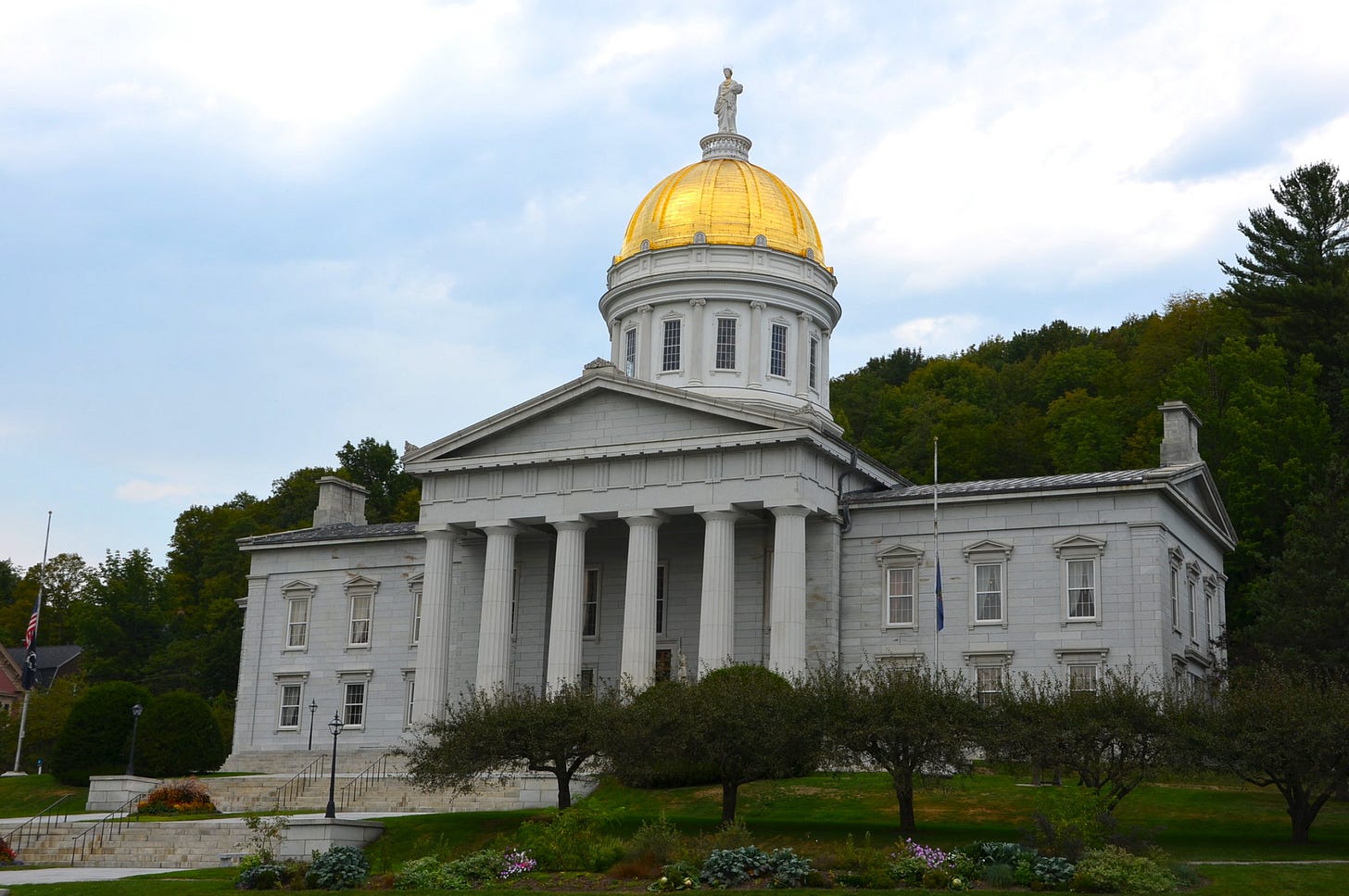
Vermont Bill Would Create State Trust Fund For Private Trans Youth Care Clinics As Trump Threatens Hospital Funding
The bill would establish the Affirming Health Care Trust Fund, administered by the State Treasurer, to support clinics and providers outside the reach of federal funding threats.
Erin In The Morning is a reader-supported publication. To receive new posts and support my work, consider becoming a subscriber.
Across the United States, gender-affirming care has come under sustained attack in Republican-led states and from the Trump administration. For transgender youth, those attacks have been especially severe, with roughly half of U.S. states now banning such care outright. At the federal level, the administration has waged an intense pressure campaign against hospitals, threatening funding and prompting many systems to drop their care programs altogether. That campaign has now escalated further, with the federal government moving to threaten hospitals’ entire Medicaid and Medicare funding if they continue providing transgender youth care. In response, some states and cities are beginning to fight back by establishing their own funding mechanisms for trans healthcare. The latest example comes from Vermont, where lawmakers have introduced a bill to create a trust fund for gender-affirming care designed to be entirely insulated from federal funding threats.
H.576, introduced by Representatives Daisy Berbeco, Tiffany Bluemle, and Troy Headrick, would establish the Affirming Health Care Trust Fund. Administered by the State Treasurer, the fund would provide direct monetary support to healthcare providers and nonprofits offering gender-affirming care in Vermont. It would cover costs for patients who would otherwise go without treatment, fund the establishment of Vermont-based clinics, and pay for malpractice and liability insurance for clinicians who continue offering care. The bill is part of an increasing movement towards private clinics as a mechanism to survive federal threats.
The bill also includes provisions designed to protect patient information from both federal pressure and out-of-state threats, going further than the recent “refuge” or “shield” laws passed in several blue states to protect transgender youth care. It explicitly bars the board and other state actors from disclosing patient-identifiable data, the identities of providers, or the identities of award recipients to the federal government. This is a significant protection given the wave of abusive legislation and attempts to subpoena transgender healthcare records nationwide. While federal preemption may ultimately be litigated, these provisions give clinics a stronger legal footing to resist such demands—particularly as similar subpoenas have been repeatedly quashed in recent court cases.
The bill comes as families scramble to locate alternatives to hospital systems that are abandoning them. With more than 20 hospitals closing their doors to transgender youth care out of fear and preemptive compliance with the Trump administration, many families have been forced to seek alternatives. Just this week, major hospital systems across Colorado, for example, have stopped providing care. Groups like the Trans Youth Emergency Project say they have the capacity to refer displaced patients to private clinics, and in many places those clinics do exist and are absorbing demand. But as hospital-based programs continue to shut down and demand rises, those private providers will need sustained support—and more clinics will need to be created. Bills like this are a targeted way to do exactly that.
If this bill passes, Vermont would be the latest state to protect care in this way—but it would not be the only one. Massachusetts passed a similar measure last year, allocating $1 million toward transgender youth care clinics, though that funding has already come under criticism as insufficient to meet statewide need in the wake of major clinic closures. In New York City, newly elected mayor Zohran Mamdani has pledged $65 million for transgender healthcare. If that funding is realized, it would position New York City as a major hub for private clinics capable of absorbing demand created by hospital closures across the country. This strategy could prove to be a critical backstop for private providers that are already emerging—and that are likely to come under increasing strain in the years ahead.
The bill allows funding from state appropriations, private donations, grants, and—importantly—federal funds under a future administration that is protective of transgender healthcare. It would take effect immediately upon passage, with the board required to convene by August 1, 2026. There are still hurdles ahead: the bill must advance through committee, pass both chambers, and ultimately receive meaningful funding to function as intended. But its introduction alone signals something important. At a moment when hospitals are retreating and families are being forced into crisis planning, Vermont lawmakers are putting forward a concrete framework to protect access to care rather than surrender it. For Vermonters who want to see their state take a clear stand, residents can find and contact their legislators through the Vermont General Assembly website to make clear where they stand on protecting transgender healthcare.
Erin In The Morning is a reader-supported publication. To receive new posts and support my work, consider becoming a subscriber.
ICE gang thugs have no restraint and the government has shown that they do not have to follow any laws governing police conduct or honor people’s US civil rights in the constitution or laws. The current people joining ICE are white supremacist gang militias who feel they are on a mission to ethnically clean the US making it a white people only population. That is the wet dream of Stephen Miller and project 2025 author Russell Vought. This is genocide as much as in Gaza. It just has not got to the mass killing stage. I just listened to a Native person describe her interactions with ICE thugs where they tell her that she and her kind are next to be rounded up. ICE / DHS has budgeted 47 million dollars a year for the next 4 to create “Prisons” that look surprisingly like concentration camps. How soon do those camps become death camps? As for those that ask where is tRump during all this. He is being managed and his media viewing is designed to make him think in his declining mental state that the ICE is going after only the worst of the worst, and the ICE people are in terrible danger, and that he should work on his pet projects and let Stephen Miller handle the ICE situation. He is clueless as to what is going. But as long as he is getting rid of the non-white people along with terrorizing the public into obedience the right wing media will support him full throatily and lie / mislead the maga public as to what is happening. Hugs
Oregon state Rep. Ricki Ruiz said three people were detained in his district after ICE agents posed as utility workers.
Immigration and Customs Enforcement officers can’t enter someone’s home without a warrant, but that doesn’t stop agents from using tactics to get to people.
ICE agents have altered license plates and placed Mexican flag stickers on their vehicles to try to lure and detain people, NPR reported. And now, Oregon utilities are taking steps to ensure their customers don’t mistake ICE agents for their employees.
In December, NW Natural, a natural gas utility serving 2 million people in Oregon and Southwest Washington, published guidance in seven different languages on how to identify if someone is actually one of their employees. Portland General Electric has similar guidance on its website.
NW Natural employees wear a uniform and a utility badge that says “contractor,” and they will never ask for immediate access to a customer’s home. Its workers usually ask for access to a back or side yard to access a meter, the guidance says.
NW Natural spokesperson David Roy said the company was made aware of incidents of people posing as utility workers and decided to issue the guidance.
“We translated the message in order to reach as many individuals and communities as possible,” Roy told the Capital Chronicle.
FILE – Rep. Ricki Ruiz, D-Gresham, in February 2024.
Kristyna Wentz-Graff / OPB
Rep. Ricki Ruiz, D-Gresham, said he was already concerned about scammers going door to door taking people’s money in his district, but he contacted NW Natural and Portland General Electric in December after hearing that three people in his city were detained after ICE agents posed as utility workers.
“They lured him out of his house, and they took him,” Ruiz said in an interview about the first instance he heard about.
Ruiz represents Oregon’s 50th House District, a diverse region that includes parts of East Portland and Gresham. According to census data, more than 16% of Gresham residents were born outside the U.S., and 44% of those residents are from Latin America.
ICE did not respond to the Capital Chronicle’s request for comment.
Oregon, particularly the Portland area, has been at the forefront of the Trump administration’s crackdown on immigration, especially within the Portland metropolitan area. U.S. Department of Homeland Security agents revealed in court in early December that the federal government brought ICE agents from around the country to Portland as part of what they’re calling “Operation Black Rose.” Agents use advanced surveillance technology to locate and detain people, often stopping people in their vehicles and using violence, according to an analysis from Stephen Manning, the executive director of Portland-based immigration law firm Innovation Law Lab.
As the February 2026 short legislative session approaches, several Democratic lawmakers have indicated they plan to sponsor bills addressing federal immigration enforcement in the state. Ruiz said he will sponsor legislation to support lawsuits against federal agents if they come into a person’s home without warrants and a bill to prevent ICE agents from wearing masks.
“As a state representative, I get the great honor of representing my constituents not only as a Democrat,” Ruiz said. “I represent Republicans. I represent unaffiliated voters and I represent people who can’t vote.”
Oregon Capital Chronicle is part of States Newsroom, a network of news bureaus supported by grants and a coalition of donors as a 501(c)(3) public charity. Oregon Capital Chronicle maintains editorial independence. Contact Editor Julia Shumway for questions: info@oregoncapitalchronicle.com. Follow Oregon Capital Chronicle on Facebook and Bluesky.
This republished story is part of OPB’s broader effort to ensure that everyone in our region has access to quality journalism that informs, entertains and enriches their lives. To learn more, visit opb.org/partnerships.
🌿This note has struck a chord and gotten some attention, so I just wanted to say that anyone who wants to share from this note, please feel free, in any way you like :)🌿
Last week, I wrote to my Senator, Angus King, asking him to please focus on three priorities in the new year: 1) Stop foreign invasions 2) Release the Epstein files 3) Restore ACA subsidies.
Senator King wrote me back, because he’s actually really good about answering constituent correspondence. And one of the things he said is that he is increasingly concerned with the “growing gulf between the left and right and the shrinking middle.”
I see this argument a lot, actually, from all these avowed “centrists.” And I will tell you, it pisses me off. It’s an entire mischaracterization of this moment in history.
This is what I wrote:
Senator King,
Thank for your recent response. One of the concerns that you expressed was regarding the “growing gulf between the left and right and the shrinking middle.”
I want to re-frame this, because it’s a mischaracterization.
When we talk about political ideology, the center of the spectrum in the United States is meant to be the Constitution and the rule of law. That is the standard, the baseline, the bare minimum of agreement against which the full right-to-left spectrum of policy negotiations and compromises must ultimately be tested. (emphasis mine)
The gulf that has developed today is not about polarization. The left and right are not migrating further apart. The right has launched off the edge of the chart into violent authoritarianism. There is no corresponding leftward lurch towards social revolution.
The overwhelming and growing public reaction, these thousands and millions of protestors flooding the phones and taking to the streets to demand that the law and the Constitution be followed – we ARE the center!
I tried to explain this to Congressman Jared Golden, too. He really, really wants me to be a far-left activist extremist. But I’m just a wife and a mom living in a cabin in the Maine woods. We chop firewood for heat, we harvest maple syrup tree by tree, our kids work on local shellfish farms. We are deeply ordinary.
But our most basic and fundamental civil rights and liberties are increasingly under assault. If an ICE agent doesn’t like the way I follow their instructions, they will shoot me in the face, call me a f****** b****, and the President will say that according to his own morality in his own mind, that was legal and I deserved it.
As I asked Jared months ago, just how far right do you have to travel to start believing that asking elected officials to follow the Constitution and the rule of law is Progressive Activism?
We are not far left extremists becoming increasingly polarized. We are masses of Americans asking for adherence to the Constitution and the rule of law. We are asking for the bare minimum.
The center is not supposed to be negotiated ever rightward into fascist dictatorship. The center is supposed to be uncompromisingly anchored in the Constitution and the rule of law. This is supposed to be the line of absolute principle.
That is why I am disappointed every single time you vote with the regime. It’s not because I’m polarized. It’s because you’re negotiating with people who don’t believe in the center at all. You are negotiating with terrorists.
What you are witnessing today is not a shrinking middle. The center is actually growing in a rising tide. Millions of Americans are suddenly deadly aware that every Constitutional right that they thought was firmly enshrined is threatened by one single group of far-right, power-hungry, violent rogue extremists.
So if the center is really what you stand for, I have good news for you. Now is your time! The center is the largest it has ever been! Millions of dead-center Americans are as awake, as alert, as active as they have been in a generation. We are demanding the absolute center of political ideologies, and the bare minimum of governance – the restoration of Constitutional democracy. So join us! But understand this about the center. It is not the place for compromise.
Snip-please go read the rest at Annie’s (I didn’t leave a lot out here, so that won’t take long;) and then quickly but thoughtfully join people who are working hard to retain our democracy, and fix the holes. Not doing anything is really simply asking for these very bad things to continue, and history has shown how that ends. Thank you!
Supporting and learning from trans people is essential in fostering an inclusive and compassionate world. Members and allies of the trans community recognize the unique struggles and challenges that trans individuals currently face: discrimination, marginalization, and dangerous legislation.
By actively supporting and learning from trans activists and leaders, we can better understand these challenges and work together to create an environment where everyone is treated with respect and dignity, regardless of their gender identity.
We’ve compiled a list of impactful quotes from trans activists to foster understanding and appreciation for the trans community.
Please share and utilize these quotes to promote support for trans people and create a more inclusive, respectful, and supportive environment for everyone.
Explore inspirational transgender quotes and captions — to help celebrate trans liberation & fight for trans rights
“I’ve never been interested in being invisible and erased.” — Laverne Cox
“Trans people are extraordinary, strong, intelligent, persistent and resilient. We have to be. And we will not stand for the picking and choosing of rights. We still have hope.” — Grace Dolan-Sandrino
“Despite the constant hatred we face as the LGBTQ+ community, we must stand united and strong in spreading our message of love.” — Jazz Jennings, in a tweet
“I think trans women, and trans people in general, show everyone that you can define what it means to be a man or woman on your own terms. A lot of what feminism is about is moving outside of roles and moving outside of expectations of who and what you’re supposed to be to live a more authentic life.” — Laverne Cox
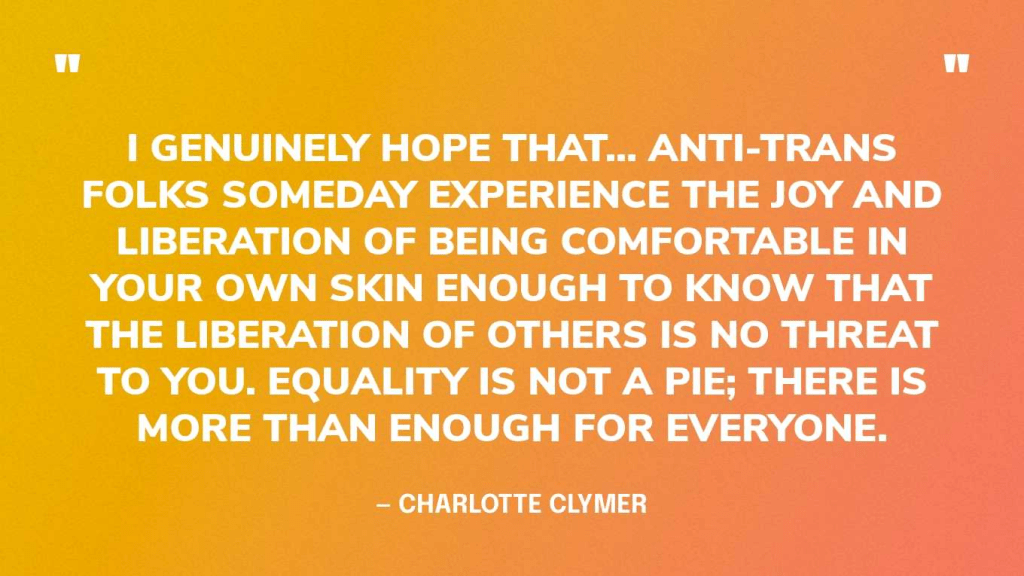
“They can try to ban us. They can try to get rid of our health care. They can try to deny us housing, credit, and public accommodations. They can try to shame us. They can try all they want to erase us, but at some point, they will realize the trans community is never going away. Trans people are everywhere. Every country, every race, every ethnicity, every religion, every socioeconomic level, every period of human history — we are everywhere. We are natural. You can’t rid of what’s natural. I think they know that, and it terrifies them.” — Charlotte Clymer
“I want to make a difference in the world by speaking out and spreading hopeful messages. I want to send the message of “you are not alone and you are safe” to other transgender kids.” — Rebekah Bruesehoff
“We have to be visible. We are not ashamed of who we are.” — Sylvia Rivera
“Being transgender is not just a medical transition. … [It’s about] discovering who you are, living your life authentically, loving yourself, and spreading that love towards other people and accepting one another.” — Jazz Jennings
“We have to remain visible. They have to see us, they have to know that we’re not going [nowhere], that we’ve been here ever since God made man and woman, and they have to get over it. I don’t need their permission to exist; I exist in spite of them. I want you to train and teach and love on and create families within my community and gender non-conforming people, so that we can understand that we have a culture, we have a history, we have a reason to be here. We have a purpose. We’re entitled to be loved, and seek happiness, and share that with the people that we care about.” — Miss Major Griffin-Gracy
Snip-There are a few more, and some graphics with the quotes that we can snag and share, too.
to spread brightness in as much space around us as we can, especially if we’re in an area endangered by the Trump enforcement brigades we’re seeing. But even if we’re not, we can extend these actions locally to build community so we’ll be safer when it is our turn.
“We, at Wrecktangle, at all locations for the rest of the weekend, are going to donate one pizza for every single pizza sold, to families and friends that are affected by the increased ICE presence in Minneapolis,” one representative said.
In the caption, they noted that they are “set on volunteers” who would deliver pizza and other goods to people unable to leave home, but added: “We could really use some help raising funds to keep the momentum and keep people safe inside during these disturbing and uncertain times.”
Wrecktangle leaders said they started with $2,000 in donations from family and friends, and figured if they posted their Venmo information, they might be able to double that.
The support exceeded their expectations.
In addition to the collection of non-perishable foods and home essentials, two days later, they announced that they had received over $83,000 in donations.
Along with the donations, the local chain sold 2,291 pizzas between Thursday and Sunday.
During this time, they distributed 600 pizzas, non-perishables, and toiletries to vulnerable families, adding that “we have been working only with volunteers we personally know and trust to ensure the safety of our community.”
But thousands more meals are being made and prepared for free delivery as quickly as possible.
Wrecktangle co-owner Breana Evans told Bring Me The News that nearly every local restaurant in their area has been negatively impacted by the presence of ICE.
“We have staff, coworkers who are directly affected and scared to come to work,” Evans said. “It’s not fair for our friends to be scared to provide for their families and make a living. We know how to make food. So, we said, let’s just start making food.”
The company began donating their 13-inch frozen pizzas privately by connecting with their network of neighboring businesses and organizations. But then they realized the community could expand their efforts even wider.
Trusted volunteers were sent off to deliver free pizzas and meal kits, and others came to the shop to help assemble the goods.
“I think that’s a testament to our community and that there’s more good in the world than this horrible bad that they’re making us go through,” Evans said.
After meeting an immediate need to distribute food, Wrecktangle owners are working to figure out how to best use the funds they raised to help the community.
A screenshot of an Instagram story from Wrecktangle, sharing a weekend total of donated pizzas. Photo courtesy of Wrecktangle/Instagram
“We are working hard with nonprofit organizations to make sure these funds do the most good. We have not yet touched a cent,” they shared on social media. “As soon as we have updates as to specifically where your kindness is going, outside of purchasing food and home products, we will keep you thoroughly updated.”
And on Sunday, to finish out the campaign, Wrecktangle encouraged supporters to spend their money with other local restaurants. For one day only, they accepted emails containing a photo of a receipt from any Minnesota restaurant, and an additional meal was donated on their behalf.
“A lot of our community wants to come back to work, and we need to make sure these restaurants can help support their staff,” Evans said in a social media video. “We need you to be there.”
s of Monday morning, Wrecktangle shared on an Instagram story that they received 176 emailed receipts, which translates to 176 more meals for vulnerable community members.
“This week has spread so much love and friendship,” the company added in an Instagram story. “And we couldn’t be more grateful.”





















 Scottie's Playtime