Check out this article from USA TODAY:
I’m raising a transgender son. My child is not a threat. | Opinion
Best Wishes and Hugs,
Scottie

Check out this article from USA TODAY:
I’m raising a transgender son. My child is not a threat. | Opinion
Best Wishes and Hugs,
Scottie


Do You Know Who Created The Super Soaker? by Lique
Read on Substack
It was him!
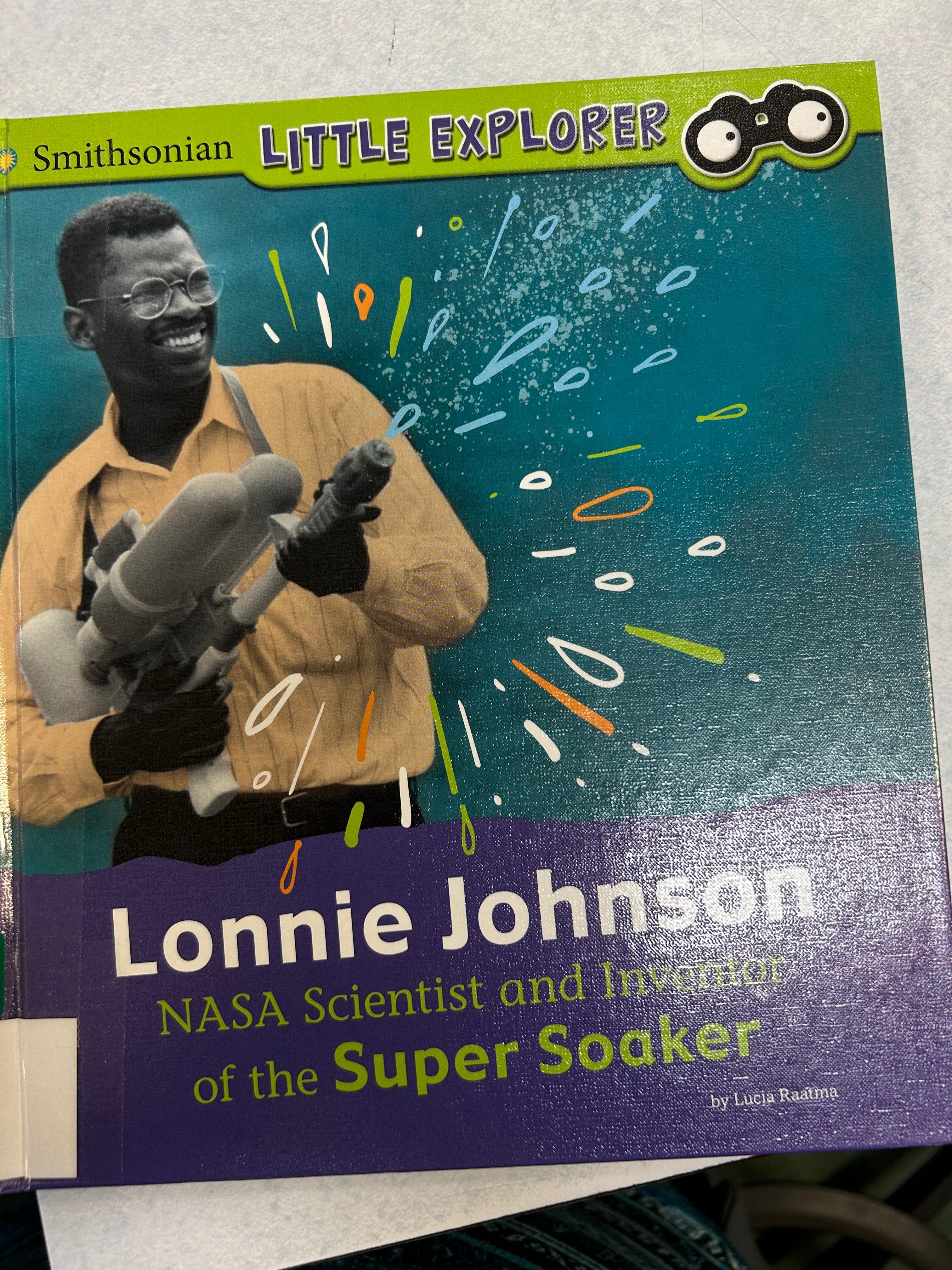
Lonnie Johnson. A NASA Scientist and Inventor.
Also, an African American. Though that should not make any difference. The part of his history that angered me, though I should not be surprised, was that Hasbro had tried to jilt this man out of $73 million dollars! I could not believe it. But him being the super star brain that he is won at his day in court.

I was so happy about that. (snip)
Tariffs are bringing in tens of billions of dollars a month. What happens to all that money?
Hardly a day goes by without President Donald Trump boasting about the record tariff revenue the US government has been collecting since he ratcheted up taxes on almost every imported good.
Read in CNN: https://apple.news/A6TBEs7dcRfqhJH8HulnVYQ
Shared from Apple News
Best Wishes and Hugs,Scottie
This is hugely pertinent to our interests. And the history callback of Dobbs/Roe is spot on!! This needs we the people’s work sooner rather than later. The story linked within is important background for working on this. Seriously: pick one or two (or more!) rights organizations and do what you can with them, now, while it’s not still too late, and stick with it until the other side is defeated. Please don’t wait until this is in court. Then:
A very sound scheme is to check in with your states on their legislative websites, see what the laws are right now, and what’s in the chute. Overturning Obergefell can’t/won’t change state laws regarding marriage, just as overturning Roe didn’t change state laws regarding repro rights. But knowing what could be coming, especially in red states, is imperative for getting ourselves protected, and protecting others. If your state is safe, well, pick another state that isn’t, and help them out. If your state has no law at all, lobby hard to get one, ASAP. And thanks! -A.
Some of Trump’s judicial nominees have refused in confirmation hearings to acknowledge that the Supreme Court’s 2015 decision in Obergefell v. Hodges, striking down state bans on same-sex marriage as unconstitutional, was correctly decided. According to an analysis by JP Collins at the legal website Balls and Strikes, Eric Tung, who Trump nominated to the U.S. Court of Appeals for the Ninth Circuit, said only, “the Supreme Court granted such a right.” William Mercer, a nominee to the U.S. District Court for the District of Montana, said Obergefell is “binding precedent,” but declined to “grade the Supreme Court.”
As Collins points out, these verbal gymnastics to avoid saying the case was correctly decided mirror those of Trump’s first term Supreme Court nominees who said Roe v. Wade was precedent but would not say it was correctly decided — and then voted to overturn it.
One might say marriage equality is different from abortion. Obergefell is just 10 years old, and Roe was decades old. But the most important feature that both decisions share is the enmity of the Christian right, and its determination to overturn them, no matter how many years or decades it takes.
Even before the court decided Obergefell in 2015, the Christian right was already planning to treat it just like Roe. The Supreme Court’s 1973 decision, they argued, was not the end of the abortion issue but rather the beginning. They used money, media, political might, religion, and relentless organizing to use abortion to drive politics and shape the judiciary. Their plans for Obergefell and LGBTQ rights are no different.

Photo by Astrid Riecken For The Washington Post via Getty Images
The weekend before this last one Odie started throwing up and he was not eating as well as he normally did. On Monday last week Ron took him to the vet. After 800 dollars the vet said she felt he had no blockage and most likely he had an ulcer. She gave us several medications and told us to get him some over the counter Pepcid. We managed to give him his medications in a syringe.
But on Thursday we took him back to the vet for a bolus of fluid because he still was not eating nor drinking. We increased his new make him hungry ear rub. All weekend we tried hard to entice him to eat or drink. On Monday I had a doctor’s appointment. When I got home I suggested that Ron call the vet. He told me he got Odie to drink something and said he heard cats can make huge turn a round after not eating or drinking for days. I felt what it really was a cry for more time. As Odie seemed stable and not in pain I let things be, after all Ron watches a lot of animal vet shows and I hoped he was correct.
For the first time since Odie got ill he did not leave his safe space which is Ron’s closet that day. Ron tried hard to get him to drink or eat. This morning (Tuesday 8-5-2025) I told Ron he needed to call the vet and he agreed, he had faced the fact of Odie’s situation and realized that Odie was passing and not able to get better.
The vet told us to bring him in around 4 pm or 1600 for those on a 24 hour clock. All day both Ron and I checked on him and Ron kept trying to get him to eat or drink. The veterinarian hospital is only like five or 7 minutes away from us. At about 3:50 pm Ron set the carrier on the counter and put a fresh blanket in it. I picked Odie up from the closet and realized he had no strength to even support himself anymore. Once I got him in the carrier he did not even try to turn around and we struggled to get his tail completely in the carrier. I ended up having to reach around him to pull the blanket further in so we could secure the door.
I needed Ron to carry the carrier to the vet’s office, but while I had been with every furry family member when they walked the rainbow bridge, Ron has not joined me during the procedure as his feelings are so strong and he has struggled with the death of each one. I feel it is the last act of love I can do for them. My last duty for them.
The vet asked if we both wanted to stay and I said yes. I was surprised Ron did also. The vet assistant took Odie to have an IV inserted. I asked Ron if he was sure he wanted to stay instead of going to the waiting room or the car. He wanted to stay. When they brought Odie back we petted him until the doctor came in to do the finial step. As first the sedative and then the last medication was injected Ron sat near him and talked to him. I stood next to him and gently rubbed his head and neck fur. I said a few things verbally and a lot more mentally. I could see Ron was doing the same. I was proud of how he handle a very painful experience. The one who was crying the most was the vet, she said that her cat was a ginger and she really liked Odie when he was visiting them.
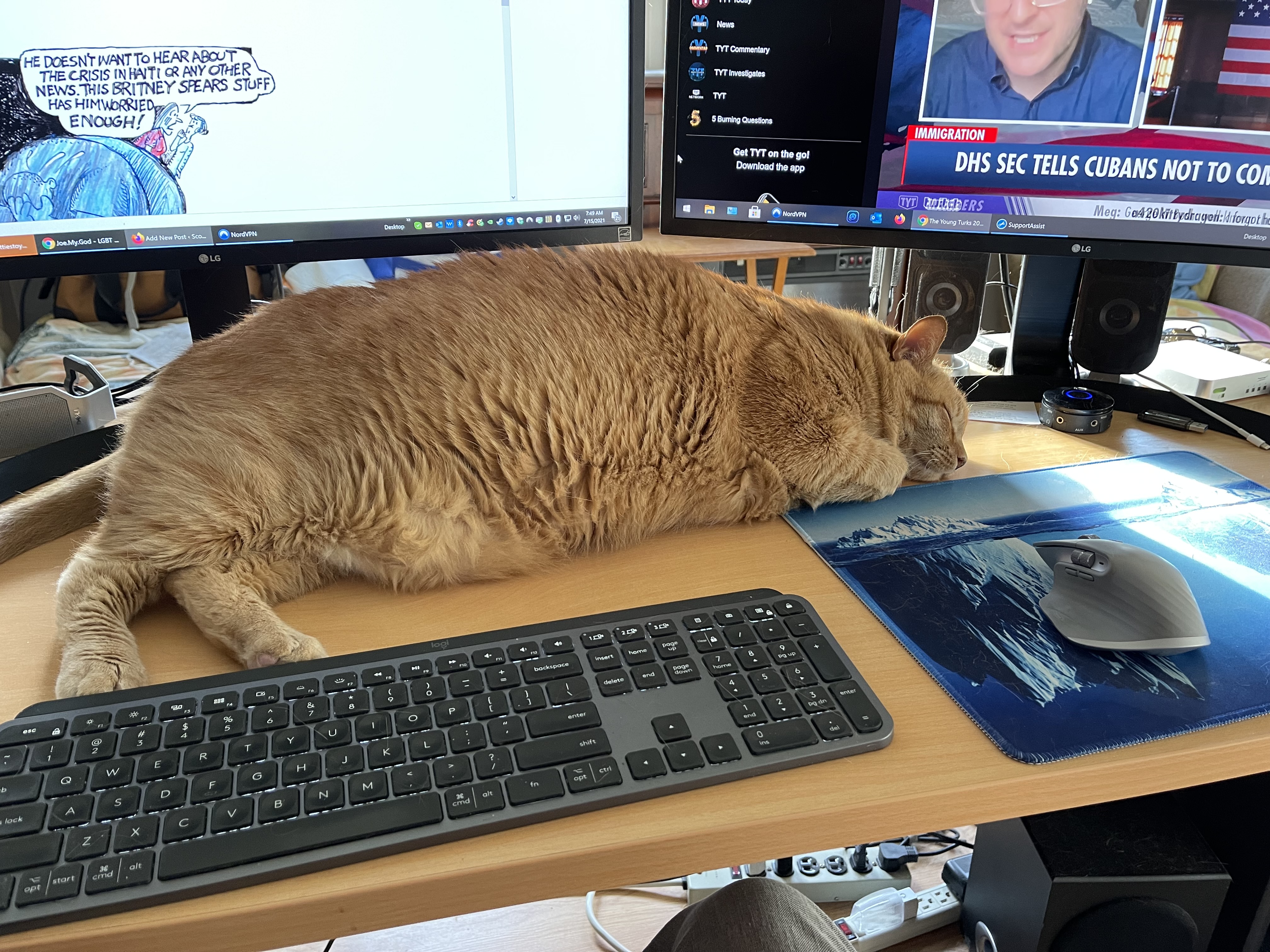
I have included a few pictures of Odie below. Best wishes, Purrs, and Hugs for all who want them.
Odie as a Kitten









Odie older.


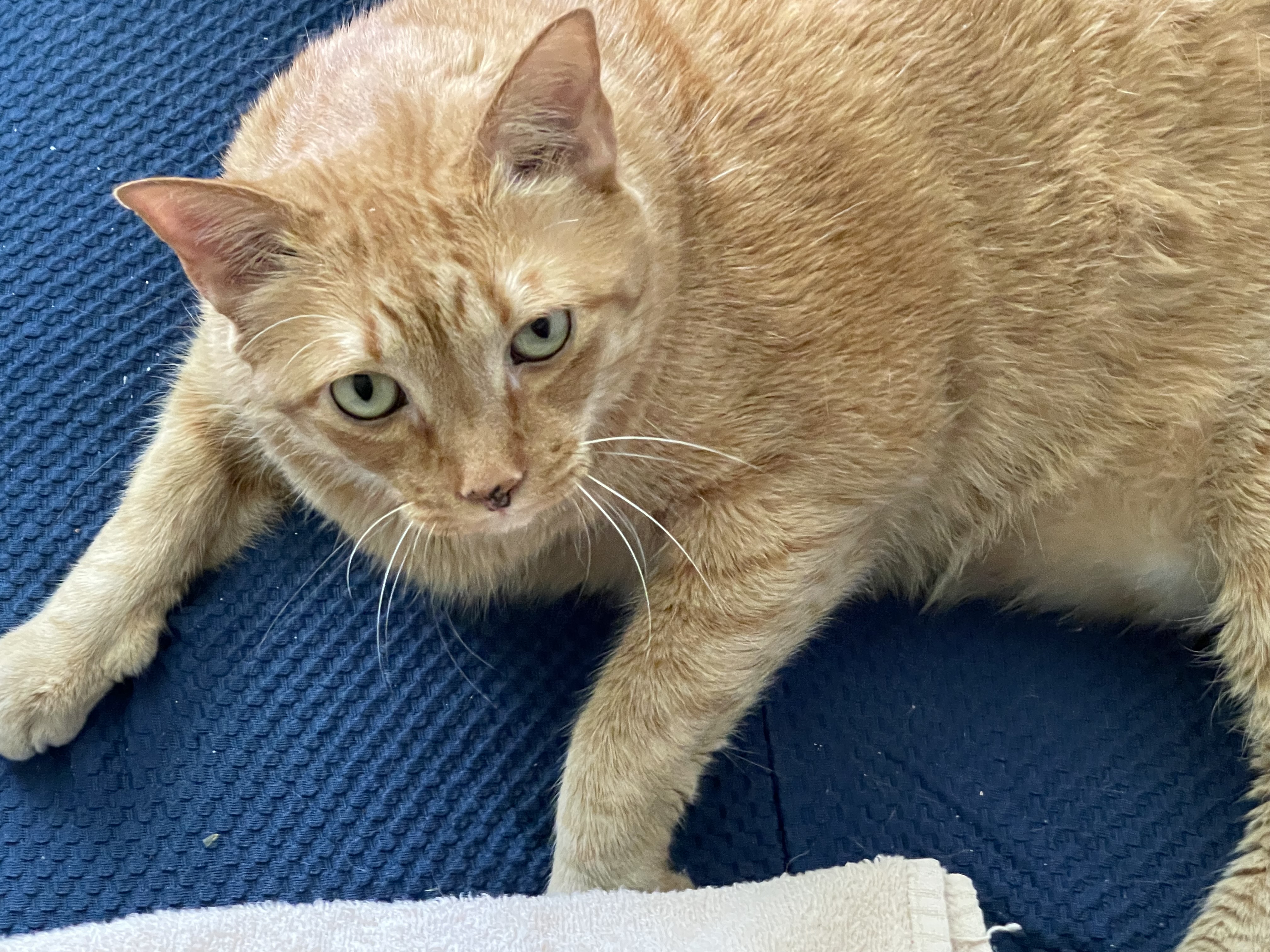


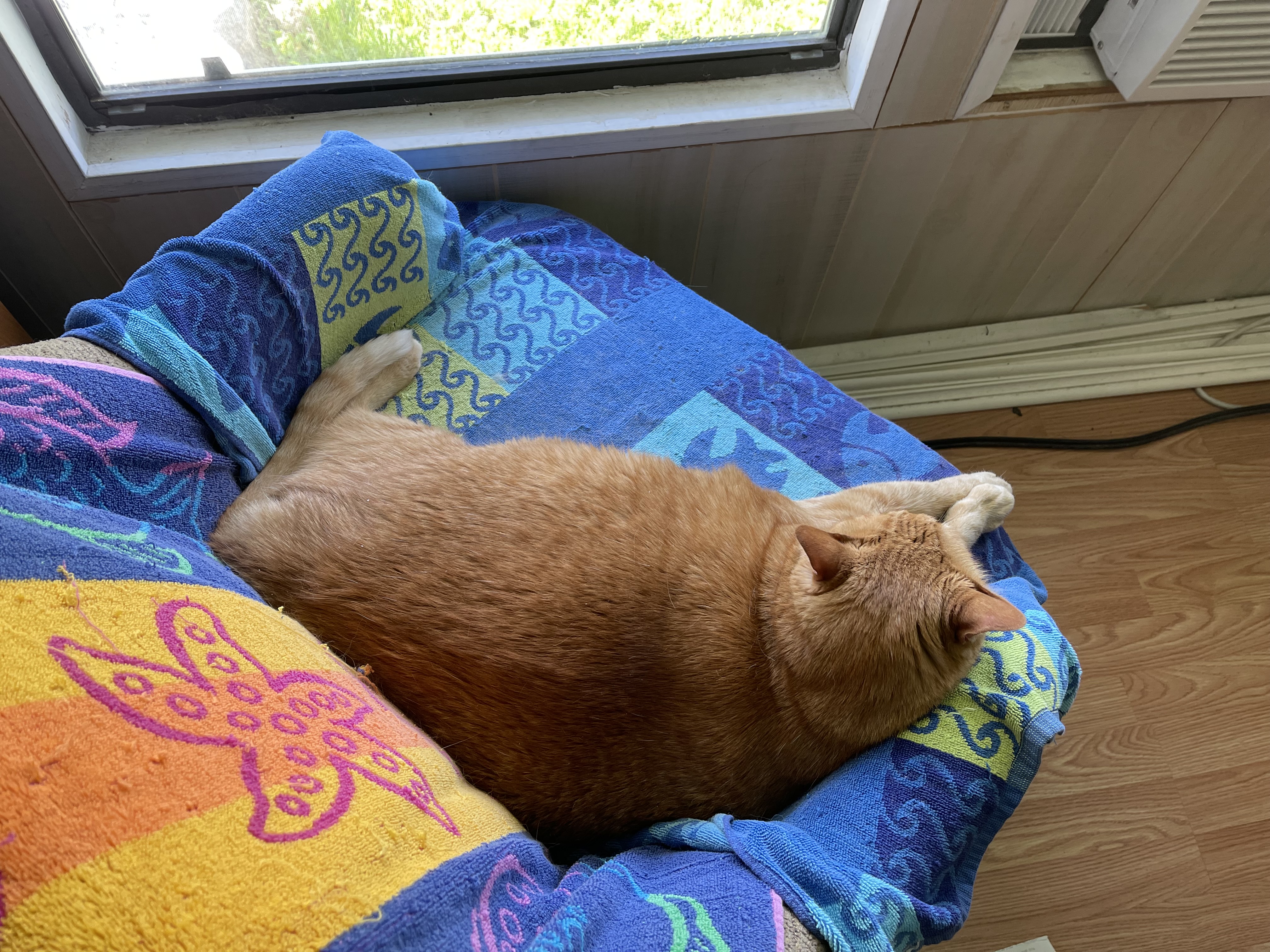

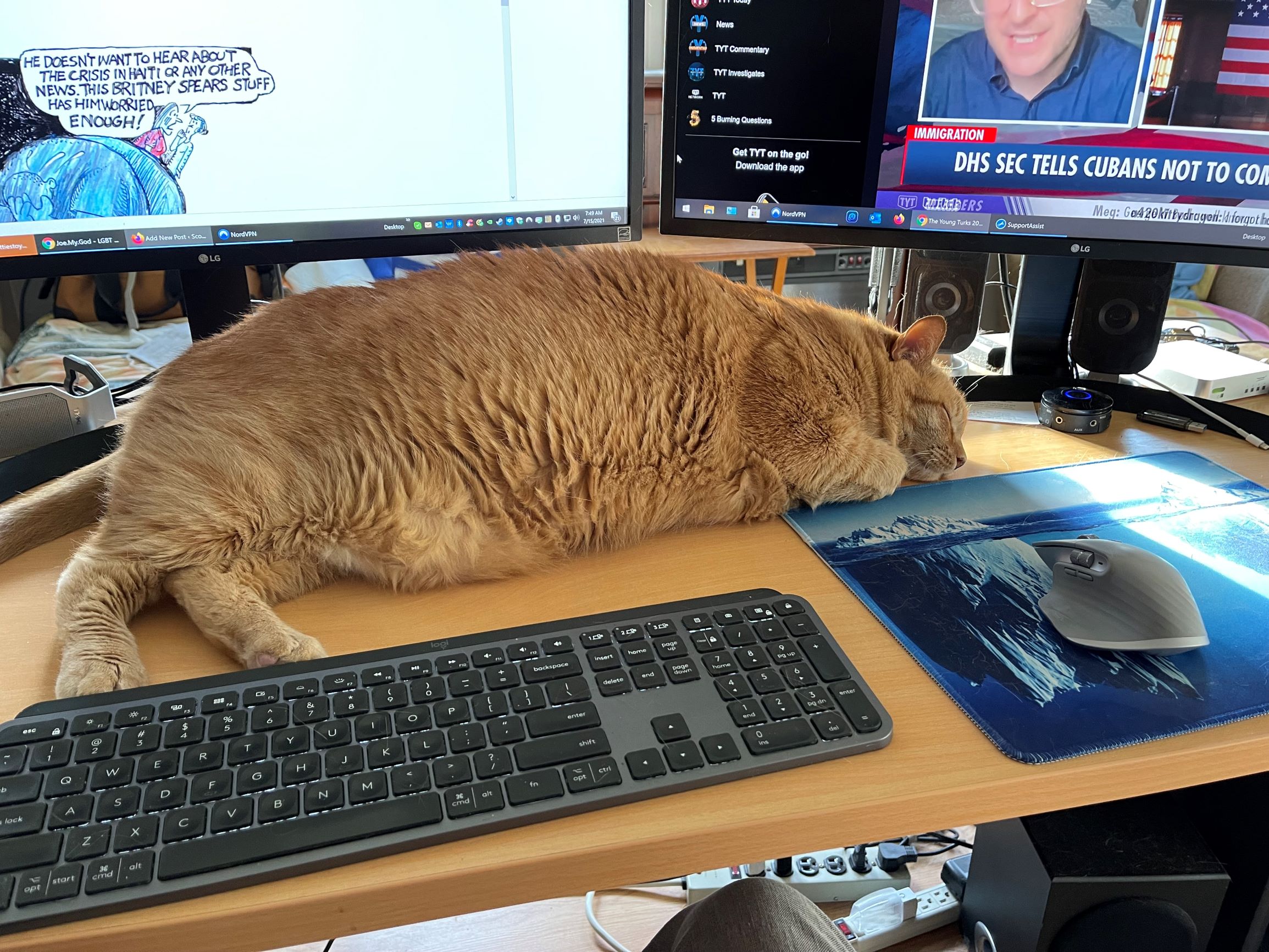
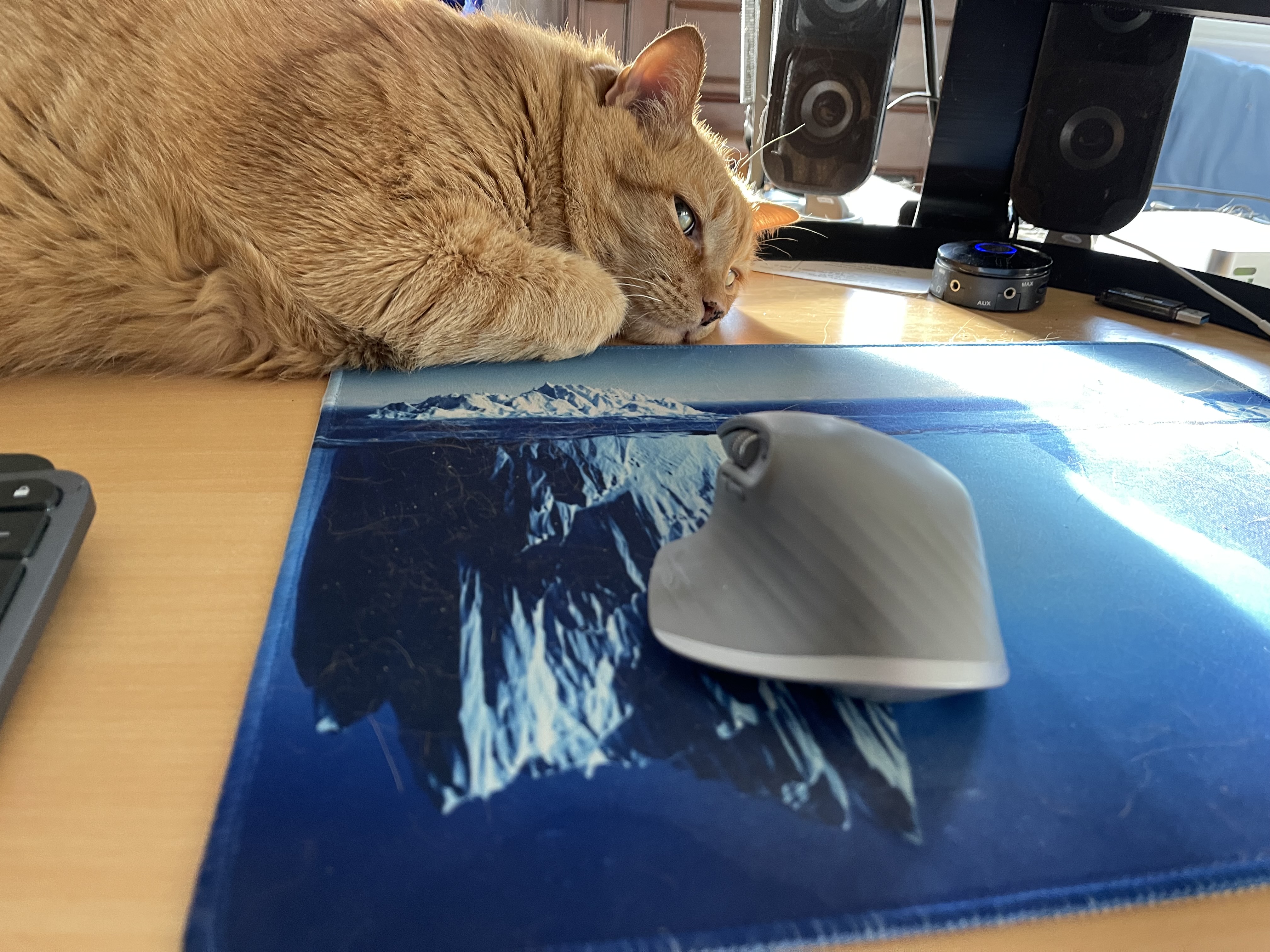
Odie in his favorite spot to get my love and attention. My desk.

This is interesting, as to what he did.
Ben Franklin and his role as the postmaster general of the U.S. Postal Service embodied a combination of individual and communal ideals that was at the heart of America’s founding.
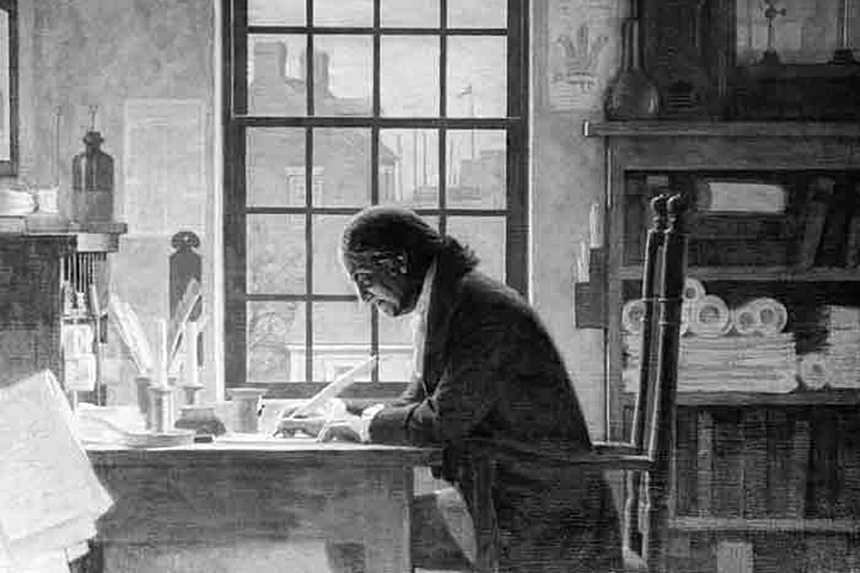
Benjamin Franklin by Charles E. Mills (Library of Congress)
This series by American studies professor Ben Railton explores the connections between America’s past and present.
By late July 1775, the military conflict between American colonials and English troops that would come to be known as the American Revolution was fully underway. The April battles at Lexington and Concord had blossomed into a war on many fronts, including the even more substantial Massachusetts Battle of Bunker Hill, Ethan Allen and his Green Mountain Boys seizing New York’s Fort Ticonderoga, and George Washington being appointed Commander in Chief by the newly convened Second Continental Congress.
Amid the growing war, on July 26th, that same body voted to establish a national mail service, the U.S. postal system, with Ben Franklin as the first postmaster general.

That might seem like a profoundly mundane action to take during the fraught military battles and campaigns of an unfolding Revolution. But it represented an important way for the Continental Congress to amplify the emerging identity of a newly unified United States: It embodied a combination of individual and communal ideals that was at the heart of the American founding and that the USPS continues to exemplify today.
As we see in the official transcript of the Second Continental Congress, the creation of a national postal system was part of an important overarching conversation throughout the week of July 24-28, 1775; on Monday July 24th, “the Congress then resolved themselves into a committee of the whole to take into consideration the state of America.” Those considerations included establishing a medical department and new hospitals (which were connected to the war effort of course, but also comprised a communal good far beyond that immediate cause), printing currency out of a new continental treasury, and, as decided on Wednesday July 26th, responding to “the report of the Committee on the post office” by creating “a line of posts … from Falmouth in New England to Savannah in Georgia,” appointing a postmaster General for the United Colonies, and unanimously electing Benjamin Franklin, Esq. to serve in that role.

By 1775, Ben Franklin had been involved in the creation of mail services for nearly four decades, and as was so consistently the case with Franklin, those efforts reflected both his pursuit of individual self-interests and his dedication to the communal good. In 1737, when Franklin was only 30 years old, he was appointed postmaster of his adopted home city of Philadelphia. In his autobiography he freely admitted that he took the job largely to support his own newspaper, the Gazette, writing, “tho’ the salary was small, it facilitated the correspondence that improv’d my newspaper, increased the number demanded, as well as the advertisements to be inserted, so that it came to afford me a considerable income.” But even if Franklin was mercenary about this new role, he was too much of an inventor not to innovate in it as well, and his most lasting and collectively meaningful such innovation was printing in the newspaper lists of people who had letters waiting for them at the post office, a practice that many other papers would take up for decades to come.

After a decade and a half in that important local role, the ever-ambitious Franklin was ready to move up. When Postmaster General for the Crown Elliott Benger became ill in 1753, Franklin lobbied for his overarching role. Eventually both he and a friend and fellow journalist, Virginia public printer William Hunter, were chosen as Joint Postmasters for the Crown, a role that Franklin would hold for the next two decades. He would bring a number of his Philadelphian innovations to that national role, including the aforementioned printed newspaper lists (which he instructed postmasters around the country to do). But he would also add successful new ideas, such as implementing nighttime service that led to far faster mail delivery. Ever the successful businessman, Franklin had the British Crown Post registering its first profit by 1760.
In 1774, after more than 20 years in that role, Franklin was dismissed by the British government for being too sympathetic to the colonies. But as he seemingly always did, Franklin parlayed this temporary setback into even more substantial long-term success, securing the July 1775 election to Postmaster General for the United Colonies with (again quoting the Continental Congress transcript) its accompanying “salary of 1000 dollars per an. for himself.” In case Franklin wasn’t able to make this new national postal system as profitable as the Crown’s had become under his leadership, Congress protected both the system and Franklin financially, adding that “if the necessary expense of this establishment should exceed the produce of it, the deficiency shall be made good by the United Colonies, and paid to the postmaster general by the continental Treasury.”
At least since the posthumous 1791 publication of his mythmaking autobiography, Ben Franklin had somehow embodied both self-made individual success and selfless philanthropy for the communal good. But contradictory as that duality may seem, it is also at the heart of America’s founding, as reflected in the opening passages of our two most famous framing documents. The Declaration of Independence begins with the “self-evident truths” that among each individual’s “unalienable Rights” are “Life, Liberty, and the pursuit of Happiness.” While the Constitution’s Preamble focuses on collective goals for “We the People” that include “forming a more perfect Union” and “promoting the general Welfare.”
In order for a society to endure, I would argue that it has to genuinely ensure both of these founding American ideals: that each individual in that nation has the opportunity to pursue their own dreams; and at the same time that the communal good remains an overarching collective goal. Since its July 1775 establishment, the United States Postal Service has impressively embodied both layers: offering mail service to every individual, in every corner of this giant nation; and doing so not as a corporation, but as a non-profit public good. Here on its 250th anniversary, let’s celebrate this continued reflection of our founding ideals.
Here’s to people staying off Democrats’s necks as they fight this in the same fashion. Gerrymandering hurts my heart; I live in a state gerrymandered to just barely inside the law. I don’t like it for any state no matter the majority, but. If one’s gonna do it, they all ought to.
Of course, if we had instant runoff voting and no parties, this wouldn’t be a thing. Everyone would have someone to vote For. And we’d be a democratic republic today. -A
Gerrymandered Balls by Clay Jones
Republicans are cheating again Read on Substack
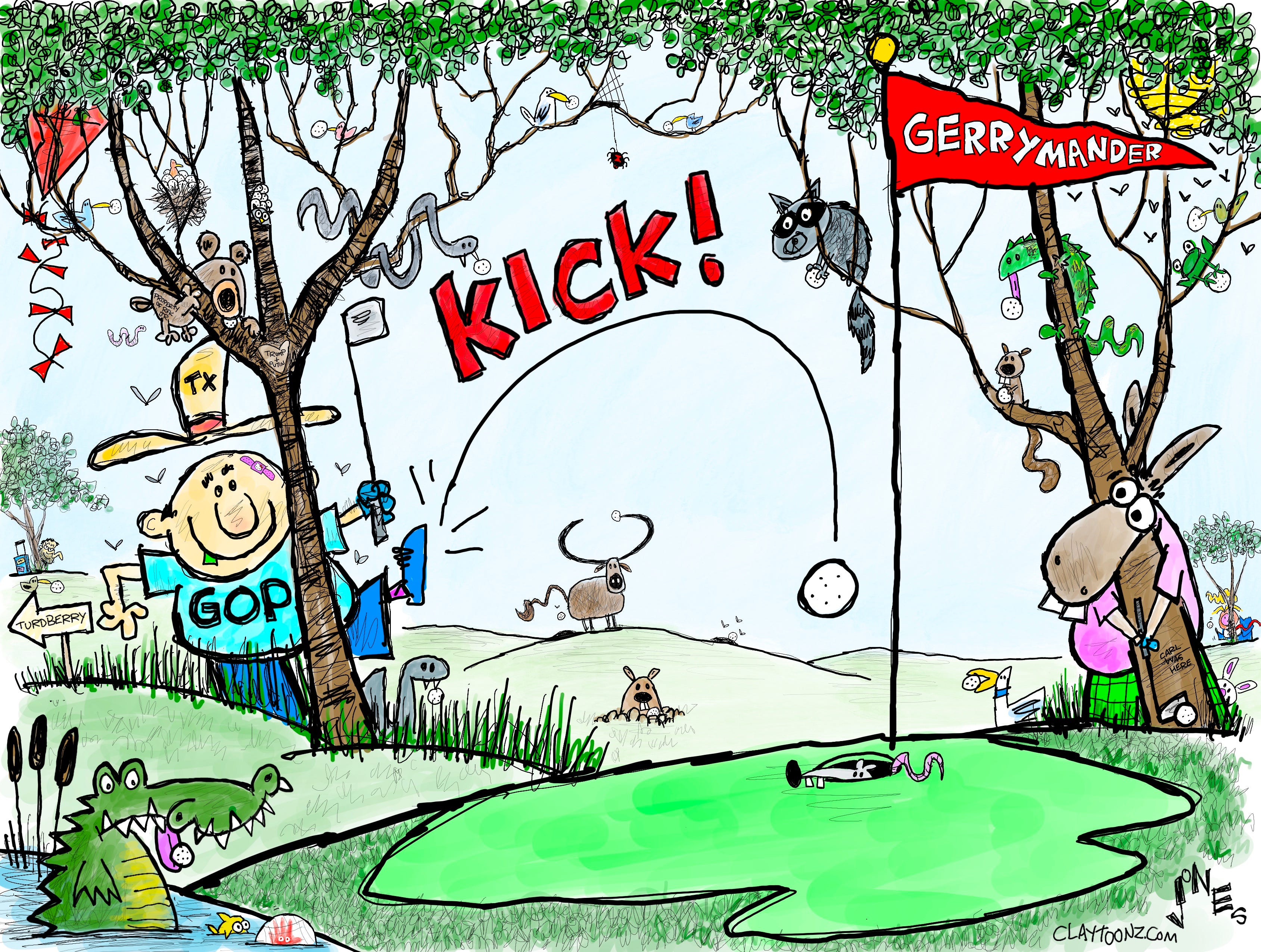
What do Republicans cheat at more, golf or elections? It’s a tough call. But cheating at one of those things means that they’ll cheat at the other.
Republicans in Texas are trying to reshape their congressional districts, even though it’s not the time redistricting is normally done. Usually, that’s shortly after the results of the census are published (which is once a decade), and states redistrict according to the new population size, and to fit with possible changes, such as new districts or losing them.
During the last census, Texas picked up two congressional seats because its population grew during the 2010s. Since the Texas legislature is controlled by Republicans, they were able to draw up the district maps. Naturally, they redraw them to favor Republicans. It’s not like they would do it honestly. They’re Republicans.
This is called gerrymandering, and Texas is one of the most gerrymandered states in the nation. Wisconsin is number one.
Texas now has 38 congressional districts, with 25 of them going to Republicans, 12 going to Democrats, and one is currently vacant. But even after winning a huge majority after gerrymandering, 25 congressional seats are not enough for Texas Republicans, so they want to redraw the lines again in their favor.
Texas will be blue someday, or at least a swing state. The best way to keep people from sending Democrats to Congress is to take away Democratic candidates. After gerrymandering, voters are not choosing the candidate. The candidates are choosing the voters. It’s horrible, rotten, unfair, and neither party should do it. But Republicans don’t care if they cheat.
After Joe Biden won the presidency in 2020 in what experts say was the most secure election in American history, Republicans cried foul and set out to change election laws in every state. In Georgia, for example, where Biden won in 2020, and Blue areas are growing, Republicans changed voting laws, and Trump won over Kamala Harris in 2024 by just 2.20 percent. In Texas, they focused on changing the laws, not for every district, just the districts that had a majority of Black voters. They tried to make it as hard as hell to vote in Houston.
Republicans said all these changes were for election “integrity.” But how much integrity do you have when you make it illegal to give an old lady a bottle of water while she’s waiting in line for nine hours in the Georgia heat? It’s a fact that when fewer people vote, Republicans win.
The 2024 election, which Trump “won,” had fewer voters than in 2020, when Biden won. (snip-MORE)
 Scottie's Playtime

