RI judge intervenes after ICE wrongfully detains Superior Court intern

The story below shows how lawless and belligerent ICE has gotten.  The laws and the legal authority of a judge mean nothing to them.  There is a video at the link below.  

On a personal note I have a doctor’s appointment this morning for steroid injections.   Depending on how it goes I may need them for the next three months.  I will try to do a video to explain as it is too hard to type out.  I am way too tired starting from when Ron and I had what we think is Covid a few months ago.   Hugs

“If they had the wrong person, then they didn’t know who they were looking for, which calls into question whether they had the legal right to seize anybody,” Weizenbaum said. “It’s very frightening.”

Lieutenant Governor Sabina Matos referred to the ICE agents’ actions as an “attempted abduction,” adding that it only emphasizes “the danger of flooding our streets with masked thugs who can’t tell the difference between a hardened criminal and a high school student.”

https://www.wpri.com/news/local-news/providence/ri-judge-intervenes-after-ice-mistakenly-detains-superior-court-intern/

Posted: 

Updated: 

A Rhode Island Superior Court intern was briefly taken into custody by Immigration and Customs Enforcement agents in Providence Thursday afternoon before a judge intervened, according to the state’s Judiciary office.

The student, a high school intern at Superior Court, was reportedly detained by the agents outside the Licht Judicial Complex on Benefit Street.

Superior Court Judge Joseph McBurney insisted the agents had the wrong person. It was not until ICE verified their information and admitted the intern was not their intended target that he was released.

Multiple sources told Target 12 that Rhode Island sheriffs earlier noticed someone taking photos of the intern inside the courthouse and in Superior Court Judge McBurney’s courtroom. When approached, the individual identified himself as an ICE agent and was told to abide by standard courthouse rules, and to stop taking pictures.

The intern was reportedly shaken, so McBurney offered to drive him home. ICE agents then surrounded the judge’s car and demanded everyone to exit the vehicle, threatening to smash in the windows if they did not comply.

Dana Smith, Head of Security Operations for R.I. Superior Court, confronted the agents and told both the judge and the intern to stay inside the car. After an argument, ICE confirmed they had misidentified the teen and left. The intern was released once his ID was checked.

Community reaction

“This egregious incident underscores both the community’s and the Judiciary’s concerns about how ICE is conducting its operations in Rhode Island,” R.I. Supreme Court Chief Justice Paul A. Suttell said.

Citing that climate, Suttell said the Judiciary understands recent calls to expand the use of virtual court hearings in Providence.

“The need to balance constitutional considerations, the public’s right of access, and the integrity of testimonial and evidentiary processes do not allow for a fully virtual court system,” Suttell said. “What occurred today, however, reinforces the Judiciary’s need to focus on ways to enhance access to virtual hearings and to educate the public as to how to request such hearings.”

Attorney Miriam Weizenbaum was outside the courthouse as the intern was being detained.

“If they had the wrong person, then they didn’t know who they were looking for, which calls into question whether they had the legal right to seize anybody,” Weizenbaum said. “It’s very frightening.”

Gov. Dan McKee described the intern’s wrongful detainment as being “an outrageous and indefensible act that could have completely upended a young person’s life. “

“Rhode Islanders should not have to fear federal agents operating with such reckless disregard for the law and human dignity,” McKee said. “This was not a harmless mistake. It was the direct result of callous and chaotic policies by the Trump administration. Moreover, ICE’s failure to exercise even a shred of due diligence is shameful and underscores just how broken and dangerous these federal policies are.”

McKee said he supports the judiciary’s commitment “to enhance access to virtual hearings and promote safe access to courts.”

Rep. Seth Magaziner called the incident “completely unacceptable.”

“This is yet another example of the disregard for civil liberties by immigration enforcement under the Trump administration,” Magaziner said, adding that he will “continue to call out the administration’s reckless actions.”

Lieutenant Governor Sabina Matos referred to the ICE agents’ actions as an “attempted abduction,” adding that it only emphasizes “the danger of flooding our streets with masked thugs who can’t tell the difference between a hardened criminal and a high school student.”

Matos commended Judge McBurney for using his position to speak up, while condemning those who continue to support ICE.

Tim White (twhite@wpri.com) is Target 12 managing editor and chief investigative reporter and host of Newsmakers for 12 News. Connect with him on Twitter and Facebook.

Letters to the Editor: A little bit of socialism isn’t so bad

Letters to the Editor: A little bit of socialism isn’t so bad

Accusations about socialism off the mark

In response to recent letters deeply concerned about the election of socialists: I don’t like excessive government ownership of the means of production or of businesses either. Though President Trump doesn’t seem to mind direct government stakes in publicly traded corporations, that seems a bit too socialist for me.

But as for other issues typically supported by American socialists: How much do you really want to oppose higher taxation of the very rich in order to redistribute wealth more appropriately? How much can we object to raising a federal minimum wage level that hasn’t changed since 2009 while the cost of living has increased far beyond it? How much can we oppose the freedom to unionize so that workers have a greater chance against large corporate employers?

People toss around the word “socialism” as if it were like anthrax. I think of it, though, as being more like salt. Though countries like Venezuela, Cuba and North Korea fell into it so heavily that it became worse than unpalatable, that’s not a reason to treat socialism as if it were categorically poisonous. You can kill a recipe with too much salt, but do you really want to do without it?

John Groff

Allentown

Don’t pay legislators who don’t pass budget

Thank goodness the state budget has been passed. The four-month delay caused chaos for many school systems, counties and nonprofits in the commonwealth. Loans had to be taken, layoffs were required and uncertainty created stress on many. This mess was caused because our elected officials didn’t do their No. 1 job, pass a budget by June 30.

That date used to be important. Now it’s treated as just a guideline. Our legislators are some of the highest paid in the country, but they don’t deserve their salary if they fail this basic responsibility. I believe that the next politician to run on the motto “No budget, no pay” would win in a landslide.  As I stand on the street corner during the 2026 primary season, my sign will read just that:  No budget, no pay!

Joan Howe

Bethlehem Township


Trump should have reported Epstein’s crimes

In Pennsylvania any teacher, social worker, church member, medical employee, law enforcement officer — anyone who has any contact with young people — has to register with the state. This involves fingerprinting, several hours of training, and a background investigation. Once you jump through these hoops and pass the tests, you are then a “mandated reporter.” This means that, if you suspect that a child has been abused, trafficked or neglected in any way, you are required by the Child Protective Services Law to report the situation. Not to your principal, not to the director of your social agency or hospital network, not to the head of your church or organization. You are given a phone number to call at the Department of Human Services. Failure to report abuse immediately at this number will result in your being charged with a misdemeanor or, in some cases, a felony.

That the president of the United States, even though perhaps he did not approve of Jeffrey Epstein’s behavior, did not report to anyone what Epstein and Ghislaine Maxwell were up to is unconscionable and amoral. He didn’t get charged. He got elected to the highest office in the country. What’s wrong with this picture? What’s wrong with this country?

JoAnn Klucsarits

Walnutport


Will everyone really be able to use White House?

Since the White House is the people’s house and it was said after construction it’s going to be magnificent and everyone is going to use it: Can I have my next birthday party there?

Beth Laury

Allentown

Trump is wrong about food prices

How can our president say food prices are way down? Did he ever buy food in a grocery store for his family? Who is telling him all these lies? I’d like to have him come here and check out food prices in our grocery stores.

I don’t think it will change his mind. But one can hope for a miracle.

Ron Snyder

North Whitehall Township

The Morning Call publishes letters from readers online and in print several times a week. Submit a letter to the editor at letters@mcall.com. The views expressed in this piece are those of its individual author(s), and should not be interpreted as reflecting the views of this publication.

Epstein Email Hints Trump Was FBI Informant

From Open Secrets:

(Embedded beneath the title with their code. Click through on the title to see the tables.)

As lobbying revenue grows at record pace, Trump-aligned firms reap the biggest rewards

Lobbying firms with close ties to President Donald Trump are raking in staggering amounts of revenue, and K Street spending is growing at the fastest pace since the federal government instituted quarterly reporting requirements in 2008.

While changes in administration shift which lobbying firms attract the most clients, Trump’s second term has introduced outsized growth among businesses that normally lag far behind the top-earning firms.

This year’s lobbying expenditures are growing at the fastest pace since quarterly reporting began in 2008. The first three quarters of 2025 saw a 13.1 percent increase in lobbying spending as compared to 2024. Adjusted for inflation, the year-over-year growth for the first three quarters was 7.7 percent. window.addEventListener(“message”,function(a){if(void 0!==a.data[“datawrapper-height”]){var e=document.querySelectorAll(“iframe”);for(var t in a.data[“datawrapper-height”])for(var r,i=0;r=e[i];i++)if(r.contentWindow===a.source){var d=a.data[“datawrapper-height”][t]+”px”;r.style.height=d}}});

While third-quarter lobbying tends to be quieter as Congress takes its August recess, Q3 of 2025 saw an 11.8 percent increase in non-adjusted spending when compared to 2024, the largest increase since 2009.

In total, the first nine months of 2025 saw $3.8 billion in lobbying spending. During the same period in 2024, lobbying spending totaled $3.3 billion.

Record increases in spending have coincided with Trump’s sweeping changes to policies and government institutions. 

Top lobbying firms

Trump’s second term has been marked by the explosive growth of lobbying firms that have close ties to the president. Leading the pack is Ballard Partners,

Ballard dethroned the previous top-earning lobbying firm, Brownstein, Hyatt, once year-to-date numbers were updated with Q3 earnings. Ballard has been paid $59.5 million for lobbying services in 2025, compared to the former lobbying king’s $54 million. Brownstein, Hyatt had earned the most revenue every year from 2021 to 2024

In last year’s third quarter, Ballard Partners took in $4.7 million and ranked 16th. This year, it made over five times that, bringing in $25 million in just the third quarter. 

The firm’s founder, Brian Ballard, was chairman of the Trump Victory PAC in 2016 and 2017. During President Joe Biden’s term, Ballard remained close with Trump while his lobbying firm lost nearly a dozen clients not even a year into the administration. In the first three quarters since Trump returned to office, the firm gained 135 clients, nearly doubling its roster.

A number of former Ballard Partners lobbyists are now serving in the White House as senior officials, including White House Chief of Staff Susie Wiles and Attorney General Pam Bondi. window.addEventListener(“message”,function(a){if(void 0!==a.data[“datawrapper-height”]){var e=document.querySelectorAll(“iframe”);for(var t in a.data[“datawrapper-height”])for(var r,i=0;r=e[i];i++)if(r.contentWindow===a.source){var d=a.data[“datawrapper-height”][t]+”px”;r.style.height=d}}});

Ballard Partners isn’t the only firm profiting from the new administration. Among the top 20 earners of the third quarter, the firms that saw the most year-over-year growth in the first three quarters all have ties to Trump.

  • BGR Group, which reported $51.4 million in lobbying revenue for the first three quarters of 2025, employs former Trump campaign adviser David Urban and previously employed Transportation Secretary Sean Duffy. The firm ended the third quarter with the second-largest revenue among all firms. Last year, it had the fifth-largest revenue in the third quarter.
  • Miller Strategies’ revenue in the first nine months increased fourfold between 2024 and 2025. The firm is headed by Jeff Miller, who served as finance chair on Trump’s second inaugural committee. The firm ranked 36th in last year’s third quarter in terms of revenue. This year, it finished fifth.
  • Headed by former Trump adviser Carlos Trujillo, Continental Strategy has multiplied its revenue by over 22 times in the first three quarters of 2025 in comparison to the same period in 2024. It reported $18.2 million in revenue in the first nine months of 2025, a staggering jump from the same period last year when it took in about $800,000.
  • A practically brand new firm, Checkmate Government Relations, which reported its first quarter of revenue at the end of 2024, has had a meteoric rise in Washington. The firm is led by Ches McDowell, a hunting buddy of Donald Trump Jr
  • Mercury Public Affairs, where Wiles formerly served as co-chair, reported a total of $19.1 million in revenue in the first three quarters of 2025, over double what it earned in the same period last year.

Top issues

Businesses and foreign governments flocked to Trump-connected lobbying firms amid confusion and concern over which imports and countries would be affected by tariffs. As a result, the number of clients who hired lobbyists to address tariff policy more than tripled between the first three quarters of 2024 and 2025, reaching 342.  window.addEventListener(“message”,function(a){if(void 0!==a.data[“datawrapper-height”]){var e=document.querySelectorAll(“iframe”);for(var t in a.data[“datawrapper-height”])for(var r,i=0;r=e[i];i++)if(r.contentWindow===a.source){var d=a.data[“datawrapper-height”][t]+”px”;r.style.height=d}}});

Lobbyists have said that the strategies to affect trade policy have changed since the first Trump administration. To have influence, lobbyists need to have close personal relationships with the president and those serving under him.. Brian Ballard attributed the growth of his firm to attracting clients concerned about tariffs. 

Along with tariffs, trade lobbying has also seen an increase in clients, with the number of clients in the first nine months of 2025 increasing 40 percent compared to the same period last year, rising to 1,570. Trade was also the fifth most lobbied issue from Q1 to Q3 in 2025.

The issues with the most lobbyists in the first three quarters of 2025 were the federal budget and appropriations, health issues and taxes

Top industries

The miscellaneous health industry, which includes health organizations that aren’t health professionals, health services and HMOs or pharmaceuticals, more than doubled its lobbying spending in the first three quarters of 2025 compared to the same period last year. The Trump administration’s cuts to Medicaid and a potential lapse in funding for the Affordable Care Act have spurred more lobbying activity. In the first nine months of 2025, the industry spent $13.8 million on lobbying. window.addEventListener(“message”,function(a){if(void 0!==a.data[“datawrapper-height”]){var e=document.querySelectorAll(“iframe”);for(var t in a.data[“datawrapper-height”])for(var r,i=0;r=e[i];i++)if(r.contentWindow===a.source){var d=a.data[“datawrapper-height”][t]+”px”;r.style.height=d}}});

The industry’s top spender was Kidney Care Partners, which spent $945,000. The groups the organization represents include dialysis providers and pharmaceutical companies. In 2025, they’ve hired lobbyists to consult on Medicaid and Medicare issues and other health issues.

Lobbying in public education policy has come primarily from “school choice” advocacy groups, followed by organizations focused on strengthening or reforming public schools. The industry spent $902,000 in the first nine months, a 97 percent increase compared to the same period last year. 

Invest in Education Policy, a conservative organization that works to advance school choice, was the highest spender in public education policy. The group spent $500,000 to lobby for the Educational Choice for Children Act of 2025 and the One Big Beautiful Bill.  The Educational Choice for Children Act was included in Trump’s OBBB package passed earlier this year. It will provide a tax credit to generate money for families’ educational expenses, including private school tuition.

The industries that spent the most on lobbying in the first nine months of this year are the pharmaceuticals & health products industry, the electronics manufacturing and equipment industry, and the securities and investments industry, which spent $341.3 million, $226.3 million and $136.4 million, respectively.

This article was originally published by OpenSecrets, a nonpartisan, nonprofit organization that tracks money in politics. View the original article.

Trump administration sues California over law banning masked federal agents

https://www.nbcnews.com/news/us-news/trump-administration-sues-california-law-banning-masked-federal-agents-rcna244679

California became the first state to ban most law enforcement officers, including federal immigration agents, from covering their faces while conducting official business.
U.S. federal agents and immigration officers raid an agricultural facility in Camarillo

Federal agents stand guard while blocking a road leading to an agricultural facility in Camarillo, Calif., where federal agents and immigration officers carried out an operation on July 10.Daniel Cole / Reuters file

LOS ANGELES — The Trump administration filed a lawsuit Monday over California’s new laws banning federal agents from wearing masks and requiring them to have identification while conducting operations in the state.

The federal government has argued the laws threaten the safety of officers who are facing “unprecedented” harassment, doxing, and violence and said it will not comply with them.

California became the first state to ban most law enforcement officers, including federal immigration agents, from covering their faces while conducting official business under a bill that was signed in September by Gov. Gavin Newsom.

The law prohibits neck gaiters, ski masks and other facial coverings for local and federal officers, including immigration enforcement agents, while they conduct official business. It makes exceptions for undercover agents, protective equipment like N95 respirators or tactical gear, and it does not apply to state police.

Newsom also signed legislation requiring law enforcement to wear clear identification showing their agency and badge number while on the job. The laws require federal law enforcement agencies to issue a mask policy by July 1, 2026, and a visible identification policy by Jan. 1, 2026.

“California’s anti-law enforcement policies discriminate against the federal government and are designed to create risk for our agents. These laws cannot stand,” U.S. Attorney General Pam Bondi said in a press release.

The lawsuit said there have been multiple incidents where Immigration and Customs Enforcement officers were followed and their families threatened. It cites a case of three women in Los Angeles who are being accused of livestreaming while following an ICE agent home and posting the address on Instagram.

“Given the personal threats and violence that agents face, federal law enforcement agencies allow their officers to choose whether to wear masks to protect their identities and provide an extra layer of security,” the lawsuit said.

Newsom has called the practice of masked federal agents arresting people across the state “dystopian.”

Critics have raised concerns about the increased role of federal agents in local policing and often unidentified agents conducting immigration enforcement activities.

“If the Trump administration cared half as much about public safety as it does about pardoning cop-beaters, violating people’s rights, and detaining U.S. citizens and their kids, our communities would be much safer,” a spokesperson for Newsom’s office said in a statement.

The Federal Bureau of Investigation issued a memo in October to law enforcement agencies across the country advising officers to clearly identify themselves in the field. It cited several incidents where masked criminals posed as immigration officers robbed and kidnapped victims.

The federal government also said in its lawsuit that the laws violate the Supremacy Clause of the Constitution, which prohibits states from regulating the federal government. It said the law banning federal officers from wearing masks discriminates against the federal government because it exempts state police.

California Attorney General Rob Bonta’s office said it was reviewing the complaint.

“It’s problematic when Californians can’t tell the difference between a law enforcement officer who is charged with protecting them and a criminal who is attempting to cause them harm,” Bonta’s office said in a statement. “The FBI itself has warned that the practice of ICE agents obscuring their identity has led to a rise in copycats committing crimes, threatening public safety and eroding trust in law enforcement.”


Two clips about horrific ICE actions from The Majority Report

You MUST Know This About Filming ICE

Trump’s Ice Terror Campaign Invades Charlotte

Just One

I do want to add a content alert; there is little to nothing horrible in Annie’s post, but there is a link to testimony that could be at the least disturbing. This is such an important story, and it really is on us to make sure this stuff stays out front all the time until there is justice.

Epstein Emails Reveal “Bubba” Bombshell About Trump & Republicans Pretend It’s NBD | The Daily Show

It’s Very Powerful-

Watch it, then share it, and CALL your congresspeople.

My Kinda Town-

Immigration crackdown inspires uniquely Chicago pushback that’s now a model for other cities

By  SOPHIA TAREEN and CHRISTINE FERNANDO Updated 10:14 AM CST, November 16, 2025

CHICAGO (AP) — Baltazar Enriquez starts most mornings with street patrols, leaving his home in Chicago’s Little Village on foot or by car to find immigration agents that have repeatedly targeted his largely Mexican neighborhood.

Wearing an orange whistle around his neck, the activist broadcasts his plans on Facebook.

“We don’t know if they’re going to come back. All we know is we’ve got to get ready,” he tells thousands of followers. “Give us any tips if you see any suspicious cars.”

Moments later, his phone buzzes.

As an unprecedented immigration crackdown enters a third month, a growing number of Chicago residents are fighting back against what they deem a racist and aggressive overreach of the federal government. The Democratic stronghold’s response has tapped established activists and everyday residents from wealthy suburbs to working class neighborhoods.

They say their efforts — community patrols, rapid responders, school escorts, vendor buyoutshonking horns and blowing whistles — are a uniquely Chicago response that other cities President Donald Trump has targeted for federal intervention want to model.

“The strategy here is to make us afraid. The response from Chicago is a bunch of obscenities and ‘no,’” said Anna Zolkowski Sobor, whose North Side neighborhood saw agents throw tear gas and tackle an elderly man. “We are all Chicagoans who deserve to be here. Leave us alone.”

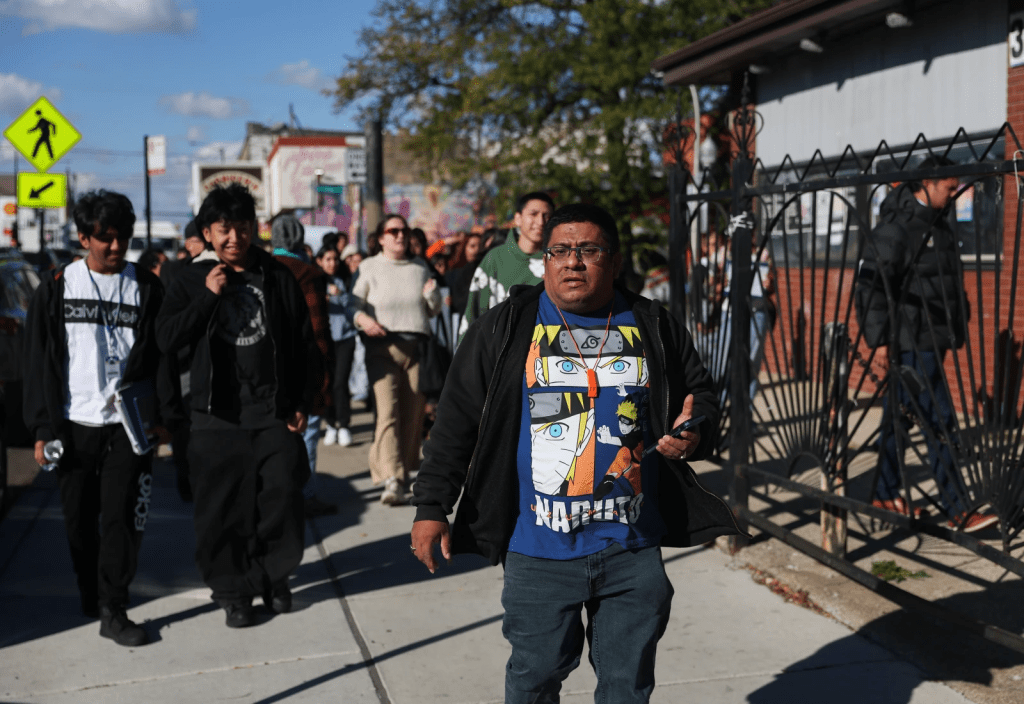
Baltazar Enriquez, president of the Little Village Community Council, walks with a Chicago Public School’s student walkout in protest against U.S. Immigration and Customs Enforcement (ICE) agents around Chicago’s Little Village neighborhood, Wednesday, Oct. 29, 2025. (AP Photo/Talia Sprague)

The sound of resistance

Perhaps the clearest indicator of Chicago’s growing resistance is the sound of whistles.

Enriquez is credited with being among the first to introduce the concept. For months Little Village residents have used them to broadcast the persistent presence of immigration agents.

Furious blasts both warn and attract observers who record video or criticize agents. Arrests, often referred to as kidnappings because many agents cover their faces, draw increasingly agitated crowds. Immigration agents have responded aggressively.

Officers fatally shot one man during a traffic stop, while other agents use tear gas, rubber bullets and physical force. In early November, Chicago police were called to investigate shots fired at agents. No one was injured.

Activists say they discourage violence.

“We don’t have guns. All we have is a whistle,” Enriquez said. “That has become a method that has saved people from being kidnapped and unlawful arrest.”

By October, neighborhoods citywide were hosting so-called “Whistlemania” events to pack the brightly colored devices for distribution through businesses and free book hutches.

“They want that orange whistle,” said Gabe Gonzalez, an activist. “They want to nod to each other in the street and know they are part of this movement.”

Midwestern sensibilities and organizing roots

Even with its 2.7 million people, Chicago residents like to say the nation’s third-largest city operates as a collection of small towns with Midwest sensibilities.

People generally know their neighbors and offer help. Word spreads quickly.

When immigration agents began targeting food vendors, Rick Rosales, enlisted his bicycle advocacy group Cycling x Solidarity. He hosted rides to visit street vendors, buying out their inventory to lower their risk while supporting their business.

Irais Sosa, co-founder of the apparel store Sin Titulo, started a neighbor program with grocery runs and rideshare gift cards for families afraid of venturing out.

“That neighborhood feel and support is part of the core of Chicago,” she said.

Enriquez’s organization, Little Village Community Council, saw its volunteer walking group which escorts children to school, grow from 13 to 32 students.

Many also credit the grassroots nature of the resistance to Chicago’s long history of community and union organizing.

Trump’s “border czar” Tom Homan said Chicago area residents were so familiar with their rights that making arrests during a different operation this year was difficult.

So when hundreds of federal agents arrived in September, activists poured energy into an emergency hotline that dispatches response teams to gather intel, including names of those detained. Volunteers would also circulate videos online, warn of reoccurring license plates or follow agents’ cars while honking horns.

Protests have also cropped up quickly. Recently, high school students have launched walkouts.

Delilah Hernandez, 16, was among dozens from Farragut Career Academy who protested on a school day.She held a sign with the Constitution’s preamble as she walked in Little Village. She knows many people with detained relatives.

“There is so much going on,” she said. “You feel it.”

A difficult environment

More than 3,200 people suspected of violating immigration laws have been arrested during the so-called “ Operation Midway Blitz.” Dozens of U.S. citizens and protesters have been arrested with charges ranging from resisting arrest to conspiring to impede an officer.

The Department of Homeland Security defends the operation, alleging officers face hostile crowds as they pursue violent criminals.

Gregory Bovino, the Border Patrol commander who’s brought controversial tactics from operations in Los Angeles, called Chicago a “very non permissive environment.” He blamed sanctuary protections and elected leaders and defended agents’ actions, which are the subject of lawsuits.

But the operation’s intensity could subside soon.

Bovino told The Associated Press this month that U.S. Customs and Border Protection will target other cities. He didn’t elaborate, but Homeland Security officials confirmed Saturday that an immigration enforcement surge had begun in Charlotte, North Carolina.

DHS, which oversees CBP and Immigration and Customs Enforcement, has said operations won’t end in Chicago.

Interest nationwide

Alonso Zaragoza, with a neighborhood organization in the heavily immigrant Belmont Cragin, has printed hundreds of “No ICE” posters for businesses. Organizers in Oregon and Missouri have asked for advice.

“It’s become a model for other cities,” Zaragoza said. “We’re building leaders in our community who are teaching others.”

The turnout for virtual know-your-rights trainings offered by the pro-democracy group, States at the Core, doubled from 500 to 1,000 over a recent month, drawing participants from New Jersey and Tennessee.

“We train and we let go, and the people of Chicago are the ones who run with it,” said organizer Jill Garvey.

Awaiting the aftermath

Enriquez completes up to three patrol shifts daily. Beyond the physical exertion, the work takes a toll.

Federal agents visited his home and questioned family members. A U.S. citizen relative was handcuffed by agents. His car horn no longer works, which he attributes to overuse.

“This has been very traumatizing,” he said. “It is very scary because you will remember this for the rest of your life.”

CHRISTINE FERNANDO