Yet Another Thing To Keep Track Of:

Majority of Americans Support Ban on Surveillance Pricing and Electronic Shelf Labels

Surprisingly, 3% saying it would make them more likely to shop at a store.

By Matt Novak

A whopping 68% of Americans say they worry about surveillance pricing increasing the cost of goods, while just 5% believe it will lead to lower prices, according to a new survey from GBAO Strategies distributed by the United Food and Commercial Workers International Union. Twenty percent say it will likely just keep prices the same.

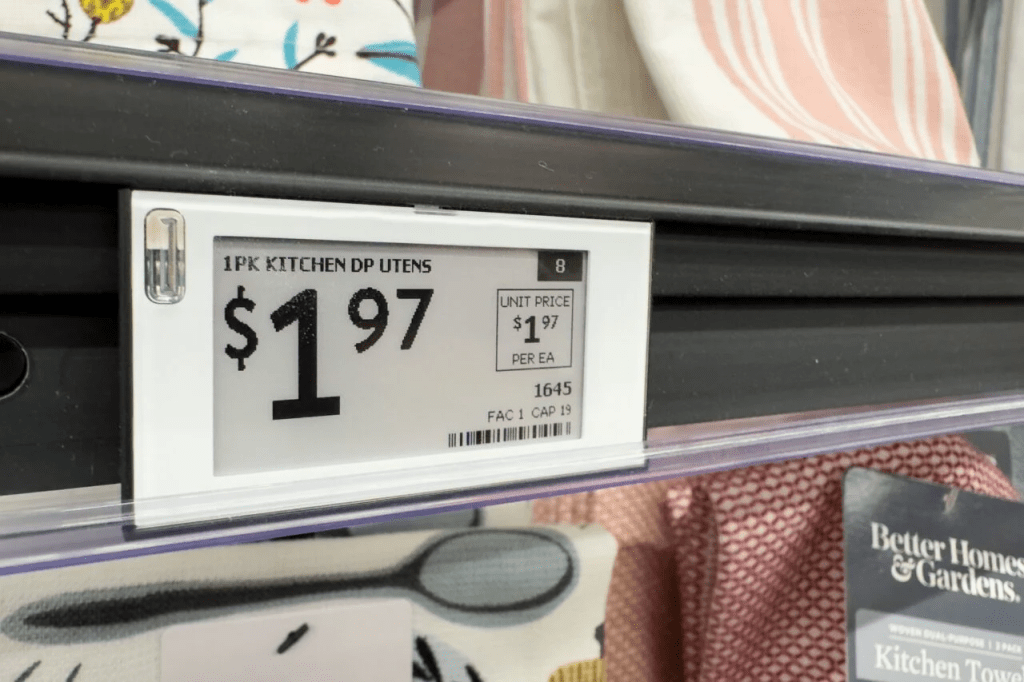
The new survey is part of the UFCW’s “Affordable Groceries and Good Jobs Campaign,” an effort to encourage states to pass laws banning surveillance pricing and electronic shelf labels (ESLs), the increasingly common price tags that some activists worry allow companies to rapidly change prices in stores several times per day.

The concern includes obvious dynamic pricing models, like increasing the cost of cold beverages when it gets hot outside, but also involves more sophisticated and as-yet theoretical examples like increasing the cost of food staples when a customer’s data is analyzed in store and it’s determined they’re willing to pay more.

Fifty-eight percent of Americans in the survey say digital price tags would make them less likely to shop in a store, with 35% saying it would make no difference, and 3% saying it would make them more likely to shop there. Sixty-seven percent are in favor of banning ESLs outright, according to the new survey.

Walmart, which has patented AI-powered price changes, has been rolling out electronic shelf labels across its stores, and it aims to feature them in every U.S. location by the end of 2026. But the company has insisted it’s not going to use ESLs for jacking up prices and insists that a human manager must be in the loop when prices change.

Unsurprisingly, 66% of those surveyed say they’re worried about the cost of groceries. And it’s no wonder, given the trajectory of inflation in recent months. The University of Michigan’s May sentiment index hit a record low last month at 44.8, down five points from April, according to Bloomberg.

In April, inflation rose 3.8% on an annualized basis, while wages rose just 3.6%, the first time wages have failed to keep up with inflation since 2023, according to CBS News. And that’s causing major concerns about supermarkets’ plans to squeeze customers for more money with new tech.

The new survey takers at GBAO Strategies noted that some grocery stores are replacing paper price tags with digital price tags and asked Americans whether that technology was likely to increase or decrease prices for consumers. Just 3% thought it would decrease prices, while 65% thought stores would use digital price tags to increase prices. 24 percent of participants believe it will keep prices about the same, with the remainder (8%) saying they don’t know.

UFCW International Vice President Ademola Oyefeso told Gizmodo that he believes electronic shelf labels are a tool for price gouging and that tech companies are marketing them for that purpose.

“The ESL industry sells the prospect of higher prices and job losses as positives,” said Oyefeso. “Across the country, families are having to make tough choices in the grocery aisle every day as a result of sky-high prices, and polling clearly shows that they want these predatory technologies banned.”

Proponents of digital shelf labels take issue with the idea of using the term surveillance pricing at all. They prefer terms like “personalized pricing” and believe that stores have an incentive to make pricing competitive. But unions like UFCW don’t believe that’s true and are urging legislation to be passed around the country to fight it.

“Federal and state lawmakers know these practices are wrong, and the UFCW urges them to get ahead of them before they appear in every store,” Oyefeso told Gizmodo. “Any lawmaker that is serious about cutting costs for hardworking families must support a ban on electronic shelf labels and surveillance pricing in grocery stores.”

At least a dozen states are currently considering legislation that would regulate surveillance pricing, with Maryland recently passing the first law banning the practice at grocery stores. But activists have spoken out about that law and worry that it has way too many loopholes.

White Lion – When The Children Cry (Official Music Video)

I hate the YouTube algorithm and and myself more for giving into it and saving all the hateful abuse videos I get.  I am crying now trying not to alert Ron who is in the next room with the door between us open.  I had two open windows.  In one I had so many tabs of abuse that the algorithm pushed them to me because I occasionally watch them.  I deleted 8 of them before switching to the other open window.  What does YouTube think I need to see / hear after all that deleting and not watching all those videos?  The two videos below. 

Am I the one to blame but if so what does that say about all the vulnerable children who are led down hate rabbit holes?  At least the harm happening here is to me done myself aidded by the shit pushed into my feeds and I am so stupid that I click on them and leave the tab open while I try to move onto something else.  But eventually I end up coming back to the ones that hurt me so much.  Who is to blame?  As always in my life, as in my childhood … I am, and I have always been according to those that hurt me.   Goodnight.  Scottie.  Hugs


Accessibility For All:

‘Everyone is equal in this space’: the cosmic world of neurodivergent-friendly club night Robyn’s Rocket

Hugh Morris

Trumpeter Robyn Steward thought clubs weren’t for her until she encountered Fabric’s accessible upgrade – the new home for her radically inclusive, space-themed night

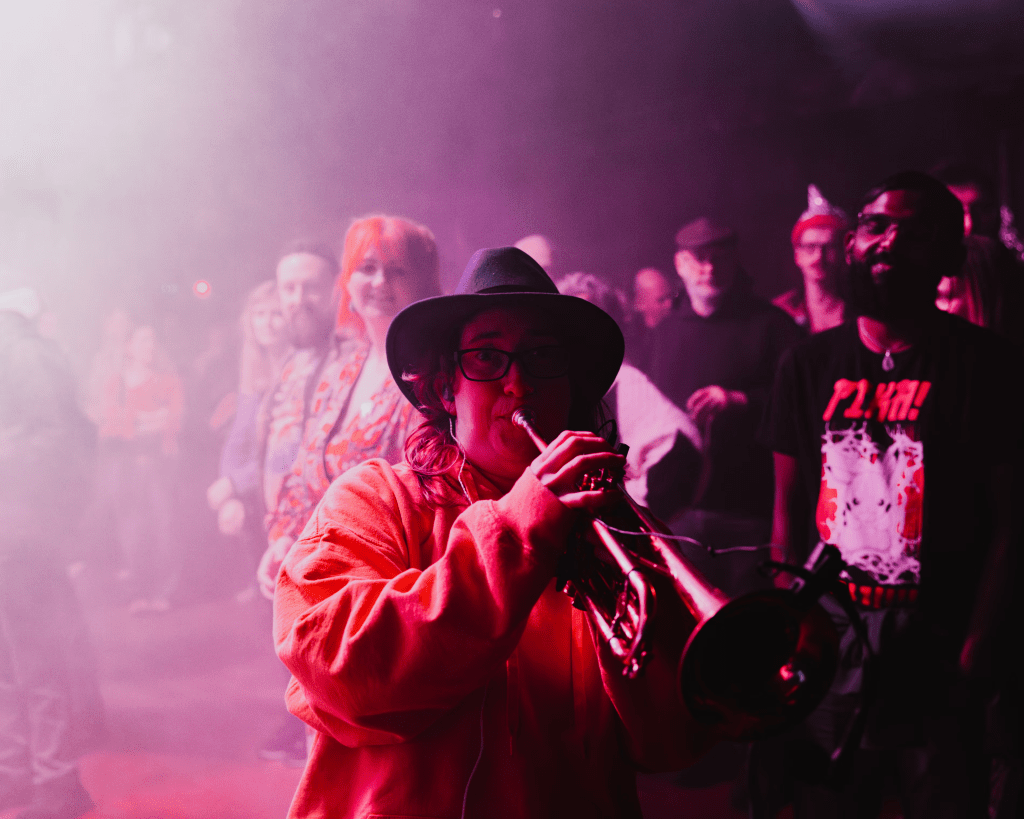
Working the crowd … Robyn playing at one of her Robyn’s Rocket nights at Fabric. Photograph: Siân O’Connor

Until May last year, trumpeter Robyn Steward had never been in a nightclub space, save for playing trumpet with Lancaster duo the Lovely Eggs at London’s Heaven, and a few nights in a university hall that doubled as a lunch room. Steward is autistic and has multiple disabilities including cerebral palsy. “Sometimes strobes can trigger migraines for me, or feel overwhelming,” she says. “I feel like my body’s a bit lost.”

When she wanted to see a gig at Fabric nightclub in London, she asked a friend to go with her as a carer. “I was amazed at how accessible it was,” she says. Subtle touches integrate multiple access needs into the space. “The mezzanine level meant that I didn’t have the strobes in my face. There was a rail that I could hold on to, and there was seating opposite the balcony so I could sit and watch the gig.” She also noticed Fabric’s recently upgraded sensory dancefloor, which deliberately transforms sound into tactile vibrations to better cater for the hearing impaired. “I could see that the lights were strobing and everything, but I felt safe,” Steward says.

Inspired, she contacted Fabric to see if they might host her long-running, space-themed experimental music night Robyn’s Rocket, which since 2017 has been booking noise bands, DJs and improv groups in London venues from Deptford to Dalston. While it champions disabled and autistic performers and audiences, Robyn’s Rocket is principally about integration. “People with and without learning disabilities – and autistic and non-autistic people – should spend time together, where there isn’t any kind of power dynamic,” she says. Her aim is to create a space “where people are all just having a really nice time together”.

We meet in a music studio in Deptford, south London, the day before the Rocket’s first night at Fabric. Steward, 39, is relentlessly upbeat; straight after the interview, she heads to the shops where a friend helps her figure out an unspecific drinks rider request. It’s in keeping with the Rocket spirit of clarifying what might usually be assumed or implied. Online, she supplies detailed visual storyboards of how an evening will progress. All artists fill out detailed tech and access riders. Every box and cable is given a name, shape or colour. All Rocket gigs are livestreamed and timings are strictly adhered to so those streaming the gig don’t get lost. “The schedule, once it’s agreed, it’s pretty non-negotiable,” Steward says.

On arrival, everyone is presented with a silver rocket-shaped badge, angled up, across or down as a visual barometer of how much communication they’re comfortable with. Fabric is adorned with more than 100 posters: signposts always feature words and shapes and are populated with cartoon characters, human and alien. Silver foil covers the stage, and live projections from visual artist Rucksack Cinema are suitably astral. “You’re into new planets, are you?” crows the frontman of “cosmic dross” band Henge.

For Steward, the space theme is also about imagining an equitable new world. “You might meet somebody here with a learning disability, or an autistic person. You might not. But everyone is equal in this space.” The Robyn’s Rocket nights echo the aesthetic and political spirit of Afro-futurist jazz visionary Sun Ra and his Arkestra. “The idea that you can create a different dimension, almost a different planetary experience, at these events is very consistent,” says Mark Williams, co-founder of the Deptford-based arts charity Heart N Soul (where Steward is an associate artist). “It’s using imagination and creativity to free people, and to exist on a different kind of plane.”

Steward was born in Suffolk, and took to music when a tutor brought instruments to her primary school: “I really wanted to go on the trumpet, but they ran out of time, so I spent a whole week blowing raspberries.” The tutor returned for an assembly the next week, and Steward immediately requested the trumpet. “I played a clear note straight away.”

As an infant, Steward used Makaton (a language that uses a combination of signs, symbols and speech) to communicate until she attended Musical Keys, a group for children with special needs, aged three: “It was song based, and so I learned to speak that way – there was a lot of repetition.” Once she learned to speak, she wouldn’t stop; her parents got her a Dictaphone for long car journeys: “They’d say, ‘You can talk to this Dictaphone as much as you want, but leave us alone in the front.’ I would make my own radio shows that would come out sounding like Alan Partridge’s Knowing Me, Knowing You.”

Unlike her East Anglian counterpart, Steward is an excellent, direct communicator. The first half of her career was spent delivering autism training, speaking at conferences, and in research. She’s also written books such as The Autism-Friendly Guide to Self Employment. But, by age 30, Steward became “very conscious that I needed to think about what I want to spend the rest of my life doing”. She had recently learned to improvise on trumpet through the big band at a local adult education centre, and seeing a gig by trumpeter Andy Diagram (who plays the trumpet with guitar pedals) proved crucial to developing her own art. With the help of Heart N Soul, she built Robyn’s Rocket up from a small residency in Deptford to a regular slot at Cafe Oto in east London, later inviting musicians including Alabaster DePlume, Coby Sey and Mica Levi to perform.

The vocalist Seaming To played a Rocket night in 2024. “More and more friends of mine are realising that they have neurodivergent aspects,” Seaming To says. “And quite a lot of them find it really awkward coming out to noisy places. At Robyn’s night, you can admit to feeling awkward, and it’s all acceptable.”

On the night, Steward dons her trademark purple fedora and doubles up as space trumpeter and energetic MC. “I’ve done this gig partly because I just wanted to put Henge on,” she says, beaming from the stage. For all the very human practicalities of Robyn’s Rocket, Steward still has celestial ambitions. “And why wouldn’t you want to put them on in a homemade spaceship?”

Go Figure-Did They Cheat?

Maine Trans Sports/Bathroom Ban Referendum Invalid Over Signature Forgery Concerns And Improper Gathering

The initiative was funded by billionaire anti-trans donor, Richard Uihlein, and used out-of-state paid signature gatherers.

Erin Reed

On Tuesday, Maine Secretary of State Shenna Bellows ruled that a proposed ballot initiative banning trans students from school sports and bathrooms will not appear before voters this November. The billionaire-funded campaign initially submitted 79,692 signatures—well over the 67,682 required to qualify—and the Secretary of State’s office certified the question for the ballot in March. But indications soon emerged that the signature-gathering process was riddled with improper procedures and, in at least one documented case and potentially many others, outright forgery. After a court remand, an evidentiary hearing, and a sworn-testimony review of the petitions, 12,542 signatures were invalidated, leaving the campaign 532 short of the threshold. Barring an appeal—which is likely though its success is far from certain—transgender students in Maine can rest a little easier this election cycle.

The infractions are striking. One out-of-state circulator left his petition forms unattended at a Topsham polling place on Election Day—twice—allowing voters to sign without a witness present, in direct violation of Maine law. Another circulator did the same at a Saco polling place, leaving her table for extended periods while crowds of voters signed unwitnessed petitions. When asked under oath whether she had destroyed the unwitnessed forms as required, she said yes—but a photograph submitted into evidence showed one of those forms was in fact turned in for validation. Most troubling of all, an out-of-state signature gatherer paid per signature submitted forms that appear to contain outright forgeries: one voter listed on her petition testified under oath that she had never signed it and had never even heard of the initiative. After the Oxford town clerk flagged additional suspicious signatures, an Elections Division review compared every name on the circulator’s forms against voter registration applications—and concluded that every single one of her validated signatures should have been thrown out as signed by another person.

Based on the evidence, Bellows ruled Tuesday that the initiative had failed to qualify for the November ballot. The decision marked a reversal of her own March certification, when her office initially determined that the petition contained enough valid signatures to move forward. That earlier ruling was challenged in Cumberland County Superior Court by three Maine voters, who alleged that thousands of signatures had been collected in violation of state law. In April, Justice Deborah Cashman agreed that the original review had been incomplete and remanded the case back to the Secretary of State’s office for further factfinding, ordering a new determination of validity within thirty days. That process produced the May 12 evidentiary hearing—where witnesses, including town clerks and voters whose names appeared on petitions, testified under oath—and ultimately the decision invalidating thousands more signatures than the initial review had caught. Bellows adopted that recommendation in full.

The initiative would have done far more than what its sports-focused branding suggested. It would have defined a person’s sex for school purposes as “a person’s biological status as male or female recorded at birth on the person’s original birth certificate”—a definition that would have stripped transgender students of legal recognition in Maine schools. It would have required public schools to “maintain separate restrooms, locker rooms, shower rooms, and other private spaces for each sex,” extending the ban well beyond athletics and into every gendered space in a school building. It would have created a private right of action allowing any student to sue their school for “direct injury” suffered from a violation of the act, effectively turning every transgender student’s presence in a bathroom or on a sports team into potential litigation. And it would have specifically carved transgender students out of the Maine Human Rights Act.

The anti-trans signature drive was not a grassroots effort. It was bankrolled by Illinois billionaire Richard Uihlein, the co-founder of Uline office supplies, who donated $800,000 to fund the entire effort. Uihlein has given more than $250 million to political causes since 2016, and is a major funder of the American Principles Project, which routinely spends tens of millions on anti-trans campaign ads during election years. He is not alone: an independent analysis published by Atmos and HEATED found that 80% of 45 major anti-trans organizations in the U.S. have received funding from fossil fuel companies or billionaires. The Maine initiative was part of that broader pattern—an attempt by a small handful of extraordinarily wealthy donors to use direct democracy as a workaround in states where elected legislatures have refused to engage in anti-trans legislation.

The decision was greeted with relief by the LGBTQ+ coalition that has fought the initiative since the day it was filed. “Maine has strict rules in place to protect the integrity of our elections and our system of direct democracy. The paid, out-of-state signature gathers and the billionaire who paid to try to put this question on the ballot failed to follow the rules,” said David Farmer, campaign manager for the Campaign for Free and Fair Schools, the coalition led by EqualityMaine, GLAD Law, and the Maine Women’s Lobby. “We believe that the appeals process and the reviews by the Secretary of State are working as the law intends. They are protecting the integrity of our elections.”

The Maine ruling is not the end of fight. Similar billionaire-backed initiatives have been certified for the November ballot in Washington and Colorado, where voters will decide whether to bar transgender students from sports as well as medical care restrictions. Both efforts are also funded by conservative megadonors, and both are part of the same strategy that produced the Maine initiative: use ballot initiatives to roll back trans rights in states whose elected legislatures have refused to do so. The Maine anti-trans campaign is expected appeal Bellows’ decision to Maine Superior Court within the ten-day window the law allows.

Your Josh Day, Next Day!

How God Made the 10 Commandments

I really enjoy this creator and how he has done this entire series on the Christian god and the inconsistancies of the bible and the figures in it.  In this series the god is a self centered older teenager who only thinks of themselves and their needs/ wants.  The full series starts out with a future highly technological civilization having graduates from school take a psychological test as them an omnipotent being and their assistant is actually their teacher in real life.  But in this case “god” is so narcissistic it causes problems in the simulator they are all connected with.  But the series does show how narcissistic and only thinking of their feelings, wants, and needs this Christian god is.  Sadly the creator has moved on from making the series and the spin-offs from them as his main YouTube product but he still produces these videos which I am grateful for.  But try to remember that God is a student and Jefferies is in reality his teacher still trying to teach him how to be a good person.  Reverse the roles of the characters and you get the joke.  Hugs.  


One Of The Many Things U.S. Reps Do

U.S. Rep. Sharice Davids urges NWS to be transparent about data collection shortcomings

Democrat renews alarm at missed Kansas balloon flights that assist forecasting

By:Tim Carpenter-May 22, 2026

TOPEKA — U.S. Rep. Sharice Davids expressed frustration Friday with the National Weather Service’s failure in the last month to launch three-fourths of the balloons typically sent aloft in Kansas to assess atmospheric conditions and assist with weather forecasting.

Davids, a Democrat representing the 3rd District in eastern Kansas, said publicly available records indicated NWS didn’t conduct on 25 of the past 30 days the standard 7 a.m. weather balloon flight dedicated to collecting atmospheric data in Kansas.

“That’s unacceptable,” she said. “Kansans deserve transparency about what’s happening, why it’s happening and what’s being done to fix it. Kansans deserve confidence that the systems meant to keep them safe are fully operational during tornado season and meteorologists deserve the reliable data they need to do their jobs.”

In the past year, Davids and U.S. Sen. Jerry Moran, R-Kansas, have raised questions about staff shortages and other issues at NWS bureaus in Kansas.

Moran recently said staffing problems persisted despite Congress appropriating sufficient funding for 24/7 operation of Kansas weather offices in Topeka, Wichita, Dodge City and Goodland.

Davids said she requested explanations one month ago from NWS about disruptions in gathering data after an outbreak of severe weather. NWS didn’t respond to the inquiry, the congresswoman said, despite seven more tornadoes touching down in Kansas last week.

NWS has an obligation to be transparent with the public about data collection failures, Davids said.

“These are not abstract bureaucratic problems,” Davids said. “You don’t get to quietly scale back something this important without transparency, especially in a state where severe weather can turn deadly fast. The administration owes the public answers and immediate action to address these reported failures before tragedy strikes.”

Davids said weather balloons provided forecasters real-time measurements, including temperature, humidity, pressure and wind conditions useful in anticipating storm intensity. Missed launches limited information available to meteorologists, she said.

She previously asked NWS to share details about reasons for missed balloon launches and how missing data contributed to delayed tornado advisories.

“For decades, 7 a.m. weather balloon launches have been a standard part of how we track severe weather and protect communities. If that standard has changed, the National Weather Service owes Kansans clear answers about why and the science and data behind that decision,” she said.

Eco-News

David Suzuki Turns 90, Says We’re All Screwed!

It’s not easy being green.

Andrew Fleming

Dr. David Takayoshi Suzuki — an author, environmental A-lister and original host of CBC’s long-running documentary series The Nature of Things — marked his 90th spin around the sun at a star-studded gala Friday night in Vancouver. Jane Fonda and Al Gore were among the VIPs who flew in to show the old tree-hugger some love and enjoy performances from Sarah McLachlan, Bruce Cockburn, Snotty Nose Rez Kids, and even a surprise set from Neil Young.

Dr. Suzuki may not be a household name outside of Canada and maybe Japan but he came in a solid fifth place in a big CBC contest back in the early aughts to name the best Canadian ever, ahead of the more problematic Don Cherry and Wayne Gretzky, the only other living finalists to make the top 10.

Imagine if Bill Nye the Science Guy and Sir David Attenborough had a baby and you’re on the right track. The hot ticket event was livestreamed for free but hasn’t yet been uploaded anywhere, presumably to cut down on the footprint from permanent data storage, so we may never know if he had anything interesting to say about attending a lavish celebration of his life’s work when it has widely fallen on deaf ears.

He was pretty blunt when asked about his hopes for the future in a recent interview with Piya Chattopadhyay where he said hunkering down in communities is our best shot at survival now that we’ve reached the point of no return:

For years I was told on The Nature of Things, “you can’t say that, that’s too depressing.” So I’ve been held back from telling the truth. And now, when the science has said “we have passed a tipping point, we cannot go back,” people are going “oh well, what the hell, it’s too late.” It’s true we are now headed for a catastrophic way and it’s unavoidable. The science is telling you that. So do you just throw up your hands? If you have children or grandchildren, you can’t do that. So you have to hunker down and say “it’s coming.” Because when the emergency comes, we don’t know what it will be. Government won’t be able to respond with the speed and the scale that you’re going to need so get your act together. The reality is the science says we’ve come to that point, and so I believe that the unit of survival is going to be your local community.

This is coming from a father of five who watched Justin Trudeau sign the Paris Climate Accords to limit the rise of global temperatures and then turn around to buy a new frickin pipeline two years later. And now the new prime minister has essentially declared war on the environment by tossing regulations aside to fast-track new projects because Donald J. Trump poses a more immediate threat to the country than Mother Nature does.

Mark Carney recently announced plans for a potential new bitumen pipeline from Alberta to somewhere in the Pacific, with construction expected to begin as early as September 2027 if they can find anyone to put build it. “This is Canada working, this is co-operative federalism, this is Canada building,” he told reporters at a press conference with Alberta preem Danielle Smith. “In effect, it creates an energy transition — all aspects of energy — but really sets the stage for an industrial transformation.”

OK. Time To Rock and Roll.

Bruce Springsteen is a model for how celebrities should resist Trump

Steven Greenhouse

His recent concerts are a thunderous call to fight for democracy. The nation could use more like him

The Bruce Springsteen concert I went to in Brooklyn last week was unlike any concert I’ve attended in decades. It was far more than a fabulous, joyous concert; it was also an inspiring resistance event.

From the get-go, the Boss made clear that this concert would be part of the anti-Trump resistance. It was a three-hour-long ode to the resistance and a thunderous call to Springsteen fans to step up and do more to fight for democracy and against authoritarianism. In this way, Springsteen is serving as a model for how celebrities can stand up against Trump and fight for what’s right.

As in the other concerts in his Land of Hope and Dreams tour, Springsteen began his Brooklyn concert with some uncontroversial, patriotic words: “We begin tonight with a prayer for our men and women in service overseas. We pray for an end to this conflict and for their safe return.” But in his very next sentence, the Boss plunged into full-scale resistance mode: “The E Street Band is here tonight in celebration and defense of the American ideals and values that have sustained our country for 250 years. We call upon the righteous power or art, of music, of rock’n’roll in these dangerous times.

How do we get more men to join the anti-Trump resistance?Read more

“Our democracy, our constitution, our rule of law,” he continued, “are being challenged right now as never before by a reckless, racist, incompetent, treasonous president and his ship of fools administration. So tonight we ask all of you to join with us in choosing hope 0ver fear, democracy over authoritarianism, the rule of law over lawlessness, ethics over unbridled corruption, resistance over complacency, truth over lies, unity over division and peace over war.”

As soon as Springsteen uttered the word war, the E Street Band began blasting Motown’s leading anti-Vietnam war song, War (What Is It Good For). Immediately came the roaring answer: “absolutely nothing.” It was Springsteen’s not-so-subtle way of dissing Trump’s disastrous war against Iran. Next, to immense applause, Springsteen belted out his great anti-war anthem, Born in the USA.

One of the concert’s final numbers was another in-your-face song to our authoritarian president: Bob Dylan’s Chimes of Freedom. Springsteen sang of those chimes flashing “for the refugees on the unarmed road of flight” and “for the rebel”, “the outcast” and the “underdog”. To an arena filled with young and old fans, he also delivered some of the oldies but goodies they hungered for: Born to Run, Hungry Heart and Dancing in the Dark. In a special bonus, Tom Morello raged against the Trump machine by joining Springsteen in an amped-up version of The Ghost of Tom Joad, about a depressing “new world order” with “families sleeping in [their] cars”. Throughout the turbocharged concert, Springsteen had phenomenal, unflagging energy, seeming more like 26 than 76.

If anyone harbored doubts about whether this was a night of resistance, Springsteen said, in a direct slap at Trump: “Honesty, honor, humility, character, truth, compassion, humanity, thoughtfulness, morality, true strength and decency – don’t let anybody tell you that these things don’t matter any more – they do… So many of our elected leaders have failed us that this American tragedy can only be stopped by the American people – by you. So join us and let’s fight for the America that we love.”

Then he shouted: “Are you with us? Are you with us?” The crowd thundered back with thousands of yeses.

In another jab at Trump, Springsteen said: “Our museums are being told to whitewash American history of any unpleasant or inconvenient facts, like the full history of the brutality of slavery. You want to talk about snowflakes? We have a president who can’t handle the truth.”

Springsteen seemed totally comfortable as he laid into Trump, who has childishly (and preposterously) called him a “total loser” and “not a talented guy”. From his early days in Asbury Park, Springsteen has championed the working class, singing about “broken heroes” who “sweat it out”, Vietnam vets who “ain’t got nowhere to go”, and twentysomethings for whom there “ain’t been much work”. While Trump has delivered to billionaires, Springsteen has been fighting for working men and women, for those who get the short end of the stick. That has given him extraordinary cred with average Americans.

To be sure, many other celebrities have stood up to Trump, among them Stephen Colbert, John Legend, Jimmy Kimmel, Robert De Niro, Lady Gaga, the country superstar Zach Bryan, and the Chicks’ Natalie Maines. Unfortunately, the courageous Mr Colbert has seemingly been punished for criticizing the thin-skinned president. His last show was on Thursday (Springsteen appeared on Wednesday’s episode). Perhaps because Springsteen knows there are hundreds of thousands of Americans willing to pay $100 or more to see him perform, he takes on Trump with less hesitation and greater abandon than other celebrities. The Boss doesn’t have any corporate overlords watching his every word.

His resistance is unflinching. In Brooklyn and at each concert, he gives a variation of this broadside: “So many American families struggle while our president and his family enrich themselves by billions of dollars trading on the people’s office in corruption unmatched in American history … This White House is destroying the American idea and our reputation around the world. We stood as a beacon for hope and liberty as an imperfect, but strong defender of democracy– standing for the global good, and to many now we are just America, the reckless, unpredictable, predatory, untrustworthy, rogue nation that is this administration and this president’s legacy.”

Every resistance movement needs an anthem, and Springsteen has obliged by writing The Streets of Minneapolis, which denounces Trump’s deployment of thousands of masked agents to intimidate that deep blue city, to essentially step on its neck.

When he began singing Streets of Minneapolis, the crowd went wild. I excerpt it:

Oh, our Minneapolis, I hear your voice

Singing through the bloody mist

We’ll take our stand for this land

And the stranger in our midst

Here in our home, they killed and roamed

In the winter of ‘26

We’ll remember the names of those who died

On the streets of Minneapolis …

At song’s end, he led an earsplitting chant: “ICE out now!” and gigantic photos of Renée Good and Alex Pretti suddenly appeared behind the stage.

Springsteen has carried his resistance message across the nation. At the flagship No Kings rally in St Paul in late March, he told the immense crowd: “The power and the solidarity of the people of Minneapolis and Minnesota was an inspiration to the entire country … You gave us hope. You gave us courage. And for those who gave their lives, Renée Good, mother of three, brutally murdered, and Alex Pretti, VA nurse, executed by ICE and left to die in the street without even the decency of our lawless government investigating their deaths. Their bravery, their sacrifice, and their names will not be forgotten.”

At his Minneapolis concert on 31 March, he poignantly told of Good’s last words: “To the man who she was protesting against, the man who would take her life, she said: ‘That’s fine, dude, I’m not mad at you. I’m not mad.’ God bless her.

“So tonight, when you go home,” Springsteen continued, “hold your loved ones close. And tomorrow, do as Renée did, find a way to take aggressive, peaceful action to defend our country’s ideals. And as the great civil rights leader John Lewis said, ‘Go out and get into some good trouble.’

“God bless Alex Pretti, God bless Renée Good, God bless you and God bless America.”

What’s giving me hope now

I, along with many others at the Barclays Center concert, came away jazzed and inspired. I imagine that hundreds of thousands of fans who have seen Springsteen in concerts across the US in recent weeks felt the same way. That gives me hope. That many young people are attending the Boss’s resistance concerts also gives me hope.

Springsteen does what celebrities should do. He uses his star power to fight the good fight. He talks to people. He doesn’t talk at them or down to them or lecture them. He voices common concerns, he rallies, he inspires. It’s perhaps easier for the Boss to do this than it is for other stars because he has a tremendous, decades-old fan base and is widely embraced as a man of the people. Let’s hope that his hugely successful Land of Hope and Dreams tour inspires other celebrities to do more to speak out and resist.

I wish that Springsteen would give dozens of free, outdoor concerts across the US over the next year or two or three, but that might be too complicated and expensive to pull off. I don’t doubt that those concerts would attract hundreds of thousands of people each, and that might help turn the tide further against Trump, the most corrupt authoritarian president in US history.

Springsteen is an unarguable leader of the resistance. The nation could use more like him.

Long live the Boss.

  • Steven Greenhouse is a journalist and author, focusing on labor and the workplace, as well as economic and legal issues

We’re Wrong About the Rates of Trans People

I love Ethel and her way of presenting facts and reality.  She points out that studies in high schools indicate that the rates of trans children are 3.+ and those questioning are 2.+.  Plus she points out the reason more trans people are out is the same reason more gay kids came out in the 2000s, it was the left handed issue again.  When being left handed became OK to admit more people admitted and openly lived as left handed. Despite everything, trans kids feel safer coming out in the US than ever before.   Hugs.