NEW YORK, NEW YORK – SEPTEMBER 05: Kate Harrison (L) and Chloe Grace Moretz are seen at the 2023 US Open Tennis Championships on September 05, 2023 in New York City. (Photo by Gotham/GC Images) Gotham
Moretz and her partner, Kate Harrison, were married in a private ceremony over the weekend, as they confirmed to Vogue. The magazine also published exclusive photos and videos of the couple’s final fittings. Rather than a traditional white gown, Moretz went with a pale blue number with elbow length opera gloves. “It just feels like me. It feels like an extension of what I would have always hoped for,” she told Vogue. The actor added that she “never really envisioned a wedding dress” in her mind, so when the time came to figure out her actual wedding look, she knew that she “wanted to do something non-traditional and not wear white and have it feel different.”
After the couple got engaged, Moretz told Vogue that she knew that she wanted to reach out to Nicolas Ghesquière, women’s creative director of Louis Vuitton, to ask if he would be interested in making her dress. He went a step further and made both Moretz and Harrison’s dresses, as well as their afterparty looks. Rather than going with another dress for the festivities, Moretz decided on a white cutout suit accessorized with a cowboy-esque hat. She explained to the magazine that the hat was partially inspired by the activities of the wedding itself — “fishing, horseback riding, and poker.” “Our second day is going to be line dancing and everything,” she added.
In an Instagram post, Moretz thanked Louis Vuitton and Ghesquière for the dress, writing, “Your generosity, artistry, dedication and kindness knows no bounds. We feel so incredibly grateful. Thank you doesn’t even begin to cut it, but, thank you. Your vision made our day all the more meaningful.”
Moretz casually came out as a “gay woman” in November 2024 via Instagram, when she shared that she had voted for Kamala Harris in the presidential election. But even before formally coming out, she’s been seen with Harrison for years, including in a 2023 Instagram post of the two of them at the New York City Dyke March. Per Cosmopolitan, the two have seemingly been linked since 2018, but they’ve kept their relationship very private. Still, we’re glad that we at least get a glimpse into what was surely a stunning wedding. Congrats to the newlyweds!
Alex Consani confirmed that a tucking panty can be an Angel’s best friend.
The superstar model, who became the first trans woman to win Model of the Year in 2024, shared some behind-the-scenes footage from a recently released campaign with lingerie brand Victoria’s Secret on her Instagram on Tuesday. Alongside usual brand accoutrement, including the iconic angel wings, was another important accessory: a tucking panty.
“Cant stop smiling! So happy to have the opportunity to shoot with the baddest group of girls and the best team there is!” Consani wrote. “I’m so so so grateful!”
The carousel of images and selfies in the mirror featured Consani’s outfit for the day, group shots with her winged campaign colleagues, shots of her in the glam chair and raw footage from the shoot. The shoot celebrated “the first six angels hitting the Victoria’s Secret Fashion Show 2025 runway,” according to the brand’s Instagram.
One shot featured the aforementioned Tuck Kit, a product of Unclockable, a trans-led brand that was founded “to meet the unique needs of trans and queer people,” per its website. The description of the product Consani showed says that it allows the wearer to don their “favorite feminine styles without a gaff and with no bulge,” and “zero panty lines.”
In 2024, Consani became the first trans model, alongside Valentina Sampaio, to walk a Victoria’s Secret runway show. Their casting came six years after Ed Razek, the brand’s former chief marketing officer, made regrettable comments to Vogue about casting “transsexuals” in their fashion shows. ‘
“Shouldn’t you have transsexuals in the show? No. No, I don’t think we should,” he said. “Well, why not? Because the show is a fantasy. It’s a 42-minute entertainment special.” Days after the interview, a statement released by the brand attributed to Razek backtracked to say that the brand “would cast” a trans model for the show, and that it has considered trans models at castings, though one had never been hired. “It was never about gender,” he added.
In 2019, Valentina Sampaio became the first out trans model to work with Victoria’s Secret as part of a shoot with the brand’s VS Pink label. Days later, Razek retired from the company. Emira D’Spain, Edun Sodipo, Honey Dijon and Ceval Omar, all trans women, have since worked with the brand. Consani’s BTS shot is a reminder of her own declaration about the fashion industry that “the future is dolls,” as she stated in a June interview with Them.
“Seeing more of us, not just white versions of our community, not just thin versions of our community, not just able-bodied versions of our community, but all of the facets of being trans,” she said. “I think that’s so fashionable: the expression that comes from having an identity, especially now, that’s so unappreciated and unsupported.”
These bans have been successful in part because of a toxic and ruthless ecosystem of far-right influencers, like Riley Gaines, who have formed entire careers around attacking trans athletes by prioritizing hate and misinformation.
“So much of what we see … just seems like it’s wrapped up in really hateful and negative messages that aren’t good for anyone,” says Mary Fry, a professor of sport and exercise psychology at the University of Kansas. “We’re creating issues where maybe we don’t need to.”
The anti-trans attacks in sports are also affecting cis women. Ayala, a competitive cyclist, remembers one race where she and her trans friend both made the podium. When photos of the event were posted on Facebook, people accused her of being trans, and she was added to a “list of males who have competed in female sports” maintained by Save Women’s Sports.
Earlier this year, 16-year-old AB Hernandez became the target of nationwide hate and harassment when the president of a local school board publicly doxxed the track and field athlete and outed her as transgender. Right-wing activists misgendered her and called her mom “evil;” swarms of adults showed up to heckle her at games; Charlie Kirk pushed state governor Gavin Newsom to condemn her; and President Donald Trump threatened to withhold federal funding from California over her participation.
While transgender athletes are very rare, this type of harassment towards them is playing out across the country and internationally. A trans girl was harassed at a soccer game in Bow, New Hampshire, by adult protestors wearing XX/XY armbands, representing an anti-trans sports clothing brand. And in British Columbia, a 9-year-old cis girl was accosted by a grown man who accused her of being trans and demanded that she prove her sex to him.
While research into the relative athletic capabilities of trans and cis women is ongoing, far-right groups, including the Alliance Defending Freedom and the Leadership Institute, have been putting hate before science to turn the public against trans athletes since at least 2014. And it’s working.
Laws, rules or regulations currently ban trans athletes from competing in sports consistent with their gender identity in 29 states, with 21 beginning the ban in kindergarten. The majority-conservative Supreme Court announced this month that it’ll be taking on the question of the constitutionality of the bans. Meanwhile, the federal government is pressuringstates without bans to change their policies in compliance with a Trump executive order that attempts to institute a nationwide ban.
Trump signs an executive order calling for bans on trans women and girls from women’s sports. Photo by: The White House.
These bans have been successful in part because of a toxic and ruthless ecosystem of far-right influencers, like Riley Gaines, who have formed entire careers around attacking trans athletes by prioritizing hate and misinformation.
“So much of what we see … just seems like it’s wrapped up in really hateful and negative messages that aren’t good for anyone,” says Mary Fry, a professor of sport and exercise psychology at the University of Kansas. “We’re creating issues where maybe we don’t need to.”
Harassment and Mental Health
Grace McKenzie has been deeply affected by these hate campaigns. A lifelong athlete, McKenzie has stayed healthy by playing multiple sports where she’s met “amazing people.” Shortly after she transitioned in 2018, she was thrilled when she was invited to join a women’s rugby team at the afterparty of a Lesbians Who Tech conference.
Grace McKenzie. Photo courtesy of McKenzie.
“Rugby became my home, it was my first queer community, it was the space where I really discovered my own womanhood,” McKenzie told Uncloseted Media. “I could be the sometimes-masculine, soft-feminine person who play[s] rugby and loves sports.”
But that started to change in 2019, when McKenzie and others on her team started to hear rumors that World Rugby was considering a ban on trans athletes. Fearing the loss of her community, she started a petition that racked up 25,000 signatures—but it wasn’t enough, and the ban took effect in 2020.
As anti-trans rhetoric in sports has ramped up, McKenzie says she’s had soul-crushing breakdowns that have left her “sobbing uncontrollably and unconsolably.”
“It would be these waves of such intense despair and rage—it was like going through grief for five years,” she says. “I have to wake up every single day and read about another state or another group of people who say that they don’t want me to exist.”
While McKenzie says she’s found the strength to keep playing where she can, sports psychologist Erin Ayala has seen clients leave sports altogether due to the hate toward trans athletes.
“It can be really difficult when they feel like they’re doing everything right … and they still don’t belong,” says Ayala, the founder of the Minnesota-based Skadi Sport Psychology, a therapy clinic for competitive athletes. “Depression can be really high. They don’t have the strength to keep fighting to show up. And then that can further damage their mental health because they’re not getting the exercise and that sense of social support and community.”
That was the story of Andraya Yearwood, who made national headlines in high school when she and another trans girl placed first and second in Connecticut’s high school track competitions. The vitriol directed at her was intense: Parents circulated petitions to have her banned; crowds cheered for her disqualification; the anti-LGBTQ hate group Alliance Defending Freedom launched a lawsuit against the state for letting her play; and she faced a torrent of transphobic and racist harassment.
“It’s a very shitty experience,” Yearwood, now 23, told Uncloseted Media.
Fearing more harassment, she quit running in college.
“I understood that collegiate athletics is on a much larger and much more visible scale. … I just didn’t want to go through all that again for the next four years,” she says. “Track obviously meant a lot to me, and to have to let that go was difficult.”
It’s understandable that Yearwood and other trans athletes struggle when they have to ditch their favorite sport. A litany of research demonstrates that playing sports fosters camaraderie and teamwork and improves mental and physical health. Since trans people disproportionately struggle from poor mental health, social isolation and suicidality, these benefits can be especially crucial.
“In some of these cases, kids have been participating with a peer group for years, and then rules were made and all of a sudden they’re pulled away,” says Fry. “It’s a hard world to be a trans individual in, so it’d be easy to feel lonely and separated.”
Caught in the Crossfire
The anti-trans attacks in sports are also affecting cis women. Ayala, a competitive cyclist, remembers one race where she and her trans friend both made the podium. When photos of the event were posted on Facebook, people accused her of being trans, and she was added to a “list of males who have competed in female sports” maintained by Save Women’s Sports.
Ayala isn’t alone. Numerous cis female athletes have been “transvestigated,” or accused of being trans, including Serena Williams and Brittney Griner. During the 2024 Paris Olympics, Donald Trump and Elon Musk publicly accused Algerian boxer Imane Khelif of being trans after her gold medal win, as part of a wave of online hate against her. She would later file a cyberbullying complaint against Musk’s X.
While women of all races have been targeted, Black women have faced harsher scrutiny due to stereotypes that portray them as more masculine.
Yearwood remembers posts that would fixate on her muscle definition and compare her to LeBron James.
“I think that is attributed to the overall hyper-masculinization and de-feminization of Black women, and I know that’s a lot more prevalent for Black trans women,” she says. “It made it easier to come for us in the way that they did.”
Subscribe
A Big Distraction
Joanna Harper, a post-doctoral scholar at Oregon Health & Science University and one of the world’s leading researchers on the subject, says that the jury is still out on whether the differences in athletic performance between trans and cis women are significant enough to warrant policy changes.
“People want simple solutions, they want things to be black and white, they want good guys and bad guys,” Harper says, adding that the loudest voices against trans women’s participation do not actually care about what the science says.
“This idea that trans women are bigger than cis women, therefore it can’t be fair, is a very simple idea, and so it is definitely one that people who want to create trans people as villains have pushed.”
Even Harper herself has been the victim of the far-right’s anti-trans attacks. Earlier this year, she was featured in a New York Times article where she discussed a study she was working on with funding from Nike into the effects of hormone replacement therapy (HRT) on adolescents’ athletic performance.
Riley Gaines and OutKick founder Clay Travis attack Harper’s study on X.
“That Nike chose to fund a study on trans athletes doesn’t actually say that they’re supporting trans athletes. They’re merely supporting research looking into the capabilities of trans athletes,” Harper says. “You don’t know what the research will show until you get the data … but the haters don’t want any data coming out that doesn’t support what they want to say.”
Harper says this anti-trans fervor and HRT bans are making it more difficult to conduct studies in the first place.
And while the far-right argues that they are “protecting women’s sports” in their war on trans athletes, multiple athletes and experts told Uncloseted Media that this distracts from bigger issues in women’s sports, including sexualharassment by coaches and a lack of funding.
“If the real goal was to help women’s sports, they would try to increase funding [and] support for athletes,” says Harper, noting that women’s sports receive half as much money as men’s sports at the Division I collegiate level. “But that’s not what they’re doing, and it becomes pretty evident the real motivation behind these people.”
Since Trump’s reelection, Grace McKenzie has somewhat resigned herself to the likelihood of attacks on trans people getting worse. Despite this, she finds hope in building community with other trans athletes, such as the New York City-based trans basketball league Basketdolls.
“If that’s the legacy that [the anti-trans movement] wants to leave behind, good for them,” McKenzie says. “Our legacy is going to be one about hope, and collective solidarity, and mutual aid, and I would much rather be on that side of the fence.”
Meanwhile, Fry remains hopeful that conflicts can be resolved and that trans people may be able to find a place in sports over time.
“If we could all have more positive conversations and not create such a hateful environment around this issue, it would just benefit everyone.”
If objective, nonpartisan, rigorous, LGBTQ-focused journalism is important to you, please consider making a tax-deductible donation through our fiscal sponsor, Resource Impact, by clicking this button:
To win, Democrats must inspire the public in a fractured information age, engage meaningfully with the cultural shifts around race, gender, family, and migration, make democracy work despite obstructionists like Manchin and Sinema, and—most critically—deliver tangible results that improve people’s lives.
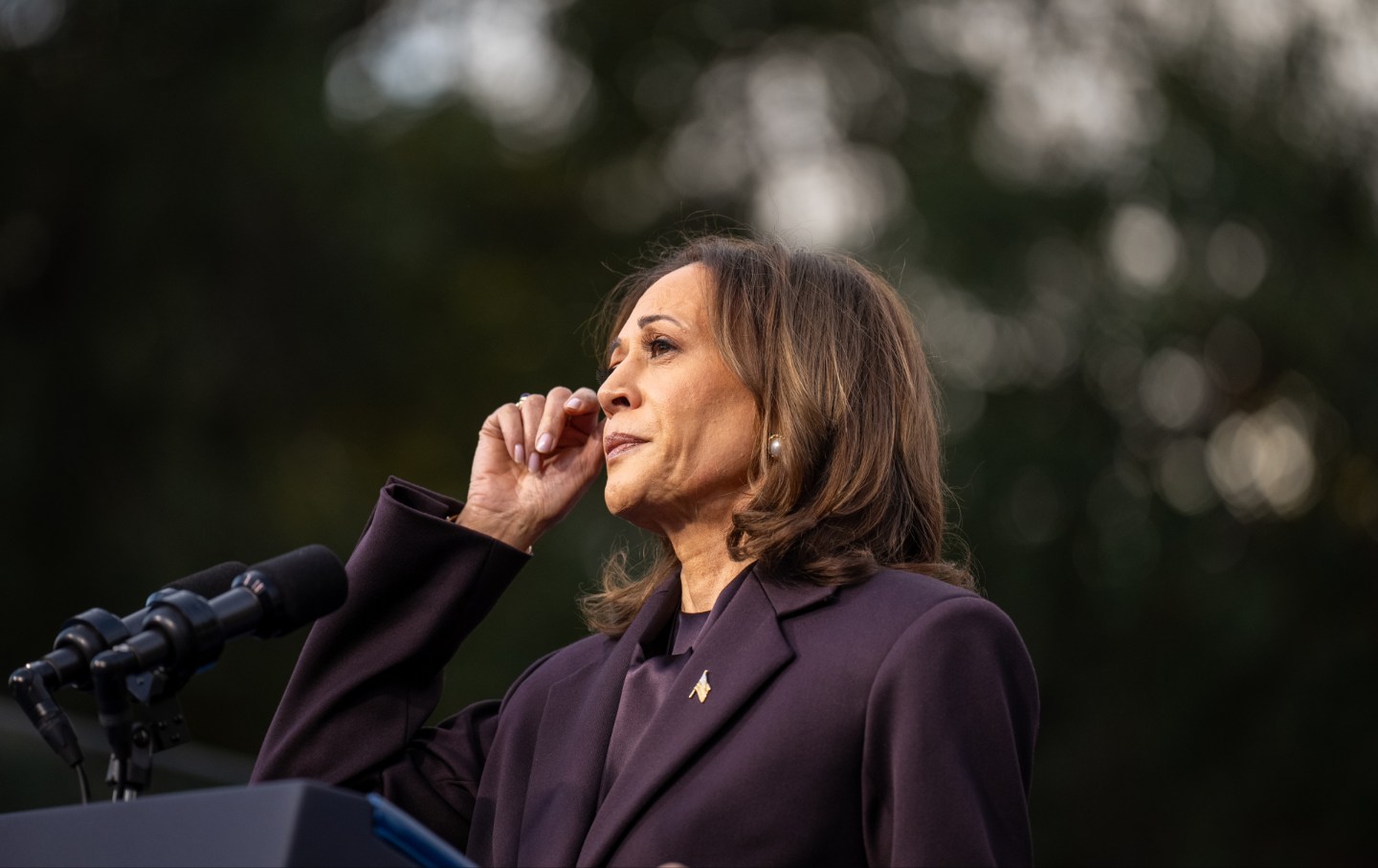
Kamala Harris pauses while speaking on stage as she concedes the election, at Howard University on November 6, 2024, in Washington, DC.
(Andrew Harnik / Getty Images)
In the aftermath of Kamala Harris’s loss, many pundits and politicians are turning to a familiar scapegoat. Critics like Adam Jentleson, a former aide to senators Harry Reid and John Fetterman, claim that “woke” advocacy groups made Democrats adopt extreme policies and drove voters away from the Democratic Party, sealing Donald Trump’s victory. But the truth is simpler—and more uncomfortable for the Democratic establishment. Despite the noise, voters didn’t reject Harris because of leftist rhetoric or activist slogans. They rejected her because she and her party failed to address the economic pain of working-class voters, who chose change over more of the same.
There’s a generation of Black and brown organizers, often the first in their families to step into positions of power, navigating institutions historically dominated by others. Alongside them are downwardly mobile white millennials, raised with expectations of stability but battered by an economy that delivers none. These activists, working within nonprofits and campaigns, fighting for causes once central to Democratic values, have somehow become scapegoats for the party’s electoral woes.
Why, after every electoral loss, is the left always the scapegoat? It’s easier to blame activists for pushing a progressive agenda than confront the real issue: the Democratic Party has long been shaped by far more powerful forces—corporate interests, lobbyists, and consultants—whose influence has neglected the real crises facing everyday Americans. We see this cycle again and again.
Contrary to establishment narratives, the Democratic leadership has often resisted advocacy organizations pushing for bold reforms on immigration, Big Tech, climate, debt, healthcare, rent, mass incarceration, Palestinian rights, and for policies like the Build Back Better agenda. This tension isn’t just about differing priorities—it reveals the actual balance of forces in the party. Corporate donors on Wall Street and Silicon Valley pour billions into campaigns, shaping agendas to suit their interests.A consultant class reaps millions from flawed strategies and failed candidates yet continues to fail upward, perpetuating a pattern of mediocrity. They, not progressives, are the roadblock preventing Democrats from becoming a populist force that could disrupt the status quo and win back voters of all stripes.
It was these elements within the party that kneecapped the Democrats’ most ambitious efforts to help ordinary Americans. The Biden administration entered with huge plans, notably Build Back Better, which would have delivered immediate relief: expanded child tax credits, free community college, universal child care and pre-K, paid leave, and more. Progressives pushed mightily for Build Back Better to pass. It was centrist obstruction—namely Senators Manchin and Sinema—that blocked those policies. The result was a patchwork of long-term measures like the Inflation Reduction Act and the Bipartisan Infrastructure Deal, whose benefits won’t be felt until 2025 at the earliest, if at all. By failing to pass Build Back Better, Democrats lost the chance to deliver easy-to-understand, tangible economic benefits and solidify their image as the party of working people.
And it was corporate Democrats—particularly lobbyists like Harris’s brother-in-law, former Uber executive Tony West, and David Plouffe—who held the most sway over Harris’s campaign. They advised her to cozy up to ultra-wealthy celebrities, Liz and Dick Cheney, and Mark Cuban, and avoid populist rhetoric that could have distanced her from the corporate elites who dominate the party. In 2024, the biggest spenders in Democratic Party politics weren’t progressives—it was AIPAC, cryptocurrency PACs, and corporate giants like Uber, all of whom poured millions into Democratic campaigns without regard for public opinion or the will of the people.
The Harris campaign’s messaging failed because, while populist economic appeals resonated with voters, the public face of the campaign was discouraged from embracing them. Instead, the focus was on issues like democracy and abortion, which, while important, couldn’t by themselves capture the priorities of working-class voters. In her public remarks and interviews, Harris, drawing on the advice of corporate leaders, frequently adopted a Wall Street–friendly tone that resonated with business interests, even if it alienated many of her core supporters.
It’s easy to forget that in 2020, Democrats saw historic turnout, driven largely by young voters who were energized by the largest left-wing and Black freedom protests since the 1960s. Biden won, and Democrats seemed to capture the nation’s hunger for justice and change, even as protesters marched with polarizing slogans like “Defund the Police.” Despite the controversy surrounding these messages, Biden triumphed decisively, calling for racial justice. The energy in the streets reflected a moment of possibility, a vision that real change was within reach. But by 2024, that grassroots energy had dissipated, and the Biden-Harris administration did little to revive it.
The loss of energy that Biden and Harris presided over showed up in youth turnout, which dropped to 42 percent in 2024, down from 50 percent in 2020 and closer to 2016 levels. However, battleground states saw higher youth turnout, around 50 percent. Young voters favored Harris over Trump by four points (51 percent to 47 percent), a sharp decline from Biden’s 25-point lead in 2020. The administration’s failure to offer a compelling narrative or deliver meaningful economic reforms alienated many young voters, especially on issues like unconditional weapons transfers to Israel.Trump capitalized on this vacuum with false promises and an anti-war message. Meanwhile, young workers, hit hardest by inflation and stagnant wages, saw little relief from the administration’s policies, leaving them feeling unseen and unmotivated. The simplest explanation may be the most accurate: after four years in opposition, Democrats under Biden had no plan for countering centrist obstruction from Manchin and Sinema. Nor did they have a clear strategy for transitioning to a new candidate, as Biden once suggested, or supporting a contested 2024 primary.
This disconnect was made worse by the administration’s lackluster communication strategy. Biden has avoided the media more than any modern president. In contrast, Mexico’s President Andrés Manuel López Obrador (AMLO) dominated the narrative with daily, three-hour, entertaining, and combative press conferences that have earned him one of the largest YouTube followings in Mexico. AMLO’s approach to the attention economy helped his party to secure another presidential term, defying global anti-incumbent trends.
Biden and Harris’s reluctance to embrace what some Democratic elites might view as “tasteless” or “uncouth” populist appeals allowed their opponents to seize the public’s attention, creating a void that ultimately drained the administration of the energy and momentum it once had. Trump’s simple, emotionally charged narrative about fixing the economy, winding down foreign wars, restoring order, and protecting “traditional” American values may have been filled with bigotry and lies. But it commanded the public discourse, pushing the Biden-Harris administration off center stage.
It’s true that some younger leftists embrace purity politics. But as Semafor’s Benjy Sarlin points out, the most polarizing moments in recent Democratic campaigns—like Beto O’Rourke’s “Hell yes” remark on gun confiscation or Julián Castro’s call to decriminalize border crossings during the 2020 primaries—were driven by the candidates themselves, not external activist pressure. Why did Kamala Harris take the positions she did in 2019? Because she was trying to distinguish herself in a crowded Democratic primary, where Bernie Sanders and Elizabeth Warren were surging and Biden seemed to have the center locked down. Ultimately, these moves were about gaining media attention in a competitive primary, not a direct result of pressure from advocacy groups—many of which, like Sunrise Movement, Working Families Party, and Justice Democrats, with which I was affiliated, have spent years working within the system to create lasting change and deliver real policy results that resonate with voters
The backlash against “wokeness” often rests on vague critiques, offering little more than cultural hand-wringing without any clear solutions. And when those solutions do emerge, they’re often morally indefensible. Jentleson’s criticism of progressive advocacy groups rings especially hollow when you consider the track record of his own political mentors. In 2010, his former boss, Harry Reid, publicly opposed the “Ground Zero mosque,” a proposed Islamic cultural center near the World Trade Center. While technically acknowledging the developers’ rights, Reid capitulated to Republican culture wars by suggesting Muslim Americans build the mosque elsewhere. This wasn’t a principled stance—it was a political maneuver that lent legitimacy to Islamophobia, feeding into narratives from figures like Sarah Palin and Newt Gingrich, who compared the center to a Nazi building next to the Holocaust Museum. In doing so, Reid allowed bigotry to flourish, leaving a vulnerable community to bear the brunt of political scapegoating.
From asylum seekers to transgender rights, today’s debates mirror the “Ground Zero mosque” controversy. From 2017 to 2020, Democrats, including Harris, were eager to condemn Trump’s cruel immigration policies. Now, however, they seem more focused on dodging the topic altogether. These are issues demanding a new approach, one that emphasizes year-round persuasion and agenda-setting over political convenience. Thermostatic public opinion might be a reality of politics, but voters appreciate when you stand for something with conviction and authenticity.
This is where movements and parties work best together: movements push the boundaries of what’s possible, creating the political space to reframe issues like transgender rights and immigration in majoritarian terms, and politicians follow when the political weather aligns with their self-interest. These two sides will clash, but it’s in that tension that progress lies.
Democrats can’t be scared of that process. They must stop ceding the narrative to far-right framing and instead invest in populist campaigns that aren’t afraid to antagonize villains, highlight the humanity of marginalized communities, and expose the Republican Party’s divide-and-conquer tactics. Only then can they build the political power necessary to shift the conversation and secure real change.
Anyone who knows me knows I’m critical of the academic jargon and misguided tactics that sometimes dominate activist circles. But to blame activists for the party’s struggles is to overlook the much larger battles they’re engaged in: 11 million undocumented Americans left in limbo, a prison system that incarcerates more people than any other in history, and an economy where three people hold more wealth than the bottom half of the country. These are the moral tests of our time—tests that any party claiming to stand for justice will be judged by. Scapegoating those pushing for change isn’t just unfair; it’s counterproductive, fracturing necessary coalitions and undermining the ability of the party to tackle the crises ahead.
Harris’s defeat should prompt serious introspection for Democrats—but not the narrow, one-sided critique Jentleson offers. Everyone, including progressive advocacy groups, has lessons to learn. The path forward isn’t about hippie-punching—it never has been. Time and again, the center-left’s response to electoral defeat has been to blame the unpopular and disruptive activists pushing for progress, whether abolitionists, suffragettes, labor unions, civil rights leaders, or environmentalists.
History reveals that oversimplified approaches often sidestep the harder questions. Success doesn’t come from rejecting the complexity of a diverse coalition but from learning to navigate it. To win, Democrats must inspire the public in a fractured information age, engage meaningfully with the cultural shifts around race, gender, family, and migration, make democracy work despite obstructionists like Manchin and Sinema, and—most critically—deliver tangible results that improve people’s lives.And if the corporate, status quo–loving forces within the party are standing in the way of that mission, they must be moved aside.
Success will come not by pointing fingers but by telling a story of transformation—with clear villains, bold vision, and conviction that democracy can, indeed, make a difference.
I don’t care if a person can afford to have facial surgery and does to make themselves look prettier than nature did at birth, but this woman who clearly had a lot of work to change her appearance would object to a young adult trans person would do the same thing. But the point is this person is spending millions to cosplay to her heart’s content all over the Northern Hemisphere so she can put a pretty face to the horror her department is inflicting on people. Look she went to the El Salvadorian SECOT prison dressed up for a photo op. But what they are trying to hide is she was living in a mansion paid for by the US taxpayer …. meaning paid by us and so when that got found out she moved into a water front mansion her boyfriend was living in paid for by the US Coast Guard. The grifting and corruption of this administration is unbelievable. They cut every healthcare and food assistance for the poor in the US but they demand every amenity paid for by the taxpayer and think they are due it. Hugs
—————————————————————————————————————–
BIG SPENDER
The DHS will pour a fortune into its “Stronger Border” ad campaign as Secretary Kristi Noem weathers a relentless storm of mockery.
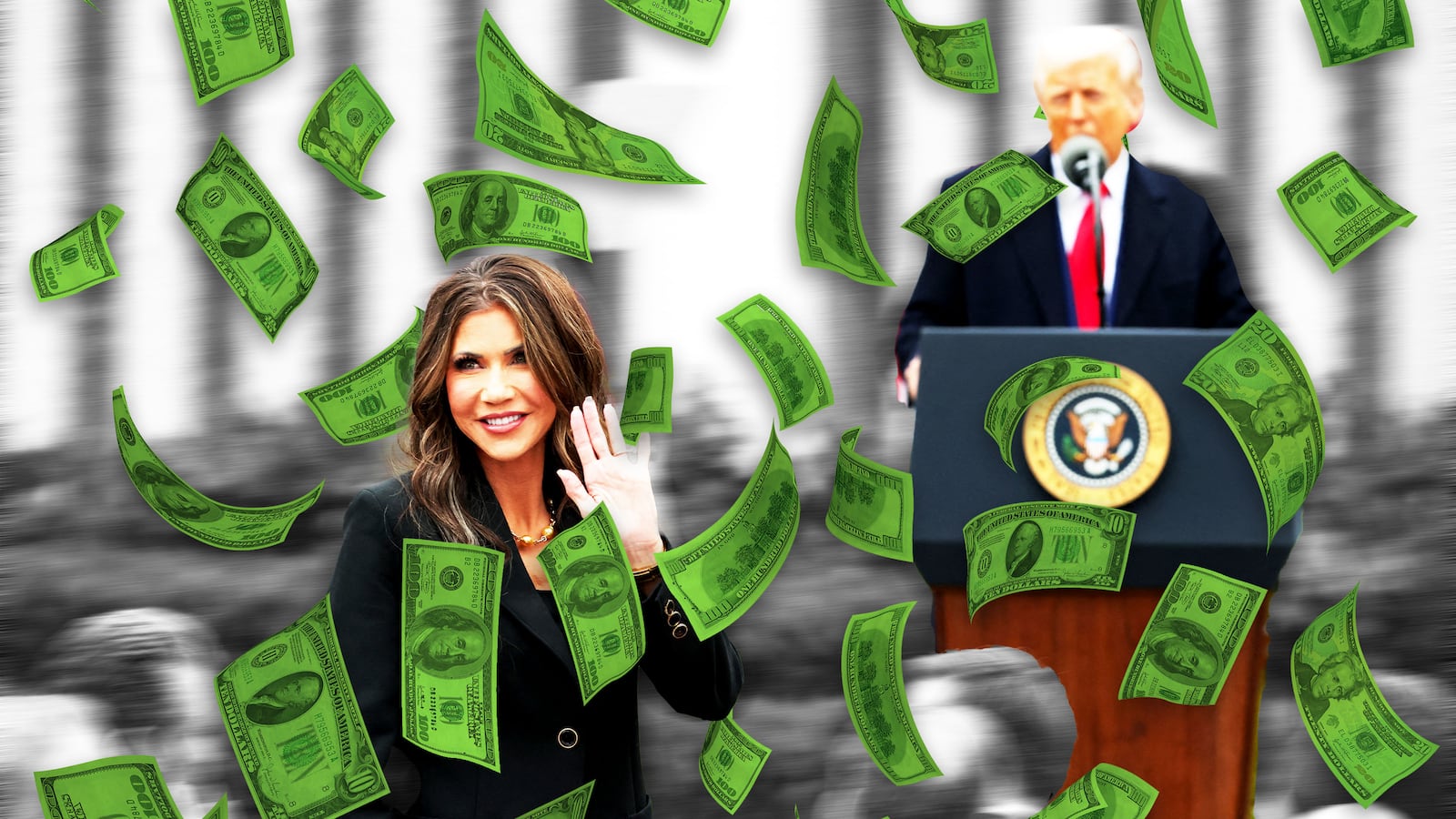
Photo Illustration by The Daily Beast/Getty/Reuters
The Trump administration is set to spend up to $50 million on a wave of taxpayer-funded PR amid the torrent of negative coverage dogging his Homeland Security Secretary Kristi Noem.
A planning forecast record posted this week by the Department for Homeland Security (DHS) pledges $20 million to $50 million as an “International Campaign Follow-on” to the “Stronger Border, Stronger America” ads that have starred Noem.
A DHS spokesperson told the Daily Beast that the spending on the campaign is not related to coverage of Noem.
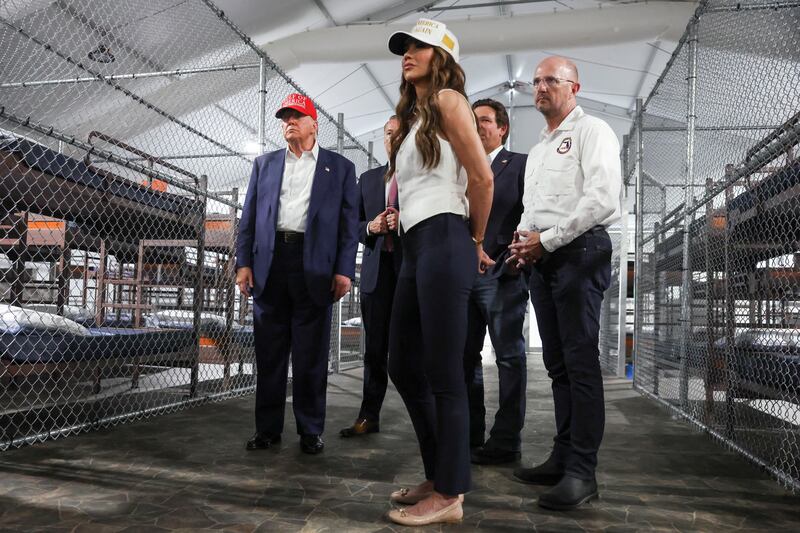
Since being appointed Trump’s DHS secretary, Noem has been skewered over her cosplays and photo-ops promoting Immigration and Customs Enforcement and Trump’s hardline deportation agenda.
That mockery has reached a fever pitch with the latest season of South Park, which won record ratings while portraying Noem as a psychotic dog-killer—referencing her memoir admission that she shot dead her own dog—and mocked DHS’s own celebratory sizzle reels.
Noem wore an ICE vest in promotional stunts for the agency—the new tranche of spending comes as she has weathered intense mockery on ‘South Park.’TheDailyBeast/DHS
The PR campaign will be funded from September through March, listing the incumbent as People Who Think LLC—a company with ties to the GOP and Noem’s unofficial chief of staff, Corey Lewandowski, who also served as Trump’s 2016 campaign manager. Noem and Lewandowski, who are both married to other people, have denied longstanding rumors that they are romantically involved.
People Who Think was co-founded by Louisiana consultant Jay Connaughton, who worked alongside Lewandowski—described by some Homeland Security officials as Noem’s gatekeeper—on Louisiana Gov. Jeff Landry’s campaign in 2024, according to Semafor. Connaughton also worked on ads for Trump’s 2016 campaign, according to the report.
Federal data shows the company has been awarded $26.7 million this financial year, suggesting it could stand to earn nearly double that in its latest deal. The Daily Beast contacted People Who Think LLC for comment.
The new spending is the latest tranche from a pot that Semafor reported as being worth up to $200 million, which has been budgeted for Noem’s nationwide and international messaging drive. The DHS began rolling it out in February.
Early spots featured Noem praising Trump in front of American flags and warning migrants—depicted as crossing the border en masse and purportedly handing over drugs—with Noem saying “we will find you and deport you,” and “you will never return.”
Images from one of the adverts in the campaign launched earlier this year—the DHS trumpeted the spots as a “nationwide and international multimillion-dollar ad campaign warning illegal aliens to leave our country now or face deportation.”TheDailyBeast/DHS
DHS insisted after the rollout that the buys were “competitive,” but a document posted in a federal database in March shows officials at that time invoked an “unusual and compelling urgency” tied to Trump’s declaration of a national emergency at the border, according to the Los Angeles Times. The measure allows federal agencies to skip a typical competitive process, the outlet reported.
The process sparked alarm from Democrats on the House Homeland Security Committee, who wrote a letter to Noem slamming a “blatant misuse of American tax dollars,” and demanding records by April 4.
As of now, the committee hasn’t posted any DHS response.
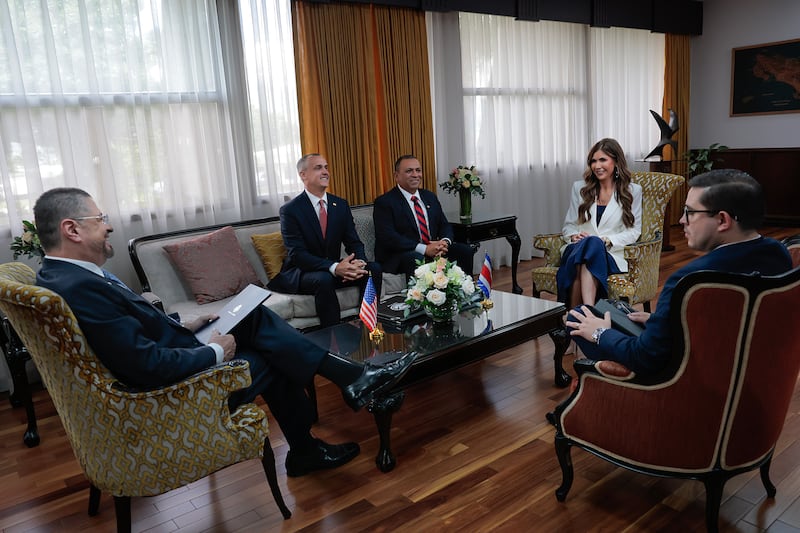
Noem is carrying out what Trump wants—and he continues to support her by funding a PR blitz.Evelyn Hockstein/REUTERSNoem meeting with President of Costa Rica Rodrigo Chaves Robles in June—Lewandowski (second left) and Noem have both previously denied rumors of being romantically involved.Anna Moneymaker/Getty Images
Given the time that has elapsed since the previous “tender,” and the fact that tens of thousands of arrests and deportations of migrants have occurred since Trump took power in January, it is not obvious his administration and the DHS can continue to argue an “unusual and compelling urgency.”
It is also unclear whether a competitive process was used this time around.
“Just yesterday, Secretary Noem announced 1.6 million illegal aliens have left the U.S. This data reveals the world is hearing Secretary Noem’s message loud and clear: if you are in America illegally, leave now or face arrest, deportation, and fines,” the DHS spokesperson told the Daily Beast on Friday.
“Following a competitive process with multiple companies competing to deliver the best service, product, and price for American taxpayers, Safe America Media and People Who Think both earned a shared contract for this targeted national and international campaign that warns illegal aliens to leave our country now, self deport, and not to enter our country illegally or face deportation,” they said, adding that multiple “career government officials oversaw this competitive procurement process.”
Noem at the notorious CECOT prison in El Salvador in March—one of her many photo-ops since being appointed Homeland Security Secretary.Alex Brandon/Alex Brandon/Pool via REUTERS‘South Park’ has been mocking the stunts, achieiving record ratings in the process—Noem has called the parody “lazy” and “petty.”South Park/Comedy Central
The spokesperson also denied that the spending is part of an effort to counter negative coverage of Noem.
“To the Daily Beast’s chagrin, these ads are working, and illegal aliens are leaving in droves,” they said.
Henry Stout runs the neo-Nazi Aryan Freedom Network with his partner. REUTERS/Jim Urquhart
HOCHATOWN, Oklahoma – Wearing cargo shorts, flip-flops and a baseball cap shading his eyes from the sun, Dalton Henry Stout blends in easily in rural America.
Except for the insignia on his hat. It bears the skull and crossbones of the infamous “Death’s Head” SS units that oversaw Nazi Germany’s concentration camps – and the initials “AFN,” short for Aryan Freedom Network, the neo-Nazi group Stout leads with his partner.
From a modest ranch house in Texas, the couple oversee a network they say has been turbocharged by President Donald Trump’s return to the White House. They point to Trump’s rhetoric – his attacks on diversity initiatives, his hardline stance on immigration and his invocation of “Western values” – as driving a surge in interest and recruitment.
Trump “awakened a lot of people to the issues we’ve been raising for years,” Stout told Reuters. “He’s the best thing that’s happened to us.”
While the Aryan Freedom Network and other neo-Nazi groups remain on the outermost edges of American politics, broadly regarded as toxic by conservatives and mainstream America, they are increasingly at the center of far-right public demonstrations and acts of violence, according to interviews with a dozen members of extremist groups, nine experts on political extremism and a review of data on far-right violence.
Several trends have converged since Trump’s re-election, Reuters found. Trump’s rhetoric has galvanized a new wave of far-right activists, fueling growth in white supremacist ranks. Trump’s pardons of January 6 rioters and a shift in federal law enforcement’s focus toward immigration have also led many on the far right to believe that federal investigations into white nationalists are no longer a priority.
[Trump] awakened a lot of people to the issues we’ve been raising for years. He’s the best thing that’s happened to us.
Henry Stout, a leader of the white nationalist group Aryan Freedom Network
And the boundaries of the far right itself are shifting. Ideas once confined to fringe groups like the Proud Boys – who helped lead the January 6 siege – are now more visible in Republican politics, from election denialism to rhetoric portraying immigrants as “invaders.” Trump’s public support and pardons for far-right figures helped normalize those views, the researchers said. As the Make America Great Again movement has come to define the party’s identity, the line separating the far right from mainstream conservatism has grown increasingly difficult to draw, they added.
What was once extreme now blends more easily into the broader far-right, not because those extreme groups have changed, but because the terrain around them has, said Heidi Beirich, co-founder of the Global Project Against Hate and Extremism, a nonprofit that tracks hate speech and extremism. “A Proud Boy doesn’t even seem that scary anymore because of the normalization process,” she said.
That shift has coincided with a surge in white nationalist activity. White extremists are committing a growing proportion of U.S. political violence, according to the Armed Conflict Location & Event Data project, a nonprofit research outfit that tracks global conflicts. In 2020, such groups were linked to 13% of all U.S. extremist-related demonstrations and acts of political violence, or 57 of the events ACLED tracked. By 2024, they accounted for nearly 80%, or 154 events.
Ideas once confined to fringe groups like the Proud Boys are now more visible in mainstream Republican politics. REUTERS/Jim Urquhart
Trump has denied that he supports white extremism, and the White House rejects the notion that his rhetoric promotes racism.
“President Trump is a president for all Americans and hate has no place in our country,” White House spokesperson Harrison Fields said in response to questions for this story. “President Trump is focused on uniting our country, improving our economy, securing our borders, and establishing peace across the globe.” Fields also pointed to a significant rise in support for Trump among Black voters. In last year’s election, his share of the Black vote nearly doubled from 2020 to about 15%.
Trump has batted away accusations of racism. At a campaign rally last year, he declared, “I’m not a Nazi. I’m the opposite of a Nazi.” A few months earlier, he told an interviewer that he can’t be racist because he has “so many Black friends.”
Even as he has made inroads with non-white voters, Trump has consistently drawn support from white nationalist and extremist groups while using racially divisive rhetoric. He promoted the false claim that Barack Obama, the nation’s first Black president, was not born in the U.S. In his 2024 campaign, he suggested immigrants commit violent crimes because “it’s in their genes,” a remark condemned by many as racist.
Stout said his group opposes violence. Yet the Aryan Freedom Network openly advocates preparing for a “Racial Holy War.” It promotes white superiority ideology, seeks to unify elements of the broader white nationalist movement and actively recruits former members of other extremist groups.
The Trump administration has scaled back efforts to counter domestic extremism, redirecting resources toward immigration enforcement and citing the southern border as the top security threat. The Federal Bureau of Investigation has reduced staffing in its Domestic Terrorism Operations Section. The Department of Homeland Security has cut personnel in its violence prevention office.
Some specialists in domestic terrorism say these moves could embolden extremists by weakening U.S. capacity to detect and disrupt threats. The DHS and FBI have defended the cuts, saying they remain committed to fighting domestic terrorism. The FBI said in a statement it allocates resources based on threat analysis and “the investigative needs of the Bureau,” and that it remains committed to investigating domestic terrorism.
“RACIST ROYALTY”
In his first interview with any news organization, Stout met Reuters journalists in April at a restaurant in Hochatown, Oklahoma, a quiet town known for its hiking and fishing about an hour’s drive north of their Texas home. He was joined by his partner, who goes by the name Daisy Barr.
Stout says AFN is focused on staying within the law. “We got to watch our Ps and Qs,” he said. Then his tone turned apocalyptic: “And when the day comes, that will be the day – that’s when violence will solve everything.” While he offered no timeline, researchers who study domestic extremism say the comment reflects a strategy among some far-right groups: operate within the law while openly predicting a moment of upheaval.
The Aryan Freedom Network first drew national attention in 2021 after organizing a “White Unity” conference in Longview, Texas. By the following year, it was distributing flyers in cities across the country. One in Texas featured racist caricatures of Black Americans – one swinging from a street lamp amid rubble and an overturned car – alongside the caption: “At the current rate of decline what will America’s major cities look like in ten years?”
An AFN flyer found in West Bend, Wisconsin, in a plastic bag. Photo via West Bend Police Department. Image was redacted by Reuters to remove group’s website address.
Another AFN flyer, targeting immigrants. The plastic bags were weighted with wood pellets to make them easier for canvassers to toss into people’s yards. Photo via West Bend Police Department.
AFN also began staging protests, often targeting drag events and LGBTQ+ gatherings. Stout says the demonstrations were designed to attract recruits. Its conferences and annual “Aryan Fests” have become networking hubs for the far right, drawing attendees from groups such as the Ku Klux Klan and other white nationalist organizations, according to two individuals affiliated with those movements. Reuters was unable to independently verify the claim.
The pseudoscientific notion of a superior white Aryan race – essentially Germanic – was a core tenet of Hitler’s Nazi regime. AFN gatherings brim with Nazi memes: Swastikas are ritually set ablaze and chants of “white power” echo through the woods. AFN’s website pays specific tribute to violent white supremacist groups of the past, including The Order, whose members killed a Jewish radio host in 1984. Two key members responsible for the killing were sentenced to lengthy prison terms and are now deceased.
Stout’s beliefs are rooted in the Christian Identity movement, which claims that white Europeans, not Jews, are the true Israelites of biblical scripture and therefore God’s chosen people. Stout and Barr also claim that Black Americans, under Jewish influence, are leading a Communist revolution – an ideology that fuses racial supremacy with far-right conspiracy theories.
Stout, 34, and Barr, 48, were born into self-avowed white supremacist families with deep ties to the Ku Klux Klan, infamous for its white robes, burning crosses and long history of racist violence, including decades of lynchings and terrorist campaigns against Black Americans.
As a child, Stout said he attended Klan ceremonies and white nationalist youth camps. He recalls reading translations of SS training manuals from Nazi-era Germany. And while other girls were playing video games, Barr said she was wrapping torches in burlap strips, for secret KKK cross-burning ceremonies.
Though they now identify as American Nazis, their ideology is anchored in the KKK and other white extremist groups. Their families are well known to historians of the movement. Stout’s father, George Stout, was a “grand dragon” in the White Knights of Texas, a KKK offshoot. He declined to comment for this story.
Barr’s late father was a KKK “grand wizard” from Indiana who was sentenced to seven years in prison for holding two journalists at gunpoint. AFN requires members to use aliases; she chose “Daisy Barr” after the name of a female Klan leader of the 1920s who sold Klan robes and died in a car crash.
AFN leaders have links to the Ku Klux Klan. Here, a KKK member attends a gathering marking the 160th anniversary of the of the Klan’s founding, outside Maysville, Kentucky, in May. REUTERS/Jim Urquhart
One person familiar with the couple described their 2020 marriage as a union of “racist royalty.”
They filed for divorce two years later, but Stout said the split was in name only – a legal move to shield their assets in case they faced civil rights lawsuits like those that once bankrupted the Klan and Aryan Nations, a neo-Nazi group held liable in a 1999 civil suit for inciting violence.
Stout and Barr declined to share membership numbers but said AFN now has nearly twice as many chapters as the 23 it claimed in early 2023.
The Terrorism Research and Analysis Consortium, a private research group that monitors extremist movements, estimates AFN’s members have grown to between 1,000 and 1,500. “We collect and record every event of theirs,” said TRAC researcher Muskan Sangwan. Some of the earliest chapters, including those in Texas, likely began with around 100 members each, Sangwan said, suggesting the group may have had roughly 200 members in its initial stages.
Chris Magyarics, a senior researcher at the Anti-Defamation League, a Jewish advocacy organization that monitors antisemitic harassment, said he was skeptical AFN was so big but said he had no independent data on its size. “The previous largest neo-Nazi group only had a couple of hundred,” he said, referring to the National Socialist Movement, which has been in steady decline.
Reuters was unable to independently establish the extent of AFN’s membership.
Despite the uncertainty over its numbers, AFN is on the radar screens of independent researchers. Jon Lewis, a research fellow specializing in domestic extremism at George Washington University’s Program on Extremism, said the group has been “really popular” among far-right “accelerationists,” a term used by white supremacists who advocate violence to hasten a race war.
Stout said his group has benefited from the decline of the Proud Boys following the Capitol attack. Once prominent for street clashes during the Trump administration, the Proud Boys have faced legal setbacks and public scrutiny since many of its members were convicted – and later pardoned by Trump – for their roles in the January 6 Capitol riots. The group describes its ideology as “Western chauvinism.” Critics say the group uses the term “Western” rather than “white” to veil its racism, a charge the Proud Boys’ defenders deny.
Stout described groups like the Proud Boys as “civic nationalists” – movements that draw in followers with patriotic rhetoric, then serve as stepping stones toward more overtly racist organizations like AFN or the Klan.
“A lot of newbies, new people to the movement, join that type of movement before they join us,” Stout said.
Reuters was unable to reach a Proud Boy representative for comment.
Members of the Ku Klux Klan take part in a cross-burning to mark the group’s 160th anniversary, outside Maysville, Kentucky, in May. REUTERS/Jim Urquhart
WEAPONS AND RACE WAR
Although Stout said the Aryan Freedom Network rejects violence, firearms and tactical training remain central to its identity and feature prominently in its gatherings and recruitment efforts, according to a review of federal court records.
One former member, Andrew Munsinger, built and traded semi-automatic AR-15 rifles and other weapons, using a machine shop to fabricate untraceable parts, according to an FBI affidavit filed in federal court. He boasted to other AFN members of stockpiling ammunition and constructing explosive devices, and claimed to have pointed a shotgun at a sleeping prosecutor, the affidavit said.
Munsinger, who went by the alias “Thor,” was arrested last year in Minneapolis on federal charges of illegally possessing firearms. As a convicted felon, he was barred under federal law from owning weapons. He attended at least five AFN events in one year, the FBI said. Agents described him as an adherent of accelerationism, which seeks to provoke a race war through violence.
An excerpt from the federal arrest affidavit for Andrew Munsinger.
AFN is “an umbrella organization for other white-supremacist organizations,” the affidavit said. Documents relating to Munsinger’s case, including testimony from an FBI informant who infiltrated the group, offer a glimpse inside its operations: firearms training across several states, encrypted communications focused on weapons, a recruitment event at a lakeside bar in Ohio, and new members building timber swastikas in a ritualistic initiation.
Stout said he disavowed Munsinger, who was convicted by a federal jury in April of illegally possessing firearms and ammunition, as well as trafficking marijuana. He is awaiting sentencing. Munsinger and his attorney did not respond to requests for comment.
Stout said his network has links to the Klan, which has splintered and shrunk dramatically since its peak a century ago.
In May, Reuters attended a modern-day Klan ceremony held in a clearing deep within the woods on private land in northeastern Kentucky. William Bader, leader of the Trinity Knights, a small Klan faction, donned a purple silk robe and conical hood as he presided over the swearing in of about half a dozen heavily tattooed new members.
Item 1 of 5 New initiates are blindfolded and walked along a trail as part of an induction ceremony during a gathering and cross-burning marking the Klan’s anniversary outside Maysville, Kentucky, in May. REUTERS/Jim Urquhart
[1/5]New initiates are blindfolded and walked along a trail as part of an induction ceremony during a gathering and cross-burning marking the Klan’s anniversary outside Maysville, Kentucky, in May. REUTERS/Jim Urquhart
In an interview, Bader said Trump has energized the white nationalist movement. “White people,” he said, “are finally seeing something going their way for once.” Bader said he had previously attended an AFN event without elaborating.
Steve Bowers, another Klan official at the ceremony, which didn’t involve AFN, said he isn’t a fan of Trump because of his administration’s close ties with Israel. But he said many white nationalists are fully behind the president. “People think he’s going to save the white race in America,” said Bowers, dressed in a white KKK robe and hood, decorated with two blood crosses on the chest.
The Klan once claimed as many as six million members in the 1920s. It had dwindled to an estimated 2,000 to 3,000 members across 72 chapters by 2015, according to the Southern Poverty Law Center, a nonprofit that tracks extremist groups. More recent figures are unavailable, a research analyst at the center said.
AFN has adopted certain tactics and rituals of the Klan, including widespread distribution of racist flyers.
AFN’s flyers have appeared in multiple cities and towns, from Florida to Washington state, according to police reports. Stout and Barr said they view them as a recruitment tool. Police in West Bend, Wisconsin, said hundreds of flyers targeting immigrants were distributed in May. One flyer found in the Wisconsin village of Mukwonago read, “Tired of being discriminated against because you’re white? Join.”
Stout said members are instructed to distribute flyers at night – what he calls “night rides,” echoing the Klan’s term for its historic terrorism campaigns against Black people.
In another echo of the Klan, its signature cross burnings, swastikas are set alight at AFN gatherings. In an AFN video posted online, Stout stands on the bed of a pickup truck, masked and flanked by armed guards, arm raised in a Nazi salute.
Still image from AFN video shows Stout on the bed of a pickup truck, arm raised in a Nazi salute. AFN website.
Still image from AFN video found on their website
“White power!” he shouts in a hoarse Texas drawl, wearing a chest rig for rifle magazines. His audience returns the Nazi salute. “White Power!” they call out.
At the restaurant in Oklahoma, asked why he believes his group is gaining momentum, Stout offered a simple explanation.





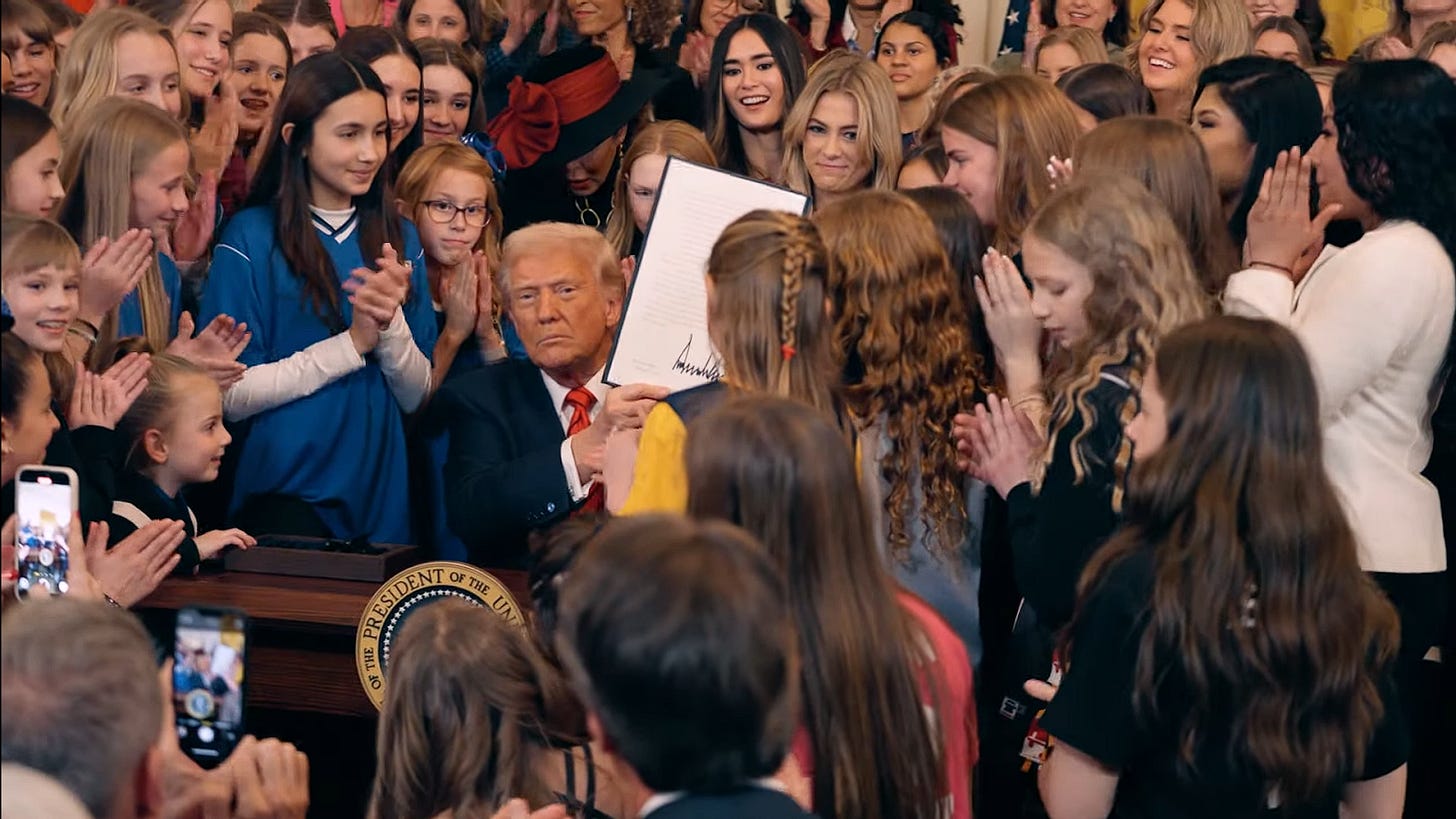

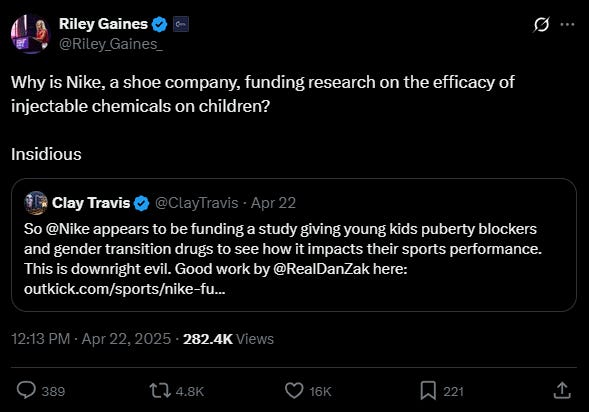
 Photo Illustration by The Daily Beast/Getty/Reuters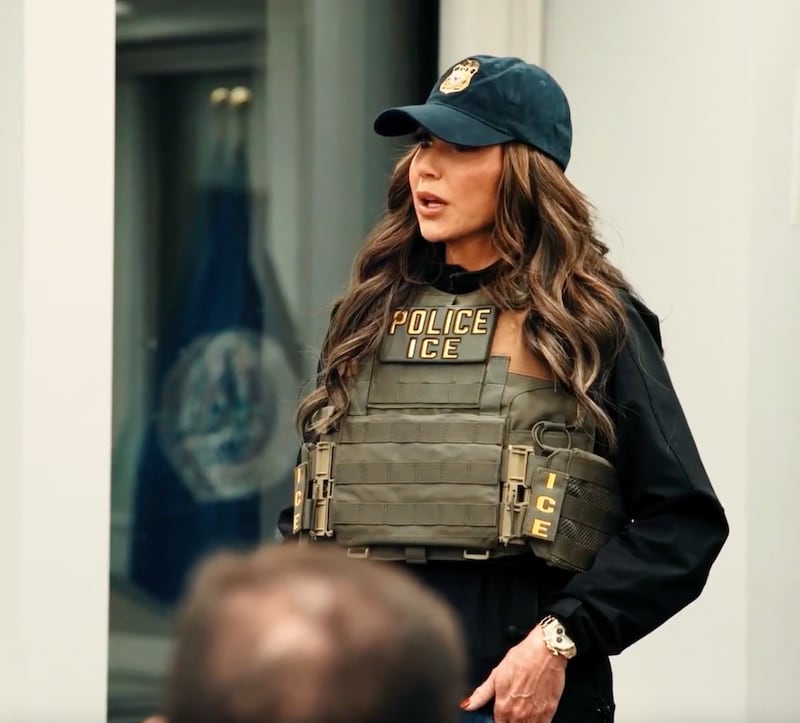






 Scottie's Playtime