Amazing news! We were in the middle of of a zoom press conference about the Gas Suffocation aspect of the planned execution of Sonny Burton in Alabama on Thursday when a reporter put into the chat:
“Did you see that Governor Ivey just commuted Burton’s sentence?”
And with that, the news was broken. Governor Ivey heard YOUR messages, received YOUR petitions, read the articles YOU sent, heard YOU ringing her phone off the hook, heard us tolling our bell outside her house…. and she acted. Amen! THANK YOU!
Once again, this proves, sometimes, our united efforts work!
Congratulations to Sonny and his legal team, his family, and to all who had a hand in creating this moment!
Governor Ivey has declared that “All Life is Precious,” which is why we made sure to bring along our 4×10 foot banner to the 24-hour vigil we helped coordinate in front of her house a few weeks ago. The banner could not be missed from any street-facing window of the Governor’s mansion. We know with certainty that the Governor was there…. NOW we know that she heard our message!
The other good news is that now we don’t have to drive all the way to Alabama. In fact, we had planned to go to Texas fiirst to toll the bell outside the prison in Huntsville at the execution of Cedrick Ricks on Wednesday, which is still on. Without our planned return through Alabama, making such a long drive makes less sense.
As you know, everything we do to support local activists working to halt executions is another expense. It’s not just the costs of being on the road that we must cover, but also the overhead…
The four full time staff and our media consultant who do the behind-the-scenes work.
The costs of the tools and services we use to communicate our message to the world.
The price of existing as an organization that shows up to oppose every execution.
(snip-donation request. You can get there from the page of any of these links.)
Thank you. Yours in the Struggle,
–abe
PS: New execution dates are being set regularly. Click here to oppose every upcoming execution.
This caller is a well know immegration lawyer who calls in often. There has been a long running joke about the buttons on Sam’s shirts so ignore that part. The lawyer talks about what ICE is doing to help the detained people and he describes how horrific the conditions are. The goal is to make it so horrific these people will self-deport willingly. But the government is doing everything possible to hurt and harm the immigrants and detained people because of hate and bigotry of ICE and the white supremacists in the US government. Hugs
It surprises me how many religious evangelicals or fundies or whatever they are called are in Congress and government offices. They really are believers in the 7 mountains religious theocracy takeover of the US government. Between AIPAC and these religious people who believe Israel must be a beacon for all Jewish people to start the end times for their god to come home and hug them is horrific and costing the US every shred of our public safety net while providing Israel and religious organizations a free ride on our dime. Hugs
Markwayne Mullin! (And I know the consequences of this could be somewhat worse than so far, because he’s yet more natively stupid. But at the moment, LMAO!)
Trump says he’s replacing Homeland Security Secretary Noem with GOP Sen. Markwayne Mullin
WASHINGTON (AP) — President Donald Trump said he’s replacing his embattled Homeland Security Secretary Kristi Noem and will nominate in her place Oklahoma Republican Sen. Markwayne Mullin.
Trump made the announcement on social media on Thursday, two days after Noem faced a grilling on Capitol Hill from GOP members as well as Democrats.
Trump says he’ll make Noem a “Special Envoy for The Shield of the Americas,” a new security initiative that he said would focus on the Western Hemisphere. (snip-fluffy stuff we already know.)
Mullin would need to be confirmed by the Senate, but under a federal law governing executive branch vacancies, he would be allowed to serve as an acting Homeland Security secretary as long as his nomination is formally pending.
The point is both cruelty and wiping trans people from public society. The not only don’t understand being trans, don’t feel trans so it must not be real, and being transgender seems to upset their god they feel. Their god created the trans person trans but that doesn’t fit with the world view of these Christians. So if their god is not powerful enough to get rid of trans people then the entire LGBTQ+ they will do it for him. Sound like they created god in their image rather than being in his. Hugs
A trans Kansas resident recently changed her name but not her gender marker on her license, fearing what Kansas may do if she did. The Kansas DMV still flagged her ID.
by Nate Zuke
Andrea Ellis of Wellington, KS was one of many transgender Kansans who opened her mail on February 25 to learn that in less than 24 hours, her driver’s license would be invalid. The letter, issued by the Kansas Department of Revenue, informed her that because House Substitute for Senate Bill 244 (S.B. 244) “requires Kansas-issued driver’s license and identification cards to reflect the credential holder’s sex at birth,” her current license would become “invalid immediately” on February 26.
Ellis had been following the news closely in the past few months. She knew S.B. 244 would be going into effect. But she never expected the state to send her a letter invalidating her license.
That’s because Ellis had never changed the sex marker on her license in the first place.
Ellis last updated her driver’s license on January 7, 2026, after completing a legal name change in December 2025. Fearing her license would be revoked if she updated her sex marker, she deliberately held off on doing so.
“I saw the writing on the wall after listening to [Attorney General] Kobach’s testimony for H.B. 2426,” she said. H.B. 2426, containing the original transphobic legislation sponsored by Republican Kansas Representative Susan Humphries, would later be repurposed as S.B. 244 using the Kansas State Legislature’s “gut and go” trick. This allowed legislators to strip the original contents of S.B. 244, replace it with the contents of H.B. 2426, and pass S.B. 244 without giving the public time to weigh in, dodging accountability for the bill’s contents.
Most bills being passed during this session of the Kansas Legislature won’t go into effect until July 1, 2026. S.B. 244, however, contains a provision that allowed it to go into effect as soon as it was published in the Kansas Register, the state newspaper of record, on February 26. This tactic echoed 2025, when the Kansas Legislature made the same maneuver with Senate Bill 63 to rapidly ban gender-affirming care for minors in Kansas.
On February 25, transgender Kansans like Ellis started receiving letters in the mail informing them that as of February 26, their licenses would be rendered invalid. With no grace period, many recipients of these letters found themselves with less than 24 hours to figure out what to do in a rural state where driving is necessary for most people.
Ellis was confused about the letter she received, but felt as though she had no choice but to comply. She spends nearly an hour and a half each day driving to and from her job in Park City. Thursdays are one of her days off, so she didn’t have to call out of work on the 26th to go to the DMV. Still, having to suddenly get a new driver’s license was extremely inconvenient, as it would be for anyone.
“Wellington doesn’t have a DMV, so when I got the letter in the mail, I had to decide between going to the DMV in Winfield or the DMV in Derby,” said Ellis. Both locations were over thirty minutes away.
When Ellis left her house on Thursday morning, her license was officially invalid. She couldn’t comply with the new law unless she was able to get to a DMV, but in order to get to the DMV, she was forced to break the law. Every minute she was on the road, she was at risk of being arrested, jailed, or fined. Fortunately, she reached her destination without any trouble.
Once Ellis arrived at the DMV, she presented the letter to a confused employee. “It seemed like none of the DMV staff had any idea what was going on. I don’t think there was time for them to have any training on how to handle the SB244 stuff,” Ellis said. After presenting her letter, she was forced to surrender the license she had been issued less than two months ago and watch as the DMV employee cut a large chunk out of it, rendering it officially invalid. Her altered license was returned to her alongside her new temporary paper license. Both credentials designated her sex as “M.”
Paper license in hand, Ellis got in her car and started driving northeast to El Dorado, a town roughly 40 minutes away. “With a background like mine, I have to do something when there’s a crisis going on. I can’t just sit still,” Ellis said, referencing her past military service and reflecting on her deployments to Afghanistan. That morning, Equality El Dorado, the town’s local LGBTQ+ organization, had posted on Facebook asking for volunteers to help drive trans Kansans to the DMV, as well as cash donations to help people cover the unexpected cost of a replacement license. Other organizations, such as the LGBTQ Foundation of Kansas, also sprung into action to try and help transgender community members.
Ellis was ready to pitch in once she arrived in El Dorado, but she was stopped in her tracks. When she parked her car and checked her phone, she learned the Derby DMV had called her and left a message requesting that she come back to the DMV as soon as she could. Apparently, there was a problem with the new license she had just been issued. She tried to call the DMV back to get more information, but no one answered her calls. Frustrated, she got back in her car, canceled a doctor’s appointment she had scheduled for later that afternoon, and resigned herself to the fact that she was going to have to spend the majority of her day off at the DMV.
The DMV employee had to call a manager over for assistance, and Ellis waited patiently as the DMV staff tried to solve the issue. “They didn’t tell me what the problem was, but I overheard them saying there was a ‘flag’ tied to my ID in their system that they had to remove,” Ellis explained. Eventually, she was given another temporary paper license. Just like the license that had been cut up that morning, just like the first temporary paper license she had been issued as a replacement, and just like her original Alabama birth certificate, the sex marker printed on her newest paper license identified her as “M.”
By the time Ellis met up with me at Pennant Coffee/Good Company in Wichita, a local queer spot, a coffee shop by day and bar by evening, she’d driven a total of over 131 miles and spent close to three hours on the road. Sitting at Pennant, surrounded by pride flag decorations and chatting with the visibly queer and trans staff, it felt surreal to think that we were in one of the worst states in the U.S. to be transgender. But Ellis’s story proved the extent the state was willing to go to torment its transgender residents.
“I had never even changed my sex marker. All I did was change my name in December, so that’s the only way they could’ve flagged me,” Ellis said.
The fact that Ellis was flagged for her name change alone suggests the state of Kansas is intensely monitoring transgender citizens. In a state where changing one’s legal sex marker has now been rendered impossible, Ellis’s story shows that even just changing one’s name can be enough for a transgender person in Kansas to be identified, targeted, and forced to surrender their legal documents.
On February 27, 2026, the ACLU of Kansas announced it would be filing a lawsuit challenging S.B. 244. However, for the time being, S.B. 244 remains in effect. With the 2026 Kansas gubernatorial election looming large in November, it is extremely concerning to see the way the state is already using its power to not only disenfranchise its citizens, but effectively immobilize them in a state where driving is so essential to daily life.
Nate Zuke (he/him) is originally from Omaha, Nebraska. He has lived in Wichita, Kansas since 2016. His Bluesky handle is @natezuke.bsky.social
This report is terrifying. This country doesn’t have money to feed or give healthcare to the people, but we can spend billions arming and militarizing a secret masked unrestrained force with the power to detain, restrain, and kill the public with no consequence. The report explains how in other cases these groups take on a power and lawlessness of their own. They are the Taliban of the US. How soon until they show up with military vehicles not just in our cities but at our places to vote? What do ICE and border patrol need with high powered rifles, military armaments, and ar-15 style weapons for anyway, they are arresting the easy low hanging fruit from court rooms and hearings, school teachers, and kids. Plus remember they have ramped up public survaence, facial recognition, and databases on everyone. Hugs
In addition to staffing up at a furious rate, ICE and CPB are acquiring a vast cache of weapons from private contractors, new data reveals. This will not end well—or anytime soon.
The “forever wars” abroad and the global war on terror after the September 11 attacks left behind a long trail of failure, disillusionment, and death—but they also funneled huge sums of taxpayer money to companies that supplied the equipment that made all that destruction possible. That resulted in windfalls for GOP-connected companies, and fueled a massive public-private bureaucracy that grew harder to rein in as it metastasized to monstrous proportions.
Something like this is happening again in a different theater of operations: Donald Trump’s campaign of violent mass deportations. It’s becoming its own forever war: It could drag on for years or decades without success. It’s producing misguided military occupations of restive local populations. It has launched a huge arms buildup. And it also has what might be termed its very own war profiteers.
To wit: A handful of private companies that manufacture weaponry and ammunition have already inked very lucrative contracts with the Department of Homeland Security, which will provide it with enormous stockpiles of military-style equipment, some to the tune of tens of millions of dollars, according to data from Senator Adam Schiff’s office, which is probing DHS contracts.
The pileup of all that equipment hints at a major long-term problem. Just as we saw in the long aftermath of September 11, this new and evolving MAGA terror bureaucracy will expand in grotesque ways. It too will grow less constrained as it amasses more troops—and more firepower.
A harrowing glimpse of this future lies in a new report by Schiff that has gotten surprisingly little notice: It finds that Immigration and Customs Enforcement and Customs and Border Protection have formally approved contracts for at least a whopping $144 million in weapons, ammunition, and other accessories during Trump’s first year. The analysis—based on government contracting data—documents at least a fourfold increase for ICE and a doubling for CBP, relative to 2024, concluding that this will “build a heavily-armed domestic police force.”
It’s eye-opening stuff. One ICE contract is with Geissele Automatics for millions of dollars’ worth of “precision long guns and accessories” to support “armed agents” and other ICE operations, Schiff’s report says. This involves an unknown number of Geissele Border Patrol rifles, the report notes, describing this weapon as an “AR-style rifle with military specifications.” CBP contracted for millions of dollars more in rifles, as well.
ICE and CBP also contracted with Glock for millions of dollars in handguns and accessories, the report says. Taking all these contracts together, the report starkly concludes: “ICE and CBP have together placed orders to purchase thousands of new high-powered lethal weapons at taxpayer expense.”
There’s still more. The report documents ICE and CBP contracts totaling more than $30 million in ammunition and more than $25 million in contracts for the “non-lethal” weapons. That’s not a reassuring description: They include Tasers, pepper spray, and tear gas canisters.
In short, we’re looking at a massive stockpiling of weapons that will be in ICE’s and CBP’s possession for years to come. And someone is supplying all that equipment.
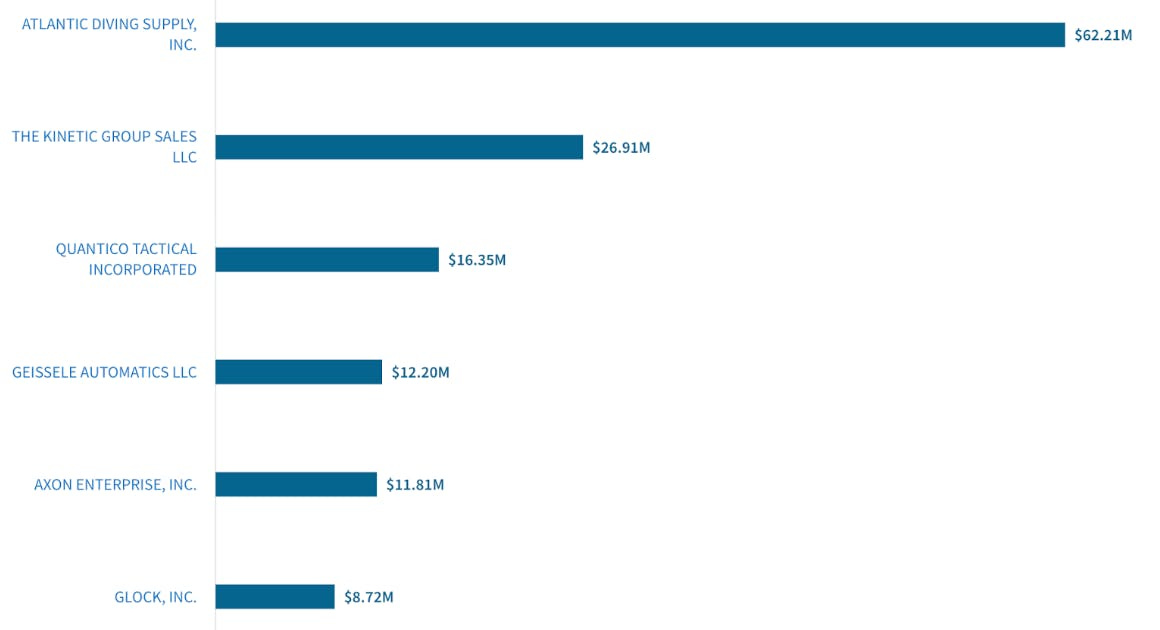
At my request, Schiff’s office analyzed the contracting data it collected to determine which companies are the top ICE and CBP contractors. Here are the results, per a chart provided by Schiff’s staff:
These particular contracts are mostly for small arms (including AR-style rifles), ordnance, ammunition, and related accessories like gun sights and suppressors, Schiff’s office says. A subcategory includes pepper spray, Tasers, tear gas, and other “non-lethal” weaponry.
“These contracts expose how DHS has set in motion a massive surge in spending to put even more dangerous weapons in ICE and CBP’s arsenal,” Schiff told me in an emailed statement. “This misuse of taxpayer dollars to maximally arm federal immigration agents, including those with questionable vetting and insufficient training, must end.”
In a sense, we’re seeing yet more cancerous growth of the post-September 11 national security bureaucracy, but with a more intensified inward focus. DHS, which was created after September 11, has long had a domestic anti-terror component. But now Trump has supercharged its role as a mass immigrant-expulsion operation that is unleashing violence toward U.S. citizens—and even killing them—while operating with near-total impunity among American populations, which Trump officials openly describe as a good thing.
“It’s the transformation of DHS from an entity that protected the homeland from external threats to one increasingly policing American society,” Donald Moynihan, author of an excellent Substack on state capacity, tells me. With this ramped-up stockpiling, Moynihan says, the endgame will be “filling those warehouses with people and using those guns and that technology to control American cities.”
The war on terror also teaches us that expanding bureaucracies like these only grow harder to control over time. “Trump is building up a well-funded, poorly trained paramilitary force that could easily take on a life of its own,” says Georgetown national security law expert Rosa Brooks. “Once you have a massive moneymaking machine ginned up, it’s hard to reverse course and turn off the spigot.”
The folly and waste of the forever wars, we are endlessly told, enabled Trump to successfully campaign against elites who foolishly sank unlimited blood and treasure into misguided imperial adventures abroad. Yet Trump’s mass deportations constitute their own forever war.
This is not meant glibly: Measured in political years, Trump’s mass expulsions actually will seemingly go on forever. Deporting an estimated 14 million people, if it continues at current rates, will take longer than this Trump term followed by two terms of President JD Vance. The scaled-up prison camps, if they materialize, will seemingly have to be packed for years, constituting an ever-expanding immigrant carceral state.
Meanwhile, just like the forever wars, this fiasco is also birthing its own captive constituencies and internal political momentum. This includes everyone from the private contractors supplying it to the large population of MAGA-adjacent young (and not so young) men signing up for ICE, which writer John Ganz describes as “an employment program for the Trumpenproletarian mob.”
Any entity this hypermaterialized—especially one simultaneously aimed at immigrants—will inevitably attract white nationalists and evolve into a political paramilitary force in thrall to ideologically aligned leaders, as Substacker Brian Beutler explains. This is borne out in ICE recruitment messaging, which explicitly seeks to get recruits invested in the mission of achieving national rejuvenation by employing cleansing ethno-nationalist violence.
The stockpiling of weapons underscores the point unnervingly. Now that Trump is feinting toward winding down in Minneapolis, what will be done with all that ideologically fired-up ICE manpower—and all that heavy weaponry? Even a relatively benign answer is alarming. It means more operations like the one in Minneapolis, but packaged with a sheen of new constraints that will simply be shrugged off by the force of this machine’s internal momentum—with more horrors awaiting us.
This is a quagmire for Trump, even if he doesn’t know it. Appropriately enough, it has also been created by unprincipled elite folly—only MAGA elites support it, while the American people verymuchdo not. Trump’s approval on immigration, once a foundational political strength, has deteriorated rapidly at moments when ICE dominates our attention. If his forever war continues in its current form—with its bureaucracy metastasizing in unpredictable directions—it will further cripple his presidency. And it’s darkly fitting that it may take down the presidential ambitions of Vance, also a self-proclaimed critic of forever war follies, along with him.
Again Christian fundamentlist rehtoric and constant attacks on LGBTQ+ people by religious leaders lead to the gullible doing actions like this. He knew demons would be there and he needed to be the hero and slay the evil man living in a way that made his god un happy. Every church leader who preaches hate against other communities should be held responsible for the actions of those who listen to their ridiculous, hateful claims and then act on them. Hugs
McGee told detectives they met on Grindr, and that he went to his apartment because he knew “demons would be there,” according to court documents. He also told detectives he intended to “slay” and “get rid of” the victim.
Investigators discovered that McGee planned the attack ahead of time, and including searching the internet for violently homophobic material, purchasing the weapon and searching for how to get away with murder, as well as how to dispose of a body.
Daniel McGee, 26, was sentenced to just over 12 years in prison, along with five years of supervised release.
“The right to live safely in one’s community is a fundamental civil right. The District of Oregon remains committed to combating hate crimes and protecting that right for all,” said U.S. Attorney for the District of Oregon Scott E. Bradford. “While no conviction can undo the harm caused, we hope this sentence will bring some measure of justice to the victim and our community.”
“Hate crimes impact not just individuals, but entire communities,” added FBI Portland Special Agent in Charge Matt Torres. “The FBI works together with our partners to prevent hate crimes from impacting our communities, and every attack on someone because of who and what they are deserves to be acted on by the full extent of the law.”
McGee made national news in 2021 when he was charged with attacking a man he met on Grindr, a dating app for gay men.
In court documents, prosecutors said he used the screen name “str8 curious” and arranged to meet the man at his apartment. He said he had just turned 18 and wasn’t ready to kiss yet, but wanted to make sure they would be alone.
But when McGee arrived at the apartment, he attacked the man. He struck the victim over the head repeatedly using a small wooden club known as a tire thumper. Multiple callers told emergency dispatchers they could hear someone screaming for help.
When police arrived, they found both men inside the victim’s apartment. The victim had life-threatening injuries, including multiple lacerations to the sides and back of his head, and a large portion of his scalp was missing.
McGee told detectives they met on Grindr, and that he went to his apartment because he knew “demons would be there,” according to court documents. He also told detectives he intended to “slay” and “get rid of” the victim.
Investigators discovered that McGee planned the attack ahead of time, and including searching the internet for violently homophobic material, purchasing the weapon and searching for how to get away with murder, as well as how to dispose of a body.
In November 2021, McGee was charged with a federal hate crime involving an attempt to kill. He pleaded guilty in federal court in Nov. 2025.

 Congratulations to Sonny and his legal team, his family, and to all who had a hand in creating this moment!

 Scottie's Playtime